

Introduction
Past research suggested that conservatives exhibit stronger physiological responses to threatening and disgusting stimuli compared to liberals (Oxley et al., Reference Oxley, Smith, Alford, Hibbing, Miller, Scalora, Hatemi and Hibbing2008; Smith et al., Reference Smith, Oxley, Hibbing, Alford and Hibbing2011), contributing to the idea that ideology may have psychophysiological foundations. However, these findings have proven difficult to replicate: physiological responses to threat and disgust do not reliably differ by political ideology (Arceneaux et al., Reference Arceneaux, Bakker and Schumacher2026; Bakker et al., Reference Bakker, Schumacher, Gothreau and Arceneaux2020; Knoll et al., Reference Knoll, O’Daniel and Cusato2015; Osmundsen et al., Reference Osmundsen, Hendry, Laustsen, Smith and Petersen2022). By contrast, associations between political ideology and self-reported threat- and disgust-related responses have been more consistently observed (e.g., Arceneaux et al., Reference Arceneaux, Bakker and Schumacher2026; Inbar et al., Reference Inbar, Pizarro and Bloom2009, Reference Inbar, Pizarro, Iyer and Haidt2012; Osmundsen et al., Reference Osmundsen, Hendry, Laustsen, Smith and Petersen2022). Indeed, recent work supports this distinction by showing that physiological and subjective responses to negative stimuli do not necessarily align (Arceneaux et al., Reference Arceneaux, Bakker and Schumacher2026). This creates an important puzzle: why are self-reported disgust and threat-related responses more consistently associated with political ideology when physiological responses to similar stimuli do not reliably differ across ideological groups?
Affective science provides one way to address this puzzle: the political relevance of threat and disgust may not be explained by physiological reactivity alone, but may also depend on how aversive bodily and affective states are subjectively experienced and interpreted. Indeed, the relationship between physiological signals and subjective experience is indirect, context-dependent, and constructed through past experiences (Barrett, Reference Barrett2017; Hoemann et al., Reference Hoemann, Khan, Feldman, Nielson, Devlin, Dy, Barrett, Wormwood and Quigley2020; Seth, Reference Seth2013; Siegel et al., Reference Siegel, Sands, Van den Noortgate, Condon, Chang, Dy, Quigley and Barrett2018). In other words, how we make sense of our physiological signals is heavily dependent not just on the strength or quality of these signals but on how we have learned to make sense of how our bodies feel in different contexts. Political differences in subjective disgust may therefore emerge not because liberals and conservatives necessarily differ in bodily reactions themselves, but because similar bodily cues may be interpreted through different learned social and ideological frameworks. This raises a more precise question for the fields of political science and political neuroscience: what determines how much bodily cues and socially acquired meanings each contribute when people interpret disgust-related experiences?
Disgust is both evolutionarily rooted and culturally shaped, extending beyond pathogen avoidance to social concerns such as interpersonal contamination, moral violations, and prejudice (Inbar & Pizarro, Reference Inbar, Pizarro and Gawronski2022). It can be socially constructed and weaponized, reinforcing group boundaries and ideological divisions (Schaller & Duncan, Reference Schaller and Duncan2011). Conservatives tend to moralize purity-related and sexual violations more strongly and to report stronger disgust toward them, whereas liberals are more sensitive to harm and fairness violations (Graham et al., Reference Graham, Haidt and Nosek2009; Inbar et al., Reference Inbar, Pizarro and Bloom2009). These ideological differences likely arise from early socialization processes that shape which kinds of norm violations (e.g., purity, fairness, or harm) are learned to elicit disgust, resulting in morally divergent disgust sensitivity (Elad-Strenger et al., Reference Elad-Strenger, Proch and Kessler2020). More broadly, disgust sensitivity and political ideology may become linked through interpretive processes that map bodily and affective experiences onto social categories. Accordingly, the direction of the disgust-politics association is unlikely to be fixed across all disgust domains, but may depend on which elicitors are measured and how they are socially and ideologically framed in particular contexts (Brandt & Bakker, Reference Brandt and Bakker2022). Here we propose that interoception may help explain this process by moderating how perceived bodily cues are integrated with socially acquired meanings when people make sense of disgust-related experiences.
Interoception, defined as the perception and interpretation of internal bodily signals from organs, hormones, and other internal systems that help us regulate our body’s needs and emotions, is a multi-dimensional construct. Beyond the automatic non-conscious physiological processes of sensing ascending information from visceral organs (Craig, Reference Craig2002, Reference Craig2009), interoception also involves becoming aware of our internal states. It is because we can become aware of how our bodies respond to what’s happening that we can figure out how we feel. If we consider disgust as an emotion that arises in response to pathogen-related stimuli, such as rotting food or bodily waste, then interoception also enables awareness of this emotional state by making bodily responses to disgust consciously accessible. Indeed, disgust is known to induce physiological responses (e.g., gastric dysrhythmias, reduced heart rate, changes in skin conductance activity), which are then processed cortically (e.g., see work on interoception and gastric processing, Mayeli et al., Reference Mayeli, Al Zoubi, White, Chappelle, Kuplicki, Smith, Feinstein, Bodurka, Paulus and Khalsa2021), with individual differences in how such bodily signals are perceived and interpreted being well documented (Nord & Garfinkel, Reference Nord and Garfinkel2022). Two key interoceptive dimensions relate to this higher-level processing: interoceptive accuracy (i.e., objective accuracy in detecting internal bodily sensations) and interoceptive sensibility (i.e., the ability to be attuned to our physiological state) (Garfinkel et al., Reference Garfinkel, Seth, Barrett, Suzuki and Critchley2015).
Interoceptive sensibility in particular is an influential index of interoceptive regulation, reflecting adaptive awareness and use of bodily signals (Desmedt et al., Reference Desmedt, Heeren, Corneille and Luminet2022). It has been associated with greater emotional awareness (Pollatos et al., Reference Pollatos, Kirsch and Schandry2005) and regulation (Mehling, Reference Mehling2016) as well as lower alexithymia (Gaggero et al., Reference Gaggero, Bizzego, Dellantonio, Pastore, Lim and Esposito2021). Experimental work using false biofeedback shows that individuals with lower interoceptive sensibility are more influenced by external cues about their physiology and emotional states (Patchitt et al., Reference Patchitt, Karapanagiotidis, Garfinkel, Miller, Tsakiris, Clark and CritchleyUnder Review), suggesting reduced reliance on internal states. Similarly, Ventura-Bort et al. (Reference Ventura-Bort, Wendt and Weymar2021) found that higher interoceptive sensibility is associated with greater differentiation of negative emotions, implying a more internally grounded emotional experience. Accordingly, our focus is not on physiological reactivity itself, but on interoceptive sensibility as a self-reported dimension of how bodily signals are consciously attended to and interpreted. By focusing on interoceptive sensibility, we may better understand whether this individual difference shapes how strongly perceived bodily cues and socially acquired meanings contribute to the interpretation of disgust-related experiences and their link to political ideology.
In a first attempt to examine the relationship among disgust, interoception, and political orientation, we test whether interoceptive sensibility moderates the relationship between self-reported disgust sensitivity and two indicators of political orientation: political ideology (conservative-liberal self-placement) and party affiliation (Republican-Democrat) in the United States. We include both indicators because, although strongly related, they capture distinct aspects of political orientation: ideological self-placement reflects a continuous belief system, whereas party affiliation reflects categorical group alignment. We hypothesize that interoceptive sensibility moderates the relationship between disgust sensitivity and political orientation. Specifically, individuals higher in interoceptive sensibility may draw more strongly on perceived internal bodily cues when interpreting disgust-related experiences, so that socially acquired meanings play a less dominant role in linking these experiences to political orientation. Conversely, among individuals lower in interoceptive sensibility, socially acquired meanings may play a larger role when bodily and affective states are interpreted, making disgust sensitivity more strongly linked to ideological self-placement and party alignment. In the present study, this stronger association is expected to run in a conservative direction, in line with prior work showing that higher self-reported disgust is often associated with conservatism (Inbar et al., Reference Inbar, Pizarro and Bloom2009, Reference Inbar, Pizarro, Iyer and Haidt2012; Smith et al., Reference Smith, Oxley, Hibbing, Alford and Hibbing2011). Accordingly, under lower interoceptive sensibility, we expect higher disgust to be associated with more conservative positioning and a greater likelihood of Republican identification, whereas lower disgust would be associated with more liberal positioning and a greater likelihood of Democratic identification. Our central claim is therefore not that bodily reactions directly produce ideology, but that interoceptive sensibility moderates how disgust-related experiences become associated with political orientation.
Furthermore, because different domains of disgust have been linked to political cognition, we employ Tybur’s (Reference Tybur2009) three-domain model of disgust, which distinguishes pathogen, sexual, and moral disgust. Examining these domains separately allows us to test whether the moderating role of interoceptive sensibility is general across disgust domains or especially pronounced in those most strongly shaped by social and moral interpretation. In line with the idea that higher interoceptive sensibility may shape how strongly perceived bodily cues and socially acquired meanings contribute when people interpret disgust-related experience, and with evidence that moral concerns and disgust sensitivity are especially tied to conservatism (Graham et al., Reference Graham, Haidt and Nosek2009; Inbar et al., Reference Inbar, Pizarro, Iyer and Haidt2012; Inbar & Pizarro, Reference Inbar, Pizarro and Gawronski2022; Terrizzi et al., Reference Terrizzi, Shook and Ventis2010), we expect the moderating effect of interoceptive sensibility to be present across all disgust domains but most pronounced for moral disgust.
Methods
Participants
As part of a larger study on US politics, approved by the Royal Holloway Research Ethics Committee, we recruited 636 participants (50.79% identifying as Democrats, and 49.21% as Republicans) from the United States using the online survey platform Prolific (https://www.prolific.co). Participants were all aged 18 or older, currently living in the United States, and proficient in written and spoken English (see Table 1 for demographic information on the final sample size of 632). Demographics are comparable to the ANES 2022 pilot study, which provides data about voting and public opinion after the 2022 midterm elections in the United States (see Supplementary Table S1 for details). Participants were paid £7.50 per hour for their participation. Results from a point-biserial correlation indicated a significant, strong association between political ideology (measured on a 7-point Likert scale, 1 = very liberal and 7 = very conservative) and party affiliation (r = 0.898, CI [0.882, 0.912], p < .001; see Figure 1).
Demographic information by party identification

Table 1. Long description
A table titled Demographic information by party identification with five columns: Variable, N, Democrat (N = 321), Republican (N = 311), and p-value.
* Gender: Total N = 632, p-value = 0.4. Male: Democrat 169 (53 percent), Republican 154 (50 percent). Female: Democrat 152 (47 percent), Republican 157 (50 percent).
* Age: Total N = 631, p-value = 0.2. Democrat mean 44.42 (S D 15.05), Republican mean 45.83 (S D 14.50).
* Ethnicity: Total N = 632, p-value < 0.001. White: Democrat 228 (71 percent), Republican 280 (90 percent). Black: Democrat 30 (9.3 percent), Republican 9 (2.9 percent). Mixed or other: Democrat 31 (9.7 percent), Republican 14 (4.5 percent). Asian: Democrat 32 (10.0 percent), Republican 8 (2.6 percent).
* Employment: Total N = 569, p-value = 0.4. Full-time: Democrat 152 (53 percent), Republican 159 (56 percent). Not in paid work: Democrat 50 (17 percent), Republican 46 (16 percent). Other: Democrat 20 (7.0 percent), Republican 11 (3.9 percent). Part-time: Democrat 47 (16 percent), Republican 42 (15 percent). Unemployed: Democrat 18 (6.3 percent), Republican 24 (8.5 percent).
1 n (%); Mean (SD).
2 Pearson’s chi-squared test; Wilcoxon rank sum test.
Relationship between political party affiliation and political ideology. The political party is represented on the x-axis (Democrat, Republican), while political ideology, ranging from 1 (Very Liberal) to 7 (Very Conservative), is represented on the y-axis. The violin plot illustrates the distribution of political ideology scores within each party group, while the scatter points show individual data points. A point-biserial correlation was calculated to assess the relationship between political party affiliation and political ideology. The correlation was found to be r = 0.898 (95% CI [0.882, 0.912], p < .001), indicating a strong positive correlation. This suggests that more conservative individuals (higher political ideology scores) are more likely to affiliate with the Republican Party, while more liberal individuals (lower political ideology scores) tend to identify with the Democratic Party.

Figure 1. Long description
The x-axis is labeled Political Party with two categories: Democrat on the left and Republican on the right. The y-axis is labeled Political Ideology with numerical markers at 2, 4, and 6.
On the left, the Democrat group is represented by a blue violin plot and blue scatter points. The data is heavily concentrated at the bottom of the scale, with the widest part of the violin plot located around the value of 2. The scatter points are densest between 1 and 3, with a thin tail extending upward toward 5.
On the right, the Republican group is represented by a red violin plot and red scatter points. The data is concentrated at the top of the scale, with the widest sections of the violin plot located between 5 and 7. The scatter points are densest in the upper region, with a thin tail extending downward toward 2.
Procedure
Questionnaires were administered online using Qualtrics (https://www.qualtrics.com/uk/). Participants were asked to complete a battery of questionnaires and provide demographic information. The questionnaires included the Multidimensional Assessment of Interoceptive Awareness (MAIA—Version 2, Mehling et al., Reference Mehling, Acree, Stewart, Silas and Jones2018), the Three Domains of Disgust Scale (TTDS) (Tybur, Reference Tybur2009), and questions about their political ideology and party identification. Questionnaires were presented in a randomized order to each participant. Attention checks were placed in the battery of questionnaires; participants were excluded if they failed half or more of all checks. As a result of these criteria, two participants were excluded. Data from two other participants were excluded from the analyses due to technical difficulties. This resulted in a final sample size of 632.
Materials
Interoceptive sensibility
We used the Multidimensional Assessment of Interoceptive Awareness (MAIA—Version 2; Mehling et al., Reference Mehling, Acree, Stewart, Silas and Jones2018) to measure self-reported interoceptive sensibility. The MAIA-2 includes 37 items scored on a six-point Likert scale (0 never, 5 always) assessing 8 dimensions of interoceptive awareness: (1) noticing (i.e., tendency to notice or become aware of body sensations), (2) not distracting (tendency to not distract oneself from sensations of pain or discomfort, (3) not worrying (tendency to not worry about or experience emotional distress in response to sensations of pain or body discomfort), (4) attention regulation (ability to sustain and control attention to body sensations), (5) emotional awareness (awareness of the link between emotion and body sensations), (6) self-regulation (ability to regulate negative emotion through attention to body sensations), (7) body listening (tendency to listen to body sensations for insight into emotion and guide behavior), and (8) body trust (tendency to experience the body as safe and trustworthy). After reversing scores where appropriate, a total MAIA score was calculated by taking the arithmetic mean of all 37 items from all the subscales. The MAIA-2 has shown high internal reliability and construct validity (Mehling et al., Reference Mehling, Acree, Stewart, Silas and Jones2018). The MAIA total score in our sample demonstrated excellent internal consistency (Cronbach’s α = 0.94), and factor and bifactor analyses supported the use of a total score, despite residual subscale variance. On average, participants had a total MAIA score of 2.82 (SD = .69); Supplementary Figure S1 shows a frequency plot for interoceptive sensibility stacked by political party. Higher scores indicate higher interoceptive sensibility.
Three Domains of Disgust Scale (TDDS)
We used the TDDS (Tybur, Reference Tybur2009) to measure self-reported disgust sensitivity. The TDDS is a 21-item scale based on a recently proposed adaptationist model of disgust and has three subscales that correspond to three functionally specialized domains of disgust: (a) pathogen disgust, which motivates the avoidance of infectious microorganisms (e.g., stepping on dog poop); (b) sexual disgust, which motivates the avoidance of sexual situations that would jeopardize one’s reproductive success (e.g., hearing two strangers having sex); and (c) moral disgust, which motivates the avoidance of social norm violators (e.g., deceiving a friend). The TDDS has been shown to have good internal consistency, and factor analyses have supported the three-factor model of the TDDS (Tybur, Reference Tybur2009). In our sample, participants had a score of 17.45 (SD = 11.11) for the sexual disgust domain, a score of 26.17 (SD = 10.90) for the moral disgust domain, and a score of 24.89 (SD = 8.81) for the pathogen disgust domain. The total disgust score was calculated by summing these three subscales; Supplementary Figure S2 shows frequency plots of the TDDS subscales and total score stacked by political party. Participants had a total disgust score of 68.51 (SD = 23.48).
Political ideology
Political ideology was measured using a single self-report item on a 7-point scale ranging from 1 (very liberal) to 7 (very conservative). Responses were distributed across the scale, with 19.3% identifying as very liberal, 23.4% liberal, 6.6% slightly liberal, 6.3% moderate, 14.6% slightly conservative, 19.8% conservative, and 10.0% very conservative.
Political party affiliation
Participants’ political party affiliation was determined based on pre-screening criteria at recruitment. Specifically, participants were pre-screened via Prolific using the question, “Generally speaking, do you usually think of yourself as a Democrat, a Republican, an independent, or what?” Only individuals identifying as either Democrat or Republican were eligible to participate. In our sample, 50.79% identified as Democrats and 49.21% as Republicans.
Results
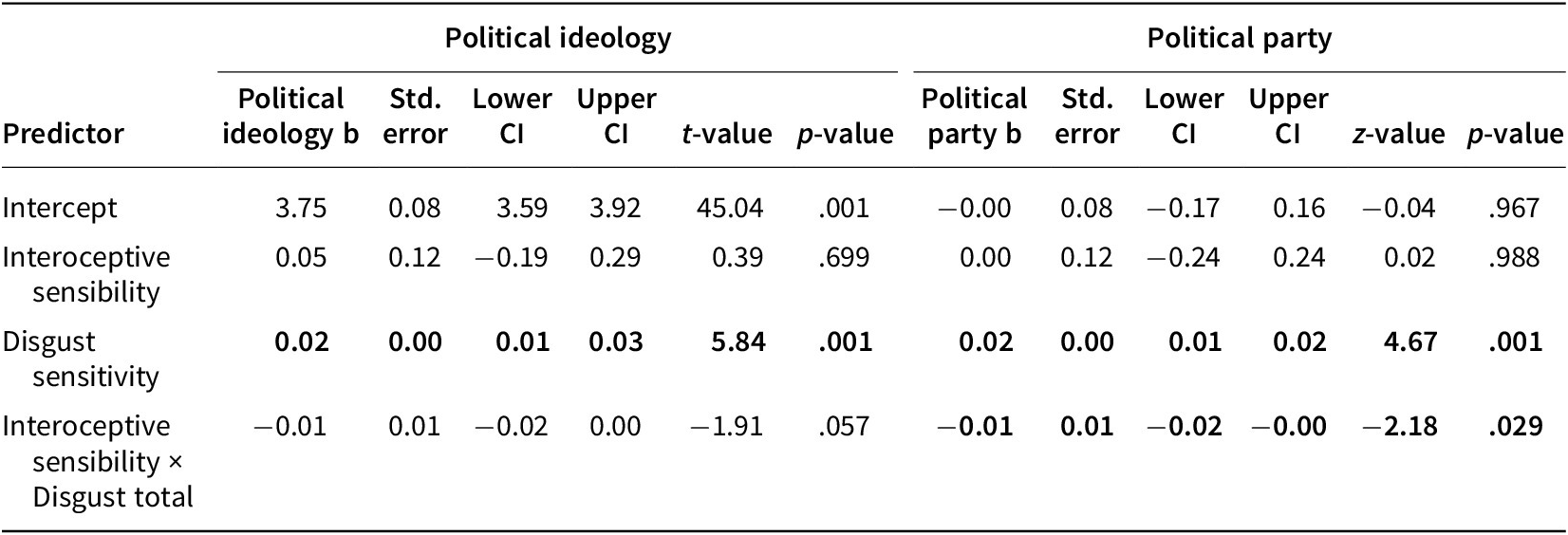
Two models were estimated using the same predictors: interoceptive sensibility, TDDS total score, and their interaction term, but with different dependent variables. A linear regression model examined political ideology (measured on a 1 to 7 scale and treated as continuous), and a logistic regression examined political party affiliation (coded as 0 = Democrat, 1 = Republican). Continuous predictors were mean-centered to address multicollinearity, as initial Variance Inflation Factor (VIF) values exceeded 10. After mean-centering, all VIF scores were below 1.05, indicating no multicollinearity concerns.
As shown in Table 2, both models, i.e., one predicting political ideology and the other predicting political party, revealed a similar pattern of results. In both models, there was no significant main effect of interoceptive sensibility, indicating that interoceptive sensibility alone did not influence political orientation. By contrast, disgust sensitivity showed a significant positive main effect, with higher disgust scores associated with a greater likelihood of identifying as conservative or Republican. Importantly, the interaction between interoceptive sensibility and disgust was statistically significant in the models on political party and at trend level in the model on political ideology, suggesting that the relationship between disgust sensitivity and political alignment is moderated by interoceptive sensibility. Specifically, as interoceptive sensibility increases, the strength of the association between disgust sensitivity and political orientation weakens (see Figure 2). We obtain the same pattern of results when controlling for demographic variables such as age and gender (see Supplementary Tables S2 and S3 in the Supplementary Materials).
Model results on political ideology and political party

Table 2. Long description
The table is divided into two primary outcome sections: Political ideology and Political party. Each section includes columns for the coefficient b, Std. error, Lower C I, Upper C I, and a significance value (t-value for ideology and z-value for party) along with the p-value.
* Intercept: For Political ideology, b is 3.75 (p = .001). For Political party, b is minus 0.00 (p = .967).
* Interoceptive sensibility: For Political ideology, b is 0.05 (p = .699). For Political party, b is 0.00 (p = .988).
* Disgust sensitivity: This predictor shows significant results for both outcomes. For Political ideology, b is 0.02 (p = .001). For Political party, b is 0.02 (p = .001).
* Interoceptive sensibility times Disgust total: This interaction is not significant for Political ideology (b = minus 0.01, p = .057) but is significant for Political party (b = minus 0.01, p = .029).
Significant main effects and interactions are highlighted in bold in the original data.
Note: Significant main effects and interactions are highlighted in bold.
Interaction between interoceptive sensibility and total disgust on predicting political ideology and political party identification. Panel A depicts predicted political ideology scores across levels of interoceptive sensibility at low (−1 SD) and high (+1 SD) levels of total disgust, with higher values reflecting more conservative ideology. Panel B depicts the predicted probability of identifying as Republican across levels of interoceptive sensibility at low (−1 SD) and high (+1 SD) levels of total disgust. After Bonferroni correction across all four planned contrasts, differences between low and high disgust at high levels of interoceptive sensibility were smaller for political ideology and were not statistically significant for political party identification. At low levels of interoceptive sensibility, however, lower disgust was associated with a more liberal ideological positioning and a lower probability of identifying as Republican, whereas higher disgust was associated with a more conservative ideological positioning and a higher probability of identifying as Republican.

Figure 2. Long description
Two panels, A and B, are arranged horizontally. Both share a common x-axis labeled Interoceptive Sensibility ranging from minus 2 to plus 1. A legend at the top of both panels indicates a solid red line for High disgust and a dashed dark gray line for Low disgust, both with shaded confidence intervals.
Panel A: The y-axis is Political Ideology, ranging from 3 to 5. Higher values are labeled More Conservative and lower values are More Liberal. The High disgust red line shows a slight negative slope, starting near 4.5 at minus 2 and ending near 4.0 at plus 1. The Low disgust dashed line shows a positive slope, starting near 2.8 at minus 2 and rising to meet the red line near 3.8 at plus 1. The confidence intervals overlap significantly at higher levels of interoceptive sensibility.
Panel B: The y-axis is Predicted probability of political party, ranging from 0.3 to 0.7. Higher values are labeled More Republican and lower values are More Democrat. The High disgust red line shows a negative slope, starting above 0.7 at minus 2 and dropping to approximately 0.5 at plus 1. The Low disgust dashed line shows a positive slope, starting below 0.3 at minus 2 and rising to approximately 0.5 at plus 1. Similar to Panel A, the lines and their shaded regions converge and overlap as interoceptive sensibility increases.
The interaction between disgust and interoceptive sensibility in each model was examined by plotting predicted values at low (−1 SD) and high (+1 SD) levels of the continuous predictors and by conducting planned simple-effects comparisons at low and high values of each variable for each model separately, following Aiken and West, Reference Aiken and West1991. These follow-up comparisons showed that, at lower levels of disgust, interoceptive sensibility did not significantly differentiate either political party identification, OR = 1.44, 95% CI [0.93, 2.24], p = .408, nor political ideology, b = 0.37, SE = 0.22, t = 1.70, p = .355, after Bonferroni correction across all four planned contrasts. Similarly, at higher levels of disgust, interoceptive sensibility did not significantly differentiate either political party identification, OR = 0.697, 95% CI [0.428, 1.14], p = .590, or political ideology, b = −0.24, SE = 0.25, t = −0.96, p = 1.000, after Bonferroni correction across all four planned contrasts. Importantly, disgust significantly differentiated political party identification, OR = 3.21, 95% CI [1.94, 5.33], p < .001, and political ideology, b = 1.28, SE = 0.24, t = 5.36, p < .001, at low levels of interoceptive sensibility. While we found a similar pattern at high levels of interoceptive sensibility for political ideology, this effect was smaller in magnitude, b = 0.68, SE = 0.22, t = 3.05, p = .009, and the corresponding contrast for political party was not significant after Bonferroni correction, OR = 1.55, 95% CI [1.01, 2.39], p = .183 (see Supplementary Tables S6 and S7 for details). Thus, higher disgust was associated with more conservative ideological positioning and a greater likelihood of Republican identification, but these associations were strongest among individuals low in interoceptive sensibility and weakened among individuals high in interoceptive sensibility. Estimated values showed the same pattern: at high disgust sensitivity, individuals low in interoceptive sensibility were about 8.7 percentage points more likely to identify as Republican than those high in interoceptive sensibility, 64.1% versus 55.4%, and also scored slightly higher on political ideology, 4.36 versus 4.12.
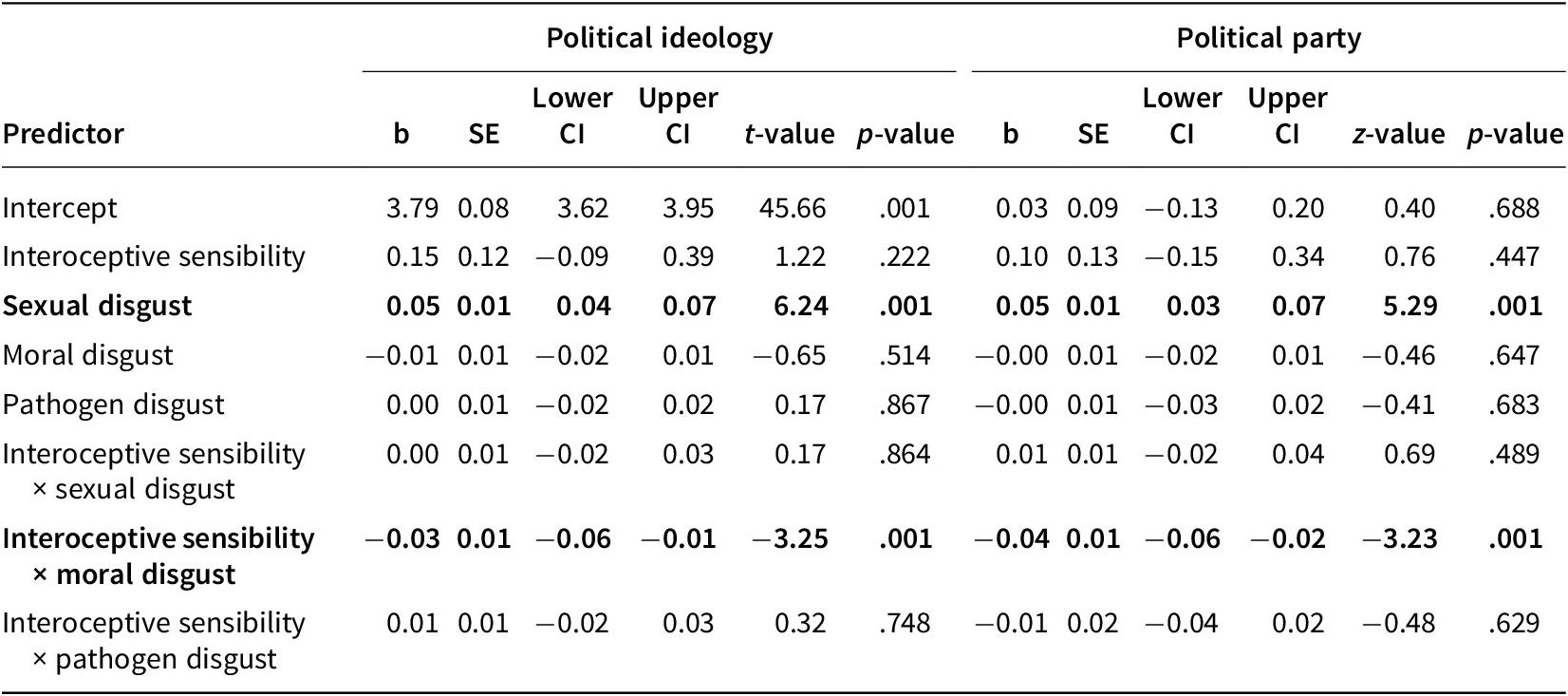
To examine how the different disgust domains may interact with interoceptive sensibility on political ideology and party, we repeated our models described above, but this time we included interoceptive sensibility, the three disgust dimensions (moral disgust, sexual disgust, pathogen disgust), as well as the three disgust dimensions and their interaction with interoceptive sensibility, as predictors. All predictors were mean-centered and had a VIF lower than 1.38, indicating no problem with multicollinearity. We obtained the same pattern of results when controlling for demographic variables such as age and gender (see Supplementary Tables S4 and S5 in the Supplementary Materials).
As shown in Table 3, both models, i.e., one predicting political ideology and the other predicting political party, revealed the same pattern of results. There was a significant main effect of sexual disgust, indicating that the higher the level of sexual disgust, the higher the likelihood of identifying as republican or conservative. However, neither moral disgust nor pathogen disgust by themselves were significant predictors of party affiliation or political ideology. Similarly, the main effect of interoceptive sensibility was not significant, suggesting that interoceptive sensibility by itself did not have an impact on party affiliation or ideology. The interaction between interoceptive sensibility and moral disgust was significant, suggesting that the relationship between moral disgust and party affiliation/political ideology was moderated by interoceptive sensibility. The interactions between interoceptive sensibility and sexual disgust and interoceptive sensibility and pathogen disgust were not significant.
Model results on political ideology and political party

Table 3. Long description
A table presenting model results for two dependent variables: Political ideology and Political party. The table includes columns for the coefficient b, S E, Lower C I, Upper C I, and statistical significance values (t-value or z-value and p-value).
Key findings highlighted in bold include:
* Sexual disgust: Significant positive predictor for both Political ideology (b = 0.05, p = .001) and Political party (b = 0.05, p = .001).
* Interoceptive sensibility times moral disgust interaction: Significant negative predictor for both Political ideology (b = minus 0.03, p = .001) and Political party (b = minus 0.04, p = .001).
Other predictors shown with non-significant results (p > .05) include:
* Intercept: Significant for ideology (p = .001) but not for party (p = .688).
* Interoceptive sensibility: b = 0.15 for ideology; b = 0.10 for party.
* Moral disgust: b = minus 0.01 for ideology; b = minus 0.00 for party.
* Pathogen disgust: b = 0.00 for ideology; b = minus 0.00 for party.
* Interoceptive sensibility times sexual disgust: b = 0.00 for ideology; b = 0.01 for party.
* Interoceptive sensibility times pathogen disgust: b = 0.01 for ideology; b = minus 0.01 for party.
Note: Significant main effects and interactions are highlighted in bold.
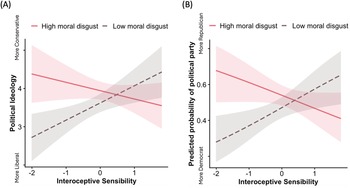
To follow up on the interaction between moral disgust and interoceptive sensibility, we repeated the models above including only moral disgust, interoceptive sensibility, and their interaction as predictors. The moral disgust by interoceptive sensibility interaction was significant for both political party identification, b = −0.03, SE = 0.01, z = −3.10, p = .002 and b = −0.03, SE = 0.01, t = −3.02, p = .003 and political ideology. Following Aiken and West (Reference Aiken and West1991), we probed these interactions by estimating predicted values at low (−1 SD) and high (+1 SD) levels of moral disgust and interoceptive sensibility, with four planned simple-effects comparisons conducted separately for each model. After Bonferroni correction, interoceptive sensibility significantly differentiated political party identification at low moral disgust: individuals higher in interoceptive sensibility were more likely to identify as Republican, OR = 1.78, 95% CI [1.14, 2.80], p = .048, and reported more conservative political ideology, b = 0.63, SE = 0.23, t = 2.79, p = .022. At high moral disgust, interoceptive sensibility did not significantly differentiate either outcome, political party: OR = 0.67, 95% CI [0.42, 1.05], p = .328; political ideology: b = −0.30, SE = 0.24, t = −1.28, p = .810. Conversely, moral disgust significantly differentiated both outcomes at low interoceptive sensibility: individuals higher in moral disgust were more likely to identify as Republican, OR = 2.15, 95% CI [1.37, 3.38], p = .004, and reported more conservative ideology, b = 0.79, SE = 0.22, t = 3.53, p = .002, than those low in moral disgust. At high interoceptive sensibility, moral disgust did not significantly differentiate either outcome, political party identification: OR = 0.81, 95% CI [0.51, 1.27], p = 1.000; political ideology: b = −0.14, SE = 0.24, t = −0.60, p = 1.00 (see Supplementary Tables S8 and S9 for details). Thus, higher moral disgust was associated with more conservative ideological positioning and a greater likelihood of Republican identification only at low but not high interoceptive sensibility (Figure 3).
Interaction between interoceptive sensibility and moral disgust in predicting political ideology and political party identification. Panel A shows predicted political ideology scores as a function of interoceptive sensibility at low (−1 SD) and high (+1 SD) levels of moral disgust, with higher scores indicating more conservative ideology. Panel B shows the predicted probability of identifying as Republican as a function of interoceptive sensibility at low (−1 SD) and high (+1 SD) levels of moral disgust. After Bonferroni correction across all four planned contrasts, differences between low and high moral disgust were not statistically reliable at high levels of interoceptive sensibility. At low levels of interoceptive sensibility, however, lower moral disgust was associated with a more liberal ideological positioning and a lower probability of identifying as Republican, whereas higher moral disgust was associated with a more conservative ideological positioning and a higher probability of identifying as Republican.

Figure 3. Long description
Two panels, A and B, both feature Interoceptive Sensibility on the x-axis ranging from minus 2 to 2.
Panel A: The y-axis is Political Ideology, ranging from 3 More Liberal to 5 More Conservative.
- High moral disgust is represented by a solid red line with a light red shaded confidence interval. It starts at approximately 4.4 at x equals minus 2 and shows a slight downward linear trend to 3.6 at x equals 2.
- Low moral disgust is represented by a dashed grey line with a light grey shaded confidence interval. It starts at approximately 2.7 at x equals minus 2 and shows a steep upward linear trend to 4.4 at x equals 2.
- The lines intersect at approximately x equals 0.5.
Panel B: The y-axis is Predicted probability of political party identification, ranging from 0.2 More Democrat to 0.8 More Republican.
- High moral disgust is a solid red line starting at 0.68 at x equals minus 2 and decreasing to 0.42 at x equals 2.
- Low moral disgust is a dashed grey line starting at 0.28 at x equals minus 2 and increasing to 0.65 at x equals 2.
- The lines intersect at approximately x equals 0.5.
In both panels, the confidence intervals for high and low moral disgust overlap significantly at high levels of interoceptive sensibility but are widely separated at low levels of interoceptive sensibility.
Discussion
Early research in political neuroscience linked stronger physiological responses to threat and disgust with conservatism (Oxley et al., Reference Oxley, Smith, Alford, Hibbing, Miller, Scalora, Hatemi and Hibbing2008; Smith et al., Reference Smith, Oxley, Hibbing, Alford and Hibbing2011), implying a neurobiological basis of ideology beyond societal factors. However, recent replication failures of physiological reactivity differences between political conservatives and liberals (Bakker et al., Reference Bakker, Schumacher, Gothreau and Arceneaux2020) challenge the idea of a direct connection between physiological reactivity and political attitudes. Against this background, we tested a narrower question, namely whether interoceptive sensibility moderates the association between self-reported disgust sensitivity and political orientation. Aligned with our hypotheses, we found that this association was weaker among individuals higher in interoceptive sensibility and stronger among individuals lower in interoceptive sensibility, both when ideology was measured continuously and when political party affiliation was examined as a discrete outcome. For example, for two individuals who have the same high level of disgust sensitivity, the one with lower interoception is 8.7 percentage points more likely to identify as Republican than the one with higher interoception. Moreover, these effects seem to be driven by moral, rather than sexual or pathogen, disgust.
Among individuals with higher interoceptive sensibility, disgust sensitivity was less strongly associated with political orientation. In line with the affective science literature (Ainley et al., Reference Ainley, Apps, Fotopoulou and Tsakiris2016; Patchitt et al., Reference Patchitt, Karapanagiotidis, Garfinkel, Miller, Tsakiris, Clark and CritchleyUnder Review), one possible interpretation is that, because interoceptive sensibility reflects greater attunement to internal bodily signals, these individuals may draw more strongly on perceived bodily cues when interpreting emotions such as disgust. This does not imply that disgust-related experiences are independent of social meaning; rather, socially acquired meanings may play a less dominant role in how these experiences become linked to political orientation.
By contrast, disgust sensitivity was more strongly associated with political orientation when interoceptive sensibility was low. Among individuals with lower interoceptive sensibility, higher disgust sensitivity was associated with a greater likelihood of identifying as Republican and with more conservative ideological positioning, whereas lower disgust sensitivity was associated with a greater likelihood of identifying as Democrat and with more liberal ideological positioning. One plausible interpretation is that, among individuals with lower interoceptive sensibility, socially acquired meanings may play a larger role when making sense of disgust-related experiences. As highlighted earlier, such meanings may be shaped by political discourse, particularly around moral and purity concerns, which are often more strongly moralized within conservative frameworks (Inbar et al., Reference Inbar, Pizarro and Bloom2009). This may help explain why, under lower interoceptive sensibility, higher disgust sensitivity was more strongly associated with conservative ideological positioning and Republican identification.
We also found that the moderating role of interoceptive sensibility is primarily present in the moral domain rather than in the pathogen or sexual disgust domains. Moral disgust is triggered by behaviors that violate social norms and moral expectations, and research shows that when people are asked to identify situations that elicit disgust, they are more likely to provide examples in a moral context (Nabi, Reference Nabi2002). The association between purity and moral virtue, with disgust serving as a morally relevant emotion, is especially evident in contexts where social norms around purity are strong. Anthropological evidence (Shweder et al., Reference Shweder, Much, Mahapatra and Park1997), observational studies (Inbar et al., Reference Inbar, Pizarro and Bloom2009), and recent theories (Haidt & Graham, Reference Haidt and Graham2007) suggest that disgust plays a central role in shaping moral systems and categorizing certain behaviors as immoral. Given its central role in moral judgment and norm enforcement, moral disgust may be especially likely to become politically meaningful through socially acquired meanings, which may help explain why the moderating role of interoceptive sensibility was concentrated in this domain.
Although we obtained the same overall pattern of results for political ideology and party affiliation, the statistical evidence for the interaction between interoception and the total score of disgust was weaker when political ideology was treated as the outcome. In this model, the interaction reached trend level, whereas it was statistically significant when party affiliation was treated as the outcome. One possible explanation is that identifying as a Democrat or Republican may be a more concrete political judgment than placing oneself on a 7-point liberal-conservative scale. Party affiliation refers to membership in a familiar political group, whereas ideological self-placement requires a more abstract self-assessment that may vary more across individuals. This may have made the total disgust interaction easier to detect for party affiliation than for continuous ideology. This interpretation is strengthened by the fact that the moral disgust interaction remained significant across both outcomes.
What can political science learn by bringing in a concept from neuroscience, such as interoception?
In the present study, our aim was not to provide a direct physiological explanation of ideology, as it is unlikely for that to be the case. Instead, we ask whether interoception can help clarify when and how disgust sensitivity is more or less strongly associated with political orientation. This is an important first step because physiological responses and subjective affective experience do not necessarily align (Arceneaux et al., Reference Arceneaux, Bakker and Schumacher2026; Mauss et al., Reference Mauss, Levenson, McCarter, Wilhelm and Gross2005; Mauss & Robinson, Reference Mauss and Robinson2009). This distinction is especially relevant in political psychology, where self-reported negativity bias has been more consistently linked to ideology than physiological indicators, which have not shown reliable associations with political ideology (Arceneaux et al., Reference Arceneaux, Bakker and Schumacher2026). The political relevance of disgust may therefore depend not only on bodily responses themselves but also on individuals’ ability to attend to and interpret bodily signals.
As a next step, future research should include physiological measures alongside subjective reports and interoceptive measures. The value of bringing interoception into political science may lie in explaining individual differences in how physiological states contribute to conscious emotional experience, and how these affective experiences become politically meaningful. In other words, interoception may help explain why similar bodily states are experienced, interpreted, and politically linked in different ways across individuals. This would move the literature beyond a simple contrast between physiology and self-report toward a more detailed account of how bodily states, subjective experience, and socio-political meaning interact.
Limitations and future directions
Although in the present study higher disgust sensitivity was associated with more conservative political orientation, particularly among individuals lower in interoceptive sensibility, we do not interpret these findings to mean that conservatives are inherently more disgust-sensitive. Rather, the direction of this association may depend on which disgust elicitors are morally and politically salient within a given sociopolitical context (Brandt & Bakker, Reference Brandt and Bakker2022; Elad-Strenger et al., Reference Elad-Strenger, Proch and Kessler2020). The moral and purity-related content captured by the disgust measure may be more closely aligned with concerns moralized within conservative ideological frameworks. The stronger association between disgust sensitivity and political orientation observed under lower interoceptive sensibility may have been more likely to run in a conservative direction in this sample. In other political contexts or societies, where different disgust elicitors are moralized by different ideological groups, the same moderating process could plausibly yield a different ideological pattern. Future work should therefore test whether the moderating role of interoceptive sensibility generalizes across sociopolitical contexts in which disgust is attached to different moral or ideological concerns.
Our data are correlational and cannot establish causal relationships. Although the present findings suggest that interoceptive sensibility may play a role in the relationship between disgust sensitivity and political orientation, the study does not include physiological measures. We therefore cannot determine whether the observed moderation reflects variation in bodily reactivity itself, variation in how bodily cues are consciously interpreted, or the correspondence between physiological and subjective responses. However, because the MAIA captures interoceptive sensibility, that is, a conscious and dispositional aspect of how we attend to, become aware of, and interpret bodily signals, the present findings do suggest that this self-reported interoceptive dimension is relevant to the disgust-politics association. Future research should test the proposed mechanism more directly using designs that combine physiological measures, subjective self-reports, and behavioral or self-report measures of interoception.
Conclusion
In sum, our findings suggest that interoceptive sensibility moderates the relationship between disgust sensitivity and political orientation, offering a more specific perspective on when disgust sensitivity may become linked to political orientation. Among people with higher interoceptive sensibility, political ideology and party affiliation were less strongly associated with disgust sensitivity. In contrast, the association between disgust sensitivity and political orientation was primarily observed among those with lower interoceptive sensibility, possibly because socially acquired meanings may play a larger role when disgust-related experiences are interpreted. Therefore, the association between self-reported disgust sensitivity and political orientation may depend in part on interoceptive sensibility. These findings underscore the value of bringing interoceptive concepts into the study of political attitudes. Since disgust sensitivity accounted for a non-trivial proportion of variance in political ideology (5.42% in our data), understanding when interoceptive mechanisms reinforce or mitigate its association with political ideology is an important direction for future research.
Supplementary material
The supplementary material for this article can be found at http://doi.org/10.1017/pls.2026.10026.
Data availability
Data is available at the Open Science Framework: https://osf.io/9fs7h.





 Open access

