The coronavirus disease 2019 (COVID-19) has become a global public health emergency, and it has caused huge losses to the economy and has resulted in the loss of human lives and properties. Reference Nicola, Alsafi and Sohrabi1 According to a World Health Organization (WHO) report, as of March 15, 2022, the number of COVID-19 cases has reached 456,797,217 in more than 220 countries across regions. 2 Medical staff play a vital role in the prevention and control of the COVID-19 pandemic. To fight against the COVID-19 infection, 42,600 medical personnel were dispatched to Hubei province in China since January 24, 2020; of them, 28,600 or nearly 70% were nurses. 3
It has been established that public health emergencies can easily cause great psychological crisis to both the medical staff and the general public. During the severe acute respiratory syndrome (SARS) outbreak in Singapore in 2003, 27% of the health-care workers exhibited psychiatric symptoms, Reference Chan and Huak4 whereas significant rates of SARS-related psychiatric (22.9%) and posttraumatic morbidities (25.8%) were observed among noninfected community individuals. Reference Sim, Huak Chan and Chong5 Similarly, health-care personnel who managed patients with Middle East respiratory syndrome-coronavirus (MERS-CoV) in Saudi Arabia in 2014 experienced fear and nervousness. Reference Khalid, Khalid and Qabajah6 In China, more than half of the general public rated the psychological impact of the COVID-19 outbreak as moderate to severe, and approximately one-third have experienced moderate to severe anxiety during the initial phase of the COVID-19 outbreak. Reference Wang, Pan and Wan7 This finding suggests that psychological problems may occur because of the high infection risk and because of the unknown nature of COVID-19, especially in the early stages of the outbreak. Health-care workers managing COVID-19 patients are at a high risk of getting infected, and they bear a heavy burden in the clinical treatment and in the public prevention efforts in Chinese hospitals Reference Bao, Sun and Meng8 ; the different challenges and levels of stress they have experienced can lead to serious psychological disorders, such as anxiety and depressive disorders as well as posttraumatic stress disorder (PTSD). Reference Shultz, Baingana and Neria9 Nurses constitute the majority of the medical staff dispatched to Wuhan. Therefore, a timely analysis of the mental health status of these frontline anti-epidemic nurses is urgently needed so that both public and nursing administrators could provide targeted psychological interventions.
As a positive mental attribute, resilience helps individuals to rebound after experiencing negative events, especially major traumas, dilemmas, setbacks, difficulties, and stressful or even life-threatening situations. Reference Bonanno10 It plays a key role in the response to stressful events and in the adaptation to environmental changes through one’s adoption of effective coping strategies. Reference Shatté, Perlman and Smith11 Individuals with higher resilience levels display such positive psychological attributes as optimism and humor, which help them manage hardships and unpleasant emotions with appropriate solutions. Studies have shown that nurses with adequate resilience may display greater adaptive capacity and better control of personal emotions, and they demonstrate lower likelihood of exhibiting such negative emotions as anxiety and irritability. Reference Vyas, Fesperman and Nebeker12 Using a randomized controlled trial, Mealer et al. found that the intensive care unit (ICU) nurses who underwent a resilience training displayed a reduced level of PTSD. Reference Mealer, Conrad and Evans13 Moreover, resilience was reported to play a protective role against nursing turnover and burnout. Reference McAllister and McKinnon14,Reference Botha, Gwin and Purpora15 Resilience has also been linked to nursing qualities and job satisfaction. Reference Sarafis, Rousaki and Tsounis16,Reference Matos, Neushotz and Griffin17 Thus, evaluating the resilience of frontline anti-epidemic nurses and identifying its influencing factors are of vital importance in alleviating career burnout, in safeguarding nursing qualities, and in promoting mental wellbeing.
The influence of demographic and psychological factors on resilience among nurses has already been examined. Inconsistencies were observed in the association between demographic factors and nurses’ resilience. Reference Yu, Raphael and Mackay18 Rodriguez-Llanes et al. and Ang et al. found that age and gender are correlated with resilience, wherein female and young nurses exhibit lower resilience than male and older nurses. Reference Rodriguez-Llanes, Vos and Guha-Sapir19,Reference Ang, Uthaman and Ayre20 Guo et al. investigated 1,061 Chinese nurses and found that education, regular exercise, and being a nonsmoker are predictors of a high level of resilience (P < 0.01). Reference Guo, Cross and Plummer21 By contrast, Gillespie et al. found no significant correlation between resilience and educational level. Reference Gillespie, Chaboyer and Wallis22 According to a survey involving 1338 Singaporean nurses, marriage is a protective factor of resilience. Reference Ang, Uthaman and Ayre20 A possible explanation for this finding lies in the fact that marriage could broaden individuals’ social circles, providing them access to more support whenever they face stressful events.
Regarding psychological factors (such as anxiety or depression), it was reported that even if anxiety is an adaptive emotional response to stress and may play an initial protective role, Reference Manomenidis, Panagopoulou and Montgomery23 long-term anxiety can adversely affect physical and mental health, and people with mental health problems display a reduced ability to cope with stress. Reference Shastri24 A survey involving 1743 nurses in Australia showed that depression, anxiety, and stress are negatively correlated with resilience levels, Reference Hegney, Rees and Eley25 consistent with the findings of pediatric health-care professionals in 2011. Reference McGarry, Girdler and McDonald26 Similarly, by investigating 744 ICU nurses in the United States, Mealer et al. found that a high resilience level was significantly associated with symptoms of anxiety or depression and with a reduced prevalence of PTSD. Reference Mealer, Jones and Newman27 Also, Saksvik-Lehouillier et al. found that anxiety (r = −0.38; P < 0.01) and depression (r = −0.44; P < 0.01) were negatively correlated with resilience among Norwegian nurses employed in shift work arrangements, which include night shifts. Reference Saksvik-Lehouillier, Bjorvatn and Magerøy28
COVID-19 is a novel infectious disease that we know very little about it; to reduce the effects of stressful events related to the current pandemic and to maintain the mental health of medical staff, the resilience of individuals may be boosted with interventions. Reference Grafton, Gillespie and Henderson29 Currently, there is no known information about the resilience of frontline anti-epidemic nurses, so we examined their resilience levels, as well as the demographic and psychological predictors of resilience. This study may serve as a reference in formulating intervention schemes aimed at improving nurses’ resilience.
Methods
Study Design
A descriptive cross-sectional design was used in a survey study conducted from February 15 to February 20, 2020.
This study was conducted in strict accordance with the provisions of the Declaration of Helsinki. The study protocol was approved by our institutional Ethics Committee (Institutional Review Board Approval Number: 202002005). All nurses who met the inclusion criteria received a questionnaire and were informed that their participation was voluntary. The questionnaires were anonymous, and a description of how confidentiality would be ensured was provided.
Study Population and Sample
A convenience sampling method was used in this study. The recruited nurses came from Xiangya Hospital of Central South University in Changsha city who worked in fever clinic, infection department, emergency department, or ICU. During the outbreak of COVID-19, 100 nurses from the Xiangya Hospital of Central South University were deployed to manage COVID-19 at the Xiangya ward (50 beds) set in the West Campus of Union Hospital Tongji Medical College of Huazhong University of Science and Technology in Wuhan, it is a tertiary hospital with 1200 beds and 810 beds were allocated for ordinary, severe and critical COVID-19 patients. Meanwhile, the Xiangya hospital of Central South University offered up to 100 beds for COVID-19 cases. So, the participants in this study were frontline nurses serving in the Xiangya Hospital of Central South University and those being dispatched from this hospital to Wuhan. The inclusion criteria were registered nurses who provided direct care to COVID-19 patients.
The questionnaire used covered 16 co-variables (depression, anxiety, and stress, along with 13 demographic variables). The variables that showed significant differences in the univariate analysis were entered into a model for the multivariate analysis. G*Power was used to estimate the sample size for this survey. A total of 128 cases were needed for the regression analysis (effect size = 0.25; P = 0.05; power = 0.95). Considering a sample turnover rate of 10%, the necessary sample size was determined to be at least 141 cases.
Instruments
The questionnaire consisted of a sociodemographic section, and it also incorporated the 10-item Connor-Davidson Resilience Scale (CD-RISC-10) and the simplified 21-item Depression Anxiety Stress Scale (DASS-21) (Lovibond and Lovibond, 1995). Reference Connor and Davidson30,Reference Lovibond and Lovibond31 The sociodemographic variables covered 13 aspects: gender, age, educational level, marital status, offspring status, daily exercise duration, annual family income, work locality, practicing department, job title, worries about insufficient protective supplies, daily working hours, and daily workload.
The simplified version of the CD-RISC-10 was used to evaluate the subjects’ ability to return to a normal state after encountering dilemmas or challenges. Reference Connor and Davidson30 This scale has demonstrated an excellent internal consistency during the evaluation of the Chinese earthquake victims (Cronbach’s alpha = 0.91); moreover, it demonstrated test-retest reliability (with an interval of 2 wk; r = 0.90). Reference Wang, Shi and Zhang32 For this assessment, a 5-point Likert scale was used, wherein 0 means not true at all, 1 means rarely true, 2 means sometimes true, 3 means often true, and 4 means true nearly all the time. When the points for each of the items were summed up, the total score would range from 0 to 40 points. A higher total score denoted a higher level of resilience. In this study, the Cronbach’s alpha of the CD-RISC-10 was 0.952.
This study also used the DASS-21 formulated by Lovibond and Lovibond. Reference Lovibond and Lovibond31 DASS-21 covered 3 dimensions, namely, depression, anxiety, and stress. Each dimension contained 7 items, which were used to evaluate the subjects’ emotions over a period of 1 wk before filling out the questionnaire. For this assessment, a 4-point Likert scale was used, wherein 0 means did not apply to me at all/never, 1 means applied to me to some degree or some of the time/sometimes, 2 means applied to me to a considerable degree or a large part of the time/often, and 3 means applied to me very much or most of the time/almost always. For each scale, the total score is 0-21. A higher score denoted greater severity of negative emotions. The scores were used to classify depression, anxiety, and stress scales as normal, mild, moderate, severe, and extremely severe. This scale has demonstrated suitable psychometric properties in assessing nurses in Australia, with a Cronbach’s alpha of 0.92, 0.86, and 0.89 for depression, anxiety, and stress scales, respectively. Reference Hegney, Rees and Eley25 In this study, the Cronbach’s alpha for the overall DASS-21 was 0.961, and the values for the depression, anxiety, and stress scales were 0.927, 0.883, and 0.895, respectively.
Data Collection
A domestic online survey platform (https://www.wjx.cn/) was used by the participants to complete the questionnaire. Two trained researchers informed the subjects about the objectives and contents of this survey, and standardized forms and procedures were used to ensure consistency of data quality. The questionnaire was made available to the participants upon signing the informed consent forms. The returned questionnaires were double-checked, and the obtained data were entered into an analysis software by 2 other researchers. A total of 150 online questionnaires were distributed, and the response rate was 95.33%, the final recruitment number was 143.
Statistical Processing
Statistical analysis was performed using SPSS Statistics 22.0 (IBM, Armonk, NY). The Kolmogorov-Smirnov test, which was used to verify the normality of data, showed that resilience was normally distributed, although the DASS-21 scores were not. Numerical data were expressed as frequencies and percentages, and quantitative data were presented as means and standard deviations. Data with skewed distributions were described as medians and interquartile ranges. The independent 2-sample t-test and analysis of variance (ANOVA) were used to compare the differences in resilience between 2 or multiple groups. Spearman’s correlation analysis was used to test the correlation of resilience with depression, anxiety, and stress. Stepwise multiple linear regression was subsequently used to identify the predictors of resilience. A P-value of < 0.05 was considered statistically significant.
Results
Demographic Data
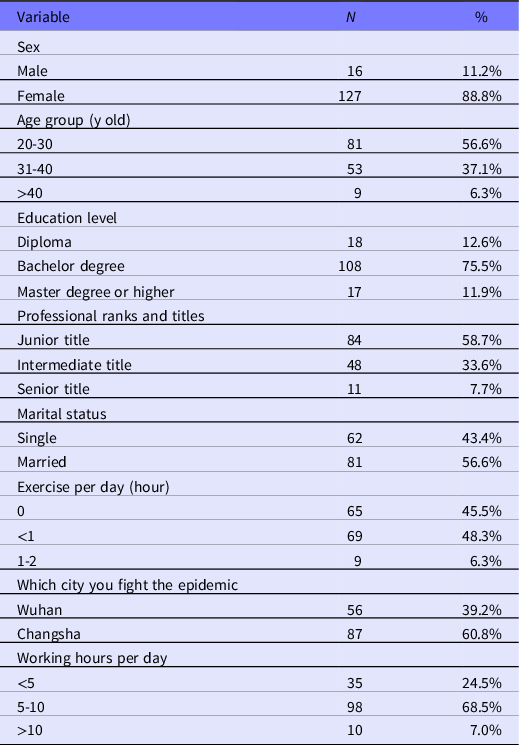
Of the 143 responders, 127 were female (88.8%) and 16 were male (11.2%). A total of 56 (39.2%) frontline nurses from Changsha were dispatched to Wuhan, whereas 87 (60.8%) served in the Changsha Hospital. The average age of the participants was 30.62 ± 5.80 y (range: 22-52 y), and their average exercise duration was 1.62 ± 0.63 h/d; moreover, the average number of patients they cared for was 10.32 ± 8.09 per d, and their average working hours was 7.03 ± 2.59 h/d. More demographic details are presented in Table 1.
Demographic characteristics and the comparison of resilience among demographic characteristics of the frontline anti-epidemic nurses (N=143)

Resilience Level of the Frontline Anti-epidemic Nurses and Its Related Sociodemographic Factors
The mean resilience score was 28.45 ± 7.05 (range: 10-40). The univariate analysis showed that resilience was significantly influenced by gender (t = 2.478; P = 0.014), age (F = 2.555; P = 0.042), and daily exercise duration (F = 4.030; P = 0.020).
Levels of Depression, Anxiety, and Stress of the Frontline Anti-epidemic Nurses
The median scores (interquartile ranges) for depression, anxiety, and stress were 1 (0-5), 2 (1-6), and 3 (1-7), respectively. Among the participants, 2.8% showed mild to severe depression levels and 11.2% showed mild to extremely severe anxiety levels. Only 0.7% experienced moderate stress levels.
Association of Resilience With the Depression, Anxiety, and Stress Levels of the Frontline Anti-epidemic Nurses
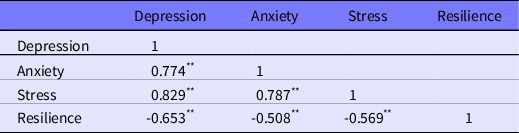
The correlation analysis (Table 2) showed that resilience was negatively correlated with the individual depression (r = −0.653; P < 0.01), anxiety (r = −0.508; P < 0.01), and stress scores (r = −0.569; P < 0.01). In other words, those nurses with higher depression, anxiety, and stress levels exhibited lower resilience.
Association between resilience and depression, anxiety, stress of the frontline anti-epidemic nurses (N =143)

** P < 0.01.
Predictors of the Resilience of the Frontline Anti-epidemic Nurses
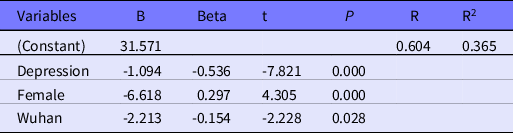
The multiple linear regression analysis showed that the female gender, being dispatched to Wuhan, and depression levels were the significant predictors of resilience (P < 0.05). These variables were shown to influence resilience significantly (P < 0.05) and accounted for 36.5% of the variance of resilience (Table 3). Frontline nurses who were female, dispatched to Wuhan, and exhibiting higher depression levels tended to have lower resilience levels.
Multiple linear regression coefficients among resilience, DASS-21, and demographics variables (N =143)

Abbreviations: B, unstandardized coefficients; Beta, standardized coefficients; R2, coefficient of determination.
Discussion
Resilience Levels of the Frontline Anti-epidemic Nurses
In this study, the frontline nurses’ resilience score was 28.45 ± 7.05, indicating a moderate resilience level. The frontline nurses’ resilience score was higher than that of the Singaporean nurses (mean resilience score was 25.9) and Chinese nurses (mean resilience score was 23.6) during the nonoutbreak periods. Reference Ang, Uthaman and Ayre20,Reference Huang, Wu and Xu33 This result could be explained by the fact that the majority of the frontline nurses were volunteers and that, even though they were facing enormous pressure, they still exhibited sufficient confidence and courage. Reference Liu, Luo and Haase34 Nurses involved in global outbreaks, such as SARS, MERS, and Ebola, have experienced increased burnout, compassion fatigue, reduced job satisfaction, low morale, and work-related stress. Reference Kim and Choi35–Reference Smith, Smith and Kratochvil37 To better protect the frontline medical staff, the CPC Central Committee, which is the leading group on the prevention and control of the COVID-19 outbreak, released on February 22, 2020, a guideline for the implementation of measures to further protect and care for medical workers 3,38 ; these measures include instituting rational shifts and manpower management, ensuring sufficient supply of daily necessities, and increasing the frontline medical workers’ compensations and benefits. The most important measure is the monitoring of the medical workers’ psychological state and the provision of psychological havens for both the frontline medical workers and their families to help the latter concentrate on their frontline duties and to help improve their physical and mental wellbeing. 3,Reference Neto, Almeida and Esmeraldo39 For instance, counseling services in various forms (eg, telephone consultation, online/virtual consultation, and face-to-face consultation) had been carried out at different levels to help frontline medical workers deal with psychological problems. 38 COVID-19 has threaten the lives of mankind, and the main workforce involved in the fight against this pandemic are the medical workers, especially the frontline nurses all over the world. Long-term exposure to public health emergencies can lead to such conditions as depression and PTSD. Reference Lee, Kang and Cho40,Reference Zhang and Tu41 Thus, administrators in all countries should realize the importance of establishing comprehensive support strategies to reduce the frontline nurses’ anxiety, depression, and stress levels to maintain their physical and psychological wellbeing.
Influencing Factors of Resilience Among Frontline Anti-epidemic Nurses
Sociodemographic Factors
Our findings showed that younger nurses had a higher probability of having low resilience than the older nurses, consistent with the findings of another cross-sectional survey involving Singapore nurses. Reference Ang, Uthaman and Ayre20 This pattern was observed possibly because the older nurses in our study were more experienced, had completed more emergency drills, and had accumulated greater knowledge and skills, allowing them to accomplish their tasks smoothly and to handle emergencies with a greater degree of mental preparedness. By contrast, due to their lesser clinical nursing experiences and skills, younger nurses have experienced greater work and psychological stress and were more likely to exhibit adverse psychological responses; ultimately, they displayed lower resilience levels.
Daily exercise duration was another factor that was significantly related to the frontline nurses’ resilience in this study. This finding is consistent with that of previous surveys, Reference Guo, Cross and Plummer21,Reference Sun, Wei and Shi42 which showed that having a positive coping mechanism, such as exercising regularly, predicted a high level of resilience.
Although these 2 factors were not entered as predictors in the regression analysis, they still illustrated that administrators should continue focusing more on younger nurses as well as on the need to encourage nurses and to help them find diverse ways to adjust their physical and psychological status. Reference Rimmer and Chatfield43
Our findings showed that female frontline nurses have a lower resilience than male frontline nurses. But this result was likely to be related to gender imbalance in the sample, male nurses’ higher resilience could be explained that they were generally better at coping with stress and emotions than female nurses, Reference Zhang and Tu41 or it was probably that the male nurses were more motivated as there were so few of them. It is imperative to encourage female nurses to communicate frequently with their family members and colleagues as social interactions reduce or divert negative emotions, such as anxiety and stress, and they improve one’s overall mood Reference Yang, Xiao and Cao44,Reference Adamczyk and Segrin45 ; moreover, the female nurses are advised to seek professional psychological counseling when necessary.
The resilience levels of the frontline nurses dispatched to Wuhan were significantly lower than those of their counterparts. Those dispatched to Wuhan during the COVID-19 crisis faced more pressure than usual, including a high risk of infection, insufficient personal protective equipment, heavy workloads and manpower shortages, confusion, discrimination, isolation, patients with negative emotions, separation from their families, and burnout. Reference Kang, Li and Hu46,Reference Lu, Wang and Lin47 A systematic review presented that during an infectious disease outbreak, nurses heavily involved with direct patient care are more likely to report high stress levels and common mental disorders compared with other health-care professionals; moreover, nurses display the highest distress level. Reference Brooks, Dunn and Amlôt48 Thus, nurses’ psychological state should be closely monitored.
Psychological Factors
In this study, the levels of depression, anxiety, and stress were negatively correlated with resilience. In the multiple regression analysis, depression level was the predictor of resilience. This correlation could be attributed to the fact that frontline anti-epidemic nurses often work long hours under heavy rescue workloads. Also, their protective gear do not support good air circulation, causing a feeling of suffocation. Patient deaths and fear of being infected may also have contributed to high depression, anxiety, and stress levels. All these factors have negatively affected the nurses’ resilience levels. Reference Wu, Styra and Gold49
A good resilience can protect nurses even from turnover, PTSD, emotional exhaustion, and burnout. Moreover, it would improve patient satisfaction arising from the perceived better quality of care and better attitudes toward patients. Reference Manomenidis, Panagopoulou and Montgomery23 The study by Gartland et al. emphasized that an individual’s resilience levels are never constant Reference Gartland, Bond and Olsson50 ; thus, even after the pandemic, medical staff may still face some psychological problems, Reference Xiong and Peng51 although these problems can be addressed with effective intervention measures. Therefore, constant attention is necessary to identify the influencing factors of resilience among frontline anti-epidemic nurses during the COVID-19 crisis and then adopt targeted intervention strategies to reduce their negative emotions and improve their experience. Interventions that promote frontline nurses’ resilience are important not only in protecting the nurses themselves, but also in ensuring patients’ safety and in preventing the spread of the epidemic.
Limitations
This study has several limitations. First, the survey recruited frontline nurses from 1 hospital, and the sample size was small. Therefore, it does not provide a complete picture of the resilience levels for all frontline anti-pandemic nurses. Second, the gender imbalance in the sample (male nurses are far fewer than female nurses) may affect the interpretation of the results. Third, we did not explore the correlation between resilience and nursing quality in fever clinics. Probably, frontline nurses with different levels of resilience will provide nursing care of varying qualities to their patients. Future studies may focus on the interventions that take into account the predictors reported herein to enhance nurses’ resilience; moreover, future studies may follow up on nurses’ mental health and psychological resilience.
Conclusions
This study conducted a survey to explore the sociodemographic and psychological predictors of resilience among the frontline nurses fighting the COVID-19 epidemic. The results suggested a moderate resilience level among the investigated nurses. Age, gender, work locality, and level of depression are the significant predictors of resilience. This finding suggests that nursing administrators should pay particular attention to young female nurses dispatched to epidemic hotspots, especially those exhibiting depression symptoms; moreover, administrators should take appropriate measures to boost nurses’ resilience.
Acknowledgments
The authors are grateful to Xiangya Hospital, Central South University for help and cooperation. We are also grateful to the nurses who took the time to participate in this study.
Author contributions
Drs. Yan Zhang and Yang Xiong contributed equally to the article.