Introduction
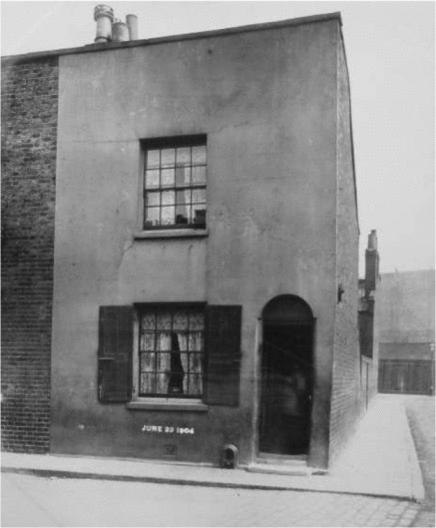
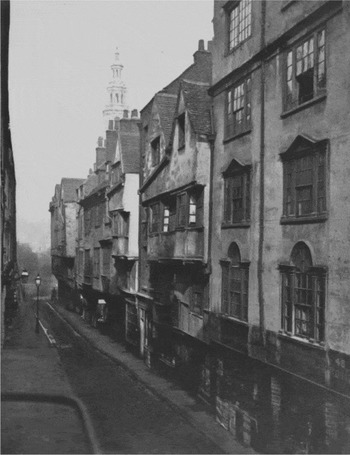
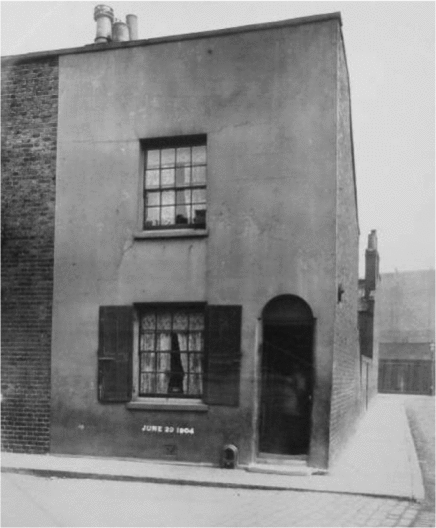
In the Edwardian decade, the London County Council (LCC) made photographs of hundreds of old houses about to be demolished in street improvement schemes. Figures 1 and 2 are typical examples, depicting houses in Rotherhithe. Yet why were they made, and what do they show? Are they picturesque images, for instance, or record photographs? Whose visualization of the city do they reflect, and of what dialogues do they form a part? Photographs are not simple illustrations, but parts of processes. They play active roles in dialogues and are both formed and read within complex historical contexts. It follows, then, that photographs of urban buildings reflect relationships between historical actors and ways of visualizing and representing the city.
‘Ainstey Street’, 1903, by LCC (by courtesy of City of London, London Metropolitan Archives, box ref. SC/PHL/01/035).

‘37 Ainstey Street’, 1904, by LCC (by courtesy of City of London, London Metropolitan Archives, box ref. SC/PHL/01/035).
This article looks at LCC images of London around the turn of the twentieth century. They are framed in the context of metropolitan improvement schemes at a time of intense debate about centralization versus suburbanization of working-class housing.Footnote 1 By examining both the form and the provenance of this large collection of images, and by exploring the historical contexts in which they were made, this article will challenge a dominant reading of such photographs as preservationist. Whilst recognizing the important role of such readings in a dialogue of modernization and ‘creative destruction’, it offers an additional layer of contextual meaning. Here, the photographs were made and mobilized within political dialogues of decentralization, progress and the right place of working Londoners amidst wider ideas of light and air, time and space, and the affordances of electric transport and fast motor roads – as well as more mundane concerns over municipal spending.
First, the politics of decentralization is explored, focusing on light and air and concerns over municipal spending expressed by solicitor and LCC councillor, Melvill Beachcroft. Secondly, the LCC's metropolitan improvements programme is examined in the context of debates over preservation and destruction. Different forms of visualizing these concerns are described, from picturesque antiquarianism to utilitarian record photography. Then, the tensions in this story are highlighted by examining the activities of the politician, financier and scientist, John Lubbock, who was deeply involved both in preservation and in the materialization of technological modernity. Finally, conclusions are drawn which address multiple layers of meaning encoded in the LCC's photographs.
The politics of light, air, time and space
In 1885, the Royal Commission on the Housing of the Working Classes put forward proposals for cottage homes to be built in London's suburbs for working people, with cheap workmen's trains laid on by railway companies. The Royal Commission's work was part of an increasing awareness of the shortcomings of working-class housing in London, seen by many as the most urgent social problem of the age. In the final years of the nineteenth century a great deal of political, philanthropic and municipal activism – at the highest levels – took place in attempts to solve the problem.
In 1900, the Conservative prime minister, Lord Salisbury, told the National Union of Conservative Associations that ‘the subject which should occupy their attention more than any social subject is that of providing adequate and healthy accommodation for the working classes’,Footnote 2 and for many, a ring of cottage suburbs was the only healthy option as the urban population continued to rise and space for housing in central London ran out. ‘You ought to be able to house a great part of the working population of London more healthfully and more economically in the country near London’, stated the former prime minister, Lord Rosebery, in 1899.Footnote 3 The alternative to decentralization was the building of high-density, multistorey tenement blocks on central sites cleared of their old, low-rise housing stock, a tradition begun decades earlier by philanthropists such as the Peabody Trust and enabling workers to walk to their employment. In the early days of the LCC, formed in 1889 with an initially strong Progressive majority, this was the dominant policy when urban improvement schemes led to working people being displaced from their homes, but conservative politicians on the Moderate side were fiercely critical, seeing such municipal intervention as inherently expensive and inefficient. One such Moderate was Melvill Beachcroft, who described the building of the LCC's first major tenement development, the Boundary Street estate in Bethnal Green, as ‘an event which not only invited but demanded criticism’.Footnote 4 A partner in a firm of London solicitors, and a hard-hitter in debates, Beachcroft was soon elected an LCC alderman, serving as council deputy chairman in 1896 and vice-chairman the following year. As chairman of the LCC Housing Committee from 1892 to 1894, he had become intimately versed in the complexity of the council's housing policies.Footnote 5 His approach was one of ‘sturdy individualism, and of a deep-rooted hostility to undue interference by the local authorities and the State’Footnote 6 and he spoke widely on matters relating to working-class housing in London, being described as ‘one of the leading spirits of the rehousing movement’.Footnote 7
The decentralization plan conjured up wider narratives at large in the later nineteenth century: the industrialization of time and space.Footnote 8 Arthur Balfour (Salisbury's successor as prime minister in 1902), spoke at length on the subject in a Commons debate in May 1900, stating that ‘the remedy for the great disease of overcrowding . . . is a question simply of time and space, and nothing else’. To find this remedy, he explained, ‘you must go outside the narrow area at the centre of your congested district, and you must trust to modern invention and modern improvements in locomotion for abolishing time’. Balfour's invocation of modern inventions was rooted in the ferment of the ‘second industrial revolution’ in full sway at the turn of the twentieth century, which saw electrification, the internal combustion engine, scientific management and new factory methods sweep across the industrial landscape.Footnote 9 ‘It is not’, he went on to say, ‘to the inventive legislation of this House that we must look, but it is to the inventive power of men of science and of manufacturers.’ But this inventive legislator's dream went beyond cheap workmen's trains. ‘I sometimes dream’, he told the House, ‘that in addition to railways and tramways, we may see great highways constructed for rapid motor traffic, and confined to motor traffic, which would have the immense advantage . . . of taking the workman from door to door, which no tramway and no railway could do.’Footnote 10
This was a period when time and space – and their relative shrinkage – was a profoundly powerful narrative, linking science, technology, industry and progress.Footnote 11 Abolishing time and shrinking space were powerful techno-scientific tropes in the housing debate; yet it was natural requirements that defined the problem in the first place: the growing need for light and air, as every little pocket of open ground in the city, every forecourt and yard, was built over, as tall as possible, with no restriction on landowners’ greed. Beachcroft observed, ‘the preservation of light and air has indeed for centuries in London been the privilege merely of those able to afford to fight their neighbours in the law courts’.Footnote 12 The need for light and air was expressed particularly eloquently by the radical politician and campaigner, Frederick Lawrence, in an essay entitled ‘The housing problem’ contained in Charles Masterman's 1901 treatise, The Heart of the Empire.Footnote 13 In it, Lawrence described ‘excessive towniness’ in which the struggle to accommodate workers on a finite surface area led to ‘the evil’ that saw people ‘built up towards the sky in barracks, so many hundred persons all being hived on one small spot of ground’.Footnote 14 Such residents benefited from proximity to their work, but at a great cost. ‘The working man barters away sunlight, fresh air, and decent accommodation for life with additional interests in a great city, and in many cases he makes a bad bargain.’Footnote 15 For Lawrence, as for Beachcroft, localized rehousing after improvement schemes made no economic sense, and he pleaded for a frank acknowledgment of the fact, observing that ‘re-housing the ejected upon the same spot, is not only of no benefit but actually injurious’, and, instead, demolition schemes ‘should be frankly unremunerative, and an open space should be left in order to give fresh air and health where before all was squalor and disease’.Footnote 16 The symbolism of light and air was, in this period, Biblical. Missionary literature on slum housing – where dwellers lived in the blackness of sin, far from the light of civilization – had made the association well understood.Footnote 17
This ideological battle between the centralizers and the decentralizers was very much unresolved in the late 1890s, and arguments swung both ways. However, in the end, the council came down on the side of suburban development, and in their separate and highly detailed analyses, James Yelling and Andrew Saint place the turning point at 1898–9, after council elections which returned the Progressives with a second clear majority.Footnote 18 By then, Beachcroft was confidently espousing the credo of mass migration, concluding, ‘reasonable hours of labour and fair wages, such as now rule, accompanied by better facilities for enabling people to live away from their work, should operate to induce the present workers in our crowded districts to migrate and to exchange the wretched slum or barrack dwelling and the public-house for the fresh air and cheerful surroundings of the suburb’.Footnote 19 The same year, his colleague on the council, LCC Improvements Committee chairman George Shaw-Lefevre, joined him in imagining a technological flight to the suburbs, crying, ‘No one can look at the tangled and confused map of London without admitting what a vast field there is for improvements of all kinds. Broad avenues and boulevards should be made, stretching out directly from the centre to the suburbs providing for double tracks of tramways, and affording opportunities for fresh air.’Footnote 20 To understand further the political processes involved in the housing problem, we must study both the activity and the rhetoric of improvement and mobility at the LCC in the 1890s and 1900s.
Picturesque visualizations
If the solution to overcrowding was a working-class flight (or push) to the suburbs, the key means by which it would be enabled was the LCC's metropolitan improvement programme. This series of major civil engineering works had twin aims: to clear away parts of London deemed unfit for habitation, and to resolve transportation and circulation problems of congestion, by widening roads, building viaducts and tunnels and creating new thoroughfares. Both aims went hand in hand and both displaced large numbers of residents.
The LCC's first major home-grown improvement scheme was a grand thoroughfare joining Holborn and Strand in central London, comprising a north–south avenue known as Kingsway with a crescent-shaped street called Aldwych at the southern end.Footnote 21 Preparatory work began in 1896 and the main scheme began in 1899. This was a mammoth job, involving the building of new housing within walking distance for 6,000 of the 6,900 people displaced. In October 1905, Kingsway was formally opened by King Edward VII and Queen Alexandra in a glitteringly triumphal celebration.Footnote 22 But the LCC had ambitions well beyond Holborn. As Kingsway was being given royal assent in 1899, the council was approving its next major infrastructure project, the building of a cross-river tunnel in the east-end docks to connect Rotherhithe and Shadwell, opened in 1908 as the Rotherhithe Tunnel following the clearance of several hundred houses and the displacement of almost 3,000 residents.
Political arguments about the right place to re-house Londoners were not, therefore, abstract. They took place at a time when the LCC's projects were turning almost 10,000 people on to the streets. Much rested on the outcome – politically, financially and socially – and the actors used a variety of rhetorical mediums to construct an image of the future they envisaged. One means to do this was via the growing use of photography. For some, the debate rested not on the right place for the new buildings, but on the value of the places being demolished in the first place. This was a time when preservation and a respect for the relics of the past was growing in cultural significance, after decades of urban dislocation and upheaval from the new infrastructures of railways, gas mains, water supplies and sewers. As these modernization schemes continued to dislocate the streets, an increasingly vocal and diverse network of activists sought to record and preserve what they defined as historic buildings at risk of demolition in the name of progress.
An early example of preservationist photography came with the Society for Photographing the Relics of Old London (SPROL), founded in 1875, which issued 120 pictures of endangered buildings over the next decade.Footnote 23 Historian Kenneth Foote has cast this survey in a firmly reactionary light. ‘Stemming from what seemed to be broadly held perceptions of the negative consequences of Victorian life, it expressed an essentially conservative view of the changes in London.’ Its attitude, he says, ‘stood in contrast to the optimistic views of Victorian society, which served to celebrate the accomplishments of the newborn industrial age and to promote its progress’.Footnote 24 The survey took place in a wider debate about the preservation of Britain's material past at that time. Following much effort, in 1882, Liberal member of parliament Sir John Lubbock (later Lord Avebury) succeeded in steering his Ancient Monuments Bill through to the statute book. Lubbock is strongly associated with the preservationist movement. In 1894, the Committee for the Survey of the Memorials of Greater London (later the London Survey Committee or simply the Survey of London) was founded to survey and record important London buildings at risk. From 1896 onwards, the LCC worked alongside the Survey on photographing and describing London's historic buildings. This connection was initiated by Lubbock, by then a former LCC chairman and a highly influential public figure, together with the involvement of the council's statistical officer and later clerk, Laurence Gomme, a prominent antiquarian and folklorist.Footnote 25 The year 1894 also saw the founding of the National Trust, a preservationist landholding body established to hold ‘places of historic interest or natural beauty’ – open spaces and historic buildings – for the nation. Lubbock was on the first provisional council.Footnote 26 This was a complex personal and professional network, with Lubbock occupying a prominent central position, and common threads were evidenced in the photographs made of buildings at risk.
Figures 3 and 4, depictions of Wych Street near the Strand taken 25 years apart, demonstrate the endurance of a pictorial formula established early and maintained for a long time. The first was taken in 1876 at the start of the SPROL survey. The second, published in the LCC's 1905 commemorative brochure accompanying the opening of Kingsway, had been taken by the council in 1901.Footnote 27 The views are almost identical, reinforcing a reading that the LCC's photographs were broadly reactionary. This is further strengthened by examining other images in the Kingsway brochure, which illustrated an essay by Gomme entitled ‘Historical notes’, and totalled 21 photographs of buildings in the area taken before demolition. Four further examples are shown in Figures 5 to 8. We can see clearly the picturesque trope in these images: pleasing perspective views, ‘in the fragment rather than in the whole’, the ‘aesthetic of the ruin and of the artistry of age’,Footnote 28 all based firmly on the styling of the amateur antiquarian photography of the 1870s. There is a characteristic shabbiness, placement of rugged details, and avoidance of ‘symmetry, balance [and] four-squareness’, in Francis Klingender's words, dating back to the origins of the picturesque style in the 1790s.Footnote 29
‘Old Houses in Wych Street’, 1876, by A. and J. Bool for the SPROL (by courtesy of the Royal Photographic Society Collection at the National Media Museum).

‘Wych Street’, 1901, by LCC, reproduced in Opening of Kingsway and Aldwych (London, 1905) (by courtesy of Imperial College Library).

‘Sheffield Street’, ‘Plummer's Court’, ‘Little Wild Street’ and ‘Hall's Yard, Little Wild Street, showing rear of Mission Chapel’, c. 1901–02, by LCC, reproduced in Opening of Kingsway and Aldwych (London, 1905) (by courtesy of Imperial College Library).

James Winter has noted, ‘It is fitting that Gomme, the historian, did what he could to preserve some record of the past by having photographers and artists hired to record the frontages of buildings about to be destroyed and to make detailed drawings of particularly interesting interior details.’Footnote 30 Winter is doubtless referring here to Gomme's essay which states, ‘The Council have had to demolish many buildings of considerable interest, but in every case photographs have been taken or drawings made of special features’ (emphasis added).Footnote 31 We have here a historian's selection of buildings of ‘considerable interest’ within a mass of those presumably of little interest, and we have the antiquarian's eye for detailed ‘special features’ and their preservation in picturesque, pictorial form.
Yet there was also a distinct Janus-facedness to this visualization of late Victorian London, rooted in its urban improvement programme: thrill at the benefits brought by modernity alongside fear of the loss of the known. Several scholars have explored the manifestation of this ambivalence in pictorial representations, seeing a more complex set of meanings encoded within their overt picturesque antiquarianism. This became stronger from the mid-nineteenth century as urban change accelerated, and carried a direct purpose, according to Lynda Nead. The representations were ‘a way of aestheticising complex historical and social changes in the landscape, a calming resolution of antagonisms within the frame of a picture’.Footnote 32 By depicting the changing urban landscape as picturesque, image-makers were tacitly implicated in the processes of change themselves. ‘For most of Victoria's reign, the image of the metropolis had been forged and reworked to meet the changing requirements of an imperial nation . . . It had been improved and it was modern, and yet its distinctive character lay in its individual personalities and residual forms.’Footnote 33
Images and textual descriptions, such as those co-present in Gomme's essay, can be seen as part of a wider project to make London a ‘historic’ city from the turn of the twentieth century, as described by Andrea Zemgulys. In this project, ‘disappearance’ was a rhetorical trope employed to construct a new city ‘that would affirm London's place in history and in modernity’.Footnote 34 She has equated visual and literary representations of ‘vanishing London’ with the process of modernization.Footnote 35 Referring to both the LCC's survey work and the London Topographical Society's efforts (with which Gomme was also involved), she described their aim as being ‘to awaken a cultural interest in London by identifying and recording historic sites. In so doing, these groups would educate Londoners to be good citizens and simultaneously create material evidence for London's imperial and national superiority.’Footnote 36 Philip Davies has similarly observed the presence of modernity in these images, explaining that ‘Increasingly, preservation was identified with progressive planning and utilitarian ideals rather than just whimsical antiquarianism. The preservation of historic buildings, parks and open spaces was seen as an integral part of a wider social idealism – the provision of the proper amenities of life for a great city and for adequate housing for the poor.’Footnote 37
Yet even this reading, which places the preservationists in dialogues of modernization, is not sufficient when one examines the whole of the LCC's photographic coverage of the Kingsway and Rotherhithe Tunnel from 1899. By doing so, we can form conclusions from the set that are easily missed by focusing on a selection. We can discern three key developments in the images made from that date onwards. First, the quantity of images of old London made is greater than one might expect for a selective antiquarian exercise. Secondly, the subject selection appears to become wider in scope, taking in not just selected architectural treasures (however defined) but every single building earmarked for demolition. Thirdly, the internal form of the images shows more variety, as we shall see shortly.
Utilitarian record photography
Figures 9 to 12 show four images made by the LCC of houses due for demolition in the Rotherhithe Tunnel project. There are, in total, some 200 such views.Footnote 38 But these do not appear to conform to the selective, artful views we have already seen. Instead, we have countless photographs – house after house, front and back – possessing a straight-on production-line realism more akin to the new industrial or commercial photography that was rapidly emerging in that decade.Footnote 39 These were not picturesque history pictures. They were utilitarian pictures of record, depicting the streets about to be cleared away in the improvement rather than architectural treasures at risk of demolition. If the picturesque history photographs were taken for Lubbock and Gomme's preservationist project, who commissioned these utilitarian record pictures?
‘2 Adam Street’, ‘25 Albion St’, ‘51 Albion St Rotherhithe’ and ‘83 Broad St’, by LCC, 1904–7, selection of four from over 200 (by courtesy of City of London, London Metropolitan Archives, box ref. LMA/4208/001).

In January 1899, the LCC Improvements Committee was presented with a single photograph (Figure 13) taken by the council's chemist at the request of the valuer.Footnote 40 The photograph showed the rear of houses in Dukes Court (off Drury Lane, now gone), abutting the line to be taken by Kingsway, and was taken to record the ‘ancient lights’ at the premises. The council's valuer often asked the chemist to take photographs at short notice, as in this case, where questions of light and air were likely to arise in the course of an improvement project. Such matters would naturally affect the value of properties involved, whether liable for purchase by the council or adjoining an improvement.
‘Holborn to Strand improvements: ancient lights in rear of property in Dukes Court’, by LCC, 1899 (by courtesy of City of London, London Metropolitan Archives, file LCC/MIN/07888).

The ‘right to light’ had long been a complex aspect of civil law practice. Since the dramatic growth in urban living in the nineteenth century combined with the civil engineering construction boom of its later decades, right-to-light cases had become highly contentious as they struggled to balance the rights of existing residents to light (in an age of poor artificial lighting and much artisanal handwork) with the need for new housing, infrastructure and other modernizing construction.Footnote 41 This was not abstract legal work: it relied heavily on the expert evidence of practical surveyors working on the ground, and photography became crucial in their professional practice.
Yet, whilst such ad hoc images were practical tools in the surveyor's arsenal, the photograph of Dukes Court appeared to hold wider value in a discourse about the geographies of housing, lightness and air. The minutes of the meeting do not record why this particular example was brought to the committee, but they state that in discussion, Melvill Beachcroft, who as we have seen was staunchly against the building of tenement blocks near to clearance zones, commissioned the council to take a series of photographs ‘showing the streets and buildings to be abolished’ whenever it was about to start any large improvement scheme.Footnote 42 The committee noted that ‘a photographic record of the position, condition and architectural features of buildings before being demolished by the Council would be very valuable, not only from an antiquarian point of view, but also as evidence in connection with the negotiations for the acquisition of property’.Footnote 43 The council agreed and the scheme was put into action for the Kingsway project. Other improvement schemes, including road developments in Long Lane and Old Street and new approaches for Tower Bridge, were also earmarked for systematic house-by-house photography as part of this new project, and in July 1902, the council authorized photography of the Rotherhithe Tunnel clearance area. The resulting images taken between 1904 and 1907 – over 200 of them, a tiny handful of which we have seen already – depict every property destined for clearance.Footnote 44
Little systematic research has been done on the LCC's photograph commissioning process, but it is clear that there were many commissioning departments within the council, each with its own aims and audiences for the resulting images. As we have seen, some were taken for the historical record and destined to be published in council pamphlets and publicity such as the Kingsway brochure. Others, such as the Dukes Court property, were originally made for an audience of one or two internal specialists. Beachcroft's light-and-air record photographs, now absorbed into the wider set of LCC photographs of ‘old London’, were made not primarily for antiquarian reasons but for economic ones, driven by the valuer's need for evidence in his negotiations. For Beachcroft, this was a welcome boost to driving down the cost of the project. But it is worth remarking that the LCC valuer made clear at the time that the systematic photography project would not be sufficient for his needs – he would need additional photographs for individual negotiations.Footnote 45 Why, then, did Beachcroft want council money to be spent on a mass photography scheme that did not even meet the valuer's full needs? Why not simply continue with the ad hoc photography that had gone on before? The Dukes Court episode reveals the multiple potential audiences for, and meanings of, such photographs. In this instance, the image, once made, was presented to a wider body of influential council members on the Housing Committee. It might be expected that images from the new photography project might similarly be seen by politicians as well as the valuer. What was Beachcroft showing his Housing Committee colleagues – and rivals – in these record photographs?Footnote 46
Representations of working-class dwellings, both literary and pictorial, were heavily encoded in this period.Footnote 47 What is striking about the Rotherhithe images is the scarcity of conventional markers of ‘crowdedness’. For overcrowded housing, we should see tiny yards or no outside spaces; buildings with chaotic and ad hoc additions; lack of privacy and so on. Yet, in the Rotherhithe images, whilst we see some markers of dilapidation – there may be damp marks on some of the walls, and some of the housing is clearly in poor condition – it is hard to read this as a dense ‘congeries’ of overcrowded housing. In fact, it is easier to see many of the Rotherhithe dwellings more resembling the suburban cottage ideal of low-rise family homes with quiet streets and back gardens. What we have in Beachcroft's set of photographs is a scientific survey, and it is suggested that in creating it, Beachcroft was, in part, offering his council colleagues hard evidence of the situation on the ground at a time of intense political debate over the right form and location of working-class housing. He was taking his political rivals into the field, as a social scientist might, to show them the reality of housing they were obliged to replace – not plans or diagrams, but evidence of real people and places. Rehousing in tenement buildings would inevitably have looked more dense when compared even with the Dukes Court style of building, if access to light, air and open space was to be improved. And in Rotherhithe, the evidence showed housing stock that was not overcrowded; buildings with reasonable access to light and air; low-density housing with decent outside space suitable for working families: cottages, more or less. In this reading, by examining both the content and the context of all the images, and in the political motivations of the people who commissioned them, we can see many of the images of ‘old London’ as utilitarian record photographs depicting right buildings in the wrong place with the potential – through science and politics – for transportation elsewhere.
Taking this into consideration we may also have shed new light on our view of Lubbock's motivation in connecting the LCC to the London Survey Committee. As we have already observed, he played a key role in preservationist activities commonly held to be reactionary, whether the protection of ancient monuments, the initiation of the LCC's relationship with the Survey of London's photography project or his work for the National Trust. Yet, it is argued, this interpretation is challenged when one considers his wider world view and his political activities with politicians like Melvill Beachcroft. In this reading, his work was rooted not in a desire to preserve the past out of sentiment, but as scientific evidence of human progress. Described by Hermione Hobhouse as a ‘remarkable polymath’,Footnote 48 Lubbock was in his day a prominent scientist and banker as well as politician, both in the LCC and in parliament. His science was deeply rooted in the emerging concepts of evolution set out by Charles Darwin, a close personal friend, and by Lubbock's father-in-law, Augustus Pitt-Rivers, a key figure in anthropology, archaeology and the evolution of culture.Footnote 49 Lubbock's contributions to science were many and varied, but crucial was his optimistic belief in cultural evolutionary progress through rational learning. For him and his circle, old buildings exhibited typological characteristics that placed them on a chronological scale of progress. His 1882 Ancient Monuments Act enabled the preservation of this crucial evidence of our journey as a culture. ‘These monuments are part of the unwritten history of the country’, he said in 1877. ‘In the interests of our culture as a people, and in some cases for artistic, in other cases for scientific, reasons, they should be preserved from vandalism and neglect.’Footnote 50 For Lubbock, liberal progress was measured against the survival of ancient people: ‘if the past has been one of progress, we may fairly hope that the future will be so too . . . so that we shall not see before us always, as now, countrymen of our own living, in our very midst, a life worse than the savage’.Footnote 51 It seems reasonable to transfer this role from primitive people to primitive buildings, and thus to the photographic preservation of London's relics.Footnote 52
It is this scientific progressivism which tempers any interpretation of his preservationist activity as reactionary. He believed emphatically in the evolutionary improvement of humanity's lot through science and, in the complex Victorian world of close links between commerce, politics and economics, saw no reason to keep separate his business as a financier and his influence as a politician. In 1882, the same year that he guided the Ancient Monuments Bill to completion, he also sponsored the Electric Lighting Bill which sought new powers for the nascent electrical industry to make money out of electric street lighting, and became a director of Thomas Edison's offshoot company formed to bring incandescent lighting to Britain.Footnote 53
Thus, at the same time that Lubbock was calling for the material preservation of our cultural past, he was rooted in the material construction of an electrical future. His firm financed and founded the world's first public electric power station, on Holborn Viaduct (itself London's first major municipal transportation improvement project, built by the City Corporation and opened in 1869) and he took his children to see the 1,000 electric lights it powered get switched on.Footnote 54 The previous month he had visited a huge electric lighting expo at London's Crystal Palace, at which Edison had mounted a remarkable and vast pavilion.Footnote 55 And in 1883, he steered through the merger of Edison and Swan, Britain's two pioneering electrical companies.Footnote 56 London's politics, commerce and science were ablaze in the 1880s with the new electric light and Lubbock spoke publicly and clearly for all three spheres in which progress through modernization seemed inexorable. In his 1881 address to the British Association, of which he was president, he spoke at length on recent advances in the science of light, luminosity and brilliance, moving on to extol the virtues of electric lighting, which, he said, ‘combines brilliancy and freedom from obnoxious products of combustion, with comparative cheapness’.Footnote 57 Observing the potential for electric lighting to stimulate plant growth in horticulture, he said, ‘It would be difficult to assign the limits to which this development of electrical energy may not be rendered serviceable for the purposes of man.’Footnote 58 His work on ancient monuments and, later, in the photographic documentation of London's architectural past, thus took place in the context of continuous improvement measurable against the relics of the past.
This belief found further expression in an abhorrence, shared with Beachcroft, of municipal socialism and trading – state ownership and operation of services such as housing, transport and utilities – believing that it stifled rather than supported human improvement and development. Instead, he was a staunch supporter of the power of the market and free trade allied with good education, and brought this view to the LCC. ‘Our municipalities have most important duties to perform’, he thundered in 1907, ‘duties sufficient to occupy all their time and tax all their energies. They cannot both govern and trade. If they persist in embarking on commercial undertakings they will, I am persuaded, increase our rates, check the progress of scientific discovery, and stifle, if not destroy, that spirit of private enterprise to which in the past our commercial supremacy is mainly due.’Footnote 59
Whilst broadly liberal, Lubbock was not a strict adherent to all aspects of Liberal party doctrine and, in the LCC, where matters did not play out along clear party lines, he increasingly sided with the Moderates against the Progressives.Footnote 60 This flexibility meant that in matters of municipal spending, he could be politically close to the conservative Beachcroft. The pair supported each other in debates and in print relating to municipal housing, with Lubbock as strongly in favour of housing decentralization as Beachcroft. They were co-founders of the London Municipal Society in 1894, a group dedicated to shrinking the activities and reach of the centralizing LCC, and they both sat on an LCC finance sub-committee together to push for strict financial scrutiny of the council's work.Footnote 61 For nearly two decades, therefore, Lubbock had been actively immersed in a world of progress, opportunity, techno-science, light, locomotion, profit and improvement, played out on the streets of London, grounded in the politics of decentralization as the right solution for working Londoners. The housing problem, the discourse in which the LCC carried out its photographic survey of London's old buildings, was a resolutely modern one, in which emblems of urban modernity formed a stratified geographical landscape of right living.
Conclusions
Photographs are not passive. They are active tools in political processes and dialogues. In the case of LCC photographs of old London, these include the dialogues of preservation and conservation, of the creative destruction wrought in an age of improvement. But by examining the photographs as a set, we find an additional story which places the images – whether picturesque or utilitarian record as seen in the twin images of Ainstey Street at the start of the article – at the heart of distinctly modern discussions not just of the politics of rehousing but of right urban living and the place of the worker in an age of scientific development.
Inner city or suburb: this was the housing choice offered to working Londoners at the turn of the twentieth century as the LCC struggled to balance the conflicting demands of modernization. A radical reshaping of the geography of the metropolis was being proposed – and fought over – as ancient demands for lightness and fresh air met the ability of modern transportation, infrastructure and electrical technology to shrink time and space and throw brilliant light into darkness. The very place of working people was under political and social scrutiny, as the pressures and costs of urbanization, combined with new literary and pictorial views of the lives of the poor, created a pathologically crowded city. In this light, we can see the photography of LCC improvement projects as part of this wider discourse. The photographs become not merely picturesque, antiquarian illustrations of an inevitable and unstoppable process, nor just as enablers of ‘creative destruction’, nor still simply utilitarian documents for immediate use in property acquisition negotiations. Alongside all of these uses, they also become active tools in the political dialogue of modernization and a techno-scientific future.
For Beachcroft, Lubbock and their ilk, acutely allergic to municipal trading and the burden of the rates, rebuilding on the inner-city clearance sites could never be the answer – it was an economic impossibility. The result – and at huge expense – would be tenement blocks of greater and greater density, with less open space, less light, less access to fresh air. ‘It may well be doubted whether it is really in the interests of the poor to encourage them to substitute a cubicle for a home’, concluded Lubbock in 1907.Footnote 62 No, the right dwelling of working people was in cottages just like those depicted in many of Beachcroft's images – but the space for them had run out. The only place to provide right housing was in the suburbs. And the politics succeeded, with new workers’ cottages soon being built in Tooting, Tottenham, Croydon and beyond.Footnote 63 In the apparent pictorial evidence of relatively low-density housing, we see images constructed so that they might call themselves into being across space and time, the twin concerns of a scientific fin de siècle. Through these visualizations, old Holborn and Rotherhithe were regenerating themselves in the bright light and fresh air of the new suburbs, separated by a one-hour commute along modern electric railway lines and fast motor roads.