Introduction
The treatment of cancer using radiation therapy is the process of optimisation of maximising radiation dose to tumour cells while sparing healthy tissues and critical organs. In a course of treatment, target volumes and critical organs should be outlined accurately. Induction of adverse side effects on the normal tissues and critical organs depends on dose–volume relationship and hence development of complications. There is always a trade-off between complications and cure and it depends on best possible margins to achieve favourable treatment outcomes. Using the International Commission on Radiation Units and Measurements recommendations, there are margin formulations studied based on probabilistic dose distributions by considering a linear relationship between planning target volume (PTV) margin and radiotherapy errors.Reference Byrne1 This symmetric or linear nature of PTV margins may be applicable for all treatment strategies today. But in actual fractionated treatment phase, delivered dose may differ from planned dose due to the presence of organ motion and other radiotherapy set-up errors encountered in radiotherapy. The advantages of intensity-modulated radiotherapy and volumetric modulated arc therapy (VMAT) are limited due to these treatment uncertainties.Reference Van Herk, Remeijer, Rasch and Lebesque2,Reference Alasti, Petric, Catton and Warde3 Also currently using margin recommendations is mostly based on geometrical or physical dose/volume considerations as they may not account for radiobiological effects of tumour and adjacent critical organs at planning level.
The relationship is difficult between radiobiological parameters such as tumour control probability (TCP), normal tissue complication probability (NTCP) and radiotherapy margins as well as radiotherapy uncertainties to quantify mathematically or has a large degree of variability. This may be one of the possible reasons to consider only geometrical or dose/volume constraints in current margin formulations. Deasy et al.Reference Deasy, Charles and Colin4 highlighted that treatment optimisation and evaluation should be biologically and not physical dose/volume based.
In treatment planning, the clinical target volume (CTV) margin is incorporating the region of microscopic spread of the disease. This region is a diagnostic uncertainty in the definition of treatment volume. A minimal CTV definitely containing the tumour was outlined as well as a maximal CTV outside of which there was no tumour spread. The region of diagnostic uncertainty in between these two volumes is called fuzziness particularly in dynamic target volume. Fuzzy logic application was chosen in this study because it offers a methodology to link radiobiological parameters such as TCP, damage to healthy tissues (NTCP), geometrical parameters such as organ motion or deformations and other set-up errors. The required target volume margin is derived using linguistic rules and membership functions (MFs) which cannot be combined easily using statistical techniques. The strength of fuzzy logic is that it allows input patterns to belong to the output classes to a certain degree. However, this work focuses only on the outlining errors related to organ motion and set-up errors in the definition of the target volume.
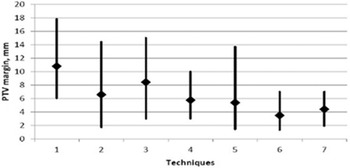
A study was done by Yartsev et al.Reference Yartsev and Bauman5 on the possible variations in PTV margins with various approaches due to the presence of organ motion as shown in Figure 1, which illustrates fuzziness of target volume which may effect on nearby normal overlapped volumes. Also critical organs such as rectum and bladder volumes change during prostate cancer radiotherapy.Reference Chen, Yang, Wang and Weigang6 Hence the rigidity of currently using conventional margin formulation may be limited to adapt for many treatment scenarios such as prostate, like dynamic tumour volumes. Complex radiotherapy techniques such as VMAT require precise selection of treatment margins for optimisation and dose escalation. Also the difficulty in treatment planning in prostate cancer varies greatly case by case where there is organ motion near to the PTV. Thus, in such cases, possible treatment margins may be asymmetric in nature instead of conventional symmetric margins. Recently, Patnaikuni et al.Reference Patnaikuni, Saini, Chandola, Chandrakar and Chaudhary7 studied asymmetric margins and practical limitation on the margin size of prostate cancer using VMAT technique and compared with conventional van Herk margin using total displacement standard errors. In radiation dose planning, a predictor of rectal toxicityReference Chen, Yang, Wang and Weigang6 is V60, that is, rectal volume receiving more than 60 Gy of radiation dose.Reference Nuyttens, Milito, Rust and Turrisi8,Reference Ling, Liu, Berthelet, Patterson, Dick and Kwan9 The bladder is highly distensible organ; a predictorReference Chen, Yang, Wang and Weigang6 for bladder toxicity is V60, that is, bladder volume receiving more than 65 Gy of radiation dose.
PTV margin values with max/min range proposed in the literature using different techniques: (1) positioning on external marks, (2) image-guided radiation therapy, (3) bone anatomy match, (4) soft tissue match, (5) fiducial markers, (6) electromagnetic tracking and (7) adapted delivery. (Yartsev S et al. 2016).

The present study is based on our earlier work.Reference Patnaikuni, Saini, Chandola, Chandrakar and Chaudhary7 In this study, we have estimated the dose-limiting parameters and dosimetric impact of rectum and bladder in VMAT treatment planning of prostate cancer. These parameters are compared between fuzzy margin VMAT planning and the conventional van Herk margin VMAT planning to assess the dosimetric benefit of treatment.
Material and Methods
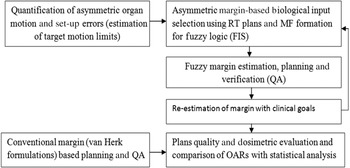
In the present study, Mamdani-type fuzzy inference system (FIS) was used in a biological-based PTV margin derivation procedure using eight localised prostate radiotherapy patients (n = 08). The Mamdani-type FIS has an expected output suited to human thinking. So the Mamdani-type FIS is widely accepted for capturing expert knowledge which is expected as significant in real-time adaptive treatment. The basic workflow of the current study is shown in Figure 2.
The workflow of study on estimating dosimetric impact with FIS.

Fuzzy-based PTV margin framework
The preferred method was VMAT for prostate cancer patients using adopted asymmetrical PTV margins, which were estimated statistically as asymmetrical (LR: 0–12 mm, SI: 0–14 mm, AP: 0–14 mm and PA: 0–12 mm) using image guidance analysis,Reference Patnaikuni, Saini, Chandola, Chandrakar and Chaudhary7 external marks, image-guided radiation therapy with cone beam computed tomography (CBCT), soft tissue match-volume assessment of normal structures and ultrasound guided tracking which were consistent with the study by Yartsev et al.Reference Yartsev and Bauman5 In treatment planning, 1 mm stepped size was added to subsequent asymmetric PTV margin from minimum (LR: 0–3 mm, SI: 0–5 mm, AP: 0–5 mm and PA: 0–3 mm) to maximum limit (LR: 0–12 mm, SI: 0–14 mm, AP: 0–14 mm and PA: 0–12 mm) for fuzzy input data. For each 1 mm stepped sized PTV, there is a VMAT plan and hence up to margin order 10, there are 10 VMAT plans in 1 patient case. Total 8 patients are considered, and 80 VMAT plans were performed with plan passing criteria as PTV will be covered by the isodose of 95% of prescription dose. All VMAT plans were used in calculating baseline TCP and NTCP corresponding to minimum acceptable value of PTV margin. After each 1 mm stepped increment margin of PTV, recalculation of new TCP and NTCP values was done. The fuzzification of inputs (TCP and NTCP) and defuzzification of output were done in Mamdani-type FIS using adopted rules and MFs. Finally, the margin obtained from fuzzy model was applied in VMAT treatment planning.
Planning and biological fuzzy margin estimation
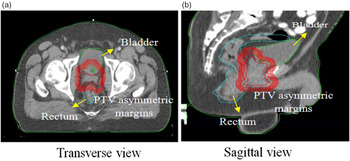
All VMAT plans were performed with dose prescription of 73·5 Gy for treating localised prostate radiotherapy patients (n = 08). The position and shape of the bladder and rectum vary throughout the course of prostate radiotherapy treatment. The most significant variation in dose area is caused by the air bubbles, which expands the rectum closer to the target. Moreover, the image quality of CBCT suffers from the air bubbles, which blurs the boundary of the rectum and causes uncertainty in contouring and further dose evaluation. Bladder shrinkage and expansion are two key factors for volume and dose variances, but may be difficult to control. Some patients may not feel comfortable holding urine and did not realise the importance of drinking water to keep the bladder full so they may not always drink sufficient water. Furthermore, some patients may be too nervous and therefore drank more water, making the bladder full. Some patients could not keep the bladder volume constant during each fraction treatment. So before simulation, all patients were advised to empty their bowel and drank more water so that bowel and bladder preparation was reasonably considered to maintain their position during treatment. PTV with magnetic resonance imaging co-registrations was outlined by expanding each CTV as per guidelines.10 All VMAT plans were generated using asymmetric PTV margins to CTV using Eclipse 15.6 treatment planning system (Varian Medical Systems, Palo Alto, CA, USA) with gEUD-based parameters setting,Reference Niemierko11 as shown in Figure 3. Sample characteristics, planning objectives and dose constraints are mentioned in Table 1. The radiobiological parameters TCP and NTCP were calculated in Matlab R 2018a (Mathworks, Natick, MA, USA) based simulation toolReference Mzenda, Hosseini-Ashrafi, Palmer, Hodgson, Liu and Brown12 using the equivalent uniform dose (EUD) modelling with required statistical values from all plans. The TCP and NTCP can be calculated as follows:
 $${\rm{TCP}} = {1 \over {1 + {{\left( {{{{{\rm{D}}_{50}}} \over {{\rm{EUD}}}}} \right)}^{4{\gamma _{50}}}}}}$$
 $${\rm{NTCP}} = {1 \over {1 + {{\left( {{{{\rm{T}}{{\rm{D}}_{50}}} \over {{\rm{EUD}}}}} \right)}^{4{\gamma _{50}}}}}}$$
PTV asymmetric margins range used for treatment plans (LR: 0–12 mm, SI: 0–14 mm, AP: 0–14 mm and PA: 0–12 mm).

Planning objectives and parameters used for modelling (Mzenda et al. 2010 and AAPM Task Group 166, AAPM)

PTV, planning target volume; TCP, tumour control probability; NTCP, normal tissue complication probability; EUD, equivalent uniform dose; OAR, organ at risk.
where D50 is absorbed dose producing a 50% control rate of tumour exposed to uniform radiation, γ50 is unit less model parameter for describing the slope of tumour dose–response curve and TD50 is tolerance dose producing a 50% complication rate.
Initial TCP and NTCP values were calculated for all treatment plans based on various PTV margins from margin order 1–10 using above equations. The effect of margin order on prostate ΔTCP, rectum ΔNTCP and bladder ΔNTCP using CTV only margin. For the effect on TCP, increasing the errors resulted in the increased loss of TCP. Also for the effect on NTCP, the increase in magnitude of margin order was found to increase the NTCP values. This variation may be expected to be linear or nonlinear depending on organ type and sub-volumes overlapping. Subsequent changesReference Patnaikuni, Saini, Chandola, Chandrakar and Chaudhary7 in TCP and NTCP due to target volume displacements standard deviation (SD) were calculated using these initial TCP and NTCP values to estimate subsequent loss in TCP (i.e., ΔTCP) and increase in NTCP (i.e., ΔNTCP).
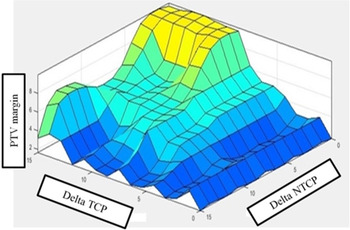
In the present study, the Mamdani-type FIS consisted of two inputs as ΔTCP and ΔNTCP while one output as PTV margin. MFs were chosen in modelling for assessment of outputs. For implementing the rules in fuzzy system, an absolute NTCP of the maximum acceptable value was considered.Reference Benk, Adams and Shipley13,Reference Combs and Andrews14 Fuzzy rules were devised based mainly on limitation that increase in NTCP is compensated for by reducing PTV margin while loss in TCP is compensated for by increasing PTV margin size. Optimum number of fuzzy rulesReference Combs and Andrews14,Reference Mzenda, Hosseini-Ashrafi, Gegov and Brown15 was selected using clinical goals imposed on margin limits using permutations of MFs for ΔTCP, ΔNTCP and PTV margin. The 3D output surfaceReference Patnaikuni, Saini, Chandola, Chandrakar and Chaudhary7 of FIS is adopted in the current study which was generated in Matlab R 2018a. Figure 4 represents combination of ΔTCP, ΔNTCP and PTV margin values that indicate uneven changes in PTV margin with required TCP/NTCP relation while a standard uncertainty 0·5 ± 0·2 mm was considered as error in PTV margin.
Fuzzy output as 3D surfaces (Patnaikuni et al. J Med Phys 2020).

As current van Herk et al. formulations in theory, PTV margin was continuous linear increasing irrespective of organ motion. PTV margin was studiedReference Patnaikuni, Saini, Chandola, Chandrakar and Chaudhary7 as greater than 13 mm using current margin techniques, while the fuzzy margin remained below 12 mm depending on displacement errors SD It was observed that the PTV margin results were consistent for both conventional margin technique and fuzzy margin model at low error SD (< 5 mm SD approximate). At higher standard errors (> 5 mm SD approximate), the fuzzy margin remained below 12 mm and van Herk et al. formulations were greater than 13 mm margin size. This trend was attributed to the effect of introducing volume-based TCP/NTCP in the margin formulation. However, the resulting PTV margin conditions may vary from case to case while considering confounding factors such as organ motion, deformation and other clinical factors.
Implementation of fuzzy margin and dosimetric predictors of normal structures
The VMAT plans using fuzzy PTV margin were performed to assess organ at risk’s (OAR) dosimetric benefit. Using the SD of total displacement errors, fuzzy PTV margins of 6 mm and 10 mm corresponding to 4 mm (low error SD) and 6 mm (high error SD) standard errors were selected respectively.Reference Patnaikuni, Saini, Chandola, Chandrakar and Chaudhary7 The selection of fuzzy PTV margins was arbitrary to compare dosimetric results with conventional van Herk margins at low and high SD errors, respectively. All VMAT plans (using fuzzy PTV margin as well as conventional PTV margin) were planned and compared statistically to assess OARs dosimetric predictors of normal structures corresponding to low SD as well as high SD error regions. The biological dose–volume evaluations for fuzzy VMAT plans were estimated for OARs such as mean dose and dose–volume predictors (V30, V50 and V60 Gy for rectum; V30, V50 and V65 Gy for bladder). Also other OARs dose receiving volumes were observed for better quality plans while maintaining 95% isodose of prescription dose will covered by CTV. For PTV, the conformity index (CI) and homogeneity index (HI) were used.Reference Lee, Fang, Chao, Su and Leung16 The CI was used to evaluate conformal coverage of PTV by isodose volume, prescribed in treatment plan. CI =
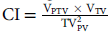 $${{{{\rm{V}}_{{\rm{PTV}}}}\; \times \;{{\rm{V}}_{{\rm{TV}}}}} \over {{\rm{TV}}_{{\rm{PV}}}^2}}$$
(VTV, volume of actual prescribed dose; VPTV, volume of PTV; TVPV, volume and VPTV within VTV). The HI was used to determine dose homogeneity of PTV. HI = D5%/D95% (D5% and D95% are minimum doses delivered to 5 and 95% of PTV, respectively). Dosimetric results were analysed using a two-tailed t-test for patient-specific dose–volume histogram (DVH) values. Statistical significance was set at p ≤ 0·05. Data processing was done with Statistical Package for Social Science. Final dosimetric results were compared with currently using van Herk margin formulations.
Results and Discussions
Dosimetric predictors of normal structures and comparison to current margins
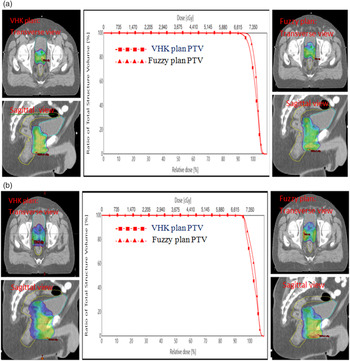
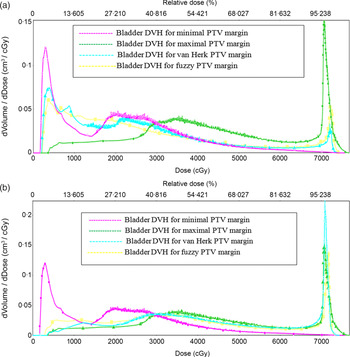
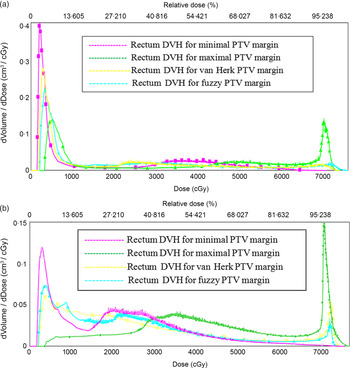
The VMAT plans were performed with 6 and 10 mm fuzzy PTV margins corresponding to total displacement standard errors 4 and 6 mm SD, respectively. PTV dose distribution and DVH of fuzzy PTV plan were compared to current van Herk margin, as shown is Figure 5. All plans were clinically acceptable in the present study in view of PTV conformity so there were no significant changes found in PTV objectives as shown in Table 2. The statistical analysis of bladder and rectum dosimetric predictor results is shown in Tables 3 and 4, respectively, corresponding to 4 mm SD (below 5 mm SD was considered as lower error region) and 6 mm SD errors (greater than 5 mm SD was considered as high error region). Also the differential DVHs of bladder and rectum were shown in Figures 6 and 7, respectively. In lower error region (Figures 6a and 7a), no significant changes in dosimetric predictors were found except bladder mean dose (p = 0·03) and rectum mean dose (p = 0·04). This may be due to fuzzy margin that was found to be similar or 0·5 mm larger compared to conventional van Herk margin. However, taking the modelling uncertainty into account, results showed good match between fuzzy PTV margin calculated and van Herk et al.’s formulation of up to error 5 mm SD But at higher error region (Figures 6b and 7b), significant changes in dosimetric predictors were found in mean dose (p ~ 0·002), V30Gy (p ~ 0·003), V50Gy (p ~ 0·005), V65Gy (p ~ 0·0010) for bladder and mean dose (p ~ 0·0012), V30Gy (p ~ 0·0014), V50Gy (p ~ 0·0011), V65Gy (p ~ 0·0013) for rectum, respectively. This was due to optimal dose-received volume benefit in dosimetric predictors based on biological volume–dose relationship. Because at higher SD errors (>5 mm) the fuzzy margin was limited than current margin formulations. Therefore, present FIS technique may be expected as suitable for radiotherapy margin modelling. The resulting margins were providing better OAR sparing without compromising target dose coverage and so FIS technique is at least as good as current methods in dose escalation applications.
Target volume dose distributions and dose–volume histogram (DVH) at (a) 4 mm SD standard errors and (b) 6 mm SD standard errors: conventional margin plan versus fuzzy margin plan.

PTV dosimetric results for all plans: conventional margin plan (VHK) versus fuzzy margin plan

CI, conformity index; HI, homogenate index; TCP, tumour control probability; Vx%, volume receiving ≥ x% of the prescribed dose.
Dosimetric results of bladder (volume = 16,030 ± cc): conventional VHK plan versus fuzzy plan at (a) 4 mm SD standard errors and (b) 6 mm SD Standard errors

Vx%, volume receiving ≥ x% of prescribed dose; Vz%, volume receiving ≥ Z% of prescribed dose. DYcc, dose of Ycc volume (all decimals were round figured).
Dosimetric results of rectum (volume = 15,915 ± cc): conventional VHK plan versus fuzzy plan at (a) 4 mm SD standard errors and (b) 6 mm SD standard errors

Vx%, volume receiving ≥ x% of prescribed dose; Vz%, volume receiving ≥ Z% of prescribed dose. DYcc, dose of Ycc volume (all decimals were round figured).
Bladder differential dose–volume histogram at (a) 4 mm SD standard errors and (b) 6 mm SD standard errors: conventional margin plan versus fuzzy margin plan.

Rectum differential dose–volume histogram at (a) 4 mm SD standard errors and (b) 6 mm SD standard errors: conventional margin plan versus fuzzy margin plan.

In radiotherapy, dose escalation can carry a substantial risk of late toxicity particularly when there is internal organ motion was considered. So far, existing DVH analyses were indicated the presence of volume effect with respect to grade 2 or higher complications across doses of 60–78 Gy for prostate cancer. This risk grows exponentially as greater volumes of OARs are irradiated and resulting co-morbidities may be enhanced significantly. These complications may be severe when planning targets are defined with margins symmetrically irrespective of movement and shape of tumour and OARs. Hence, the above results on asymmetric margin-based fuzzy approach may helpful to estimate and reduce the risk of OARs toxicities by estimating appropriate interplay between TCP/NTCP values versus acceptable risk of complications even at higher doses. This variation may be dependent on proximity between tumour volume and OARs as well as preselected TCP and NTCP tolerances in FIS.
The proposed method combines the radiobiological data, the proximity of the surrounding critical structures by considering dose effects to these organs with increasing margin size and knowledge using linguistic (clinician’s intensions) relationships to produce the output margins. The resulting treatment margins may explicitly express the assumed margin variations for treatment planning and dose escalation with computational efficiency. The present study also allows the calculation of individualised patient margins and prospective purpose based on true expected biological outcomes. Individualised patient margins calculation is currently very difficult to accomplish with manual set-up of current techniques. Also due to the range of variability in patient anatomy and organ motion such as prostate target, OARs like bladder and rectum vary between patients. So the current margins may not be suitable in some cases. This biological fuzzy approach may be expected as an efficient tool for estimating the risk of gastrointestinal toxicity for rectum and gastrourinary toxicity for bladder in retrospective analysis of dose–volume and OARs toxicity relationship. Also fuzzy approach may take minimal additional set-up time so it is expected as effective in busy radiotherapy centres. In the present study, the dosimetric results were discussed for localised prostate target volume only. But in advanced cases, it involves multiple targets such as prostate, seminal vesicle and LN targets. In such cases also, fuzzy approach would be expected as a helpful tool for judgement of toxicity estimation by considering individual clinical case history.
In radiotherapy, fuzzy logic application was studied using uniform or symmetrical margins of PTV in the literature. Mzenda et al. studied fuzzy logic application using organ motion related considering uniform motion and they did not consider the asymmetric nature of motion of PTV and other nearby multiple critical organ effects around target volume. But in nature, dynamic targets and adjacent OARs have irregular motion, so their treating margins not always symmetric or uniform. However, as there are lot of radiotherapy uncertainties. So under small error deviation, the results of the present study were consistent with current margin formulations studied by Van Herk et al. But at high error deviations, the results of the present study may be expected as superior clinical/survival benefit, though all plans are clinically acceptable in terms of dose–volume statistics. Hence, it would be expected the fuzzy approach may helpful to estimate actual risk of OARs and reduce toxicities by estimating appropriate interplay between TCP/NTCP values versus acceptable risk of complications even at higher doses, by considering individual clinical case history.
The computational intelligence methods such as fuzzy logic have proved to be consistent and accurate in calculating the required treatment margins of prostate target volumes with real time. The computational intelligence methods such as fuzzy logic may also applicable in treating other target volumes where organ motion involves. The proposed fuzzy margins method is inherently more accurate as they include all the factors that affect the PTV. In comparison to manual or conventional techniques, the proposed model is computationally more efficient. The possibility of margins computation may be faster and accurate with proposed model, whereas conventional techniques are time taking due to manual statistical techniques. With the immense demands on radiotherapy in terms of high patient numbers and the required quick turnaround, it is important to reduce the time in all the steps in the process. The limitation of the current study was the estimation of standard errors SD at the patient realignment performance in all axial views (SI, AP and LR directions) only with small number in the sampleover course of treatment in estimation of fuzzy margin. The performance of the current study may be improved with the identification of relevant factors (co-morbidities, lifestyle, etc.) which can affect the normal tissue complications and incorporation of these factors into fuzzy rules at the planning level.
Conclusions
Advanced treatment technologies such as VMAT are options for dose escalation which inevitably involves critical organs lying next to steep dose gradients. Using the conventional margins for same tumour type for all patients may not be ideal due to physiological variations from patient to patient. The advantage of using the proposed fuzzy logic model is its ability to combine measured input/output data with radiobiological data using linguistic relationships to predict possible results in order to avoid complexities in current and emerging radiotherapy treatment techniques. Being closer agreement to statistical models, fuzzy margins were expected to be clinically more applicable to reduce late complications normal structures for survival benefit.
Acknowledgements
The authors are thankful to Department of Radiotherapy, Pt JNM Medical College and Department of Physics, National Institute of Technology, Raipur for providing support at each level to complete this work.
Financial Support
None.
Conflicts of Interest
There are no conflicts of interest.