Introduction
Elderly people living in an institution have a higher risk of developing depression and anxiety disorders than elderly people living in the community, and therefore they deserve more attention in terms of preventive interventions (Thakur and Blazer, Reference Thakur and Blazer2008). Chronic illnesses, disability, loneliness, older age, and female gender (Cole and Dendukuri, Reference Cole and Dendukuri2003; Smit et al., Reference Smit, Ederveen, Cuijpers, Deeg and Beekman2006) may all increase this risk, and for many, if not most residents in homes for the elderly, all these risks add up. An important argument for the application of preventive strategies is that antidepressant medication has limitations in this group, mainly because of somatic co-morbidity, and potential interactions with other drugs (Schellander and Donnerer, Reference Schellander and Donnerer2010).
Not surprisingly, the rates of clinically relevant symptoms of depression and anxiety in people living in long-term care facilities have been estimated to be as high as 35% (Dozeman et al., Reference Dozeman, van Schaik, van Marwijk, de Wit and Beekman2008; Thakur and Blazer, Reference Thakur and Blazer2008). The prevalence of anxiety disorders alone has been estimated at 6.7% by Smalbrugge et al. (Reference Smalbrugge, Pot, Jongenelis, Beekman and Eefsting2003) in a review focusing on institutionalized elderly people. Moreover, 30–35% of the residents in residential and nursing homes with symptoms of depression and anxiety develop a full-blown major depressive disorder and generalized anxiety disorder (van den Berg et al., Reference van den Berg, Spijker, van Limbeek, van Tilburg and van Alem1995; Smalbrugge et al., Reference Smalbrugge, Pot, Jongenelis, Beekman and Eefsting2003). The risk of an increase in the level of symptoms is also very high; in a study of frail elderly people with scores below 16 on the Centre for Epidemiologic Studies Depression Scale (CES-D), it was found that 48% developed clinically relevant levels of depression within 18 months (Dozeman et al., Reference Dozeman, van Marwijk, van Schaik, Stek, van der Horst and Beekman2010).
Several studies have shown that the prevention of depression and anxiety in high risk populations can be very effective (Beekman et al., Reference Beekman, Smit, Stek, Reynolds and Cuijpers2010), and the use of a guided self-help intervention has several advantages. It has also already been found to be an efficient and effective form of therapy in other settings (Cuijpers, Reference Cuijpers1997), and it may lower the threshold of requesting help for those who are reluctant to acknowledge distress, or unwilling to participate in formal methods of treatment. Furthermore, it is an easy-to-use and cheap type of intervention. In a recent meta-analysis, Gellatly et al. (Reference Gellatly, Bower, Hennessy, Richards, Gilbody and Lovell2007) found a large effect size (pooled standardized mean difference 0.80, 95% confidence interval (CI) 0.58–1.01) for self-help interventions in various populations. Providing some guidance in the use of self-help interventions was a significant positive moderator of the treatment effect, although the effect had no clear relationship with the therapist's background, the content or mode of the guidance (monitoring/supportive), or the number of sessions. In a recent systematic review of meta-analyses on the efficacy of self-help interventions for depression and anxiety disorders, these large effect sizes were confirmed (van 't Hof et al., Reference van 't Hof, Cuijpers and Stein2009), and also for older people (McKendree et al., 2003).
However, no studies have yet assessed the feasibility and effectiveness of this type of intervention in a residential care setting. The reading ability of older people is important if they are to understand self-help forms of information. Moreover, the educational format of the course may be unfamiliar to those with only a few years of formal schooling (Haringsma et al., Reference Haringsma, Engels, Cuijpers and Spinhoven2006). Residents who have a lower educational status and suffer from vision impairments may find that these factors are barriers to completing a self-help course. Furthermore, it is likely that the residents who have the highest risk for depression and anxiety may be the most difficult to reach with preventive interventions, due to the very same reasons that constitute their vulnerability for depression and anxiety. The aim of the present study was to determine the feasibility and the effectiveness of a self-help course for elderly residents with a high risk of developing depression or an anxiety disorder.
We addressed the following research questions:
1. Is it feasible for residents to participate, and for care-providers to implement adequately a guided self-help intervention under the prevailing conditions in residential homes?
2. What is the effectiveness of a guided self-help course in activity-scheduling, compared to usual care, on the reduction of symptoms of depression and anxiety, and on participation in organized activities in a residential home population?
With regard to aspects of the feasibility of the intervention our hypotheses were:
a) Uptake of the intervention is probably difficult for this old and vulnerable population.
With regard to the effectiveness of the intervention our hypotheses were:
a) Guided self-help is more effective than usual care in reducing the symptoms of depression and anxiety in residents.
b) Residents with more severe symptoms of depression at baseline will profit most from the guided self-help intervention.
c) The intervention is more effective in reducing symptoms of depression than symptoms of anxiety.
d) The effect of the intervention is related to an increase in participation in organized activities.
Methods
Design
We tested our guided self-help intervention in a pragmatic randomized controlled trial with two parallel groups of participants. The word “pragmatic” refers to the fact that we performed this trial under regular care conditions, with very few exclusion criteria, in order to assess the feasibility of the intervention in “real life” conditions. The guided self-help intervention was part of a more comprehensive stepped-care program for elderly people with a high risk for developing depression and anxiety, living in residential homes. The design of this study has been described in detail elsewhere (Dozeman et al., Reference Dozeman, van Schaik, Beekman, Stalman, Bosmans and van Marwijk2007). In the present paper we focus on the effectiveness of this first step in the intervention protocol: guided self-help, which may lower the threshold for the following steps for those who are reluctant to acknowledge distress. Four major health services providing care for the elderly in and surrounding the city of Amsterdam were willing to participate in the trial. These organizations covered a total of 14 residential homes. After informing the staff and the client council of these organizations, an introductory letter was sent to all residents in the homes (elderly people living singly or together with a spouse).
Interviewers visited every address, and asked the resident(s) for permission to assess their symptoms of depression and anxiety with the CES-D (Radloff, Reference Radloff1977). Respondents with a score of 8 or more were invited for a follow-up interview, during which a diagnostic and cognitive assessment took place. The chosen cut-off point on the CES-D reflects symptom levels which are higher than the average levels found in the general population of elderly people (Bisschop et al., Reference Bisschop, Kriegsman, Deeg, Beekman and van Tilburg2004). Respondents were excluded if they met the criteria for DSM IV depressive and anxiety disorders, according to the Mini International Neuropsychiatric Interview (MINI) (Sheehan et al., Reference Sheehan1998), or were suffering from cognitive impairment, defined as a cut-off score of 21 for the Mini-Mental State Examination (MMSE; Folstein et al., Reference Folstein, Folstein and McHugh1975). Residents who gave informed consent and who had sufficient command of the Dutch language were eligible for participation in the study. The study is registered with the Dutch Cochrane Center under number ISRCTN27540731. The study protocol was approved by the Medical Ethics Committee of the VU University Medical Center.
Participants
In the Netherlands, several types of facilities for sheltered accommodation for the elderly are available, the two most important being residential homes and nursing homes. Residential homes provide assisted-living facilities, including daily care (e.g. meals and house-cleaning) and, if needed, uncomplicated demand-led medical care. Nursing homes provide more specialized medical care to dependent people of all ages. The demand for residential care mainly depends on the lack of a social network and (in)ability to perform everyday activities (van Bilsen et al., Reference van Bilsen, Hamers, Groot and Spreeuwenberg2006).
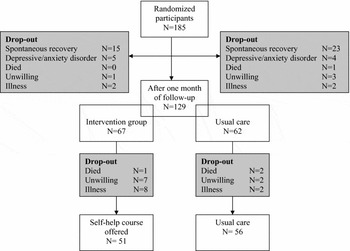
Of the 1478 residents who were approached for the screening interview, 51% (n = 754) were able and willing to participate. Of these participants, 459 (61%) scored higher than the predetermined threshold, 277 (60%) gave informed consent, and 85 were excluded. Seven residents were unwilling to participate before randomization, for various reasons, resulting in the randomization of 185 residents for the stepped care trial. However, in our trial we offered the guided self-help course after one month of watchful waiting, because it is well known that symptoms frequently disappear without any active intervention (Spijker et al., Reference Spijker, de Graaf, Bijl, Beekman, Ormel and Nolen2002). We considered participants to be eligible for participation if the level of their symptoms had not improved by at least 5 points on the CES-D, and they had not developed a DSM-IV depressive and anxiety disorder after one month. We used this definition for improvement because a 5-point change on the CES-D is clinically relevant and statistically reliable, and has also been used in earlier studies (Jacobson and Truax, Reference Jacobson and Truax1991; Lipsey and Wilson, Reference Lipsey and Wilson1993; Smit et al., Reference Smit, Ederveen, Cuijpers, Deeg and Beekman2006). After the period of watchful waiting, residents in both groups either improved according to the 5-point criterion, or developed a MINI depressive and/or anxiety disorder, and therefore dropped out of the study. A total of 129 residents were finally eligible for inclusion in the guided self-help intervention. Assessments took place at the start and directly at the end of the intervention. The recruitment of participants is presented in Figure 1.
Flow chart showing the recruitment and loss of participants in the trial.

Intervention
We selected the module on “activity-scheduling” from a previously tested and effective self-help course “Coping With Depression” (CWD) (Haringsma et al., Reference Haringsma, Engels, Cuijpers and Spinhoven2006). This course has been found to be effective in reducing depressive symptoms in several randomized clinical trials, both in group and individual format, and also in self-help format. The selected module on activity-scheduling consisted of four steps, in which participants monitored their mood and designed a pleasurable activity plan. We adjusted the lay-out for our specific study population (font and format of the characters were enlarged).
There are clear indications that activity-scheduling is effective also as a preventive intervention (Cuijpers et al., Reference Cuijpers, van Straten and Warmerdam2007b). Activity-scheduling is relatively simple and does not require complex skills from coaches or patients. It is a behavioral treatment for depression in which patients learn to monitor their mood and daily activities. So far, the evidence with regard to its effectiveness is limited to depression, but because depression and anxiety overlap to a large degree, and because similar interventions are often found to be effective for both, we also wanted to determine whether activity-scheduling would have effects not only on depression but also on anxiety.
We designed the intervention as a guided self-help course, which can be distinguished from other self-help interventions by the support that is given by a coach to the client in working through the standardized treatment schedule. The nature of this support should be guidance or facilitation only, and the staff and volunteers in the residential homes were instructed to guide and stimulate the residents to work through the course at their own pace. All the coaches were individually trained by one researcher (ED) in a 60-minute training session, in which they were given information about the rationale of the course. They received a process evaluation leaflet containing instructions and questions about the coaching sessions. The focus in this training was on practicing the tasks in the course together. The coaches were all specifically instructed to deliver the materials only to their assigned residents. They were instructed to visit the residents at least twice, but more often if needed, with a maximum of five visits. The management of the homes allowed the coaches no additional time to follow the training, and their visits to the residents also had to fit in with their regular shifts. During the course the coaches received feedback by telephone or, occasionally, through personal contacts. The instruction leaflets were collected by the researcher after the end of the sessions.
Usual care
Residents in the usual care group had unrestricted access to any form of health care that was deemed appropriate. In residential homes in the Netherlands, nurses and caregivers provide generic care, and general practitioners (GPs) are responsible for medical care. Volunteers and occupational therapists also offer help with (collective) social activities. All residential homes provide an activity program on a daily basis, and this can include group activities such as music performances, parlor games, physical exercise and bus tours. The health care uptake of all participants was recorded, including their use of prescribed medication.
Outcome measures
Aspects of feasibility
To assess the participation of each resident in the intervention, the coaches filled in a process evaluation leaflet in which the number of visits, the steps of the intervention that had been completed, and the time spent on coaching were recorded. At the end of the coaching sessions the leaflet was collected by the researcher, who evaluated the sessions with the coach.
Finally, we also measured the resident's satisfaction with the intervention with a GGz Thermometer, developed by the Netherlands National Mental Health Institute (Trimbos). The participants were asked to score, on a scale ranging from 1 to 10, the usefulness of the intervention for themselves and for others, and also to give an overall evaluation of the intervention.
Effectiveness
Depressive and anxiety symptoms after three months were the primary clinical outcomes. In the follow-up interview, symptoms of depression were measured with the CES-D, which consists of 20 items, with total scores ranging from 0 to 60. A minimum change of 5 points on the CES-D would indicate a medium to large effect size, which is deemed to be clinically relevant (Jacobson and Truax, Reference Jacobson and Truax1991; Lipsey and Wilson, Reference Lipsey and Wilson1993). Symptoms of anxiety were measured using the Hospital Anxiety and Depression scale (HADS-A) (Zigmond and Snaith, Reference Zigmond and Snaith1983). The HADS-A consists of seven questions concerning anxiety, to which answers can be given on a 4-point scale (0–3). The total HADS-A score varies from 0 (no symptoms of anxiety) to 21 (many symptoms of anxiety).
The secondary outcome was the participation of residents in activities organized in the residential homes, measured with the Trimbos/iMTA Questionnaire for Costs Associated with Psychiatric Illness (Tic-P) (Roijen et al., Reference Roijen, Straten, Tiemens and Donker2002). The Tic-P generates quantitative data on use of the mental health services and other related services. The recall period for the questions is three months, and the questionnaire is constructed with modules that can be omitted if necessary. We used only the participation in activities module to assess participation in the various different activities organized in the homes.
Sample size
In other studies focusing on self-help treatment with activity-scheduling for depression and anxiety, considerable effects have been found in the reduction of symptoms of depression (d = 0.8) (Cuijpers et al., Reference Cuijpers, Smit and van Straten2007a; Gellatly et al., Reference Gellatly, Bower, Hennessy, Richards, Gilbody and Lovell2007). To detect a difference in symptom means of Cohen's d = 0.50 (with an alpha = 0.05 and 1-beta = 0.80), 64 residents per group are needed (Cohen, Reference Cohen1995).
Randomization
Randomization took place after the baseline measurements. The participants were randomized to the intervention group or to the usual care group, in blocks of four, by an independent research assistant using random number tables.
Blinding
The interviewers were blinded for the randomization status of the respondents during all measurements. However, because residents in the intervention group received the self-help intervention and those in the control group did not, it was not possible to blind the participants. Care-providers were allocated to individual residents in the intervention group to help them with the intervention when needed.
Analyses
First we investigated possible differences in demographic and clinical characteristics at baseline (t-tests for continuous data, and χ2 tests for categorical data). To check for possible selective attrition, we compared the characteristics of drop-outs and completers at baseline. For our primary outcome, the analyses were conducted on an intention-to-treat basis. This approach requires that the analyses are based on all randomized patients, and therefore all missing observations need to be replaced by the most likely values. First, predictors of outcome and drop-out were identified. Prediction of outcome supplies the most precise value of the outcome variable, while prediction of drop-out helps to correct for the bias that may be caused by selective loss to follow-up. The statistically significant predictors for outcome and drop-out (age, CES-D score at baseline, HADS score at baseline, and number of activities at baseline) were used in a maximum likelihood estimation (MLE), as implemented by the estimated maximum (EM) algorithm in SPSS, to obtain and impute the required predicted values. Because guided self-help has not yet been assessed among very old and vulnerable elderly people, we were unsure of the feasibility of the intervention, and so we also performed analyses for the completers.
To obtain an impression of the magnitude of the effect in the analysis of the completers, we calculated effect sizes: Cohen's d, by subtracting the mean score difference in the usual care group from the mean score difference in the intervention group, and dividing the result by the pooled standard deviation of the difference scores. This frequently used measure enables comparison with the results of other studies. Effect sizes between 0 and 0.3 are considered to be small; between 0.3 and 0.5 they are considered to be moderate; and between 0.5 and 1.2 they are considered to be large (Lipsey and Wilson, Reference Lipsey and Wilson1993). In order to test the hypothesis that the effect is modified by the severity of the symptoms at baseline, we calculated effect sizes for a sub-group of participants with more severe symptoms of depression at baseline (CES-D ≥ 16). The effectiveness of the self-help intervention was further assessed by performing an analysis of covariance (ANCOVA) with the baseline score as a covariate, because this approach corrects for baseline status. It also allows us to investigate the possible interaction effects between participation in the trial and the characteristics of the residents, and between participation in the intervention and outcome measurements. Pre-test data were available for all participants. All analyses were performed with SPSS (version 15.0), and statistical significance was considered as 2-tailed p < 0.05.
Results
Participants
Recruitment took place between April 2007 and December 2008, and 129 residents were allocated to the intervention group (n = 67) or to the usual care group (n = 62) (Figure 1). Of the 129 participants, 22 (17 %) dropped out during the study period. The reasons for drop-out are shown in the flowchart (Figure 1). On average, drop-out in the intervention group was higher than in the usual care group; 23.9% versus 9.7%. This difference was significant (χ2 = 4.59, df = 1, p = 0.04).
Baseline characteristics
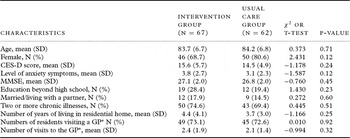
The baseline characteristics of the participants are summarized in Table 1. The majority of the participants were female (74%), and their mean age was 84.0 years (SD 6.7). Most of them (83.7%) were living alone, and most of them (72.1%) suffered from two or more chronic diseases, such as heart disease and arthritis. The mean CES-D score for depressive symptoms was 15.1 (SD 5.3), and the mean HADS-A score for anxiety symptoms was 3.4 (SD 2.5). No significant differences (p < 0.05) in these variables were found between the two groups. Most of the residents had visited their general practitioner in the past three months (72.9%), with a mean of 2.2 visits (SD 1.7). Only two residents reported that they had visited a mental health specialist (data not included in the table), both of whom were randomized to the usual care group.
Baseline characteristics of participants (n = 129)

*in the past 3 months.
CES-D = Centre for Epidemiologic Studies Depression Scale; MMSE = Mini-Mental State Examination; GP = general practitioner.
Usual care
We found that in both the intervention group and the usual care group no participants had received counseling from a psychiatrist or psychotherapist during the study period. Six participants in the usual care group received antidepressant medication vs. 11 participants in the intervention group (χ2 = 1.28, df = 1, P = 0.26). Finally, 24 participants in the usual care group received sedative medication vs. 30 participants in the intervention group (χ2 = 0.44, df = 1, P = 0.49).
Aspects of feasibility
A total of 51 residents were eligible for participation in the guided self-help intervention, 44 (86%) of whom finally attended the self-help course with guidance from a coach. Evaluation, by means of the process evaluation leaflets revealed that two residents were unwilling to participate in the self-help course, while five coaches failed to contact the resident. When coaches were asked for the reasons for non-compliance of residents, they reported lack of time themselves or illness of the residents. The mean number of visits made by the coaches was two, and the mean amount of time they spent on guiding the residents in the self-help course was 48 minutes for each resident (SD 44.6, range 5–180 minutes). A total of 14 residents completed all four steps in the self-help course, and eight residents completed three steps, but failed to complete the last step, i.e. making an activity plan for the following week. Fourteen residents accepted the course but did not start performing the exercises, four completed one step, and four completed two steps. Thirty-four out of 44 (77%) residents answered the questions about satisfaction with the intervention: nine (27%) thought that the self-help intervention was a useful way to improve their mood, 19 (53%) thought it was not useful, and six (18%) answered “don't know”. A positive response to the intervention was equally spread among completers and non-completers; a quarter of the participants in both groups thought that the intervention was helpful. The overall score for the self-help intervention varied from very bad (1–5 on a scale of 1–10) (6/35 = 17%), to moderate (6 or 7 on a scale of 1–10) (12/35 = 34%), and very good (8 or higher on a scale of 1–10) (8/35 = 23%). Again, seven residents answered “don't know”, and there was one missing score. The mean overall score for the self-help intervention was 6.3 (SD 2.2): nine residents (25%) thought that the effect of the self-help intervention could be improved if the coaches were more attentive, and four residents (11%) thought that the intervention could be useful for other people, but not for themselves.
In this pragmatic trial we tried to involve the personal caregivers or contact nurses for the individual residents. A total of 20 caregivers coached their own residents, and 11 of them had more than one resident in their case-load. When personal caregivers were not available, we trained occupational therapists (2) or volunteers (4).
No interaction effects were found between participation in the intervention group and subgroups with specific characteristics (age, living alone, or number of chronic diseases). Moreover, no interaction effects were found between level of uptake of the intervention and symptoms of depression. Residents who completed the intervention received significantly more visits from their coaches than those who did not (3.2 [SD 1.2] vs. 1.8 [SD 1.0] t = 4.12, df = 42, p< 0.01), and the coaches spent more time visiting the completers than the non-completers (73 minutes [SD 47] vs. 35 minutes [SD 38] t = 2.78, df = 39, p < 0.01).
Effectiveness
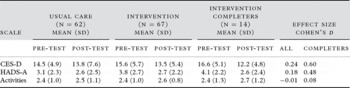
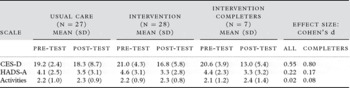
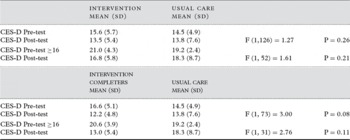
Effect sizes were small (d < 0.30) for symptoms of depression, symptoms of anxiety, and participation in activities in the population as a whole (Table 2). In the subgroup of participants with more severe symptoms of depression at baseline (CES-D ≥ 16), a large effect size on reducing symptoms of depression was found (d = 0.55). The effect sizes with regard to symptoms of anxiety and level of activities were small in this sub-group (Table 3). In the group of completers (n = 14), reduction in the symptoms of depression and anxiety was greater than in the usual care group (a large effect size on symptoms of depression d = 0.60, and a medium effect size on symptoms of anxiety d = 0.48) (Table 2). Finally, in the subgroup of completers with severe symptoms of depression at baseline (CES-D ≥ 16, n = 7), a large effect size was found on reduction of depressive symptoms (d = 0.80) (Table 3). However, the effects of the guided self-help course on depressive symptoms found with ANCOVA, correcting for baseline severity, were not significant (Table 4).
Effects of guided self-help on symptoms of depression, symptoms of anxiety, and participation in organised activities

Effect size is presented as Cohen's d; the difference between two means divided by a standard deviation for the data.
CES-D = Centre for Epidemiologic Studies Depression Scale; HADS-A = Hospital Anxiety and Depression scale.
Effects of guided self-help on symptoms of depression. symptoms of anxiety. and participation in organised activities in a sub-group with baseline CES-D ≥16

Effect size is presented as Cohen's d; the difference between two means divided by a standard deviation for the data.
CES-D = Centre for Epidemiologic Studies Depression Scale; HADS-A = Hospital Anxiety and Depression scale.
ANCOVA for guided self-help effects with the pre-test CES-D score as covariate

CES-D = Centre for Epidemiologic Studies Depression Scale.
Discussion
In the intention-to-treat analysis, no significant difference was found between guided self-help and usual care. We hypothesized that participation in the intervention would probably be difficult for these old and vulnerable residents. We did indeed observe that only a minority of the residents were able to complete the intervention (14/67 = 21%); seven (14%) did not accept the intervention at all, and 14 accepted the course but did not start performing the exercises. The drop-out in the intervention group was significantly higher than in the usual care group. However, many residents (n = 8, 50%) dropped out of the intervention group because of somatic illness, which does not seem to be related to the intervention, although a certain amount of energy is needed for the exercises. There was no significant difference between the mean baseline characteristics of the completers and the drop-outs. Only 27% of the residents thought that the intervention was useful. We suggest several reasons for this low assessment of feasibility and lack of effect:
1. Because we actively screened all residents and invited those with an average or above average CES-D score for symptoms of depression to participate, we may have selected a group of residents with low acknowledgement of their symptoms of depression and anxiety. Many participants did not feel that they needed help for their (mild) symptoms, and therefore might be less motivated to start and to complete the intervention, compared to participants in other comparable studies. This is in line with our finding that the effect sizes were greater in the subgroup of residents with more severe symptoms of depression at baseline. Some residents might even have been discouraged by being confronted with their symptoms during the self-help intervention. Therefore, self-help should only be offered to residents who are interested and motivated.
2. Minimal contact interventions, like this activity-scheduling self-help intervention, aim to empower high risk groups to improve their own functioning themselves. However, in an institutional environment such as a residential home, the aim of the intervention (i.e. empowerment) might be in conflict with the attitudes and needs of residents for help and security in a caring environment. Other interventions may be more appropriate for residents for whom hospitalization is a barrier to self-help,.
3. We performed this trial under regular care conditions, with very few exclusion criteria, in order to assess the feasibility of the intervention in “real life” conditions. We only excluded patients below a cut-off score of 21 on the MMSE, which is relatively low. We chose this cut-off score because most residents have a low level of education, and we did not want to exclude those who may profit from our relatively simple intervention. However, residents who were not interested in the intervention may have had levels of cognitive functioning or literacy that were too low to enable them to understand this self-help course.
4. The staff of the residential homes reported that they lacked the necessary time to guide residents through the self-help course, and previous research has shown that self-help without guidance is less effective (Gellatly et al., Reference Gellatly, Bower, Hennessy, Richards, Gilbody and Lovell2007; Spek et al., Reference Spek, Cuijpers, Nyklicek, Riper, Keyzer and Pop2007). The number of visits and time spent on guidance by the coaches in our intervention might have been insufficient, and it is possible that the support during those contacts did not motivate the participants enough to achieve significant effects. If the management of the residential homes provided more time for training and adequate support from care-providers, this might improve the uptake of the intervention.
In the several relevant reviews and meta-analyses that have been carried out (Cuijpers et al., Reference Cuijpers, van Straten and Smit2006; Gellatly, et al., Reference Gellatly, Bower, Hennessy, Richards, Gilbody and Lovell2007; Spek et al., Reference Spek, Cuijpers, Nyklicek, Riper, Keyzer and Pop2007), overall guided self-help was found to be much more effective than usual care in which the patients received no treatment. In the present study of the effects of a guided self-help intervention for improving symptoms of depression and anxiety, we found no significant difference in effects between the intervention group and the usual care group. However, the estimated effect sizes (Cohens'd) were large for completers with symptoms of depression, and also large for residents with more severe symptoms of depression at baseline. However, lack of statistical power within these subgroups may have precluded statistically significant results.
Among the completers, a medium positive effect size was also found for anxiety, which again was not statistically significant. This may be partly due to the low level of anxiety symptoms at baseline. A score of 8 or higher on the HADS-A is accepted as a cut-off point for more severe symptoms (Bjelland et al., Reference Bjelland, Dahl, Haug and Neckelmann2002), and the mean baseline score in our study population was 3.4.
Finally, guided self-help did not improve the level of participation in organized activities. Although the level of symptoms of depression tended to decrease with activity-scheduling, the number of activities did not increase. A possible explanation is that we only recorded the number of activities which were organized in the residential home. Residents who improved after the intervention may have undertaken more activities outside the regular activities that were organized in the residential home.
The results of our study contribute to the existing body of knowledge about the prevention of depression and anxiety in the elderly. The hypothesis that activity-scheduling as a self-help intervention is more effective than usual care in lowering symptoms in a very old residential home population with a high risk for depressive and anxiety disorders, cannot be confirmed on the basis of this trial, mainly because of the limited uptake. Although it is an attractive approach, self-help is difficult to achieve in vulnerable elderly people, and further research is necessary to improve the acceptability, level of participation and uptake in such interventions. Future research could focus on how to develop a beneficial relationship with a caregiver, before acknowledgement issues can be discussed. A large minority may indeed benefit, so a flexible approach, in which the intervention is offered as an option to residents who are interested, together with adequate guidance from care-providers, would seem to be the most promising approach at the moment.
Conflict of interest
None.
Description of authors' roles
E. Dozeman collected the data for this study, performed the statistical analyses, and wrote the first draft of the paper. All authors contributed to and approved the final paper.
Acknowledgments
The study was carried out by the Department of General Practice at the VU Medical Centre in Amsterdam, the Netherlands. Financial support (grant no. 62200026) was received from the Netherlands Organization for Health Research and Development (ZonMw). The study is registered in the Dutch Cochrane Center under number ISRCTN27540731.