Introduction
Dolichocephala Macquart is a genus of aquatic dance flies (Diptera: Empididae: Clinocerinae) found nearly worldwide (Sinclair Reference Sinclair1995) and includes 39 described and numerous undescribed species. The genus is one of most distinctive among empidoids with their normally white spotted wings and elongate head with high attachment (Figs. 1, 10–13). In North America, previous to this study, only two species of Dolichocephala were recorded: Dolichocephala argus Melander and Dolichocephala irrorata (Fallén) (Melander Reference Melander1965). This study has confirmed that the latter species is based on misidentifications. The original record of D. irrorata is from Osten Sacken (Reference Osten Sacken1878) “Loew in litt.” based likely on a male specimen we found in the MCZ collection (labelled: “Loew”; “irrorata/Fall.”), which is actually Dolichocephala vockerothi sp. nov. The specimen illustrated in Melander (Reference Melander1928: pl 3, fig. 24) is identified as D. irrorata, although the male genitalia appears similar to that of D. vockerothi (however there are only two spots in cell r2 + 3).
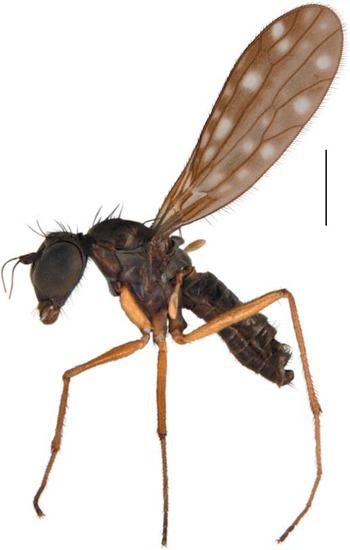
Dolichocephala vockerothi sp. nov., male habitus photograph, lateral view. Scale bar = 0.5 mm.

Very little is known about the biology of these flies, largely because they are very small, cryptic in coloration and habitat, and not commonly collected with an insect net. For example, unlike certain other genera of clinocerines, Dolichocephala is very rarely collected from emergent rocks or rocky seeps and specimens are very infrequently encountered in a heavily collected area like southern Ontario, Canada, including likely habitats around Ottawa (where the Canadian National Collection of Insects is situated). In Europe, adults have been collected from moss and wet earth near madicolous or seepage habitats where they are thought to feed on Collembola and adults of small nematoceran Diptera (Vaillant Reference Vaillant1960). One of us (BJS) collected two species in Germany over wet depressions (ditches) along forest trails. The depressions held thick layers of mud and leaf litter in a mature Quercus L./Fagus L. (Fagaceae) forest. In North America, we have collected occasional specimens in Malaise traps set up across or along small streams. Label data indicate that numerous specimens were collected in association with aquatic vegetation, including moss, sphagnum, and sedges. Larvae and pupae have been collected from moss and travertine deposits near madicolous habitats in Europe (Vaillant Reference Vaillant1953), but have yet to be discovered in North America.
This paper is written to honour the efforts of the coordinating team in the production of the highly influential Manual of Nearctic Diptera and their enormous and valuable efforts in augmenting the holdings of the Canadian National Collection of Insects upon which a great proportion of the material for this revision is based.
Material and methods
This study was facilitated by examination of specimens added to North American collections since Melander (Reference Melander1928). The collections are listed below with collection codens in parentheses. The codens are listed in the text to indicate the location of specimens and are based mostly on the list provided in the website “The insect and spider collections of the World” (Evenhuis Reference Evenhuis2009): American Museum of Natural History, New York, United States of America (AMNH); Brigham Young University, Provo, United States of America (BYU); California Academy of Sciences, San Francisco, United States of America (CAS); Crane Hollow Inc. Collection, Laurelville, United States of America (CHIC); Canadian National Collection of Insects, Ottawa, Canada (CNC); California State Collection of Arthropods, Sacramento, United States of America (CSCA); Colorado State University, Ft. Collins, United States of America (CSU); Cornell University Insect Collection, Ithaca, United States of America (CUIC); University of Guelph Insect Collection, Guelph, Canada (DEBU); Iowa State University, Ames, United States of America (ISU); Lyman Entomological Museum, McGill University, Macdonald Campus, Ste-Anne-de-Bellevue, Canada (LEM); Museum of Comparative Zoology, Harvard University, Cambridge, United States of America (MCZ); Montana Entomology Collection, Bozeman, United States of America (MTEC); Oregon State Arthropod Collection, Corvallis, United States of America (OSAC); Royal British Columbia Museum, Victoria, Canada (RBCM); Royal Ontario Museum, Toronto, Canada (ROM); Snow Entomological Collections, University of Kansas, Lawrence, United States of America (SEMC); Spencer Entomological Museum, University of British Columbia, Vancouver, Canada (UBCZ); R.M. Bohart Museum of Entomology, University of California, Davis, United States of America (UCD); United States National Museum of Natural History, Washington, District of Columbia, United States of America (USNM); Department of Biology, Utah State University, Logan, United States of America (USUL); Museum of Zoology, Lund University, Lund, Sweden (UZIL); Rüdiger Wagner Entomological Collection (private), Kassel, Germany (WEC); James Entomological Collection, Washington State University, Pullman, United States of America (WSU).
The following abbreviations are used in the “type material” and “additional material” sections: Ck – Creek; Co – County; Cpgd – Campground; Cyn – Canyon; E – east; ET – emergence trap; FIT – flight intercept trap; for. – forest; Hwy – Highway; Lk – Lake; MT – Malaise trap; mi – miles; Mt/Mtns – Mountain/Mountains; N – north; NF – National Forest; NP – National Park; nr – near; PK – Park; PP – Provincial Park; R – River; S – south; SP – State Park; Spr/Sprs – spring/springs; Tr – Trail; V – valley; W – west; YPT – yellow pan trap.
The following abbreviations for the most frequent collectors are used in the “Material examined” sections: AB – A. Borkent; ALM – A.L. Melander; BK – B. Kondratieff; BJS – B.J. Sinclair; DDW – D.D. Wilder; JFM – J.F. MacDonald; JGC – J.G. Chillcott; JLL – J.L. Laffoon; JMC – J.M. Cumming; JRV – J.R. Vockeroth; PHA – P.H. Arnaud Jr.; SAM – S.A. Marshall; SEB – S.E. Brooks; TAW – T.A. Wheeler; WJH – W.J. Hanson; WJT – W.J. Turner.
Freshly collected specimens were killed in tubes containing potassium cyanide or by placing them directly into 70%–75% ethanol. Specimens collected into alcohol were later critical-point-dried or dried in ethyl acetate (Vockeroth Reference Vockeroth1966) or by passing them through cellosolve and then xylene (Sabrosky Reference Sabrosky1966). Abdomens were macerated in crucibles of hot 85% lactic acid to facilitate examination of male and female terminalia (Cumming Reference Cumming1992).
Wings were mounted on microscope slides for photography. A wing was detached from the body and passed through 2-propanol before being mounted directly into euparol. Estimation of the variable body size for each species is based on the length of the wing measured from its base in a straight line along the costal margin to a line perpendicular to the wing tip.
Terms used for adult structures follow McAlpine (Reference McAlpine1981), Stuckenberg (Reference Stuckenberg1999 – antennae), and Saigusa (Reference Saigusa2006 – wing venation). In the system outlined by Saigusa (Reference Saigusa2006), the dipteran vein A1 (as used in McAlpine Reference McAlpine1981) is homologized with the mecopteran CuP, and consequently CuA1 (of McAlpine) is termed M4, CuA2 is CuA, the anal cell is cell cua, and the anal vein (A1 + CuA2) is CuP + CuA. Homologies of the male terminalia follow Sinclair and Cumming (Reference Sinclair and Cumming2006). The term “bristle” is used for differentiated large setae on the head, mesonotum, and legs bearing a particular name or one of a series with a particular name, for example, notopleural bristle, dorsocentral bristle, anterodorsal bristle.
The following abbreviations are used in the descriptions for the scutal bristles: dc – dorsocentrals, pprn – postpronotals, presut spal – presutural supra-alars, npl – notopleurals, pal – postalars, sctl – scutellars. The configuration of scutal bristles in Clinocerinae is illustrated in Sinclair (Reference Sinclair2008, fig. 5b).
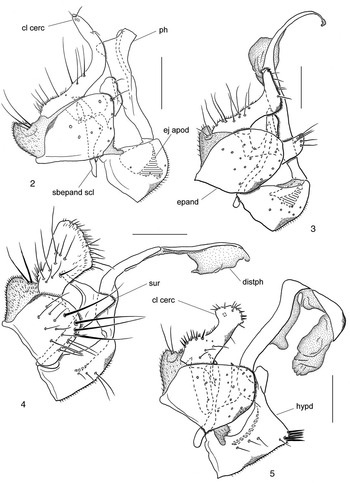
Male terminalia of Dolichocephala, lateral view. 2. Dolichocephala argus; 3. Dolichocephala borkenti sp. nov.; 4. Dolichocephala arnaudi sp. nov.; 5. Dolichocephala chillcotti sp. nov. Scale bar = 0.1 mm. cl cerc, clasping cercus; distph, distiphallus; ej apod, ejaculatory apodeme; epand, epandrium; hypd, hypandrium; ph, phallus; sbepand scl, subepandrial sclerite; sur, surstylus.

Label data for primary types are cited from the top downward, with the data from each label in quotation marks. Labels are cited in full, with original spelling, punctuation, and date, with lines delimited by a slash (/). Additional information is included in square brackets. The repository of each type is given in parentheses. Secondary type data are abridged and listed alphabetically.
Dolichocephala Macquart
Dolichocephala Macquart, Reference Macquart1823: 147. Type- species, D. maculata Macquart (monotypy) (=Tachydromia irrorata Fallén).
Ardoptera Macquart, Reference Macquart1827: 105. Type-species, T. irrorata Fallén (original designation).
Leptosceles Haliday, Reference Haliday1833: 160. Type-species, L. guttata Haliday (original designation).
Lamposoma Becker, Reference Becker1889: 338. Type-species, L. cavaticum Becker (monotypy).
Fur Garrett Jones, Reference Garrett Jones1940: 294. Type-species, F. fugitivus Garrett Jones (original designation).
Obstinocephala Garrett Jones, Reference Garrett Jones1940: 296. Type-species, O. tali Garrett Jones (original designation).
Diagnosis
Dolichocephala is distinguished from all other clinocerine genera by the following combination of characters: position of attachment of head high on occiput, white spotted wings on nearly all species, and extension of subepandrial sclerite beyond base of clasping cercus. This genus can be identified in Steyskal and Knutson (Reference Steyskal and Knutson1981) and Sinclair (Reference Sinclair1995).
Remarks
Detailed descriptions of the genus are provided in Collin (Reference Collin1961) and in Sinclair (Reference Sinclair1995), including information on geographical distribution and phylogenetic relationships. Larvae and pupae of Dolichocephala ocellata (Costa) have been described and illustrated by Vaillant (Reference Vaillant1953).
Dolichocephala argus Melander
Dolichocephala argus Melander, Reference Melander1928: 246.
D. argus: Melander Reference Melander1965: 470; Steyskal & Knutson Reference Steyskal and Knutson1981: 615, figs. 25, 27; Sinclair Reference Sinclair1995: 705 (lectotype designation).
Type material
Lectotype: ♂, “Mt. Constitution/31.VII[190]8 Wash[ington]”; “PARATYPE/Dolichocephala/argus/Mel [red label]”; “LECTOTYPE/Dolichocephala/argus Mel./des. B.J. Sinclair 1991 [red label]” (USNM).
Additional material
CANADA. Alberta: Elkwater L., Cypress Hills, wet algal mat among sedges, 7.viii.1978, E.E. Lindquist (1 ♀, CNC). British Columbia: Abbotsford, sticky trap in crop field, 24.viii.2007 (2 ♂, CNC); Baron Island, grassy estuary, ENT987-2070, 28.vii.1987, C.S. Guppy (1 ♂, RBCM); Delta & Fraser R., 49°6′5.59″N, 123°2′50.79″W, sticky trap in crop field 26.vi.–3.vii.2009 (1 ♀ in alc, CNC); Blue Lk, Hwy 97, 34 mi NW Williams Lk, 17.viii.1978, PHA (1 ♀, USNM); 7.3 km N Armstrong, MT, 10.vi.–28.vii.1997, AB (3 ♂, 2 ♀, CNC); Haney, UBC research for., 3.vii.1988, SAM (2 ♂, 1 ♀, DEBU); Hornby Is., Norman Pt., 10.vii.1989, MT behind beach, S.G. Cannings (1 ♀, UBCZ); Ladysmith, 2.vi.1955, R. Coyles (1 ♂, CNC); Monte Lk, 13.v.1936, ENT991-21052, J.K. Jacob (1 ♂, RBCM); Vancouver Is., Lake Cowichan, 19–28.vii.1985 I.M. Smith (1 ♀, CNC); 33 km NW Lake Cowichan, 9.vii.1991, AB (1 ♀, CNC); Vancouver Is., N Campbell R., wet sedge, 23.vii.1988, SAM (2 ♂, 3 ♀, DEBU); Vancouver Is., Mt. Washington, Battleship Lk Tr, 1150 m, 49°43.90′N, 125°18.84′W; 13.viii.2008, JMC (1 ♂, CNC); Lumby, 22.vi.1973, H.J. Teskey (1 ♀, CNC); Point Grey, Vancouver, MT, 17.vii.1973, JRV (1 ♂, CNC); 6.5 km NW Enderby, 6.v.1992, AB (1 ♀, CNC); 24 km E Enderby, 8–9.vi.1991, AB (2 ♂, CNC); 28 km E Enderby, 13.viii.1989, AB (1 ♀, CNC); 16 km N Revelstoke, 3.vii.1989, AB (1 ♂, CNC); Robson, 11.x.1965, H.R. Foxlee (1 ♂, UBCZ). Manitoba: Fort Churchill, 6.viii.1952, JGC (2 ♂, CNC). Nova Scotia: Blomidon, moss in small stream [45°13′N, 64°22′W], 27.viii.1989, SAM (1 ♂, DEBU); Cape Breton Highlands NP, 380 m, 3 km W Paquets Lk, PG935886, sifting mosses, 17.x.1984, J.M. Campbell & A. Davies (1 ♀, CNC); Lockeport, Cranberry Lk., 26.vii.1958, JRV (1 ♂, CNC). Ontario: Algonquin PP, wooded fen near Lk Sasajewan, sphagnum pan trap [45°35′N, 78°31′W], 12–20.viii.1992, R. Burgess (1 ♀, DEBU); Black Ash Ck., Collingwood Twp., No. sp., 21.v.1955, F.P. Ide (1 ♂, ROM). USA. California: Alpine Co., Indian Ck Lk, 15.vi.1979, G.E. Bohart (1 ♂, USUL); Del Norte Co., Jedediah Smith Redwoods SP, Walker Rd., Ck, ca. 41°48′44″N, 124°6′36″W, 22.v.2009, JMC (1 ♀, CNC); Fresno Co., Sierra NF, Forebay Lk, 2200 m, 31.vii.1979, DDW (1 ♂, CAS); Parlier, v.1993, R. Gerber (1 ♂, CNC), Huntington Lk, Rancheria Ck, 7.vii.1984, JFM, MT (1 ♀, CNC), Huntington Lk, Rancheria Ck, 10.viii.1984, JFM, MT (1 ♂, CNC); Madera Co., Beasore Meadows, 14.vii.1993 (1 ♂, CNC); Marin Co., Lily Pond, Alpine Lk, MT, 11.v.–25.vi.1971, D.D. Munroe (3 ♂, 2 ♀, CNC), Tocaloma, Lagunitas Ck, 4.v.1968, H. Leech (1 ♀, CAS), Hicks Valley, Arroyo Sausal, W Point Reyes-Petaluma Rd., FIT in shaded stream, 150 m, 12.iv.1987, PHA (1 ♀, USNM), Mt. Tamalpais Game Refuge, Lagunitas Lk, 10.ix.1983, PHA (1 ♀, USNM), Mt. Tamalpais, Rock Springs, 610 m, 13.v.1978, PHA (1 ♂, USNM); Nevada Co., Sagehen Ck, 23.vi.1976, J.R. Nixon, 25.vi.1980, J.A. Skinner (1 ♂, 1 ♀, UCD); Placer Co., E end Bear Valley, 2.vi.1964, PHA (2 ♂, CAS); Plumas Co., Lassen NF, N fork Feather R., 30.v.1997, DDW (1 ♂, CAS); San Mateo Co., Jasper Ridge Res. Searsville, Lk, trap edge of marsh, 16–19.iv.1999, PHA (1 ♂, USNM), Portola valley, Alpine Rd., Corte de Madera Ck, 230 m, 12.vi.1983, PHA (2 ♀, USNM), LaHonda, 23.vii.1967, PHA (1 ♀, USNM), San Mateo Co Mem. Pk, 80 m, 9–10.viii.1969, PHA (1 ♀, USNM); Santa Cruz Co., Big Basin SP, 14.vi.1978, DDW (2 ♂, CAS); Sierra Co., Salmon Ck Cpgd, 8 km NW Sierra City, 1768 m, 6.vii.1975, PHA (1 ♀, USNM); Siskiyou Co., Mt. Shasta, Panther Meadow, 7460′, 8.x.1992, PHA, M.M. Arnaud (1 ♀, USNM); Siskiyou Co., 16 mi E, McCloud, 7.5 mi N Bartle, spring along road to Sheep Heaven Spring, 18.vi.1978, N.L. Herman (1 ♀, AMNH); Trinity Co., Rush Ck Public Camp, 823 m, 22.viii.1980, PHA (1 ♀, USNM), Goldfield Cpgd, Boulder Ck, 926 m, 15.viii.1980, PHA 1 ♂, USNM); Tulare Co., Sequoia NP, Lodgepole, 3.vii.1984, D. Burdick (1 ♂, CNC). Idaho: Boundary Co., 9 mi NE Bonner's Ferry, Smith Lk, 21.vi.1982, R.S. Zack (1 ♀, WSU), 5 mi E Moyie Springs, Bonner Lk, 22.vi.1982, R.S. Zack (1 ♂, WSU), 9 mi N Moyie Springs, Moyie R., 22.vi.1982, R.S. Zack (1 ♂, WSU); Caribou Co., Kendall Ck, 25.vi.–3.vii.1981, WJH (1 ♀, USUL). Nevada: White Pine Co., Great Basin NP, 2–4.vii.2001, JFM (2 ♂, CNC). Oregon: Baker Co., U Goose Ck, 34 mi SE Union, 4160′, MT, 1–3.vii.1976, E.J. Davis (1 ♂, WSU), 28 mi SE Union, Velvet Ck, 4720′, MT, 13–19.vii.1975, E.J. Davis (1 ♀, WSU); Benton Co., Corvallis, 44°35′N, 123°18′W, 160 m, ET, 16–29.vi.2005, N.H. Anderson (2 ♂, 2 ♀, CNC); Philomath, MT, 9–11.viii.1998, S. Fitzgerald (7 ♂, 6 ♀, OSAC); Hwy 34, 4 mi W Philomath, 21.vi.1977, DDW (1 ♀, CAS); Coos Co., Myrtle Point, 43°3′36″N, 124°8′24″W, wetland & small str, 28.v.2009, SEB, JMC (3 ♂, 1 ♀, CNC); Cornelius, 6.v.1938, Grey & Schuh (1 ♂, CUIC); Curry Co., 8 km W Sixes, Edson Ck cpgd, Edson Ck, 16.vii.1989, BJS (1 ♂, CNC); Douglas Co., 7 mi E Myrtle Ck, S Myrtle Ck, 43°2′5″N, 123°9′54″W, 26.v.2009, SEB (1 ♂, 1 ♀, CNC); Douglas Co., Day Ck, junction of Wood & Day cks, 42°58′50″N, 123°9′00″W, 26.v.2009, SEB (1 ♂, CNC); Douglas Co., Tenmile, Lower Tenmile Ck, 43°5′27″N, 123°34′13″W, 27.v.2009, JMC (1 ♀, CNC); Douglas Co., 5.5 mi WS camas Valley, Twelvemile Ck, 42°58′41″N, 123°44′29″W, 27.v.2009, SEB (1 ♀, CNC); Hood River Co., 1.5 mi E Cascade Locks, Herman Ck, 10.vii.1978, L. & N. Herman (2 ♀, AMNH); Jackson Co., 22 mi ESE Eagle Point, Dead Indian Ck at Dead Indian Soda Spring nr South Fork Butte Ck, 2660′, 23.vi.1978, J. Schuh, L. & N. Herman (1 ♂, AMNH); Lane Co., Siuslaw NF, Tenmile Ck, 14.vii.1989, BJS (1 ♀, CNC); Union Co., 28 mi SSW La Grande, Wallowa-Whitman NF, dripping spring, 23.vi.1976, WJT (1 ♂, WSU). Utah: Cache Co., Logan Cyn, Twin Ck, MT, 1–6.vii.1979 (1 ♂, USUL), Blacksmith Fork Cyn, MT, 14.vii.1964, WJH (1 ♀, USUL), 9–29.ix.–29.x.1976, Knowlton & Hansen (10 ♂, 5 ♀, USUL), W Hodges Cyn, 16.ix.–1.x., 6–14.x.1976, Knowlton & Hansen (7 ♂, 11 ♀, USUL), Tory Grove Junction, MT, 30.viii.–6.ix., 12–21.ix., 21–28.ix.1983 (2 ♂, 8 ♀, USUL); Washington Co., Crystal Ck, C.R. Nelson (1 ♂, USU); Utah Co., American Fork Canyon (1 ♂, BYU). Washington: Cowlitz Co., 10 km W Longview, 19.vi.1984, R. Danielsson (1 ♂, UZIL); Greys Harbor Co., Olympic NF, Willaby Cpgd, 21.vii.1978, DDW (2 ♀, CAS); King Co., Seattle, Issaquah, 14.vii.1988, R. Danielsson (1 ♂, 1 ♀, UZIL); Stevens Co., 5 mi NE Deer Lk, MT, 3200′, 18.vii.1975, WJT (1 ♂, WSU); Olympic NP, Elwha R., 6.vii.1968, boggy for., W.W. Wirth (2 ♂, USNM); Pierce Co., Clover Ck, 4,12.viii.1980, T.L. Whitworth (1 ♂, USUL), Mt. Rainier NP, 14 km EnE Paradise, 0.8 km up Owyhigh Tr, 900–1200 m, 46°25′44″N, 121°39′26″W, 16.vi.2004, C.J. Borkent (1 ♂, 1 ♀, LEM), Eatonville, 25.vii.1988, R. Danielsson (1 ♀, UZIL); Pleasant Valley, 22.vii.1978, T.L. Whitworth (1 ♂, USU); Spokane Co., Mt Spokane Pk, nr Bald Knob Cpgd, 4800–5200′, WJT (1 ♀, WSU); Tacoma, 28.vi.1982, T.L. Whitworth (1 ♂, USUL); Whitman Co., Steptoe Cyn, 10 mi SW Colton, 24.iv.1981, R.S. Zack (1 ♂, 1 ♀, WSU), Yakawawa Cyn, 7 mi NW Colton, MT, 11–27.vi.1977, WJT (2 ♂, 1 ♀, USNM, WSU); Yakima Co., 8 mi SW Tieton RS nr Rimrock Lk, Bear Ck, 3000′, 7–9.vi.1983, 27–30.v.1986, WJT (2 ♀, WSU).
Recognition
This species is distinguished by cell r5 with as many as seven more or less prominent circular white spots extending from cross-vein r–m to the wing tip; clasping cercus strongly arched, finger-like; apex of phallus truncate, lacking distiphallus.
Description (wing length 1.8–2.3 mm)
Male. Head: Slender, tapered ventrally. Lower half of face with greyish pruinescence. Vertex dark brown with greyish pruinescence; occiput with V-shaped pattern of pruinescence. Ocellar triangle with pair of stout upturned bristles.
Thorax: Scutum with bluish pruinescence medially on anterior fourth. Postpronotum, and pleural ridge pale brown. Several very minute acrostichals anterior to first dc; five dc; one pprn; one presut spal; two npl (lower weak); one pal; two sctl. Laterotergite with several pale setulae.
Legs: Legs yellowish-brown, somewhat darker on tarsi; fore coxa paler than mid and hind coxae.
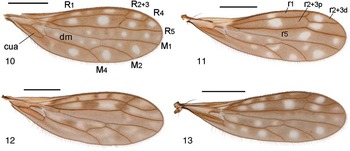
Wing: (Fig. 10): Narrow; infuscate; single long basal costal seta present; R4 and R5 divergent apically; R4 with auxiliary cross-vein connecting to R2 + 3; irrorations more or less distinct: two to four spots in cells r1 and dm; two spots in each of cells r2 + 3 (proximal section), r4, m4 and m1; one spot in cells m2 and distal section of r2 + 3; cell r5 with four to seven (usually six to seven) spots evenly distributed from r–m cross-vein to wing margin.
Abdomen: Sclerites dark brown, concolorous with thorax. Terminalia (Fig. 2): Hypandrium cone shaped, with four to five lateral setae. Phallus straight, stout, well sclerotized with expanded apex; lacking subapical process; distiphallus absent. Ejaculatory apodeme crescent shaped with median process. Epandrium subtriangular with several long marginal posterior setae. Clasping cercus strongly arched, finger-like and narrow; crossed medially in dried specimens; anterior margin with long slender setae; apex with several setulae; inner margin with one to two peg-like sensilla. Lobe of subepandrial sclerite extended beyond epandrium acting as brace to phallus; apical margin of subepandrial plate lacking short erect projection. Surstylus broadly rounded apically, bearing one to two pairs of setulae.
Female. Similar to male.
Remarks
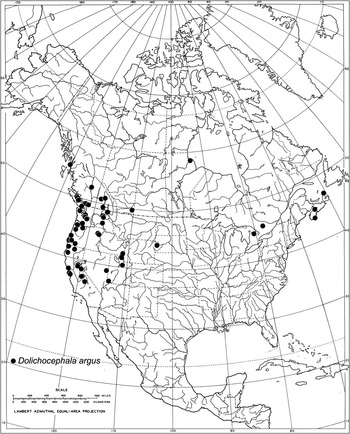
Dolichocephala argus is widespread and relatively common in western Canada and United States of America, with several records from eastern Canada (Fig. 14) where it is apparently rare. The eastern records mostly appear to be from Sphagnum L. (Sphagnaceae) habitats in Ontario and Nova Scotia. The Black Ash Creek record in Ontario is based on a single specimen collected during a 10-year survey of this spring-fed stream (Ide Reference Ide1968), possibly from near the spring source.
Dolichocephala arnaudisp. nov.
Type material
Holotype: ♂, “U.S.A.: CALIFORNIA:/Marin County, Mill/Valley, Blithedale/Ridge, Lee Street/110 m 8-14-I-1968/Paul H. Arnaud, Jr.”; “COLLECTION OF/PAUL H. ARNAUD, JR. [green label]”; “HOLOTYPE/Dolichocephala/arnaudi/Sinclair & MacDonald [red label]” (USNM). Paratypes:USA. California: Alameda Co., Sunol Valley Reg. Pk, Welch Ck, 27.v.1968, PHA (1 ♀, USNM); El Dorado Co., Sly Pk, 8 km S Polloch Pines, Hasel Ck, 1060 m, 22.vi.1975, PHA (1 ♀, CAS); Fresno Co., Huntington L, Rancheria Ck, 2600 m, 10.viii.1984, JFM (1 ♀, CNC); Humboldt Co., Six Rivers NF, Ikes Ck at Klamath R., 3.vii.1976, DDW (1 ? dissected, CAS); Marin Co., same data as holotype (7 ♂, USNM); Mill Valley, 26.x.1968, PHA (1 ♂, USNM); Santa Cruz Co., Big Basin SP, 9.v.1975, DDW (1 ♀, CAS); Santa Cruz Co., Big Basin SP, Opal Ck, 14.vi.1978, DDW (4 ♂, 3 ♀, CAS); San Mateo Co., Corte de Madera Ck, near Potola, 31.v.1954, PHA (1 ♀, USNM).
Recognition
This species is distinguished by cell r1, proximal and distal sections of cell r2 + 3 and cell r4 typically with a single circular white spot (a second, weaker spot apically in r1 on some specimens); phallus long, recurved with battleaxe-like distiphallus.
Description (wing length 2.0–2.4 mm).
Male. Head: Slender, tapered ventrally. Lower half of face with pale greyish pruinescence. Vertex dark brown with greyish pruinescence; occiput with basomedial stripe of pruinescence. Ocellar triangle with pair of stout upturned bristles.
Thorax: Scutum with bluish pruinescence medially on anterior fourth. Postpronotum and pleural ridge pale brown. Several very minute acrostichals anterior to first dc; five dc; 1 pprn; one presut spal; two npl (lower weak); one pal; two sctl. Laterotergite with several pale setulae.
Legs: Legs yellowish-brown, somewhat darker on tarsi; fore coxa paler than mid and hind coxae.
Wing (Fig. 11): Narrow; infuscate; single long basal costal seta present; R4 and R5 divergent apically; R4 with auxiliary cross-vein connecting to R2 + 3; irrorations more or less distinct: cells r1 and r2 + 3 (proximal section) with single spot (occasionally a second, weaker spot apically in r1 on some specimens); two to three spots in cell dm; two spots in each of cells m1, m2, and m4; one spot in cells r2 + 3 (distal section) and r4; cell r5 with two spots on apical fifth.
Abdomen: Sclerites dark brown, concolorous with thorax. Terminalia (Fig. 4): Hypandrium cone shaped with four to five long lateral setae. Phallus long, strongly recurved with battleaxe-like distiphallus; lacking subapical process. Ejaculatory apodeme very slender, crescent shaped. Epandrium rounded with several long marginal posterior setae. Clasping cercus broadly rounded apically, subtriangular; posterior margin with rows of setulae. Lobe of subepandrial sclerite extended beyond epandrium acting as brace to phallus; apical margin of subepandrial plate lacking short erect projection. Surstylus L-shaped, prominent, with narrow apex.
Female. Similar to male.
Remarks
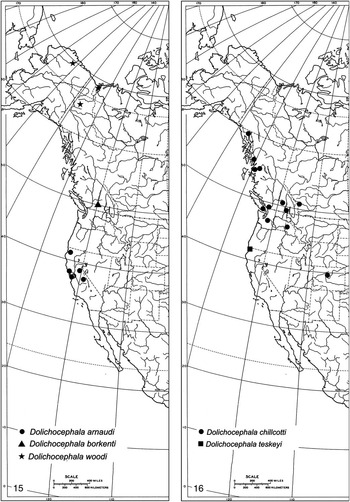
This species is known only from the northern half of California (Fig. 15). Most specimens have been collected in Santa Cruz County, but two are from the central Sierra Nevada Mountains and one from northern coastal Humboldt County.
Etymology
The specific name is a patronym in honour of P.H. Arnaud Jr., who has contributed greatly to our knowledge and collections of Diptera.
Dolichocephala borkentisp. nov.
Type material
Holotype: ♂, “CANADA: BC; 6 km NE/Falkland CD 1054 [50°31.914′N, 119°29.660′W, Bolean Lk., 1460 m]/12–13.VII. 1989/A. Borkent”; “ex. floated/from wet moss”; “HOLOTYPE/Dolichocephala/borkenti/Sinclair & MacDonald [red label]” (CNC).
Recognition
This species is distinguished by the very short, narrow stenopterous wings.
Description (wing length 1.0 mm). Specimen in poor condition obscuring colouration.
Male. Head: Slender, tapered ventrally. Ocellar triangle with pair of stout upturned bristles.
Thorax: Several very minute acrostichals anterior to first dc; five dc; one pprn; one presut spal; two npl (lower weak); one pal; two sctl. Laterotergite with several pale setulae.
Legs: Legs yellowish-brown, somewhat darker on tarsi, paler than thorax.
Wing: Stenopterous, narrow; with rounded apex, with all veins distinct; single long basal costal seta present; R4 and R5 divergent apically; R4 connected to R2 + 3, lacking auxiliary cross-vein; pair of irrorations in proximal section of cell r2 + 3. Halter knob reduced, similar to width of stalk.
Abdomen: Terminalia (Fig. 3): Hypandrium cone shaped with four to five lateral setae. Phallus straight, narrow, with membranous expanded apex; lacking subapical process; distiphallus slender, flattened, recurved, filamentary. Ejaculatory apodeme subtriangular. Epandrium rounded with several long setae. Clasping cercus L-shaped, bent at right angles on apical third; apex rounded with one peg-like sensillum; anterior margin with long slender setae. Lobe of subepandrial sclerite extended beyond epandrium acting as brace to phallus; apical margin of subepandrial plate lacking short erect projection. Surstylus broad, apex slightly pointed, bearing two to four pairs of apical setulae.
Female. Unknown.
Remarks
This reduced winged species was collected from wet moss from cold water pools surrounding Bolean Lake, a high altitude lake with late spring snow and ice (A. Borkent, personal communication 2010). This species is known only from the holotype, collected in British Columbia (Fig. 15).
A possibly conspecific female specimen with slightly reduced wings was collected on the San Juan Ridge (BC: Jordan River, San Juan Ridge, 677 m, 31.viii.2009, R. Bennett, C. & D. Copley [RBCM]). Males from this locality are required for species determination. Variation in wing reduction is possible in this species, but additional specimens are required to assess this possibility.
Wing reduction is well known in Dolichocephala, with two stenopterous species from East Africa (Dolichocephala fugitiva (Garrett Jones) and Dolichocephala tali (Garrett Jones)) and an undescribed species from Venezuela (in CNC).
Etymology
The specific name is a patronym in honour of A. Borkent, collector of the holotype and many other specimens of Empididae.
Dolichocephala chillcottisp. nov.
Type material
Holotype: ♂, “Kleanza Ck,/14 mi E. Terrace/B.C. 30.VI.1960/J.G. Chillcott”; “HOLOTYPE/Dolichocephala/chillcotti/Sinclair & MacDonald [red label]” (CNC). Paratypes. CANADA. Alberta: Kananaskis Field Stn, 51°01′49″N, 115°02′01″W, MT, 11.ix.1999 (1 ♂, LEM). British Columbia: Cowichan Lk, 18.ix.1964, J.A. Chapman (8 ♂, 3 ♀, CNC); Exchamsiks R., 58 km SW Terrace, 54°20.00′N, 129°17.81′W, 15.viii.2008, SEB (2 ♂, 1 ♀, CNC); Mt. Thornhill, Terrace, 14.vii.1960, C.H. Mann (1 ♂, CNC); Terrace, airport area, 4.viii.1960, CH Mann (1 ♀, CNC); 50 mi SW Terrace, 9.vii.1960, B. Heming (1 ♀, CNC); Robson, 8.viii.1949, H.R. Foxlee (1 ♀, CNC); Lakelse L. Bog, S. Terrace, 5.viii.1960, W.R. Richards (1 ♂, CNC); Shuswap L, 50°59′N, 119°06′W, 400 m, 23–31.viii.1987, MT, J.E. O'Hara (3 ♂, CNC); Vancouver, 10.viii.1932, H.B. Leech (1 ♀, UBCZ). USA. Alaska: Haines, Chilkoot L. SP, 27.vii.1996, PHA, M.M. Arnaud (2 ♀, USNM); Hyder, Camp-Run-A-Muck, FIT, 5.viii.1996, PHA, M.M. Arnaud (1 ♂, USNM). Colorado: Doolittle Ranch, Mt. Evans, 9800′, 3.viii.1961, JGC (2 ♀, CNC). Idaho: Latah Co., 7 mi N Troy, nr Big Meadow Rec. Area, 3000′, 13.vii.1979, WJT (1 ♂, WSU). Washington: Mt. Rainier NP, Yakima Pk, 1830 m, 3.viii.1977, DDW (1 ♀, CAS).
Recognition
Similar to Dolichocephala teskeyi sp. nov., with white spots in cells r1 and r2 + 3 that are more rectangular compared with the circular spots found on other species included in this revision. Males of D. chillcotti are distinguished from D. teskeyi by the subapical anterior excavation on the clasping cercus and a patch of spine-like setae apicoventrally on the hypandrium.
Description (wing length 2.0–2.4 mm).
Male. Head: Slender, tapered ventrally. Face with pale greyish pruinescence. Vertex and occiput dark brown with greyish pruinescence. Ocellar triangle with pair of stout upturned bristles.
Thorax: Scutum with bluish pruinescence medially. Several very minute acrostichals anterior to first dc; five dc; one pprn; one presut spal; two npl (lower weak); one pal; two sctl. Laterotergite with several pale setulae.
Legs: Legs yellowish-brown, somewhat darker on tarsi; fore coxa paler than mid and hind coxae.
Wing (Fig. 12): Narrow; infuscate; single long basal costal seta present; R4 and R5 divergent apically; R4 with auxiliary cross-vein connecting to R2 + 3; irrorations less distinct than in other Nearctic species: four to six rectangular-like spots in cells r1; three spots in cell dm; two rectangular-like spots in cell r2 + 3 (proximal section); two spots in cell r4; one spot in cells m2 and distal section of r2 + 3; one to two spots in cell m1; m4 lacking spots; cell r5 with one to two indistinct spots apically.
Abdomen: Sclerites dark brown, concolorous with thorax. Terminalia (Fig. 5): Hypandrium subrectangular with patch of spine-like setae apicoventrally and several setulae laterally. Phallus strongly arched at base; apical half with posterior membranous expansion; distiphallus with broad cap-like sclerite, with long membranous sac; lacking subapical process; base with broad expansion. Ejaculatory apodeme very slender, crescent shaped. Epandrium rounded with scattered setae. Clasping cercus digitiform with subapical anterior excavation; basal margin broadly rounded clothed in stout setae; apical margin with short stout setae; peg-like sensillum on inner face of apex. Lobe of subepandrial sclerite extended beyond epandrium acting as brace to phallus; apical margin of subepandrial plate with short erect projection between clasping cerci. Surstylus short, sickle shaped.
Female. Similar to male.
Remarks
This species is known only from western North America, extending from Colorado to Alaska (Fig. 16).
Etymology
The specific name is a patronym in honour of J.G. Chillcott, who contributed greatly to our knowledge and collections of Diptera and initiated the concept of the Manual of Nearctic Diptera before his sudden death. He made initial sortings of the CNC material in the early 1960s, including notes and sketches, and had planned to revise this genus.
Dolichocephala teskeyisp. nov.
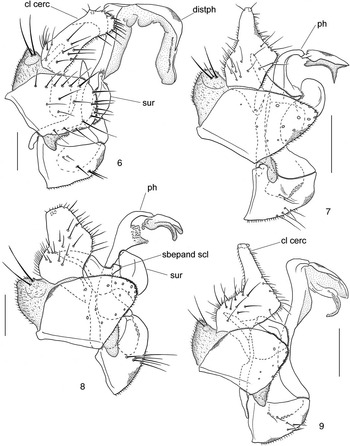
Male terminalia of Dolichocephala, lateral view. 6. Dolichocephala teskeyi sp. nov.; 7. Dolichocephala vockerothi sp. nov., (eastern); 8. Dolichocephala vockerothi sp. nov. (western); 9. Dolichocephala woodi sp. nov. Scale bar = 0.1 mm. (cl cerc, clasping cercus; distph, distiphallus; ph, phallus; sbepand scl, subepandrial sclerite; sur, surstylus).

Type material
Holotype: ♂, “USA: CA: Del Norte County/Jedediah Smith Redwoods SP/Walker Rd., ca 41°48′44″N/124°6′36″W, 25.V.2009/S.E. Brooks”; “HOLOTYPE/Dolichocephala/teskeyi/Sinclair & MacDonald [red label]” (CNC). Paratypes. USA. California: same data as holotype (1 ♂, CNC); Del Norte Co., Jedediah Smith Redwoods SP, Walker Rd., Ck, ca. 41°48′44″N, 124°6′36″W, 31.v.–3.vi.2009, MT, YPT, JMC & SEB (2 ♀, CNC), Jedediah Smith Redwoods SP, Walker Rd., Ck, ca. 41°48′44″N, 124°6′36″W, 22.v.2009, JMC (1 ♂, CNC); Jedediah Smith Redwoods, Del Norte Co., 4.vii.1969, E.M. & J.L. Fisher (1 ♂, CSCA).
Recognition
Similar to D. chillcotti, with white spots in r1 and r2 + 3 that are more rectangular compared with the circular spots found on other species included in this revision. Male D. teskeyi are distinguished from D. chillcotti in lacking a dorsal excavation on the clasping cercus and in lacking a patch of spine-like setae apicoventrally on the hypandrium (only two or three relatively strong setae are present).
Description (wing length 2.5–2.8 mm).
Male. Head: Slender, tapered ventrally. Lower half of face with pale greyish pruinescence. Vertex and occiput dark brown with greyish pruinescence. Ocellar triangle with pair of stout upturned bristles.
Thorax: Scutum with bluish pruinescence medially. Several very minute acrostichals anterior to first dc; five dc; one pprn; one presut spal; two npl (lower weak or absent); one pal; two sctl. Laterotergite with several pale setulae.
Legs: Legs yellowish-brown, somewhat darker on tarsi; fore coxa paler than mid and hind coxae.
Wing: Narrow; infuscate; single long basal costal seta present; R4 and R5 divergent apically; R4 with auxiliary cross-vein connecting to R2 + 3; irrorations less distinct than in other Nearctic species: four to five subrectangular spots in cells r1; three spots in cell dm; two subrectangular spots in cell r2 + 3 (proximal section); two spots in cell r4; one spot in cells m2 and distal section of r2 + 3; one to two spots in cell m1; m4 lacking spots; cell r5 with two indistinct spots apically.
Abdomen: Sclerites dark brown, concolorous with thorax. Terminalia (Fig. 6): Hypandrium cone shaped, with three to four long, stout lateral setae and several lateral setulae, lacking crown of spine-like setae. Phallus strongly arched at base; apical half with posterior membranous expansion; distiphallus with broad cap-like sclerite, with long membranous sac; lacking subapical process; base lacking broad expansion. Ejaculatory apodeme very slender, crescent shaped. Epandrium rounded with long scattered setae. Clasping cercus digitiform, broad, lacking subapical excavation; basal margin clothed in setae; apical margin with short stout setae; peg-like sensillum on inner face of slightly projected subapex. Lobe of subepandrial sclerite extended beyond epandrium acting as brace to phallus; apical margin of subepandrial plate with short erect projection between clasping cerci. Surstylus short, sickle shaped.
Female. Similar to male.
Remarks
The entire type series was collected at a single locality in Jedediah Smith Redwoods State Park in northwestern California (Fig. 16).
Etymology
The specific name is a patronym in honour of H.J. Teskey, a dedicated specialist of Tabanidae and larval dipterology, and author of the larval morphology and key to larval Diptera chapters in the Manual of Nearctic Diptera.
Dolichocephala vockerothisp. nov.
Wings of Dolichocephala. 10. Dolichocephala argus; 11. Dolichocephala arnaudi sp. nov.; 12. Dolichocephala chillcotti sp. nov.; 13. Dolichocephala vockerothi sp. nov. Scale bar = 0.5 mm (cua, anterior cubital cell, dm, discal medial cell, M1,2,4, medial veins, r1,2 + 3,5d,p, radial cells [distal or proximal section]; R1,2 + 3,4,5, radial veins).

Distribution of Dolichocephala argus.

Type material
Holotype: ♂, “N.S. CBHNt. Pk./Beulach Ban/Falls PG812870/8.VII.1983”; “Swept along/fast rocky/stream/J.R. Vockeroth”; “HOLOTYPE/Dolichocephala/vockerothi/Sinclair & MacDonald [red label]” (CNC). Paratypes:CANADA. Alberta: For. Trunk Rd., 50 mi N Nordegg along beaver pond, 20.vii.1987, SAM (1 ♀, DEBU); 10 km N Whitecourt, Sakwatamau R., 54°12′03″N, 115°46′40″W, sweep sedges & grasses at upper beach, 18.vii.2003, TAW (2 ♀, L.E.M.). British Columbia: Alaska Hwy DC-335, Kledo Ck, 28.vi.1978, PHA (1 ♂, USNM); Kiskatinaw PP, Alaska Hwy DC 31.4 km, 26.vi.1978, PHA (1 ♂, 6 ♀, USNM); Kleanza Ck, 14 mi E Terrace, 30.vi.1960, JGC (1 ♀, CNC); Moon Lk, Alaska Hwy DC-1331, 8.vii.1978, PHA (1 ♂, USNM); Prophet R. Prov. Cpgd, Alaska Hwy DC-221, 13.viii.1978, PHA (4 ♂, 1 ♀, USNM). Newfoundland: Agric. Exp. Stn., St. John's, 26.vii.1967, J.F. McAlpine (1 ♂, CNC). Nova Scotia: Cape Breton Highlands NP, Beulach Ban Falls, 8–11.vii.1983, JRV (1 ♂, 2 ♀, CNC); Cape Breton Highlands NP, bog trap, 11.vii.1983, D.M. Wood (1 ♀, CNC); Cape Breton Highlands NP, Pleasant Bay, damp meadow, 17.viii.1984, R. Martin (1 ♂, CNC); S. Harbour beach, 12.vii.1983, JRV (1 ♂, 1 ♀, CNC). Ontario: Algonquin PP, nr. Brewer Lk, 8–22.vii.2008, MT, hardwood for., 45.5855°N, 78.3104°W, E. Proctor (1 ♀, CNC). Iroquois Falls, 2.vii.1987, JRV (2 ♀, CNC); Thunder Bay Distr., Prairie R. at Hwy 17, 38 km E Terrace Bay, 48°48.4′N, 86°47.4′W, boggy spruce MT, 15–19.vii.2002, M. Buck (1 ♂, DEBU). Quebec: Fort Chimo [Kuujuaq], 6.vii.1954, J. McAlpine (1 ♀, CNC); James Bay Hwy, 323 km, Lac Mirabelli, 20–21.viii.2001, YPT, L. Masner (1 ♀, CNC); James Bay Hwy, 204.5 km, 50°58.59′N, 77°38.2′W, spruce/sphagnum MT, 7–16.vii.2001, M. & B. Buck (1 ♂, DEBU). Saskatchewan: Carrot R, Swede midge traps, viii.2008, S. Rudy (1 ♂, CNC); Marean Lk, 1 km E Rt.679, Greenswater Lk PP, 12-YPT in aspen for., 14.vii.1998, JMC (1 ♀, CNC). Yukon Territory: Alaska Hwy, mi F 362, Snag-Junction Yukon Gov't Cpgd, FIT, 23.vii.1996, PHA & M.M. Arnaud (1 ♀, USNM); Alaska Hwy, 1251 km, Morley R., 50 mi E Teslin, sedge, 14.vii.1987, SAM (1 ♀, DEBU); 14 mi E Dawson, 1300′ 30.vii.–1.viii.1962, P.J. Skitsko, R.E. Leech (2 ♀, CNC); Engineer Creek, “Sulphur Springs” [65.16551°N, 138.37097°W, 169 km Dempster Hwy], pan trp, cool-spring, sedge/mud, 26.vi.–12.vii.1987, S. Cannings (1 ♂, DEBU); Haines Hwy, mi H 96, Million Dollar Falls Cpgd, FIT, 25.vii.1996, PHA, M.M. Arnaud (3 ♂, 2 ♀, USNM); Klondike Hwy, 8.8 km S Twin Lakes, Conglomerate Mt. 61°37.9′N, 135°53.1′W, sweep long Klusha Ck, 15.vii.1998, TAW (1 ♂, 1 ♀, LEM); Klondike Hwy, 15 km S Carmacks, 61°58′N, 136°12′W, sweep sedges at pond edge, 8.vii.1997, TAW (2 ♂, 1 ♀, LEM); Minto Landing Terr. Cpgd, Klondike Loop, 4.vii.1978, PHA (1 ♀, USNM); 128 km, Nahanni Range Rd., 61°38′N, 128°20′W, 30.vii.1986, S. Cannings (1 ♂, UBCZ); Whitehorse, Robert Service Cpgd, 60°42.1′N, 135°2′W, Yukon R., 27.vii.1998, TAW (1 ♂, LEM); Whitehorse, Miles Cyn, 60°40′N, 135°01.8′W, sweep grass/sedges at Yukon R., 27.vii.1998, TAW (1 ♂, LEM). USA. Alaska: Anchorage, Ship Ck, Landings Downtown RV Pk, 9.vii.1996, PHA, M.M. Arnaud (3 ♂, USNM); King Salmon, Naknek R., 23.vii.1952, W.R. Mason (1 ♀, CNC); Matanuska Valley, 2.vii.1950, C.O. Berg (1 ♂, CUIC); Richardson Hwy V 79.4, Squirrel Ck Cpgd, 13.vii.1978, PHA (1 ♂, USNM). Colorado: Tennessee Pass, 21.vii.1966, F.C. Harmston (1 ♀, USNM). Georgia: Clarke Co., Athens, 9–16.iv.1976, JFM, MT (1 ♀, CNC); McIntosh Co., Sapelo Island, 28.vi.–9.v.1987, FIT, Hymen. Team (1 ♀, CNC). Indiana: Crawford Co., Hoosier NF, Hemlock Cliffs, 19.v.1991, BJS (1 ♂, CNC); Lawrence Co., Avoca Fish Hatchery, 12.viii.1974, R.W. Meyer (1 ♂, CNC); Tippecanoe Co., W. Lafayette, MT, ix.1978, JFM (1 ♀, CNC), MT, v.1979, JFM (7 ♂, 4 ♀, CNC), W. Lafayette, MT, vii.1980, JFM (2 ♀, CNC), MT, 6.vii.1986, JFM (1 ♀, CNC), MT, 11.vii.1990, JFM (1♀, CNC). Iowa: Allamakee Co., 3 mi NW Lansing, 6.viii.2002, R. Hurley (1 ♂, MTEC); Boone Co., Lodges SP, 13.v.1949, JLL (1 ♀, ISU), 25.vi.1950, JLL (1 ♂, ISU); 23.vi.–4.vii.1953, JLL (2 ♂, ISU), 23.vi.1960, JLL (1 ♂, ISU); 2.vii.1963, JLL (1 ♂, ISU); 23.vi.1965, JLL (2 ♀, ISU); Dubuque Co., White Pine Hollow, 2.viii.1960, JL (2 ♂, ISU); Van Buren Co., Lacey-Keosauqua SP, 10.ix.1949, JLL (1 ♂, ISU), 26.vi.1971, W. Bryan (1 ♀, ISU). Michigan: Cheboygan Co., Sturgeon R. at Rondo, 7.vii.1987, R. Hurley (1 ♂, MTEC); Marquette Co., 15 mi SW Big Bay, 22–26.vi.1986, JFM, MT (1 ♀, CNC). New Hampshire: Mt. Washington, A.T. Slossan (1 ♀, AMNH); Mt. Washington (1 ♂, USNM); Coos Co., Jefferson Notch, 3000′ 31.vii.1981 (1 ♂, MCZ). New York: Hamilton Co., 43°17.2′N, 74°33.4′W, 5.viii.1961, JLL (1 ♀, ISU); Thompkins Co., Ithaca, 9.viii.1961, R.J. Gagné (2 ♀, ISU). North Carolina: Macon Co., Highlands, 2300′, J.G. Franclemont (1 ♂, CUIC). Ohio: Geauga Co., Novelty Twp., Chagrin R., 6.viii.1982, R.S. Zack (6 ♂, WSU); Hocking Co., Crane Hollow State Nature Preserve, 17–19.v.2003, JMC (1 ♂, CNC), same as previous, Turtle Rock Falls, 16.viii.2010, GAC 32464, sweeping wet rocks below falls, G.A. Coovert (9 ♂, 3 ♀, CHIC), same as previous, sweeping shaded rocky bed of N. Hood Hollow ravine, GAC 32467, G.A. Coovert (4 ♂, CHIC). Tennessee: Clarksville, 15.vii.1939, D.E. Hardy (1 , SEMC); Fentress Co., 11.vii.1957 (1 ♀, CNC); Sevier Co., Great Smoky Mtns NP, Elkmont Cpgd, Jakes Ck, 14.vi.1990, BJS (1 ♂, CNC). Virginia: Dickenson Co., Cranesnest R., 1250′, 2 mi E Clintwood, 37°8.509′N, 82°25.310′W, J.B. Runyon (1 ♂, MTEC). West Virginia: Ritchie Co., North Bend SP, 23.vi.1970, G. Steyskal (1 ♀, USNM).
Additional material examined
In the absence of a male specimen, the following record cannot be confirmed: Ontario: Hilton Twp., Tenby Bay, MT edge of lake, 24.vii.1994, J.E. Swann (1 ♀, ROM).
Recognition
Similar to Dolichocephala woodi sp. nov., with cell r2 + 3 having three to four circular spots proximally. It is distinguished from D. woodi in possessing two to three circular spots distal to cell cua.
Description (wing length 1.8–2.2 mm).
Male. Head: Slender, tapered ventrally. Lower half of face with greyish pruinescence. Vertex dark brown with greyish pruinescence; occiput with V-shaped pattern of pruinescence. Ocellar triangle with pair of stout upturned bristles.
Thorax: Scutum with bluish pruinescence medially on anterior half. Several very minute acrostichals anterior to first dc; five dc; one pprn; one presut spal; two npl (lower weak); one pal; two sctl. Laterotergite with several pale setulae.
Legs: Legs yellowish-brown, somewhat darker on tarsi; fore coxa paler than mid and hind coxae.
Wing (Fig. 13): Narrow; infuscate; single long basal costal seta present; R4 and R5 divergent apically; R4 with auxiliary cross-vein connecting to R2 + 3; irrorations more or less distinct: three to four spots in cells r1 and dm; three to four spots in cell r2 + 3 (proximal section); two spots in cells r4, m4 (sometimes three) and m1; one spot in cells m2 and distal section of r2 + 3; cell r5 with two spots on distal third near wing margin.
Abdomen: Sclerites dark brown, concolorous with thorax. Terminalia (Figs. 7, 8): Hypandrium cone shaped with five to six long lateral setae. Phallus arched, stout, well sclerotized with recurved apex bearing cap-like distiphallus; subapical process present, clothed in microtrichia, and produced into narrow process. Ejaculatory apodeme slender, straight, lacking median process. Epandrium subrectangular with several long marginal posterior setae. Clasping cercus variable in shape from broad L-shaped lobe with truncate apex to subtriangular lobe, strongly attenuated apically; inner apical margin with one peg-like sensillum. Lobe of subepandrial sclerite extended beyond epandrium acting as brace to phallus; apical margin of subepandrial plate lacking short erect projection. Surstylus broadly rounded apically.
Female. Similar to male.
Remarks
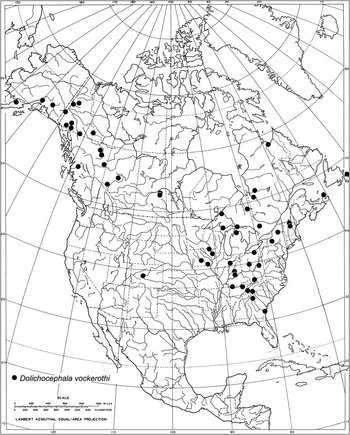
This species is widespread and relatively common from eastern Canada and United States of America, westward to British Columbia and north into Alaska and Yukon Territory (Fig. 17). There is quite distinctive variation in the clasping cercus, from a truncate apex in some western populations to rather pointed and subtriangular in eastern and some western populations. Mid-western populations are a combination of the two extremes in shape of the clasping cercus. The phallus is nearly consistent throughout its range, although the pair of narrow spinose projections on the subapical expansion is less discrete among eastern specimens.
Etymology
The specific name is a patronym in honour of J.R. Vockeroth, coeditor of the Manual of Nearctic Diptera, a gifted collector who contributed greatly to our knowledge of Diptera.
Dolichocephala woodisp. nov.
Distribution of species of Dolichocephala. 15. Dolichocephala arnaudi sp. nov., Dolichocephala borkenti sp. nov. and Dolichocephala woodi sp. nov.; 16. Dolichocephala chillcotti sp. nov. and Dolichocephala teskeyi sp. nov.

Distribution of Dolichocephala vockerothi sp. nov.

Type material
Holotype: ♂, “Umiat, Alaska/14.VII.1959/R. Madge”; “HOLOTYPE/Dolichocephala/woodi/Sinclair & MacDonald [red label]” (CNC). Paratypes:CANADA. Northwest Territories: Inuvik, 68°22.102′N, 133°45.713′W, 11–13.vii.2010, MT, shore of E branch MacKenzie R., H. Goulet & C. Boudreault (1 ♂, CNC). Yukon Territory: Engineer Creek, “Sulphur Springs” [65.16551°N, 138.37097°W, 169 km Dempster Hwy], pan trp, cool-spring, sedge/mud, 26.vi.–12.vii.1987, S. Cannings (1 ♂, DEBU). RUSSIA. MagadanskayaOblast, Aborigen Field Stn., 500 m, 25.vii.–10.viii.1990, D.M. Wood (1 ♂, 1 ♀, CNC).
Recognition
Similar to D. vockerothi, with cell r2 + 3 having three circular spots proximally. It is distinguished from D. vockerothi in lacking spots distal to cell cua.
Description (wing length 2.0–2.3 mm).
Male. Head: Slender, tapered ventrally. Lower half of face with greyish pruinescence. Vertex dark brown with greyish pruinescence; occiput with V-shaped pattern of pruinescence. Ocellar triangle with pair of stout upturned bristles.
Thorax: Scutum with bluish pruinescence medially on anterior half. Several very minute acrostichals anterior to first dc; five dc; one pprn; one presut spal; two npl (lower weak); one pal; two sctl. Laterotergite with several pale setulae.
Legs: Legs yellowish-brown, somewhat darker on tarsi; fore coxa paler than mid and hind coxae.
Wing: Narrow; infuscate; single long basal costal seta present; R4 and R5 divergent apically; R4 with auxiliary cross-vein connecting to R2 + 3; irrorations more or less distinct: three spots in cells r1 and dm (occasionally one spot); three spots in cell r2 + 3 (proximal section); two spots in cells r4 and m1; m4 (distal to cell cua) lacking spots; one spot in cells m2 and distal section of r2 + 3; cell r5 with two spots on distal third near wing margin.
Abdomen: Sclerites dark brown, concolorous with thorax. Terminalia (Fig. 9): Hypandrium cone shaped with five to six pairs of short lateral setae. Phallus arched, stout, well sclerotized, bearing cap-like distiphallus; phallic shaft expanded subapically. Ejaculatory apodeme slender, straight, lacking median process. Epandrium subrectangular with several marginal posterior setae. Clasping cercus L-shaped with broad base; inner apical margin with two peg-like sensilla. Lobe of subepandrial sclerite extended beyond epandrium acting as brace to phallus; apical margin of subepandrial plate lacking short erect projection. Surstylus broadly rounded apically.
Female. Similar to male.
Remarks
This new species is known from Yukon Territory, Alaska (Fig. 15), and eastern Russia. The male terminalia are very similar and most closely related to Dolichocephala bellstedti Joost, which is known from Germany, Slovenia, and herein newly from Abisko, Sweden (housed in LEM). Dolichocephala woodi differs from D. bellstedti in lacking the crown of stout setae on the hypandrium and the clasping cercus is stouter.
Etymology
The specific name is a patronym in honour of D.M. Wood, coeditor of the Manual of Nearctic Diptera, who collected the Russian material of this species and has contributed greatly to our knowledge of the phylogeny, morphology, and collections of Diptera.

Acknowledgements
We are indebted to the following curators and their respective institutions for the loan of specimens: D. Grimaldi (ANMH), C.R. Nelson (BYU), N.D. Penny (CAS), G.A. Coovert (CHIC), S. Gaimari (CSCA), B. Kondratieff (CSU), J.K. Liebherr (CUIC), S.A. Marshall (DEBU), G.W. Courtney (ISU), T.A. Wheeler & S. Boucher (LEM), D. Furth (MCZ), M.A. Ivie (MTEC), C. Marshall (OSAC), R.A. Cannings (RBCM); D.C. Currie (ROM), Z.H. Falin (SEMC), S. Cannings and K. Needham (UBCZ), S. Heydon (UCD), N.E. Woodley (USNM), W.J. Hanson (USUL), R. Danielsson (UZIL), R. Wagner (WEC); R.S. Zack (WSU). Scott Brooks (CNC) assisted in the habitus and wing photographs. Adrian Plant and Igor Shamshev kindly reviewed the manuscript and Danielle Takoff translated the abstract to French.