Introduction
Although Emergency Medical Services (EMS) professional demographics are provided by a number of different federal data collection efforts, each effort has certain weaknesses hindering the generalizability of their findings to the EMS workforce. The US Department of Labor (DOL; Washington, DC USA) Current Population Survey (CPS) estimates do not distinguish EMS providers by certification level and exclude volunteers and both cross-trained firefighter and law enforcement workers. Likewise, DOL’s Occupational Employment Survey, a national survey of employers, does not collect information on volunteers, does not distinguish between provider levels, and does not identify firefighters cross-trained as Emergency Medical Technicians (EMTs) or Paramedics.
The National Fire Protection Association (NFPA; Quincy, Massachusetts USA) conducts regular surveys of all fire departments in the United States and publishes extensive data on fire and EMS calls. However, this survey does not distinguish firefighters who perform EMS services from those that do not. The National Association of State EMS Officials (NASEMSO; Falls Church, Virginia USA) conducts regular surveys of State EMS Directors; the data supplied by states varies in quality, is often an estimate, and does not distinguish employed EMS staff from licensed staff.Reference Bentley, Shoben and Levine 1 Nonetheless, within these constraints, data collected by these organizations appear to produce a reasonable picture of the EMS workforce.
The EMS services are provided by fire-based organizations, public safety organizations, hospitals, and private services. According to 2011 estimates from NASEMSO, fire-based EMS employed the largest proportion of EMS professionals: 40% of the agencies providing EMS services were fire-based.Reference Chapman, Linder and Kaiser 2 According to NFPA’s assessment, in 2005, over two-thirds (67%) of fire departments provided EMS, with the proportions increasing concurrently with community size. 3 Alarmingly, in 2005, over one-third (36%) reported that not all of their EMS personnel are formally trained. 3 The most common non-fire-based agencies were private, non-hospital-based (25%); 21% were government, non-fire-based; 6% were hospital-based; and the remainder included tribal, emergency medical dispatch, and other.Reference Chapman, Linder and Kaiser 2
In 2005, CPS data indicated that the average age for an EMS provider was 35 years.Reference Bentley, Shoben and Levine 1 These data also indicated that the profession was predominantly male (71%). The CPS data from 2003 also indicated that the profession was primarily white, non-Hispanic (81%).Reference Bentley, Shoben and Levine 1 More recent data, collected as part of the 2011 National EMS Assessment, estimated that 67% of credentialed EMS professionals were male, 70% were between the ages of 20-49 years, and three-quarters (75%) were white.Reference Chapman, Linder and Kaiser 2 The 2011 National EMS Assessment also reported that the average EMT-Basic had 9.8 years of job experience; the average EMT-Paramedic, 11.2 years. However, only about one-half of the states were able to provide estimates of experience levels of their EMS workforce.Reference Chapman, Linder and Kaiser 2
The EMS workforce, unlike other allied health workforces, has a large volunteer component. The EMS volunteers are most likely to be found in rural areas, where almost one-half (49%) of all volunteer agencies are located. 4 - Reference Mueller, Zhang and Lucas 6 A 2003 survey of state EMS directors indicated that nearly one-half (47%) of EMS providers were volunteers, with the proportion of providers in the most rural states who were volunteers approaching three-quarters (73%).Reference Freeman, Patterson and Slifkin 7 Unfortunately, in these studies, the term “volunteer” was left undefined, leading to a recommendation that a standard definition of volunteerism be established.Reference Chapman, Linder and Kaiser 2
The EMT-Basic and Paramedic education is challenging to assess for a variety of reasons: federal data sources do not distinguish programs by level and individual states establish their own training requirements.Reference Bentley, Shoben and Levine 1 In 2009, the National EMS Education Standards replaced the EMS National Standard Curriculum (NSC). However, while the NSC was being utilized, the vast majority (98%) of EMS educators reported the use of the NSC on either a “word for word” or “as-needed” basis.Reference Mears 8 Research on EMS education has tended to focus on the need for continuing education to maintain skills and comfort in treating pediatric patients or knowledge of specific procedures such as aspirin use, wound care, infectious disease, and domestic violence.Reference Ruple, Frazer, Hsieh, Bake and Freel 9 - Reference Mencl, Birkle, Blanda and Gerson 15
Estimates from 2006 and 2007 suggested that nearly two-thirds (61%) of EMS educational programs were offered in non-academic settings; less than 5% of EMS educators reported teaching at 4-year colleges or universities.Reference Weiss, Ernst, Blanton, Sewell and Nick 16 , Reference Ruple, Frazer and Bake 17 At the paramedic level, graduation from an accredited program became an eligibility requirement for National EMS Certification as of December 31, 2012.Reference Ruple 18 Program accreditation at other EMS levels is not yet required. It is noteworthy that students who attended an accredited paramedic program were 50% more likely to pass their certification exam.Reference Cason and Robinson 19
Training opportunities are believed to be more restricted in rural areas, with distant training sites, lower patient volume, and limited supervisory opportunities.Reference Dickison, Hostler, Platt and Wang 20 The adequacy of training for rarely performed, complex skills, such as intubation, is a concern due to skill fade. Deakin et alReference Becknell and Ostrow 21 noted that the success rate for tracheal intubation (84%) was significantly associated with the number of patients intubated. However, the median number of such intubations by paramedics, on an annual basis, is one. Other investigations have noted similar success rates (77%) and such rates are substantially lower than rates seen when performed in emergency departments of hospitals.Reference Deakin, King and Thompson 22 , Reference Stevenson, Graham, Hall, Korsah and McGuffie 23
One of the objectives of the Longitudinal EMT Attributes and Demographic Study (LEADS) was to provide an accurate picture of the demographics, including education and training, of the EMS workforce and to assess changes over time. Thus, the objective of the current study was to describe changes to EMS professional demographics and employment characteristics and assess cross-sectional changes in EMS education over the 10-year study period.
Methods and Data
Study Design
Detailed methodology and study design for LEADS have been published elsewhere in this special issue. Briefly, these data were collected between 1999 and 2008 employing survey techniques aimed at collecting valid data. A random, stratified sample was utilized to allow results to be generalizable to the nationally certified EMS population. Survey weights were calculated reflecting individual’s probability of selection and adjusted for within stratum response rates. The American Institutes for Research’s Institutional Review Board (Washington, DC USA) approved this project.
Measures
An assessment of demographics focused on the following areas: (1) personal demographics, (2) employment characteristics, and (3) initial EMS education. Personal demographic items included gender, marital status, and age. Work-life characteristics encompassed number of employers, organizational characteristics, years of experience, and the size of the community in which providers worked. Lastly, EMS educational items included evaluation of the course lead instructor, the materials associated with the course, location of training, and level of perceived preparation after EMS course completion.
In 2004, the EMS employment status item (volunteer, one or more EMS employers, and do not do EMT work) was changed to ascertain the number of EMS services (0, 1, 2 or more) for which the individual worked. Also, in 2004, the work organization and EMS employer items were combined into a single service-type item.
Data Analysis
Gender data from 1999 will not be reported due to coding and data processing issues.
Likert scales for educational items were converted to continuous variables (4=excellent, 3=good, 2=fair, and 1=poor). Utilizing adjusted survey weights, proportions, means, and 95% confidence intervals (CI) were calculated. Cross-sectional changes over time and comparisons between EMT-Basics and Paramedics were statistically evaluated utilizing CIs; those that did not overlap were labeled as statistically significant. Data were analyzed using Stata 12.1 (StataCorp LP; College Station, Texas USA).
Results
Demographics
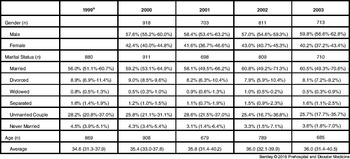
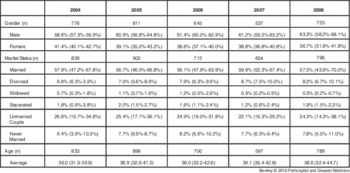
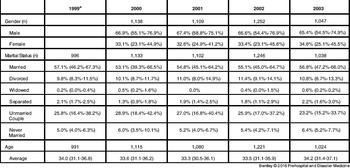
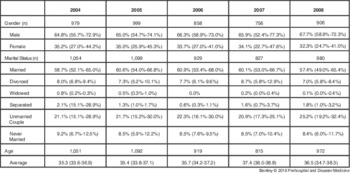
Tables 1a-2b reflect demographics by year for EMT-Basics and Paramedics. The majority of EMT-Basics and Paramedics were male; the proportions within level remained relatively constant over the duration of the study (EMT-Basics ranging from 57.0% to 63.3% and EMT-Paramedics ranging from 64.8% to 67.7%). In each year, the proportion of EMT-Paramedics who were male was greater than the proportion of EMT-Basics who were male.
EMT-Basic Personal Demographics by Year, 1999-2003

Abbreviation: EMT, Emergency Medical Technician.
a Gender data for 1999 were unavailable due to coding and data processing errors.
EMT-Basic Personal Demographics by Year, 2004-2008

Abbreviation: EMT, Emergency Medical Technician.
Paramedic Personal Demographics by Year, 1999-2003

a Gender data for 1999 were unavailable due to coding and data processing errors.
Paramedic Personal Demographics by Year, 2004-2008

The majority of respondents reported that they were married. These proportions remained relatively stable over the 10 years of the study and were comparable for EMT-Basics and Paramedics. However, the proportion of EMT-Paramedics who reported they were divorced declined significantly from 2000 (10.1%) to 2008 (7.0%).
The average age of an EMT-Basics ranged from 34.6 to 39.1 years. The average age of EMT-Paramedics ranged from 33.3 years in 2001 to 37.4 years in 2007, which although lower in each of the 10 years, was comparable to EMT-Basics.
Employment Characteristics
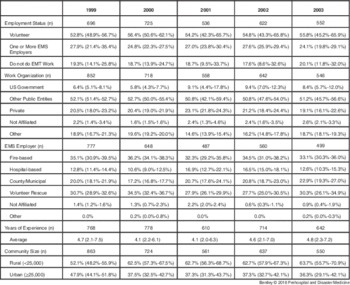
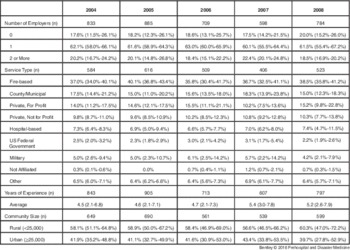
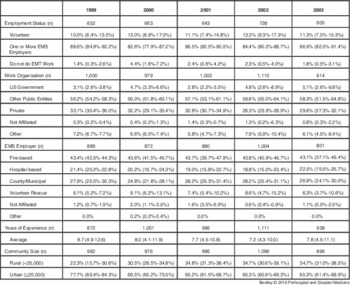
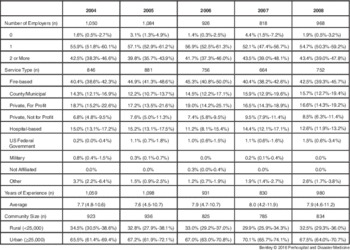
From 1999 through 2003, more than one-half of EMT-Basics (52.8%-56.4%) reported working as volunteers (Table 3a). The proportion of volunteer EMT-Basics was significantly higher than that of volunteer EMT-Paramedics (10.0%-13.3%) (Table 4a). The prevalence of respondents who reported working for more than one EMS organization was quite high, ranging from 39.8% to 43.5% for EMT-Paramedics and from 18.4% to 22.4% for EMT-Basics. In each year, EMT-Paramedics were significantly more likely to report working for two or more EMS agencies than were EMT-Basics.
The most prevalent employer or service type was fire-based (Tables 3a-4b). About one-third of the EMT-Basics worked for fire-based services (range: 32.3%-40.1%) compared with a significantly larger proportion of EMT-Paramedics (range: 43.1%-45.3%). The EMT-Basics were significantly more likely to report their main EMS employer was a volunteer rescue organization than were EMT-Paramedics. These proportions, which remained stable over time, ranged from 27.7% to 34.5% for EMT-Basics and from 6.1% to 9.1% for EMT-Paramedics.
EMT-Basic Employment Characteristics by Year, 1999-2003

Abbreviations: EMS, Emergency Medical Services; EMT, Emergency Medical Technician.
EMT-Basic Employment Characteristics by Year, 2004-2008

Abbreviation: EMT, Emergency Medical Technician.
Paramedic Employment Characteristics by Year, 1999-2003

Abbreviation: EMS, Emergency Medical Services.
Paramedic Employment Characteristics by Year, 2004-2008

The average amount of experience was relatively constant over time for both EMT-Basics and Paramedics. Even though the amount of EMS experience was not significantly different, in each of the 10 years, the average years of EMS experience possessed by paramedics was substantially greater compared with EMT-Basics (ranging from 7.2 to 8.7 vs. 4.1 to 5.4 years, respectively).
The EMT-Basics were significantly more likely to practice in rural areas (<25,000 people) than EMT-Paramedics. In each year, over one-half of the EMT-Basics (range: 52.1%-63.7%) worked in communities of this size, while 22.3%-34.7% of EMT-Paramedics worked in rural communities (Tables 3a-4b).
Initial EMS Education
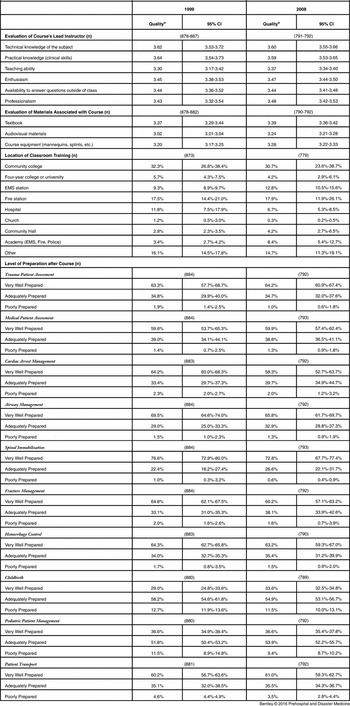
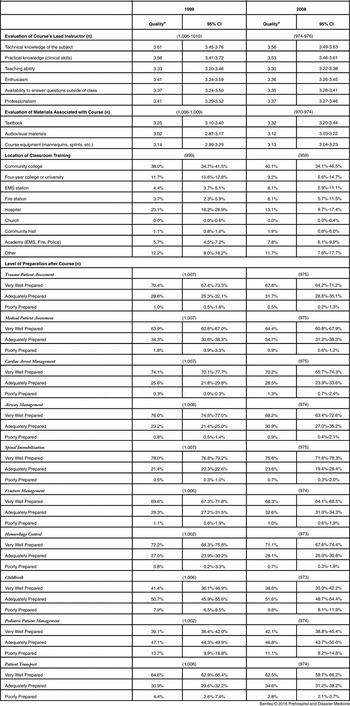
The EMT-Basics and Paramedics were quite similar in their evaluation of the knowledge and abilities of their EMS instructors; few changes were noted over time (between 1999 and 2008) (Tables 5 and 6). However, a marginal, yet statistically significant, increase in EMT-Basics’ satisfaction with the audio-visual materials used in their last course was noted (3.02 in 1999 to 3.24 in 2008).
Cross-Sectional Changes over Time in Education for EMT-Basics

Abbreviations: EMS, Emergency Medical Services; EMT, Emergency Medical Technician.
a Quality was rated on a scale with 1=Poor, 2=Fair, 3=Good, and 4=Excellent.
Cross-Sectional Changes over Time in Education for Paramedics

Abbreviation: EMS, Emergency Medical Services.
a Quality was rated on a scale with 1=Poor, 2=Fair, 3=Good, and 4=Excellent.
Community colleges were the most common locations of EMS training for both EMT-Basics and Paramedics in 1999 and 2008, when these survey items were administered.
Significantly more EMT-Basics (1999: 32.3%; 2008: 30.7%) and significantly more EMT-Paramedics (1999: 38.0%; 2008: 40.1%) reported receiving their training at these institutions than at any other type of institution. The proportion of EMT-Paramedics who received their initial training at hospitals declined significantly (23.1% in 1999 to 13.1% in 2008); the proportion of EMT-Basics who received initial training at hospitals also declined (11.8% in 1999 to 6.7% in 2008). Nonetheless, at both times, a significantly greater proportion of EMT-Paramedics received their initial EMS training in hospitals compared with EMT-Basics (Tables 5 and 6).
Overall, the majority of EMT-Basics and Paramedics felt their training prepared them “very well” for nearly all of the tasks that were included in the questionnaire. However, while EMT-Paramedics were significantly more likely to report their training left them very well prepared for childbirth issues than EMT-Basics in 1999 (41.4% vs. 29.0%) and in 2008 (38.6% vs. 33.6%), fewer than one-half felt prepared to manage childbirth. Similarly, fewer EMS professionals felt prepared for pediatric patient management, with proportions of EMT-Basics reporting they were “very well” prepared remaining constant at 36.6% in 1999 and 2008 and slightly increasing for EMT-Paramedics (39.1% in 1999 and 42.1% in 2008). In terms of EMT-Basics’ level of perceived preparedness in handling certain patient care components after their initial course, no change was noted across study years for trauma patient assessments, medical patient assessments, fracture management, hemorrhage control, pediatric patient management, or patient transport. While not statistically significant, a decline in feelings of preparedness was noted for cardiac arrest management (64.2%-58.3%), airway management (69.5%-65.8%), and spinal immobilization (76.6%-72.8%). However, an increase in feeling very well prepared to handle childbirth was found (29.0%-33.6%) (Table 5).
In all of the areas asked about, in both 1999 and 2008, higher proportions of EMT-Paramedics than EMT-Basics reported their training made them “very well” prepared. In 1999, significantly greater proportions of EMT-Paramedics reported they were “very well” prepared for cardiac arrest management (74.1% vs. 64.2%), for airway management (76.0% vs. 69.5%), and for hemorrhage control (72.2% vs. 64.3%). Similarly, significant differences were also noted in 2008 for cardiac arrest management (70.2% vs. 58.3%), for fracture management (66.3% vs. 60.2%), and for hemorrhage control (71.1% vs. 63.2%) (Tables 5 and 6).
Discussion
This study described the changes in demographics and employment characteristics of EMS professionals during the 10 years of the LEADS study. Results of this study indicate that, in terms of gender, other national estimates may have slightly overestimated the proportion of males.Reference Bentley, Shoben and Levine 1 , Reference Chapman, Linder and Kaiser 2 Nevertheless, the EMS profession is primarily male dominated, which is the opposite of many other health care professions. It has been previously estimated that 92% of nursing assistants, 90% of registered nurses, 75% of radiology technicians, and 62% of physician assistants are female.Reference Wang, Mann, Mears, Jacobson and Yealy 24 - 27 However, EMS mirrors that of other public safety organizations, with an estimated 87% of police officers and 96% of firefighters being male. 28 , Reference Hulett, Bendick, Thomas and Moccio 29 Furthermore, in terms of marital status, these data show that the anecdotal belief of high divorce rates in EMS may be misleading, with current marital status indicating a 6.6%-11.4% divorce prevalence.Reference Lonsway, Carrington and Aguirre 30 , Reference Grayson 31
The LEADS employment characteristics reflected those of other studies of the non-LEADS nationally certified EMS professional cohort.Reference Rainone 32 - Reference Lerner, Fernandez and Shah 34 Trends in global EMS show that fire-based, municipalities, private, and hospital-based services are common both in the United States and throughout the world.Reference Studnek, Bentley, Crawford and Fernandez 35 - 38 Years of experience in the profession were also similar in other health care professions; 45.4% of nursing assistants had 2-10 years of experience and the majority of physician assistants had 5-9 years.Reference Wang, Mann, Mears, Jacobson and Yealy 24 , 26
Volunteerism differed substantially when comparing EMT-Basics with EMT-Paramedics. Because, at the time of this study, there was not a standard definition of “volunteer,” comparisons cannot be made with other professions. However, it is important to note that a majority of EMT-Basics were volunteers and a majority practiced in a rural setting. Previous studies have shown that rural settings were more likely to have both EMS and fire volunteer services, which may explain this trend. 3 Furthermore, EMT-Paramedics were more likely to report working two or more jobs than EMT-Basics. Out of the scope of this study, it is unknown whether these EMT-Paramedics were working in full-time or part-time environments; however, EMT-Paramedics were more likely to work in an urban setting. It is possible that urban environments are more likely to have extended shifts with more days off (eg, a 24-hour on shift, 48-hour off shift) that would allow these individuals to work multiple jobs.
In terms of initial EMS education, marginal changes were noted in participants’ feelings of preparedness when handling certain patient care situations. Beginning in the 1990s, EMS educators implemented the NSC, and no major changes in EMS education occurred during the study period that may affect overall changes in internal feelings of preparedness. 39 Conversely, changes to state legislation that would adjust the number of clock hours of EMS education and an increase in EMS research may have affected the amount of training and the recognition of the criticality of certain areas of prehospital medicine. Future efforts should focus on understanding associations between outside factors and feelings of preparedness to handle critical patients in the field.
Limitations
In 1999, when the LEADS study was first conducted, 40 states required National EMS Certification at the EMT-Basic and/or EMT-Paramedic level as a part of the process for licensure. By 2008, the number of states with such requirements had increased to 45. Accordingly, some of the year-to-year demographic changes observed might reflect the initial inclusion of a specific state, with its unique demographics and licensure requirements. For example, from 1999 to 2000, the proportion of EMT-Basics working in communities with populations under 25,000 increased significantly, from 52.0% to 62.5%. Although 45 out of the 50 states utilize National EMS Certification for initial EMS licensure, individuals in all states and US territories can take the national certification exam.
Common to most survey research, the LEADS project’s response rates were relatively low in some years. As mentioned in the Methods section of this supplement, LEADS included a non-responder survey. While this non-responder survey found very few differences between responders and non-responders, as with any survey, self-report bias may be present.
Conclusion
This analysis serves as a useful baseline to measure future changes in the EMS profession. This study described the demographic and employment characteristics of a cohort of nationally certified EMT-Basics and Paramedics over a 10-year period. This analysis also summarized initial EMS education cross-sectional changes over time.