

My title is a pun intended to imply the misapplication of the discipline of anthropology as well as a racial contempt, perhaps even as extreme as hatred, on the part of one of the personalities I am introducing to you today.
I have to make a confession. When I first saw Siliva the Zulu at the National Film Archives in Pretoria in 1990, I looked upon it only as an amusing curiosity; it did not have any direct relationship with my study at that time, which was principally around cinema and apartheid, broadly speaking, how images of Africans have conditioned us to accept white domination in South Africa, and really for the entire continent. Siliva the Zulu did not fit easily into that category. It took me some time to appreciate that the film was really, in South African terms and even in African terms, sui generis. I had been deceived by Siliva’s surface appearance as an amusing but banal melodrama, at times a wild misrepresentation of Zulu life and culture. This is how it was advertised at its première in Milan:
Pitonesse, maghi e stregone …
Well it sounds even better in Italian, but in English:
Pythonesses, magicians and witches!
A real Zulu prince!
Hundreds of virgins!
Masses of warriors!
Crocodiles, cobras, monkeys … etc
Sensational. And that is pretty much where I stopped in 1990, which shows only my myopia, probably the great failing of the researcher, to find only what you are looking for. Yes, it was advertised as exotic but, at the same time, much of the film has to be accepted as an accurate record of Zulu life in the 1920s, of immeasurable importance because I believe it to be probably the only such record on film, certainly in any detail. There is some newsreel footage of a gathering of chiefs from the early 1920s, but not much else.
In the annals of cinema, its uniqueness lies in that it is almost certainly the first fiction film made in Africa south of the Sahara with a completely black cast. That this came about as the result of a fortunate accident does not make it any the less important. Not only does it show us Africans going about their daily tasks, but it presents a group of Zulus who are acting out a contrived plot with all the demands upon their abilities that silent cinema made – in other words, they were not, as in neorealistic cinema, asked to act themselves, to ‘act naturally’, but to act in the exaggerated fashion that silent cinema demanded. And anyone who has seen the film will agree, I think, that they acquit themselves remarkably well, especially as it is highly unlikely that any of them would have seen a silent film, with the possible exception of the young man who plays Siliva, who had worked in Durban.
When I mentioned it in my book In Darkest Hollywood: cinema and apartheid, I was rather dismissive of the film. What drew me into deeper – at this point, prolonged – study of the film was my stumbling upon more information (after I had written the book) about the personalities involved in the making of the film. In fact, I am rather grateful that I did not know then what I know now, since I would not have known how to control it in the context of the book I was writing then. I am now almost lost in a maze of tunnels leading in many different directions, each one with tempting vistas. Here, I intend to seize the hands of the two leading personalities and see where that takes us.
We have to begin as far back as the Italy of the First World War, in which two young men served with distinction. One of these was Attilio Gatti, scion of an upper crust Milanese family. Gatti seems to have been born in the saddle, and he served with the cavalry. He retained the title throughout his life of ‘Comandante’. He had a strong sense of adventure, and he founded Explorator Films with the intention of making films about exotic places and people. In 1925, he had an elaborate plan to travel around the world filming where it took his fancy. By 1927, he had to curb his ambition when he could raise only enough money to take him to Africa.
Lidio Cipriani, after serving with distinction in the war (he received five decorations), became drawn to physical anthropology. After studying in Florence and in Paris, he became a professor at the University of Florence, and it was here that Gatti discovered him when he was searching for an anthropologist to go with him to Africa. I suppose that Cipriani’s role, as far as Gatti was concerned, was in a sense to interpret the peoples and customs they would be dealing with, and to serve as a kind of warrantor of authenticity for the film. However, the film in fact was not to be an anthropological study or record, but a scripted melodrama centred around the adventures of a group of whites set in an alien and exotic situation; in brief, ‘the civilized’ versus ‘the savage’, the constant theme of white representations of Africa. So they took along with them a number of white silent-screen actors, plus two cameramen.
This was not even a decade after the ending of the First World War out of which Italy had made some territorial gains, but was disappointed in others. Moreover, Italy was not a great power in the sense that her allies Britain and France demonstrably were, with their vast overseas territories. Italy was that most demeaned of states, a European country without an empire. The resentment that Italy felt about being sidelined when the European powers carved up Africa was palpable, and would play a part in the rise of fascism. After all, Rome had once governed an immense empire, much of it in Africa. The horizons of young Frenchmen and young Britishers were not bounded by the English Channel, but offered limitless opportunities overseas. For Italians, not even the Mediterranean belonged to them.
So the Gatti expedition was an assertion of Italian claims to adventure and to the kind of limited conquest that the movie camera offers, a proof at least that one had been there, done that.
Their intended destination is Angola, but somewhere along the east coast of Africa a missionary on board their vessel persuades Gatti that he would be much better off stopping in South Africa and filming the Zulu people. Gatti is convinced, and the group disembarks in Durban, much to the consternation of South African Immigration, which has no idea what to make of this motley crew. However, Gatti’s service as a cavalry officer in the Great War, plus the recommendation of the Italian Ambassador in Cape Town, stand the party in good stead. Cipriani also has the support of Raymond Dart in Johannesburg – and Dart is world-famous as the discoverer of the famous Taung skull ‘missing link’.
But there are financial problems. Money from Explorator Films back in Milan has not arrived. They are reduced to selling one of their cameras, and earn some extra money when Vitrotti, the leading cameraman, does some promotional photography for local businesses.
They make their way to Eshowe, the administrative capital of Zululand, and seem to be accepted as a glamorous addition to the small white population. But the local authorities, who assume the role of censors for this film, are horrified by the script that Gatti presents to them – it actually mingles black and white in the same scenes! The story is about a white woman who is kidnapped by savages, a subject that had in fact appeared in a South African film of a decade before, Symbol of Sacrifice. But clearly the local authorities were not as enlightened as those of Johannesburg, where the earlier film was made. It looks like the crew must pack up and head home.
The crew have already been fraternising with the local people, and Vitrotti who, like all of them, is impressed by the physical beauty of the Zulus, now suggests to Gatti that they write a script about Zulus only. Gatti seizes upon this, and it is accepted by the censors. So it is by complete accident that we have the first feature film with an all-black cast to be made in South Africa.
And here we have to speculate about the frame of mind of the Italians, who – fortunately for them, although they would not have seen it in quite that way – were largely free of the cultural baggage of colonialism, to the extent that they could discern a physiological symmetry, a beauty in the black human form, that South African whites were largely blind to; and could even consider making Africans the protagonists of a story they certainly intended to sell internationally.
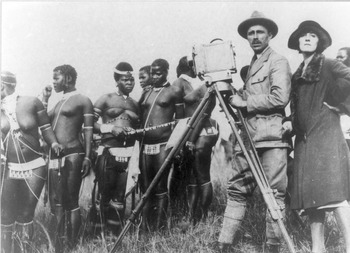
Gatti has taken his wife and two children with him, and Vitrotti, the cameraman, his wife. These are deposited in a hotel in Eshowe, while the crew go to live under canvas in the hilly countryside where they would film. One photograph shows them accompanied by two members of the South African constabulary, probably more as liaison than for protection. Other photographs show what seems to be a natural camaraderie among the crew, but the really interesting photos are those of members of the crew together with the Zulus. The crew lived to a degree off the land, and there are some photos of Gatti and others surrounded by Zulus and dogs in a hunting party, the whites proudly displaying their rifles, which natives were not allowed to own. There is a particularly revealing photo of Vitrotti and his wife against a background of young naked Zulu women dancers, Milanese elegance offset by African exotica.
Vitrotti, wife and Zulu dancers.Footnote 1

Most fascinating of all are some group photos that show physical contact between Cipriani and the second cameraman, Franzeri, and Zulu males, that is to say, human touch. This seems to me uncontrived, and supportive of Cipriani’s self-congratulatory claim as I quote it in the exhibition:
One day a Zulu said to me, “Why don’t you take me to your country?” And with a comical simplicity, added, “The blacks in your country must be the happiest in the world.” And this because he had noticed that our behaviour as Italians towards people of colour was much less rough than that of the English, or, worse still, of the Boers.
Gatti himself confessed in an interview for the Johannesburg Sunday Times that the view of the Zulu in Italy was not different from that of, say, England:
In Italy many people still look upon the Zulu as a savage, always ready for bloodshed and destruction. Our pictures will show that the Zulus are an interesting and intelligent people, with a wealth of traditions.
On the whole, free from the white man’s burden of having to rule over people of colour, it does seem that the Italians were remarkably free from prejudice. The photos show us that Gatti clearly liked directing in topee with swagger stick pointing out his instructions to the Zulus, but I suspect this was mainly Gatti playing the role of an Eric von Stroheim to his largely uncomprehending natives. A man with a sense of humour, Gatti described his own directing efforts as ‘A leetle English, a leetle Zulu, and much gesture!’ It does seem to be the case that Gatti won over the Zulus with his pleasant personality and, at least regarding the lead actors, with what they would have considered to be decent pay. Highest paid was sangoma [healer] Tuadikili, given the title of ‘pythoness’ in the film. Not only was she paid more than the others, but she acted at her pleasure, and refused to leave her own home – the crew had to travel several miles for the privilege of filming her. From the performances, one gets the impression that the actors became engaged with a sense of fun, which was precisely the right attitude for this melodrama.
The film Siliva the Zulu that Gatti embarked upon was not in any true sense an ethnographic film, although it was touted as such. Ethnographic films were already an established genre – Nanook of the North had already been made some five years earlier, and its success was almost certainly Gatti’s inspiration. It is possible that the exclusion of the white actors led Gatti to include more of the actuality of Zulu life than the original story might have permitted, but there is no way of verifying this.
The Siliva troupe finished up with a number of elements which we may categorize in this way. The 35mm film itself consists of a fictional fable created by Gatti interwoven with elements from real life, notably the everyday work of tending the herds, making the beehive huts, something of family life, plus traditional Zulu practice of marriage ceremonies, dance, stick-fighting, and indabas (meetings, conferences). Since we have little to compare it with from that time, the presentation of the practices of inyangas and sangomas (different kinds of healers) is hard to verify, although I can vouch for at least a superficial verisimilitude, for I recorded similar practices in my own documentary from Zululand, Sangoma. The courting customs may or may not be authentic, the libation to the gods to stop the drought is certainly a fantasy derived from classical Greek and Latin libations to the gods; in fact, the invocations to a higher being as depicted in the film are, I believe, entirely a Gatti creation. The act of Nomazindela in biting his thumb looks more Sicilian than Nguni. In the scenes inside the huts of Mdabuli and Siliva, I am sure the wall-decorations made up of handicrafts were an initiative of Gatti, and I suspect that is the case also with many of the body ornaments worn by Siliva and Nomazindela. A comparison with the dress of the dancers shows no such elaborate ornamentation. The long torture scene of Siliva that constitutes the climax of the film, with the tribe dancing around the bound Siliva and stabbing him with spears, is shamelessly borrowed from Wild West depictions of American Indian torture (already a white invention) – with the iconic image of Siliva as a St. Sebastian that is drawn directly from Gatti’s own Italian Renaissance heritage.
So the film is a mélange of factual and wildly fictional elements, the one belonging to the ideally strict discipline of ethnographic film, the other to the world of a generic ‘Hollywood’. Each worthy of study in its own way. Added to this we have a collection of photographs that breaks down into three streams, one of production stills of scenes from the film, another depicting the life of the crew and their families while on location, and a third documenting Zulu life and culture. The latter consists of what I estimate to be around 800 photographs taken during the five-month sojourn of the crew in Eshowe district, and it is certainly the most comprehensive collection of photographs of Zulu life at that time.
If the role of Professor Cipriani was to guarantee ethnographic authenticity in the film, it was a role he took very lightly. I suspect it would in any case have been useless to challenge Gatti on his filmic choices. Cipriani put his energies into studying the Zulus and in taking his photographs, which I find to be of an extraordinary quality. He was also an avid fabricator of clay masks, for which he became famous, and which would later cause him distress; but I have not seen any of these masks, although some were purchased by Wits University, presumably through the intervention of Raymond Dart.
This is what Cipriani wrote of the Zulus he was studying:
The Zulus are a fine people, happy and good-humoured … Without having to work or engage in trade, owners of great herds of cattle, which are the means of acquiring their numerous wives, besides affording a never-diminishing supply of meat for their almost daily dances; ready to gather for the hunt at the command of their chief, but content also to remain day after day in the most absolute inertia, drinking beer, smoking cannabis and snorting tobacco, doing nothing but converse with friends, in which everyone sings the praises of their cattle, they live the most blessed life that is possible on earth.
It is unabashedly envious, limited and distorted, but it is an evaluation supported by the images from the film and in the photographs. Certainly life for Zulu women was not as idyllic as Cipriani paints it for the men, yet at the same time, one does not get a sense of degradation or of oppression from their images, although the film takes pains to point out that they are largely ‘beasts of burden’.
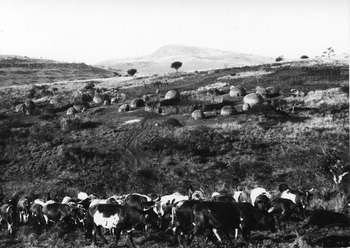
In my admittedly superficial research into Zulu life at that time, I was astonished to find statistics that estimated the number of Zulus working on the mines to be no more than 3 per cent of the mine workforce. With a white agricultural sector dominated in Natal by Indian labour, it seems the majority of Zulus led the kind of life sketched in Siliva the Zulu and described in such admiring terms by Cipriani above. It was a life where rural Zulus, who still constituted the majority, never left their kraals, and could go for years without seeing a white man and could hold to their traditional ways without any interference.
Cattle and kraal.

And while this is not a life of overabundance, it does not seem to me to be at all a demeaning one. I am particularly struck by the health radiated by the people we see. The film was shot in the South African winter, yet the people go largely naked, even the old men. The men are in superb physical condition, with hardly an ounce of excess fat among them, scarcely the result of sitting around smoking pot all day long. The hero Siliva himself has arguably the most perfect male physique to be seen on the cinema screen in any era. Everyone seems to have a natural grace and pride of bearing. I point this out because the tragedy is that all of this has been lost, not only to the devastation of AIDS, but to an impoverished diet and lack of exercise. It would be hard to find a community like this in South Africa today, perhaps even in the whole of Africa.
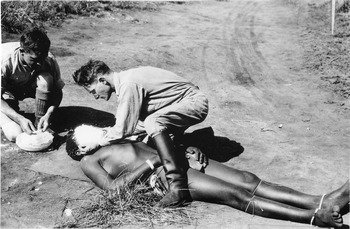
If Cipriani truly envied these Zulus, he treated them with respect. His photos do not seem to me to be depictions of a primitive people but portraits of human beings, even when he is portraying some detail like the beehive hairdo. These are not candid shots but posed portraits, because Cipriani is interested in capturing the whole image with its cultural elements of dress and bodily adornments, or a significant detail. But when you pose a body, you impose also certain cultural assumptions about the object, and at the same time, you impose with your own unconscious cultural givens. So as well as being ethnographic studies, the photos are also, unavoidably I think, in the hands of a photographic artist such as Cipriani, aesthetic creations.
Cipriani plastering face.

Besides the photos and the masks, Cipriani later published his written studies of Zulu life, which seem to me a valuable contribution, although I am simply ignorant of any similar undertakings by South African or British anthropologists at that time with which to compare them.
The fate of Cipriani’s images is of interest, and I will get back to them. What happened to the film is this: it appeared in only four cinemas in Italy, then disappeared into near oblivion. When Siliva opened in Milan, it was greeted with the relatively subdued headline ‘Zulus in Milan’ by one journal and by the more provocative ‘Zulus invade Milan!’ by another. As a sign of the times – now 1928 – Milan-Cine, a journal for film fans, begins its review thus:
At a time when, by command of Il Duce (i.e., Mussolini, of course) and in accordance with the aspirations of the people, a colonial consciousness is being formed in Italy, and our literature urges the young generation to get more deeply involved in colonial problems, to travel and get to know distant places and peoples, to find new outlets for our exuberant vitality and our products, there arrives at just the right moment an exceptional African documentary.
The article goes on to praise the film-makers for ‘having completed their film by enduring every sacrifice and enormous difficulties and dangers of every kind.’ This of course was wildly inaccurate, a concealed exhortation for the youth of Italy to emulate the adventurers.
Thus, in a manner already formulaic, but nevertheless echoing the reigning ideology, Siliva the Zulu – whatever the intentions of Gatti and Co. – was co-opted by Italian fascism, or those who paid lip-service to it to protect their careers. This should be said with the caution that this does not necessarily reflect the true feelings of the writer, but was simply a way of keeping on the right side of authority – something not totally alien to our current society.
However, although the reviewer refers to the Zulus as savages, he does not give the word a racist spin. Another reviewer, beginning with the same incantatory invocation of il Duce, praises the film-makers for overcoming every difficulty, but does not hesitate to compare in beauty the Zulu actors and actresses to the greats of the silent screen, Valentino, Pola Negri, Gloria Swanson …. Clearly, whatever Italian society was at that time, it was not consumed by racism. This would change.
In some ways the forerunner of Murnau’s Tabu, Siliva the Zulu was very well received by reviewers in Italy. But it quickly disappeared from view. This despite the fact of its extensive female nudity, which would not have gone unappreciated by macho Italians at that time; indeed, the film was originally called Venere Nera, ‘Black Venus’, clearly an attempt to cash in on the charms of the heroine Mdabuli; but because the character of Siliva so clearly dominates, the change to its name was only logical.
After the initial four openings, Siliva disappears from cinema screens. This was a sad coincidence of Gatti’s Explorator Films going bankrupt at the same time that sound films became all the rage. It is also quite possible that the film had little popular appeal. In any event, as far as I have been able to discover, it seems that distribution rights went to an educational distributor. All well and good, but clearly the prevailing nudity meant that the film in the long version of 90 minutes was unsuitable for showing to Catholic schoolchildren. A half-hour version was made. Someone doing research into the film in the 1950s turned up, and purchased, two copies in near-pristine condition; I have not been able to track down this person so far, but three copies of the film were later extant in Europe, two in Italian archives, one in France. One of the two Italian versions has been lost. However, all of these seem to have been of the half-hour version.
The most interesting copy is the one in the South African archives. It is of the complete 90-minute version, with a couple of oddities, one being a misplaced edit near the head of the film, probably the result of the film’s being torn and re-spliced incorrectly; the other being a shot near the end of the film that has been spliced in, deriving from a completely different production with white actors. This is truly a mystery – among many.
There is no record of deposit, so we don’t know the donor, nor when it was deposited. One guess is that it is possible that a copy was sent to Raymond Dart for showing in South Africa; however, since it is a negative, there is the implication that there was hope for some distribution, with a number of copies being made. I have so far failed to uncover any record of the film’s having been shown in South Africa. Most tragically, it was likely never shown to the people of Eshowe district – although there is one slight possibility that it was.
Back to Gatti and Cipriani: undeterred by the lack of success of Siliva, the two planned a very ambitious Cape-to-Cairo expedition. There are photos of them in Cape Town in 1930, but soon thereafter they parted ways, I suspect due to money problems, or clash of personality. I don’t recall seeing any mention of Gatti afterwards in any of Cipriani’s writings, but there is a somewhat mocking mention of ‘Il Professore’ in one of Gatti’s books.
Cipriani’s place was taken by another Italian anthropologist, and Raymond Dart was part of the expedition also. By the time they got to Northern Rhodesia, the Cape-to-Cairo expedition seemed to be suffering under a failing leadership, understandably, since Gatti was down with malaria. At one point, Dart confronted Gatti with the fact that they were way behind schedule; Dart’s principal concern was that he had planned to meet his fiancée at an appointed time in Italy and felt that he was not going to make it. After a midnight quarrel, Dart literally walked off into the night to make his own way to Egypt, and thence to Italy. He made it. But then, Dart is another story …. (This account was given to me by a wonderful ninety-year-old Kay Smithford, who knew Gatti in Northern Rhodesia and afterwards, and who became engaged to the Italian anthropologist who remained with the expedition.)
Gatti and Cipriani each wrote their accounts of their respective Cape-to-Cairo treks. Commandante Gatti went on to spend the rest of his life mounting expedition after expedition in Africa. A man of seductive powers, he met a young American woman in New York, and within a few days persuaded her to go on one of his expeditions, and oh, by the way, they would get married – despite the fact that Gatti already had an Italian wife, who was not the expeditionary kind, and being Catholic, they could not divorce – well, somehow this all got sorted out, Ellen went off with Gatti to the Congo and proved to be just the right mate for him, working with him through every hazard, until her death.
Gatti was first and foremost an adventurer, an explorer who came late to the game of exploration, most of it having happened in the previous century. In the service of both – exploration and adventure – he was a showman and self-promoter. His work was principally in the Belgian Congo, where he would work, mounting expedition after expedition, until his death in the 1960s. He was an enthusiastic inventor, among other things of what seems to have been an all-terrain ‘Jungle Yacht’, a huge vehicle which included a lab for developing film that traversed impossible terrains. (This was built by International Harvester of Chicago.) He loved interacting with the peoples of Africa as much as he loved slaughtering the wildlife – there is one particularly distressing photo of Gatti alongside a huge gorilla that he had shot, for no obvious reason other than to pose beside it.
Gatti was a Member of the Italian Anthropological Society, but more to the point was probably his membership in the Adventurers Club of New York. He may have made some pretence at being an anthropologist, but if he did so, it was all for the sake of adventure. A prolific writer, he was not averse to recycling material – on one occasion, he took an episode from Siliva and set it instead in East Africa as if it had happened in real life, and this was a typical practice. There is a hazy blending of fact and fiction for the sake of a good story, a carelessness with the truth of the kind that is regrettably becoming common today in our daily news reports and so-called documentary.
He was the author of some thirty-two books, most of which were translated into fifteen languages, so he was an immensely popular writer. He took thousands of photographs, made several adventure-travelogue films, many of which appear to have been lost. Of most interest from my point of view was his return to Zululand around 1959/60 to do a re-make of Siliva the Zulu, this time of course, a sound version. In fact, it turned out to be a series of half-hour films made for television, loosely based on the original script. This time, of course, the maidens’ bosoms were covered, to prevent any embarrassment for the TV viewer.
Because of this return, I conjecture as to whether Gatti might have taken with him a copy of the original Siliva to show to the people of Eshowe district, and perhaps that is how the film landed up in South Africa. It would have been laudable for Gatti to do this, but it is not even certain that Gatti himself had a copy of Siliva the Zulu at that time. And there is no record of this happening.
Gatti, in his gusto for life, his energy, his enterprise, his determination, his courage, could have been the personification of the New Man of Italian fascism. But Gatti could not find in 1930s Italy the kind of vision and willingness to finance his projects that he needed, and which was to be found really only in the United States, especially in conjunction with companies like International Harvester and Hallicrafters. So, with his useful American wife, he made his home base there, ultimately in Vermont. He probably would have had little reason to visit Italy. His first wife and their two children lived in Switzerland, and he had an amiable, if distant, relationship at least with the children. Commandante Gatti was to a certain extent shaped by the Italy of post-World War I, and his sympathies were certainly towards fascism, although he cannot be said with certainty to have practised it. However, in 1940, he wrote an article in praise of Il Duce for an Italian-American publication. Fortunately for Gatti, the article was never published, so he never landed up on any list of suspicious aliens – although if he had, he would probably have been treated better than such people are nowadays. In this, he was more fortunate than Lidio Cipriani.
By the early 1930s, Cipriani was possibly Italy’s most renowned anthropologist. He had travelled to South and Central Africa, North Africa, then to India and Ceylon. He became an authority on the Andaman Islanders. He was celebrated in Europe and America for his work. In the late 1930s, he worked in Ethiopia. This was during the period of the Italian conquest of that country, of which Cipriani approved. His interest in Ethiopia extended beyond the area of detached anthropological study: among other things, Cipriani studied how the indigenous people could be successfully colonized. Some of his work was around how well-suited different ethnic groups were to being trained as soldiers.
It is worth remembering that at that time, colonialism – often presented in the guise of enlightenment and Christian civilization – was a generally accepted system. The colonial order itself, where one country ruled over another, seemed to be proof of a hierarchy of race. ‘Racism’ was not yet a dirty word, and theories of eugenics and racial purity were widely accepted. Probably most anthropologists believed themselves to be involved in the study of ‘primitive people’.
But Cipriani’s career took him way beyond this. In fact, Cipriani had been a member of the Italian Fascist Party since 1925. His extensive fieldwork had only convinced him that white men were destined to conquer and colonize Africa, and he had no hesitation in expressing his beliefs.
…it is necessary for the civilised world not to give way to misconceived sentimentality towards people who are incapable of managing the exceptional treasures of their own country, while the pressing needs of all of humankind demand with a loud voice their exploitation.
He even declared himself to be not opposed to slavery.
His studies in physical anthropology made him aware of wide physical racial differences, and he became convinced of the cultural superiority of the white race, and above all, that part of the white race known as Aryan. He believed that Italians belonged rightfully to the Aryan race, although the nation was threatened by interbreeding with inferior peoples.
In no case may a white woman destroy by miscegenation the treasure that lies latent within her. To allow this is shameful, I would say, monstrous – inviting the gravest harm to the most civilised people.
Cipriani, with the backing of the Italian Society of Anthropology, proposed a census of ‘people of colour’ currently living in Italy. He felt that it was extremely dangerous to the race that the offspring of miscegenation could hold Italian citizenship, which threatened the purity of the race. He believed that in mixed breeding, the qualities of the ‘lesser’ race would inevitably dominate. He wanted strict vigilance against interracial relationships, and favoured adoption of Nazi eugenics. He wanted racial teaching introduced into the Humanities as well as Science. Also, he wanted to hold conferences and museum exhibitions on the subject. His credo regarding his own discipline was the following:
The various human groups must keep themselves distinct from one another so as not to harm by interbreeding those who are most intellectually endowed. In this way, anthropology transforms itself into a biopsychological study compared to the human races, champion of a particular ‘politics of the genes’, synonymous with racism.
A dedicated nationalist, he longed, like Mussolini, for the restoration of the glory of the Roman Empire, but one in which there would be strict protection of Aryan genes.
Professor Cipriani cemented his place in the Italian Fascist Party by his energy in the propagation of racial theories, by his cultivation of men of influence both inside the party and in the academic community, and by his international renown as an anthropologist. He became an intellectual force behind the Fascist Party’s colonial policy, and he co-operated closely with Minculpop, the Ministry of Popular Culture. Most speciously, at Mussolini’s prompting, Professor Cipriani, together with nine other academics, signed the notorious Racial Manifesto, which appeared in July 1938, and which laid out the groundwork for fascist policy with regard to race. It would become the basis for Italy’s race laws passed that same year.
The respect that Cipriani earlier seemed to have for Zulu culture now evaporated:
Everywhere the Negro acts like an overgrown child, childishly happy, content with simple pastimes. He shuns as much as he can the exercise of his mental powers, which he uses for imitation rather than for rational thought, especially when he is living among us. In him, natural impulses overcome reflection…. Even in individual acts, they do not follow personal concepts, but they adopt those that exist in the collectivity, even when they are illogical. Every true criticism and every action intended to assist the common good is simply beyond the grasp of Negroes. So they never spontaneously set about to construct a short road in order to avoid the hardship and even the dangers of a long path…. To work in order to have a road or a well is, according to them, not worth giving up the time they can spend in chatting hour after hour about silly things, or of jumping, making a noise, arguing, or wasting time with women.
Although these laws covered all races, they were directed primarily at Italian Jews, who, as a first stage, became second class citizens. Writing as a journalist and with the prestige of his ‘scientific’ studies, Cipriani attacked Jewish ‘subversion’ of Aryan civilization. Earlier, in 1936, Cipriani apparently harboured no anti-Semitic feelings, describing Jews as a Mediterranean people like the Italians, with a religion from the same root as Christianity, and with the same capacity for abstract reasoning as Aryan people. (Mussolini himself had earlier challenged Hitler on his anti-Jewish stance.) But as the Fascist Party moved towards militant anti-Semitism, Cipriani had no difficulty in regurgitating age-old stereotypes:
In fact, besides proclaiming themselves to be the Chosen People and therefore destined to rule the world, they subscribe to ideas like these: ‘We Jews are men; all others are cattle. The progeny of a non-Jew are therefore the progeny of animals…. The Jew is the living god, the man from heaven; other men are of the earth, of inferior race, they exist to serve the Jew … they are only beasts: slaughter the best of them…’
Writings like this, backed by the authority of the fascist state, which stripped Jews of their civil rights, would eventually lead to the death camps for what had hitherto been one of the best-integrated Jewish communities of Europe.
In 1938, Cipriani became an editor of the virulently racist magazine Difesa della Razza (Defence of the race). Cipriani had no hesitation now in distorting images that he had gathered in the service of a racist ideology. They were turned into cartoons of a crudity, akin, to take a recent example, to the smear and jeer attacks on the Prophet Mohammed in the cyberspace of the hard Right.
As an intellectual ideologue, he was a useful tool of the Fascist Party, and close to its most influential members. It is therefore extremely curious that the Party does not appear to have come to his assistance when the University of Florence (still his employer) accused him, in 1940, of selling for his own profit artefacts he had gathered on expeditions financed by the university, as well as the clay masks he had made, which were deemed not to be his personal property. While rejecting the charges, he attributed this disgrace to the malevolence of powerful personalities he had offended.
Stripped of his academic duties, in 1942 he was drafted into the army, with the rank of major. He was sent to Crete, at that time occupied by the Italians. In late 1943, he was captured by the Germans when Italy changed sides in the war, and held prisoner on the island until 1944. But even under these conditions (and probably because his steadfast fascist creed would have endeared him to the Nazis) he managed to continue his anthropological studies, gathering material for a book titled Crete and the Mediterranean Origin of Civilisation.
His dedication to fascism as more than a tool for advancement is evidenced by his decision to join Mussolini’s last-ditch so-called Salò Republic in northern Italy towards the end of the war. After the war, Cipriani was brought before a military tribunal, accused of having belonged to the fascist Racist Committee and of signing the proclamation against the Jews. In unclear circumstances, he was released, amazingly, some months later for lack of evidence. Just as strangely, in 1947 he was hired by the Government of India – obviously based on his reputation as an anthropologist, but apparently ignorant of his fascist past – for a number of expeditions to the Andaman Islands. He continued to attend international gatherings of anthropologists, and only in Italy did his past seem to be prejudicial. His work on the Andamans continued until 1954, when it was abruptly terminated by the Museum of Calcutta because his studies ‘were tainted with racist connotations’.
Surveying Cipriani’s life, it seems a case-study of the perversion of the science of anthropology for political purposes in an arena where this became literally life-threatening for thousands of people. As with other scientists, then as now, Cipriani’s research was seriously tainted by his political beliefs. He was a virus of racism during a century when this would become the overwhelming plague.
He clearly had great respect for Jewish intellectual accomplishments, and was contemptuous of Nazi anti-Semitism, which seemed to him primitive, lacking in the ‘scientific’ proofs of the threat to the race that racial mixing presented, such as he believed his own studies provided. However, he became increasingly anti-Semitic, involving himself in ridding the University of Florence of his Jewish colleagues, and writing diatribes against Jews. Eventually, he would express satisfaction that the Fascist Party was facing up to the Jewish problem with its customary determination, ‘enough to ensure the disappearance once and for all from Italy of the Jewish plague’. There is no way that this can be explained away.
At the same time, exasperatingly for us, Cipriani left a considerable legacy of scientific information. Although he himself perverted its use, it remains a treasury of knowledge. It seems an anomaly that his thousands of photographs – mainly studies of human types ranging from Africa to India – far from being demeaning stereotypes, if anything tend towards depictions of the Noble Savage.
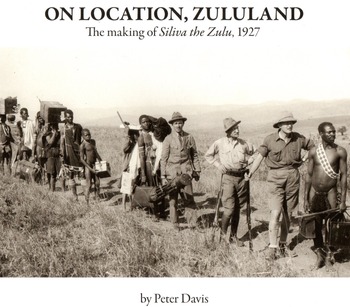
The author’s book cover of On Location Zululand: the making of Siliva the Zulu, 1927.

Cipriani spent the last years of his life in Florence, under the cloud of his fascist past. Rejected by a humanity he had attempted to degrade, his last studies were on animal behaviour.
Peter Davis is a filmmaker and writer whose long record includes many documentaries on Africa. He is distinguished particularly by his work on South Africa during the apartheid period, including biographies of Winnie and Nelson Mandela. He continues to be active under the name of Villon Films.