

Introduction
This paper uses the biography of a filmmaker known in Indonesia as Dr Huyung to examine the history and legacy of Japanese colonialism in Asia and the nationalist histories that have since been constructed in both South Korea and Indonesia. It will show how Dr Huyung's role changed over the course of his life from colonial subject, to colonial collaborator, to colonial agent, and finally to pro-independence nationalist. His biography opens new perspectives on the spaces, opportunities, and identities created by colonialism and post-colonial nationalism, moving beyond ideas of ambivalence and the dichotomies of nationalist historiography to assert mobility, self-reinvention, and ‘third spaces’ as strategies for surviving the tumultuous period of Asian decolonization in the 1940s and 1950s.
It has been argued by Homi Bhabha (Reference Bhabha1984) that the colonial encounter is fraught with ambivalence between the colonisers and the colonised. What this means is that the relationship between colonisers and colonised is not simply one of power and subjugation, but that it produces mixed responses in both. Here it has been argued that while the colonised hate the oppressors, they still desire their status and culture. Similarly, the colonisers want the colonised to mimic them in terms of language, culture, and norms while maintaining that as subjects they are always inferior. In colonised Korea, for example, the Japanese expected ethnic Koreans to mimic Japaneseness by learning Japanese and taking Japanese names, but still always regarded Koreans as inferior. As a result, the colonial encounter contains this unresolved tension between the colonisers and the colonised, existing in an ambivalent relationship with each other.
What remains unexplored in this scenario is how a third geographical location may affect this relationship. Typically, the colonial encounter happens in the country or land of the colonised, but does in some cases occur elsewhere. For example, Japan's empire in the early twentieth century expanded into Korea and China, but by the 1940s had extended south into the Philippines, Malaya, Singapore, and Indonesia. Many ethnic Koreans were recruited by the Japanese as soldiers and support staff servicing the empire in Southeast Asia. This paper traces the biography of one such ethnic Korean who went by the Japanese name of Hinatsu Eitarō. He was born in Korea, and moved to Japan to study film as a Japanised colonial subject, before moving to occupied Indonesia as a colonial agent in 1942. Then, after 1945, Hinatsu became Dr Huyung and switched allegiance again, becoming a pro-revolutionary nationalist supporting Indonesian independence. This complicates the typical coloniser-colonised relationship familiar to studies of colonial societies by considering Indonesia as a third space.
As this paper will show, Huyung's biography allows us to reconsider the ambivalence of the colonial encounter. Most studies to date that consider Hinatsu-Huyung focus either on his life before arriving in Indonesia in 1942 (e.g. High Reference High2003; Yecies and Shim 2012), or on his life in Indonesia, especially after 1950 (e.g. Biran Reference Biran2009; Said Reference Said and Siagian1991). One of the few studies that does consider his entire life is the Reference Utumi and Yoshinori1987 Japanese book シネアスト許泳の「昭和」 (Cineaste Hoe Yoeng's Showa Era) by Utumi and Murai, but as it is in Japanese it remains inaccessible to this author and is a lacuna in this research. By considering his life in its entirety, this paper is able to question how nationalist historiography constructs the categories of collaborator/traitor and revolutionary/nationalist in both the Indonesian and Korean nationalist contexts. Instead, we see how new forms of identity and subjectivity were created under colonialism, how the colonial situation created opportunities for colonial subjects, and the legacy that this has left scholars and historians for the study of colonialism in Southeast Asia, national histories, and the history of film.
The Making of a Japanese Collaborator
Dr Huyung's life was shaped from birth to death by Japanese colonialism. He was born Heo Yeong (허영) in 1907 in Hamgyeong Nam province on the east coast of what is now North Korea, three years before the Japanese annexed the Korean peninsula.Footnote 1 He moved to Japan in 1925 at age 18 and, assuming the Japanese name of Hinatsu Eitarō (日夏英太郎), enrolled in the elite Waseda University in Tokyo to study filmmaking in the school of Film and Performing Arts. At some point he studied cinematography at Universum Film AG (UFA), the premiere German production studios which produced the Nazi propaganda film Triumph of the Will (1935) amongst others. In Japan, Hinatsu found work at a number of film companies including Makino Film Productions, Suzugin Jange, Shinkō Kinema (in Uzumasa Kyoto), and as assistant director to Kinugasa Teinosuke.Footnote 2 Described by Baskett as an “upwardly mobile Korean colonial youth” (2008: 87), it appeared that from early on Hinatsu had assimilated his Japanese identity and was using it to pursue a career in the film industry that would enable him to direct his own films.
Early in 1937, however, Hinatsu's film career appeared to be over. While working as assistant director for Kinugasa Teinosuke on Osaka Natsu No Jin (1937, The Summer Battle of Osaka), an on-set explosion went wrong, damaging the stone wall of Himeji Castle, a national heritage building and, according to one source, killing one person and injuring seven others (NHK 1993: 6). In the subsequent police investigation, Hinatsu was revealed to be an ethnic Korean and in 1938 he was convicted with reprieve. He was able to graduate from Waseda University in 1938, but it appeared his filmmaking career in Japan was over. It is not clear if the accident really was Hinatsu's fault or whether he was singled out because of his Korean background and was thus an easy scapegoat. Either way, the event would lead to Hinatsu becoming even more of a Japanese collaborator.
A year later, in October 1939, the Japanese government legalised their policy of controlling film production by bringing all film companies under their control (Kurasawa Reference Kurasawa1987: 66–67). Even famed directors such as Akira Kurosawa found themselves having to produce films favourable to the wartime Japanese government. These circumstances gave Hinatsu the opportunity to write and direct his own film You and I (1941, Neo-wa Na / Kimi to Boku). In consultation with Japanese film critic Iijima Tadashi, Hinatsu spent a lot of time and effort preparing a script and then lobbying the Korean Forces Command to have his film approved for production (A Filmmaker with Three Names 1997). Inspired by the story of Yi In-suk – a Korean volunteer soldier killed in action and made an exemplary hero by the Japanese – it tells the story of a young Korean man who volunteers as a soldier for the Japanese, leaves his family and his proud father for the front lines, and falls in love with a Japanese woman. It is “a short precis on how to become a model imperial subject whom the Japanese would admire” (Baskett 2008: 85). You and I became the biggest film made by a Korean at that time and received huge backing from the army. For the Japanese, Hinatsu was the perfect propaganda ambassador because he was an ethnic Korean who exalted the Japanese.
You and I earned Hinatsu significant notoriety and he experienced a backlash from his friends, from Korean nationalists, from critics, and subsequently from historians. In a 1997 Korean documentary made about his life, You and I is described as “a humiliating debut as a director” (A Filmmaker with Three Names 1997). Although public criticism was muted at the time for obvious reasons, reactions to the film were not positive (High Reference High2003), and probably intensely negative from within the circle of Hinatsu's Korean film industry peers. High describes You and I as a mockery of a film (High Reference High2003), heavily saturated with propaganda and watchable only because of the plethora of stars pulled in and the musical numbers interlaced throughout the story (Yecies and Shim Reference Yecies and Shim2011). High suggests that Hinatsu made this film partly as opportunism to advance his film career, but also because of his “thoroughly ‘colonized’ psychology” in which he believed in the primacy of the Japanese (High Reference High2003: 309). Conversely, Hinatsu's Japanese daughter, reading her father's writing at the time, suggests that in You and I “the real intention of my father was to display the splendid history of the Korean Royal Palace and its culture to the inland people” [i.e. to colonised Koreans].Footnote 3
From available sources, it is hard to discern the definitive reason Hinatsu decided to leave for Indonesia in 1942. Arguably, his move was a logical extension of his already pro-Japanese position and made to advance his career, but it may just as easily have come from a sense of regret and humiliation from having made You and I. Making it was a Faustian bargain for Hinatsu, in that it gave him the opportunity to make and direct his first feature film but, as blatantly pro-Japanese propaganda, it lost him respect in his Korean community of peers. According to his friend Sasagi Genichiro from the Shinko Cinema, at his farewell drinks party Hinatsu sat and drank without saying a word (A Filmmaker with Three Names 1997). At the stopover in Kyoto, Hinatsu did not disembark to visit his wife and newborn child. Broken by his experience in Korea, his friend Sasagi stated “He said he was not going back to Korea but to Southeast Asia” (A Filmmaker with Three Names 1997). Moving south to Indonesia allowed Hinatsu to escape his past and reinvent himself in a new context, at the cost of becoming a colonial agent in the service of the Japanese empire.
As Colonial Agent
Sendenbu, Japan's propaganda apparatus in Java, was particularly extensive and powerful and would have a profound effect on the residents of occupied Indonesia (Kurasawa Reference Kurasawa1987), as well as the local artists in its employ. Bahasa Indonesia was used in propaganda material to reach as many of the local population as possible, cementing it as the official language of governance of the subsequent modern Indonesian nation (Heider Reference Heider1991: 16). As in other parts of Japanese-controlled Asia, “the Japanese were able to train local technicians in the craft of making films of the highest technical quality while… serving their own propaganda interests” (Anderson and Richie Reference Anderson and Donald1982: 158; see also Said Reference Said and Siagian1991: 34). Local film production had been active right up until 1942, but with the Japanese occupation these companies were closed or were amalgamated into the Japanese company Nippon Eigasha (established in April 1943) and many film workers moved into theatre during this period (Ramdhan and Pane Reference Ramdhan and Nina2006: 10). Emphasis was given to audio-visual media such as theatre, news reels, film, traditional wayang, and Japanese paper puppetry (kamishibai) because they were seen as more effective at reaching the illiterate countryside where the majority of the. population lived (Kurasawa Reference Kurasawa2015: 256).
Following the difficulties faced by Japanese colonisers in China, a greater effort was made to ensure that the idea of the Greater East Asian Co-Prosperity Sphere and Japan's role as leader in Asia were accepted by the colonised population (Cohen Reference Cohen2016: 175–176). To achieve this, ‘culture-men’ (bunka-jin), civilians with expertise in fields such as manga, writing, journalism, film, and theatre, were recruited by the Japanese government to run the vast propaganda apparatus necessary to their rule (Kurasawa Reference Kurasawa1987: 61). Bunka-jin occupied an “influential mediating role between occupier and occupied” (Mark Reference Mark and Post2010: 349) and “many of them not only promulgated but believed in a conception of the war as one of ‘liberation’ from Western domination and its evils both for Japan and for Asia” (Mark Reference Mark and Post2010: 350). To work alongside the bunka-jin, many local artists and playwrights were recruited into the Sendenbu, including brothers Armijn Pané (writer) and Sansui Pané (writer), Utojo (musician), Simanjuntak (musician), and Usmar Ismail (playwright).
Not much is known about Hinatsu's role or work between his arrival in 1942 as a bunka-jin and 1943 when he directed Australia Calling (Goshu no Yobigoe) since he does not seem to have occupied any prominent leadership roles in any of the Sendenbu's divisions. Hinatsu was assigned to direct Australia Calling under the direction of Captain Yamagawa after Kurata Bunjin, who was chief of the Nippon Eigasha, refused to direct the film. According to Hidenori (Reference Hidenori2002), Kurata Bunjin refused because it went against the Japanese values of bushido (chivalry) and he preferred instead to focus on education and training.
Australia Calling was a blatant misrepresentation of how Allied POWs were being treated by the Japanese forces and is regarded as a “war atrocity” by the ex-prisoners (High Reference High2003: 468). It showed how ‘humanely’ the Japanese were treating Allied POWs (High Reference High2003: 468–470) with scenes of them playing sports outdoors, putting on a play, and eating steak.Footnote 4 Directing Australia Calling solidified Hinatsu's status as an agent of the Japanese empire; however, it is hard to discern Hinatsu's own position on the film and its content, especially since the task of directing Australia Calling was probably thrust upon him (Hidenori Reference Hidenori2002). The film was lost for many years until its rediscovery in the 1980s in an Australian archive. Australia Calling was the subject of a counter-propaganda Dutch film called Nippon Calling (1946; also known as Nippon Presents) featuring many of the same Australian soldiers. Although Australia Calling represented the worst kind of propaganda because of its distortion of the truth of how POWs were treated, the fact that the film was lost for so long and that Hinatsu was not credited with the film meant that he escaped some of the notoriety that may have followed.
Following Australia Calling, Hinatsu was placed in charge of the Perserikatan Oesaha Sandiwara di Djawa (POSD, Java Theatrical Play Association) established in August 1944 as an umbrella organisation for all theatre groups in the country. It is here that Hinatsu would be credited with seven scripts: Fadjar Telah Menjingsing (1944, Dawn is Breaking), Samoedra Hindia (1944, Indian Ocean), Moesim Boenga di Asia (1944, Blossoming in Asia), Pradjoerit Nogiku (1944, Soldier from Nogiku), Djoedjoer Moejoer (1945, Prosper Honestly), Benteng Ngawi (1945, Ngawi Fortress), and Boenga Rampai Djawa Baroe (1945, New Java Medley), collectively published in the book Fadjar Masa on 26 April 1945 (Hutari Reference Hutari2009: 89). Kurasawa (Reference Kurasawa1987: 109–111) also credits Hinatsu with writing Toeroet Sama Amat (1945, Following Amat). POSD seems to have come about due to a multiplication of theatre groups and incorporated Djamaluddin Malik's theatre groups at the time, Pantja Warna (Five Colours) and Bintang Timoer (The Eastern Star). As head, Cohen (Reference Cohen2016: 238) describes Hinatsu as an “authoritarian” figure and one review of his Samoedra Hindia calls it “boring” due to its heavy-handed propaganda (Hutari Reference Hutari2009: 111).
Despite the fact that cultural industries came totally under Japanese control from 1942 to 1945, the period is seen positively by Indonesian nationalists for the impact it had on the subsequent emergence of an Indonesian national cinema after 1950. In standard accounts of film history, the period prior to 1942 is seen as being purely commercial in its orientation and providing limited opportunities to native Indonesians in production (Biran Reference Biran2009). By contrast, the Japanese actively employed native Indonesians to write and produce cultural works, including films, and provided them with technical education (Biran Reference Biran2009: 339). The Japanese focus on film as propaganda introduced many young Indonesians to the potential for film as a medium for education directed at the broader population (Kurasawa Reference Kurasawa1987: 348). Usmar Ismail regards the years of the Japanese occupation favourably, saying that it “created an understanding of the function of film which became extremely useful in efforts to develop a national film industry after independence” (Ismail Reference Ismail and Siahaan1983[1954]: 55).Footnote 5 While collaboration with the Japanese did not sit easily with Indonesian nationalism, it was nevertheless crucial in bringing cohesion and organisation to many of the disparate anti-colonial figures and movements under the Dutch and giving them a revolutionary focus (Ricklefs Reference Ricklefs1981).
While Hinatsu played the role of Japanese agent, he also made a positive impression on the Indonesian artists who were recruited into the Sendenbu. Armijn Pané recounted meeting Hinatsu after he had been told there was a “good (hearted) theatre expert” working in the Japanese censorship office (Pané Reference Pané1955: 26–27). Armijn Pané (1908–1970) was one of Indonesia's most prominent pre-war intellectuals: he edited the literary magazine Poedjangga Baroe (1933–1942, New Writer) and authored the novel Belenggu (Shackles) in 1940. Armijn Pané writes:
Later, after the Censor's Office had moved to West Gambir, I got to know him [Hinatsu] as an officer specializing in theatre. At that time I didn't consider him differently to the other Japanese. One of the Censor officers sneered when I asked: I'm here about theatrical production and would like to meet Hinatsu Heitaro, as that was his name at the time. I didn't understand what the officer had meant. Later, after the revolution, I came to know what the officer had meant by his sneering. (Pané Reference Pané1955: 26–27)Footnote 6
This reminder of Hinatsu's Korean origins and thus his inferiority compared to his Japanese colleagues was no doubt a source of constant acrimony and a reminder that while he worked for the Japanese, he was not considered Japanese. He may have compensated for this by being “more Japanese than the Japanese” (Cohen Reference Cohen2016: 226), as one acquaintance describes him, although “he did not mix with the Japanese” according to another (Kim quoted in NHK 1993: 25). While Hinatsu occupied an ambivalent position in relation to the Japanese, for the Indonesians he was a sympathetic personality, hardworking, and dedicated to the arts.
By 1945, the course of the war was irreversibly heading towards a Japanese defeat. Open warfare, however, had largely bypassed Indonesia, influencing the subsequent independence movement and their fight against the returning Dutch (Ricklefs Reference Ricklefs1981: 197–199). This was a crucial time for Hinatsu as he saw the collapse of that Japanese power which had been present for almost his entire life and of which he had once spoken so positively (High Reference High2003: 309). It was at this point, as the other Koreans around him turned against the Japanese, that his sense of Korean identity emerged. Hinatsu planned to return to Korea with them. Between August and September 1945, he was active in securing the release of eight imprisoned members of the Korean Youth Party for National Independence.Footnote 7 As one of the party members recalls, “he tried day and night to get us out of prison” (Kim Sun Gi quoted in A Filmmaker with Three Names 1997). Hinatsu joined the Association of Korean Residents in Java, becoming their media officer, and worked to have the approximately one thousand Koreans repatriated. He even started to learn Korean in preparation.
Yet becoming Korean again was not that simple for Hinatsu because his past deeds could not easily be forgotten. As Hinatsu himself explained to a friend:
You [Koreans] all came here [to Indonesia] in a group to work for the Japanese military. But I on my own initiative persuaded the Korean Colonial Government to make You and I with the support of the Colonial Military Forces. Everyone knows about You and I. Everyone knows that Heo Yeong and Hinatsu Eitarō are one and the same. And in addition to that, my Korean isn't even that good. I'm a Korean who knows almost nothing about Korean history other than what little I studied about in Tokyo. […] If I returned to Japan now there wouldn't be any jobs for me and if I returned to Korea, I'd most likely be branded a Japanese collaborator. (quoted in Baskett 2008: 89)
His fellow Koreans recount the story of a British officer who came and demanded a Korean woman from them, and they were disappointed when Heo Yeong [Hinatsu] did not stand up to him (NHK 1993). Their disappointment turned to anger and they accused him of being a Japanese collaborator. Their accusations played on Hinatsu's fears that he would be punished when he returned to Korea for having been a Japanese collaborator and agent. Kim Songi, one of the directors of the Korean Residents Association, remembers that,
Hinatsu was quite shocked to hear this. I remember the day he came up to me in tears. He said that he thought he would be understood by his fellow members because they were all in a similar situation. They were also the people who had been living in a foreign county and fighting for the Japanese military as Koreans. But if they didn't understand Hinatsu, who would? I'm sure he was worried about whether he would be accepted by the Koreans in Korea. After that, Hinatsu cut himself off from the Koreans and went with his Indonesian friends. (quoted in A Filmmaker with Three Names 1997)
Hinatsu had been inspired by the nationalism and dedication of the Indonesians he had worked with in the Sendenbu. Adopting the Indonesianised spelling of his Korean name and adding the doctor title, Dr Huyung left Jakarta for Jogjakarta where the republican forces had established their temporary government.
Up until this point in his life, it is easy to see how Hinatsu-Huyung has been understood as an agent of the Japanese empire and thus a traitor to his Korean origins. This is particularly evident in You and I, which marks him as a collaborator according to Korean nationalist historiography. Alternatively, his life can be interpreted as having been driven by opportunism and pragmatism for which he had to mimic Japaneseness due to the limited opportunities afforded a Korean under Japanese rule. Most English-language accounts of his life stop at this point, seeing his life largely within the Korean-Japanese context. Without considering his life after 1945, these accounts are incomplete and fail to take into account Huyung's ‘second life’ in Indonesia. As the next section will show, his life in Indonesia after 1945 creates a very different reading of his biography, his identity, his sense of belonging, and his position as a colonial subject.
A Pro-Revolutionary Nationalist
Dr Huyung quickly established himself as part of the cultural and artistic life of the city of Jogjakarta and the emerging nation of Indonesia. The period between the Proclamation of Independence (17 August 1945) and the actual achievement of independence (27 November 1949) was tumultuous: the Dutch returned, aided by other Allied powers, to reclaim their former colony, factional fighting and internal struggles within the independence movement almost resulted in civil war, and the continued presence of Japanese soldiers complicated matters (Ricklefs Reference Ricklefs1981). In the revolutionary capital, Dr Huyung spent a highly productive period producing a number of plays in collaboration with Djadug Djajakusuma, renovating and refitting a cinema (Soboharsono) and a theatre (Seni Seno), and in 1948 established the Stichting Hiburan Mataram (Mataram Entertainment Foundation). With backing from the Ministry of Information, he established the country's first film and theatre schools called the Kino Drama Atelier (KDA) and the Cine Drama Institute (Cohen Reference Cohen2016: 238). During this interregnum period, Dr Huyung worked hard to build and maintain his bridges with the artistic community, situating himself as a central figure in the artistic and cultural life of the new republic.
The situation following the Japanese surrender was unexpectedly fortuitous for Huyung. Although there was widespread resentment against the Japanese occupation, the Japanese themselves were not purged from Indonesia and the independence struggle focused on fighting the Dutch who were attempting to reclaim their former colony. Some Japanese and Koreans elected to stay in Indonesia after 1945, including former soldier Yang Chil-seong (양칠성), known in Indonesia as Komarudin, who led guerrilla skirmishes against the Dutch. Being Korean might have helped Dr Huyung, but he was obviously liked by his Indonesian friends, especially if the opinion of Armijn Pané quoted above is taken as representative (Pané Reference Pané1955). On the enactment deed for the KDA, Dr Huyung is listed as a high-ranking official in the Department of Information, along with two other signatories from the Department, suggesting Huyung maintained a status similar to that he held in Sendenbu under the government of the revolutionary republic. These connections and his position helped him to establish himself as an important figure in the temporary capital, enabling him to continue his work in film and theatre.
As a theatre supporting the revolutionary cause, the KDA produced and performed plays relevant to the politics and concerns of the day. Their first production was a salutation to the young republic's government, a production called Drama Reportage Penduduk Jogjakarta (n.d., Dramatised Reportage from the Residents of Jogjakarta). Another KDA production, Konvoi Penghabisan (1949, The Final Convoy), celebrated the fourth anniversary of the Declaration of Independence. The comedy Revue Fantasia (n.d.) brought together the students of the KDA with famous actors, including Agus Muljiana, Hardjomuljo, and D. Ariffin (Ksatriya Dharma). Posters for the play Rosina Dalam Taufan (n.d., Rosina in the Cyclone) to accompany the Indonesian Women's Conference (Kongres Wanita Antar Indonesia) had already appeared during the performance for Drama Reportage Penduduk Jogjakarta. In celebration of the 1949 Chinese revolution, the KDA staged the play Malam Sutji (1949, Holy Night) between 8–10 October 1949 after only two days of rehearsal. Expressions of solidarity, celebration, and informative presentations enriched the cultural life of the revolutionary capital and served as propaganda for the revolutionary cause.
Huyung taught both theory and practice to around 50 students of the KDA, and provided them with valuable practical experience through the various KDA productions. Experts in literature and the arts gave lectures and one particular ten-day course brought together Prof Dr Prijono, Katamsi, K.H. Dewantoro, and Dr Huyung himself to teach students. Students of these lectures and of the KDA included Trisno Soemardjo, Kusbini, Usmar Ismail, D. Djajakusuma, and Sri Murtono amongst others. Huyung and his KDA continued the education and instruction given under the Sendenbu, introducing young Indonesians to the disciplines of theatre and film through both theory and practice, but this time within a revolutionary context, serving as incubator for many of them in the tumultuous years of the revolution. A recent account from Pantau magazine writer Budi Setiyono (Reference Setiyono2010) calls Dr Huyung the “filmmaker's teacher” (“guru para sineas”).
Despite the prominence and activity of the KDA, there is little recognition of Huyung's efforts in accounts of the Indonesian film industry. The calibre of the people who were associated with his school is indicative of the quality and importance of his influence.Footnote 8 Although his was not the only arts group active at the time, Dr Huyung provided artists with coherence and an institutional structure during this turbulent period. A theatre student of his recounts having to master all the skills associated with theatre including decor, props, lighting, and so on (Ratih Reference Ratih1952). Soemardjono, who went on to become one of the greatest directors and film intellectuals in Indonesia, was twenty-two when he studied at the KDA. He says Dr Huyung “was the one who taught me what film making is about” (NHK 1993: 35–36). Film historian and former producer Misbach Yusa Biran said Dr Huyung “was [able] to convey to the Indonesian people the importance of movies, through his teaching at the Atelier. Until then, people in our country didn't value movies as an art form” (NHK 1993: 35–36). However, reading histories of the Indonesian film industry, recognition of Dr Huyung's depth of involvement is brief and cursory and he figures as an intermediate figure between the colonial era and independent Indonesia after which the pribumi (natives) such as Usmar Ismail and Djamaludin Malik became preeminent.Footnote 9
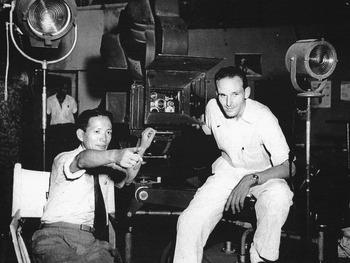
Following independence, Dr Huyung moved to Jakarta and began production on his first feature film free from colonial controls. Antara Bumi dan Langit (1950, Between Heaven and Earth) written by Armijn Pané is a love story between an Indo (Eurasian) woman, Frieda and Abidin, a native, who are reunited after twenty-seven years of separation but who find themselves on different sides of the revolution (see Figure 1.). Their rekindled love, however, is stronger than her betrayal of the revolution, and she is persuaded to join him in the fight for independence. Controversy erupted when pre-production stills showing a kissing scene were released to the press and protests by a Muslim youth group in Sumatra attacked the film for not being compatible with Indonesian culture. While not officially banned (though it did cause somewhat of a crisis for the Film Control Board (Harrymawan Reference Harrymawan1951: 51)), Dr Huyung delayed the film's release by six months, releasing it with the title Frieda (1950). Armijn Pané, who had been very active in defending the film from critics, was exasperated by the experience and refused to be credited. He dedicates a significant portion of his long essay ‘Produksi Film Tjerita di Indonesia’ (Reference Pané1953, Feature Film Production in Indonesia) to discussing the case of Antara Bumi dan Langit.
Dr Huyung (second from the right) on set shooting Antara Bumi dan Langit. Photo courtesy of Peter Schumacher.

As his first Indonesian film, Antara Bumi dan Langit is poignant as it directly tackles the question of who belongs in the new nation and challenges the prevalent ethno-nationalism. If it is indeed possible that a film can tell us something about its director, this film suggests that Dr Huyung was still engaged with questions relating to his own heritage and sense of belonging in his newly adopted nation. Dr Huyung was no doubt subject to some suspicion because of his origins and background, just as ethnic Chinese and Eurasians were, and through the film was able to show that foreigners could also support independence. On the copy of the script held at the Sinematek film library in Jakarta, a handwritten note by Dr Huyung describes the film as being at the centre of fierce debate between progressive and reactionary groups.Footnote 10 Unlike You and I, which brought him shame and regret, in Antara Bumi dan Langit Huyung expresses a sense of political purpose, offering an inclusive vision of Indonesian nationalism in the cultural tradition of what Armijn Pané calls acculturatie, or cultural melange (Reference Pané1953: 89). This was evident for example in the multicultural nature of the crew represented in Figure 2.
Dr Huyung (left) and Dutch cameraman Eimert Kruidhof (right) on the set of Antara Bumi dan Langit. Photo courtesy of Peter Schumacher.

One legacy of Huyung's experience with Antara Bumi dan Langit was his engagement in public debates around censorship and its role in the new republic. In a series of writings published in Aneka magazine called ‘Tjatatan Film’ (Film Notes), Dr Huyung questioned the purpose of censorship (Huyung Reference Huyung1951, Reference Huyung1952a, Reference Huyung1952b, Reference Huyung1952c). Once a film had passed censorship, he reasoned that it should receive institutional backing from the Censorship Board against spurious and reactionary attacks such as he experienced with Antara Bumi dan Langit. Rather than siding with protests, he argued that the Censorship Board should protect filmmakers who often had little institutional backing or public support. Otherwise, any film could be criticized and forced to be withdrawn, not only causing financial losses for the filmmakers and their investors, but inhibiting the development of the nation and its culture. Indeed, similar problems for filmmakers have emerged following the end of authoritarianism in 1998 as the Censorship Board has struggled to adapt its role to a democratic era. Many young filmmakers have become exasperated by the failure of the Censorship Board to protect them from protestors despite their films having passed censorship (Barker Reference Barker2011). While contemporary filmmakers have preferred to campaign for the abolition of censorship altogether, there is an argument to be made for the Censorship Board to be actively protecting filmmakers.
Huyung resumed filmmaking, and his next three films did not contain any of the controversial material of Antara Bumi dan Langit but still dealt with issues relevant to the new nation. Based on a popular play by Utuy T. Sontani, Bunga Rumah Makan (1951, The Flower of the Restaurant) received positive reviews for its portrayal of a love story between a pretty waitress and an uncouth male customer. Kenangan Masa (1951, Memories Past) told the story of Sumiati who engaged to Anwar but becomes jealous of Maria, his childhood friend. One critical review says the film merely imitates American films and that Dr Huyung “is unable to uncover the spirit and character of Indonesian people”Footnote 11 (Preview 1952). Gadis Olahraga (1951, Sportswoman), a continuation of Kenangan Masa, tells of how after the death of her husband, Maria returns to her village to train as an athlete and wins at the National Athletics Championships held in Jakarta. Gadis Olahraga presents sport both as a means of self-improvement and as a modern institution in national development. Moreover, the central character is a woman and at the time this was (and still is) a bold and progressive statement to make. Unfortunately, only synopses and brief reviews of these films survive while the films themselves have been lost.
Reportedly, Huyung had been working on translating a copy of Shina No Joru (1940, China Nights) for Indonesian audiences just before his death. The choice of this story is interesting because many regard it as another example of Japanese propaganda, as it involved the love story between a Japanese soldier and a Chinese woman. It was also a hit as a film in Japan due to the Chinese actress Ri Koran and the songs (High Reference High2003: 274). Without historical sources to verify the reason behind his choice, some possible reasons can be suggested. The economic reason is obvious, that a highly popular film in Japan could sell well in Indonesia and bring Dr Huyung much-needed capital to continue making films. He may have still been clinging to ideas about an Asian brotherhood, in the spirit of the Co-Prosperity Sphere as promulgated by the wartime Japanese. Or simply this was a film that made a huge impression on Dr Huyung, possibly inspiring You and I, and he wanted to bring it to Indonesia. The answers to these questions and many others went to the grave with Dr Huyung on the 9th of September 1952.
Nationalist Histories and Third Spaces
Huyung's biography offers a means to interrogate nationalist historiography in both South Korea and Indonesia. In both countries, nationalist historiography, also called a ‘nationalist paradigm’ (Glade Reference Glade1991), is the dominant frame in which colonial history is remembered and interpreted. Nationalist histories tend to create dualities of temporality, origin, and subjectivity. Time is divided between before and after independence; individuals are designated based on their allegiance as either pro-revolutionary or collaborator/traitor; and foreigners and transnationals are ignored in favour of indigenous figures. Due to his actions and origins, Huyung has been subject to this discourse, typically falling on the ‘wrong’ side of nationalist history in both Korea and Indonesia.
In Korea, the distinction between collaborators/traitors and nationalists/victims is particularly pronounced. Hinatsu is a maligned figure in Korean national history for directing the pro-Japanese propaganda film You and I. He is seen as a colonial agent and willing collaborator with the Japanese imperial project. However, by appreciating his trajectory after 1945, a much more complicated picture emerges of a man who switched sides as he crossed borders: from being a colonial subject to being a colonial agent; from being a colonial collaborator to becoming a revolutionary supporter. This was possible because of Hinatsu's ambivalent position as a Korean working for the Japanese in Indonesia, and as much as he may have tried, he could not erase the fact that he was Korean, and not Japanese.
Huyung therefore becomes an example of what Mark (Reference Mark and Post2010: 349) describes as “the full ideological complexity and significance of this [occupier and occupied] interaction.” Recent academic work has begun to challenge the strict duality of nationalist historiography as more people recognise the ‘grey area’ between collaboration and resistance (Kim Reference Kim2005: 6). Indeed, recent historical work reveals a much more complicated picture of negotiation and opportunism, recognising that some people were the victims of circumstances making it impossible to be exclusively a collaborator or resister. Ethan Mark (Reference Mark2006), for example, has documented the story of the Indonesian ‘collaborator’ Sanusi Pané whose ideas of Asianism became entangled with the pan-Asian vision of Japanese colonialism. Another contradictory trajectory is seen in the figure of anti-fascist Japanese writer Takeda Rintarō, who on becoming a bunka-jin in Java became entangled within a web of contradictory political and social ideas (Mark Reference Mark2014).
Huyung offers another model since he belonged neither to Japan nor to Indonesia. In this, he has much in common with another Japanese ‘collaborator’, dancer Choe Seung-hui who owes her fame to the opportunities given to her by Japanese colonialism. Park Sang-Mi writes that,
Choe rose from relative obscurity to become an East Asian cultural activist on- and offstage who represented the entire wartime Japanese Empire. This did not simply occur out of luck, nor was it the outcome of some helpless collaboration with the Japanese to survive oppressive colonial times. The specific conditions of the 1930s established Choe, who had been no more than a novice in Ishii's dance studio in the 1920s, studying Western ballet with Japanese students, as a prominent figure who was to contribute to the overall cultural clout of the Japanese Empire. (Park Reference Park2006: 625)
Choe travelled beyond the borders of the Japanese empire as a Korean subject and came to represent Korea on the world stage even though she was working as part of a Japanese cultural mission. In a similar way, Dr Huyung's biography traces a similar trajectory, not simply as a collaborator, but as someone who had to negotiate the compromising conditions created by the Japanese empire for an ethnic Korean.
Huyung's biography also complicates the ethno-nationalist history of Indonesian cinema in which indigenous Indonesian filmmakers Usmar Ismail and Djamaluddin Malik are given precedence (Barker Reference Barker2010). Dr Huyung is a peripheral figure in the emergence of a post-independence film industry, known more for having produced the first kissing scene in an Indonesian film than for any other contribution he made (see for example, Indrarto Reference Indrarto2013). Usmar Ismail, a contemporary of Dr Huyung's, was also a native (pribumi) and a nationalist, and in keeping with the ethno-nationalist foundations of Indonesian nationalism, is privileged over so-called foreigners such as the ethnic Chinese who have often been denied recognition in the foundation of the Indonesian film industry (Setijadi-Dunn and Barker Reference Setijadi-Dunn and Barker2010). However, Huyung's contribution to the Indonesian film industry challenges the racialised account of Indonesian independence and the history of the film industry.
The mobility, opportunism, and re-invention that shaped Hinatsu-Huyung's identity also pose a challenge to nationalist historiography in both South Korea and Indonesia. While we have seen the ambivalence of his identity as a Korean subject of colonial Japan, after 1945 he undergoes a process of re-invention signified by his adoption of the title ‘Dr’. Although he graduated from Waseda University, the ‘Dr’ title refers more to his sense of status as a film intellectual and practitioner, his desire to give himself a certain amount of clout and prestige in post-1945 Indonesia. Like Choe in the USA, the third space of Indonesia for Huyung represents an arena in which this process becomes possible, allowing him to escape the troubling ambivalence of being a ‘collaborator/traitor’ and to find belonging in the emerging independent nation of Indonesia where his skills in theatre, film, and propaganda were valuable and needed. In this sense we can see that it was possible for a colonial subject to transcend the stalemate of the ambivalence embedded in the colonial encounter and move beyond the binary logic of nationalist historiography.
Conclusion
In conclusion, the biography of Hinatsu-Huyung opens up new avenues of enquiry on the relationship between colonialism and the subjectivities it produced. This paper has shown how a lone figure born under the yoke of Japanese colonial rule became a foundational figure in the establishment of Indonesia's post-independence film industry. Yet, because of his foreign origins, Dr Huyung has been somewhat overlooked due to the ethno-nationalist emphasis in Indonesian history. This paper challenges the dominant historical paradigm of Indonesian cinematic history by using biography as a tool for reinterpreting Indonesian film history and the legacy of Japanese colonialism. Once we begin to trace his story back before 1942, another side of his life, this time as a Korean who collaborated with the Japanese, becomes apparent. Huyung's life story can also tell us something about the legacies of Japanese colonialism in both Indonesia and Korea and the discourses of post-colonial nationalism and independence.
In this way, we can move beyond the idea that colonialism only produces ambivalence in the relationship between coloniser and colonised or fixed positions of resistance and collaboration, and instead see the opportunities that were opened to a colonial subject in a third country undergoing decolonisation. While this is not to excuse Hinatsu's work as a propaganda officer or forget how colonisation was a system of subjugation and oppression that denied personhood to the colonised, for some such as Dr Huyung, the colonial encounter opened pathways to opportunity through which the self could be reinvented and histories could be rewritten.
Acknowledgements
I would like to thank Hong Guo-Juin, Kirsty Hoban, Gaik-Cheng Khoo, Sean Matthews, and Carina Hart for reading and commenting on early drafts of this paper and the two anonymous reviewers for their insightful criticism and feedback. Presentation of an earlier version of this paper at the 12th Annual Harvard East Asia Society Graduate Student Conference was made possible by a National University of Singapore conference travel grant (2009).