INTRODUCTION
Background
In March 2004, The National Institute for Health and Clinical Excellence (NICE) published the guidance Improving Supportive and Palliative Care for Adults with Cancer. NICE is a UK organization that produces clinical guidance on the optimal treatment of various disorders and conditions, based on the latest available evidence. This document set out a system for providing psychological support to patients with cancer within the context of holistic supportive and palliative care. The guidance describes the pathway that cancer patients should take through support services and explicitly states the requirement for access to formal psychological support for patients and their family members who are identified through screening protocols as requiring it.
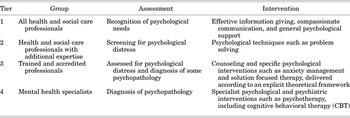
NICE recommended a Four-Tier Model of psychological provision structured around the level of complexity of a patient's needs (Table 1). The model also emphasizes the importance of self-help and informal support that patients may draw upon to help them cope with the experience of cancer.
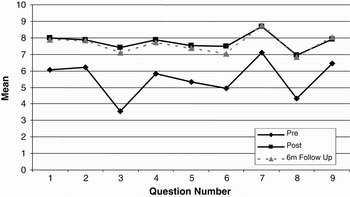
Precourse, postcourse, and 6-month follow-up mean scores. Pre- and postcourse, N = 255; 6-month follow-up, N = 66. 1 = not at all confident, 10 = very confident.

Recommended Four-Tier Model of professional psychological assessment and support (National Institute of Health and Clinical Excellence, 2004)

Problems in accessing support are noted, as symptoms of psychological difficulties are often not identified in the first place, and there is limited access to professionals providing psychological therapies to cancer patients. A key recommendation is to provide front-line staff with training in communication skills and assessment of psychological needs to address this deficit. Importantly, the guidance describes how Regional Cancer Networks, working across organizational boundaries, should coordinate the provision of training to front-line staff from professionals with expertise in psychological assessment and treatment.
It is recommended that the training given to practitioners in Tier 2 should include listening for symptoms of psychological problems and simple therapeutic skills for handling distress. This would enable professionals in Tier 2 to provide interventions to enhance self-help skills and be more able to identify those patients who require referral to Tier 3 or 4. The guidance suggests that specialists should work in an integrated psychological support service, which receives referrals from Tier 2 professionals. NICE also highlights the psychological needs of the staff that care for cancer patients and suggests that professionals providing support at Tier 2 of the model need to be supervized by those at Tier 3 or 4 in order to help them manage their own psychological needs.
This study forms part of a large 3-year project funded by Wessex Cancer Trust, a regional charity, involving the implementation of the Four-Tier model as a whole, but focuses on the development of a training package for staff working in Tier 2, delivered by those in Tiers 3 and 4.
Designing Training for Tier 2
The evidence base for various forms of training and course formats was examined in order to design a program that provides the optimum opportunity for learning in the most cost-effective way that is accessible to staff in the UK national health service.
Communication/Listening Skills Programs
Fellowes et al. (Reference Fellowes, Wilkinson and Moore2004) reviewed three large studies of communication skills training in cancer care and concluded that providing training has a positive effect in improving some areas of cancer care professionals communication skills. They noted significant positive changes in rates of leading questions, focused questions, open questions, and empathy. Overall, however, they concluded that the effectiveness of the training is likely to be linked to the enthusiasm and/or skill of the facilitators and/or participants, and the long-term efficacy of such training was not clear.
The methods of providing training in communication skills to oncology professionals are varied. Back et al. (Reference Back, Arnold and Baile2007) measured the effects of a 4-day residential workshop with 115 medical oncology fellows and found it to be a successful model. Grassi et al. (Reference Grassi, Travado and Gil2005) used a mix of educational and experiential training in two modules with 30 oncologists from southern Europe, using formal teaching and small group exercises as well as large group discussions. Their method of teaching was found to be mostly well accepted and was subjectively reported to be useful for clinical practice.
Jenkins and Fallowfield (Reference Jenkins and Fallowfield2002) asserted that in order to improve interviewing styles and alter cancer professionals' attitudes and beliefs, training must include behavioral, cognitive, and affective aspects, which help participants to focus on acquiring skills and strategies for dealing with specific situations. Wilkinson et al. (Reference Wilkinson, Leliopoulou and Gambles2003) found evidence that supported the use of 3-day training courses to effect clinically relevant behavioral change, improvements in perceived confidence in communication, and dissemination of skills.
However, Merckaert et al. (Reference Merckaert, Libert and Razavi2005) evaluated the influence of communication skills training on physicians' ability to identify distress in cancer patients. They found no statistically significant improvement in the ability to specifically detect distress following training including a brief theoretical information course, a 2.5-day basic training program, and six 3-hour consolidation workshops.
Although communication skills are an essential aspect of supportive and palliative care, research evidence indicates that these skills alone are not sufficient to increase the specific detection of psychological distress and acquisition of skills to ameliorate this distress. It could be hypothesized that communication skills training is the mechanism by which staff moves from Tier 1 to Tier 2 of the model, but does not address the issue of a lack of recognition of specific symptoms of psychological disorder or how to intervene.
Maguire and Pitceathly (Reference Maguire and Pitceathly2003) identified several reasons why cancer professionals may distance themselves from discussing patient's distress, including lack of communication training, fear of difficult questions, fear of causing distress or thoughts of self-harm, and a lack of practical and emotional support. They state that key tasks in communication include eliciting patients' perspective of their own problems and checking understanding of those issues. They also describe in detail the cognitive input of training courses, which should include detailed handouts and evidence of the effectiveness of the skills being acquired. Modeling is recommended, through the use of audiotaped or videotaped sessions with patients or, alternatively, the use of “simulated patients” in an interactive demonstration. Finally, the ability to practice the skills and get feedback from the facilitators is seen as a beneficial element to any training course. Offering doctors feedback on real consultations was seen as preferable to simulated patients.
Screening
Depending on the population reviewed and the criteria used to define distress, studies have shown that up to 50% of patients with cancer can suffer from clinical levels of psychological distress that would benefit from an intervention at Tier 3 or 4 of the model (Carlson & Bultz, Reference Carlson and Bultz2003). Unfortunately, there is also striking evidence that few of these cases are identified by nursing or medical staff (Keller et al., Reference Keller, Sommerfeldt and Fischer2004), and so specific training in symptom recognition and screening techniques is recommended, if not essential, in order to ensure that patients receive the appropriate support (Ryan et al., Reference Ryan, Schofield and Cockburn2005). Many screening tools exist, with varying levels of validity and reliability, depending on the population being screened and the stage in the care pathway.
This program focused on two of the most widely used screening tools in regular use in health care settings, The Hospital Anxiety and Depression Scale (HADS; Zigmond & Snaith, Reference Zigmond and Snaith1983) and The Distress Thermometer (DT; National Comprehensive Cancer Network, 2005). Both of these screening tools have been shown to have good validity and reliability in detecting clinical levels of distress in cancer patients (Zwahlen et al., Reference Zwahlen, Hagenbuch and Carley2008).
Specific Psychological Interventions Appropriate for Tier 2 Staff
Soothill et al. (Reference Soothill, Morris and Harman2001) described cancer patients' unmet needs as falling into various categories, including managing aspects of daily life, managing emotions, and social identity. These needs are often above and beyond the remit of basic services provided to treat the physical disease.
Although nursing staff recognize the importance of attending to psychosocial need, this can be blocked by the perceived extra time required and a lack of confidence or knowledge of what to do with the information (Frost et al., Reference Frost, Brueggen and Mangan1997).
Specific interventions such as relaxation training, psychoeducation, active behavioral problem solving, and cognitive challenging are all seen as effective interventions that can be provided at varying points along the care pathway, but the importance of being flexible in responding to individual patient need should not be underestimated (Fawzy, Reference Fawzy1999). In particular, relaxation and systematic desensitization programs, administered by nursing staff in a chemotherapy outpatient department, have been shown to be effective in reducing nausea and vomiting as well as reducing psychological distress (Carlson & Bultz, Reference Carlson and Bultz2003).
Psychoeducation has also been shown to be an important element in treating psychological distress in patients with cancer and can be very effective when given relatively briefly by supportive nursing staff (McArdle et al., Reference McArdle, George and McArdle1996; Helgeson et al., Reference Helgeson, Cohen and Schulz1999). We therefore designed a program that attempted to address these issues, including communication skills, screening tools, detection of distress, appropriate interventions with patients, and support for the staff themselves.
METHOD
Design
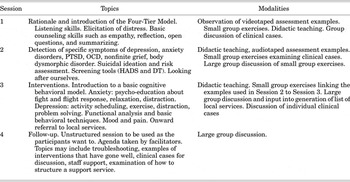
Based on the recommendations of the NICE Guidance for Supportive and Palliative Care and the available literature, a four-session workshop was developed (see Table 2). Sessions 1, 2, and 3 are each 1 week apart, and Session 4 followed a month after Session 3 in order to allow staff to practice and consolidate the skills. Each session is run over half a day to make it easier for staff who may work shifts to attend.
Format of teaching sessions

Training Administrators
Six different members of the Psychological Support Team for Patients with Cancer from Salisbury District Hospital administered the training over the course of 2 years. Facilitators included a clinical psychologist, an oncology counsellor, two assistant psychologists, and two senior social workers. Each team member was trained to deliver the training in a standardized way by the clinical psychologist. Due to the fluid nature of Session 4, it was important that facilitators were confident in staff support and being reflective with participants.
Sample
Participants were recruited through lead cancer nurses in NHS Trusts located within the Central South Coast and Dorset Cancer Networks. Flyers for the training course were emailed to the lead cancer nurses for dissemination among Tier 2 staff working in cancer services. Specific staff groups, such as clinical nurse specialists, were individually invited to attend the training, as these staff members were deemed to have the highest degree of patient contact in terms of supportive care. In addition, many participants were recruited through word of mouth as staff informed colleagues of the benefits of attending.
Measures
Confidence Questionnaires
Confidence Questionnaires were developed for the purposes of the study to measure participants' levels of confidence in nine key areas. These nine areas were identified through the NICE Guidance (National Institute of Health and Clinical Excellence, 2004), relevant evidence from the literature (e.g., Maguire & Pitceathly, Reference Maguire and Pitceathly2003), and a small focus group where staff working in cancer services were asked their opinion on what they perceived to be areas of difficulty in terms of providing psychological support. Participants rated their confidence in each area on a 10-point Likert scale, where 1 = not at all confident and 10 = very confident.
The questionnaire comprised nine questions and asked participants how confident they felt about their ability to (1) discuss psychological problems with patients with cancer, (2) elicit worries or concerns from patients with cancer and their families, (3) use specific screening tools to detect psychological problems, (4) recognize symptoms of psychological disorders, (5) manage a patient or family member who is describing symptoms of psychological distress, (6) provide information to patients or family members about how to manage their psychological distress, (7) discuss concerns about a patient's psychological distress with other members of their team, (8) discuss suicide with patients and families, and (9) manage their own feelings when dealing with high levels of psychological distress.
The questionnaire was administered at three time points: precourse, postcourse, and at 6-month follow-up in order to evaluate whether participants' confidence levels had increased and been maintained over time.
Practical Evaluation
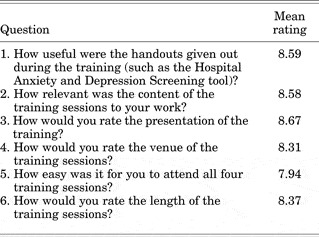
A subjective evaluation form assessed participant ratings of the following areas: (1) the usefulness of the handouts given out during the training course, (2) the relevance of the content of training sessions to their work, (3) the presentation of training, (4) the training venue, (5) how easy it was for participants to attend each session, and (6) the length of the training sessions. A 10-point Likert scale was used, where 1 = the lowest and 10 = the highest rating.
RESULTS
A total of 325 participants began the teaching program; however, 70 people did not complete the course. A total of 255 participants completed at least the pre- and postcourse confidence questionnaires and 66 completed all three measures (precourse, postcourse, and 6-month follow-up questionnaires).
Professional Groups
The most represented group was nursing (61%). A further 8% of the participants were doctors, 18% were allied health professionals, such as physiotherapists, occupational therapists, radiographers, and social workers, and 13% were nonqualified staff, such as health care support workers and volunteers.
Work Place Environments
Of those who completed the teaching, 51% worked within a hospital environment, 23% within a hospice setting, 18% worked with patients in the community, and 8% worked in other settings, such as nursing homes. It should be noted that some participants worked in more than one environment.
Comparison of Precourse, Postcourse, and 6-month Follow-Up Scores
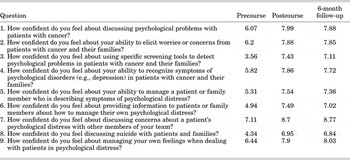
Mean scores were calculated for each of the nine questions for the precourse, postcourse, and 6-month follow-up questionnaires (see Figure 1 and Table 3). T tests were then performed to allow for comparisons to be made between levels of confidence; pre- to postcourse and precourse to 6-month follow-up. Results show that participants' confidence between pre- and postcourse measures significantly increased in all areas (p = .0001) Participants' confidence increase between precourse and 6-month follow-up measures were also highly significant (p = .0001), indicating that the improvements are maintained.
Mean confidence scores by question at precourse, postcourse, and 6-month follow-up (where 1 = not at all confident and 10 = very confident)

Evaluation Results
All participants who had attended the final session of the teaching completed the evaluation form (n = 255). All elements were rated at a mean of between 8 and 9 out of 10 (see Table 4).
Mean evaluation by question (where 1 = low/poor and 10 = high/very good; N = 255)

DISCUSSION
This study found that a four-session, evidence-based teaching program, administered by staff at Tiers 3 and 4, was successful in improving the confidence of staff at Tier 2 in eliciting and managing psychological distress in patients with cancer and their families.
The preliminary long-term results also indicate that this program was successful in consolidating these skills, as illustrated by the long-term maintenance of increased confidence. The course has also shown to be acceptable to a range of professional groups and levels of experience and was well received by staff.
These results should be interpreted with care for a number of reasons. First, the training was delivered by a number of different facilitators who, although all trained in the same way, inevitably had slightly different styles of delivery. Further studies will examine whether the qualification of the facilitator had a significant impact on the increase in confidence levels, as hypothesized in the literature (Fellowes et al., 2003).
Second, the confidence questionnaire itself is a subjective measure that has not been tested for reliability or validity. In the future, it is hoped that examination of referrals to psychological support services as well as patient experience may give an indication of whether increased staff confidence is relayed into their clinical practice.
Although the course was designed to be as accessible as possible for NHS staff, there were inevitably those who could not attend all four sessions, so data was lost on occasion.
The course was able to address many of the issues raised in the literature. Communication skills, the use of screening tools, specific symptoms of psychological disorder, and interventions were all included in the program (Carlson & Bultz, Reference Carlson and Bultz2003; National Institute of Health and Clinical Excellence, 2004; Ryan et al., Reference Ryan, Schofield and Cockburn2005). The course also made use of a number of different teaching methods as recommended, including small group exercises, modeling, videotaped examples, detailed handouts, and opportunity for feedback on real clinical examples (Jenkins & Fallowfield, Reference Jenkins and Fallowfield2002; Maguire & Pitceathly, Reference Maguire and Pitceathly2003).
Finally, the course was designed to fulfill the requirements of the Four-Tier Model recommended by NICE (National Institute of Health and Clinical Excellence, 2004). It achieved this by providing a structured, streamlined framework for staff at Tier 2 to identify those in distress, assess the severity of this distress, intervene themselves if appropriate, but know when an intervention at Tier 3 or 4 was required. We would recommend the implementation of similar training programs across the United Kingdom in order to fulfill the requirements of the Four-Tier Model. The program has now been written up into a complete pack, which is available from the authors for the purposes of replication in other areas.
Future Directions
During the course of this study, the authors were approached by departments in other countries, such as Australia and Canada, who are keen to pilot the teaching program with a non-UK audience. Hopefully, this will lead to joint research in order to validate the program with a non-UK sample.
The authors are also currently in the process of training staff at Tier 2 in the facilitation of the program. There are long-term plans to see if the program is as effective when delivered by Tier 2 staff, as in the United Kingdom there is a shortage of staff at Tiers 3 and 4. If this proves to be as effective, then it will increase the accessibility of the course in all areas, as counsellors and psychologists will not be essential as facilitators, but will be able to use their advanced skills to train Tier 2 staff in the delivery of such programs.
Notwithstanding the limitations discussed, this program has been shown to be accessible and relevant to staff working at Tier 2 in the United Kingdom. It has significantly improved staff confidence in exploring the psychological impact of cancer with their patients and family members. Finally, it is hypothesized that ongoing data analysis will show a significant impact of the training on the patient experience during the cancer journey and on referrals to a formal Psychological Support Team.
ACKNOWLEDGMENTS
This project would not have been possible without the generous support of the Wessex Cancer Trust, Southampton, UK.