Child maltreatment is a significant societal problem, with serious mental and physical health effects for victims and enormous costs to society (Carvalho et al., Reference Carvalho, Donat, Brunnet, Silva, Silva and Fristensen2015; Cicchetti & Banny, Reference Cicchetti, Banny, Lewis and Rudolph2014; Gilbert et al., Reference Gilbert, Widom, Browne, Fergusson, Webb and Janson2009; Stoltenborgh, Bakermans-Kranenburg, van IJzendoorn, Reference Stoltenborgh, Bakermans-Kranenburg and van IJzendoorn2013). Official statistics from the National Center for Injury Prevention and Control (2014) indicate that the rate of victimization in the United States is as high as 9.2 children per 1,000 children. Self-report studies reveal that as many as 1 in 4 US children will experience some form of maltreatment in their lifetime (Finkelhor, Turner, Ormond, & Hamby, Reference Finkelhor, Turner, Ormond and Hamby2013). The total lifetime economic burden resulting from new cases of fatal and nonfatal child maltreatment in the United States is estimated to be approximately $124 billion, with each nonfatal case associated with a lifetime cost of $210,012, including childhood healthcare costs, adult medical costs, productivity losses, child welfare costs, criminal justice costs, and special education costs (Fang, Brown, Florence, & Mercy, Reference Fang, Brown, Florence and Mercy2012). One factor that may make child maltreatment so persistent and difficult to prevent is its intergenerational continuity. We used a multilevel approach to examine risk factors that were hypothesized to be associated with the intergenerational transmission of maltreatment in a sample of high-risk women who were removed from their parents and placed in out-of-home care as adolescents (and subsequently followed for a 10-year period) with the goal of identifying malleable factors that could be targeted in future interventions.
Intergenerational Continuity of Maltreatment
Beginning with the publication of a book on child abuse that served as a practical guide for professionals and laypersons (Kempe & Kempe, Reference Kempe and Kempe1978), it has been a commonly held belief that parents who maltreat their children are likely to have been maltreated (as children) themselves. Some empirical studies have found support for the notion that a common outcome of experiencing maltreatment in childhood is engaging in interpersonal violence and maltreatment in adulthood (e.g., Heyman & Slep, Reference Heyman and Slep2002; Zuravin, McMillen, DePanfilis, & Risley-Curtis, Reference Zuravin, McMillen, DePanfilis and Risley-Curtis1996). For instance, longitudinal findings from the Rochester Youth Development Study revealed that victims of child maltreatment were 2.6 times more likely to perpetrate maltreatment with their own children than were those who had not been abused as children (Thornberry et al., Reference Thornberry, Henry, Smith, Ireland, Greenman and Lee2013). Yet, there has also been significant critique of Kempe and Kempe's (Reference Kempe and Kempe1978) claims regarding the high continuity of maltreatment across generations (e.g., Cicchetti & Aber, Reference Cicchetti and Aber1980), with some studies reporting the risk of intergenerational transmission to be weak to moderate (Renner & Slack, Reference Renner and Slack2006). More exhaustive reviews and meta-analyses conclude that there is a modest, but significant risk of intergenerational transmission of child maltreatment (Kaufman & Zigler, Reference Kaufman and Zigler1987; Thornberry, Knight, & Lovegrove, Reference Thornberry, Knight and Lovegrove2012), but they caution against generalizing results from single-sample studies due to methodological limitations and/or the unique nature of the sample utilized. More recent reviews (e.g., Thornberry et al., Reference Thornberry, Knight and Lovegrove2012) find that studies with stronger designs showed only mixed support for the intergenerational transmission hypothesis, which challenges commonly held beliefs about intergenerational continuity and calls for additional research to investigate the nature of this association. More interesting, perhaps, these studies also indicate that there are many individuals who have experienced maltreatment as children, but who do not go on to perpetrate maltreatment as adults (Kaufman & Zigler, Reference Kaufman and Zigler1987; Thornberry et al., Reference Thornberry, Knight and Lovegrove2012). We attempt to help clarify the mixed evidence surrounding intergenerational transmission of maltreatment by (a) utilizing longitudinal data from a high-risk sample of women who had been removed from the custody of their parent(s) as youth; (b) assessing multilevel predictors of risk within the individual's social ecology; and (c) comparing across three different approaches to measuring perpetration of maltreatment.
A Multilevel Framework for Examining Risk for Maltreatment
As noted by Cicchetti (Reference Cicchetti2013), one challenge for the field of maltreatment is to shift from its traditional focus on a single level of analysis to multilevel investigations that explore more than one domain of influence on the perpetration or outcomes of maltreatment. An individual's developmental trajectory is influenced by a myriad of individual, contextual, and societal factors that are layered and transactional (Cicchetti & Lynch, Reference Cicchetti and Lynch1993). By using a multilevel framework to study child maltreatment, we can better decipher the risk and protective factors and work toward developing more effective interventions that not only help prevent maltreatment but also reduce the risk of psychopathology and behavioral health problems often associated with maltreatment. Moreover, using a more nuanced approach to understanding this complex phenomenon might also help clarify the mixed evidence surrounding intergenerational transmission of maltreatment. Bronfenbrenner's (Reference Bronfenbrenner1979) ecological systems model lends itself well to this kind of investigation. Cicchetti and Lynch (Reference Cicchetti and Lynch1993) further elaborate on this model to propose an ecological–transactional framework that can be used to examine the interactional processes whereby maltreatment occurs and development is shaped as a result of risk and protective factors present within each level of the social ecology. These risk and protective factors can serve to exacerbate or deter the likelihood of intergenerational transmission of maltreatment.
Within this framework, the innermost layer of influence, that is, the individual level, encompasses personal characteristics that are unique to the individual, such as genetic factors, temperament, and behavior. Next is the microsystem, which involves interpersonal relationships at the most immediate level, such as family, friends, partners, and relationships within the school or work environment. As noted by Cicchetti (Reference Cicchetti2004), because it is the level of the ecology closest to an individual, characteristics of the microsystem have the most direct effects on development, and the most relevance to understanding child maltreatment. The mesosystem, which comes next, comprises the interactions between two microsystems. For example, an individual's family connecting with his/her romantic partner represents a mesosystem for a young adult. Following the mesosystem is the exosystem, which includes relationships that occur between two spheres within the individual's ecology, one of which the individual is not directly involved. For example, a parent may become incarcerated, which affects the caregiving situation for the child. The outermost layer of the ecological model is the macrosystem, which encompasses the larger cultural environment. The individual does not directly interact with this system, yet it can have a meaningful impact on development. In this study, we focus jointly on factors within the individual level (adolescent delinquency), the microsystem (partner behavior), and the exosystem (family contextual risk), using a sample of women who had been exposed to the child welfare and juvenile justice macrosystems during adolescence and followed longitudinally into young adulthood.
Family contextual risk: The influence of the exosystem
Numerous studies have documented that the family context a child experiences across development can have a significant influence on future risk for engagement in maltreatment. For instance, Thornberry et al. (Reference Thornberry, Matsuda, Greenman, Augustyn, Henry and Smith2014) found that multiple aspects of the family context, such as low parental income, teenage parenthood, parental experiences of negative life events, and exposure to family violence in early adolescence, were all linked to perpetration of maltreatment as an adult. Late adolescent risk factors for subsequent engagement in maltreatment included parental conflict and parental alcohol use (Thornberry et al., Reference Thornberry, Matsuda, Greenman, Augustyn, Henry and Smith2014). Similarly, parent criminality has been identified as a risk factor related to youth delinquency (Lederman, Dakof, Larrea, & Li, Reference Lederman, Dakof, Larrea and Li2004; Leve & Chamberlain, Reference Leve and Chamberlain2004), which in turn is associated with heightened risk for the perpetration of maltreatment. Family contextual risks, including parent criminality, can also affect the resources available to parents, which ultimately can affect the parenting a child receives. Further, the presence of multiple contextual risk factors appears to have a cumulative effect on the perpetration of maltreatment (Thornberry et al., Reference Thornberry, Matsuda, Greenman, Augustyn, Henry and Smith2014), suggesting the importance of incorporating multiple domains of family contextual risk into our theoretical model of intergenerational transmission of maltreatment. The accumulation of risk in multiple domains is likely to overwhelm an individual's coping abilities and, therefore, may have the largest impact on predicting maltreatment (Thornberry et al., Reference Thornberry, Matsuda, Greenman, Augustyn, Henry and Smith2014). Given the prior literature on the association between family contextual risks and perpetration of maltreatment, as well as the evidence surrounding cumulative nature of family contextual risks (Appleyard, Egeland, van Dulmen, & Sroufe, Reference Appleyard, Egeland, van Dulmen and Sroufe2004; Thornberry et al., Reference Thornberry, Matsuda, Greenman, Augustyn, Henry and Smith2014), we examine the influence of a composite family risk index on the intergenerational transmission of maltreatment.
Individual risk: Delinquency
Delinquency has well-established associations with child maltreatment, but it is a complex risk factor because of its reciprocal nature of influence; it has been shown to be a risk factor for engaging in maltreatment (e.g., Thornberry et al., Reference Thornberry, Matsuda, Greenman, Augustyn, Henry and Smith2014) as well as a potential outcome of the experience of maltreatment (e.g., Widom, Reference Widom, Korbin and Krugman2013). The evidence surrounding the positive association between childhood maltreatment and female delinquency is vast, with numerous studies indicating that adolescent girls in the juvenile justice system are more likely than their male counterparts to have been victims of sexual and/or physical abuse (e.g., Cauffman, Feldman, Waterman, & Steiner, Reference Cauffman, Feldman, Waterman and Steiner1998; Moore, Gaskin, & Indig, Reference Moore, Gaskin and Indig2013; Zahn et al., Reference Zahn, Agnew, Fishbein, Miller, Winn and Dakoff2010). In addition, adjudicated girls and those at-risk for adjudication with a history of sexual abuse tend to have more extreme delinquency outcomes than those without such a history (Goodkind, Ng, & Sarri, Reference Goodkind, Ng and Sarri2006; Wareham & Dembo, Reference Wareham and Dembo2007). Further, delinquency is also a commonly reported outcome among individuals who were maltreated as children. For instance, children with histories of physical abuse are found to be at greater risk of being arrested in adolescence for both violent and nonviolent crimes compared to those without abusive pasts (Lansford et al., Reference Lansford, Miller-Johnson, Berlin, Dodge, Bates and Pettit2007). Overall, girls who are exposed to abuse or interparental violence during childhood are more than seven times as likely as control girls (selected from an age-matched community sample who had not been exposed to marital violence) to commit a violent act that is referred to the juvenile justice system (Herrera & McCloskey, Reference Herrera and McCloskey2001). The association between child maltreatment and delinquency remains strong across different methods of assessment, including self-report and formal records (Smith, Ireland, & Thornberry, Reference Smith, Ireland and Thornberry2005).
Engaging in delinquent behaviors in adolescence is subsequently linked to perpetration of maltreatment as an adult (Thornberry et al., Reference Thornberry, Matsuda, Greenman, Augustyn, Henry and Smith2014). For example, Colman, Mitchell-Herzfeld, Kim, and Shady (Reference Colman, Mitchell-Herzfeld, Kim and Shady2010) found that 62% of the girls who had been released from juvenile justice facilities were investigated by child protective services at least once as an alleged perpetrator of abuse and neglect before age 28. Forty-two percent of them had a confirmed case of perpetration of child maltreatment, and 68% of those investigated were implicated in two or more cases during the 12-year study period, with a mean of 3.95 investigations per study female. Similarly, Thornberry et al. (Reference Thornberry, Matsuda, Greenman, Augustyn, Henry and Smith2014) found that adolescent general delinquency behaviors were associated with an odds ratio of 1.56 for perpetration of maltreatment in adulthood, supporting the argument that juvenile delinquents are at an increased risk for placing their children in vicious cycles of system involvement and health disparities. These cyclical intergenerational effects appear to be more pronounced in girls; the Colman et al. (Reference Colman, Mitchell-Herzfeld, Kim and Shady2010) study noted above found that girls involved in the juvenile justice system were approximately 3.5 times more likely than their male counterparts to be identified as a perpetrator of child abuse and neglect during young adulthood. For these reasons, in the current study, we focus on female youth who had been involved in the juvenile justice system for serious delinquency during adolescence, and include measures of delinquent engagement across a 2-year period during adolescence to examine its association with perpetration of maltreatment in young adulthood.
Partner risk: The microsystem
Young adulthood is known to be a challenging developmental period, with prevalence rates of several health-risking behaviors (e.g., substance use and unprotected sex) peaking during this stage (Arnett, Reference Arnett2000). Young women with histories of juvenile justice involvement are found to be at particular risk for making unhealthy partner choices (Oudekerk & Reppucci, Reference Oudekerk and Reppucci2010), making them more prone to involvement in negative behaviors, including perpetration of maltreatment (Woodward, Fergusson, & Horwood, Reference Woodward, Fergusson and Horwood2002). For example, women who were involved in the juvenile justice system as youth were more likely to select partners who engaged in antisocial or violent behavior (Oudekerk & Reppucci, Reference Oudekerk and Reppucci2010). There is also evidence that partner choice and relationships during young adulthood can be influenced by prior maltreatment experiences. For example, significant associations between self-reported receipt of physical punishment or maltreatment in childhood and negative partner relationships, partner social adjustment problems, and experiences of intimate partner violence in adulthood were identified in a birth cohort study of more than 900 individuals in New Zealand (McLeod, Fergusson, & Horwood, Reference McLeod, Fergusson and Horwood2014). These relationships, however, were significant only for females, not for males (McLeod et al., Reference McLeod, Fergusson and Horwood2014).
Partner behaviors, such as drug use and criminality, can have a strong influence on the behavioral choices of young women with histories of delinquency. For instance, in a previous report using the same sample as reported on here (women with prior juvenile justice involvement and out-of-home placement), we found that women's drug use was significantly related to their partners’ use (Rhoades, Leve, Harold, Kim, & Chamberlain, Reference Rhoades, Leve, Harold, Kim and Chamberlain2014). Similarly, Bright, Ward, and Negi (Reference Bright, Ward and Negi2011) conducted a qualitative study and found that women with a history of juvenile justice involvement indicated a close link between their substance use and either their intimate partners’ or a family member's drug use. Further, women with history of juvenile justice involvement were more likely to date partners who were involved in antisocial behaviors (Cauffman, Farrugga, & Goldweber, Reference Cauffman, Farruggia and Goldweber2008). This constellation of risky behaviors (exposure to maltreatment, family contextual risk, delinquency, and partner risk behavior) is intricately linked, making it important to investigate these links using longitudinal designs and rich measurement approaches. Within our multilevel framework, we investigate the role of partner risk behaviors (a microsystem influence) on the intergenerational continuity of maltreatment by including a composite measure of partner risk, comprising criminality and drug use indicators.
Measurement Issues in the Study of Maltreatment
As noted by others (e.g., Cicchetti, Reference Cicchetti2004; Kaufman & Zigler, Reference Kaufman and Zigler1987; Thornberry et al., Reference Thornberry, Knight and Lovegrove2012), the measurement of maltreatment is important to consider in any study examining intergenerational transmission patterns given the variability in measurement approaches and the subsequent variability in findings. Researchers often do not have the ability to utilize a prospective design, and thus rely on self-report, archival child protective system records, or a mixture of both. Each method has its own strengths and weaknesses. Self-report studies are especially vulnerable to the social desirability bias. This is particularly a concern when self-report data are used to measure both retrospective recollections of maltreatment as well as perpetration of maltreatment. The utilization of official child welfare records avoids this limitation, but only captures what has been successfully reported to child protection authorities (Widom, Czaja, & Dumont, Reference Widom, Czaja and Dumont2015). A more rigorous approach is to collect official maltreatment records and code them using the Maltreatment Classification System (MCS; Barnett, Manly, & Cicchetti, Reference Barnett, Manly, Cicchetti, Cicchetti and Toth1993), rather than relying on the dispositional status from the case file. The MCS uses all information available from the case record, and a team of trained staff code the file, thereby allowing for an independent determination of maltreatment experiences and classification by maltreatment subtype, severity, frequency, and developmental period of each event. Despite these advances in coding official records, Widom et al. (Reference Widom, Czaja and Dumont2015) note that there exists no “gold standard” for measuring child maltreatment, which may partially explain the large variance in measurement approaches seen in the extant literature. Notable but rare are prospective longitudinal studies that use a combination of official records and interview data, across both maltreated and control samples (e.g., Kim-Spoon, Cicchetti, & Rogosch, Reference Kim-Spoon, Cicchetti and Rogosch2013).
In an effort to examine potential variations in findings associated with different measurement approaches, Widom et al. (Reference Widom, Czaja and Dumont2015) examined self-report, official child welfare records data, and self-report of the children (third generation) in order to examine intergenerational transmission effects. They found clear measurement differences: the extent of the intergenerational transmission of maltreatment largely depended on the source of information used. Specifically, women with a history of child welfare system (CWS) involvement were significantly more likely to be reported to child welfare authorities for perpetration of child maltreatment; however, they did not self-report more maltreatment than matched comparisons. The authors suggest that this measurement artifact may be the result of a surveillance bias, with individuals who have previously been in the system garnering higher levels of surveillance than those who have not been in the system. These findings suggest the grave importance of attending to the issue of measurement in studies of intergenerational transmission of maltreatment before drawing conclusions about continuity across generations.
The Current Study
In this study, we sought to apply a multilevel approach to the study of intergenerational transmission of maltreatment by examining multiple levels of predictors (family contextual risk, adolescent delinquency, and partner risk), and examining the perpetration of maltreatment across multiple modes of assessment. Our sample included women who had been removed from the care of their parent(s) as teenagers, had been involved in the juvenile justice system, and were assessed longitudinally into young adulthood. Eighty-five percent of the sample had a substantiated incident of maltreatment during childhood, and all had experienced at least one out-of-home care placement and significant family adversity. Using the transactional ecological model of maltreatment (Cicchetti & Lynch, Reference Cicchetti and Lynch1993), we hypothesized that a cumulative family contextual risk index, a multiwave, multimeasure construct of adolescent delinquency, and young adult partner risk would each independently predict whether participants would show intergenerational continuity of maltreatment. We also examined interactions between levels of the social ecology. Within these models, we sought to explore whether intergenerational associations would vary as a function of how the perpetration of maltreatment was measured by including three different modes of measurement: official child welfare records, self-reported child welfare contact, and self-reported maltreatment chronicity as indexed by a standardized questionnaire. Finally, because the sample participated in a randomized trial that was aimed at preventing recidivism during adolescence, we examined whether there were any long-term effects of the intervention on the perpetration of maltreatment in young adulthood.
Method
Participants
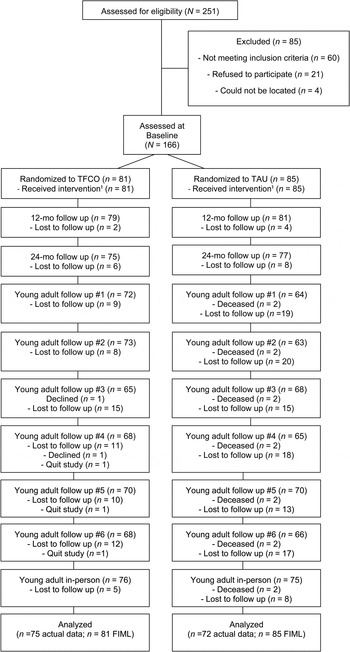
The study sample included 166 women, baseline age 13–17 years (M = 15.31, SD = 1.17), who participated in one of two consecutively run randomized controlled trials contrasting Treatment Foster Care Oregon (TFCO; formerly known as Multidimensional Treatment Foster Care) and out-of-home treatment as usual (TAU), which was typically a group care residential facility. The trial was conducted from 1997 to 2006, with Cohort 1 n = 81 and Cohort 2 n = 85. Participants were followed for approximately 10 years. The girls had been referred by Oregon juvenile court judges during the study period and had been mandated to community-based, out-of-home care because of problems with chronic delinquency and serious family adversity. Enrollment was consecutive and based on when girls were court-mandated to out-of-home care. We attempted to enroll all referred girls who were 13–17 years of age, had at least one criminal referral in the past 12 months, were placed in out-of-home care within 12 months following referral, and were not currently pregnant. Enrolled girls were randomly assigned to the treatment condition (TFCO; ns = 37 and 44) and control condition (TAU; ns = 44 and 41) for Cohorts 1 and 2, respectively (see Figure 1).
Consolidated standards of reporting trials diagram of participant flow through study recruitment, randomization to Treatment Foster Care Oregon or treatment as usual, and follow-up assessments. Some treatment services were received by all youth, although treatment length varied.

The ethnic breakdown of participants was as follows: 68.1% Caucasian, 1.8% African American, 11.4% Hispanic, 0.6% Native American, 0.6% Asian, and 16.9% mixed ethnic heritage. Less than 1% reported other or unknown ethnicity. Ethnicity was reported by participants at the first young adult assessment; note that these percentages differ slightly from those in some earlier published reports due to the self-report (vs. caregiver report) nature of the data used here. In comparison, 93% of the girls 13–19 years of age living in the region at the time this study was conducted were Caucasian (US Department of Commerce, 1992). At baseline, 63% of girls had been living in single-parent family homes, and 54% of families had an annual income of <$10,000. All girls had been removed from their parent(s) and placed in out-of-home care settings. The vast majority of girls had a formal record of child welfare involvement for maltreatment and/or neglect, with current caseworkers reporting a history of physical abuse, sexual abuse, and/or severe family violence for 85.5% of girls. No group differences were observed in the rate or type of prebaseline offenses or demographic characteristics.
Procedures
Prior to entering her out-of-home placement, each girl and her parent (or other primary preplacement caregiver) completed an in-person, 2-hr baseline assessment. Research assistants responsible for data collection and data entry were blind to participants’ group assignment and were not involved in delivering the intervention. In-person follow-up assessments were conducted at 6 months, 12 months, and 24 months postbaseline, and once during young adulthood, approximately 8 years postbaseline (M = 8.36 years postbaseline, SD = 2.47). In addition, a series of six telephone interviews was conducted during young adulthood, occurring once every 6 months over a 2.5-year period, inclusive of the time the participant completed her in-person young adult assessment. One hundred and fifty-four participants (93.9% of the 164 participants still living) completed at least one of these young adult follow-up assessments (in person or a phone). The young adult follow-up assessments began at means of 9.81 (SD = 1.73) and 4.69 (SD = 1.16) years postbaseline for Cohorts 1 and 2, respectively. Juvenile justice court records were collected during each in-person adolescent assessment, and CWS records about the participant as perpetrators in young adulthood were collected at the final young adult follow-up assessment, approximately 10 years postbaseline (M = 10.01 years postbaseline, SD = 2.96). The baseline, 12-month, 24-month, and 8-year in-person assessment data; the young adult telephone interview data; the young adult child welfare records data; and the juvenile courts records data were utilized in this study. No adverse events were reported during the course of the study.
Experimental intervention
The TFCO intervention is described in detail elsewhere (Chamberlain, Reference Chamberlain2003; Chamberlain, Leve, & DeGarmo, Reference Chamberlain, Leve and DeGarmo2007; Leve, Chamberlain, Smith, & Harold, Reference Leve, Chamberlain, Smith, Harold, Miller, Leve and Kerig2011). TFCO girls were individually placed in one of 22 highly trained and supervised homes with state-certified foster parents. Across the years that the trial was conducted, each TFCO home served 1–19 study participants (M = 3.68, SD = 4.53). Experienced program supervisors with small caseloads (10 TFCO families) supervised all clinical staff, coordinated all aspects of each youth's placement, and maintained daily contact with TFCO parents to monitor treatment fidelity and provide ongoing consultation, support, and crisis intervention services. Interventions were individualized but included all basic TFCO components: daily telephone contact with the foster parents to monitor case progress and adherence to the TFCO model; weekly group supervision and support meetings for foster parents; an individualized, in-home, daily point-and-level program for each girl; individual therapy for each girl; family therapy (for the aftercare placement family) focusing on parent management strategies; close monitoring of school attendance, performance, and homework completion; case management to coordinate the interventions in the foster family, peer, and school settings; 24-hr on-call staff support for foster and biological parents; and psychiatric consultation, as needed. In Cohort 2, the TFCO condition also included intervention components that targeted sexual-risk behaviors and substance use behaviors.
Control condition
TAU girls were placed in one of 35 community-based program sites located in Oregon. TAU programs represented typical services for girls being referred to out-of-home care by the juvenile justice system, which were primary group care residential placements. The programs had 2–83 youths in residence (M = 13) and 1–85 staff members (Mdn = 9). The program philosophies were primarily eclectic (61.5%) or behavioral (38.5%); 80% of the programs reported delivering weekly therapeutic services.
Measures
Outcome variables
Committing one or more acts of child maltreatment by the study participants was assessed during the young adult assessments, conducted approximately 8–10 years postbaseline, using two self-report measures, and at the conclusion of all assessments (September 2012; approximately 10 years postbaseline) using official CWS records data. Each of the three maltreatment measures is described below.
Official CWS records
Official maltreatment records were obtained from the Oregon Department of Human Services, Children, Adults and Families Division at the conclusion of the final young adult assessment. Participants who had an official child welfare record with one or more substantiated maltreatment incidents against them for at least one child were assigned a score of 1; those without a record were assigned a score of 0.
Self-reported CWS contact
At each of the six phone assessments during young adulthood, participants were asked to self-report their own contact with the CWS for suspected abuse or neglect of any of their children. The question was asked separately about each child. Those who responded affirmatively for at least one child at any of the six assessment waves were assigned a score of 1; those without a self-reported history of CWS contact were assigned a score of 0.
Self-reported maltreatment chronicity
At the in-person young adult assessment, participants’ completed the Conflict Tactics Scale, Parent–Child version (CTS; Strauss, Hamby, Finkelhor, Moore, & Runyan, Reference Straus, Hamby, Finkelhor, Moore and Runyan1998). Mean chronicity of physical assault (five items) and neglect (five items) was assessed by summing the frequency of items endorsed in each category for the past year. Mean chronicity scores were then computed by dividing the sum of frequency scores by the total number of items that were answered. To obtain a total chronicity score, we summed the individual mean chronicity scores for the two maltreatment categories.
Predictor variables
Predictor variables included risk factors associated with intergenerational transmission of maltreatment across three levels of the individual's social ecology: family context, individual characteristics, and partner characteristics.
Family contextual risk
At the baseline assessment, the girl's Department of Youth Services caseworker responded to a survey about the girl's exposure to family context-level risk factors by answering yes or no to each of the following eight items: single family at present, current family income <$10,000, parents divorced during lifetime, three or more siblings or stepsiblings, any parent (biological/step/adoptive) hospitalized for mental illness, any parent (biological/step/adoptive) convicted of crime, any sibling placed in out-of-home care, and family violence in the home (weapons used or arrested for or victim of). The family contextual risk composite was calculated by summing the eight individual risk scores, and ranged from 0 (no risk factor present) to 8 (all eight risk factors present).
Adolescent delinquency
A multiple-method delinquency measure was computed at baseline, 12 months, and 24 months from three indicators that assessed delinquent behaviors occurring during the prior 12 months: number of criminal referrals, number of days in locked settings, and self-reported delinquency (Chamberlain et al., Reference Chamberlain, Leve and DeGarmo2007). Criminal referrals were collected from state police records and circuit court data, which have been found to be reliable indicators of externalizing behavior (Capaldi & Stoolmiller, Reference Capaldi and Stoolmiller1999). The number of days spent in locked settings was measured by girls’ report of total days spent in detention, correctional facilities, jail, or prison over the past 12 months. Self-reported delinquency was measured with the Elliott General Delinquency Scale (Elliott, Huizinga, & Ageton, Reference Elliott, Huizinga and Ageton1985); this 21-item subscale records the number of times girls report violating laws during the preceding 12 months. The three delinquency indicators were significantly correlated with each other. A principal components analysis revealed a single factor solution at each wave with eigenvalues ranging from 1.5 to 1.6 and loadings ranging from 0.44 to 0.82. An adolescent delinquency score was calculated at each wave by rescaling each continuous indicator from 0 to 1 and then averaging them. Criminal referrals and days in locked settings were log transformed before rescaling to correct for distributional skewness and kurtosis. Delinquency scores across time were significantly correlated (rs = .36–.50, p < .001). The final adolescent delinquency score was computed by averaging delinquency scores from the baseline, 12-month, and 24-month assessments.
Partner risk
During each of the six young adult telephone assessments, women were asked to report, for up to four recent partners, their partners’ use of marijuana (Y/N) and illicit drug use (Y/N) in the past 6 months, and if the partner had ever been arrested in his/her lifetime (Y/N). For each risk factor, participants were assigned a score of 1 if the risk factor was present for any partner at any wave. All women had at least one partner during at least one assessment wave. Only those telephone interviews that occurred at or prior to the in-person assessment (when the CTS maltreatment measure was collected) were used in analyses, to preserve the sequential ordering of the predictor and outcome variables. The partner risk composite was computed by summing the individual risk scores, and ranged from 0 (no risk factor present) to 3 (all three risk factors present).
Controls
All models included an examination of potential intervention effects (0 = TAU, 1 = TFCO) and age at the final young adult assessment (when the CWS records were collected).
Analytic plan
We used separate logistic regression analyses to predict perpetration of maltreatment for the two categorical outcomes (i.e., official CWS records and self-reported CWS contact), and ordinary least squares regression for the continuous outcome of CTS maltreatment chronicity. Independent variables were added in blocks with the control variables entered first, followed by our predictor variables. Interaction effects were explored for all key independent variables. Analyses were conducted in Mplus version 7 using robust estimation procedures to account for any violations of normality.
Missing data were handled using full information maximum likelihood under the missing at random assumption. Missing data were present only in case of the partner risk variable, with 11% of the sample having missing values (due to failure to complete the in-person assessment, or a participant choosing to skip the partner items). A dummy variable was created to indicate missingness on the partner risk variable, and was correlated with the key study variables and sample demographics. Participants with missing data did not differ significantly from those with complete data on any of these variables, suggesting that missing data were ignorable and use of full information maximum likelihood was appropriate (Schafer & Graham, Reference Schafer and Graham2002).
Results
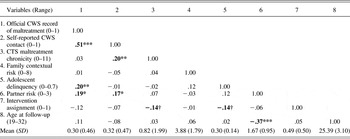
Means, standard deviations, and correlations between study variables included in the analytical models are reported in Table 1. Nearly one-third of the sample (n = 50) had a substantiated CWS record for at least one child. Approximately the same number of participants (n = 53) also self-reported CWS contact. Nevertheless, the correlation between the two variables was only 0.51. CTS self-reported maltreatment chronicity was significantly associated with self-reported CWS involvement (r = .20, p < .05), but not with official CWS records, suggesting the possibility of shared method variance.
Correlation matrix of study variables

Note: CWS, Child welfare system; CTS, Conflict Tactics Scale. Bold values indicate significant coefficients.
†p < .08. *p < .05. **p < .01. ***p < .001.
Bivariate analyses revealed partner risk to be significantly associated with both official CWS records and self-reported CWS involvement. Adolescent delinquency was only associated with official CWS records, and family contextual risk was not significantly associated with any of the three maltreatment outcomes. Overall, none of the predictor variables was significantly correlated with the CTS maltreatment chronicity outcome. Two trends were also noted at the bivariate level: assignment to the TFCO intervention group was associated with lower CTS maltreatment chronicity and lower adolescent delinquency. The later association was anticipated based on the previously reported intervention effect on adolescent delinquency (Chamberlain et al., Reference Chamberlain, Leve and DeGarmo2007); although in this study, we also include baseline delinquency in our delinquency construct to examine its effect on later perpetration of maltreatment, and therefore did not specifically hypothesize intervention effects for the delinquency composite. Finally, a significant inverse correlation between partner risk and age at follow-up was also noted, with younger women reporting more partner risk.
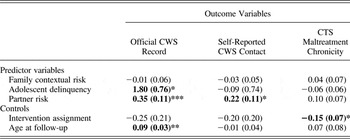
Consistent with the bivariate linkages, regression analyses revealed that both adolescent delinquency (β = 1.80, SE = 0.76, p < .05) and partner risk (β = 0.35, SE = 0.11, p = .001) were significant predictors of official CWS child maltreatment records (see Table 2). Participants who engaged in delinquent behaviors during their adolescent years and those who had a high-risk partner in young adulthood were significantly more likely to have an official CWS record. Age at follow-up was also a significant predictor of official CWS records (β = 0.09, SE = 0.03, p < .01), with older age associated with greater likelihood of an official CWS record.
Unstandardized regression coefficients (standard errors) associated with model pathways (N = 166)
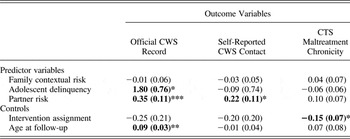
Note: CWS, Child welfare system; CTS, Conflict Tactics Scale. Bold values indicate significant coefficients.
*p < .05. **p < .01. ***p < .01.
Having a high-risk partner was also associated with a higher likelihood of self-reported CWS involvement (β = 0.22, SE = 0.11, p < .05). There were no other significant predictors of self-reported CWS involvement. Finally, intervention assignment was a significant predictor of CTS maltreatment chronicity (β = –0.15, SE = 0.07, p < .05), indicating that women who previously were randomly assigned to the TFCO intervention had lower self-reported CTS maltreatment chronicity. None of the other predictor variables significantly accounted for the variation in CTS maltreatment chronicity scores. In addition, family contextual risk did not emerge as a significant predictor of any of the three indicators of child maltreatment. None of the interaction effects were significant. Overall, our models explained 19% of variance in the official CWS record outcome, 5.9% variance in self-reported CWS involvement, and 3.4% variance in the CTS maltreatment chronicity.
Discussion
We sought to examine factors related to the intergenerational continuity of maltreatment from a multilevel perspective in a sample of young women who had been removed from the care of their parent(s) as teens, and had experienced maltreatment and/or chronic adversity in childhood. We examined three levels of predictors in the social ecology: family contextual risk, individual risk (adolescent delinquency), and young adult partner risk, and examined associations across three different modes of assessment of the perpetration of maltreatment during young adulthood. Our results indicated that there were only weak to modest associations among self-reported CWS involvement, self-reported maltreatment, and official CWS records, and that different patterns of predictors emerged as a function of the measurement mode used to assessment perpetration of maltreatment.
The lack of a robust pattern of associations among the three measures of maltreatment has been noted in past studies (e.g., Widom et al., Reference Widom, Czaja and Dumont2015) and poses a challenge for the field. In this study, the correlations between the three measures of maltreatment ranged from .03 to .51, suggesting that a different core construct was being measured in each instance. To some extent, the lack of stronger associations is not surprising because reporting biases may cause women to over- or underreport their own involvement in the CWS, and specific neglectful and physically assaultive parenting practices may not meet the same definitional threshold for “maltreatment” as do substantiated events that have been acted upon by the CWS sector. Nonetheless, the diversity of measurement approaches used in prior studies in the field, the lack of an agreed-upon gold standard for measurement, and the differential prediction patterns in this study give pause for concern about the translation of findings from any given study to the delivery of evidence-based interventions. Are we over- or underidentifying individuals most at risk for intergenerational continuity? The answer to this question depends on the type of maltreatment assessment used and the specific risk factors examined. In the present study, 30%–32% of the sample engaged in perpetration of maltreatment as a young adult when relying on any single indicator (official records or self-reported CWS contact). When endorsement of either self-reported CWS contact or official CWS records is used as the marker to maltreatment, 42% of the sample showed a pattern of intergenerational continuity. Thus, the specific individuals identified as showing intergenerational continuity varied as a function of the measurement instrument used.
In addition, the risk factors showed a different pattern of prediction as a function of the outcome measure used. When examining official CWS records, both adolescent delinquency and partner risk were associated with later perpetration of child maltreatment. However, when self-reported CWS contact was the outcome of interest, partner risk was the only significant predictor. Consistent with the findings from Widom et al. (Reference Widom, Czaja and Dumont2015), this pattern of associations may indicate a system surveillance issue: individuals who have had high contact with the juvenile justice system (i.e., are highly delinquent) may be more likely to fall under the surveillance of child welfare authorities at levels that exceed their counterparts who are engaging in similar parenting behaviors but do not have as extensive of a history of delinquency and juvenile justice involvement. A question that cannot be addressed in this study is whether the potential surveillance difference results in overly aggressive decision making for dual-system involved women, or whether heightened surveillance would be beneficial to prevent future harm to the children of women who have been less involved in the juvenile justice system. In the case of both official records and self-reported CWS contact, partner risk emerged as a significant predictor, suggesting the potential utility in implementing evidence-based interventions that include a partner focus in future prevention work, as is further discussed below.
In contrast, CTS maltreatment chronicity was not significantly associated with any of the three hypothesized risk factors. There are a variety of explanations for this lack of significance, including the likelihood that the neglect and physical assault items included on the CTS may not rise to the level of “maltreatment” (even though this measure is commonly used as a measure of maltreatment), and even when they do, there is a difference between parenting acts that come to the attention of the child protective services and parenting behaviors that are serious and harmful nonetheless but that escape the attention of teachers, neighbors, relatives, or others who would file an official report with child welfare authorities. In addition, because the CTS is a self-report measure, participants may have underreported on parenting practices reflective of abusive parenting, and the reporting period only covered the 2.5 years spanning the young adult telephone assessments. In contrast, the official CWS records measured participants’ lifetime perpetration of maltreatment.
Of note, however, is the significant intervention effect on CTS maltreatment chronicity: women originally assigned to the TFCO condition reported lower levels of maltreatment chronicity than women assigned to the TAU condition. The TFCO intervention involves placing a youth in a well-trained and supported foster home for a period of approximately 6 months. It may be that this family living experience, where the youth is parented by an effective and well-trained foster parent, helps provide a positive role model for women as they enter young adulthood and begin to form families of their own. In contrast, the TAU youth received a group care based intervention, and therefore did not have an opportunity to experience the same highly structured and supported family-like environment as TFCO youth. This experience during the formative adolescent years may have affected women's own parenting behaviors as young adults, and led to the significant intervention effect identified in this study.
Prior reports from this study have identified intervention effects on trajectories of drug use (Rhoades et al., Reference Rhoades, Leve, Harold, Kim and Chamberlain2014) and depressive symptoms (Kerr, DeGarmo, Leve, & Chamberlain, Reference Kerr, DeGarmo, Leve and Chamberlain2014) in young adulthood, which may be alternative proximal mechanisms associated with the lower trends for maltreatment chronicity in the TFCO group. In support of this notion, a mediated pathway from maternal history of sexual abuse to substance use problems to offspring victimization was identified in a large community-based study of mothers and their young children (Appleyard, Berlin, Rosanbalm, & Dodge, Reference Appleyard, Berlin, Rosanbalm and Dodge2011). The current findings, as well as the Appleyard et al. (Reference Appleyard, Berlin, Rosanbalm and Dodge2011) findings, offer support for the supposition that substance use problems may be an important behavior to target in the intergenerational transmission of maltreatment.
Intervention implications
In addition to the positive benefits of the TFCO intervention on maltreatment chronicity, the current findings have implications for the development and delivery of additional preventive intervention approaches. We found that partner risk (a composite score comprising partners’ marijuana use, other illicit drug use, and criminal behavior) was significantly associated with official CWS records and with self-reported CWS contact. This suggests a potential opportunity for intervention (or prevention) by identifying women who have been maltreated, and delivering intervention services specifically designed to help them make healthy partner choices and improve the quality of their partner relationships. Because intimate relationship patterns are established early in development, beginning with the parent–child relationship and development of the attachment system, timing interventions aimed at establishing healthy romantic partner relationships to be delivered during adolescence may be more effective than waiting until adulthood. There are a number of school-level, family-level, and group-level interventions that have shown promising evidence for the development of adaptive partner relationships and the prevention of teen dating violence (http://www.nij.gov/topics/crime/intimate-partner-violence/teen-dating-violence/pages/prevention-intervention.aspx). These could be useful directions to pursue among populations of teenage girls who have experienced the dual systems of the CWS and the juvenile justice system. In addition, there are evidence-based relationship-based approaches focused on the mother–child attachment relationship that might be appropriate for women who have already given birth and are parenting. For example, child–parent psychotherapy has been shown to lead to improvements in attachment security among children in a maltreated sample (Cicchetti, Rogosch, & Toth, Reference Cicchetti, Rogosch and Toth2006).
During young adulthood, interventions that include a dual focus on the couple relationship and parenting may be particularly beneficial. Cowan and Cowan (Reference Cowan and Cowan2008) found that the inclusion of dual couple and parenting components resulted in positive outcomes for both children and parents. Knox, Cowan, Cowan, and Bildner (Reference Knox, Cowan, Cowan and Bildner2011) reviewed interventions that strengthen fathers’ involvement and family relationships, with a particular focus on fatherhood programs aimed at disadvantaged noncustodial fathers and relationship skills programs for parents who are together. They found that fatherhood programs have some efficacy in increasing child support payments, and that some relationship skills approaches have benefits for the couples’ relationship quality, coparenting skills, fathers’ engagement in parenting, and children's well-being. Together, this work suggests that women's relationship with their partners should be a fundamental consideration in future programs aimed at reducing intergenerational transmission of maltreatment.
In addition, given the significant association between adolescent delinquency and subsequent perpetration of child maltreatment as shown by official CWS records, it is important to continue to deliver interventions aimed at preventing girls’ involvement in the juvenile justice system. At least four empirically validated, evidence-based interventions for juvenile justice involved youths have been tested with girls, including Functional Family Therapy (Alexander & Parsons, Reference Alexander and Parsons1982), Multisystemic Therapy, Multidimensional Family Therapy (Henggeler, Schoenwald, Borduin, Rowland, & Cunningham, Reference Henggeler, Schoenwald, Borduin, Rowland and Cunningham2009), Treatment Foster Care Oregon (Chamberlain, Reference Chamberlain2003), and Multidimensional Family Therapy (Liddle, Rodriguez, Dakof, Kanzki, & Marvel, Reference Liddle, Rodriguez, Dakof, Kanzki, Marvel and Lebow2005). Each has been shown to be effective in preventing subsequent delinquency and related problems in girls, and during the past decade, these four evidence-based practices have had an increased presence in routine care of youth in juvenile justice (Henggeler & Schoenwald, Reference Henggeler and Schoenwald2011). However, recent surveys indicate that only 9% of youths per year in the United States are served by one of these four interventions, or about 15,000 of 160,000 juvenile justice–involved youths (Henggeler & Schoenwald, Reference Henggeler and Schoenwald2011). This speaks not only to the feasibility of implementing research-based programs in community settings but also to the need to expand the reach of these effective programs and to develop new implementation models, to ultimately help reduce rates of intergenerational transmission of maltreatment.
Limitations and future directions
In addition to the strengths and weaknesses related to each of the maltreatment measures noted earlier, other design issues warrant consideration. First, the women in this study were, on average, 23–25 years old when the three outcome assessments were collected. Although teens and women under 25 have high rates of perpetrating child maltreatment (http://www.datanetwork.org/viz/risk), studies show that women age 25–34 comprise the largest group of perpetrators (Finkelhor et al., Reference Finkelhor, Turner, Ormond and Hamby2013), with 82% of perpetrators being between the ages of 18 and 44 years (Finkelhor et al., Reference Finkelhor, Turner, Ormond and Hamby2013). If we had access to longer term follow-up assessment data, additional cases of maltreatment may have been reported, either by CWS records or by self-report, because women in this study have not yet passed the period of risk for maltreating their child. Therefore, data collection in 10 or 15 years would yield a more complete picture of the predictors of intergenerational transmission of maltreatment.
Second, only females were assessed in this study. Although the data on perpetrators suggest that men and women engage in maltreatment in approximately equal rates (US Department of Health and Human Services, Administration for Children and Families, Administration on Children, Youth and Families, Children's Bureau, 2012), there is evidence that the effects of some forms of maltreatment may vary by sex. For example, one study indicated that men evidence reduced hippocampus volume as a function of childhood emotional abuse, but not women (Samplin, Ikuta, Malhotra, Szeszko, & Derosse, Reference Samplin, Ikuta, Malhotra, Szeszko and Derosse2013). However, despite this neurobiological difference, emotional abuse was associated with higher levels of subclinical psychopathology in both men and women, suggesting that both sexes suffer from behavioral symptoms associated with childhood maltreatment (Samplin et al., Reference Samplin, Ikuta, Malhotra, Szeszko and Derosse2013). In addition, physical abuse in childhood has been shown to be significantly related to the onset of mental health conditions in adulthood for women, but not for men (Thompson, Kingree, & Desai, Reference Thompson, Kingree and Desai2004). Because women tend to have a primary parenting role more often than men, the vast majority of research on the intergenerational transmission of maltreatment has focused on samples of women. Given the possible sex differences in both the outcomes of maltreatment and the prevalence rates of different forms of maltreatment (Asscher, Van der Put, & Stams, Reference Asscher, Van der Put and Stams2015), additional longitudinal research that examines intergenerational patterns of maltreatment among men is needed.
Third, this study only included women who had been removed from the care of their parent(s) and placed in out-of-home care as adolescents. The majority of the sample (85%) had at least one substantiated maltreatment incident during childhood, and all women were involved in the juvenile justice system. We lacked a comparison group of age-, ethnicity-, and socioeconomic status-matched girls to examine potential differential prediction to perpetration of maltreatment among a cohort of women who had not been maltreated as children and had not been involved in an out-of-home placement. Our sample had extremely high levels of problems on all three predictors, with an average of nearly four family contextual risks, 12 prior criminal referrals for delinquency, and with 82% of the sample reporting that one of their partners had been arrested at least once. Although the variable distributions approximated normality, the sample as a whole falls on the right (higher) end of the distribution, and we did not have women without maltreatment histories, low rates of contextual risk, low teen delinquency, and drug- and crime-free partners in the study. Including a comparison sample with these more normative features may have yielded different associations between our risk factors and the maltreatment outcomes, and is an important avenue for future research.
Fourth, our measure of partner risk was limited by the fact that we relied on young women's self-report of partner drug use and delinquency, rather than having access to partner's self-report data. In constructing the partner risk measure we only included data from the telephone interviews that were collected prior to or at the same time as the in-person assessment to preserve the sequencing of this predictor and our CTS outcome measure (which was collected during the in-person assessment). The in-person assessment occurred anywhere across the first to the sixth telephone interview, and thus some women had more data to aggregate in this measure than others. Having additional data points on partner risk for all participants may have yielded a different pattern of associations.
Fifth, although a strength of our approach was the inclusion of multiple methods of measuring maltreatment, this approach did not allow us to distinguish among different forms of abuse (i.e., sexual abuse, physical abuse, neglect, and emotional abuse), or factors such as age of first incident and severity of any given incident. Use of the MCS (Barnett et al., Reference Barnett, Manly, Cicchetti, Cicchetti and Toth1993) would have allowed us to delve deeper into questions related to specific type of maltreatment, and issues related to maltreatment severity and chronicity. Our CTS measure did capture chronicity, but only via self-report, and our other two measures were categorical (yes/no). Extant research has shown that all forms of maltreatment can have deleterious behavioral health impacts (e.g., Norman, Brambaa, Butchart, Scott, & Vos, Reference Norman, Brambaa, Butchart, Scott and Vos2012), but it is also clear that maltreatment subtypes may yield distinct effects (e.g., Mendle, Leve, Van Ryzin, Natsuaki, & Ge, Reference Mendle, Leve, Van Ryzin, Natsuaki and Ge2011; Nikulina, Widom, & Brustowicz, Reference Nikulina, Widom and Brzustowicz2012; Pears, Kim, & Fisher, Reference Pears, Kim and Fisher2008; Widom, Czaja, Bentley, & Johnson, Reference Widom, Czaja, Bentley and Johnson2012). For example, some studies suggest that experiencing abuse during childhood is a stronger predictor for victimization of future children than experiencing neglect (Berlin, Appleyard, & Dodge, Reference Berlin, Appleyard and Dodge2011). Additional insights could be gained in future research by attending to the different types of maltreatment, as well as factors such as chronicity and onset.
Sixth, this study accounted for only a modest amount of the variance in perpetration of maltreatment, regardless of which measure was examined. The model examining official CWS records accounted for the most variance (19%) of all our models, which still leaves a large amount of variance unaccounted for. When using the generous criteria of perpetration of maltreatment on either self-reported CWS contact or official records, only 42% of the women in this study had involvement with the CWS for maltreatment of their child. This suggests that half the sample was successful in breaking the pattern of intergenerational continuity, despite having experienced maltreatment as a child (as well as a host of other risk factors such as juvenile justice involvement and removal from the one's parents). As recommended by Cicchetti (Reference Cicchetti2013), the field needs to turn its attention to multilevel studies that examine the contributors to resilient functioning to enhance our understanding of why some individuals are able to develop into well-adjusted, nonmaltreating parents despite their own experiences of childhood maltreatment.