Introduction
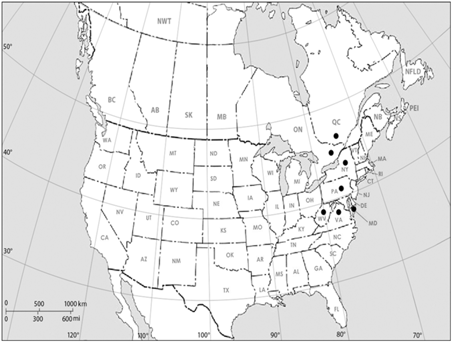
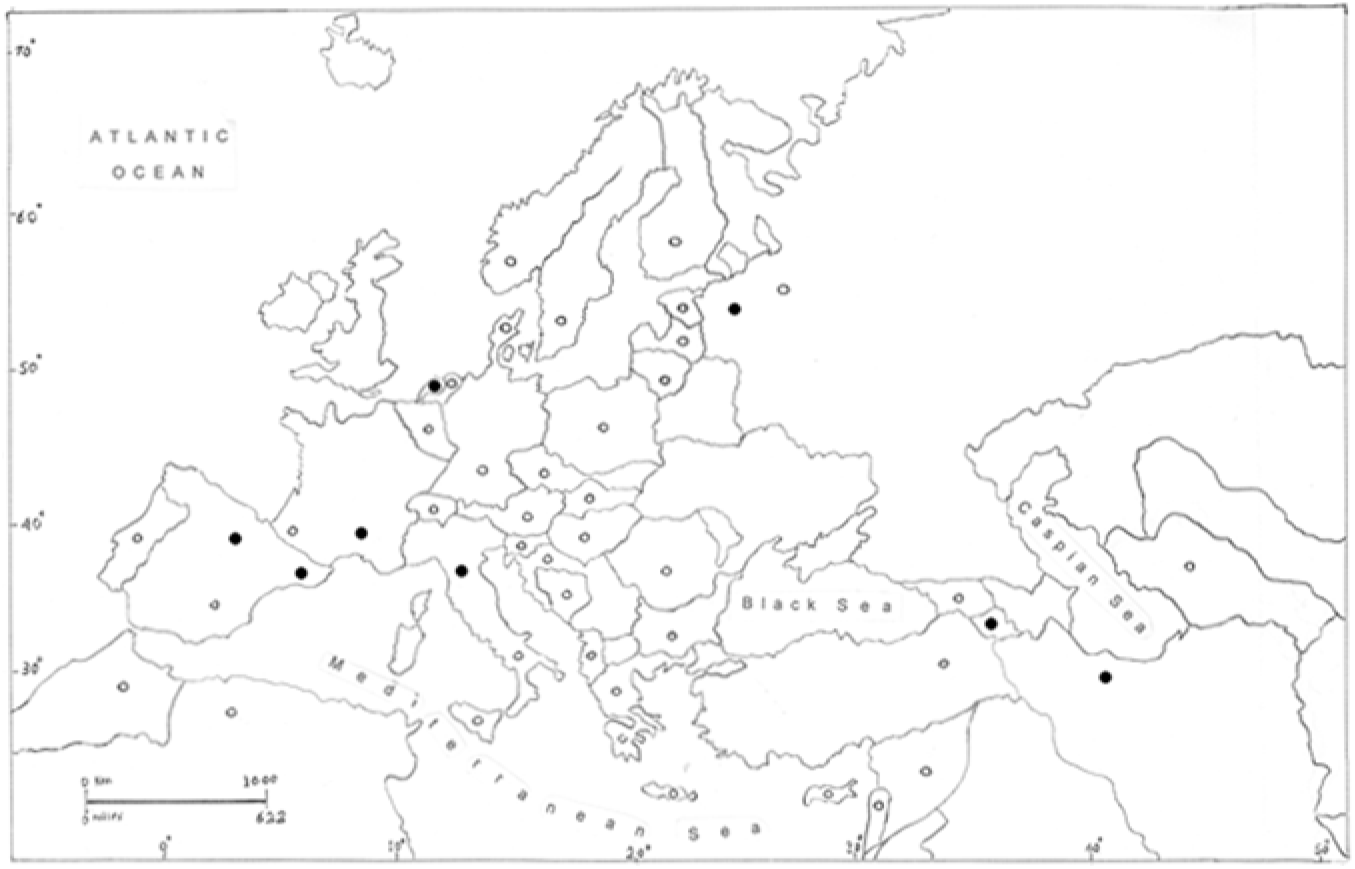
The lace bug Dictyla echii (Schrank) (Hemiptera: Tingidae), a Palaearctic species, has successfully become established in North America. Hambleton (Reference Hambleton1968) first recorded this lace bug on the naturalised European host plant Echium vulgare Linnaeus (Boraginaceae), commonly known as blueweed or Viper’s bugloss, in Maryland, Virginia, and West Virginia, United States of America. Wheeler and Hoebeke (Reference Wheeler and Hoebeke1985) studied seasonal history and habits during 1981–1982 in Pennsylvania and documented the range of expansion of D. echii on Echium vulgare in the United States of America, including the first records from Ontario, Canada (Fig. 1). The native distribution of Dictyla echii is from Scandinavia and Siberia south to northern Africa, the Caucasus, Iran, Turkestan, and China (Southwood and Leston Reference Southwood and Leston1959; Drake and Ruhoff Reference Drake and Ruhoff1965; Péricart Reference Péricart1983; Dolling Reference Dolling1991) (Fig. 2).
Distribution of Dictyla echii in North America.

Palaearctic distribution of Dictyla echii. •, Specific localities; ο, country records.

Adults overwinter in the soil near rosettes of E. vulgare, one of the preferred host plant (Vayssieres Reference Vayssieres1983). In spring, eggs are deposited in stems, petioles, and principal veins of the host foliage (Štusák Reference Štusák1958; Vayssieres Reference Vayssieres1983). Adults and nymphs feed on rosettes, flowers, and shoots, causing chlorosis stunted floral shoots and, in heavy infestations, a decrease in seed production. Several generations are produced annually in France (Vayssieres Reference Vayssieres1983). Two generations per year are reported in south central Pennsylvania (Wheeler and Hoebeke Reference Wheeler and Hoebeke1985). Puchkov (Reference Puchkov1974) described with illustrations the egg, fifth instar, and adult. Cobben (Reference Cobben1958) described and figured the fifth instar.
Dictyla echii is well adapted in its new environment in south central Canada and the northeastern United States of America (Wheeler and Hoebeke Reference Wheeler and Hoebeke1985). This species was collected from cuttings of reproductive parts of the host plant, Echium vulgare, in the study sites in Québec. However, there are no records of importation of this species for evaluation as a potential biocontrol agent for Echium Linnaeus species. Echium vulgare is believed to have been introduced unintentionally, on agricultural or nursery stocks, when people migrated from Europe to North America sometime in the early nineteenth century (Drake and Ruhoff Reference Drake and Ruhoff1965). In Europe, it occurs on a number of Echium species and several other plants, but the preferred food plant is E. vulgare. It also has been recorded from species of Anchusa Linnaeus, Cynoglossum Linnaeus, Pulmonaria Linnaeus, and Symphytum Linnaeus (Boraginaceae) (Drake and Ruhoff Reference Drake and Ruhoff1965). Dictyla echii has been cited as a potential biological control agent for Echium plantagineum Linnaeus in France and Australia (Vayssieres Reference Vayssieres1983).
Dictyla echii has a wide distribution in the Palaearctic between 35° and 48° latitude and between 10° west and 70° east longitude (Fig. 2) (Drake and Ruhoff Reference Drake and Ruhoff1965; Péricard Reference Péricart1983). In North America, this species is limited to between 35° and 45° latitude and 70° and 80° longitude in Maryland, Pennsylvania, Virginia, West Virginia, New York, and Ohio in the United States of America, and between 43° and 48° latitude and 70° and 77° longitude in Canada (Figs. 1–3).
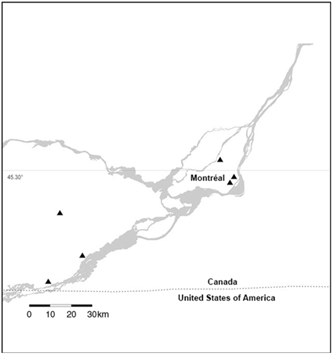
Distribution of localities of Dictyla echii in this study in Ontario and Québec, Canada.

The natural history, morphology, and distribution of this introduced lace bug have not been studied in Canada. Therefore, the objective of this study was to report a long-term biological, ecological, and morphological investigation of D. echii over several generations using representatives from southeastern Canada in Ontario and Québec (Fig. 3). According to the current survey, D. echii appears to be expanding its distribution in southeastern Canada.
Materials and methods
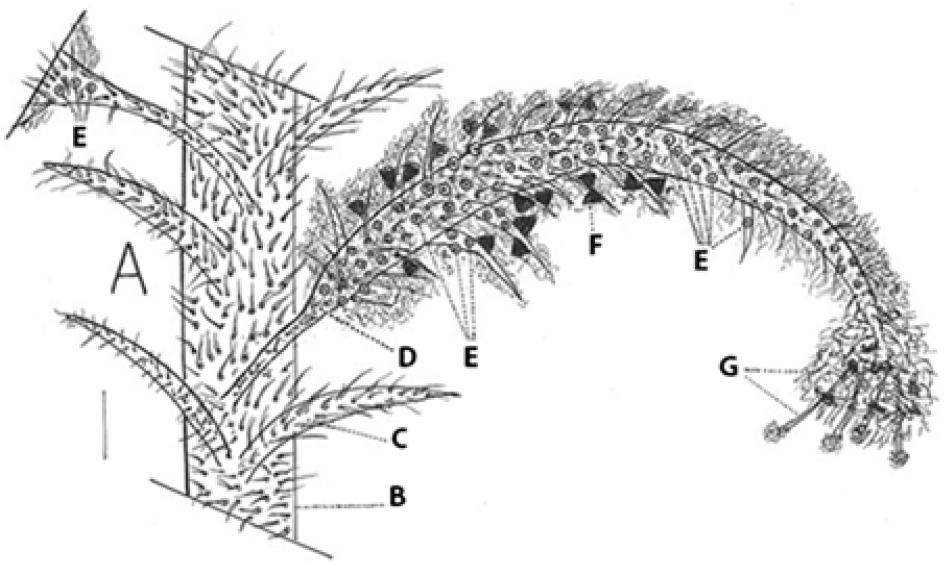
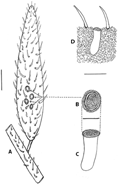
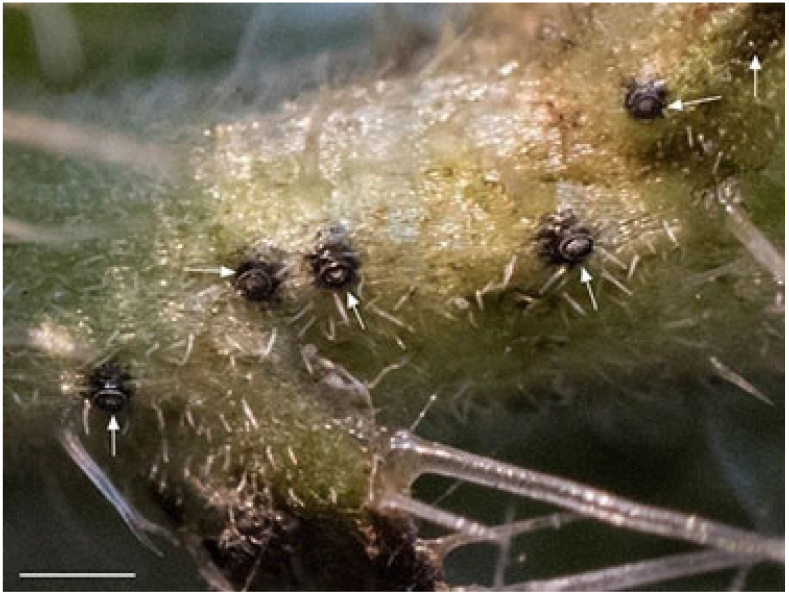
The natural history of D. echii was examined by sampling five green, spiny shoots of E. vulgare every two weeks, from mid-May to the end of September in 2014–2017. The samples, consisting of stems, leaves, and flowers to ground level, were carried separately in transparent ventilated plastic bags to the laboratory and kept at 2–3 °C for 1–2 days. In the laboratory, samples of host plants were shaken or beaten with a wooden stick above a 50-cm-by-50-cm white cloth to dislodge adults and nymphs. The green leaves, stems, and flowering parts of the host plants were also checked for eggs of D. echii deposited between spines in the stem and leaf mesophyll (Figs. 4E, 5B–C, 6). Eggs of D. echii are inserted singly within the mesophyll, mostly on soft green stems, as well as on the surface of small green leaves, mid-ribs, and petioles of the host plants (Figs. 4E, 5A, C, 6). Oviposition sites are quite inconspicuous, being marked only by the small operculum, which is flush with the surface of the plant tissue (Fig. 6).
The oviposition site selection of Dictyla echii. A, Portion of a cutting of the main stem of the spiny host plant, Echium vulgare and one smaller green stem with several small green leaves, flowers, and seeds; B, sharp-pointed, pale spines of host plant; C, large-sized leaf on main stem; D, small green stem with over 50 eggs; E, eggs of D. echii inserted into stem and leaf parenchyma; F, seeds of host plant; G, flowers of host plant. Scale: 0.5 mm.

The oviposition pattern and site selection of Dictyla echii on leaf surface of Echium vulgare and chorionic collar cum apparatus of an egg. A, Leaf of E. vulgare with top of four eggs flush with leaf surface; B, cap of an egg; C, an egg with cap; D, an egg inserted into parenchyma of host leaf. Scales for egg: 0.3 mm; scale, cap: 0.1 mm.

Eggs of Dictyla echii inserted vertically to the soft green stem parenchyma of Echium vulgare. Only the neck collar and operculum of eggs (arrows) are visible. Scale: 0.2 mm.

Using sharp surgical scissors and working under a binocular microscope, eggs of this species were collected by cutting tiny squares (5 mm × 5 mm) of the host leaf or soft stem tissue around the operculum of the eggs, which are set in the parenchyma. The eggs were then recorded and examined, with only those in good condition incubated or used for breeding.
Breeding and rearing D. echii were carried out on E. vulgare taken with roots and soil from the natural habitat close to the railroad station in Beaurepaire, Québec (45.427°N, 73.886°W) and Rockland railroad parking facilities station (45.517°N, 73.645°W) in Montréal, Québec. Each host plant was potted in one of the five 30-cm-diameter clay pots covered with a 65-cm clear plastic cylinder, closed at one end with fine screen. The other open end was inserted into the pot soil. A pair of non-mated adults of D. echii collected near rosettes of the host plant in soil on 12 May 2016 and 15 May 2017 was released on E. vulgare through a 3-cm hole made in the plastic cylinder in each cage-pot that was secured with a cork. The experimental host plants were free of lace bugs and predators and in good condition for potting and breeding. The surface of the soil around host plant was covered with white towelling, which was moistened every 2–3 days to have sufficient humidity in the cage. The cultures were maintained under ambient conditions and checked 2–3 days per week. The incubation, the number of eggs, nymphs and new adults, as well as feeding, mating, and development of nymphs were recorded from 20 May to the end of September of each season.
The host plants of D. echii were found mostly in open, sunny, disturbed gravel areas. This habitat was found close to railroad right-of-ways and around train dikes and stations in the western suburbs of Montréal, which includes the townships of Beaconsfield and Beaurepaire as well as disturbed areas close to train parking facilities in Rockland. It was also found in isolated, disturbed gravel lands in Green Valley near Alexandria, Lancaster, and Cornwall, Ontario (Fig. 3).
Voucher specimens of D. echii adults (male and female), first to fifth-stage instars, eggs, and eggshells were preserved in 75% ethanol. Adults and eggshells were also glued on triangular points. All vouchers were deposited in the Lyman Entomological Museum of McGill University (Sainte-Anne-de-Bellevue, Québec, Canada). Adults from the Nearctic (n > 1000) and Palaearctic (n > 800) regions were examined from the following institutions: American Museum of Natural History, New York, New York, United States of America; Canadian National Collection of Insects, Arachnids, and Nematodes, Ottawa, Ontario, Canada; Ecology and Evolutionary Biology Collection of Insects, University of Connecticut, Storrs, Connecticut, United States of America; Iranian Research Institute of Plant Protection, Tehran, Iran; Lyman Entomological Museum, McGill University, Sainte-Anne-de-Bellevue, Québec, Canada; Nationaal Natuurihistorisch Museum, Leiden, The Netherlands; Natural History Museum, Barcelona, Spain; Royal British Columbia Museum, Victoria, British Columbia, Canada; Royal Ontario Museum, Toronto, Ontario, Canada; Spencer Entomological Collection, Beaty Biodiversity Museum, University of British Columbia, Vancouver, British Columbia, Canada; and Zoological Institute, Insect Collection, Saint Petersburg, Russia.
Dictyla Stål
There are 52 described species of the genus Dictyla worldwide, including one fossil, D. veteran (Scudder) (Drake and Ruhoff Reference Drake and Ruhoff1965). Of these, only two species of D. echii (Schrank) and D. labeculata (Uhler) are reported from Canada (Wheeler and Hoebeke Reference Wheeler and Hoebeke1985; Maw et al. Reference Maw, Foottit, Hamilton and Scudder2000, Neal and Schaefer Reference Neal, Schaefer, Schaefer and Panizzi2000).
Dictyla echii (Schrank)
Habitat
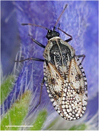
Echium vulgare was usually found in disturbed, open, sunny gravel and limestone areas near deciduous bushes and within or under clumps of weeds. The adults of Dictyla echii (Fig. 7) overwintered around rosettes of host plants in soil from October until the following spring in May when temperatures reached 15–20 °C.
Dorsal view of an overwintered adult of Dictyla echii feeding on the flowering parts of its spiny host plant, Echium vulgare. Scale: 1.5 mm.

Descriptions
Adults
Elongate-ovate black. Length 3.2 mm, width 1.5 mm. Pronotum elevated, finely punctate dorsally; posterior extension somewhat inflated. Median carina of pronotum well developed starting from the collar going down between the end of two lateral carinae. The lateral carinae are half the length of the median carina. Paranotum curved, long, flat, with small areolae on two vertical edges. Body and eyes black with the exception of the lighter amber third antennomere and tibia. Pronotum with clear, lacy areolae; fore wings lacy with deep brown lines forming two spots on the middle of the subcostal and discoidal areas. Antennae with four antennomeres; antennomere 1 black, and slightly longer than antennomere 2; antennomere 3 light amber, three times longer than antennomere 4; antennomere 4 deep brown, setose, and pointed, one-third the length of antennomere 3. Tarsi with two tarsomeres, dark brown, with two sharp claws.
Male reproductive system
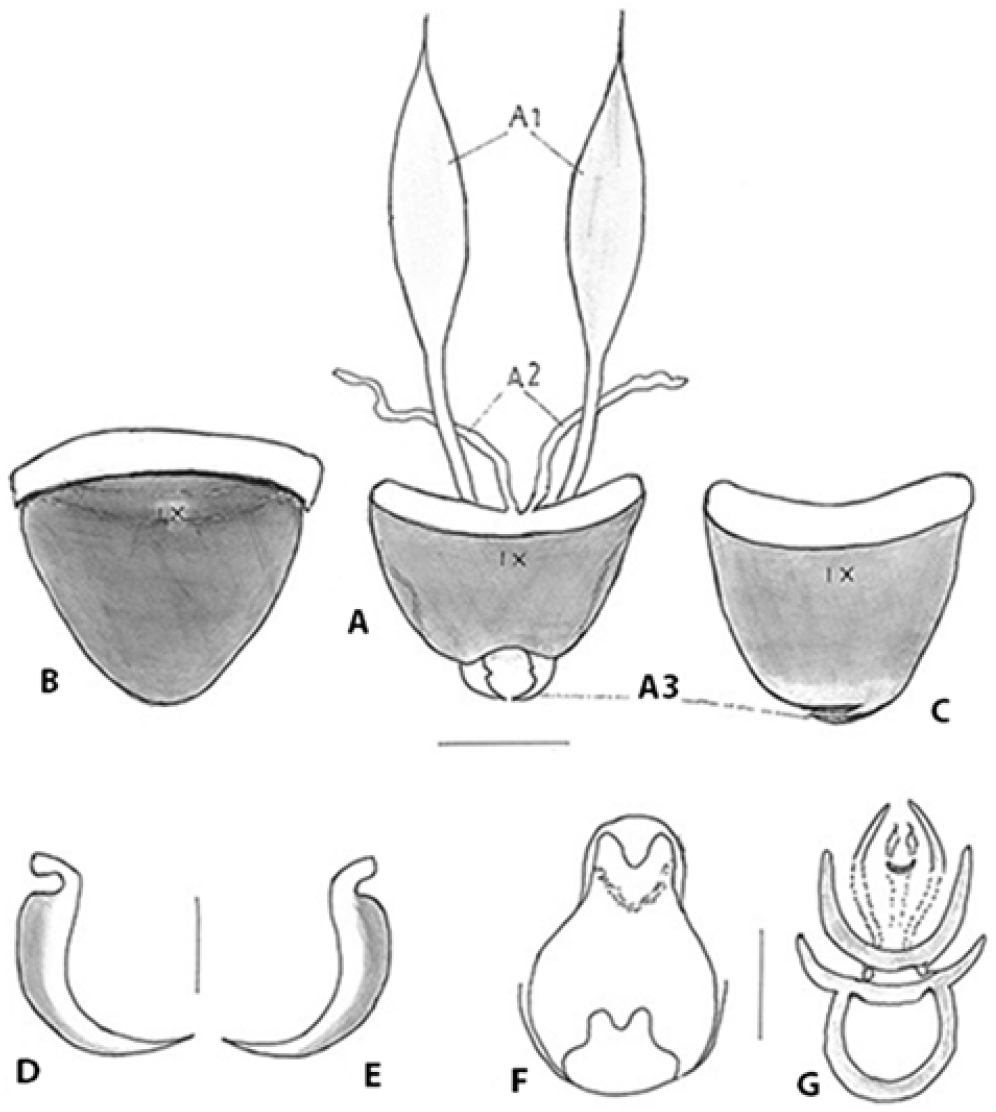
The male reproductive system consists of a pair of narrow, elongate, oval testes, which are pointed apically and connected by a long, thin duct to the median exit tube (Fig. 8A). Paired accessory glands open to the median exit tube. Pygophore rounded dorsally, broader than long, tapering apically, and rounded at apex (Fig. 8B). Parameres at the end of the pygophore, which open during copulation (Fig. 8A) and close at rest (Fig. 8C) are strongly curved and sharply pointed apically (Figs. 8D–E). Aedeagus ovoid, the external opening of its exit duct is within a median intromittent organ, the penis (Figs. 8F–G).
Male reproductive system of Dictyla echii. A, Testis (A1), accessory gland (A2); B, male terminalia, ventral view; C, male terminalia, dorsal view; D, left paramere; E, right paramere; F–G, aedeagus. A–C, Scale: 0.3 mm; D–E, scale: 0.25 mm; F–G, scale 0.1 mm.

Female reproductive system
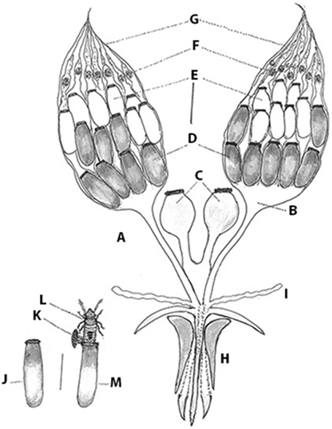
The female reproductive system consists of a pair of ovaries and a pair of rounded pseudo-spermathecae, each of which with a circular, cap-like structure on top (Fig. 9C) and a pair of accessory glands (Fig. 9I). All of these open to a median oviduct leading to the ovipositor. Each ovary has seven ovarioles connected to the main oviduct. All ovarioles are tied together at the apex by a very delicate flagellum (Fig. 9G). Eggs develop from oocytes in the ovarioles (Fig. 9F). Mature eggs (Fig. 9D) pass through to the common median duct, and then to the exit passage to the ovipositor (Fig. 9H).
Female reproductive system of Dictyla echii, A, Overall reproductive structures; B, right ovary with seven mature, dark-coloured and seven-non-matured, pale coloured eggs in ovarioles; C, pseudospermathecae; D, mature, dark egg; E, non-mature, pale eggs; F, oocyte; G, flagellum; H, ovipositor; I, accessory glands; J, egg with developed embryo; K, egg cap pushed aside and remains attached to the egg shell; L, first instar emerging from an egg; M, egg shell. Scale: 0.3 mm.

Egg
Elongate, cylindrical, narrowed at top and end (Figs. 9J, 4E, 6). Length 0.8 mm, width 0.3 mm. Colour varies from brown to dark brown or black, usually considerably darker on the cephalic half and lighter on the cap. The cephalic end is distinctly neck shaped and closed by a round cap. Eggs of D. echii are almost entirely inserted into the soft green stem of the host plant and rarely among the cells on the surface of the leaves (Figs. 5A, D, 6).
First instar
Oval, elevated dorsally (Fig. 9L). Length 0.6 mm, width 0.3 mm. Body light amber on eclosion with three orange dots on eyes, soon turning fuscous or black. Lines dividing mesosternum and metasternum and abdominal segments visible. Head pointed dorsally with long setae, pronotum with one seta at the joint of the pronotum with the costal area. Joint of each abdominal segment with a seta. Antennae stout, with four antennomeres: antennomeres 1 and 2 approximately the same length; antennomere 3 two times the length of antennomere 2; antennomere 4 wider, with long setae. Rostrum four segmented, surpassing the middle of the metacoxae.
Second instar
Body deep brown to black. Length 0.8 mm, width 0.4 mm. Similar to the first instar morphologically. Mesosternum and metasternum more elevated.
Third instar
Oval, elongate, black. Length 1.3 mm, width 0.6 mm. Pronotum, abdominal segments 2–9 elevated dorsally with fine setae at costal areas. Antennae stout, with four antennomeres; antennomere 1 and antennomere 2 0.12 mm; antennomere 3 0.4 mm; antennomere 4 ovate, 0.25 mm, with long setae. Legs deep brown to black. Eyes red-brown to black. Rostrum long, four segmented, reaching the second abdominal segment. Tips of wing pads visible. A pale narrow line from the buccula, starting between the eyes and continuing ventrally to abdominal segment 8. A seta is present at costal area of abdominal segments 2–9. Tarsi with two tarsomeres, with two brown claws.
Fourth instar
Body black. Length 1.6 mm, width 0.8 mm. Pronotum, abdominal segments elevated. Wing pads developed. Antennae with four antennomeres; antennomeres 1 and 2 the same length; antennomere 3 three times longer than antennomere 2; antennomere 4 stout with fine setae, 2 times shorter than antennomere 3, apex pointed with fine setae. Legs and antennomeres black. Tarsi with two tarsomeres, with two brown claws.
Fifth instar
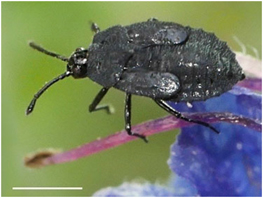
Ovate (Fig. 10), body black. Length 2.9 mm, width 1.3 mm. Pronotum wide, depressed, almost rectangular in outline. Wing pads fully developed, reaching abdominal segment 5. Antennae with four antennomeres; antennomeres 1 and 2 similar; antennomere 3 slender, twice the length of antennomere 4; antennomere 4 slightly wider, with fine setae. Abdominal segments elevated medially.
Lateral view of a fifth-instar Dictyla echii with fully developed wing pads on an Echium vulgare flower. Scale: 1 mm.

Life cycle
Overwintered adults (Fig. 7) appeared on the host plant, Echium vulgare, from the middle of May or early June in 2014–2017. Adults were active at temperatures above 16 °C, moving among the spines of green stems or on the small green leaves, searching for suitable spots to insert their stylets into the parenchyma. Adults of D. echii are reproductively active in spring. Mating was generally observed after about one week of feeding during sunny warm days in May or early June with temperature between 18 °C and 28 °C at 75–90% relative humidity. Females mated 3–5 times; the mating position in D. echii is side to side with last abdominal segment at approximately a 35–40° angle from the substrate. This is similar to that of Corythucha juglandis (Fitch) (Hemiptera: Tingidae), which was described by Javahery (Reference Javahery2019). Adults of the new generation leave the breeding sites after the host becomes dried in late August and in September. They hibernate in top soil near roots of the host plants from mid-October to about mid-May in the following spring.
Oviposition, fecundity, and incubation
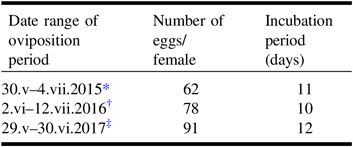
The D. echii females that overwinter reproduce in the spring. Oviposition started several days after feeding and mating from late May to early June. Eggs were laid close to each other. The female inserted eggs entirely in the soft tissues of the upper and lower green stems and rarely into tissue of small leaves (Figs. 4E, 5A, D). Only a small portion of the egg or the neck-like structure of the operculum was exposed from the stem or leaf (Figs. 4E, 5A, 6). The exposed operculum is concealed by dark brown frass (Fig. 6, arrows). In proportion to the size of the abdomen, the eggs are quite large and up to 14 mature eggs can be contained within the two ovaries of the female at the same time (Fig. 9D–E). Eggs are generally inserted singly between spines in the stem and leaf mesophyll in no particular order (Figs. 4E, 5A, 6). Two, three, or five eggs may be laid in one line, rather than in close proximity to each other (Fig. 4E). Eggs were deposited from late May or early June to mid-July. Hatching was observed in the field on 3 June 2014, 10 June 2015, 7 June 2016, and 11 June 2017, respectively. Hatching occurs without an egg burster and is similar to that described for Pentatomidae and Scutelleridae (Hemiptera); the egg cap is attached to embryonic membrane and eggshell (Javahery Reference Javahery1994). The number of eggs/female (n = 5) were 62 (2015), 78 (2016), and 91 (2017) (Table 1). Incubation times were 11, 10, and 12 days in June during the above three seasons, respectively (Table 1).
Oviposition period, fecundity, and incubation times of overwintered of Dictyla echii in the field in 2015–2017 (n = 5 pairs). Host plant: Echium vulgare.

* Females and males collected 12–15 May 2015 at their hibernation sites in soil.
† Females and males collected 18–20 May 2016 from leaf hosts near the ground.
‡ Females and males collected 14 May 2017 at their hibernation sites in soil.
Development of immature stages
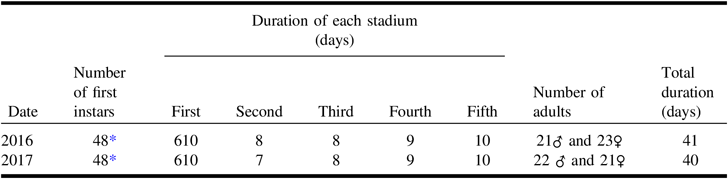
First instars (Fig. 9L) were observed on green stems and leaves of samples of host plants from the second week of June 2014–2017. Second instars were collected on third week of June 2016 and 19 June 2017. Third instars were collected on 21 June 2016 and 28 June 2017. Fourth instars appeared on 12 July 2016 and 10 July 2017. Fifth instars (Fig. 10) were collected on 17 July 2016 and 15 July 2017. Adults of the new generation appeared on 27 July 2016 and 1 August 2017. The developmental times from first instar to adult and the number of males and females feeding on Echium vulgare are given in Table 2. Overlap of all stages was encountered in late July and during early August in four seasons. The host plants at the study site had dried up by late August and the first week of September. By mid-September only three late-developing fourth instars, two fifth instars, and four adults (three males, one female) were found in 10 samples in 2016. The average number of immatures and adults from 10 samples on 7 September 2017 were: two third instars; four fourth instars; six fifth instars, and 15 adults (seven males, eight females). These immatures and adults were collected on the newly green shoots of the host plants (15–20 cm), which were developed from remaining of the old central stems of host plants near the ground after mowing spring shoots of hosts, in mid-July or late August.
Duration of immature stages of Dictyla echii in the field in 2016 and 2017. Host plant: Echium vulgare.

* 1–2 days old of first instars from the laboratory. Culture at 23 °C, 75% relative humidity, 10:14 light:dark photo period. Transferred into rearing cages (n = 5) for development on 12 June 2016 and 8 June 2017.
Dictyla echii probably has one generation per year above 45° latitude in southern Québec and eastern Ontario. New adults overwintered in soil near rosettes of host plants.
Natural enemies
Little is known about the natural enemies of Dictyla echii. Vayssieres (Reference Vayssieres1983) observed an Orius niger (Wolff) (Hemiptera: Anthocoridae) attacking eggs and first-instar D. echii in southwestern France. Wheeler and Hoebeke (Reference Wheeler and Hoebeke1985) found an adult Sinea diadema (Fabricius) (Hemiptera: Reduviidae) feeding on a fifth instar in Pennsylvania. In the present study, two fourth-instar D. echii were observed wrapped in a white-coloured web of an unknown spider (Araneae), between three top leaves of Echium vulgare, on 3 August 2014 at Green Valley, Ontario.
Discussion
Dictyla echii was observed to feed, breed, and develop on Echium vulgare at study sites in Beaurepaire, Beaconsfield, and Rockland on the Island of Montréal as well as in southeastern Ontario. The host plant has been reported from overgrazed pastures, especially in limestone gravel regions or calcareous sand, and is tolerant of hot dry weather (Pusateri and Blackwell Reference Pusateri and Blackwell1979).
Dictyla echii is native throughout much of the Palaearctic Region (Fig. 2) with the exception of the United Kingdom (Southwood and Leston Reference Southwood and Leston1959; Drake and Ruhoff Reference Drake and Ruhoff1965; Dolling Reference Dolling1991). In North America, it is recorded from Ontario in Canada, and Maryland, New York, Ohio, Pennsylvania, Virginia, and West Virginia in the United States of America (Wheeler and Hoebeke Reference Wheeler and Hoebeke1985) (Fig. 1).
There is no record of D. echii being introduced into North America or of it being evaluated as a potential biocontrol agent of the host plant. Both species are well adapted to their new environment and were probably introduced into North America sometime in the early 19th century. Wheeler and Hoebeke (Reference Wheeler and Hoebeke1985) provided a list of the localities in eastern United States of America and in Mount Forest and Owen Sound, Ontario, Canada.
Adults of D. echii overwintered in a state of non-reproductive (diapause) in the soil near rosettes of E. vulgare (similar observations were made in France by Péricart Reference Péricart1983 and Vayssieres Reference Vayssieres1983). They first emerged from diapause in mid-May or early June in Ontario and Québec. Wheeler and Hoebeke (Reference Wheeler and Hoebeke1985) reported collecting adults of overwintering individuals of D. echii, from Pinus virginiana Miller (Pinaceae), during mid-April and early May in south-central Pennsylvania.
Little is known about the aestivation period of D. echii (i.e., the time after maturation and before overwintering in the soil). It was observed to start after about two weeks of feeding by new adult, usually in mid-August, and terminated after the first cold weather or frost in October. Dictyla echii overwinter as adults and are in a state of low metabolism during aestivation and the first 3–5 months of hibernation. These periods are critical in the life cycle of Hemiptera (Javahery et al. Reference Javahery, Schaefer, Lattin, Schaefer and Panizzi2000), including D. echii, because feeding, mating, and reproduction are influenced by factors such as photoperiod and freezing temperatures. Newly matured lace bugs, which overwinter as adults, generally do not mate or reproduce for 3–5 months. This period is known as the obligatory diapausing time, which has been reported in a number of Hemiptera (e.g., Javahery Reference Javahery1995) and is present in several other species occurring north of 43° latitude (e.g., Javahery et al. Reference Javahery, Schaefer, Lattin, Schaefer and Panizzi2000).
Mating position in Heteroptera is usually end-to-end (Javahery Reference Javahery1995), although mating is side-by-side or lateral in orientation in a few species (Javahery Reference Javahery2013). However, in D. echii and the two Tingidae (Corythucha juglandis (Fitch) and Gargaphia tiliae (Walsh)), mating was at an angle of about 30–45° (Javahery Reference Javahery2019).
The development time for one generation for D. echii on E. vulgare was about two months in the breeding sites in June and July (Table2). However, two annual broods are reported for this species in south-central Pennsylvania (Wheeler and Hoebeke Reference Wheeler and Hoebeke1985). First brood adults appeared in early July and by late August, and early September, the second generation matured (Wheeler and Hoebeke Reference Wheeler and Hoebeke1985). Therefore, an estimated six weeks is suggested as the time required for completion of the life cycle (Twinn Reference Twinn1935).
Acknowledgements
My thanks to C.M. Buddle (McGill University, Sainte-Anne-de-Bellevue, Québec, Canada), C. Cutler (Dalhousie University, Halifax, Nova Scotia, Canada), A. Smith (Canadian Museum of Nature, Ottawa, Ontario, Canada), R. Manuel, and two anonymous reviewers for their useful input. The late C.W. Schaefer (University of Connecticut, Storrs, Connecticut, United States of America), J.E. McPherson (Southern Illinois University, Carbondale, Illinois, United States of America), G.G.E. Scudder (University of British Columbia, Vancouver, British Columbia, Canada) the late I.M. Kerzhner (Zoological Institute, Insect Collection, Saint Petersburg, Russia), and the late T.A. Wheeler (McGill University) all provided helpful comments or references.
Special thanks to M. Armata, S. Boucher (McGill University), B. Caballero (Natural History Museum, Barcelona, Spain), C. Copley (Royal British Columbia Museum, Victoria, British Columbia, Canada), M. Goula, A. Grégoire-Taillefer (McGill University), G. Masó (Natural History Museum, Barcelona, Spain), K.M. Needham (University of British Columbia), R. Nixdorf, J. Ribes (Natural History Museum, Barcelona), S. Rochefort (McGill University), and J.F. Roch, for assistance in checking specimens and with analysing distributional data. I also thank J. Mohaghegh (Iranian Research Institute of Plant Protection, Tehran, Iran) and P. Azmayesh Fard (Tehran University, Tehran, Iran) for useful discussions on lace bugs or their natural enemies. Finally, I am indebted to my family for their patience and help in collecting, sampling, and recording field data of lace bugs throughout this work.