

Eighteenth-century English sermons about music are not often the subject of sustained discussion.Footnote 1 When they are written about, these texts are generally used as evidence about musical practice in the Church, or to serve broader arguments about canon and nationalism in English musical culture.Footnote 2 Yet an examination of the contents and rhetorical strategies of this specific genre reveals a coherent literature of musical aesthetics with a traceable line of development. As I demonstrate below, it is helpful to read these texts with an awareness of the evolving ideas of sympathy and sensibility characteristic of much eighteenth-century thought. An understanding of the original intellectual contexts places the music sermon in a field that stretches beyond the narrow confines of English religious history; the ideas of these sermons sit squarely among some of the most prominent philosophical, social, literary, musical and moral-aesthetic concepts of the eighteenth century.
Music historians have increasingly acknowledged the importance of pathos and sympathy in eighteenth-century musical aesthetics. Stefano Castelvecchi, for instance, notes how a new genre of sentimental opera ‘emerged’ in the century's middle decades.Footnote 3 Handel scholars, too, recognize the importance of sentiment, sympathy and sensibility in that composer's output and its reception, particularly in the decades under consideration here, during which time Handel's oratorios brought the aesthetics of the musical theatre and the discourses of church and state ever closer in the perceptions of his English contemporaries.Footnote 4 Less often acknowledged is the importance of religious thought in the historical discourse of sympathy, much as religious writing is often overlooked in writings on musical aesthetics of the eighteenth century.Footnote 5 The music sermon provides a point of intersection in these well-established fields of enquiry concerning English sentimentalism, musical aesthetics and religious thought.
This article joins a body of scholarship that reassesses the centrality of the sermon in eighteenth-century English culture, contradicting the widespread perception that ‘in the “secular age” the Church of England was in a century-long stupor’.Footnote 6 Keith A. Francis and William Gibson have identified a ‘transformation’ of scholarly discourse which now recognizes eighteenth-century England as a ‘sermonic society in which preaching was one, if not the principal shared experience of all classes and conditions of people’.Footnote 7 Printed sermons had a diffusion far beyond the pulpit, and in large numbers; estimates for the annual publication of sermons run between 187 and 350, and a single publisher of the time could find it profitable to print as many as forty thousand copies of sermons in his career.Footnote 8 Throughout the eighteenth century these publications were widely read, with Samuel Johnson quipping that sermons were ‘as likely to be read in the coffee house and inn as the country house library’.Footnote 9 This secular appeal of sacred writing reflects the multifarious topics it covered: there are sermons addressed to tradesmen, sermons on military victories, sermons about masonry, sermons about the aesthetics of interior decorating, and – for our purposes – sermons about music.Footnote 10 As Ruth Smith reminds us, ‘sermons, biblical commentaries, and works on religion formed a major, possibly the largest, part of the nation's reading matter’, including ‘the bulk of contemporary music criticism’ at this time.Footnote 11
Music sermons were printed in every decade of the century, as illustrated in the Appendix to this article. This list shows that the music sermon's numbers were more significant than previously known: I have identified eighty-four sermons published between 1700 and 1799, increasing the known bibliography by a third compared with earlier tallies.Footnote 12 This count (while surely not complete) places the average rate of publication at eight music sermons annually, a figure sitting between two and four per cent of the sermons published in any given year. Music was the only art to be granted such a significant treatment in the published record; John Cooke's 1783 bibliography, The Preacher's Assistant (which forms the starting-point for this article's Appendix), includes separate categories for both general music sermons and for organ dedications, but no such indications for sermons on any of the other arts.Footnote 13 Modern search tools provide similar results: the English Short Title Catalogue lists sixty music sermons, but gives only three results for sermons on the theatre, two for sermons on architecture and none on poetry or painting.
Virtually all of these sermons were products of the established English Church, rather than Nonconformist or alternative Protestant denominations. These mainstream institutions published music sermons for two main reasons. Occasionally, churches would celebrate the installation of an organ with a sermon on the power of music, and there are nineteen such publications included in the Appendix (marked ‘OD’ for ‘organ dedication’). More common than these organ sermons, though, were those published to commemorate the annual meetings of musical societies. The festival sermons of the three cathedral choirs of Worcester, Gloucester and Hereford (marked ‘3C’), formally begun in the second decade of the eighteenth century and continuing to the present day, make up the largest number of published music sermons. There are forty-three extant Three Choirs sermons dating between 1720 and 1800; these constitute more than half of the items in the Appendix and form the core of the literature.Footnote 14
Sometimes the contents of these music sermons would be shaped by the occasions for which they were prepared, but most often they had a markedly universal focus. They almost never mentioned specific composers or works, and they generally made no distinction between instrumental and vocal music (although, given the nature of their statements and cathedral traditions, it is clear that they almost always had texted vocal music in mind). These writings covered both time-tested topics such as the illustration of how all ‘Grave and Solemn Musick’ could be a ‘Help to Devotion’, and more specifically eighteenth-century concepts, such as the moral value of music that vibrated in sympathy with the ‘Melody of the Heart’.Footnote 15 This rhetorical approach has led Andrew Pink to suggest that printed sermons might be inspected for a ‘theology of music’, and Ruth Smith to speak of an ‘Anglican canon’ of views on music.Footnote 16 Pierre Dubois has also taken a synchronic view, offering the theory of sympathy as a unifying strategy in the eighteenth-century music sermon, which, he says, aimed to ‘reconcile religion with entertainment, morality with decorum, and decency with aesthetic or sensuous gratification’.Footnote 17
In this article I embrace Dubois's recognition of sympathy as the central aesthetic axis of this literature, but I resist earlier scholars’ claims that there was a single, coherent musical theology in the eighteenth century. I advocate instead a diachronic understanding of the aesthetics of the music sermon, one that recognizes an evolution of the notion of sympathy and its link to musical morality. There was a significant development in the clergy's attitude towards music, with this art of sympathetic vibrations receiving ever higher approbation during the century's middle decades.
Definitions of ‘sympathy’ in the eighteenth century exhibit a dual understanding of the term. Benjamin Defoe's 1735 dictionary, for instance, offers the following: ‘The Natural Agreement of Things, a Conformity in Nature, Passions, Dispositions or Affections’.Footnote 18 Here we see an understanding of sympathy as, on the one hand, an observable physical relationship between ‘Things’. On the other hand, this definition also offers ‘Dispositions or Affections’ as possible points of sympathy; we thus see a hint of the idea that later authors would refer to as ‘Fellow-Feeling’ – ‘sym’ + ‘pathos’ – not quite here given the clearest articulation. Yet this is the meaning of the term that, by the time of publication of Johnson's Dictionary in 1755–1756, would be the primary one: ‘Fellow-feeling; mutual sensibility; the quality of being affected by the affection of another’.Footnote 19 In Johnson's definition, the notion of physical vibrations has disappeared, replaced by an emotional understanding of the term. Still, Johnson hinted at the physical rootedness of morality here with ‘sensibility’; Johnson defined that term as ‘Having the power of perceiving by the senses’, and defined ‘sensible’ as both ‘Perceptible by the senses’ and ‘Having moral perception’.Footnote 20 This link between physical and moral sensation demonstrates a complex understanding of goodness in the eighteenth century, the evolution of which can be traced in the music sermons examined here.
The most common histories of sympathy see this concept as part of the tide of sentimentalism unleashed by the ‘moral sense’ school of philosophy, established by the third Earl of Shaftesbury at the beginning of the eighteenth century and flowering in the mid-century work of writers like Frances Hutcheson and Adam Smith, with the latter using the term ‘moral sentiments’ in 1759.Footnote 21 Smith focused more closely on the concept of feeling than had Shaftesbury, and argued that ‘Humanity’ – a term that in Smith's writing is related to the moral sense, the idea of natural morality – ‘consists merely in the exquisite fellow-feeling which the spectator entertains with the sentiments of the persons principally concerned, so as to grieve for their sufferings, to resent their injuries, and to rejoice at their good fortune’.Footnote 22 Smith claimed a nexus of mental and sensory response (the notion of sensibility) as proof of natural morality. His most memorable illustration of this nexus was his meditation on witnessing a man tortured upon the rack: ‘By the imagination we place ourselves in his situation, we conceive ourselves enduring all the same torments, we enter as it were into his body and become in some measure him.’Footnote 23 Through the intermediary step of imagination, the ultimate act of sympathy is the collapsing of identity into that of a fellow human being, the ability to ‘enter as it were’ into the body of another and to conjoin with her or his sensory experience.
Philosophical sympathy had sacred as well as secular roots. R. S. Crane once argued that lessons from the pulpit far outstepped the ‘teaching of individual lay moralists after 1700’.Footnote 24 The particularized circles of the Scottish Enlightenment could hardly have been as influential, Crane pointed out, as what he called the ‘humanitarian homiletic’ of the English church:
It was not necessary to read the Earl of Shaftesbury to learn that ‘to love the public, to study universal good, and to promote the interest of the whole world, as far as lies within our power, is surely the height of goodness, and makes that temper which we call divine’; the same lesson was being taught from hundreds of pulpits . . . by clergymen who had inherited the benevolistic spirit of their Latitudinarian predecessors of the generation before.Footnote 25
Other historians have remarked generally that the religious lessons of the eighteenth century moved ever further from severe dictates of fire and brimstone, a jealous God and original sin.Footnote 26 Theirs was a theology that stressed a benevolent creator moved by ‘the Softer Dictates and Whispers of Humanity’.Footnote 27 Since we were created in such a being's image, such divines argued, we were naturally disposed toward sympathy and kindness. G. J. Barker-Benfield has described both eighteenth-century clergymen's desire to restore ‘all natural feelings and bodily passions’ to a ‘Nature’ they called ‘humane’ and their growing obsession with the ‘material signs’ of virtue, such as sympathetic tears, then considered ‘as crucial as the more spiritual signs of grace had always been’.Footnote 28 Other scholars have discussed how visceral gut reactions to the sufferings of others were ‘natural revelations of God's moral expectations of us’.Footnote 29
Music sat at a unique crossroads between these secular and sacred forms of sentimental thought. In what follows, I provide a survey of a subset of the items included in the Appendix, focusing on the period 1700–1760. In music sermons of these decades there was a clear change in attitude towards the concept of sympathy and its connection to music and morality. The earliest decades show continuity with the preoccupations of the Commonwealth and Restoration; the religious upheavals of the seventeenth century and the changes that they wrought on church music were hardly forgotten, and there was a persistent conflict between the practices and ideals of cathedrals and parish churches. Clergy who wished to speak about the role of music in public religious practice thus needed to address some fundamental issues: the divine sanction of both vocal and instrumental musical practice; music's use throughout the Christian era and its relationship to Catholicism and Protestantism; the dangers and potentials of music's inherent sensuality; and the moral edification that music, as opposed to any other form of human communication, could accomplish. By the middle of the century, music was enjoying a sharp upswing in approbation, based upon a new understanding of the inherent morality of all musical experience. At the centre of these discussions was the word ‘sympathy’, a term that underwent development, beginning as a simple, psycho-acoustical concept, and eventually broadening to encompass a perceived unity of bodily, social and moral senses. Sympathy, a natural property of both musical vibration and the responses it elicited, eventually came to be proof of both the art's moral value and of the morality of listeners themselves.
MUSIC'S ‘SYMPATHISING POWER’
The music sermons of the early decades of the century were devoted to the support of what Thomas Bisse (Chancellor of Hereford Cathedral) called, in the first of the Three Choirs sermons to be published (1720), the ‘Rationale on Cathedral Worship’.Footnote 30 Bisse's approach in this publication established the norms for the genre during the 1720s (at least among the Three Choirs sermons): after a meditation on a verse stressing the link between praise and music-making, these sermons would turn to the nature of music itself and its suitability for religious practice. At the centre of the rationale sat the notion of sympathy, which united sounds floating through the air with the corporeal presence of the auditors’ bodies and, eventually, with their inner souls. On this topic, these clergymen actually agreed with music's most virulent critics: music was consumed through the body, and listening was foremost a physical experience. It was therefore vital for music's supporters to explain how sympathetic experience could engender moral edification. Their explanation was one that would have been familiar to Plato: music was a sort of gateway, a sensual experience that could open the mind to loftier, more pious and more rational contemplation of the Word.Footnote 31 These authors wanted music to be submitted to tight control under the watchful eye of the clergy. But music was also respected greatly as a magnanimous gift from a benevolent creator – indeed, humankind's bodily organs had been framed specifically to receive musical sound waves, and emotional reactions to sound served not only as a path toward pious experience but also as a sign of the godliness of the affected hearer.
Bisse was the most prolific music sermonizer of the period: he published no fewer than three sermons on the topic, in 1720 (with a second edition printed in 1721), 1726 and 1729 (see Appendix). Bisse's contributions in that decade were part of his ongoing efforts to connect religious discourse and charity to the Three Choirs Festival, which, he admitted, began as a chiefly musical tradition:
It was . . . a fortuitous and friendly proposal between a few Lovers of harmony, and brethren of the correspondent Choirs, to commence an anniversary visit, to be kept in turn: Which voluntary instance of friendship and fraternity, was quickly strengthen'd by social compact: And afterwards being blessed and sanctified by a Charity-collection, with the word of exhortation [that is, a sermon] added to confirm the whole, it is arrived to the figure and estimation, as ye see this day.Footnote 32
This combination of concertizing and a religious musical institution under a single umbrella was a rarity in the eighteenth century, and it would have served as a powerful site from which to proclaim the unity of secular and sacred music – as Bisse did.Footnote 33
Pleasure formed Bisse's central evidence in asserting the divine intention of music:
Since then the greatest pleasures of men arise from their passions employed on the objects præordained for them; and since every affection . . . doth universally delight in harmony, as the common object, enjoyment or relief of all . . . I cannot affirm less, than that harmony was ordained for man. . . .
And according to this ordinance of nature hath it been made a constant attendant in the greatest scenes of pleasure. . . . No less hath it born a principal part in Theaters, those fictitious scenes of pleasure, from their first institution. . . . Nay, what at present supersede both [comedy and tragedy], our Operas; what are these but a collection of chosen harmony, a concatenation of Songs; which, tho’ composed in an unknown tongue, connected by an unnatural chaunt [here a footnote indicates ‘Recitative’], upbraided for their irrational half repetition, and for the general futility of the subject and sense, notwithstanding these defects, are for the sake of the harmony, the continued and cardinal entertainments of our Princes, our Nobles, and the chief of our Israel [the English nobility].
For the same and higher reasons hath musick been admitted into consecrated places, into the courts of the living God.Footnote 34
Bisse thus stressed that all musical society was joined together in a triangular hierarchy, with the Church at its apex, but with secular music and even music of the theatre standing alongside it, in this nexus of ‘same and higher reasons’. Musical pleasure joined the sacred and secular together, a proof of God's benevolent spirit:
Musick transcends them all [other earthly pleasures]; gives a more direct and delightful impression to the Soul; and was ordained by God for the delight of the sons of men, to be above all sensible enjoyments, the principal entertainment in human life. . . . Now that musick in both kinds [sacred and secular] . . . was ordained for the delight of mankind . . . let me offer this general reason; because the two principal organs or faculties in the make of man, seem chiefly framed for the performance, and for the reception and conveyance of musick to us. These are the hand and the ear; the hand the instrumental organ to perform, the ear to receive, form, and convey musick to the Soul. Both these I presume to affirm, seem framed principally for musick, as designed to be the superlative delight of the sons of men.Footnote 35
Not only was music designed for man, but man for music. Even his hand – the source of manual labour, of high workmanship, the means by which statuary and painting were made – was chiefly a musical creation. Most activities in life could be performed by a hand even ‘when maimed or defective’, but good music required both music and body to be healthy: harmony must be ‘sound and entire in every part, in every joint and sinew, but also that the correspondent hand be in the same perfection’.Footnote 36
Moreover, music connected man's corporeal nature with his innermost soul, a linkage that these sermons referred to as ‘sympathy’. These writers were not using the word as in later decades to refer to shared feelings between auditors. Instead, they emphasized the old, Platonic linkage between sound, affect, body and spirit. Bisse defines ‘sympathy’ as follows:
Now there is a mutual sympathy framed by the maker of all things between the passions of men and the harmony of sounds. . . . It can comfort the one, and exhilerate [sic] the other; so by the same sympathising power with the other affections, it can stir up what is heavy, quicken what is unactive, moderate what is eager, and quiet what is troubled. There is no state of mind so pleasing but what it can confirm us in; none so irksome, but what it can change.Footnote 37
Henry Abbot, a chaplain to Lord Bathurst, described sympathy in similar terms in his own Three Choirs sermon of 1724: ‘Now, this is a great Secret in Nature, and shews an unaccountable Sympathy between Sounds and Passions, which are mutually the Causes and Effects of each other.’Footnote 38
The most common claim for music's spiritual value lay in the sensual appeal of this ‘sympathising power’; again drawing on Platonic ideas, authors argued that music's effects began in the body, but could open the mind to spiritual influences, a seductive power used for good ends. According to Bisse:
By the composition of sounds and numbers, and their harmonious co-operation on the ear, the heavenly truths contained under them might slide into the minds of the young and ignorant, whom bare words could not move, nor reasonings instruct . . . . [Music can] convey, as it were, by stealth the treasure of good things into a man's mind.Footnote 39
Abbot states that music exists in Christian practice ‘that we may be thereby incited to the greater Ardency of Devotion; and that People, who have not Zeal enough for Religion, to bring them into the Courts of Praise, might be drawn thither by the Chords of Musick’.Footnote 40 James Brooke, Rector of Hill Croome and Vicar of Hanley Castle, similarly argued in his 1728 Three Choirs sermon, ‘The Musick may at first be all that is regarded; yet at length the excellent Things conveyed under those delightful Sounds may insinuate themselves more powerfully into the Soul, and a Precept be wrought into the Mind, when nothing was thought of but gratifying the Ears.’Footnote 41 St Augustine's approbation of music along similar terms provided an antique authority for these writers, ‘weaker minds being, as St. Austin there speaks, by the delight of the ear raised up to the real affection of piety’.Footnote 42 This ‘irresistible power of harmony’, such authors said, was well known to both church congregations and attendees at the theatre: ‘and why should it not be made as serviceable in the one, as in the other . . . to the improvement of virtue, as [well as] to the propagation of vice?’.Footnote 43
This type of spiritual seduction was not music's only benefit; clergy also held that it could be utilized for the improvement of devotional passion among those already faithful. Abbot, for instance, argued, ‘Why should we not think that devotional Musick will excite, or heighten our devotional Passions, as well as amorous Airs kindle wanton Fires? For Nature will always act like itself, whether we apply it to good or evil Purposes.’Footnote 44 Music was thus always going to elicit passionate responses owing to the ‘natural’ properties of sympathy and the way in which the human frame was designed to respond to musical vibration. George Lavington, Prebendary of Worcester Cathedral (and future Bishop of Exeter), took a slightly different approach in his Three Choirs sermon of 1725, musing that a sort of pious competition could ensue between musicians: ‘So provoking, and striving as it were to outvie one another: whereby the holy flame is mutually stirred up; and catcheth from mouth to mouth, from heart to heart.’Footnote 45
Yet there was a concern: to argue for the power of music to elicit automatic sympathy was to admit that musical pleasure was a carnal experience. Physical mechanisms were inextricable from passionate musical response: ‘This influence . . . may seem to be wrought mechanically, by the organs and conveyances of sense.’Footnote 46 This idea of a bodily mechanism implied a lack of rational contemplation in the human response to music, an unmediated and uncontrollable reaction. This was nothing less than the nature of God's creation: humankind, these sermons argued, had been created as a ‘compound Creature, consisting of Soul and Body’, and receiving ‘strong Impressions from the Body, whilst united to the Soul’.Footnote 47 Indeed, in our earthly state, it was impossible to have religious experience without an embodied, physical stimulus:
As long as we have an animal, as well as rational Part in our Composition, it is impossible, we should offer up our Service to God in the manner we ought, without the Concurrence of the Heart, as well as the Head: nor is the Warmth of the one, inconsistent with the Coolness of the other. The Ardor of our Desires is the Life and Soul of Divine Worship, which separated from this vital Principle, is no more than an opus operatum, a dead Carcase.Footnote 48
Body and soul thus depended upon one another, as man was equally framed for sensual pleasures, intellectual stimulation and pious goodness by his creator.
Despite the necessity of sensual stimulation for ‘compound creatures’, the carnality of music required clerics to remind their congregations that a danger lay in music's dual nature. Lavington, for instance, claimed:
Music is a two-edged Sword; capable, as of quelling the rebel passions, so of giving a mortal wound to vertue and religion . . . . Quick and powerful, and penetrating the minutest parts of the body, and inmost recesses of the spirit, when employed under the banners of religion: but likewise searching, and irritating every evil thought, and intention of the heart, when debauch'd into the service of immorality and profaneness. . . . [It] may be the fuel and incentive of vice. . . . [Instead] of curing, it will add venom to the Serpent’s sting.Footnote 49
Brooke similarly worried that there lay a ‘Danger of its [music's] being too affecting, lest it should too much dissolve the Mind, and destroy the Attention to the Matter [that is, the meaning of texts], by the Delicateness of the Melody in which it is conveyed’.Footnote 50 Music also had a discomforting habit of making its way into unsavoury company, being a particular favourite (Lavington reminded his readers) of ‘Pagans’ and their ‘Bacchanalian feasts’, where the ‘noisy and intemperate meetings of disorderly persons’ could ‘prostitute her [music] to irreligious company, and make her become a harlot to intemperance and immodesty’.Footnote 51 Arthur Bedford, a famous tract writer and one of the century's most outspoken critics of modern music, complained in 1711 that contemporary music was particularly debauched: ‘Our antient Church Musick is lost, and that solid grave Harmony, fit for a Martyr to delight in, and an Angel to hear, is now chang'd into a Diversion for Atheists and Libertines, and that which Good Men cannot but lament’.Footnote 52 There was a real danger that unholy music could invade sanctuaries and their instruments, as Brook articulated: ‘Even an Organ consecrated to the Temple service, if employed in drunken and obscene catches, would it not be profan'd?’.Footnote 53 Music, with its penetrating sympathetic powers over body and soul, could be used in the Church or in ‘the Seminaries of Impiety’ with equal force.Footnote 54
The solution was carefully to guard, even control, music to protect its listeners from ‘Theatrical levity’.Footnote 55 One writer in 1713 appropriated Jeremy Collier's famous 1698 phrase that music ‘has the force of Gunpowder, and should be as carefully look'd after’.Footnote 56 Some writers drew on Plato for these cautions, as did Abbot, who reminded his congregation that ‘Plato complain'd in his Days . . . that the Men of Art contemning the ancient Majesty of Musick, instead of those manly, grave, and heavenly Notes, so acceptable to their Deities, brought into their Theatres a sort of effeminate, musical Tattling, meer Sounds without Substance, which he utterly rejects’.Footnote 57 The key words here – ‘manly’ vs ‘effeminate’, ‘grave’ vs ‘of levity’, ‘heavenly’ vs ‘carnal’ – marked typical complaints throughout these sermons about ‘modern’ music as a force that could enervate both body and soul.
In the decades of the rise of opera, the foreignness and perceived indulgence of some music could not go without comment, and Bisse's admission of opera into the pantheon of ‘reasonable’ musical pleasures was not endorsed by all of his contemporaries. In 1712, Luke Milbourne (a High Churchman and enemy of Dryden and Pope) bemoaned that ‘many are willing to ratify an Eunuch singing in an Opera, in a much more liberal Manner than a Teacher of Psalmody’.Footnote 58 Lavington, too, expressed concern about the ‘injudiciousness, the uncomeliness, of introducing flutting and light airs, into the Temple’, fretting that inviting operatic performance into the Church would ‘incur the guilt of robbing the Playhouse, only to dress up the Spouse of Christ in the attire of a harlot’.Footnote 59 At the height of Italian opera's popularity on the English stage in 1727, Thomas Naish, Sub-Dean of Salisbury, similarly expressed distress at English trends in abandoning its own musical traditions:
We do not so much mind the Singing with Understanding, as to love and follow the Modes of other Countries, rather than our own. Of late we borrow our Musick from the most effeminate Nation in the World, and I fear in Time we shall bring it into our Churches too. . . . But after all, they only hover about our Souls, and fan our Passions, but do not seem adapted to the Masculine Genius of the English Nation.Footnote 60
Even Bisse, who had granted that both secular and sacred music were gifts of heaven, worried that the theatres might allow a Popish influence to creep into his nation's music, while the Church's music was the root of all things properly English: ‘Our endowed Choirs are the acknowledged fountains of our Musick. . . . notwithstanding the great encouragement given to our theatres for that end [music-making]; which chuse as it were in opposition or contempt to borrow from foreign theatres, not considering that those theatres borrow from their temples.’Footnote 61 According to this line of thought, foreign music could be ‘Catholic’ music, posing a seductive danger to what Bisse and his contemporaries considered the religious and cultural purity of England.
These writers argued that music had to be carefully monitored and controlled to protect its listeners’ hearts and souls. Lavington insisted that music, important though it was, must know its place: ‘All our care and intention must not centre in that [music] to the neglect of any other portion of the Liturgy.’Footnote 62 Milbourne, preaching directly to parish clerks, cautioned musicians that they stood in a subservient position to the clergy, even in matters of music, because ‘as he's the proper Judge of what is fittest to preach; so he's the proper Judge of what is fittest to sing, for the Edification of the People’.Footnote 63 Those writers who cautioned against the irrationality of music insisted on the precedence of the Word, without which, said Bisse, ‘the most melodious voice is no other nor better than a pipe’.Footnote 64 Lavington similarly insisted:
I presume men sing, especially in the Church, with the same design that they speak. i.e. to be understood. . . . [Without] an articulate distinction to the sound; there can be no such thing as edification: if any kind of devotion is raised, ’tis that which hath ignorance for it's [sic] mother; and a sort of Popery is brought even into music.Footnote 65
Such musical ‘Popery’ was equivalent, Lavington claimed, to the use of Latin in Catholicism; in a good, English service, ‘the Lord's songs . . . shall never be perform'd in an unknown tongue’, and instead, composers should devote themselves to making ‘the sound expressive of the Sense; and the notes correspondent with the nature of the Subject’.Footnote 66
Such perceptions of conflict between sound and sense were nothing new, of course, and this insistence on the Word was a well-worn epistemology, especially within Protestant discourse. But these old ideas were balanced by eighteenth-century writers’ acceptance of sympathy and its sensual pleasures. In later decades, the outward signs of sensibility – tears, sighs, gasps, fainting spells – would be seen as a sign of the sensitive party's inner goodness both in secular philosophy and in the novel of sentiment.Footnote 67 At this early stage of the century's musical sermon, the idea was already present in connection to music, though expressed in two different ways than in secular writing.
First, in order for the sympathetic connection to have its effect, it was vital that music be well performed, and by musicians who felt ardently the passions that their music conveyed. Musicians had to be as harmonious in their souls as in their throats, singing ‘with grace in their Hearts’.Footnote 68 For Bisse, ever the bridge-builder between secular and sacred artistic experience, even the theatre could serve as a model for church musicians: ‘We behold even in Theatres, where men represent the actions of others, they are not tolerated, unless they make that representation to appear under all the vigour and spirit of reality. How can we expect that mankind will be content with less in the Temples of the all-seeing God?’.Footnote 69 Lavington argued that pious music had to be accompanied by
what the text calls the melody of the heart; an inward fervency and intention agreeing and consenting to the words of the mouth. You cannot sing to the Lord, unless under a true sense of devotion you feel the warmth of what you utter. . . . Without this qualification the most piercing sound will move nothing but the air, and there dye away: it can never go up into God's presence, and enter into his ears.Footnote 70
Secondly, these authors charged that if the mechanics of sympathy did not move a member of the congregation, there was something wrong with him or her; such an auditor was callous, rendered hard and unfeeling by the impurities of modern life, to be deeply pitied – and perhaps distrusted:
Now this Insensibility [to music] must arise, either from some Defect in themselves [the listeners], or some undue Performance in the Musick.
If those Defects in themselves are natural, and therefore unavoidable, their Infirmity is their Infelicity, and much to be pitied. . . . But upon a nearer Enquiry it will be found, that the far greatest Part of those who complain of such Insensibility, are themselves to blame. They rob themselves of the Pleasures of Musick, through a Stupefaction of Mind wrought in them, through the hurry, noise, and criminal Sensualities of Life.Footnote 71
Repeatedly, we read in these sermons that distaste for music is a sign of illness or deformity, and quite likely a degenerate, sinful soul: ‘Aversion and insensibility of all these [musical charms] proceed from the defects, depravations and distortions of human nature, not from it in its original rectitude . . . [that] gave ground not only to that ancient fable of Orpheus, celebrated by all Poets, but to the definition of certain Philosophers, that the Soul itself was harmony.’Footnote 72
The imagery in these illustrations of cold, unfeeling auditors is significant. These preachers insisted that their congregations’ hearts vibrate sympathetically with the harmony of the scriptural message, whether in word or in song. Those ‘compound’ creatures in the congregation, reliant upon the circuit of body–mind–soul, were thus urged simultaneously to guard against insensibility and to avoid too much sensual pleasure. In later decades, an even more fervent embrace of sympathy, extending outward from individual experience with music to communal connections through music, would come to be the dominant rhetoric among sermon writers, crowding out concerns about sensuality.
THE HARMONY OF BENEVOLENCE
In contrast to the early eighteenth century's understanding of musical sympathy as a physical linkage between sound and an individual's body, mind and spirit, music sermons from the mid-century onwards broadened the concept: ‘sympathy’ came to mean a connection between all humankind's bodies, minds and spirits, the fundamental experience that made social cohesion possible. Music rose to an unassailable position in these later sermons, unambiguously moral and an indispensable aid to charitable and sociable aims. Authors of sermons on music in this period drew upon the contemporary terms ‘sympathy’, ‘moral sentiments’, ‘moral sense’ and ‘sensibility’, mobilizing them to argue that music facilitated the spiritual union between congregants.
Henry Procter, Vicar of Orleton, displayed in 1750 a clear command of the new terminology. Explaining why Jesus cared for his disciples, Procter wrote, ‘What is mentioned as the Ground and Cause of this his [Jesus's] Tenderness and Compassion is their being his Brethren. That is given as the Reason of his thus sympathizing with Them in their Distress. Inasmuch as ye have done it to these my Brethren, ye have done it unto Me.’Footnote 73 Procter also urged his readers to ‘sympathize with each other in Adversity’ – a religious use of ‘sympathy’ that preceded Adam Smith's appropriation of it by some nine years.Footnote 74 This application soon became the standard one among preachers; Robert Eden (Canon of Worcester), for instance, discussed in 1755 how ‘natural and becoming it is to sympathize with our Brethren in any circumstances of Calamity and Distress’.Footnote 75
These sermons tapped into notions of ‘natural’ sociability and pleasurable goodness, the ‘agreeable Harmony of Human Society’ that the third Earl of Shaftesbury theorized at the opening of the century.Footnote 76 According to him, goodness infused everything, guiding our actions, if we would just listen to our own natures. William Parker (Rector of Little Ilford, Essex and Minister of St Catherine Cree, London) preached in 1753 that we are impelled to be benevolent, because of the kindness of God, inscribed in the creation of man after his own image; benevolence is thus a ‘law of instinct’, a ‘natural appetite’.Footnote 77 Eden, writing two years later, agreed; society, he claimed, is a body, a ‘corporeal Structure’, a system that is utterly interdependent and completely automatic, with each member harbouring a ‘moral Instinct which instantly discerns . . . what is right and what is wrong, by a kind of Sensation and Taste independent of Reason and Reflection’.Footnote 78 For evidence of this assertion, Eden called not on reason, but on instinct: ‘The Truth and Justness of these Observations, I am persuaded, will not only be perceived, but felt by every humane, generous, and compassionate Man.’Footnote 79 Readers were thus, by the 1750s, urged simply to feel, ‘independent of Reason and Reflection’, the rightness of these claims. Such trust in the linkage of morality and sensory perception would have been foreign to even the most ardent supporters of music in the early decades of the century.
In its most crystalline formulation, the discourse of sympathy held that morality was itself a sensual experience, echoing the Platonic notion of the inextricability of beauty and goodness. This was a concept that Robert Eden called ‘The Harmony of Benevolence’, and which Digby Cotes (Rector of Door (now Dore) and chaplain to John Egerton, Bishop of Bangor) called ‘universal Harmony’, which he defined by quoting directly from Shaftesbury: ‘Virtue is the Truth and Symmetry of Manners. . . . Symmetry and Proportion are founded in Nature. . . . The same Numbers, Harmony, and Proportion will have place in Morals [as in aesthetic beauty]; and are discoverable in the Characters and Affections of Mankind.’Footnote 80 Music, morality and sympathy were thus inextricable in their shared quality of being perfectly proportioned and a natural part of God's creation. The ear and eye were not the only sense organs involved in this perceptual experience: ‘It is not the meer Perception of Sounds from whence this Efficacy [our natural emotional response to music] is derived; but a more elevated Sense distinct from that of Hearing; to which the external Senses are only Accessories’.Footnote 81 This sixth sense was quite plainly the Shaftesburian and Hutchesonian moral sense.
This natural harmony of morality liberated these clergymen from explaining why music should be considered a moral art; its goodness was self-evident to anyone willing to listen with an open heart. For instance, William Taswell, Vicar of Wotton under Edge, used a frankly experiential reasoning in 1742: ‘But, exclusive of all Precedent, the Expedience of Musick, as it stands in itself, only is sufficient to recommend it to the Worship of God.’Footnote 82 Just listen attentively to music, Taswell seems to be saying, and you will immediately understand its goodness. Sentiment emerges as the most important tool and proof of man's morality. Taswell tells us that a rational grounding is necessary as a first step, a necessary prerequisite to the moral experience of music; but once that reasonable ground is established, it can be fertilized continually with more purely sensual pleasures that pose no danger to one's moral fibre:
The proper Source indeed, it must be confess'd, of all true Religion . . . [is] a well-grounded and rational Faith. But when its Truths and Principles have once been well impress'd upon us, and to each such Impression Reason has given its sacred Sanction – it has in some measure, I apprehend, done its Work; and what remains is of a more operative and active Nature, in which every Passion that the Supreme Disposer has thought fit to inform our Beings withal, is to be awaken'd, and call'd up into his Service.Footnote 83
The claim here is a significant refinement of one we have seen from the 1710s and 1720s, when music was a means to an end, a gateway to loftier contemplation of faith through reason and scriptural study. For Taswell and other clergymen of the mid-eighteenth century, the importance of rational contemplation of the Word is made antecedent to the musical experience: music ‘undeniably moves with a gentle influence upon the Passions, and has a natural Tendency still to heighten and enflame that Devotion, which the Heart had conceived before’.Footnote 84 Once a Christian has laid the groundwork of a clear and rational understanding of the tenets of the faith, Taswell tells us, that person is free to revel in the sensual pleasures of music, a gift from God that can only reinforce, ‘heighten and enflame’ the already established piety of the believer, with apparently no risk of corrosion or weakening of this faith.
These authors believed this moral musical experience to be a product of nature itself. As Thomas Morell, Rector of Buckland in Hertfordshire (and Handel's last librettist), put it, humankind has a ‘melodious Constitution’.Footnote 85 Morell insisted that to know music is to know the ‘natural Order of Things’, since humankind is naturally harmonious, and therefore drawn to the harmonious arts.Footnote 86 Digby Cotes similarly claimed that the natural pleasure that human beings take in music was inscribed in the creation of the universe: ‘The enchanting Pleasure raised in us by the Organs of Hearing, is a natural Effect, coeval with the System of the Universe, and produced the first Instant of the Creation, by that Divine Being, who hath ordered all things in Number, Weight, and Measure, and who then gave Existence to, what we call, Beauty and Proportion.’Footnote 87 The perception of these proportions, the natural sensitivity to music's effects, was thus inscribed in the human frame itself.
More strikingly modern was these authors’ assertion that musical pleasure was inextricable from the drive to be and to do good. Building upon the old idea of sympathy, the simple concept that music could move the affections, writers of this period would go further, arguing that music inspired goodness, itself one of the affections:
Thus by the different applications of mimick sounds is it [music] calculated to promote grief, or contrition of spirit in the penitent; to inspire with grandeur, and sublimity of thought the heavenly minded; to inflame with love and gratitude the satisfied heart; to blow up, or pacify resentment in the angry spirit; to let down the soul insensibly in the considerate breast, and conduct it on, as it were, by gentle, moderate steps, to coolness, and tranquillity, and contentedness, and meekness, and a love of moral harmony.Footnote 88
Morality, then, is just one of the sentiments, akin to the flaming of ardent desire or the motion to empathetic sadness, and goodness is simply sympathetic vibration. In this system of moral sentiments, to be moral is to feel, to act on nature – the same nature that impelled us to make and appreciate music.
This acceptance of the naturalness yet also frank irrationality of musical experience as signs of goodness meant that the body, a source of worry in earlier decades, was now hailed as an essential element in the musico-religious nexus. Thomas Payne, for instance, argued in 1738 that ‘Christian Worshippers cease not to be Men under the New Dispensation . . . neither ought nor can the Body be excluded a share in the performance’.Footnote 89 The logic here is that man is a sensual being, and the senses are therefore necessary for all human activity, including devotion. Thomas Morell expressed a similar idea in 1742, drawing on Psalm 34:8:
He [the Psalmist] calls upon Man, be his Condition what it will, to taste, and see, that the Lord is good. – To taste? That is, to think, to commune with his own Heart . . . . The Man that thinks, and is devout . . . does not only believe, but feel a Deity. . . . He sees every thing he can imagine, as great, wonderful, and lovely.Footnote 90
Morell's conflations here – of sense with reason, of thinking with tasting, of belief with feeling and aesthetic pleasure – are signs of the time.
Pleasure was a central concept in this argument: ‘There is a kind of pleasure, as well as pain, in the first stimulating springs of appetite, prompting us to that which is beneficial to our nature, or conducive to the common good.’Footnote 91 Pain in this exchange is caused by the sympathy of a humane soul when witnessing the suffering of another, balanced by the pleasure felt by the recipient of kindness: ‘The internal feelings of compassion upon the sight of a distressed object, the strong inclinations to gratitude in the breast of the relieved, are both of them a bias upon the soul to mutual intercourses of benevolence.’Footnote 92 Pleasure, a gift from God, comes through many sources, physical and spiritual. It is pleasing to give praise to God, a ‘natural pleasure attending the discharge of the duty [of praise]; God hath urged us to acts of virtue by motives of delight’.Footnote 93 These are pleasures to be proud of, ‘pleasures founded on reflexion [rather than impulse]; on a moral sense’.Footnote 94 The use of Shaftesbury's term ‘moral sense’ is not to be missed; giving goodness gives pleasure to the giver, a marker of our natural humanity in this vision of divinely ordained social order.
From these admissions of moral pleasure, it was but a small step to justify the morality – even the sensual morality – of musical art. William Parker calls the ‘ear and the eye . . . the inlets of pleasure’ and claims that music holds a special place in inspiring the Christian to good works: ‘The pleasures of gratitude [are] encouraged, and excited by harmony. To these sensations of pleasure natural motives towards duty are annext’.Footnote 95 In other words, sensual pleasures like music were in these writers’ estimations not dangerous, not to be tempered and limited by rational contemplation. They were themselves gateways to morality:
Thus the creator having endow'd man with many faculties, intellectual, as well as corporeal, all tending to lead him to happiness, is willing to conduct him to his end, not only by way of reason, but by subordinate appetites, and gratifications of the sensitive organs, and the satisfactions attendant upon moral sentiments instilled through those organs, propelling the soul to action, as it were, if I may so call it, by a kind of intellectual instinct . . . . [God] invested him [mankind] with the organs of delight . . . and established the proportions of sensibility, between the organ, and it's [sic] striking object.Footnote 96
Parker offers here a clear expression of the discourses of ‘moral sentiments’ and the morality of sensibility, linking bodily, intellectual and moral senses, firmly connecting them to the pleasures of the musical arts.
The old cautions about music fell away by mid-century. Music became unassailable, inherently good and indispensable; Morell, for instance, held that religion ‘can never be full and strong without it’.Footnote 97 Benjamin Newton (Fellow of Jesus College Cambridge) asserted music as ‘the most natural and the most innocent’ of all the sensual pleasures, which ‘inclines us to the Pursuity of proper and decent Amusements’.Footnote 98 The phrase ‘natural and innocent’ is carefully chosen here. These writers outright rejected the idea that music could be of questionable moral status; if the universe is a naturally proportional, harmonious place, and if our fondness of music is a reflection of our own creation in the image of the perfect creator, then the idea of irreverent music is a theoretical impossibility. Digby Cotes pointed out, ‘It has been thought possible, to express by Sounds such Affections as are morally ill; but one would imagine, this should be neither Melody nor Harmony: As it could not be Music to the Mind, it should not be so to the Ear.’Footnote 99 Cotes was here going so far as to claim that music cannot even sustain sensual pleasure without being morally edifying:
Where Reason has little to do, or is dissatisfied, the Senses must of Necessity languish. The Soul is fatigued with an Attention, wherein it finds nothing to affect it . . . . Any Extravagance set off with Music, tho’ the Accompanyments be ever so charming, by degrees grows dull and insipid, and at length offends. Music therefore in its just Elevation, disdains the false Movements of the Heart, addresses itself to our noblest Faculties, and conquers by its Union with our most exalted Reason.Footnote 100
Music not accompanied by virtue is thus not only unordained by God – it is simply bad music and becomes boring after repeated listening. This is an about-face from the early years of the century, in which the senses were distrusted for their ability to lead listeners astray. Here, the senses are an ultimate check, an outward proof of the inner sanctity of both musical art and the listener's soul.
According to this reasoning, all well-composed music is moral, since all the senses, including the moral sense, can be actuated by sympathetic vibrations between composer, sound, auditor and God's harmonious creation. Love of music is thus closely aligned with love of morality. As Cotes explains, ‘There is undoubtedly a strong Analogy between what we call Arrangement, Proportion and Design, and the Beauty of moral actions. The Power of Musical Compositions is properly of a moral Kind. Nothing affects the Heart but what is purely from itself.’Footnote 101 Music even taught us about the conflict between good and evil through its very nature:
But the Power that arises from Music extends itself still farther; It is capable of representing the Foils and Contrarieties, as well as the Beauties, of the human Soul. We are never more nearly touched than by a Representation of the imperfect Characters: Discords may be used so as to have the same Effect in Music, as the imperfect Characters in moral Representations: The Contrasts in each are beautiful, and the Struggles between the Passions admit a Variety that is justly admired; especially as they are succeeded by Concords, and overcome, as it were, by such as constitute the Perfection both of natural and moral Harmony.Footnote 102
Music is represented here as a sort of drama, with the competing ‘characters’ of consonance and dissonance illustrating the moral lessons often said to be communicated through literature or theatrical performance. Music in this understanding is ‘of the heart itself’ and reflects both the challenges and the moral triumphs of humankind.
In this moral-aesthetic view, not only was all music a reflection of natural, harmonious goodness, but it could also inspire good works. The Three Choirs meetings had taken charitable donations for the benefit of widows and orphans of the clergy since 1724, but when sermons addressed charity at these festivals in early decades, the subject of music was awkwardly appended to their ends.Footnote 103 Thomas Bisse's 1726 Three Choirs sermon, for instance, was the first to trumpet the charitable impulses of the institution in a lengthy meditation on the value of benevolence. Bisse expressed relief at the opportunity to turn from music to a more traditional clerical topic: ‘From the subject of Harmony I more gladly pass to that of Charity, as getting more into my province and knowledge, and within the limits and language of my profession’.Footnote 104 The separation here between the topic of charity and that of harmony was stark; Bisse's only attempt to unite the two in this sermon was to argue that a socially charitable activity would give the festival street credibility: ‘A publick Charity superadded [to these concerts], as it compleats and crowns the excellency of our worship, so it justifies the propriety, not to say the civility of that musical entertainment’.Footnote 105 In some cases in the 1730s, charity even fell out of the sermons altogether; the Three Choirs sermons by Richard Banner and Thomas Payne, for instance, made no mention of the charitable aspects of the festival.Footnote 106
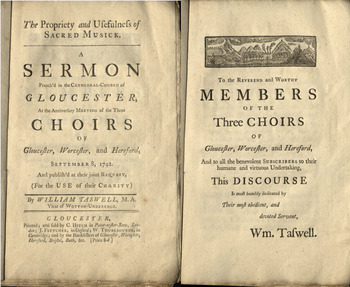
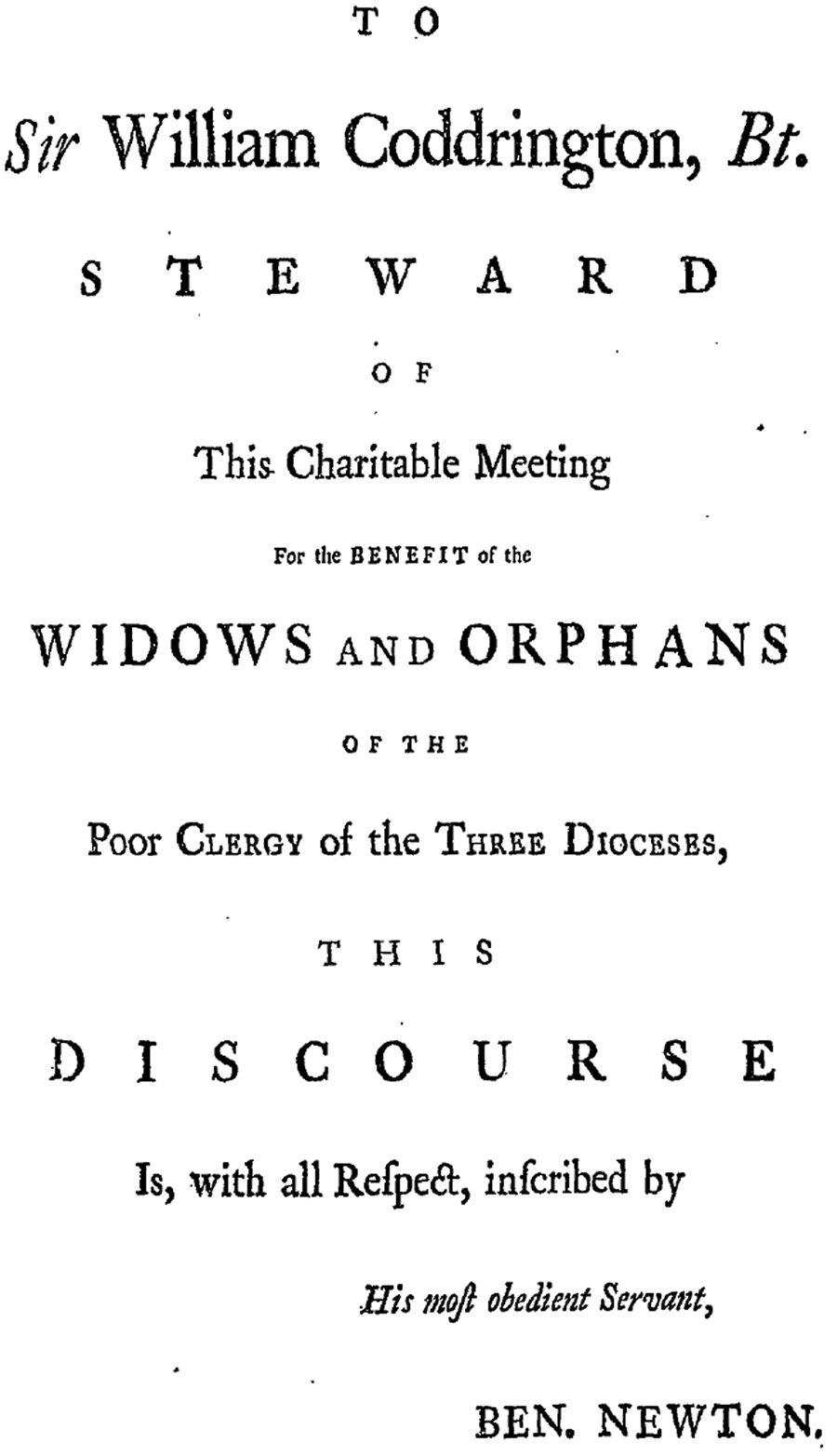
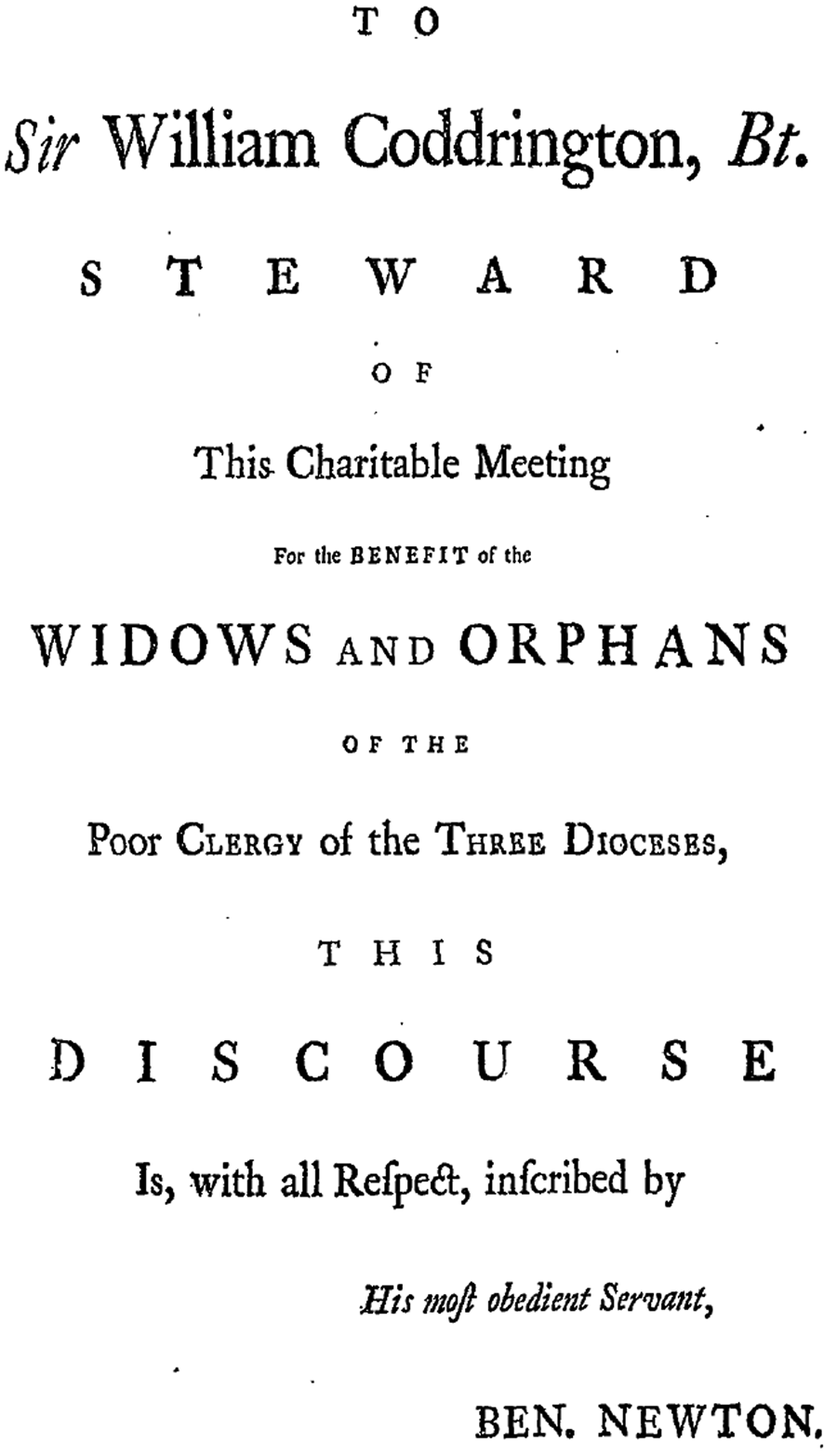
If the sermons of the 1720s treated charity as a mere appendage to the Festival and those of the 1730s sometimes neglected it altogether, the sentimental sermons of the 1740s–1760s saw charity as tightly integrated with music-making. The 1742 sermon by William Taswell was the first to mention on its title-page that the sermons were printed for the benefit of charity, and his dedication praised the ‘benevolent SUBSCRIBERS’ and ‘their humane and virtuous Undertaking’ (Figure 1). Taswell was also the earliest sermonizer to draw a direct connection between charitable impulses and the discourse on music: ‘Nor will our Transition from Harmony to Charity be thought, I hope, any ways forc'd or unnatural.’Footnote 107 Taswell searched for biblical connections between music and charity and found Job; that patient, faithful man had an experience that was ‘the reverse, from Charity to Harmony: He caus'd the Widow's Heart to sing for Joy . . . . However, they are certainly Sisters that may well go Hand in Hand . . . . [Music] seems to step in as the other's [charity's] Harbinger, to open and enlarge your Hearts in the Support of her Cause’.Footnote 108 Harmony could lead to charity, and charity, in turn, back to harmony: ‘And may that Charity shall survive all her Sister Virtues and Graces, that shall survive Mortality and even Time itself, bring you to those blessed Regions of Peace and Harmony.’Footnote 109 In 1760 Benjamin Newton (Fellow of Jesus College Cambridge) would also include the objects of the Three Choirs meeting's charity on his dedication page, with a typographic stress on the words ‘WIDOWS and ORPHANS’ (Figure 2). And Digby Cotes carefully chose an epigraphic scripture passage for his 1756 sermon, drawing from Psalm 68:4–5: ‘O sing unto God, sing Praises unto his Name, magnifie him that rideth upon the Heavens, by his name. / He is the Father of the fatherless, and defendeth the Cause of the Widow: Even God in his Holy Habitation.’Footnote 110 This conjoining of songs of praise, a merciful and loving God and the evocation of suffering widows and orphans made the perfect biblical accompaniment to the sentimental ethics of the music sermons of the mid-century.
William Taswell, title-page and dedication page to The Propriety and Usefulness of Sacred Musick (1742). Tom Perry Special Collections, Harold B. Lee Library, Brigham Young University, AC 901.A1 no. 1156

Benjamin Newton, dedication page to The Church of England's Apology for the Use of Music in Her Service (1760). © British Library Board: 694.i.4(15)
The most sophisticated of these arguments drew once again on the discourse of sympathy, and particularly the notion that a universal sympathetic resonance existed between God's charitable nature, humankind's naturally benevolent disposition and our inherent love of music. Thomas Morell, for instance, wrote, ‘Nothing can open and enlarge the Heart to these divine Offices [charity] like the sweet Charms of Music... . Music assimilates the Disposition of the Heart to itself; and therefore I cannot think the Author much mistaken, who took the delighting in Harmony to be a moral Sign of all Good.’Footnote 111 Morell's phrase that music could regulate the heart ‘to itself’, a stressing of the natural goodness of every human being, was a common theme. John Newton (Rector of Taynton and minor canon of Gloucester Cathedral) similarly stated that music opened the heart to benevolent affections: ‘I have observ'd, in the former Part of this Discourse, that Musick has a natural Tendency to promote benevolent and friendly Affections.’Footnote 112 William Hughes, minor canon of Worcester Cathedral, agreed, claiming that ‘the powerful Language of Musick’ had the ability to ‘soothe and soften the Mind into Pity and Compassion’.Footnote 113 Turning directly to the performers on that occasion, he praised them, and said, ‘It is greatly to be hop'd, that your Melody has gain'd an easy Access to the Hearts of this Audience, and left no one insensible of the great Cause, in which we are now particularly interested, and engag'd’ – that is to say, the care of the widows and orphans for whom the donations were intended.Footnote 114
The inverse argument was also offered: if one gives charity, one proves one's love of music, and if one dislikes music, one is probably an uncharitable sort. Parker, for instance, urged his auditors, ‘If any man then is desirous to prove his sense of harmony, and demonstrate the judgment of his ear for musick, let him shew it in the proportion of his charity this day.’Footnote 115 Parker here unashamedly asserts that the more one loves music, the more money one will give to orphans. He calls this linkage of musical appreciation and charitable impulse ‘the highest reflexion upon your hearts, and ears’. And if not much is given? ‘A shame will it to be us, to shew, that we have either an ear not to hear, or an heart not to feel; that we have neither an ear for musick, nor an heart for compassion!’Footnote 116 Whereas charity had in the past merely been a happy accident, appended to a yearly meeting of musical conviviality, sermons were now apt to assert that the musical performances could aid and even cause charitable contribution, and that lovers of music were the most naturally apt to give charity.
By the middle of the eighteenth century sermons no longer apologized for music's sensuality. No longer did they worry about the art's corporeality or its association with opera, theatres or other morally questionable places. These sermons concluded that listening to music would inspire auditors to kindness and good works. To persuade their readers of the value of music, these authors relied both on reason and on feelings, stressing chiefly their brotherly love for one another and their natural propensity for music appreciation. These two phenomena were closely interconnected, culminating in a ‘divine sympathy with which the powers of Music have united your souls’.Footnote 117 Congregations were understood to be joined together in social and sonic harmony, united by the sympathetic vibrations of music and morality.
From the analyses of sermon texts presented here it is possible to see a changing understanding of music, morality and sympathy across the first half of the eighteenth century. While clergymen fiercely defended the use of music in worship during the century's first decades, its sensuality and potential association with sinful activity created anxiety that demanded careful censorship. These concerns faded into the distant background for mid-century clergy, who expressed a fundamental belief in a link between charity, goodness, happiness, sensuality, pleasure and music. The writers of these later sermons were aware that times and tastes were changing. In at least one clergyman's view, in 1756, they were getting better: ‘There have been many Improvements made in our Church-Music, since the great Masters of former Times; but the striking and sublime Beauties with which the Compositions of an eminent Master now among us do abound, are touching Proofs, to what a Degree of Perfection this noble Science may be carried.’Footnote 118 There can surely be no doubt that the ‘eminent Master’ was Handel. By the time that the composer was generating his oratorios, with their religious and moral messages united with the most modern musical approaches, clergy were preaching that music was good simply because it made humankind feel – and feeling was at the root of all sociable experience. The argument was rooted in a physical, empirical understanding of humankind's compound nature. According to this line of reasoning, humankind was naturally good; belief in the creation of human beings in their maker's image also implied the edifying nature of that human's sensual and intellectual experiences. These concepts reinforced the status of music as the most sensually affecting of all the arts. By the middle of the eighteenth century, English music sermons positioned sonic harmony as a perfect instance of the sympathetic vibrations that linked human beings to the natural world, to each other and to the divine.
APPENDIX
Music sermons printed in England, 1700–1799 (ordered chronologically)
Abbreviations
[3C] = Sermon for the Three Choirs Festival
[OMS] = Sermon for society other than Three Choirs Festival
[OD] = Organ dedication
* = Not located
1. Shuttleworth, John. A Sermon Preached at Bridgwater in Somersetshire July the Seventeenth, 1700, at the Opening of the Organ Lately Erected There. London: J. Miller, 1700.[OD]
2. Naish, Thomas. A Sermon Preach'd at the Cathedral Church of Sarum, November 22, 1700. Before a Society of Lovers of Musick. London: James Lacy, 1701.[OMS]
3. Hawkshaw, Benjamin. A Sermon Preach'd at the Cathedral Church of St. Patrick, Dublin, November 29th, 1704, before the Lovers of Musick. Dublin: printed at the sign of the printing-press in Fishshamble-street; and are to be sold by W. Norman, John Forster and Jer. Peppit, and W. Dowdal, 1704.[OMS]
4. Bradbury[, Thomas]. ‘Arguments to Prove the Obligation of the Duty of Singing’. In Practical Discourses of Singing in the Worship of God; Preach'd at the Friday Lecture in Eastcheap. By Several Ministers, ed. Jabez Earle, 19–54. London: N. Cliff, 1708.
5. Earle, Jabez. ‘On the Nature of the Duty of Singing’. In Practical Discourses of Singing in the Worship of God, 1–18.
6. Gravener, Benjamin. ‘Exhortation to Singing’. In Practical Discourses of Singing in the Worship of God, 185–226.
7. Harris[, William]. ‘Arguments to Prove the Obligation of the Duty of Singing’. In Practical Discourses of Singing in the Worship of God, 54–99.
8. Newman[, John]. ‘Directions for the Right Performance of the Duty of Singing’. In Practical Discourses of Singing in the Worship of God, 146–184.
9. Reynolds[, Thomas]. ‘Objections Against Singing Consider'd’. In Practical Discourses of Singing in the Worship of God, 100–145.
10. Beveridge, William. ‘A Discourse on Church-Musick’. In Thesaurus Theologicus: Or, a Complete System of Divinity, volume 4: 211–220. London: Richard Smith, 1710 [date of sermon unknown].
11. Harris, Samuel. Scripture-Knowledge Promoted by Catechizing. A Sermon Preach'd at the Reverend Mr. Flemming's Meeting-Place, in Lothbury; May the 11th. 1712. to a Society, for Carrying on That Work. In Which Is Also Set Forth, The Excellency and Usefulness of Singing of Psalms. By Samuel Harris. London: T. Harrison, 1712.
12. Dingley, William. Cathedral Service Decent and Useful. A Sermon Preach'd before the University of Oxford at St Mary's on Cecilia's Day, 1713. By W. Dingley, B.D. Fellow of C. C. C. Oxford: Anthony Peisley, 1713.[OMS]
13. Milbourne, Luke. Psalmody Recommended in a Sermon. Preach'd to the Company of Parish-Clerks, at St. Alban's Woodstreet, November 17, at St. Giles's in the Fields, November 22, 1712 . . . By Luke Milbourne, a Presbyter of the Church of England. London: J. Downing, 1713.
14. Burroughs, John. The Devout Psalmodist. 2 Sermons: 1. Concerning Singing Psalms with Devotion and Melody; 2. Shewing the Indecency and Irreverence of Sitting at the singing of Solemn Praises to God. London: J. Downing, 1714.
15. Norman, John. God to be Worshipped in Spirit and in Truth. A Sermon Preach'd at Portsmouth 27th of July, 1718 . . . to Which is Added an Appendix Containing Some Remarks on a Sermon Preach'd by the Revd Willm. Ward M.A. Vicar of Portsmouth at the Opening of the Organ There. London: John Clark, 1718.[OD]
16. Ward, William. A Sermon Preach'd at Portsmouth at the Opening of the Organ on Saturday the 26th of July, 1718. London: A. Bettesworth, 1718.[OD]
17. H. C. [Henry Cornwallis] Laus Deo: Or, How to Sing to the Glory of God. An Abstract of a Sermon Preach'd at Brenckley in Kent. With Several Divine Hymns Collected out of the Best Members of the Church of England. By H. C. Author of The Country Curate's Advice to His Parishioners. Printed in This Small Volume for the Benefit of Those That Delight in Singing. Licensed and Enter'd according to Order. London: V. H., 1719.
18. Sherlock, William. ‘Sermon Preach'd at St. Paul's Cathedral November 22, 1699, Being the Anniversary Meeting of the Lovers of Musick’. In Sermons Preach'd upon Several Occasions. In Two Volumes. By Will. Sherlock, D. D. Late Dean of St. Paul's. Vol. 1: 345–68. London: William Rogers, 1700.
19. Bisse, Thomas. A Rationale on Cathedral Worship or Choir Service. A Sermon Preach'd in the Cathedral Church of Hereford, at the Anniversary Meeting of the Choirs of Worcester, Glocester, and Hereford. Sept. 7. 1720. By Tho Bisse, D. D. and Chancellor of the Said Church. London: William Innys, 1720.[3C]
20. Corney, Thomas. Of Musick: A Sermon Preach'd at the Opening of the New Organ, in St. Laurence's Church in Appleby in Westmorland, on July 25. A. D. 1722. London: Thomas Corney, 1723.[OD]
21. Abbot, Henry. The Use and Benefit of Church-Musick, towards Quickening our Devotion. A Sermon Preach'd in the Cathedral-Church of Gloucester, at the Anniversary Meeting of the Three Choirs . . . September 9, 1724. By Henry Abbot, M. A. Chaplain to the Right Honourable Allen, Lord Bathurst. London: Jonah Bowyer, 1724.[3C]
22. Lavington, George. The Influence of Church-Music. A Sermon Preach'd in the Cathedral-Church of Worcester, at the Anniversary Meeting of the Three Choirs . . . September 8, 1725 . . . By George Lavington, L. L. B. Canon of the Church of Worcester. London: James and John Knapton, 1725.[3C]
23. Bisse, Thomas. Musick the Delight of the Sons of Men. A Sermon Preach'd in the Cathedral Church of Hereford, at the Anniversary Meeting of the Three Choirs . . . September 7, 1726. By Tho. Bisse, D. D. Chancellor of the Said Church. London: William and John Innys, 1726.[3C]
24. Naish, Thomas. Sarum: A Comfort. A Sermon Preach'd at the Cathedral Church of Sarum, November the 30th, 1726. Being the Anniversary Day Appointed for the Meeting of the Society of Lovers of Musick. By Thomas Naish, M. A., Sub-Dean of Sarum. London: James Lacy, 1726.[OMS]
25. Naish, Thomas. A Sermon Preached at the Cathedral Church of Sarum, November the 30th, 1727. Being the Anniversary Day Appointed for the Meeting of the Society of Lovers of Musick. By Thomas Naish, M. A., Sub-Dean of Sarum. London: James Lacy, 1727.[OMS]
26. Stockwell, Joseph. A Sermon Preach'd at St Helen's in Abingdon April 2d 1726 on the Occasion of Opening an Organ, and a Sermon Preach'd before the University of Oxford . . . May 15th 1726. By Joseph Stockwell, B. D. Fellow of Triniity College, Oxon. Oxford: Sam. Wilmot, 1727.[OD]
27. Boydell, John. The Church-Organ: Or, a Vindication of Grave and Solemn Musick in Divine Service, in a Discourse at the Opening of the New Organ, Erected in St. Oswald's, Ashbourn, Com. Derb. A. D. 1727. By John Boydell. London: John Boydell, 1727.[OD]
28. Senhouse, Peter. The Right Use and Improvement of Sensitive Pleasures, and More Particularly of Musick . . . A Sermon Preach'd in the Cathedral Church of Gloucester, at the Anniversary Meeting of the Choirs . . . September 20, 1727. By Peter Senouse, A. M. Prebendary of the Collegiate Church of Brecon, and Vicar of Linton. London: John Palmer, 1728.[3C]
29. Brooke, James. The Duty and Advantage of Singing to the Lord. A Sermon Preach'd in the Cathedral-Church of Worcester, at the Anniversary Meeting of the Choirs . . . Sept. 4, 1728 . . . By James Brooke, M. A. Rector of Hill-Croome and Vicar of Hanley-Castle. London: Samuel Mountfort, 1728.[3C]
30. Bisse, Thomas. A Sermon Preach'd in the Cathedral Church of Hereford, at the Anniversary Meetings of the Three Choirs . . . September 3, 1729. By Thomas Bisse, D. D., Chancellor of the Said Church. London: William Innys, 1729.[3C]
31. Harper, James. The Natural Efficacy of Music to Prepare the Mind for Good Impressions . . . A Sermon Preach'd in the Cathedral-Church of Gloucester, at the Anniversary Meeting of the Choirs . . . September 2, 1730. By John Harper, M. A., Vicar of Beckford. Oxford: Richard Clements, 1730.[3C]
32. Philips, William. [A Sermon Preached in the Cathedral Church of Worcester.] London, 1731.*[3C]
33. Coningesby, George. Church-Musick Vindicated, and the Causes of Its Dislike Enquired Into. A Sermon Preach'd at the Cathedral Church of Hereford, at the Anniversary Meeting of the Three Choirs . . . On Wednesday, September 6th, 1732. By George Coningsby, M. A., Vicar of Bodenham in Hereford-shire. Oxford: Richard Clements, 1733.[3C]
34. Wheler, George. [A Sermon Preached at the Cathedral Church of Gloucester, at the Anniversary Meeting of the Three Choirs.] Preached 1733.*[3C]
35. Bedford, Arthur. The Excellency of Divine Musick: Or a Sermon Preach'd in the Parish-Church of St. Michael's Crooked Lane, in the City of London, on Thursday the Fourth Day of October: And at Sir George Wheeler's Chapel, in Spittle-Fields, On Monday the Fifth of November, in the Year of Our Lord, 1733. Before Several Members of Such Societies Who Are Lovers of Psalmody. To Which Is Added, A Specimen of Easy, Grave Tunes, instead of Those Which Are Used in Our Profane and Wanton Ballads. London: W. Pearson, 1733.[OMS]
36. Dennis, Rev. Mr. [A Sermon Preached at the Cathedral Church of Worcester, at the Anniversary Meeting of the Three Choirs.] Preached 1734.*[3C]
37. Macro, Thomas. The Melody of the Heart: A Sermon Preach'd at the Opening of an Organ in St. Nicholas's Church, in Great Yarmouth, December the 20th, 1733. By Thomas Macro, D. D., Minister of Yarmouth. London: W. Parker, 1734.[OD]
38. Atterbury, Francis. ‘The Usefulness of Church Musick, A Sermon Preached on St. Cecilia's Day’. In Sermons on Several Occasions, by the Right Reverend Father in God, Francis Atterbury, D. D. Late Lord Bishop of Rochester, and Dean of Westminster, Published from the Originals by Thomas Moore, D. D. His Lordship's Chaplain, volume 2: 233–282. London: Thomas Moore, 1734 [date of sermon unknown].
39. Ellis, Anthony. [A Sermon Preached at the Cathedral Church of Gloucester, at the Anniversary Meeting of the Three Choirs.] Preached 1736.*[3C]
40. Banner, Richard. The Use and Antiquity of Musick in the Service of God. A Sermon Preach'd at the Cathedral-Church of Worcester, Septemb. 14, 1737, at the Annual Meeting of the Three Choires . . . By Richard Banner, D. D. Oxford: printed at the Theatre, 1737.[3C]
41. Payne, Thomas. A Defence of Church-Musick. A Sermon Preach'd at the Cathedral Church of Hereford, at the Anniversary Meeting of the Three Choirs . . . On Wednesday, September 6, 1738. By Thomas Payne, M. A., Custos of the College of Hereford, and Vicar of Hom-Lacy. Oxford: James Fletcher, 1738.[3C]
42. Coleire, Richard. The Antiquity and Usefulness of Instrumental Musick in the Service of God. In a Sermon Preach'd at Isleworth, in the County of Middlesex, on Palm-Sunday, 1738, at the Opening of an Organ in That Parish. London: Henry Woodfall, 1738.[OD]
43. Shorthose, Hugh. ‘A Sermon Preached at Salisbury on St. Caecilia's-Day’. In Sermons on Several Occasions, by the Late Reverend Mr Hugh Shorthose, Chaplain to His Grace James Duke of Chandos, and Lecturer of Chelsey, 135–153. London: Astley, 1738 [date of sermon unknown].
44. Salter, Samuel. [A Sermon Preached in the Cathedral Church of Gloucester.] Preached 1739.*[3C]
45. Green, Thomas. [A Sermon Preached in the Cathedral Church of Worcester.] Preached 1740.*[3C]
46. Croxall, Samuel The Antiquity, Dignity and Advantages of Music. A Sermon Preach'd in the Cathedral Church of Hereford, September 2, 1741, at the Anniversary Meeting of the Choirs . . . By S. Croxall, D. D., Canon Residentiary of Hereford and Chaplain in Ordinary to His Majesty. London: J. Watts, 1741.[3C]
47. Taswell, William. The Propriety and Usefulness of Sacred Music. A Sermon Preach'd in the Cathedral-Church of Gloucester, at the Anniversary Meeting of the Three Choirs . . . September 8, 1742. And Publish'd at their Joint Request, (For the Use of their Charity). By William Taswell, M. A., Vicar of Wotton-Underedge. Gloucester: C. Hitch[, 1742].[3C]
48. Brooker, D. Cathedral Music, Skilfully and Religiously Performed, a Reasonable Service. A Sermon Preach'd in the Cathedral Church of Worcester, at the Anniversary Meeting . . . By D. Brooker, Vicar of St. Peter's in the City of Worcester, and Minor Canon of the Cathedral in the Said City. London: J. and J. Bonwicke, 1743.[3C]
49. Atwell, Joseph. [A Sermon Preached in the Cathedral Church of Gloucester.] Preached 1745.*[3C]
50. Morell, Thomas. The Use and Importance of Music in the Sacrifice of Thanksgiving. A Sermon Preach'd at Worcester, September 3, 1746, at the Anniversary Meeting of the Three Choirs . . . By T. Morell, D .D., Rector of Buckland in Hertfordshire. London: M. Cooper, 1746.[3C]
51. Burnet, Gilbert. ‘On Church Musick: Occasioned by the Opening of the Organ at St. James's Clerkenwell, 1734’. In Practical Sermons on Various Subjects. London: C. Ackers, 1747.[OD]
52. Newton, J. The Natural, Moral, and Divine Influences of Musick. A Sermon Preach'd in the Cathedral-Church of Gloucester at the Anniversary Meeting of the Choirs . . . September 14, 1748 . . . By John Newton, M. A., Rector of Taynton, and Minor Canon of the Cathedral-Church of Gloucester. London: E. Cave, 1748.[3C]
53. Hughes, William. The Efficacy and Importance of Musick. A Sermon Preach'd in the Cathedral Church of Worcester, at the Annual Meeting of the Three Choirs . . . Wednesday, Septempter [sic] 13, 1749 . . . By William Hughes, M. A., Minor Canon of the Cathedral-Church of Worcester. London: Samuel Mountfort, 1749.[3C]
54. Owen, Edward. A Sermon Preached at the Opening of the Organ in the Parish Church of St. Neots in the County of Huntingdon, September 26, 1749, by Edward Owen, D. D., Vicar of Great Stoughton, and sometime Fellow of St. John Baptist's College, Oxford. London: R. Manby and H. S. Cox, 1749.[OD]
55. Procter, Henry. A Sermon Preach'd at the Cathedral-Church of Hereford on Wednesday, September 12, 1750, at the Anniversary Meeting of the Three Choirs . . . By Henry Procter, A. B., Vicar of Orleton. Gloucester: Procter, 1750.[3C]
56. Bayley, Anselm. [A Sermon Preached in the Cathedral Church of Gloucester.] Preached 1751.*[3C]
57. Gill, John. Two Discourses: The One on Prayer, the Other on Singing of Psalms. London: G. Keith, 1751.
58. Griffin, Rev. Mr. [A Sermon Preached in the Cathedral Church of Worcester.] Preached 1752.*[3C]
59. Parker, William. The Pleasures of Gratitude and Benevolence Improved by Church-Musick. A Sermon Preach'd at the Anniversary Meeting of the Three Choirs . . . in the Cathedral Church at Hereford, on Wednesday, Sept. 12, 1753. By William Parker, B. D., Rector of Little Ilford in Essex, Minister of St. Catherine Cree, London, and F. R. S. London: James Fletcher, 1753.[3C]
60. Eden, Robert. The Harmony of Benevolence. A Sermon Preach'd in the Cathedral-Church of Worcester, September 10, 1755, at the Annual Meeting of the Three Choirs . . . By Robert Eden, D. D., Canon of Worcester. London: W. Sandby, 1755.[3C]
61. Cotes, Digby. Music a Rational Assistant in the Duty of Praise when United with Charity. A Sermon Preach'd in the Cathedral-Church of Hereford, September 15, 1756, at the Annual Meeting of the Three Choirs. . . By Digby Cotes, M. A., Rector of Door, and Chaplain to the Right Reverend the Lord Bishop of Bangor. London: James Wilde, 1756.[3C]
62. Stopford, Joshua. Halleluja: Or, the Use of Vocal and Instrumental Musick in the Publick Worship and Service of God Asserted and Vindicated, and the Excellency and Usefulness Thereof Set Forth and Proved in a Sermon Preached upon Psalm LXXXI. 2, 3, 4 at the Opening of an Organ in Shaw-Chappel, in the Parish of Oldham and County Palatine of Lancaster on Friday August 8, 1755. By Joshua Stopford, A. B. and Presbyter of the Church of England. Manchester: James Schofield, 1756.[OD]
63. Green, Thomas. [A Sermon Preached in the Cathedral Church of Worcester.] Preached 1758.*[3C]
64. Charlton, Rev. Mr. [A Sermon Preached in the Cathedral Church of Hereford.] Preached 1759.* [3C]
65. Newton, Benjamin. The Church of England's Apology for the Use of Music in Her Services. A Sermon Preach'd in the Cathedral-Church of Gloucester, September 10, 1760, at the Annual Meeting of the Three Choirs . . . By Benjamin Newton, M. A., Fellow of Jesus College, Cambridge. London: R. Raikes, 1760.[3C]
66. Taylor, Rev. Mr., of Salwarp [A Sermon Preached in the Cathedral Church of Worcester.] Preached 1761.*[3C]
67. Bagnall, Gibbons. The Antiquity of Music, and the Propriety of Admitting it into Divine Worship, Asserted from the Example of Beings Above Us and the Custom of All the Wisest and Politest Nations. A Sermon Preached in the Cathedral-Church of Hereford, at the Anniversary Meeting of the Three Choirs . . . By Gibbons Bagnall, M. A. Prebendary of the Church of Hereford, and Master of the Free School. Gloucester: R. Raikes, 1762.[3C]
68. Fawconer, Samuel. Church-music an Help to Devotion: A Sermon Preached in the Parish-Church of St. Michael, Bassishaw, on Sunday, May 29, 1763, at the Opening of an Organ Lately Erected in the Said Church, by Samuel Fawconer, Assistant Preacher at Grosvenor-Chapel and Lecturer of St. Michael, Bassishaw. London: J. Rivington and J. Robson, 1763.[OD]
69. Bishop, Charles. A Sermon Preached in the Cathedral-Church of Glocester, September 10, 1766, at the Annual Meeting of the Three Choirs . . . By Charles Bishop, M. A., Rector of Rudford, and Under-Master of the College-School in Glocester. Gloucester: R. Raikes[, 1766].[3C]
70. Brekell, John. A Discourse on Music, Chiefly Church Music: Occasioned by the Opening of the New Organ at St. Peter's Church in Liverpool, on Wednesday, April 30, Being the Substance of a Sermon Preached the Lord's-Day Following. London: J. Waugh and J. Gore, 1766.[OD]
71. Bromley, Robert Anthony. On Opening a Church and Organ. London: [Bromley?], 1771.*[OD]
72. Rawlins, John. The Power of Musick, and the Particular Influence of Church-Musick. A Sermon Preached in the Cathedral-Church of Worcester, at the Anniversary Meeting of the Choirs . . . September 8, 1773. By John Rawlins, A. M., Rector of Leigh, Minister of Badsey and Wickamford in Worcestershire, and Chaplain to the Right Honourable Lord Archer. Oxford: Clarendon, 1773.[3C]
73. Glasse, Samuel. The Beneficial Effects of Harmony. A Sermon Preached at the Meeting of the Three Choirs in the Cathedral-Church of Glocester on Wednesday the 9th of September, 1778. By S. Glasse, D. D. F. R. S. and Chaplain in Ordinary to His Majesty. Gloucester: R. Raikes, 1778.[3C]
74. Horne, George. The Antiquity, Use, and Excellence of Church Music a Sermon Preached at the Opening of a New Organ in the Cathedral Church of Christ, Canterbury, on Thursday, July 8, 1784. By George Horne, D. D., Dean of Canterbury and President of St. Mary Magdalen College, Oxford. Oxford: D. Prince and J. Cooke, 1784.[OD]
75. Morgan, Hugh. A Sermon Preached September 20th, 1786, at the Meeting of the Three Choirs . . . By Hugh Morgan, M. A. Canon Residentiary of the Cathedral Church of Hereford. Hereford: C. Pugh[, 1786].[3C]
76. Newton, John. Messiah: Fifty Expository Discourses, on the Series of Scriptural Passages, which Form the Subject of the Celebrated Oratorio of Handel, Preached in the Years 1784 and 1785 in the Parish Church of St. Mary Woolnoth, Lombard-Street, By John Newton, Rector. Two volumes. London: Newton, 1786.
77. Jones, William. The Nature and Excellence of Music: A Sermon Preached at the Opening of a New Organ, in the Parish Church of Nayland in Suffolk, on Sunday, July the 29th, 1787. London: G. G. J. and J. Robinson, 1787.[OD]
78. Langford, William. A Sermon, for the Relief of the Widows and Orphans of Clergymen, Belonging to the Three Dioceses of Worcester, Hereford, and Gloucester, Preached in the Cathedral, at Worcester, before Their Majesties, At the Music-Meeting, on Wednesday, Aug. 6, 1788, By W. Langford, D. D., Canon of Windsor and Chaplain in Ordinary to His Majesty. Worcester: J. Holl, 1788.[3C]
79. Huntington, William. The Music and Odours of Saints. A Sermon, Preached at Providence Chapel, September 2, 1787, By William Huntington, S. S., Minister of the Gospel. London: G. Terry, J. Chalmers, J. Davidson, Mr Baker, Mrs Howes, Mr Mantle, Mr Fenley and Mr Chalmers, 1788.
80. Napleton, John. A Sermon Preached in the Cathedral of Hereford at the Meeting of the Three Choirs of Worcester, Hereford and Gloucester, September IX. MDCCLXXXIX, By John Napleton, D. D. Canon Residentiary of Hereford, Chaplain to the Lord Bishop of Hereford, Late Fellow of Brasen Nose College Oxford. Oxford: Clarendon, 1789.[3C]
81. Muirhead, John. The Divine Institution of Singing the Psalms of David Stated and Defended in a Sermon. Montrose: Muirhead, 1790.
82. Lucas, Robert. A Sermon, Preached in the Cathedral Church of Worcester at the Music Meeting, Sept. 10, 1794, by Robert Lucas, D. D. London: J. Robson and F. and C. Rivington[, 1794].[3C]
83. Keate, William. The 109th, Commonly Called the Imprecating Psalm, Considered, on a Principle, by Which the Psalm Explains Itself a Sermon, Preached in Chelsea College Chapel, April 6, 1794. By the Rev. William Keate, M. A. Rector of Laverton, in the County of Somerset, and Prebendary of Wells. London: F. and C. Rivington, 1794.
84. Munkhouse, Richard. A Sermon, Preached in the Church of St. John Baptist, Wakefield by the Rev. Richard Munkhouse, D. D. Previous to the Introduction of the Rev. James Merrick's Version of the Psalms, with Music, Provided by the Rev. W. D. Tattersall. London: F. and C. Rivington, 1797.
Sources consulted
OCLC WorldCat http://www.worldcat.org/.
Eighteenth-Century Collections Online http://www.gale.com/primary-sources/eighteenth-century-collections-online/.
English Short Title Catalogue http://estc.bl.uk/F/?func=file&file_name=login-bl-estc.
Cooke, John. The Preacher's Assistant (after the Manner of Mr. Letsome) Containing a Series of the Texts of Sermons and Discourses Published Either Singly, or in Volumes. Oxford: Printed for Cook at the Clarendon Press, 1783.
Lysons, Daniel, John Amott, Charles Lee Williams and H. Godwin Chance. Origin and Progress of the Meeting of the Three Choirs of Glouchester, Worcester & Hereford, and of the Charity Connected with It. Gloucester: Chance and Bland, 1895.
Spaulding, John Gordon, and John Cooke, eds. Pulpit Publications, 1660–1782: Being a New Edition of ‘The Preacher's Assistant’. Six volumes. New York: Norman Ross, 1996. (Spaulding seems to include one sermon under ‘Music’ in error: Davies, Samuel. The Curse of Cowardice: A Sermon Preached to the Militia of Hanover County, in Virginia, at a General Muster. London, 1758 <24048010>. The error stems from the abbreviated code ‘At. Gen. Mus’ [at a General Muster], which was read for computer code ‘Mus’ [Music].)