

INTRODUCTION
Seedling vigour is an important contributor to subsequent tillering quality and yield of rice (TeKrony and Egli, Reference TeKrony and Egli1991). It is found to be associated with plant viability, height, thickness of stems and uniformity (Matsuo and Hoshikawa, Reference Matsuo and Hoshikawa1993). The establishment of transplanted rice seedlings and their subsequent growth depends not only on the above-ground morphological characteristics that define seedling vigour, but also on the growth of new roots (Hoshikawa and Ishi, Reference Hoshikawa and Ishi1974) and the amount of irreparable damage incurred by the roots during transplanting (Ros et al., Reference Ros, Bell and White2003). These above- and below-ground characteristics of rice plants, before and after transplanting, vary with seedling age (Himeda, Reference Himeda1994), growing environment (Kordon, Reference Kordon1974) and seeding rate (Sasaki, Reference Sasaki2004).
Due to increasing scarcity of water at field level, many alternative technologies are now being evaluated. In particular, the System of Rice Intensification (SRI) has attracted much interest among rice-growers around the world. It recommends growing seedlings with a healthy root system to obtain healthy plants under limited water supply by applying four management practices. These include rapid and shallow transplanting of very young seedlings at 2–3 leaf stage after growth in a dry seed bed, transplanting one or two seedlings with wider spacings, maintaining non-flooded soil conditions during the vegetative stage and very shallow irrigation after flowering, and applying compost as fertilizer (Stoop et al., Reference Stoop, Uphoff and Kassam2002). To raise healthy seedlings with healthy root systems, SRI recommends maintaining well-drained soil conditions, low seeding rates and application of organic manure to the seedbed.
Following long-standing cultural practices in Asia, farmers generally use wet seedbeds for raising seedlings, and organic manure is applied to flooded and puddled seedbeds. The average age of seedlings used for transplanting is 30–45 d, and they are transplanted into continuously flooded soils. Under these conditions, seedling age and field conditions at transplanting are therefore quite different to those recommended under SRI management. Although there are many reports of the benefits of transplanting younger seedlings (Horie et al., Reference Horie, Shiraiwa, Homma, Maeda and Yoshida2005; Yamamoto et al., Reference Yamamoto, Ikejiri and Nitta1995), few researchers have examined the synergistic effect of seedbed management on the characteristics of younger/older seedlings and its subsequent contribution to plant growth after transplanting when grown under different water regimes.
It has been reported that SRI practices increase tiller number and yield compared to continuously flooded conditions (Ceesay et al., Reference Ceesay, Reid, Fernandes and Uphoff2006; Kabir and Uphoff, Reference Kabir and Uphoff2007; Sato and Uphoff, Reference Sato and Uphoff2007; Sinha and Talati, Reference Sinha and Talati2007). In contrast, others have reported that the tillering potential of the plant is significantly reduced under drained soil conditions due to leaching of N, resulting in reduced uptake by plants (Aulakh and Singh, Reference Aulakh and Singh1996; Sah and Mikkelsen, Reference Sah and Mikkelsen1983). Recent findings have suggested that there is no effect on plants' uptake of N under either flooded or non-flooded saturated soil conditions, but that manganese (Mn) uptake can be significantly reduced under non-flooded soil conditions (Tao, Reference Tao2004), resulting in poor tiller formation.
In order to realize better management practices, SRI and conventional practices regarding seedbed and transplanted fields need to be investigated systematically. This study was therefore designed to characterize the morphological features of rice seedlings at early and later growth stages – when grown with either conventional or SRI methods, using different doses of fertilizer and high v. low seedling densities in dry and wet nursery seedbeds to assess the effects of these different practices separately and in combination. Subsequently the effects of alternative seedbed management, water regimes and seedling age, on root and shoot growth and on tillering potential of the transplanted rice plants were evaluated.
MATERIALS AND METHODS
Experimental site
Experiments were conducted in an open-sided greenhouse (14 × 10 × 10 m), with open sides and plastic roof (transmissivity 93%) located at the Asian Institute of Technology, Bangkok, Thailand (14°04′N lat., 100°37′E long.; 2.27 m asl), from late 2005 to mid 2006. Rice (Oryza sativa) seeds of the Pathumthani variety (photo-nonsensitive, maturity period of 110–120 days) were soaked in water (pH 7.87, EC 0.39 mS cm−1) for 24 h at a temperature of 24 ± 3 °C with an average relative humidity (RH) of 60–70% and a photoperiod of 16:8 h (light:dark). After 24 h, the water was drained and the seeds were kept moist for another 24 h.
Experimental procedures
Experiment 1: in nursery seedbeds
Two parallel experiments, 1(a) and 1(b), comparing a dry seedbed (DSB) and a wet seedbed (WSB) respectively, were set up with two different water regimes: ‘just moist’, i.e. drained soil (DS), and ‘flooded’, i.e. wet soil (WS), with the soil kept saturated by maintaining 2-cm water depth above the soil surface throughout the experiment. Each experiment had four treatment combinations, varying seed density (low seeding rate [LD] or high rate [HD]) and fertilizer applications (fertilizer applied [F] or no fertilizer [0F]). For the dry seedbeds, the treatments were DSLDF, DSLD0F, DSHDF and DSHD0F. The corresponding treatments for wet seedbeds were WSLDF, WSLD0F, WSHDF and WSHD0F. Treatments DSLD0F and WSHD0F were the SRI and conventional control methods respectively.
In the first experiment, 24 black plastic pots (six for each combination), each 60-cm high with 50-cm top and 35-cm bottom diameters, and with a drainage hole at the bottom for DS, were filled with approximately 35 kg (oven-dried weight) of soil (pH 5.3; organic matter 1.9%; sand 30%; silt 41%; clay 48%; total N 0.4%; K 0.65%; P 0.18%; and Ca 0.08%). Cow manure (total N 15.1%, P 7.9%, K 14.1%, Ca 3.7%) was incorporated at the rate of 10 kg m−2 for all the trials. Two seeding rates, 15 g for LD and 35 g for HD (dry seed weight) and two fertilizer treatments, F:NPK (46:0:0) 4 g pot−1, and 0F: no NPK were used. Fertilizer was mixed into the soil before sowing, and seeds were sown at 3-cm depth. In similar fashion, another 24 pots were prepared without drainage holes to maintain WS condition.
To maintain drained soil in DSB, the pots were watered until water started to drain from the bottom and then water was applied everyday to maintain the water content. In WSB, pots were watered up to 2-cm depth above the soil surface, and this was maintained by checking the water level every 24 h.
Experiment 2: transplanting
In the second experiment, 64 pots were filled with the same soil as in (1) and placed at the same location. These pots were flooded, puddled and constantly maintained with 3-cm depth of ponded water for a week before transplanting. Fertilizer was applied at the rate of 100 mg N kg−1 of soil as urea, 66 mg P kg−1 of soil as Ca (H2PO4)2, 166 mg K kg−1 as K2SO4 and 200 mg Mg kg−1 as MgSO4. The N was applied in three split doses, and other nutrients were mixed thoroughly during puddling. Seedlings of different ages, 12 or 30 d old, were selected from the dry or wet seedbed and grown and maintained in a similar fashion. Seedlings, carefully uprooted from their seedbeds with minimum damage to the roots, were transplanted immediately with a single seedling/pot. Two water regimes were maintained: for the flooding treatments a 5-cm ponded water depth was maintained throughout crop growth by checking water level depth every 24 h. For non-flooded trials, the upper layer of soil in the pots was maintained at field capacity throughout the crop growth period until 45 days after transplanting by checking soil moisture using a moisture meter calibrated for the experimental soil with a rooting and sensor depth of 230 mm (wet sensor, type WET-2, Delta-T Device Ltd, Cambridge, England). The water was applied twice a day as indicated. Water treatments were started one week after transplanting when the transplanting shock had abated.
Observations
For seedling characteristics in experiments 1(a) and 1(b), the percentage emergence was evaluated at the stage when the coleoptiles had grown about 3 mm above the soil surface, and then a percentage was calculated relative to the number of seeds sown. The first leaf emergence (folded leafy structure observed along with or after the emergence of the coleoptiles) was recorded at 2, 4, 6 and 8 days after sowing (DAS). Seedlings were sampled at 4, 8, 12, 16, 20 and 24 DAS. Seed dry weights were measured at 4, 8 and 12 DAS by detaching the seed from the seedling and heating it at 75–78 °C for 48 h in a drying oven. Seminal root length was measured manually with a ruler from the point of emergence in the seed to the seminal root tip. Shoot length (distance from the coleoptilar node to the tallest leaf), and dry shoot and root weights (dried at 80 °C for 48 h) were recorded. The vertical distribution of nodal roots (defined as the roots originating from the coleoptilar node and distributed along the length of the seminal roots) was observed and recorded. These were classified into two categories, namely, heavily branched nodal roots (HBNRs) and lightly branched nodal roots (LBNRs). HBNRs were those nodal roots with lateral roots that branched into higher-order laterals, whereas LBNRs were those with first-order lateral roots only. It was assumed that the former nodal roots were relatively older and the latter were newly emerged.
For experiment 2 (after transplanting), data collected included plant height, tiller number, root length density (Tennant, Reference Tennant1974), root weight density, dry weight of aerial parts (heated at 75–78 °C for 48 h in a drying oven), N content (estimated by the steam distillation method, Gianello and Bremner, Reference Gianello and Bremner1986), and Mn content obtained by grinding the dried plant sample and then digesting it in HNO3 at 185 °C in an autoclave (AAS; PU9200, Philips). Data were collected at 45 d after transplanting.
The daily mean temperature and RH were recorded throughout the growing period by means of an automatic data logging system. The average temperature range was 28–35 °C and the RH was 75–85%.
Experimental design and analysis
Experiments 1(a) and 1(b) were set up with a randomized complete block design (RCBD) with the main factors being seedling density and fertilizer application, and with a total of four treatments in each experiment and six replications. Both experiments were set up in the same environment except for the two water regimes. Likewise, experiment 2 was carried out in a RCBD with three factors: seed bed – dry and wet as main factor; water regimes – flooded and non-flooded as the sub-factors, and seedling age – 12 d (12) and 30 d (30) as the sub-sub-factors, providing a total of eight treatments, replicated eight times.
Data were analysed using Sigma Stat (3.1) to determine single or interaction effects. Whenever a significant interaction was observed between all the factors, the level of one factor was compared to each level of the other factor by using all pair-wise multiple comparison procedures (Holm-Sidak method). When an interaction was found between two factors, one factor was compared to each level of another factor by using Duncan's method. A significance level of p < 0.05 was used for all analyses.
RESULTS
Experiment 1: in nursery seedbeds
Emergence and seedling establishment
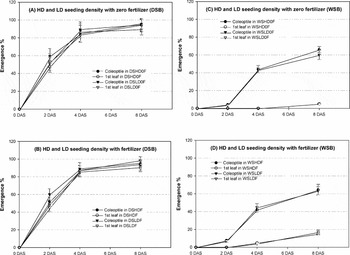
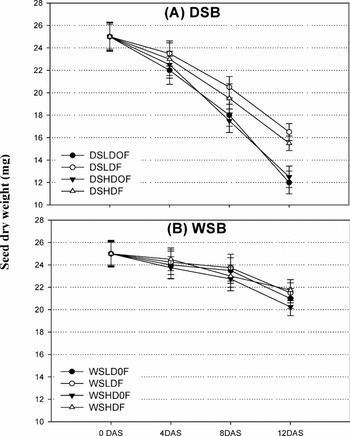
The coleoptile and first leaf emerged simul-taneously from the soil surface in the DSB whereas in the WSB the coleoptiles emerged in advance of the first leaf in all treatment combinations under study (Figure 1). Under DSB, the rate of dry seed weight decrease was faster than for WSB (Figure 2). Within DSB, a slow decrease of endosperm weight in DSLDF and DSHDF was noted. Moreover, treatment DSLD0F (i.e. SRI) had earlier emergence and establishment than WSHD0F (i.e. conventional seedbed).
Emergence of coleoptile and first leaf after sowing in dry seed bed (DSB) [experiment 1 (a)] and flooded seed bed (WSB) [experiment 1 (b)] with different seeding rate and fertilizer application. DAS: days after sowing; HD: high seeding rate; LD: low seeding rate; HDF: treatment with high seeding rate with fertilizer; HD0F: high seeding rate with zero fertilizer; LDF: low seeding rate with fertilizer; LD0F: low seeding rate with zero fertilizer. DS or WS before treatments indicate that treatments are placed in dry seed bed and wet seed bed respectively. Error bars show s.e.

Changes in weight of endosperm with days after sowing (DAS) in LD0F, LDF, HD0F, and HDF in DSB and WSB (see Figure 1 for explanation of abbreviations), (n = 6). Error bars show s.e.

Shoot growth
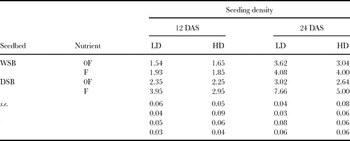
Under WSB, at 12 DAS, the plant age, represented by leaf numbers, was less than two leaves in all treatment combinations (Table 1). At a later stage, all the treatments with a low seeding rate had similar performance whereas WSHDF plants had more leaves than WSHD0F. The greater uniformity of growth under lower density conditions in the early stages of seedling development could be a factor in ultimate plant performance.
Leaf development (numbers) in dry seedbed (DSB) and wet seedbed (WSB).

DAS: days after sowing; HD: high seeding rate; LD: low seeding rate; 0F: zero fertilizer; F: with fertilizer.
Means for DSB and WSB were separately compared for fertilizer (0F and F) and seeding rate (LD and HD), (n = 6).
By contrast, under DSB conditions all treatments had more than two visible leaves at 12 DAS. This varied with different seeding rates and fertilizer application for both DAS.
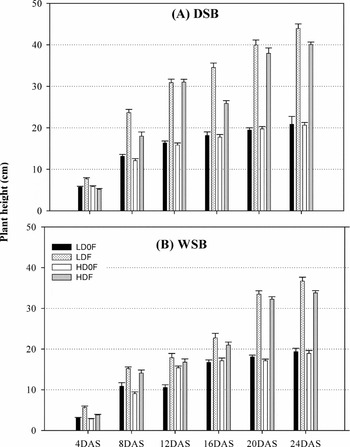
Similarly, plant height was greater under DSB compared to WSB for all dates, and the nutrient effect was significant under both water regimes (Figure 3). Hence, it appeared that a dry seedbed helped seedlings to establish better and induced a faster growth rate, by shortening the phyllochronFootnote 1, than in a wet seedbed at the initial growth stage – even without fertilizer application. By comparison, at a later growth stage, fertilizer application become crucial under dry seedbed conditions if seedling vigour was to be maintained. This would account for SRI (DSLD0F) performing better in terms of shoot growth at 12 DAS but not at 24 DAS.
Plant heights at different days after sowing (DAS) in LD0F, LDF, HD0F and HDF in DSB and WSB (see Figure 1 for explanation of other abbreviations), (n = 6). Error bars show s.e.

Root growth
Root elongation and the vertical distribution of nodal roots were studied at 12 and 24 DAS.
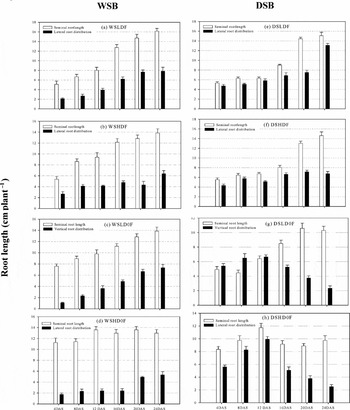
It was found that seminal root elongation was greater under WSB than DSB conditions throughout the growing period (Figure 4). Initially, at 12 DAS, elongation was greater in treatments having no fertilizer and with the higher seeding rate. However, at 24 DAS this trend was reversed, as maximum elongation was observed in treatments with the low seeding density and fertilizer application, in both seedbeds.
Vertical length of seminal and nodal roots at different days after sowing (DAS) in DSB and WSB (see Figure 1 for explanation of other abbreviations). Error bars show s.e.

The nodal root elongation that resulted in lateral root development was greater in all treatment combinations under DSB, whereas it was mostly restricted to the upper 5–7 cm soil depth under WSB (Figure 4). Under both seedbed conditions, treatment having lower seeding density and fertilizer application showed greater elongation. However, under DSB, seedlings showed poor nodal root elongation in the absence of fertilizer at both low and high seeding rates, whereas under WSB, elongation was not affected under low seeding rates, but higher seeding rates showed less elongation at 24 DAS. This trend was somewhat similar to that for leaf number in all treatment combinations, reflecting a causal relationship between below- and above-ground seedling characteristics at initial growth stages.
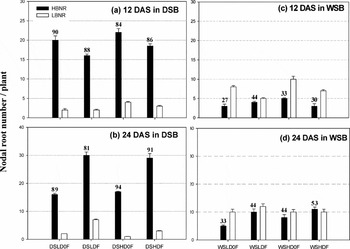
Nodal root number, which helps with better seedling establishment and better nutrient uptake after transplanting, showed a trend similar to nodal root elongation (Figure 5).
Root development at 12 and 24 days after sowing (DAS) in LD0F, LDF, HD0F and HDF in DSB and WSB (see Figure 1 for explanation of abbreviations). Numbers above the black bars show the percentage of heavily branched nodal roots (HBNR) in respect of total nodal root number. Error bars show s.e.

The distribution of LBNR and HBNR in all the treatments was similar to that for nodal root elongation in both seedbeds. However, the percentage of HBNR under DSB was always higher than that for LBNR, indicating that nodal root formation and lateral root development, which help to increase the surface area, were both favoured by drained soil, but that the same rate was continued only when the soil was fertilized (Figure 6).
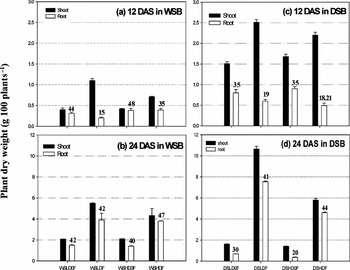
Root and shoot dry weight at 12 and 24 days after sowing (DAS) in WSB and DSB (see Figure 1 for explanation of abbreviations). Number above the white bars show the percentage allocation of dry matter to the roots with respect of total dry matter production. Error bars show s.e.

Dry matter production and allocation
Under DSB, dry matter production at 12 DAS was almost double that for WSB (Figure 6) and showed a similar trend to shoot and root growth at 24 DAS indicating that fertilizer application enhances the seedling vigour under both water regimes. Moreover, seedlings benefited more from fertilizer when grown in a dry seedbed than in a wet seedbed.
The main difference was in dry matter allocation between roots and shoot. At 12 DAS, the % dry matter allocation to the roots was more in the treatment having zero fertilizer application under both seedbed conditions. However, at 24 DAS, the % allocation of dry matter to the roots was almost similar under WSB in all treatments. By comparison, under DSB, a greater allocation of dry matter to roots was observed only in treatments with fertilizer application. This might be due to root degeneration or poor root formation at a later growth stage, or greater priority given to shoot growth over root growth when the soil is deficient in nutrients. Overall, it appeared that a dry seedbed is the better option to produce vigorous seedlings with better nodal root development compared to a wet seedbed in the first stage of seedling growth.
Experiment 2: after transplanting
Tiller formation
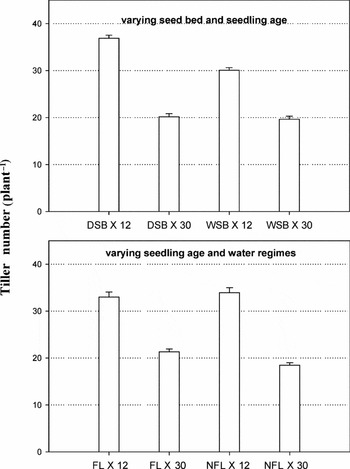
For transplanted rice, once established in the field, the effects of seedbed type, seedling age and water regimes on growth were compared. It was found that at 45 DAS, 12-day-old seedlings had more tillers than 30-day-old seedlings in both seedbeds. Younger seedlings from a dry seedbed produced more tillers after transplanting than those from a wet seedbed, whereas older seedlings taken from either seedbed did not show any major effect (Figure 7). Water regimes had no effect on tiller formation when the seedling age was 12 d, whereas 30-day-old seedlings had more tillers when grown in flooded soil compared to non-flooded soil (Figure 7A and B).
Plant's tiller development at 45 days after transplanting with interaction effect of different factors: (top) seed bed (DSB and WSB), seedling age (12: 12 days old and 30: 30 days old) and (bottom) water regimes (FL: flooded and NFL: nonflooded). (n = 16). Error bars show s.e.

Plant height
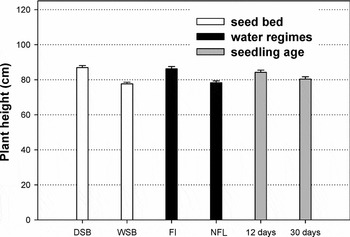
Plant height was greater in flooded soil than in non-flooded conditions. The inter-node length increased at the upper part of the culm. The seedlings grown in DSB were longer than for WSB. Similarly, younger seedlings were taller than older seedlings (Figure 8). This might be due to their ability to produce more phyllochrons before entering the reproductive phase compared to older seedlings.
Plant height at 45 days after transplanting with effect of different factors: seed bed (DSB: dry seed bed; WSB: wet seed bed), water regimes (FL: flooded; NFL: nonflooded), and seedling age (12 days, 30 days) in experiment 2. (One-way ANOVA was done for each factor with n = 32). Error bars show s.e.

Root growth
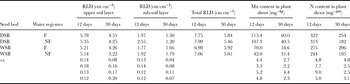
The effect of seedbed and water regimes on root growth depended on the age of the seedling. Under non-flooded conditions, young seedlings showed similar root growth in the upper soil layer but more growth in the sub-soil than older seedlings. When different seedbeds were compared with 12-day-old seedlings, DSB showed better performance than WSB. For 30-day-old seedlings,' those in the flooded soil had higher root growth than those in non-flooded soil (Table 2). Therefore, it appears that root growth was induced mainly by transplanting young seedlings raised in a dry seedbed. Greater root weight in the treatments having younger seedlings taken from dry seedbeds was observed. Likewise, the effect of water regime was not observed in 12-day-old seedlings, but 30-day-old seedlings were heavier in flooded soil.
Effects of seed bed management, seedling age, and water regimes on root characteristics and N and Mn uptakes.

RLD = Root length density. Mn and N content in shoot were expressed on dry weight basis.
Dry matter production
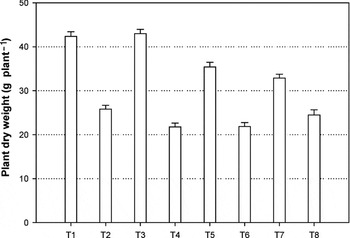
Maximum dry matter was obtained by younger seedlings grown in dry seedbeds (Figure 9). There was no effect of the water regimes on 12-day-old seedlings, whereas 30-day-old seedlings whether grown in wet or dry seedbeds had higher dry matter production in flooded soil. This may support farmers' preference for flooding fields if they use older seedlings.
Plant biomass at 45 days after transplanting with the effect of different seed bed, seedling age and water regimes in experiment 2; x-axis shows the different treatments (T1: DSB+12+FL; T2: DSB+30+FL; T3: DSB+12+NFL; T4: DSB+30+NFL; T5: WSB+12+FL; T6: WSB+30+FL; T7: WSB+12+NFL; T8: WSB+30+NFL). (n = 8) Error bars show s.e.

N and Mn uptake
Twelve-day-old seedlings, raised in a dry seedbed and grown under either flooded or non-flooded soil conditions, had greater N uptake than for other treatments. In contrast, older seedlings raised in a wet or dry seedbed, showed better N uptake under flooded conditions. There was no effect of the seedling-raising method on the N uptake ability of older seedlings when they were grown under non-flooded conditions. However, seedlings raised in a dry seedbed and then grown under flooded conditions had better N uptake than seedlings grown in a wet seedbed (Table 2).
Likewise, Mn uptake was significantly improved in younger seedlings compared to older seedlings. For younger seedlings, there was no effect of water regimes on Mn uptake but uptake was significantly improved under flooded condition when older seedlings were used (Table 2). This again supports farmers' preference for flooding of fields and use of older seedlings even it does not give the best attainable results.
DISCUSSION
Rice seeds grown in soil are subjected to various levels of growth promoting or inhibiting factors, and the effects of these factors on seedling growth will vary over time. In the nursery seedbed, one factor is the presence of adequate water. Many studies have examined the germination pattern of rice seeds under submerged conditions (Noguchi, Reference Noguchi1937; Takahashi, Reference Takahashi1978, Yamaguchi and Biswas, Reference Yamaguchi and Biswas1997). These researchers concluded that hypoxic conditions in flooded soil caused elongation of the coleoptiles. A similar result was found in the present study, where greater elongation of the coleoptiles was observed under flooded soil (WSB) than in aerobic soil (DSB), reflecting what happens when seeds are subjected to a reduced soil environment. Also, at the time of germination no effect of seeding rate and fertilizer application was noted. This indicates that an oxygenated soil environment associated with drained soil is an important factor affecting seed germination.
The development of leaves and roots is a prerequisite for rice seeds to shift from heterotrophic to autotrophic status. It is clear from Figure 3 that the morphogenesis of germinated seeds under flooded soil conditions is different from that of seeds sprouting in drained soil. The reduced leaf, along with coleoptile elongation, primarily relates to delayed seedling establishment when seeds are sown in flooded soil. Thus, seedling establishment is better in a dry seedbed than in a wet seedbed, which is in agreement with earlier findings (Jones, Reference Jones1933; Yamauchi and Biswas, Reference Yamaguchi and Biswas1997).
In the present study, seedlings grown under DSB reached the 2–2.5 leaf stage at 12 DAS (Table 1), which is a pre-requisite for seedlings to shift from heterotrophic to autotrophic growth (Sasaki, Reference Sasaki2004). When plants were grown under WSB this stage was not achieved until later. Further, the high rate of endosperm consumption along with greater plant age in terms of leaf number indicates that seedling growth rate was higher in the dry than the wet seedbed. This provides a basis for shortening the phyllochron that results in increased physiological age of plants', but it also indicates a need for nutrient provision, to maintain seedling vigour at later growth stage when managing the DSB method of raising seedlings.
The nodal root from the coleoptilar node plays a large role in the absorption of water and nutrients just after transplanting. It promotes rooting and development of transplanted rice (Sasaki and Hoshikawa, Reference Sasaki and Hoshikawa1997). In this study, oxygenated soil promoted nodal root development. These observations indicate that at the initial stage of seedling development, seedlings favour more root formation for better establishment and nutrient uptake. Root elongation did not seem to be a problem under flooded soil conditions, but root initiation was restricted under flooding. This might be due to the N status of the soil that governs the rooting pattern. A higher ratio of NH4+:NO3− favours greater cytokinin production that helps support the elongation of roots whereas a higher NO3−:NH4+ ratio favours the production of auxins, which favour root initiation (Debi et al., Reference Debi, Taketa and Ichii2005). That is why NO3− is seen to induce root development (Friend et al., Reference Friend, Eide and Hinckley1990). This might be the reason one finds more nodal roots with a higher ratio of HBNR under dry than wet seedbed conditions.
The SRI method revealed better nodal root development than the conventional method at the initial growth stage when soil nutrients were not limiting. The trend was similar for shoot length and dry matter production, indicating that drained soil favours shoot and root development. In the initial stage (12 DAS), seeding rates had no effect either on root or shoot growth under either soil conditions. Thus a drained soil is one of the most important factors in SRI seedbed management to promote better root and shoot growth.
However, at later stages seedling growth very much depends on the soil nutrient status and also seeding rate. That is why DSLDF and DSHDF performed better under drained soil. In contrast, a wet seedbed delayed establishment, but the growth and development of roots and shoots showed an increasing trend, although nutrient application promoted better nodal root development along with a lower seeding rate. This is in agreement with the findings of Ros et al. (Reference Ros, Bell and White2003). Hence, the SRI seedbed management which performed significantly better at 12 DAS was not better at 24 DAS.
The benefits of transplanting rice seedlings at a younger stage have been confirmed by many researchers (Horie et al., Reference Horie, Shiraiwa, Homma, Maeda and Yoshida2005; Randriamiharisoa and Uphoff, Reference Randriamiharisoa and Uphoff2002; Yamamoto et al., Reference Yamamoto, Ikejiri and Nitta1995). This practice capitalizes on the fact that the early phyllochron stages (fewer than four leaves) have the potential to produce more total tillers plant−1 (Katayama, Reference Katayama1951). In this experiment too, the age of the seedlings appeared to be the most important factor affecting rice growth and tiller production. The increase in plant height, tiller number and dry matter production in young seedlings could be due to the early phyllochron stage and less root damage during uprooting, as root length was less than that of older ones. This resulted in full utilization of the root structure for the absorption of nutrients, and their upward flow in young seedlings produced vigorous plants at later growth stages.
Similarly, the younger transplanted seedlings had a greater root length density than older ones. Further, younger seedlings raised in a dry seedbed had greater root length density than those from a wet seedbed. This could be due to the larger number of highly branched nodal roots of seedlings favoured by drained soil conditions in the seedbed. It allowed seedlings to have better root growth after transplanting. This might have also helped seedlings to take up more nutrients and water from the soil due to higher root surface area that resulted from completion of more phytomers due to shortening of the phyllochron, resulting in a greater number of tillers being produced before grain formation and filling begins.
However, the root length density was affected not only by the age of seedlings and seedbed management but also by water regimes. Flooded soil favoured root length density but only at shallow soil depths and mainly with older seedlings (Table 2). This could be due to the preference of shoot growth over root growth in older seedlings and the dominance of NH4+ in the soil solution which, in a reduced environment, remains mostly in the upper soil layers (Sah and Mikkelsen, Reference Sah and Mikkelsen1983). In contrast, non-flooded soil improved root growth in the subsoil layer, but more in younger seedlings than older ones.
The improved uptake of N by younger seedlings grown in a dry seedbed further supports the findings that the larger surface area of roots due to a greater root length density and more lateral roots help to improve acquisition of nutrients from the soil. Further, under non-flooded conditions young seedlings were able to acquire sufficient N from the upper and subsoil layers due to greater root growth in both layers. Therefore, it seems that N uptake is more related to root density, as compared to the water regime, provided that water is not a limiting factor.
The different response to Mn uptake too seems to be related to root distribution at different soil depths. The low availability of soil Mn under aerobic condition, indicated by many researchers (Aspinall, Reference Aspinall1961; Liu et al., Reference Liu, Zhang and Daru1999; Tao, Reference Tao2004), is mainly due to leaching loss, fixation and excessive removal of Mn from the top soil layer at an early growth stage. However, in these situations, total and available Mn, although depleted from the upper soil layer, remain available in lower soil layers (Zhang et al., Reference Zhang, Li and Liu2004). In this study, younger seedlings did not show poor Mn uptake; rather the uptake was enhanced. It appears that this might be due to the higher root length density in the sub-soil. Therefore, this analysis indicates that induction of enhanced root growth could alleviate certain limitations of aerobic or non-flooded rice that limit tiller formation.
CONCLUSIONS
Our results showed that at the establishment and initial growth phase, a dry seedbed is better than a wet seedbed, as the former helps to shorten phyllochron length and to produce seedlings with better root and shoot characteristics. In unfertilized seedbeds, seedlings allocate more dry matter to the roots for better nutrient uptake, whereas in soil where nutrients are easily available, shoot growth can take preference over roots. After the establishment phase, seedling growth rate is a function of soil nutrient status. Therefore, SRI seedbed management helped to improve seedling establishment, and accelerated seedling growth with more nodal roots and shoot growth.
This study also revealed that transplanting of younger seedlings raised in a dry seedbed appeared to be the most suitable management practice to achieve higher tiller production even under non-flooded soil conditions due to better root growth. This adaptive trait could be exploited to manage rice crops under limited water application without compromising grain yield. This could be one reason why farmers claim that they experience better yields with SRI practices compared to conventional production methods.
This research also indicates that these SRI benefits could not be exploited under non-flooded water regimes when older seedlings are used. Farmers sometimes report difficulties in transplanting very young seedlings as these are difficult to handle. However, once they realize that growing and transplanting younger seedlings will have a positive impact on production and yield with reduced water application, the popularity of SRI management will increase. Skill in handling young seedlings is something that can be acquired with practice, and this could become appreciated for the impact it can have on crop profitability. Further study is needed to investigate the effects of young seedling transplants on N-use efficiency under intermittent irrigation with different soil characteristics. This research has identified a promising area for investigation.
Acknowledgements
The authors wish to thank Professor Norman Uphoff, Cornell University, USA, for reviewing the draft of this manuscript and offering useful comments. This research was supported in part by a grant from the Asia Rice Foundation, USA, in 2005.