More than 200,000 cases of Clostridiodes difficile infection (CDI) occur in hospitalized patients each year in the United States, with high morbidity and mortality. 1,Reference Guh, Mu and Winston2 Recent studies have demonstrated that asymptomatic patients colonized with C. difficile may contribute to nosocomial transmission. Reference Caroff, Yokoe and Klompas3,Reference Riggs, Sethi, Zabarsky, Eckstein, Jump and Donskey4 Several healthcare systems have utilized screening of asymptomatic patients for C. difficile colonization as part of a bundled approach to reducing hospital-onset CDI (HO-CDI), with promising results. Reference Linsenmeyer, O’Brien and Brecher5–8 Screening remains controversial partly due to anticipated challenges of hospital-wide C. difficile screening and unclear benefit in prior studies. Reference Caroff, Yokoe and Klompas3,Reference Longtin, Paquet-Bolduc and Gilca9,Reference Paquet-Bolduc and Gervai10 Our institution implemented universal C. difficile screening at admission to identify colonized patients for HO-CDI prevention interventions. This report describes our implementation process, results, and challenges encountered.
Methods
The University of Chicago Medicine is an 800-bed, academic hospital located in Chicago, Illinois. We began C. difficile inpatient screening on August 30, 2015. Screening was initially implemented on 2 hospital units, with 2 additional units added to the screening program every 2 months until screening was ongoing in all 26 adult inpatient units. We developed a nurse-driven protocol to allow nurses to perform C. difficile screening without a clinician order. As part of nursing admission order sets, an electronic medical record (EMR) reminder prompted the admitting nurse to complete the screening. Nurses provided education to patients and obtained a peri-rectal swab collection with patient permission. The swabs were sent for PCR testing using the Xpert C difficile assay (Cepheid, Sunnyvale, CA). All patients who screened positive for C. difficile were isolated in individual rooms with contact precautions (gowns and gloves) and hand washing with soap and water. At discharge, rooms of screen-positive patients were cleaned using an enhanced method including bleach and ultraviolet light via Surfacide. For the first 3 months of the screening program, an antibiotic stewardship team member verbally contacted clinicians caring for patients with positive screens to (1) provide education on interpretation of a screen-positive test result and (2) encourage judicious use of antibiotics and proton pump inhibitors (PPIs). After the initial 3-month period, all positive C. difficile screening test results had this guidance incorporated into the EMR microbiological report. For the first 2 months of roll-out on each unit, ICPs audited screening compliance daily with the assistance of an EMR report. LabID events as defined by NHSN were tracked. 8 For all C. difficile screening tests completed between August 30, 2015, and November 30, 2018, we calculated C. difficile colonization rates and compared rates using χ Reference Guh, Mu and Winston2 analysis between unit types: oncology, neurology, transplant, intensive care, and medical-surgical. The number needed to screen to detect 1 patient with C. difficile colonization, as compared to having no admission screening and no detection of colonization, was calculated for each unit. Patients screened multiple times during a hospitalization were evaluated to assess for discordant results. Because the intervention is ongoing, C. difficile LabID events were obtained for the 12 months prior to screening implementation (August 1, 2014, through August 1, 2015) and 12 months after the end of this interim quality review (November 1, 2018, through November 1, 2019).
Results
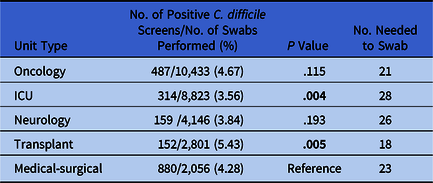
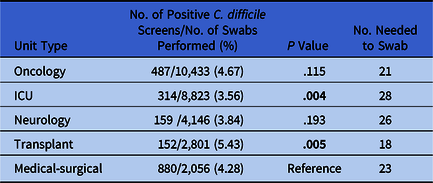
Over the study period, 47,048 C. difficile screening swabs were performed: 2,010 (4.2%) were positive. Based on unit audits, compliance with screening ranged from 79% to 96% on units during the first 2 months of the roll-out. Overall, 22% (10,433 of 47,048) of swabs were performed on oncology units, 19% (8,823 of 47,048) in ICUs, 44% (20,564 of 47,048) on medical-surgical units, 9% (4,146 of 47,067) on neurology units, and 6% (2,801 of 47,076) on transplant units. Table 1 displays rates of positive screens by unit type. Patients on transplant units had a higher rate of C. difficile colonization than patients on medical-surgical units: 5.4% (152 of 2,801) versus 4.3% (880 of 20,564) (P = .005). Patients in ICUs had a lower rate of C. difficile colonization than those on medical-surgical units: 3.6% (314 of 8,823) versus 4.3% (880 of 20,564) (P = .004). The number needed to screen to identify 1 colonized patient was 21 for oncology units, 28 for ICUs, 26 for neurology units, 18 for transplant units, and 23 for medical-surgical units. Repeat screening upon unit transfer occurred in 1,823 patients. Of these, 4.1% (75 of 1,823) were positive on their first screen. Of the 1,748 patients who were negative on initial screening 4.4% (77 of 1,748) screened positive later during their hospitalization. The number of C. difficile LabID events decreased over the study period. The LabID event rate for the 12 months prior to implementation was 13.3 events per 10,000 patient days. For the 1 year after the study period, the LabID event rate was 5.0 per 10,000 patient days.
Results of C. difficile Screening by Unit Type
Note. ICU, intensive care unit.
Discussion
This report describes the implementation of a universal C. difficile inpatient screening program over 3 years, with nearly 50,000 screening tests performed. Previous studies have suggested that C. difficile screening may be an effective intervention for reducing C. difficile transmission among hospitalized patients, Reference McDonald, Gerding and Johnson7,Reference Paquet-Bolduc and Gervai10 but barriers to screening include cost, staff time, patient satisfaction/education, and isolation bed capacity. Reference Caroff, Yokoe and Klompas3 At our institution, we were able to implement universal C. difficile screening with high compliance. Tools that assisted in successful implementation included an EMR prompt, nurse ordering, and an EMR-based auditing system. We also utilized a team-based approach, including infection control, microbiology, antibiotic stewardship, and environmental services education, and we provided appropriate isolation and cleaning of patient rooms.
We found an overall C. difficile colonization rate of 4.2%, which is similar to prior studies. Reference Longtin, Paquet-Bolduc and Gilca9 The prevalence of C. difficile colonization was higher on transplant units, and the prevalence of colonization in ICUs was lower compared to medical-surgical units. These findings suggest that there may be increased yield with targeted screening of transplant patients in hospitals that choose not to perform universal C. difficile screening. We detected no statistically significant difference between oncology and medical-surgical units, potentially due to complexity of patients with multiple comorbidities at a tertiary-care center. We encountered several challenges. The microbiology lab took on additional costs of laboratory testing. ICPs devoted significant amounts of time providing initial education, and long-term compliance could not be formally monitored. The purpose of this work was to assess the feasibility of implementing universal screening. This intervention was implemented as a part of a larger HO-CDI reduction initiative with laboratory stewardship and enhanced environmental cleaning.
The study had several limitations. We were not able to evaluate the direct effect that screening has on LabID events or outcomes. LabID events may have decreased over the study period due to other factors rather than the C. difficile screening program itself. For example, with laboratory stewardship initiatives, providers may have chosen to empirically treat for C. difficile in screen-positive patients with diarrhea rather than performing a C. difficile test. Prior studies have found mixed results in terms of the effect of screening in outbreak settings. Reference Linsenmeyer, O’Brien and Brecher5,Reference Paquet-Bolduc and Gervai10 Future areas of study include cost-effectiveness and outcome assessment of both hospital-wide and targeted C. difficile screening of high-risk populations.
In conclusion, we found that implementing a universal C. difficile admission screening program in a hospital is feasible but requires provider education and compliance, patient education, and microbiology laboratory capacity. C. difficile colonization rates vary based on unit type, which has implications for targeted screening. There is much still to learn about asymptomatic carriers of C. difficile and their role in transmitting C. difficile in the inpatient setting. Further studies on cost-effectiveness, targeted screening, and provider behaviors are warranted.
Acknowledgments
We thank the microbiology laboratory staff, the antibiotic stewardship team (Jennifer Pisano, MD, Natasha Pettit, PharmD), and the clinical faculty and staff at the University of Chicago.
Financial support
No financial support was provided relevant to this article.
Conflicts of interest
All authors report no conflicts of interest relevant to this article.