INTRODUCTION
In continental climates, autumn-sown bread wheat frequently experiences low water potential early in the season prior to and/or shortly after seedling emergence. Over the course of the 20th century the annual and, in particular, the summer and autumn precipitation has significantly declined in south-eastern Europe (Quarrie et al. Reference Quarrie, Stojanović and Pekić1999; Alexandrov et al. Reference Alexandrov, Schneider, Koleva and Moisselin2004). Early season drought inhibits plant growth, affects subsequent development and can lead to a substantial loss in yield. Although progress is being made in sensing the soil physical environment (Clark et al. Reference Clark, Gowing, Lark, Leeds-Harrison, Miller, Wells, Whalley and Whitmore2005), nevertheless the identification early in breeding programmes of genotypes with useful traits is crucial. Thus, the inclusion in selection programmes of drought tolerance-related traits, acting at various stages of plant development, would serve to achieve the important breeding goal of yield stability in the face of the probable occurrence of water deficit. Specific drought tolerance traits include plant size, root elongation, long coleoptiles and early seedling vigour (Quarrie et al. Reference Quarrie, Stojanović and Pekić1999; Reynolds et al. Reference Reynolds, Skovmand, Trethowan, Pfeiffer, Ribaut and Poland2000, Reference Reynolds and Borlaug2006; Richards et al. Reference Richards, Rebetzke, Appels, Condon, Ribaut and Poland2000). The ability to extend the root system under drought conditions helps the plant to exploit stored water deeper in the soil profile and avoids the inevitable water deficiency closer to the soil surface. Longer coleoptiles ensure successful seedling emergence where deep sowing is employed as an agronomic means to access soil moisture during germination. Rapid growth of the aerial part of the plant aids in crop establishment and provides early ground cover, needed both to minimize soil water evaporation and to out-compete weeds for the limited supply of water and nutrients typical of drought conditions (Richards Reference Richards1996; Quarrie et al. Reference Quarrie, Stojanović and Pekić1999; Reynolds et al. Reference Reynolds, Skovmand, Trethowan, Pfeiffer, Ribaut and Poland2000).
The height-reducing gibberellic acid (GA) insensitive Rht alleles have a strong effect on the growth of wheat plants at various developmental stages. Their presence represents a good compromise between adequate lodging resistance and high yield (Gale & Youssefian Reference Gale, Youssefian and Russell1985). Their mode of action is via interference in plant hormone metabolism (Peng et al. Reference Peng, Richards, Hartley, Murphy, Devos, Flintham, Beales, Fish, Worland, Pelica, Sudhakar, Christou, Snape, Gale and Harberd1999) and is manifested in the considerable size reduction at the cellular, organ and whole plant level (Keyes et al. Reference Keyes, Paolillo and Sorrells1989; Flintham et al. Reference Flintham, Börner, Worland and Gale1997; Miralles et al. Reference Miralles, Calderini, Pomar and D'Ambrogio1998). The ‘Norin 10’-derived alleles Rht-B1b (earlier designated Rht1, chromosome 4B) and Rht-D1b (Rht2, chromosome 4D) are present in at least 0·7 of worldwide commercial varieties (Evans Reference Evans1998). A further allele (Rht-B1d), derived from the Japanese variety ‘Saitama 27’, is common in warmer climates, particularly in southern and south-eastern Europe, as it appears to be less sensitive to higher temperatures (Worland Reference Worland1986; Ganeva et al. Reference Ganeva, Korzun, Landjeva, Tsenov and Atanasova2005). The ‘Tom Thumb’ allele (Rht-B1c, or Rht3) causes an extreme reduction in plant height and as a result it is not commercially exploited, although in certain genetic backgrounds it does increase grain number and reduce the incidence of pre-harvest sprouting damage (Flintham & Gale Reference Flintham and Gale1982, Reference Flintham and Gale1983).
The GA-insensitive Rht alleles have been shown to reduce coleoptile and leaf elongation in comparison with either tall (rht) genotypes or with carriers of GA-responsive dwarfing genes such as Rht8 (Botwright et al. Reference Botwright, Rebetzke, Condon and Richards2001; Ellis et al. Reference Ellis, Rebetzke, Chandler, Bonnett, Spielmeyer and Richards2004). However, they appear to have little effect on root penetration ability (Kubo et al. Reference Kubo, Jitsuyama, Iwama, Watanabe, Yanagisawa, Elouafi and Nachit2005). The shorter coleoptiles of GA-insensitive Rht carriers are not suitable for situations where deep sowing is applied, because of their negative effect on seedling emergence (Whan Reference Whan1976). The increasing popularity of GA-insensitive Rht alleles (alone or in combination with Rht8) in drought-prone areas (Ganeva et al. Reference Ganeva, Korzun, Landjeva, Tsenov and Atanasova2005) poses important questions concerning plant performance and the effects of these alleles under water deficiency stress at the critical early developmental stages. Their pleiotropic effects on a range of agronomically important traits have been elucidated by exploiting sets of near-isogenic lines (NILs) in various genetic backgrounds (Gale & Gregory Reference Gale and Gregory1977). These lines have also been used to define the influence of Rht alleles on callus culture response (Mathias & Atkinson Reference Mathias and Atkinson1988), rooting pattern (Miralles et al. Reference Miralles, Slafer and Lynch1997), as well as on plant height, yield and its components under a range of climatic conditions (Börner et al. Reference Börner, Worland, Plaschke, Schumann and Law1993; Flintham et al. Reference Flintham, Börner, Worland and Gale1997).
The analysis of plant performance in a simulated environment can help identify tolerance-related traits, by avoiding much of the environmental noise associated with field experiments. High molecular weight PEG has been widely used to mimic osmotic stress in culture solutions, as it is inert, does not penetrate the cell walls and avoids the toxic effects associated with many other osmotica (Blum et al. Reference Blum, Sinmena and Ziv1980; Almansouri et al. Reference Almansouri, Kinet and Lutts2001). The aim of the present paper was to examine the effects of genotype and the major GA-insensitive alleles (Rht-B1b, Rht-B1d, Rht-B1c and Rht-D1b) on plant growth response to PEG-induced osmotic stress at the germination and early seedling stage.
MATERIALS AND METHODS
Genotypes
Five sets of Rht NILs were used, derived from the varieties ‘April Bearded’ (AB), ‘Bersée’ (B), ‘Maris Huntsman’ (MH), ‘Maris Widgeon’ (MW) and ‘Mercia’ (M). The first four (kindly provided by Professor M. D. Gale, John Innes Centre (JIC), Norwich, UK and maintained at IPK, Gatersleben, Germany) comprise lines carrying one of Rht-B1b, Rht-B1c, Rht-D1b, Rht-B1b+-D1b, Rht-B1c+-D1b and Rht-B1a+-D1a (wild type or tall control, rht); the latter (kindly supplied by Dr A. J. Worland, JIC, Norwich, UK and maintained at Institute of Genetics, Sofia, Bulgaria) carry either Rht-B1b, Rht-B1c, Rht-B1d, Rht-D1b, or rht.
Experimental design
Osmotic stress was applied by treating seedlings with three increasing concentrations of PEG, (PEG 6000, supplied by SERVA, actual average M.W. 6449) corresponding to nominal water potentials of −0·15, −0·30 and −0·49 MPa (Michel & Kaufmann Reference Michel and Kaufmann1973). The control treatment contained distilled water. Each set of Rht NILs was placed in a covered transparent plastic box separated by a plastic rack into six lanes. Ten seeds per NIL were sown in a lane on two layers of filter paper moistened with a fixed volume of PEG solution (water in the control treatment). The boxes were maintained at 21±1°C in the dark for 3 days, followed by 5 days in a 12 h light/12 h dark regime. The filter paper was kept moist by the regular addition of equal quantities PEG (water in the control treatment). For each NIL, five seedlings of median shoot and root length based on subjective estimation on day 8 were pooled and the root lengths (Rl), coleoptile lengths (Cl) and shoot lengths (Sl) were measured. The shoot length was determined as the distance from the base of the coleoptile to the tip of the primary leaf, when it had emerged from the coleoptile, otherwise the shoot length was assumed to be equal to the coleoptile length. Three tolerance indices (TIRl, TICl and TISl) was calculated as the ratio between the mean trait value (Rl, Cl or Sl) at low water potential and the corresponding trait value in the control treatment (water). Three independent experiments were conducted under the same environmental conditions, representing three replicates. Statistical analysis was performed using the software package STATISTICA, StatSoft, Inc., version 7.1, both for each replicate and for mean values over replicates. As no significant differences were found between replicates and the observed trend was consistent, the results are presented by summarizing the data from the three experiments.
RESULTS
The seedling growth response to low water potential was genotype-dependent, as illustrated by the highly statistically significant main effects of both the various semi-dwarfing alleles and background variety-specific genes, at all the levels of water potential applied. Their combined genetic effect also generated a large interaction between semi-dwarfing allele and variety. The size of the main genotypic effect on the growth parameters depended on the water potential, as evidenced by the significant two-way (allele×treatment, treatment×variety) and three-way (treatment×variety×allele) interactions. In the following presentation of the results, first the seedling performance at low water potential is compared to that of the control, then the effects of Rht alleles are compared to those of the wild type, rht, in water and in low water potentials.
Root length
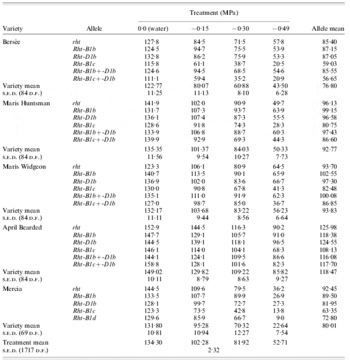
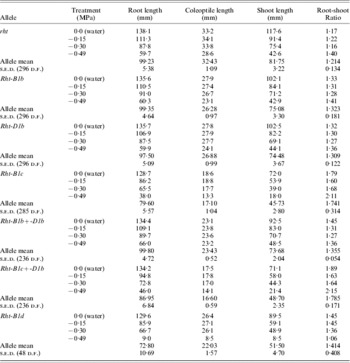
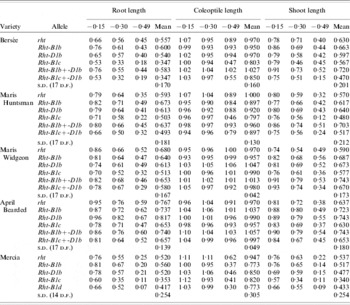
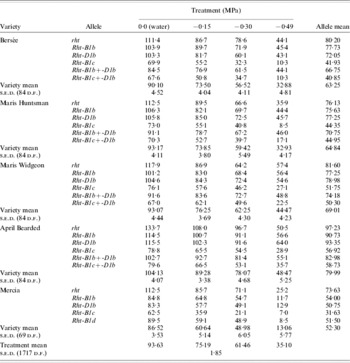
Root growth was reduced by low water potential in all genetic backgrounds, both in the presence and absence of semi-dwarfing genes (P<0·001). The inhibitory effect increased with decreasing water potential (Table 1). The genotypic (both variety and Rht allele) effects were significant (P<0·001). Whether in the control or in low water potential, and independent of allelic status at Rht loci, AB had the longest roots, while B and M had the shortest roots (Table 1). Among the Rht alleles, root growth was highest for genotypes carrying rht, Rht-B1b, Rht-D1b and the combination Rht-B1b+-D1b, both in water and at low water potentials, and across all varieties (Table 2). The strongest negative effect on root length was exerted by Rht-B1d, followed by Rht-B1c and the combination Rht-B1c+-D1b. The depressive effect of these alleles in comparison with rht was less in water, but was clearly present at low water potentials. The root length tolerance index (TIRl) was highest in the AB set of lines at all water potentials and lowest in B at −0·15 and −0·30 MPa and in M at −0·49 MPa (Table 3). Over all genetic backgrounds and at all water potentials, TIRl was lowest in the presence of Rht-B1c, Rht-D1b+-B1c, and Rht-B1d (except for MW Rht-B1c+-D1b at intermediate water potentials), while in the presence of Rht-B1b and/or Rht-D1b and Rht-B1b+-D1b TIRl was close to that in the rht control or even higher in all the varietal backgrounds.
Root length (mm) in control and after growing of Rht near-isogenic wheat lines in five varietal backgrounds at three PEG-induced water potentials (d.f. degrees of freedom; s.e.d. standard error of difference)
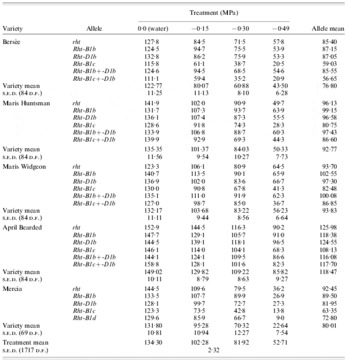
Influence of semi-dwarfing (Rht) genes on seedling growth parameters in control and after growing of Rht near-isogenic wheat lines in five varietal backgrounds at three PEG-induced water potentials (d.f. degrees of freedom; s.e.d. standard error of difference)
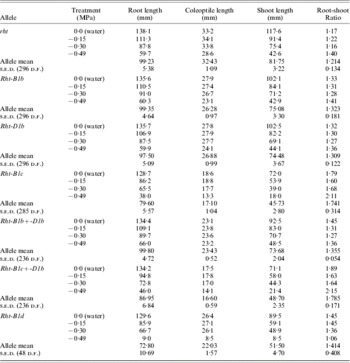
Tolerance indices for seedling growth parameters after growing of Rht near-isogenic wheat lines in five varietal backgrounds at three PEG-induced water potentials (d.f. degrees of freedom; s.d. standard deviation)
Coleoptile length
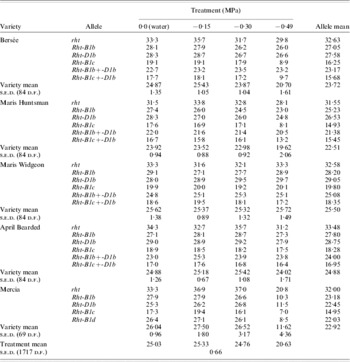
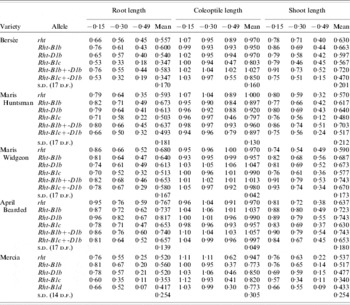
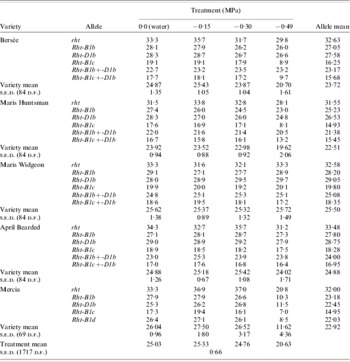
Coleoptile length was strongly influenced by the allelic constitution at Rht loci (P<0·001), by water potential (P<0·001) and by varietal background (P<0·001). All interactions involving these variables were also significant (P<0·001). While intermediate water potentials did not significantly affect coleoptile elongation, growth was increasingly suppressed at −0·49 MPa (Table 4). The varietal ranking in water was M>MW>AB=B>MH. At low water potentials MW was the most consistent, and MH the worst performer at all stress levels. The M set showed the highest coleoptile elongation at intermediate water potentials, but a great reduction in coleoptile growth at −0·49 MPa. For all isogenic sets, both in water and in low water potentials, the longest coleoptiles were produced by the rht control, followed by Rht-D1b, Rht-B1b and their combination (Tables 2 and 4). The shortest coleoptiles were produced by Rht-B1c and Rht-B1c+-D1b both stressing water and in low water potentials and also over all genetic backgrounds. Rht-B1d in the M background generated a shorter coleoptile than rht, but one which was comparable in length to those produced by either Rht-B1b or Rht-D1b. Coleoptile growth was the most consistent trait under low water potentials (Table 3). At −0·15 MPa, the coleoptile length tolerance index (TICl) was in the 0·93–1·12, and at −0·30 MPa it was 0·90–1·11. However, at −0·49 MPa, considerable variation was recorded. TICl was significantly lower in all the M lines, in particular in Rht-B1d isogenic line, whereas all MW and AB lines maintained high values. At this water potential, both Rht-B1c and Rht-B1c+-D1b or only Rht-B1c had the lowest TICl in B and MH, respectively.
Coleoptile length (mm) in control and after growing of Rht near-isogenic wheat lines in five varietal backgrounds at three PEG-induced water potentials (d.f. degrees of freedom; s.e.d. standard error of difference)
Shoot length
Shoot growth was affected by water potential (P<0·001), Rht genotype (P<0·001) and varietal background (P<0·001). The interaction terms were also significant (P<0·001). Lowering water potential gradually reduced shoot length (Table 5). In water, the variety ranking was AB>MW=MH⩾B>M, and this pattern was maintained over all the treatment levels. Generally, the wild type, Rht-B1b, Rht-D1b and their combination produced the longest shoots, and Rht-B1c and Rht-B1c+-D1b were the most inhibitory alleles (Table 2). The Rht allele effects were strongest in water. At the lowest osmotic pressure, shoot length was reduced only in presence of Rht-B1d, Rht-B1c or Rht-B1c+-D1b, whereas the effect in the remaining Rht allele carriers resulted in shoot lengths comparable to those of rht lines. At −0·15 and −0·30 MPa, there was little observable difference between the isogenic sets for TISl (Table 3), while at −0·49 MPa, the M lines recorded the lowest TISl (0·09−0·22). Generally, Rht-B1b, Rht-D1b and Rht-B1b+-D1b genotypes had a higher TISl than the rht type across all genetic backgrounds, and this effect was exaggerated as the water potential lowered. With only few exceptions, Rht-B1c and Rht-B1c+-D1b types had the lowest TISl, particularly at the lowest water potential.
Shoot length (mm) in control and after growing of Rht near-isogenic wheat lines in five varietal backgrounds at three PEG-induced water potentials (d.f. degrees of freedom; s.e.d. standard error of difference)

Root–shoot length ratio (RSR)
The variation of RSR in control ranged from 1·36 (B) to 1·52 (M) (data not shown) and from 1·17 (rht) to 1·89 (Rht-B1c+-D1b) (Table 2). Slight reductions in the RSR in all the NILs were observed at the intermediate water potentials (−0·15 and −0·30 MPa), but at −0·49 MPa, RSR were increased in all genotypes. At all treatment levels, RSR of Rht-B1b and Rht-D1b genotypes were comparable or higher than that of rht, but the highest RSR was produced by Rht-B1c and Rht-B1c+-D1b lines. The ‘Saitama 27’ allele (Rht-B1d), however, had the lowest RSR at −0·49 MPa compared with the control treatment and rht.
DISCUSSION
Numerous genes are known to control seed germination (Bewley Reference Bewley1997) and the expression of some (or all) of these is perhaps modified by unfavourable conditions, thereby potentially affecting further growth. The present study demonstrated that increasing the level of osmotic stress caused a gradual reduction in seedling growth, although it did promote the growth of the coleoptile at mild stress levels in some varietal backgrounds. Inhibited growth due to drought has been documented by many previous studies, which have shown that osmotic and oxidative stress provoked by water deficit disturbs the normal cellular activities and induces numerous metabolic changes (Kerepesi & Galiba Reference Kerepesi and Galiba2000; Alexieva et al. Reference Alexieva, Sergiev, Mapelli and Karanov2001; Yordanov et al. Reference Yordanov, Velikova and Tsonev2003; Bakalova et al. Reference Bakalova, Nikolova and Nedeva2004; Kocheva et al. Reference Kocheva, Lambrev, Georgiev, Goltsev and Karabaliev2004).
The present paper has demonstrated considerable genetic variability in growth response to low water potentials at very early seedling stage, determined by both the background genotype and the presence of Rht alleles. The Rht alleles rht, Rht-B1b and Rht-D1b and the varietal backgrounds AB and MW produced genotypes with longer roots, coleoptiles and shoots when germinated in water. These had the highest TI and maintained the highest absolute values at low water potentials. Accordingly, genotypes with shorter roots, coleoptiles and shoots (Rht-B1c, Rht-B1d; B and M) also tend to maintain their ranking at low water potentials. The behaviour of Rht-D1b in double dwarfs depended on the identity of the other Rht allele. In combination with Rht-B1b, the plant response was either similar to that of single gene Rht-B1b carriers, or was intermediate between those of carriers of Rht-D1b and Rht-B1b, whereas the strong suppressive effect of Rht-B1c dominated, so that the overall response of Rht-B1c+-D1b carriers was similar to that of carriers of Rht-B1c alone. This observation generally agrees with observations made by other authors at later developmental stages. The effect of drought on the growth of wheat was shown to be dependent on plant size, such that the relatively greater genetic potential of large plants (rht) results in higher absolute biomass and yield under stress, though the smaller plants (Rht-B1c) demonstrated greater stress tolerance (Blum & Sullivan Reference Blum and Sullivan1997; Blum et al. Reference Blum, Sullivan and Nguyen1997).
The observed varietal background effects on the seedling growth response to low water potential indicate the participation of an unknown number of uncharacterized genes. The drought response is clearly complex, involving a wide range of morphological, biochemical and physiological traits. Dehydration is known to affect the expression of many genes (Bartels & Souer Reference Bartels, Souer, Hirt and Shinozaki2003), which complicates the task of identifying those genes and/or chromosome regions of prime importance in conferring drought tolerance. The chromosome substitution method was used to show that such genes are distributed over at least eight chromosomes in wheat (Farshadfar et al. Reference Farshadfar, Köszegi, Tischner and Sutka1995). More widely in the Triticeae, quantitative trait loci (QTL) for drought tolerance component traits have been localized on chromosomes belonging to five of the seven homologous groups, although it appears that the group 5 chromosomes are the site of many of the key genes determining abiotic stress tolerance (Cattivelli et al. Reference Cattivelli, Baldi, Crosatti, Di Fonzo, Faccioli, Grossi, Mastrangelo, Pecchioni and Stanca2002). A recent study on genetics of seedling growth under drought stress identified responsible regions on ten chromosomes, thus supporting the idea of complexity of plant stress responses (Landjeva et al.,in press a).
The differential effects of the various GA-insensitive Rht alleles on growth are of importance particularly in unfavourable conditions. The present study demonstrates the clear growth-reducing effects of the more potent dwarfing allele (Rht-B1c) in comparison with the tall control, rht. The suppressive effect of this allele on the root growth is less in water but increases in severity at lower water potentials. In contrast, its depressive effect on shoot growth is strongest in water conditions and coleoptile length is independent of the water potential. Nevertheless, Rht-B1c-genotypes produced the highest RSR at low water potentials. The presence of a GA-insensitive Rht allele (Rht-D1b) is associated with reduced dry matter partitioning to the aerial part of the seedlings compared with rht (Botwright et al. Reference Botwright, Rebetzke, Condon and Richards2001). Partitioning of dry matter between roots and shoots is one of the mechanisms involved in plant adaptation to a particular environment. The currently observed changes in RSR indicate that at low water potentials, dry matter partitioning in Rht genotypes has changed so that the growth of aerial parts is more inhibited than the root growth compared with rht, and these effects are stronger in presence of Rht-B1c. The response of Rht-B1b or Rht-D1b genotypes as demonstrated by the reduction in root and shoot length under low water potentials is similar to that of the tall control, rht. Thus, carriers of the ‘Norin 10’ alleles Rht-B1b and Rht-D1b had a similar or even higher TI than carriers of rht, particularly at lower water potential.
The potential for using the genotypic variation in root system parameters to crop improvement, in particular in response to dry environment, is extensively discussed by O'Toole & Bland (Reference O'Toole and Bland1987). The ability of roots to penetrate through dry compacted soil is considered as beneficial for drought avoidance. The present results agree with the recent findings that the presence of Rht-B1b or Rht-D1b is not associated with any change in the penetrative potential of roots compared with the tall control (Kubo et al. Reference Kubo, Jitsuyama, Iwama, Watanabe, Yanagisawa, Elouafi and Nachit2005). Thus, it should be possible to select genotypes having semi-dwarf stature in the aerial part of the plant to avoid undesirable lodging of the tall genotypes, but with good root characteristics, that may be advantageous in unfavourable conditions.
Coleoptile length has been identified as another key trait for improving drought tolerance (Reynolds et al. Reference Reynolds, Skovmand, Trethowan, Pfeiffer, Ribaut and Poland2000). Maintaining coleoptile growth at low water potentials is beneficial where deep sowing is used to counteract dry conditions, as it helps to ensure rapid seedling emergence and protects the true leaves until the seedlings have reached the soil surface. Final coleoptile length is under the control of many genes (Matsui et al. Reference Matsui, Inanaga, Sugimoto and Nakata1998) and is, additionally, regulated by environment, including temperature (Radford Reference Radford1987; Botwright et al. Reference Botwright, Rebetzke, Condon and Richards2001). A repressor gene has also been identified, which although located on chromosome 4D (Matsui et al. Reference Matsui, Inanaga, Sugimoto and Nakata1998), must be different from Rht-D1b since the variety in which the repressor was found (‘Chinese Spring’) carries the non-dwarf allele at this locus. More recently, a major QTL in close linkage with Rht-B1 was described (Rebetzke et al. Reference Rebetzke, Appels, Morrison, Richards, McDonald, Ellis, Spielmeyer and Bonnett2001). This QTL accounted for up to 0·45 of the phenotypic variation for coleoptile length across a range of temperatures, while a further major QTL on chromosome arm 4BL accounted for up to 0·27 of the phenotypic variation. The expression of these genes is differentially affected by the drought stress applied, such that a wide variation in response was observed in the current study.
A promising alternative source of semi-dwarfism lies in the GA-responsive genes, such as Rht8 (Richards et al. Reference Richards, Condon, Rebetzke, Reynolds, Ortiz-Monasterio and McNab2001). This gene has already found commercial application in southern regions of Europe, Russia, Ukraine, China and Japan (Worland et al. Reference Worland, Korzun, Röder, Ganal and Law1998; Chebotar et al. Reference Chebotar, Korzun and Sivolap2001; Ganeva et al. Reference Ganeva, Korzun, Landjeva, Tsenov and Atanasova2005). Rht8 carriers have no reducing effect on coleoptiles and aerial parts of the plant or produce longer coleoptiles than do carriers of GA-insensitive alleles, as a result of having a faster growth rate (Botwright et al. Reference Botwright, Rebetzke, Condon and Richards2001; Ellis et al. Reference Ellis, Rebetzke, Chandler, Bonnett, Spielmeyer and Richards2004), and yet express significant reduction in final plant height (Worland et al. Reference Worland, Sayers and Korzun2001).
Satisfactory seedling emergence and development during germination and early seedling stages at low water potentials, requires the seedling vigour present in tall (rht) and some of the semi-dwarf (Rht-B1b, Rht-D1b and Rht-B1b+-D1b) carriers, as well as the positive influence of as yet unidentified variety-specific genes (particularly in AB and MW). It also requires adequate coleoptile elongation. The combining of these Rht alleles with GA-responsive ones (e.g. Rht8; Ganeva et al. Reference Ganeva, Korzun, Landjeva, Tsenov and Atanasova2005) might represent an efficient strategy to achieve sufficient seedling emergence and establishment in cases of early season drought. In a recent study of variation in seedling growth response to low water potential among wheat varieties, genotypes carrying a combination of Rht-B1b and Rht8 tended to produce longer roots, coleoptiles and shoots in both control and low water potentials compared to those carrying Rht-B1b alone (Landjeva et al.,in press b). The extreme height-reducing allele Rht-B1c, alone or in combination with Rht-D1b, is not commercially exploited under normal conditions, nor does it confer any advantage under drought conditions. The Rht-B1d allele also acts to suppress the growth of the coleoptile, shoot and root, so is also not likely to be beneficial in conditions where early season drought is common. Nevertheless, since this allele is widely distributed in southern and south-eastern Europe, further investigation of its effects under stress in various genetic backgrounds is warranted.
The phenotypic plasticity of crops in individual traits, including stress tolerance-related components, may lower the genotypic variation and stability of economically important characters, such as yield and quality (O'Toole & Bland Reference O'Toole and Bland1987). For this reason, combined with the limited information on the association of genetic variation for growth traits at early stages obtained in laboratory and the variation for growth and yield characteristics at later stages under field conditions (Tuberosa et al. Reference Tuberosa, Sanguineti, Landi, Giuliani, Salvi and Conti2002; Rebetzke et al. Reference Rebetzke, Richards, Fettel, Long, Condon, Forrester and Botwright2007), the current approach to investigate plant stress tolerance under simulated environmental conditions does require caution. An assumption in the current work was that all the seed samples had similar seed vigour. However, seed germination and seedling performance are influenced not only by the genotype but also by seed quality, this being determined by the environment both during seed production and storage. There is much evidence that poor quality seeds perform poorly in stress conditions (e.g. Ali et al. Reference Ali, Naylor and Matthews2006). Alam et al. (Reference Alam, Stuchbury and Naylor2006) have suggested an experimental methodology to distinguish poor performance at low water potentials (linked to salinity) due to genotype from that due to poor quality. This avoids discarding potentially useful genotypes because of poor physiological seed quality.
The authors thank Professor M. D. Gale (John Innes Centre, Norwich, UK) for his critical reading and valuable comments during the preparation of this manuscript. The first author acknowledges the financial support of the Bulgarian NSF, contract B-1538/05.