INTRODUCTION
Understanding the fundamental physics of laser matter interactions in underdense plasmas remains a challenge. While much progress has been made, no single predictive tool exists that can cover any given set of plasma conditions. The lack of such a tool presents a challenge for designing laser based high energy density experiments. To improve current predictive tools, reduced models for laser plasma interactions in different regions of parameter space must be developed and validated. Since it is challenging to perform experiments in all parameter regimes, a good approach utilizes particle-in-cell (PIC) or Vlasov simulations to construct the reduced models. However, these simulation codes require validation to ensure the accuracy of the models.
Recent progress in computational and experimental capabilities is encouraging, and good prospects are on the horizon to obtain the necessary physical understanding to formulate models that predict laser plasma instability behavior. Computers have now attained Petaflop speeds (Bowers, Reference Bowers, Albright, Yin, Bergen, Barker and Kerbyson2008a, Reference Bowers, Albright, Yin, Bergen and Kwan2008b) enabling large two and three-dimensional (3D) simulations that should provide more realistic comparisons with experiments. Advances such as the deformable mirror provide a method for reproducibly generating diffraction limited laser focal spots (Wattellier et al., Reference Wattellier, Fuchs, Zou, Chanteloup, Bandulet, Michel, Labaune, Depierreux, Kudryashov and Aleksandrov2003), the best configuration for comparison of experiments with simulations due to the high degree of experimental characterization. Compared with previous efforts to create a diffraction-limited single-hot-spot (Montgomery et al., Reference Montgomery, Johnson, Cobble, Fernandez, Lindman, Rose and Estabrook1999), which required the removal of the amplifier glass not used in the beam line to maintain a uniform laser phase front, deformable mirrors reduce the setup time significantly and provide more control over the changing of the experimental conditions. Short pulse technology such as chirped pulse amplification (Strickland & Mourou, Reference Strickland and Mourou1985) is now a common practice and mJ level short-pulse laser beam lines can be easily constructed to fit into different experimental configurations. Each of these technologies enables better experiments to be conducted under conditions closer to ideal for investigating and modeling laser plasma interactions.
One laser plasma instability of interest is stimulated Raman scattering (SRS), where the incident laser light resonantly couples with an electron plasma wave and a backscattered light wave. For SRS, one regime of great interest is the strong electron trapping regime, where kλD > 0.3 where k is the electron plasma wave (EPW) number and λD is the plasmas Debye length. In this regime, the phase speed of the electron plasma (Langmuir) wave driven by the SRS becomes roughly comparable to the electron thermal speed, and thus able to trap enough electrons in even a modest amplitude Langmuir wave, to lead to a significant reduction in damping and other nonlinear effects (Manheimer & Flynn, Reference Manheimer and Flynn1971; Morales & O'Neil, Reference Morales and O'Neil1972; Dewar, Reference Dewar1972). The interaction of the trapped particles with the electrostatic EPW is thought to lead to effects such as bending of the EPW wave fronts (Yin, Reference Yin, Albright, Bowers, Daughton and Rose2007, Reference Yin, Albright, Bowers, Daughton and Rose2008a) and trapped particle self-focusing (Rose & Yin, Reference Rose and Yin2008) that in turn affect the saturation of SRS. Accurate modeling of these phenomena is important for developing a predictive capability for SRS, and would be valuable for designing laser-based high energy density plasma experiments including inertial confinement fusion (Lindl, Reference Lindl1995), fast ignition (Tabak et al., Reference Tabak, Hammer, Glinsky, Kruer, Wilks, Woodworth, Campbell, Perry and Mason1994; Roth et al., Reference Roth, Cowan, Key, Hatchett, Brown, Fountain, Johnson, Pennington, Snavely, Wilks, Yasuike, Ruhl, Pegoraro, Bulanov, Campbell, Perry and Powell2001; Zvorykin et al., Reference Zvorykin, Didenko, Ionin, Kholin, Konyashchenko, Krokhin, Levchenko, Mavritskii, Mesyats, Molchanov, Rogulev, Seleznev, Sinitsyn, Tenyakov, Ustinovskii and Zayarnyi2007), and Raman amplification/pulse compression (Fisch & Malkin, Reference Fisch and Malkin2003; Ping et al., Reference Ping, Cheng, uckewer, Clark and Fisch2004; Clark & Fisch, Reference Clark and Fisch2005).
To investigate SRS in the high kλD regime, experiments have been conducted at two different laser facilities, the Trident (Moncur et al., Reference Moncur, Johnson, Watt and Gibson1995) and the LULI 100 TW laser facilities. Both sets of experiments use ps laser pulses to drive laser-plasma instabilities. With short laser pulses, <3 ps, experimental measurements can be directly compared with simulations over the same duration to validate the simulation code. Using multiple facilities for experiments provides a broader set of data with different laser wavelengths and measurements of different SRS properties: reflectivity of the interaction beam in one case, and density fluctuations of the electron plasma wave via time resolved Thomson scattering in the other. It is hoped that the broader, better-defined experimental approach taken here will lead to improved models for SRS. This article presents experimental results obtained at both the Trident and the LULI facilities.
EXPERIMENTAL SETUP
Details of the laser plasma interaction experimental setup for the Trident (Moncur et al., Reference Moncur, Johnson, Watt and Gibson1995; Kline et al., Reference Kline, Montgomery, Yin, Hardin, Flippo, Shimada, Johnson, Rose and Albright2008) and the LULI (Rousseaux et al., Reference Rousseaux, Casanova, Gremillet, Loiseau, Le Gloahec, Baton, Amiranoff, Audebert, Popescu, Adam, Heron, Huller, Mora and Pesme2006a, Reference Rousseaux, Gremillet, Casanova, Loiseau, Le Gloahec, Baton, Amiranoff, Adam and Heron2006b) laser facility have been described in previous work. However, a comparison of the basic differences between the two is warranted. Both sets of experiments are conducted using preformed helium gas-jet plasmas prior to firing the interaction beam. Experiments at the Trident laser facility used a frequency doubled ~2–3 ps, ~527-nm interaction laser pulse with 7–40 mJs of energy. During conversion, the potassium diphosphate (KDP) crystal operates in a saturated regime to maintain the pulse length of the 1ω beam which an autocorrelator measures on each shot. The LULI experiments used a 1059-nm interaction beam with a ~1.5 ps pulse length. A major difference between the two experiments is the diagnostics. At Trident, the experimental diagnostics measure the backscattered light energy and spectra to characterize the laser reflectivity. At LULI, a 300 fs 3ω (353 nm) Thomson scattering system measures the temporally resolved density fluctuations of the electron plasma wave (Rousseaux et al., Reference Rousseaux, Casanova, Gremillet, Loiseau, Le Gloahec, Baton, Amiranoff, Audebert, Popescu, Adam, Heron, Huller, Mora and Pesme2006a, Reference Rousseaux, Gremillet, Casanova, Loiseau, Le Gloahec, Baton, Amiranoff, Adam and Heron2006b). The different experimental approaches increase the constraints for validating models of SRS by providing a larger data set with different interaction conditions and measurements of different SRS parameters.
HIGH kλD MEASUREMENTS OF SRS AT LULI
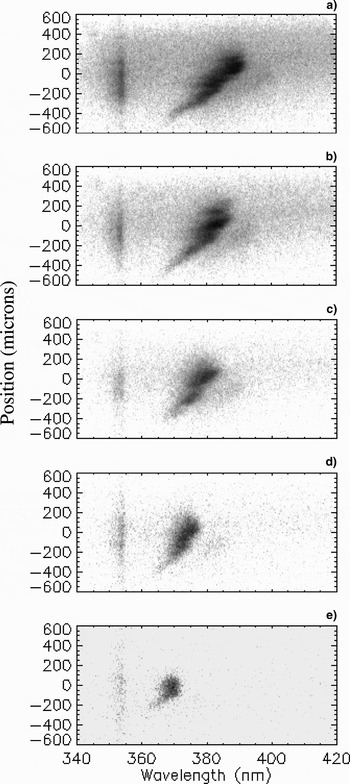
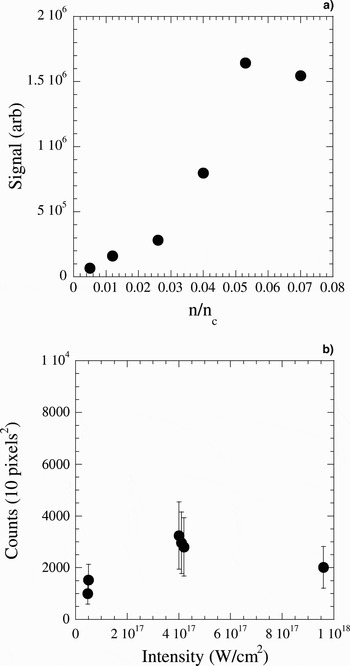
Thomson scattering spectra from the SRS EPW density fluctuations are shown in Figure 1 for different plasma densities. Varying the pressure of the gas-jet sets the peak density in the center of the plasma. The data for each measurement shows the wavelength dependence (horizontal axis) as a function of space (vertical axis). Two features stand out from the series of data. At higher plasma densities, the EPW spectra not only peak near the focal point, z = 0, but also extend toward shorter wavelengths and lower densities, consistent with a density profile in the pre-formed gas-jet plasma. From the spectra, one can see that the intensity of the peak in the data decreases with decreasing density or higher kλD. This is qualitatively expected as the EPW damping rate increases. To quantify the data, a region of 10 pixels by 10 pixels centered on the peak reflectivity is integrated to get the total signal, which is related to the integrated Thomson scattering power from the crossing volume of the Thomson probe with the EPWs. The region corresponds to ~50 µm along the spatial axis and 0.98 nm along the wavelength axis. Figure 2a, shows the density scaling of the time resolved Thomson scattered power near the peak of the interaction beam pulse (t = t 0 − 0.7 ps, where t is the time and t 0 coincides with the peak of the interaction pulse) as a function of density where decreasing density relates to increasing kλD. The data show that the relative scattered power decreases with decreasing density for a fixed interaction laser intensity of I 0 = 2.3 × 10¹⁶ W/cm2. From these measurements, the relative EPW amplitudes can be determined and compared with PIC simulations. However, a careful analysis, currently underway, is required to determine the EPW amplitudes (δn/n), since the Thomson scattered power (P s), is also proportional to the electron density among other parameters, P s ~ (n/n c)2(δn/n)2, where n c is for the 3ω Thomson probe in this case. Thus, the decrease in scattered power could be due to a reduction in density, as well as in the EPW amplitude. It should also be noted that the electron densities calculated for Figure 2a use the Bohm-Gross dispersion relationship (Bohm & Gross, Reference Bohm and Gross1949) assuming a fixed electron temperature of 300 eV. In the experiments, the electron temperature was not measured and varies as a function of density due to inverse-Bremsstrahlung absorption of the laser light. At lower densities, the electron temperature is expected to decrease leading to an under estimate of the electron density. In addition, the Bohm-Gross dispersion relationship breaks down for high values of kλD > ~0.25, lower values of density in this case, requiring an exact solution of the EPW dispersion relationship. Future analysis will employ two-dimensional (2D) radiation hydrodynamic simulations consistent with scaling arguments (Denavit & Phillion, Reference Denavit and Phillion1994) and past experimental data (DeWispelaere et al., Reference DeWispelaere, Malka, Huller, Amiranoff, Baton, Bonadio, Casanova, Dorchies, Haroutunian and Modena1999) to get a better estimate of the electron temperatures for the different densities, as well as to estimate kλD for each density setting.
Thomson scattering spectra for six different gas-jet pressures with peak densities n/n c of (a) 0.070, (b) 0.053, (c) 0.040, (d) 0.026, and (e) 0.012, assuming an electron temperature of 300 eV.

Thomson scattered power from SRS EPW integrated over space, ~50 mμ, and wavelength, 0.9 nm, as a function of (a) peak density for a fixed intensity (~2.3 × 10¹⁶ W/cm2) and (b) interaction beam intensity for a fixed density (n/n c = 0.0225 ± 0.0025, high kλD). Note that vertical error bars for (a) are within the limits of the points.

Along with the density scaling, an intensity scaling is also shown in Figure 2b at a fixed density of 0.0225 ± 0.0025 n/n c, where n c is the cut-off density for 1ω light. The data show little dependence on the intensity in this high kλD regime. This is consistent with the Trident experiments that show a saturation in reflectivity and a plateau with increasing intensity (Kline et al., Reference Kline, Montgomery, Yin, Hardin, Flippo, Shimada, Johnson, Rose and Albright2008) and it is consistent with VPIC simulations (Yin et al., Reference Yin, Albright, Bowers, Kline, Montgomery, Flippo and Rose2008b; Bowers, Reference Bowers, Albright, Yin, Bergen and Kwan2008b). Future efforts will carefully compare all of these results to 2D and 3D PIC models of these experiments.
SPECTRAL MEASUREMENTS OF SRS BACKSCATTER AT TRIDENT
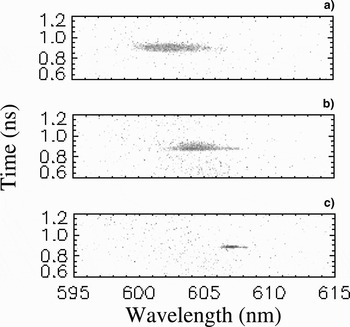
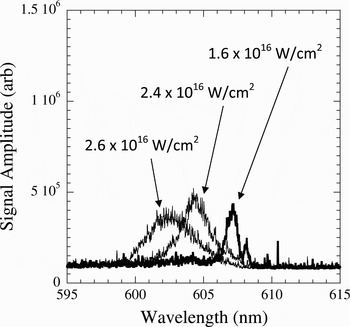
In addition to the SRS backscattered energy measurements made at Trident, the spectra of the backscattered light have also been measured. Figure 3 shows an example of three such spectra for the lowest laser intensities shot with the short pulse. Integrated plots of the spectra in Figure 4 show two features of the spectra, a broadening and a shift in wavelength with increasing interaction beam intensity. The shift toward shorter wavelength is consistent with the simple picture of a nonlinear frequency shift due to electron trapping. That is to say, with higher intensities, the amplitude of the EPW grows to larger values, leading to more trapped electrons, and a larger frequency shift until the nonlinear effects of electron trapping saturate the growth of the SRS process. Unfortunately, an estimate of the expected frequency shift is difficult to establish. Simulations suggest that SRS occurs in short pulses, ~250 fs (Yin et al., Reference Yin, Albright, Bowers, Daughton and Rose2008a). Thus, only a lower bound can be determined using the average reflectivity to estimate the EPW amplitude. In preliminary simulations, the frequency shifts in the backscattered wavelength are consistent with, but smaller than, the calculated values for intensities near the SRS onset. Independent measurements of the plasma density and temperature using the plasma formation beam as a Thomson scattering probe show that the gas-jet plasma conditions are nearly the same from shot-to-shot, although the resolution of the Thomson scattering probe is only slightly smaller than the spread in frequency shift. This suggests that the electron density and temperature are not responsible for the shift in the backscattered wavelength, but the wavelength shift may indicate a nonlinear frequency shift of the EPW due to electron trapping as observed in the simulations. If these results can be confirmed, they would constitute one of the first direct measurements of a nonlinear frequency shift due to electron trapping in laser produced plasmas.
SRS backscattered light spectra from the Trident experiments for three different interaction beam intensities (a) 2.6 × 10¹⁶ W/cm2, (b) 2.4 × 10¹⁶ W/cm2, and (c) 1.6 × 10¹⁶ W/cm2.

Plots of the temporally integrated backscattered spectra as a function of wavelength.

The broadening of the spectra poses a more challenging problem. As with previous experimental measurements of SRS with Thomson scattering (Kline et al., Reference Kline, Montgomery, Yin, DuBois, Albright, Bezzerides, Cobble, Dodd, Fernandez, Johnson, Kindel and Rose2005, Reference Kline, Montgomery, Yin, DuBois, Albright, Bezzerides, Cobble, Dodd, DuBois, Fernández, Johnson, Kindel, Rose, Vu and Daughton2006; Kline & Montgomery, Reference Kline and Montgomery2005), the temporal behavior of the SRS pulses is faster than the temporal resolution of the detection system. Thus, it could lead to artificial broadening of the measured reflected light as a result of the temporal integration. However, the previously measured spectra showed an asymmetric broadening toward lower electrostatic frequencies consistent with electron trapping (Kline et al., Reference Kline, Montgomery, Yin, DuBois, Albright, Bezzerides, Cobble, Dodd, Fernandez, Johnson, Kindel and Rose2005, Reference Kline, Montgomery, Yin, DuBois, Albright, Bezzerides, Cobble, Dodd, DuBois, Fernández, Johnson, Kindel, Rose, Vu and Daughton2006; Kline & Montgomery, Reference Kline and Montgomery2005). In the present case, the broadening appears to be symmetric about the shifted frequency. Such broadening could be due to effects such as self-phase or cross-phase modulation of the backscattered light in the plasma. In which case, the broadening could represent a frequency shift due to electron trapping and a frequency broadening of the backscattered light via one of the suggested processes. At higher intensities, the backscattered light produces even greater broadening with periodic structure in the spectra. Examination of these spectra is underway to determine the mechanism responsible.
CONCLUSIONS
Data from experiments at both the Trident and the LULI laser facilities have been presented. The data from these experiments will be compared with the VPIC (Bowers, 2008a; Yin et al., Reference Yin, Albright, Bowers, Daughton and Rose2008a) particle-in-cell code for validation and subsequently for probing the behavior of SRS in the high kλD regime. Using both sets of data imposes more constraint on the simulations hopefully leading to a more robust validation and understanding of SRS. It should be noted that even though the work here focuses on SRS for high energy density laser plasmas, a similar approach for other laser plasma instabilities such as stimulated Brillouin scattering and two-plasmon decay could impact other important areas of research such as fast ignition (Tabak et al., Reference Tabak, Hammer, Glinsky, Kruer, Wilks, Woodworth, Campbell, Perry and Mason1994). Current experiments to accelerate charged particles (Roth et al., Reference Roth, Cowan, Key, Hatchett, Brown, Fountain, Johnson, Pennington, Snavely, Wilks, Yasuike, Ruhl, Pegoraro, Bulanov, Campbell, Perry and Powell2001), which could be used for fast ignition use sub-ps laser pulses. As the laser energy is increased to the kJ level required for fast ignition, the pulse lengths also increase changing from a regime in which the pulse length is too short for SBS to grow to one in which it can (Cobble et al., Reference Cobble, Johnson and Mason1997).
ACKNOWLEDGMENTS
We acknowledge the beneficial support from the LULI technical staff during these experiments. The authors would also like to express thanks for the hard work of the Trident laser crew: F. Archuleta, D. M. Esquibel, R. Gonzales, T. Hurry, and S. L. Reid. We would also like to thank Sandrine Gaillard for useful comments on the manuscript. The LANL portion of this work was performed by Los Alamos National Laboratory under the auspices of Los Alamos National Security, LLC, for the Department of Energy under contract number DE-AC52-06NA25396.