INTRODUCTION
Employees often exhibit prosocial behaviours beyond the call of duty (Bornstein, Reference Bornstein2007; Grant, Reference Grant2008). In this respect, they strive to make positive differences in the lives of others by making prosocial attempts (May, Reference May2003; Grant, Reference Grant2008). These prosocial behaviours are prevalent in various work settings; and helping, being one such form of prosocial behaviour, received considerable attention as organizational citizenship behaviour (OCB).
Since the review of citizenship behaviours by Van Dyne, Cummings, & Parks (Reference Van Dyne, Cummings and Parks1995), the dominant view in the helping literature is that of task-focussed, generic form of helping. This earlier literature assumes helping as an affiliative form which is reactive in nature (Spitzmuller & Van Dyne, Reference Spitzmuller and Van Dyne2013); and leave unnoticed the other different types of helping and the factors impacting it (Spitzmuller & Van Dyne, Reference Spitzmuller and Van Dyne2013). Focussing on this overlooked area of helping may unfold different forms of helping with more nuanced consideration of different causes and benefits of the construct (Spitzmuller & Van Dyne, Reference Spitzmuller and Van Dyne2013).
Deriving from social exchange theory (SET), there has also been sporadic research in recent past, highlighting the difference in attention given to proactive helping vis-à-vis reactive helping. According to SET, members have different motives of exchange (Emerson, Reference Emerson1976). SET is mostly dominated by the reciprocity view of the exchange. However, motives beyond reciprocity receive the least attention (Cropanzano & Mitchell, Reference Cropanzano and Mitchell2005). The benefits accrued from prior exchanges obligate the members to reciprocate (Colquitt, Reference Colquitt2008). Similarly, benefits rendered during prior exchanges result in members to form an expectation of reciprocation. Reciprocity, both in the form of expectation or felt obligation entails reactive behaviour on account of members (Spitzmuller & Van Dyne, Reference Spitzmuller and Van Dyne2013). Therefore task-based helping – mostly a reactive form of helping is found to be dominated in helping literature.
However, the functional perspective of exchange in the form of proactive behaviour initiated by self, and irrespective of any past obligation, reflects the importance of forward-looking view of the agentic capacity of the human mind as argued by Bandura (Reference Bandura2001). Being proactive is about aspiring and striving to make a difference in the lives of others or in the environment to achieve a better future (Grant & Ashford, Reference Grant and Ashford2008; Parker, Bindl, & Strauss, Reference Parker, Bindl and Strauss2010).
Helping behaviours can be executed more or less proactively, but helping as a reactive form of social exchange got the entire attention of the past studies, almost neglecting proactive helping (Parker, Bindl, & Strauss, Reference Parker, Bindl and Strauss2010; Spitzmuller & Van Dyne, Reference Spitzmuller and Van Dyne2013). This is to the extent that literature lacks any valid measure on proactive helping (Spitzmuller & Van Dyne, Reference Spitzmuller and Van Dyne2013). Deriving from the literatures on proactive behaviours and helping, the present study develops the conceptual understanding of the proactive helping construct. Considering SET as the underpinning theoretical lens, the present study further develops and validates a composite measure of proactive helping.
The present study not only aims to develop and validate a measure of proactive helping but also aims to answer when and how prosocial behaviour is proactive in nature. The answer to this question lies in differentiating between the nature of social exchanges in reactive and active forms of helping behaviour. The present study develops a nomological model of proactive helping considering social norms of sharing, team-based incentives, social status, and team-based effectiveness. The proposed model outlines the nuanced causes and benefits of proactive helping and thus establishes the predictive validity of proactive helping construct.
This nomological network is a process model highlighting the psychosocial causes and benefits of proactive helping based upon the tenets of SET and social motivation theory. The proposed model highlights the complementary role of proactive helping in predicting others-oriented benefits in the form of team leadership and team learning. The study outlines that knowledge-based proactive helping not only leads to team learning defined as collective learning for the team (Bunderson & Reagans, Reference Bunderson and Reagans2011) but also leads to team leadership defined as members exhibiting informal leadership in the team acting as a provider for the team needs (DeRue, Barnes, & Morgeson, Reference DeRue, Barnes and Morgeson2010). Team leadership and team learning are taken as two dimensions of knowledge-based effectiveness that represents others-oriented effectiveness. Through this, the present paper relates proactive helping with unique aspects of informal leadership behaviours. The significance of the model relies on bringing the prosocial, proactive form of social exchange at the forefront of social exchanges, which was almost entirely dominated by the reactive forms of social exchanges (Spitzmuller & Van Dyne, Reference Spitzmuller and Van Dyne2013). The study is further able to account for the complementary effects of proactive helping in predicting others-oriented effectiveness.
The widest form of exchange in today’s knowledge-based economy is the exchange of knowledge resource between team members in the organizations, thus setting the context for the present study. Uncertain and rapidly changing environments create subjective and ambiguous situations for the knowledge workers (Grant & Ashford, Reference Grant and Ashford2008; Anderson & Lewis, Reference Anderson and Lewis2014). Bunderson and Reagans (Reference Bunderson and Reagans2011) highlight that knowledge transfers/behaviours in such environments should have high future orientation for collective learning to take place, eluding such behaviours closely with proactive behaviours.
The paper in the subsequent two sections addresses constructs definition and differentiation, theoretical foundations, and the building of a nomological network of knowledge-based proactive helping. Later sections consist of two studies: Study 1 for assessing convergent and divergent validity for the measure considering two different sample groups; and Study 2 for testing nomological network of the measure. The last section discusses the theoretical implications, limitations, and future scope of the study.
UNDERSTANDINGS OF KNOWLEDGE-BASED PROACTIVE HELPING FROM LITERATURE
Through the review of helping literature, the present study examines prominent scales of helping (Organ & Konovsky, Reference Organ and Konovsky1989; Seers, Reference Seers1989; Podsakoff, MacKenzie, Moorman, & Fetter, Reference Podsakoff, MacKenzie, Moorman and Fetter1990; Williams & Anderson, Reference Williams and Anderson1991; Anderson & Williams, Reference Anderson1996; Podsakoff, Ahearne, & MacKenzie, Reference Podsakoff, Ahearne and MacKenzie1997; Van Dyne & LePine, Reference Van Dyne and LePine1998; Settoon & Mossholder, Reference Settoon and Mossholder2002; Van Dyne, Kamdar, & Joireman, Reference Van Dyne, Kamdar and Joireman2008; Hofmann, Lei, & Grant, Reference Hofmann, Lei and Grant2009) and knowledge sharing (Faraj & Sproull, Reference Faraj and Sproull2000; Bock, Zmud, Kim, & Lee, Reference Bock, Zmud, Kim and Lee2005; Subramaniam & Youndt, Reference Subramaniam and Youndt2005; Collins & Smith, Reference Collins and Smith2006; Lu, Leung, & Koch, Reference Lu, Leung and Koch2006; Huang, Hsieh, & He, Reference Huang, Hsieh and He2014). As explained earlier, the previous knowledge exchange literature failed to appreciate other motives of exchange, and these scales were directed towards generic assumptions of exchange. Helping comprising of motives other than reciprocity was completely absent from these scales in knowledge exchange literature. Previous studies by Anderson and Williams (Reference Anderson1996), Podsakoff et al. (Reference Podsakoff, MacKenzie, Moorman and Fetter1990), and Smith, Organ, and Near (Reference Smith, Organ and Near1983) highlighted that existing measures of helping contained a small number of items that directly rated assistance or help given to another member. These measures considered helping as a one-dimensional construct that did not account for the different variety of forms of help that participants in a given social context provide (Anderson, Reference Anderson and Galinsky1993). Further, the focus within helping literature was on task-specific reactive helping, which reflected a one-dimensional view of helping that did not account for the different proactive dimensions of helping found in the literature. To our knowledge, no existing single scale has incorporated these multiple dimensions of proactive helping, though some individual dimensions appeared separately in scales in the literature.
The present study considers SET as the dominant theoretical lens in developing the conceptual underpinning of the measure of ‘proactive helping’. Traditionally, much of the SET’s focus was on negotiated and reciprocal agreements (Cropanzano & Mitchell, Reference Cropanzano and Mitchell2005), but other exchange motives suggest fruitful avenues for making contribution to the literature. These underresearched motives of exchange have received more attention from disciplines like sociology and anthropology than from management sciences (Fiske, Reference Fiske1991). Although there are different possible frameworks, Meeker’s (Reference Meeker1971) model represents a well-known and influential model in this regard. Meeker’s central argument rests on the premise that social exchanges can be considered as individual decisions (Cropanzano & Mitchell, Reference Cropanzano and Mitchell2005), but these decisions involve making choices that are guided by social norms. Meeker thus posited six motives: reciprocity, competition, rationality, altruism (helping and altruism are used interchangeably in the organizational citizenship behaviour literature), status consistency, and group gain. The focus of the present study is on altruism/voluntary motive of social exchange.
Earlier literatures suggest that ‘knowledge sharing’ means the reactive sharing of one’s knowledge, skills, and abilities, directed towards an individual, a team, or a community. The primary motive in reactive knowledge sharing is task-focussed reciprocity. ‘Knowledge-based proactive helping’ indicates team- or community-directed proactive helping behaviours and is concerned mainly with professional development and problem mitigation of team members through the use of one’s knowledge, skills, and abilities. By contrast with knowledge sharing, which mainly involves reciprocity as the motive of social exchange, the motive of exchange for knowledge-based proactive helping involves more generic and broader motives of support and development of fellow team members. Knowledge-based proactive helping may or may not include an explicit transfer of knowledge.
The major focus of earlier studies was on the narrow aspect of task-focussed reactive helping; however, minimal attention was given to studying proactive helping. Considering the operationalization of knowledge-based proactive helping and the lack of a suitable measurement scale, the present study focusses on developing a composite measurement tool for knowledge-based proactive helping. The items in the scale were primarily chosen and adapted from the relevant dimensions of helping as a general construct found in organizational citizenship behaviour studies. The present study modifies the original scale items to suit the context of the study, taking cultural and work-related aspects into account. This is done based on the field study which is part of the present study.
Knowledge-based proactive helping, as mentioned earlier, is an extra-role behaviour of an individual who engages voluntarily helping the team members. This proactive helping occurs mainly at times of difficulty and ambiguity in work and for contextual support and development in improving team performance. Through an extensive review of the literature on helping, the present study identifies five dimensions of helping that elicit proactive behaviours. Proactive developmental aspects have three dimensions of development and training (Lepine & Van Dyne, Reference Lepine and Van Dyne2001; Jackson & LePine, Reference Jackson and LePine2003), task mentoring and coaching (Organ, Reference Organ1988, Reference Organ1990a, Reference Organ1990b), and constructive suggestions and correction (George & Brief, Reference George and Brief1992; George & Jones, Reference George and Jones1997). These three dimensions involve proactive developmental aspects, as with new or underperforming individuals and with informal mentoring/coaching (Jackson & LePine, Reference Jackson and LePine2003). For example, help or mentoring provided to underperformers/junior members of the team towards their professional development is mostly devoid of reciprocal motives because underperformers/junior members are less likely to reciprocate equally (Jackson & LePine, Reference Jackson and LePine2003) and the helping is mostly voluntary in nature (Organ, Reference Organ1988). Such helping exchanges are mostly proactive and more likely to be one-sided. These aspects of helping take into account a larger timeframe or horizon than does a focus only on spontaneous aspects of helping.
The other two dimensions of proactive helping – handling difficult and ambiguous situations (Faraj & Xiao, Reference Faraj and Xiao2006; Hofmann, Lei, & Grant, Reference Hofmann, Lei and Grant2009), problem solving (Anderson & Williams, Reference Anderson1996) – are specifically associated with uncertain situations as proactive behaviours are more likely to be rendered in uncertain/ambiguous situations (Parker, Bindl, & Strauss, Reference Parker, Bindl and Strauss2010). Knowledge-based social spaces are a concept that considers context specificity by describing where helping happens in situations of doubt/ambiguity. Knowledge workers in these social spaces frequently encounter situations fraught with ambiguity, equivocality, and uncertainty in the context of complex work and technologies (Garicano & Wu, Reference Garicano and Wu2012). These social spaces rely heavily on knowledge as the input for their production (of product, service, or research) activities.
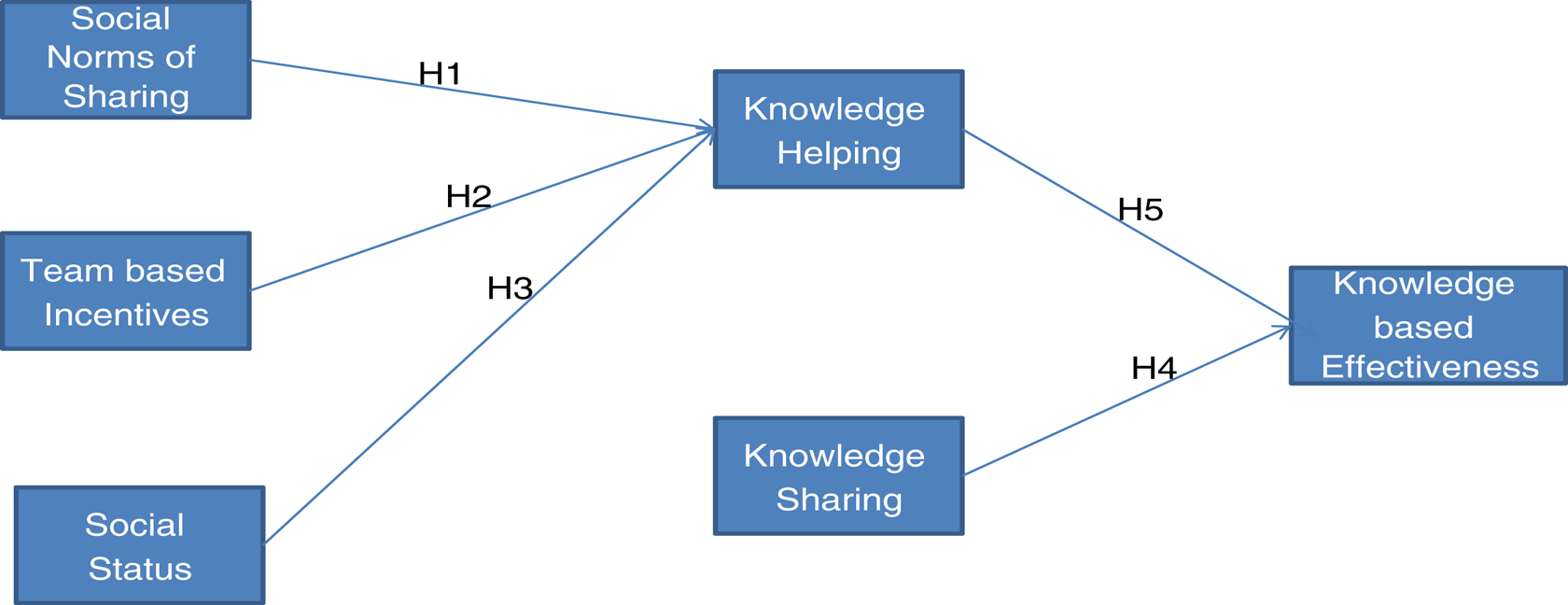
The following section develops a nomological network of knowledge-based proactive helping as shown in Figure 1.
Nomological network of knowledge-based helping

NOMOLOGICAL NETWORK AND HYPOTHESIS DEVELOPMENT
Hypotheses were developed for the sake of testing nomological network of knowledge-based proactive helping. The nomological network is presented in Figure 1.
Incentives, team (social) norms, and knowledge-based proactive helping
Rationalist and functionalist literature on knowledge exchanges have given primary importance to incentives and norms as factors explaining knowledge exchanges. Incentives and norms are known from different studies to be consistent factors that successfully explain knowledge exchange intentions or behaviours. Incentive theory (Jenkins & Lawler, Reference Jenkins and Lawler1981) provides useful insights on motivational aspects that influence the knowledge provider’s analysis and decisions regarding knowledge exchange. Incentives determine the amount of effort a team member would allocate for knowledge exchange (Pinder, Reference Pinder1984, Landy & Becker, Reference Landy and Becker1987). The present study intends to investigate whether team-based vis-à-vis individual-based incentives affect the extent of knowledge exchange among the team members of knowledge-based production teams.
Researchers have highlighted at least three ways through which incentive structure may increase the likelihood of proactive helping. First, team-based incentive shifts the attention of employees towards their team members (Meglino & Korsgaard, Reference Meglino and Korsgaard2004). As the employees’ incentives are not only tied towards their performance but also towards the performance of the team as a whole, the focus is more likely to shift from individual to the team as a whole. This shift in focus motivates the employees to proactively identify ways to help their team members (Meglino & Korsgaard, Reference Meglino and Korsgaard2004) to create the opportunity for improving the performance of the team as a whole. Second, team-based incentives motivate employees to be more responsible and committed towards their team members (Ilies, Judge, & Wagner, Reference Ilies, Judge and Wagner2006; Grant, Reference Grant2008), especially helping underperformers or junior employees towards improving their performance (Jackson & LePine, Reference Jackson and LePine2003) for the sake of team performance. Third, team-based incentives may even prompt employees to subordinate their self-interest to the interest of their team members. Team-based incentives reduce the notion of cost in helping and makes it more favourable towards the benefit of the team as a whole (Meglino & Korsgaard, Reference Meglino and Korsgaard2004; Moon, Kamdar, Mayer, & Takeuchi, Reference Moon, Kamdar, Mayer and Takeuchi2008).
The social motivation theory that Green-Demers, Pelletier, and Menard (Reference Green-Demers, Pelletier and Menard1997) presented, having adapted it from prior works on informal peer control (e.g., Roethlisberger & Dickson, Reference Roethlisberger and Dickson2003), indicated that external motivational mechanisms like norms were the result of interpersonal interactions among the team members, who put pressure on each other by indirectly influencing and intensifying other aspects of existing motivational effects (Green-Demers, Pelletier, & Menard, Reference Green-Demers, Pelletier and Menard1997). Earlier research suggested that cooperative norms within a team are important for team members to involve in knowledge exchanges (e.g., Davenport & Prusak, Reference Davenport and Prusak1998; Jarvenpaa & Tiller, Reference Jarvenpaa and Tiller1999). By adopting rationalist and functionalist views, these researchers placed transactional and reciprocal rules and norms of social exchange at the forefront of inquiries into knowledge exchange.
Behaviours are reinforced based on the culture and the context of groups. Culture and context of the group set the social norms of the group (O’Reilly, Reference O’Reilly1989). Social norms reinforce behaviours through clan type of control mechanisms on the members of the group (O’Reilly, Reference O’Reilly1989). Mimetic pressure reinforces its effect on adoption of any social norm by the members just by following the norms through imitation. Normative pressures, on the other hand, are more deeply rooted in cultural values and context and are more reinforcing. More specifically, Indian culture is collectivistic and more likely to reinforce its culture and philosophy of voluntary helping over Western societies which are individualistic (Perlow & Weeks, Reference Perlow and Weeks2002). Perlow and Weeks (Reference Perlow and Weeks2002) in their study highlighted that Indian software engineers are motivated differently to help from their Western counterparts on account of differences in ‘combined influence of national, occupational, and organizational layers of culture in the two settings’ (Perlow & Weeks, Reference Perlow and Weeks2002: 345). Indian engineers have multiple layers of normative influences that make them more willing to help whoever needs help whereas American engineers provide help only to those from whom they expect to need help (Perlow & Weeks, Reference Perlow and Weeks2002). Indian cultural tradition regards this relationship, based on the genuineness of the parties, to be the best means for conveying subtle or advanced knowledge (Matilal, Reference Matilal1971).
Hypothesis 1: Team norms of exchange are positively related to knowledge-based proactive helping.
Hypothesis 2: Team-based incentives are positively related to knowledge-based proactive helping.
Social status and knowledge-based proactive helping
Organizations are the social spaces for complex relationships and situations that foster individual differences in several status dimensions. The prior research on status suggested that individuals in teams primarily derive status both from the knowledge, skills, and abilities or professional expertise that they are known to possess and from the types of official roles they fulfil in the given context (Kilduff & Krackhardt, Reference Kilduff and Krackhardt1994; Wittenbaum, Reference Wittenbaum2000, Reference Wittenbaum1998; Thomas-Hunt, Ogden, & Neale, Reference Thomas-Hunt, Ogden and Neale2003; Hofmann, Lei, & Grant, Reference Hofmann, Lei and Grant2009).
An individual member who is considered to be an expert by the team or who plays an important official role in the team gains access to power and status because of the virtue of his or her importance to the team. This access may lead to further enhancement of the performance of this individual member because of the influence of the team’s and the member’s own positive perceptions (Stewart & Stasser, Reference Stewart and Stasser1995; Wittenbaum, Reference Wittenbaum2000; Thomas-Hunt, Ogden, & Neale, Reference Thomas-Hunt, Ogden and Neale2003). Keltner, Gruenfeld, and Anderson (Reference Keltner, Gruenfeld and Anderson2003) in their review of status and power concluded that status advantages result in approach responses in the form of positive emotions and initiatives, whereas status disadvantages create hindrances and result in inhibitive responses in the form of negative emotions and threat (Langner & Keltner, Reference Langner and Keltner2008). Grant and Ashford (Reference Grant and Ashford2008) in their review on proactive behaviours suggested that approach response patterns towards goals are closely associated with proactive behaviours. More and more growing body of research suggest that individuals lower in the status are less likely to get involved in the social interactions (Anderson & Galinsky, Reference Anderson and Williams2006; Magee, Galinsky, & Gruenfeld, Reference Magee, Galinsky and Gruenfeld2007) because of psychosocial hindrances in the form of negative emotions (Langner & Keltner, Reference Langner and Keltner2008) and lack of initiatives (Galinsky, Gruenfeld, & Magee, Reference Galinsky, Gruenfeld and Magee2003)
Team members who are recognized for their skill and task-based expertise and use it to fulfil team needs are highly revered and gain both self-confidence (Trafimow & Sniezek, Reference Trafimow and Sniezek1994) and the confidence of their team members. The implications of status are directly associated with the way people approach helping others. The people higher in status usually have better access to knowledge and resources and are therefore better equipped to help others (Bunderson & Reagans, Reference Bunderson and Reagans2011). These people are more likely to render help and advice (Bunderson & Reagans, Reference Bunderson and Reagans2011) to their team members. Furthermore, official status may confer legitimacy and reduce the status threat otherwise associated with helping and divulging knowledge. Such status differences between the members of the team often result in increased participation and contributions from the high-status members of the team (Thomas-Hunt, Ogden, & Neale, Reference Thomas-Hunt, Ogden and Neale2003); relatively low-status members may also be more receptive to taking help from high-status members (Hofmann, Lei, & Grant, Reference Hofmann, Lei and Grant2009). The research by Larson, Christensen, Abbott, and Franz (Reference Larson, Christensen, Abbott and Franz1996) found that experts render more unshared information than do nonexperts, and the research by Hofmann, Lei, and Grant (Reference Hofmann, Lei and Grant2009) found that experts were more approachable than were nonexperts for those who seek help in cases of doubt.
Hypothesis 3: Higher social status is positively associated with knowledge-based proactive helping.
Knowledge-based social exchanges and knowledge-based effectiveness
Knowledge-based social exchanges have been closely related to causing collective learning in the organizations. Bunderson and Reagans (Reference Bunderson and Reagans2011) review on collective learning highlighted three conditions for collective learning to take place – knowledge transfer, initiatives in the form of risk-taking and experimentation, and shared goals. Collective learning at all levels, including teams, units, and organization, is known to depend on knowledge transfers in the form of knowledge-based social exchanges (Argote, Reference Argote2013). Argote (Reference Argote2013) outlined knowledge exchanges as the indispensable process that facilitates collective learning in the organization. Research shows that knowledge exchanges among team members have important consequences for various outcomes in the form of collective learning (Reagans et al., Reference Reagans, Argote and Brooks2005) and informal team processes (Szulanski, Reference Szulanski1996).
Informal brainstorming sessions and regular sessions on the coordination of project activities involve knowledge sharing and helping among team members (Amabile, Reference Amabile1988, Reference Amabile1996). It is only through these social exchanges, members are placed in the better position to identify and cater to teams needs of execution and development. This understanding of team’s learning and developmental needs comes through information exchange (Gong Lee & Zhu, Reference Gong, Kim, Lee and Zhu2013) and social interaction (Woodman Sawyer & Griffin, Reference Woodman, Sawyer and Griffin1993) in the team social processes. Informal mentoring and coaching by the senior team members during on-the-job training, and feedback entails substantial socialization and knowledge exchanges among the members (Nonaka, Reference Nonaka1994).
Contribution to collective learning by team members represents a part of team leadership function that is analogous to informal mentoring (Kammeyer-Mueller & Judge, Reference Kammeyer-Mueller and Judge2008). Such contribution not only involves, directly and indirectly, supporting the team members with know-what and know-how regarding the task at hand but also training and preparing them for more challenging, future tasks. An individual who exhibits more knowledge sharing and helping contributes substantially to the learning and development of the team. Proactive helping and knowledge sharing behaviours act as trust building social mechanisms that facilitate individuals to exhibit trustworthiness and reliability (Colquitt, Reference Colquitt2008; DeRue, Barnes, & Morgeson, Reference DeRue, Barnes and Morgeson2010.), which is must for collective learning to take place. Knowledge sharing is a reactive process based upon expectations of reciprocity, but recipient learning requires a consistent approach to build trustworthiness.
Proactive helping is not only closely associated with collective learning goals but also with the leadership role in the team. This type of knowledge exchange is not dependent on the expectations of reciprocity; therefore help is rendered even when not asked for (Spitzmuller & Van Dyne, Reference Spitzmuller and Van Dyne2013). This refers to the social exchange with forward-looking approach orientation. The recent review by DeRue, Barnes, and Morgeson (Reference DeRue, Barnes and Morgeson2010). offered a broadened definition of leadership, which was traditionally recognized only as a formal function. Team leadership is about members acting as informal leaders as and when required by fulfilling various requirements of the team (DeRue, Barnes, & Morgeson, Reference DeRue, Barnes and Morgeson2010.). Team leaders act as completers and providers for the team by fulfilling important functions for the team members collectively (DeRue, Barnes, & Morgeson, Reference DeRue, Barnes and Morgeson2010). Derue et al. in their review suggested that team leadership functions require members to exhibit high involvement in social exchanges which requires elements of forward-looking approach orientation. Therefore, proactive helping becomes an important prerequisite of team leadership and team learning because of its such orientation towards the training and developmental needs of the team. Researchers of the present study refer knowledge-based effectiveness as the informal team leadership and team learning effectively performed by the individual members of a team.
Hypothesis 4: Knowledge sharing is positively related to knowledge-based effectiveness.
Hypothesis 5: Knowledge-based proactive helping is positively related to knowledge-based effectiveness.
METHOD
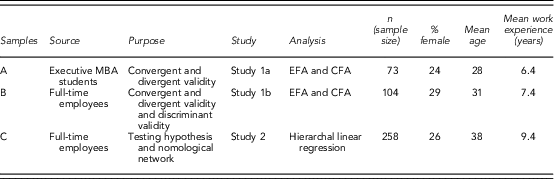
Studies 1a and 1b, are used to develop and validate the knowledge-based helping scale. Study 1a addresses the generation of scale items, including the establishing of face validity and content validity of the scale. Specifically, Study 1a checks for convergent and divergent validity of the scale through exploratory factor analysis (EFA) and confirmatory factor analysis (CFA). Study 1b focusses on discriminant validity and once again tests for convergent and divergent validity through EFA and CFA analysis on a different sample. Multiple sample group was used for checking validity across different groups of people. Study 2, incorporates tests for the hypothesis developed in third section and is thus used to establish the predictive validity of knowledge-based helping. Table 1 describes the empirical studies and samples and analysis associated with them.
Samples, studies, and analysis

Note. CFA=confirmatory factor analysis; EFA=exploratory factor analysis.
Study 1a: knowledge-based proactive helping scale validation with N=73 (executive MBA students)
Participants and procedures
In the first study, data were collected from 73 students enrolled in an executive MBA programme of a premium management institute in India. All of the students were full-time employees of the different organizations for which they work. The researchers asked the participants to complete a questionnaire about the context of the organization for which they work. Initially, 83 participants responded on the knowledge-based proactive helping scale; however, only 73 responses were kept for the analysis. The demographic details of the participants are presented in Table 1.
Development of knowledge-based proactive helping measure
The present study followed suggestions by Hinkin (Reference Hinkin1995) to develop a robust and valid measure of knowledge-based proactive helping. Informed by relevant literature and an inductively derived definition, the researchers generated an initial list of 32 items and subsequently discussed the face validity of each item. Based on the face validity and item clarity, the researchers ultimately kept 21 items for the knowledge-based proactive helping scale to be used in subsequent empirical testing (refer to Appendix A). Items were rated using a Likert scale from 1 =‘strongly disagree’, to 5=‘strongly agree’.
Based on the operational definition of knowledge-based proactive helping mentioned in second section, five dimensions for the knowledge-based proactive helping scale were identified from the literature. Through interviews with five highly experienced technology professionals working in reputable companies, the researchers further validated the relevance of these dimensions in describing the knowledge-based proactive helping construct. The five dimensions included skill training and development (Lepine & Van Dyne, Reference Lepine and Van Dyne2001; Jackson & LePine, Reference Jackson and LePine2003), handling difficult and ambiguous situations (Faraj & Xiao, Reference Faraj and Xiao2006; Hofmann, Lei, & Grant, Reference Hofmann, Lei and Grant2009), problem solving (Anderson & Williams, Reference Anderson1996), task coaching and mentoring (Organ, Reference Organ1988, Reference Organ1990a, Reference Organ1990b), and constructive suggestions and correction (George & Brief, Reference George and Brief1992; George & Jones, Reference George and Jones1997). The original scale items were modified to suit the context of the study by considering cultural and work-related aspects.
Furthermore, three experts in the organizational behaviour field assessed the scale to check for content validity. During this process, the researchers explained detailed definitions of the dimensions and their respective items to the experts. The experts were asked to rate whether an item fits with its respective dimension. Congruence was assessed from the interrater reliability, and it was found to be high. Finally, the researchers showed the scale to five management students to check their understanding of the items.
Convergent and divergent validity
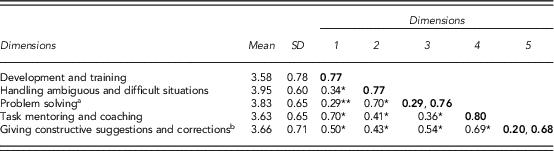
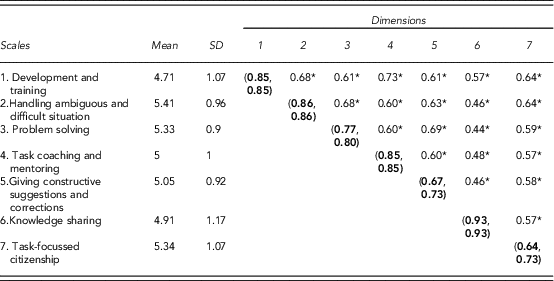
Cronbach’s α, item-total correlations, and the factor structure of the scale items were analysed. The results are presented in Table 2. Based on Cronbach’s α and item-total correlations, five items were dropped from the scale, which resulted in dropping an entire dimension – constructive suggestions and correction. In the case of ‘constructive suggestions and correction’, the reliability of the subscale did not improve substantially and remained under 0.7, which resulted in the elimination of the entire subscale. Perhaps the meaning of this subscale was captured by the participants as a feedback activity that is regular and passive in nature, and not proactive. Further, dropping an item from the subscale ‘problem solving’ resulted in an increase of Cronbach’s α reliability to 0.766.
Study 1a: sample A means, standard deviations, reliabilities, and intercorrelations of subscales (n=73)

Note. Bold values in the diagonal of the correlation matrix represent Cronbach’s α reliabilities. The second value of reliability represents increased reliability of the dimension after dropping items from the dimension.
a Problem solving: dropping a negatively worded item resulted in Cronbach’s α reliability increasing to 0.76.
b Giving constructive suggestions and corrections: even after dropping items, Cronbach’s α reliability remained under 0.7, which resulted in dropping the entire subscale.
*p<.05; **p<.01; ***p<.001.
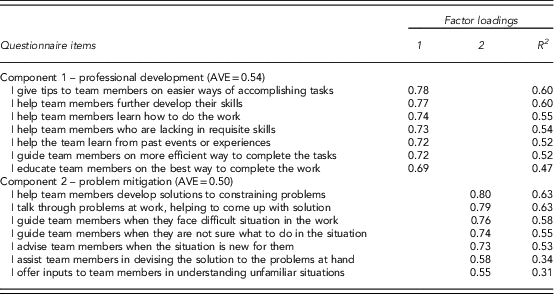
Therefore, the entire subscale ‘suggestions and corrections’ and one item from the subscale ‘problem solving’ were removed from the original scale. This resulted in a scale of knowledge-based proactive helping comprising four dimensions and 16 items. Regarding construct validity, convergent and divergent validities were tested using EFA. (Please refer to Table 3.) The reduced scale of 16 items was used only for EFA.
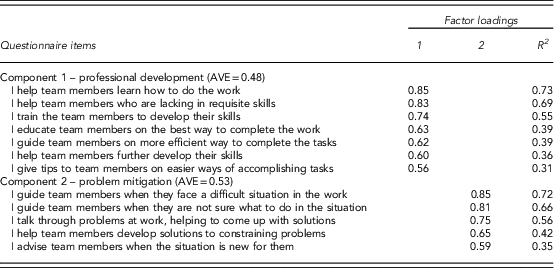
Study 1a: sample A standardized parameter estimates for factor loadings of all scale items (n=73)

Note. AVE=average variance extracted.
Participants were asked to rate themselves and the team with which they worked, based on the initial 16 knowledge-based proactive helping items. From this data, we conducted a series of principal components analyses using Varimax rotation. The factors were free to vary based on the traditional Eigen value cut-off of 1.0. Following Hinkin (Reference Hinkin1995), we eliminated knowledge-based proactive helping items with low loadings (i.e., below 0.40) on the respective first and second factors or with unacceptably high cross-loadings (i.e., above 0.40) across the factors. The factor analysis was then rerun using the remaining items. This entire process resulted in one item being dropped; yielding a two-factor solution with each factor comprising seven items. Two subscales, ‘development and training’ and ‘task mentoring and coaching’, merged into a factor that we called ‘professional development’; two other subscales, ‘problem solving’ and ‘handling difficult and ambiguous situation’, merged into another factor that we called ‘problem mitigation’. ‘Professional development’ therefore includes the overall task- and skill-based development of an individual, while ‘problem mitigation’ includes providing support for uncertain situations and difficult problems. Scale items statistics are presented in Table 3. Average variance extracted (AVE) for both components was found to be >0.40 which forms the threshold value of AVE (Fornell & Larcker, Reference Fornell and Larcker1981). Any value of AVE >0.40 shows evidence of moderate validity and anything above 0.50 shows evidence of strong validity (Fornell & Larcker, Reference Fornell and Larcker1981). The researchers thus established the convergent and divergent validities of the knowledge-based proactive helping scale.
CFA was also conducted to check further for convergent and divergent validity. Table 4 reveals that the fit index for the two-factor model is considerably better than for the one-factor model, thereby establishing divergent validity.
Study 1a: sample A confirmatory factor analysis for all scale items (n=73)

Note. RMSEA=root mean square error of approximation.
***p<.001.
However, to check the discriminant validity of the knowledge-based proactive helping scale, a similar empirical study was conducted on another set of sample group. This subsequent study again examined the convergent and divergent validities of the scale to establish strong support for the validities.
Study 1b: knowledge-based proactive helping scale validation and discriminant validity with N=104 (IT professionals)
Participants and procedures
For the second empirical study, the data were collected from 119 executives working in IT and technology companies, out of which 104 responses were kept for the analysis. All of the executives were full-time employees of IT industry which were considered to be most relevant with respect to the context of knowledge-based social exchanges. Participants were asked to fill the survey questionnaire by considering the context of their respective organizations. At this stage, 7-point scales were used for all of the scale items. To check the discriminant validity of knowledge-based proactive helping, the researchers compared it with knowledge sharing and task-focussed citizenship behaviour empirically.
Measures
Knowledge sharing
The measure of tacit knowledge sharing in Huang, Hsieh, and He (Reference Huang, Hsieh and He2014) was used in the current study through three self-reported items. Explicit knowledge sharing was measured using two items. The variable was measured on a 7-point Likert-type scale, ranging from 1=‘strongly disagree’, to 7=‘strongly agree’.
Knowledge-based proactive helping
Operationalization of knowledge-based proactive helping was accomplished using the five dimensions derived from the literature on helping and the interviews with five technology professionals working in reputable companies. The following five dimensions of knowledge-based proactive helping were incorporated – skill training and development, handling difficult and ambiguous situation, problem solving, task coaching and mentoring, and constructive suggestions and correction. The original scale items were modified to suit the context of the study, taking cultural and work-related aspects into account. The variable was measured on a 7-point Likert-type scale, ranging from 1=‘strongly disagree’, to 7=‘strongly agree’.
Task-focussed citizenship behaviour
This variable was measured with three items adapted from Settoon and Mossholder (Reference Settoon and Mossholder2002). We selected the three items from the Task-Focussed Citizenship Behaviour subscale.
Convergent and divergent validity
Final analysis checked for Cronbach’s α, item-total correlation, and factor structure of the scale items. Based on Cronbach’s α and item-total correlation, five items were dropped from the scale, which resulted in the dropping of an entire dimension – constructive suggestions and correction. (Please refer to Table 5.) In the case of ‘constructive suggestions and correction’, the reliability of the subscale did not improve substantially and remained under 0.7, resulting in the elimination of the entire subscale. Further, dropping an item from the subscale ‘problem solving’ resulted in an increase of Cronbach’s α reliability from 0.77 to 0.80.
Study 1b: sample B means, standard deviations, reliabilities, and intercorrelations of scales and subscales (n=104)

Note. Bold values in the diagonal of the correlation matrix represent Cronbach’s α reliabilities. The second value of reliability represents increased reliability of the dimension after dropping items from the dimension.
*p<.05; **p<.01; ***p<.001.
Therefore, the entire subscale ‘suggestions and corrections’ and one item from the subscale ‘problem solving’ were dropped from the original scale. This resulted in a scale of knowledge-based proactive helping comprising four dimensions and 16 items. Construct validity – convergent and divergent validity – was tested using EFA. The reduced scale of 16 items was used only for the first EFA. The results in Table 6 were reported after removing loadings <0.5 and cross-loadings. This resulted in a two-factor structure of 12 items. Two subscales, ‘skill development’ and ‘task mentoring’, merged into a factor that we called ‘professional development’; two other subscales, ‘problem solving’ and ‘difficult/ambiguous situation’, merged into another factor that we called ‘problem mitigation’. ‘Professional development’ therefore included the overall task- and skill-based development of an individual while ‘problem mitigation’ included providing support for uncertain situations and difficult problems.
Study 1b: sample B standardized parameter estimates for factor loadings and R 2 for the reduced-scale items (n=104)

Note. AVE=average variance extracted.
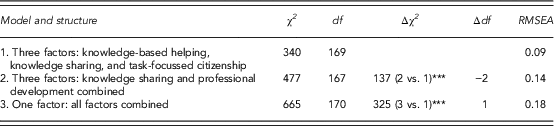
As evident from Table 6, the items ‘professional development’ and ‘problem mitigation’ converged on their respective subscales, showing clear evidence for convergent validity. Also, the AVE of both dimensions were found to be >0.40, thus lending support for convergent and divergent validity. Furthermore, these items had very low factor loadings on other subscales and therefore showed high divergent validity. As evident from the CFA analysis in Table 8, the two-factor model demonstrated a better fit than did the one-factor model. This shows that the items converge on their respective dimensions.
Discriminant validity
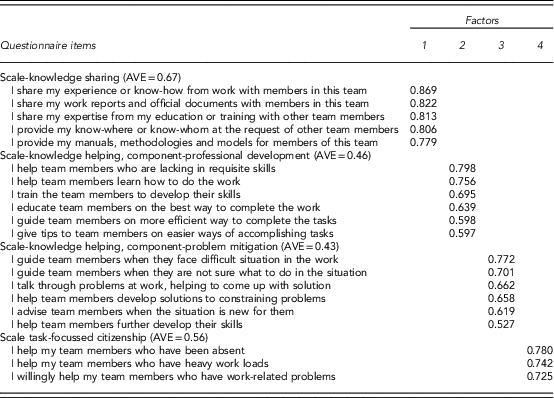
For ascertaining the discriminant validity of the scale, another EFA and CFA were conducted. This included two scales of ‘knowledge sharing’ and ‘task helping’, revealed in Table 6, apart from the reduced ‘knowledge-based proactive helping’ scale of 12 items that were obtained from the previous EFA. The researchers reported the results in Table 7 after removing loadings <0.5 and cross-loadings, which resulted in no dropping of items. The EFA resulted in a 4-item factor structure, with all items’ loading on their respective dimensions. Furthermore, the AVE of both scales and both subscales were found to be >0.40, providing support for discriminant validity. This clearly established that both subscales of ‘knowledge sharing’ were distinct from the ‘knowledge sharing’ and ‘task helping’ scales. From the CFA, presented in Table 8, it was further evident that the four-factor model’s χ2 and other fit indices were significantly better than the three-factor and one-factor models, clearly establishing discriminant validity.
Study 1b: sample B standardized parameter estimates for factor loadings of all three scale items

Note. AVE=average variance extracted.
Study 1b: sample B confirmatory factor analysis for all scale items (n=104)

Note. RMSEA=root mean square error of approximation.
***p<.001.
In order to test the hypotheses, a nomological network was considered in the third empirical study.
Study 2: testing hypotheses and nomological network with N=258 (IT professionals)
Participants and procedures
Sample C was used for this study, as highlighted in Table 1. The research sites for the study were medium- and large-sized IT and technology-based organizations India, consisting of more than 300 employees and minimum turnover more than $10 million (US). These organizations included teams or units whose work was dependent on knowledge and in which the employees placed substantial emphasis on knowledge as part of their work and career. These teams were either project-based or research- and development-based teams in technological and professional contexts. These teams were characterized as knowledge-based production teams, for whom the emphasis in carrying out successful production of services or products was on knowledge.
Before administering survey questions to the participants, the researchers explained the purpose of the study to the participants and solicited their voluntary participation. It was guaranteed that all of the responses would be kept confidential and used solely for academic research purposes. As the survey was administered to members of teams in person, the response rate was almost 80%, which included 359 responses from 51 teams. Responses of those employees who were rated by their managers/team leads were included only for the analysis. This reduced the sample size to 307 employees nested in 43 teams. Furthermore, cleaning the data and treating for missing values and casual patterns led to a sample size of 258 employees nested in 41 teams. The final sample had an average overall experience of 9 years, tenure within the current organization of 4 years, tenure within the current team of 1.7 years, and average age of 38 years. The sample comprised 74% males and 26% females.
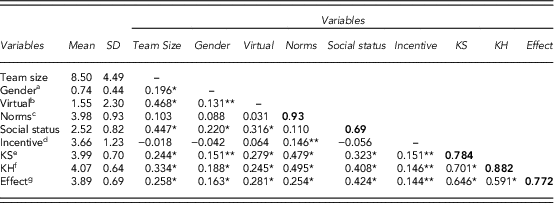
A series of hierarchical linear regressions were conducted to test the hypotheses. We used the factor scores of the latent variables for hierarchical linear regressions. Means, standard deviations, reliabilities, and intercorrelations of variables are presented in Table 9. The correlation between the two factors (‘professional development’ and ‘problem mitigation’) is found to be 0.757 which is more than any correlations between any other two variables. If both the factors are used separately in the analysis, it may lead to the possible multicollinearity (Sekaran, Reference Sekaran2006). To solve this problem and check whether both the factors represent the same underlying construct of ‘proactive helping’ the following is undertaken. Merging both the factors to form the single factor of ‘proactive helping’ yielded correlations of proactive helping with both the factors to the tune of more than 0.90. Therefore, it is suitable to replace two factors with single factor of ‘proactive helping’ to solve the problem of multicollinearity (Sekaran, Reference Sekaran2006). Moreover, the strength and direction of the relationships of two factors with other variables of interests are almost similar. In this regard, previous researchers (e.g., Mulaik, James, Van Alstine, Bennett, Lind, & Stilwell, Reference Mulaik, James, Van Alstine, Bennett, Lind and Stilwell1989; Preacher, Reference Preacher2006) have argued that given the similar relationships among parameters, fewer parameters should be preferred over more parameters. Therefore, a single parameter of ‘proactive helping’ is finally used in the study.
Study 2: sample C means, standard deviations, reliabilities, and intercorrelations of variables (n=258)

Note. Bold values in the diagonal of the correlation matrix represent Cronbach’s α reliabilities. The second value of reliability represents increased reliability of the dimension after dropping items from the dimension.
a Gender: 1=male, 0=female.
b Virtual: number of geographically dispersed team members.
c Norms: team norms of exchange.
d Incentive: team-based incentive.
e KS: knowledge sharing.
f KH: knowledge-based helping.
g Effect: knowledge-based effectiveness.
*p<.05; **p<.01; ***p<.001.
Measures
Knowledge sharing
The same measure of knowledge sharing was used as in Study 1b.
Knowledge-based proactive helping
The same measure of knowledge helping was used as in Study 1b, except that the four items of each dimension having the highest factor loadings in Study 1b were chosen. This was done to keep the number of items low so as to avoid respondent fatigue. The cut-off score for the factor loadings of the items was 0.7.
Task-focussed citizenship behaviour
The same measure of citizenship behaviour was used as in Study 1b.
Team norms of exchange
The scale was taken from Kankanhalli, Tan, and Wei (Reference Kankanhalli, Tan and Wei2005), who adapted it originally from Kalman (Reference Kalman1999). Social norms were measured on a 5-point Likert scale from 1=‘strongly disagree’, to 5=‘strongly agree’.
Team-based incentives
Measures of incentive were operationalized to include the extent to which performance incentives of team members were linked to the overall performance of the team. The single item ‘My monetary incentives depend on the success of my team’ was used to measure the incentive on the scale of 1=‘strongly disagree’, to 5=‘strongly agree’.
Knowledge-based effectiveness
Based on the literature on knowledge exchange and on insights from the interviews and research setting, an effectiveness criterion was selected that would capture employees’ contributions to team learning as well as team leadership qualities exhibited by the employees. Items were measured on a 5-point Likert scale.
Contribution in team learning
As per the literature on knowledge exchanges, knowledge exchange should lead to team members learning to be useful and effective for the team. ‘Contribution in team learning’ was defined as the individual team member’s contribution to the overall task- and skill-based learning of the team during formal and informal interactions within the team. The team manager/supervisor rated the team’s subordinates on their respective contributions in team learning.
Team leadership
Knowledge and expertise resulted in an influence or effect on the team through the team leadership role exhibited by individual team members towards fellow team members. ‘Team leadership’ was defined as the responsibility assumed by a team member, who was not the official supervisor or formal team leader/manager, of satisfying the team’s needs in the service of enhancing team effectiveness. The team manager/supervisor rated the employees on their team leadership as exhibited in the work group.
Social status
Social status was operationalized as a combination of expertise and official position. Expertise was considered on the basis of one’s knowledge and skills, that is, total experience and skill level. Total work experience, skill level, and official position each were categorized into five different levels from 1 to 5 (with 5 being highest and 1 being lowest).
Control variables
Gender, team size, and number of geographically dispersed team members were used as control variables because these variables might affect the result of analysis. The descriptive analysis of the variables is presented in Table 9.
Analysis and results
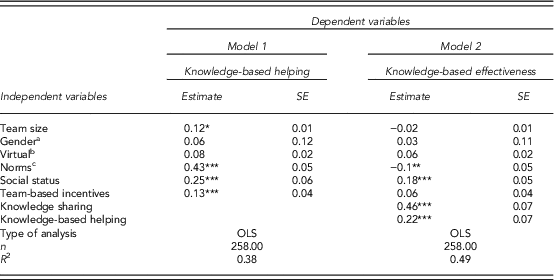
Findings were mostly consistent with the proposed hypothesis (refer to Table 10). Model 1 (R 2=0.38; df=252; F=27.47; p<.001) tested effects of predictors on knowledge-based proactive helping. All of the control variables except team size were found nonsignificant. Climate and incentive were found to be statistically significant at p<.001, thus supporting the Hypotheses 1 and 2. Status was found to be statistically significant at p<.001, thus establishing Hypothesis 3. Model 2 tested effects of knowledge-based proactive helping and knowledge sharing on knowledge effectiveness. Model 2 included knowledge sharing and knowledge-based proactive helping over and above all of the predictor variables of Model 1. Thus, Model (R 2=0.49; df=249; F=31.20; p<.001) ascertained the effect of knowledge-based proactive helping on knowledge effectiveness over and above the effect of all variables of Model 1. Knowledge sharing was found to be significant at p<.001, supporting Hypothesis 4. Knowledge-based proactive helping was found to be significant at p<.001, over and above knowledge sharing, thus lending support to Hypothesis 5. This analysis established the strong predictive validity of the knowledge-based proactive helping variable over and above other existing predictors.
Study 2: hierarchal linear regression (n=258)

Note. OLS=ordinary least square.
a Gender: 1=male, 0=female.
b Virtual: number of geographically dispersed team members.
c Norms: team norms of exchange.
*p<.05; **p<.01; ***p<.001.
DISCUSSION
Summary of findings
The inadequate attention to rules and norms of helping in the exchange of knowledge resources, and the existing gap in the literature of knowledge sharing and helping, set the context for the present study. We attempted to answer the research question about who helps others through the use of knowledge resources and, consequently, to develop and validate a knowledge-based proactive helping scale based on two literatures – that of helping and that of proactive behaviours.
In this study, a composite measure of helping was developed in the context of knowledge workers. ‘knowledge-based proactive helping’ was defined in such a way as to highlight the importance of knowledge in helping, which includes overall professional development and problem mitigation aspects of helping. The researchers identified five dimensions of knowledge-based proactive helping from the literature and developed a composite scale of 21 items. The scale’s items were checked for reliability and validity and based on the results of these checks, a shortened, 12-item scale having two dimensions – professional development’ and ‘problem mitigation’ – was found to be robust. Furthermore, hypotheses for a nomological network with antecedents as ‘team norms’, ‘social status’, and ‘incentives’ were found to be significant; a hypothesis for the nomological network with consequences as ‘knowledge effectiveness’ was also found to be significant.
Theoretical implications
The present study has important implications for literature on helping and proactive behaviours. Prior studies considered acts of helping as task-based and generic concept measured on a one-dimensional scale (Van Dyne, Kamdar, & Joireman, Reference Van Dyne, Kamdar and Joireman2008; Huang, Hsieh, & He, Reference Huang, Hsieh and He2014). Through an extensive review of the literature on helping and proactive behaviours, the present study identifies five dimensions of helping that elicit proactive behaviours. Dimensions are taken from helping literature based on their possible linkages from the literature on proactive behaviours. In fact, our paper is the first one to derive these linkages. By forming these linkages, the present study is able to form conceptual framework of proactive helping. More specifically, this study develops the conceptual framework of knowledge-based proactive helping that was missing in both the knowledge exchange and helping literature.
Going further, the paper substantially modifies/reformulates the original scale items of dimensions to include the proactive perspective of helping, thus forming the scale items to represent the common underlying construct of proactive helping. Original scale items only had the aspects of helping behaviours; it was only the modified scale items which suitably included the common theme of proactive helping. The construct of proactive helping scale is manifested in the scale items effectively, to the extent that five dimensions merged to form two factors: professional development and problem mitigation. Helping team members in their ‘Professional development’ is a proactive approach as it involves self-initiated actions (Higgins & Krams, Reference Higgins and Kram2001) that include proactively identifying and catering to the overall task and skill-based development of team members. Similarly, ‘problem mitigation’ is a forward-thinking approach that provides proactive support for uncertain situations and difficult problems (Parker, Williams, & Turner, Reference Parker, Williams and Turner2006). Both the factors allude closely with proactive orientation in helping behaviours; whereas original scale items were having generic aspects of helping. Subsequent analysis found that both the factors represent the same underlying construct of proactive helping. Therefore, a single parameter of ‘proactive helping’ was finally used in the study.
Both how proactive helping takes place have important implications for helping literature. Traditionally, helping is being viewed as task-based generic helping where parties helping each other view it as past obligation or future expectation (Spitzmuller & Van Dyne, Reference Spitzmuller and Van Dyne2013). Most of the researchers considered that the helper views an inherent cost in the helping activity. However, Grant (Reference Grant2008) in their conceptual framework on relational work design and prosocial behaviour highlighted the importance of perceived impact on beneficiary as motivation to make prosocial attempts. Our findings suggest that helping in the form of professional development and problem mitigation provides interesting and worthy avenues for knowledge workers to go beyond the immediate nature of exchanges based on quid pro quo. It is likely that these ways of helping provide avenues for self and others growth and therefore individual may consider it as an opportunity for making a larger impact for self and others growth. This is therefore in line with the relational design of prosocial work (Grant, Reference Grant2008) where helping if viewed as more complete and having a larger impact may have cost-less and voluntary motives. This is in contrast to helping in routine tasks because of the nature of the task being mundane and having limited impact on self and others. Therefore, the helper attaches a greater cost to it.
DeRue, Barnes, and Morgeson (Reference DeRue, Barnes and Morgeson2010) in their review on team leadership suggested that team leadership function not only require prosocial orientation of the members, but they also need to be preemptive in their approach towards team needs. The findings of the present study suggest that proactive helping has a unique outcome in the form of team leadership. This relationship suggests that team leadership functions require members to be sensitive towards the team needs in proactively identifying and catering to them. Therefore, our findings are in line with DeRue, Barnes, and Morgeson (Reference DeRue, Barnes and Morgeson2010) suggestions.
Further, the present study has important implications for the literature on collective learning. Bunderson and Reagans (Reference Bunderson and Reagans2011) in their review on collective learning suggested that knowledge transfers having forward-looking social orientations are important for collective learning to take place. Our findings that proactive helping is positively associated with team learning suggests that collective learning happens through social exchanges that involve proactively identifying and catering to the overall development of team members and mitigating their problems. Therefore, our findings confirm the view of Bunderson and Reagans (Reference Bunderson and Reagans2011).
Further, through the proposed nomological network, we were able to establish the predictive validity of proactive helping. The finding of the current study that ‘knowledge-based proactive helping’ predicts knowledge-based effectiveness over and above knowledge sharing has important theoretical implications for the knowledge exchange literature. Team leadership and team learning functions can be effectively carried out either involuntarily through the expectations and obligations of reciprocity (knowledge sharing) or voluntarily through proactive orientations (proactive helping) (Spitzmuller & Van Dyne, Reference Spitzmuller and Van Dyne2013). The past literature has been almost unilaterally dominated by the reactive form of knowledge exchange (knowledge sharing) (Spitzmuller & Van Dyne, Reference Spitzmuller and Van Dyne2013), neglecting other aspects of knowledge exchanges and social exchanges in general (Cropanzano & Mitchell, Reference Cropanzano and Mitchell2005). Our findings suggest a complementary role for both types of knowledge exchanges.
Over the last decade, many knowledge researchers adopted interpretivists’ approach by defining knowledge exchanges within knowledge-based social spaces (e.g., Chia & Holt, Reference Chia and Holt2008; Nicolini, Reference Nicolini2009). They assumed that knowledge is complex and tacit, lying within individuals who voluntarily share knowledge and help others (Nicolini, Reference Nicolini2011). On the other hand school rationalists assumptions considered knowledge exchanges solely based upon expectation or obligation of reciprocity. Our findings suggest complementary effects of both the view-points. Important functions in the form of team learning and team leadership are carried through both the motives of reciprocity and voluntarily in social exchanges.
Lastly, we could not find empirical support for the ‘constructive suggestions and corrections’ dimension. This dimension is mainly defined in the literature as feedback given in work settings and is closely alluded with proactive behaviours (Frese & Fay, Reference Frese and Fay2001; Parker, Bindl, & Strauss, Reference Parker, Bindl and Strauss2010). The past literature on proactive behaviours suggests that feedback could be rendered more or less proactively. Feedback as part of the ongoing regular task is considered to be passive in nature whereas feedback associated with developmental aspects is considered to be proactive and extra-role in the literature (Frese & Fay, Reference Frese and Fay2001; Parker, Bindl, & Strauss, Reference Parker, Bindl and Strauss2010). The lack of empirical support for this dimension may be partly due to participant’s consideration of some of the subscale items as a feedback activity that is regular and passive. However, given the theoretical importance of feedback in proactive helping, it may be worthwhile to keep this dimension as part of the overall scale.
Practical implications
The practitioner-based contributions lie in the context of the study, which is a knowledge-based production team. Understanding knowledge sharing in this context has important practical contributions about the motivational aspects of knowledge exchanges, which may not always be transactional. This research highlights that knowledge exchange behaviours in this context are also voluntary; therefore, they require the right mix of governance or incentive structures. The present study enhances our understanding of the nuances of knowledge-based exchanges in the context of knowledge workers by highlighting different motives of exchange.
The findings of the present study have important implications for the managerial role in the team. Our findings indicate that managers should not only focus on the promotion of knowledge sharing (which is mainly self-oriented and based upon the motive of reciprocity) in the team but also duly recognize the importance of proactive helping (which is mainly others-oriented and based upon the motive of altruism). The relational architecture of work suggests that when helping is perceived to be having significant benefit for self and others, the frame of helper changes from cost in helping to the benefit of helping. Therefore, manager and team members should recognize and reward prosocial activities so that team could foresee the importance of such activities. Further, findings indicate that in any relationship (formed out of series of exchanges) both the types of social exchanges complement each other. It becomes an important managerial function to foster both the types in an optimum mix to get the best out of them. The manager should duly recognize and reward others-oriented efforts of employees in the form of professional development of team. Focussing entirely on the promotion of reactive motives may ultimately create bottle-necks in the team functioning.
Further, knowledge-based effectiveness outcomes, team learning, and team leadership, are found to be driven by knowledge-based social exchanges in the team. This becomes more relevant in knowledge-based organizations having flatter structures and autonomous work teams. In case of traditional organizations having a hierarchal structure, functions of team learning, and team leadership are traditionally assigned to a formal leader. But in case of the former, these functions require team members to engage actively in knowledge-based social exchanges for team learning and team leadership to take place. As noted, it is the complementary nature of reciprocity and altruism that is responsible for team effectiveness outcomes of team learning and team leadership.
Limitations and future scope
The context of the study itself imposed limitations of scope. The assumptions are valid in their specific contexts as specified in the remainder of the study. Therefore, theoretical results of the study are largely valid only in the context of knowledge-based production teams and cannot be generalized to other types of teams. Although convenience samples were used to provide evidence of construct validity, the emergence of similar results across studies reduces concerns about limited generalizability. Nevertheless, we recognize that construct validity is never accomplished in a single study and that future research is needed to replicate results across other samples, organizations, work contexts, and study designs.
The study does not aim to introduce knowledge-based proactive helping as a new construct; rather, the prefix ‘knowledge’ highlights the role of knowledge resources in various helping activities in the context of knowledge workers. The present study aims to develop a composite measure of ‘knowledge-based proactive helping’, but as is the case with any composite measure, there always remains a possibility of leaving out some relevant dimensions of the construct. This possibility raises a concern about content validity.
The future scope of the present research includes examining the differential effect of knowledge-based social exchanges on real, virtual, and mixed teams. The literatures on social identity theory and SET clearly propose that differences exist in these three types of team settings in terms of identification and exchanges. Therefore, further studies in these settings may reveal useful findings.
Culture influence the way knowledge as a resource is viewed and exchanged. It is observed by Perlow and Weeks (Reference Perlow and Weeks2002) that Americans (knowledge workers) as individualists differ from Indian (knowledge workers) as collectivists in the way helping is viewed and practiced. They argue that helping is viewed as an unwanted interruption in an individualist society. However, it is considered to be a desirable opportunity for development in a collectivist society. Therefore, Indian culture renders a unique opportunity for looking at knowledge exchanges from proactive helping perspectives that may differ from the concept of Western societies, which focus more on reactive sharing. Future research may explore this phenomenon of proactive helping in Western culture and look for similarities and differences.
Acknowledgements
The author is highly thankful to the editors and anonymous reviewers for their constructive comments and feedback.
Declaration
The authors state that the manuscript is an original work and it has not been submitted to nor published anywhere else. The authors did not receive any financial assistance for conducting this research. Data were collected from private enterprises. However, the authors have disguised the name of the companies for maintaining the confidentiality. The authors have approved the paper and met the criteria for authorship as suggested by this esteemed journal.
Appendix A: Knowledge-Based Proactive Helping
I. Training and development/deficiency
1. I help team members further develop their skills
2. I help the team learn from past events or experiences
3. I help team members who are lacking in requisite skills
4. I train the team members to develop their skills
II. Difficult/ambiguous situation
5. I advise team members when the situation is new for them
6. I offer inputs to team members in understanding unfamiliar situations
7. I guide team members when they are not sure what to do in the situation
8. I guide team members when they face difficult situation in the work
III. Problem solving
9. I talk through problems at work, helping to come up with solution
10. I help team members develop solutions to constraining problems
11. I assist team members in devising the solution to the problems at hand
12. I don’t help team members when they are faced with difficult problems
IV. Task coaching/mentoring
13. I help team members learn how to do the work
14. I guide team members on more efficient way to complete the tasks
15. I teach team members how to prioritize responsibilities
16. I give tips to team members on easier ways of accomplishing tasks
17. I educate team members on the best way to complete the work
V. Constructive suggestions and correction
18. I help team members to identify and correct mistakes by calling attention to errors and omissions
19. I give suggestions to team members on improving their work and skills
20. I give constructive feedback to team members on the issues with their work
21. I refrain myself in making team members aware of their mistakes
Appendix B: Knowledge-Based Effectiveness: Team learning (Gray & Meister, Reference Gray and Meister2004) and Team Leadership (Morgeson et al., Reference Morgeson, DeRue and Karam2010)
1. ‘Contribution in team learning’ is defined as the individual team member’s contribution in the overall task and skill-based learning of the team during formal and informal interactions in the team. Observable contributions could be enhancing team member’s ability to replicate, adapt or innovate. Rate each of your team members on ‘contribution in team learning on 1–5 scale; 1 being highly ineffective and 5 being highly effective.
2. ‘Team leadership’ is defined as the responsibility assumed by a team member, who is not the supervisor or formal team leader/manager, of satisfying team’s needs in the service of enhancing team effectiveness. Observable behaviours could be acting as an informal mentor or coach for the team members. Rate each of your team members on ‘team leadership’ on 1–5 scale; 1 being highly ineffective and 5 being highly effective.
About the authors
Shashank Mittal is affiliated with Indian Institute of Management Raipur in the field of OB and HRM. He has over 5 years of work experience.
Atri Sengupta is affiliated with Indian Institute of Management Raipur as Assistant Professor in the field of OB and HRM. She has over 15 years work experience. She received her PhD from Indian Institute of Technology, Kharagpur. She has authored two books and several book chapters. She has also published articles in national and international journals of repute.
NM Agrawal is affiliated with Indian Institute of Bangalore as Adjunct Professor in the field of OB and HRM. He has more than 30 years of work experience. He has published articles in national and international journals.
Sumeet Gupta is affiliated with IIM Raipur, India. He obtained his PhD (Information Systems) from School of Computing, National University of Singapore, Singapore; and MBA from NUS Business School, National University of Singapore. He has a total experience of 12 years including 4 years with Indian Institute of Management Raipur. He has published more than 90 papers in top-rated International Journals and conferences. He is also a reviewer for many top-ranked International Journals in Information Systems.