Introduction
Obesity negatively impacts reproductive function in women by increasing the incidence of complications such as polycystic ovarian syndrome, anovulatory cycles, and irregular menses, reduced embryo implantation success and impairs fetal development. Reference Silvestris, de Pergola, Rosania and Loverro1 In addition, obesity in women is linked to an increase in the prevalence of obstetric risks such as gestational diabetes, hypertension, preeclampsia, and neonatal mortality. Reference Scott-Pillai, Spence, Cardwell, Hunter and Holmes2,Reference Khan, Rahman and Shariff3 Obesity also programs changes in the growth and metabolism of the fetus, which predisposes descendants to the development of obesity and other chronic noncommunicable diseases in adulthood, including nonalcoholic fatty liver disease (NAFLD). Reference Dahlhoff, Pfister and Blutke4-Reference Lomas-Soria, Reyes-Castro and Rodriguez-Gonzalez8
Increased adiposity in obesity progresses to the deposition of ectopic fat, especially in the liver, which results in NAFLD. This disease comprises a spectrum of hepatic histopathological changes ranging from simple steatosis to nonalcoholic steatohepatitis, which may progress to cirrhosis and eventually to hepatocarcinoma. Reference Contos, Choudhury, Mills and Sanyal9 Approximately 50% of the overweight population worldwide has NAFLD, and the disease is linked to liver-related morbidity or mortality, as well as predisposition to type 2 diabetes and cardiovascular disease. Reference Younossi, Koenig and Abdelatif10 The augmented hepatic triglyceride’s (TG) content may occur due to serum-free fatty acids (FAs) generated from adipose tissue lipolysis, excess of FA supply to the hepatocytes from the diet, enhanced hepatic de novo lipogenesis, impaired mitochondrial β-oxidation, reduced clearance of very low density lipoprotein (VLDL) particles, or a combination of these factors. Reference Donnelly, Smith and Schwarzenberg11-Reference Berlanga, Guiu-Jurado, Porras and Auguet14 Among the several experimental models used to investigate obesity and NAFLD physiopathology, the Western diet (WD) model stands out because it induces in rodents various features of the human obesity, such as hyperphagia, augmentation of adiposity, accumulation of ectopic fat, hyperglycemia, hyperinsulinemia, dyslipidemia, and insulin resistance. Reference Sampey, Vanhoose and Winfield15,Reference Balbo, Ribeiro and Mendes16
Bariatric procedures are the most effective treatment for morbid obesity, providing improvement and/or resolution of its associated comorbidities. Reference Gloy, Briel and Bhatt17,Reference Cheng, Gao, Shuai, Wang and Tao18 In addition to the benefits of bariatric operations on neural circuitries and circulating molecules, there is evidence to indicate that bile acids (BAs) play an important role in the metabolic amelioration induced by these procedures. Reference Browning, Pessoa, Khoraki and Campos19 However, the influence of bariatric surgery on the metabolism of females during gestation and lactation or/and the effects of the bariatric procedures on the metabolic health of offspring are still poorly documented. Reference Cummings, Graham, Stanhope, Chouinard and Havel20-Reference Pietrobon, Bertasso and Ribeiro22 This is a worrying phenomenon as most bariatric operations are performed in women of childbearing age. Reference Edison, Whyte and van Vlymen23 Although these operations have been reported to improve fertility, they lead to nutritional deficiencies that may be harmful to offspring and yield an increased risk of congenital abnormalities. Reference Edison, Whyte and van Vlymen23,Reference Soares, Lobel, Ejzenberg, Serafini and Baracat24 The Roux-en-Y gastric bypass (RYGB) is one of the most commonly performed bariatric techniques; however, there have been few studies regarding the effects of RYGB on the metabolism of mothers during or after pregnancy and lactation, and repercussions of these alterations in their children. Reference Gonzalez, Lecube, Rubio and Garcia-Luna25,Reference Machado, Pereira, Saboya, Saunders and Ramalho26
In this way, here we hypothesize that pregnancy and lactation after RYGB procedure could impair hepatic lipid metabolism of the mothers, since these periods comprise various modifications in lipid storage and mobilization to support maternal energy demand and milk production. In addition, the changes in lipid homeostasis in the mothers would lead to changes in hepatic lipid metabolism in their F1 offspring, increasing the risk to NAFLD in adulthood.
Thus, we evaluated the liver morphofunction after pregnancy and lactation in female WD-obese rats that previously underwent RYGB surgery. In addition, we also analyze hepatic morphology and lipid metabolism in the adult F1 offspring of these dams.
Experimental methods
Maternal (F0) rat groups and obtainment of first generation (F1) offspring
All experimental procedures are in accordance with the Ethical Principles for Animal Research established by the National Council for the Control of Animal Experimentation (CONCEA) and were approved by the Institutional Committee for Ethics in Animal Experimentation at UNIOESTE (CEUA/UNIOESTE) in 13/02/2015. From 21 to 130 days of age, 34 female Wistar rats were submitted to a WD. The WD consisted of standard chow (Biobase, BRA), Italian salami (Sadia, BRA), mini bread rolls (Nutrella, BRA), Cheetos balls snack (Cheetos, Pepsico, BRA), marshmallow (Fini, BRA), mixed sausage (Sadia, BRA), chocolate cake (Renata, Selmi, BRA), cookie cornstarch (Zadimel, BRA), mortadella (Frimesa, BRA), bacon snack (Troféu, Santa Helena, BRA), chocolate wafer biscuits (Bauducco, BRA), and 350 ml of degassed beverages (Coca-Cola, BRA or Guarana Antarctica, BRA) containing 49% carbohydrate, 24% lipids, and 22% proteins totalizing 5.4 Kcal/g. Reference Balbo, Ribeiro and Mendes16,Reference Pietrobon, Bertasso and Ribeiro22 During the entire experimental period, the rats were maintained under a 12-h light/dark period (lights on 06:00–18:00) and controlled temperature (22 ± 2 ºC). As represented in Fig. 1, WD rats with 130 days of age were randomly submitted to RYGB (WD-RYGB-F0, n = 20) or SHAM (WD-SHAM-F0, n = 14) operations, according to our previous description. Reference Pietrobon, Bertasso and Ribeiro22 Briefly, the rats were fasting for 12–16 h, anesthetized with 1% isoflurane (Isoforine®, Cristalia, SP, BRA) and were submitted to nasotracheal intubation, under a 1 L/min O2 supply and spontaneous ventilation. To RYGB operation, the stomach was divided forming a gastric pouch of ˜ 5% of total organ volume and a large distal portion was physically separated from the pouch, which remained connected to the duodenum. The jejunum was interrupted 10 cm after the ligament of Treitz. The distal limb of the jejunum was connected to the gastric pouch and the proximal limb of the jejunum was reconnected downward at 15 cm from the gastrojejunostomy. To SHAM operation, the stomach and the abdominal cavity were exposed, and the small intestine was massaged with the aid of a sterile scalpel handle followed by abdomen suture.
Schematic representation of the F0 and F1 groups.
Obesity was induced by the ingestion of a WD from 21 to 130 days of age in female Wistar rats. Subsequently, WD females were randomly submitted to RYGB (WD-RYGB-F0) and SHAM (WD-SHAM-F0) operations. At 5 weeks (wk) after these procedures, both female groups were mated with male control breeders. The WD consumption continued through pregnancy and the lactation period in the WD-RYGB-F0 and WD-SHAM-F0 rat dams. WD-RYGB-F1 and WD-SHAM-F1 male and female offspring were weaned at 30 days of age and consumed standard rodent chow and filtered water until 120 days of age.

At five weeks after the RYGB or SHAM operations, the female rats were placed in cages with sexually active lean control adult male rats (2 females/1 male) for 3 weeks, only during the dark period (06:00 pm–06:00 am), returning to the WD during the light period (06:00 am–06:00 pm). Male breeders only consumed standard rodent chow (BioBase, Águas Frias, SC, BRA) consisting of 3.8 kcal/g (70% carbohydrate, 20% protein, and 10% fat) and filtered water.
Due to problems in obtaining the F1 offspring (as recently reported by Pietrobon et al. Reference Pietrobon, Bertasso and Ribeiro22 ), the F1 rats used in this study were obtained from just 7 WD-SHAM-F0 and 5 WD-RYGB-F0 dams. Male and female F1 offspring were designated, according to the operative procedure of their mothers as WD-SHAM-F1 or WD-RYGB-F1 and were maintained from 30 to 120 days of age in collective cages with free access to standard rodent chow (BioBase, Águas Frias, SC, BRA) and filtered water. All experimental procedures in the F0 groups were performed one week after the end of the lactation period and in the F1 groups at 120 days of age. To serum parameters analysis, hepatic fat content, liver weight, and histomorphology we randomly chosen 1–2 male and female rats of F1, while gene or protein expression analyzes were performed in the liver of only one male or female F1 rat (also randomly chosen) from each WD-SHAM-F0 and WD-RYGB-F0 litter.
Statistics
Results are presented as means ± SEM for the number of rats indicated in the figure legends. Data were analyzed by Kolmogorov-Smirnov distribution normality test and compared with parametric (Student’s t test) or nonparametric (Mann-Whitney U-test) unpaired tests (p < 0.05), separately, considering the effect of programming on the male and female F1 groups, using GraphPad Prism Software© version 6.00 for Windows (San Diego, CA, USA).
The detailed procedures regarding the measurements performed are provided in Supplementary Information.
Results
Maternal (F0) hepatic morphofunction and lipid profile after the lactation period
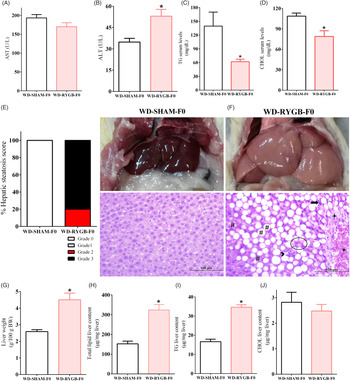
As recently reported by our laboratory, Reference Pietrobon, Bertasso and Ribeiro22 after the lactation period, WD-RYGB-F0 dams exhibited reduction in body weight and various features that indicated increased peripheral lipolysis, which contributed to depletion of the retroperitoneal and perigonadal fat pads, an effect that would increase the FA supply to the liver contributing to hepatic injury and steatosis. In fact, as can be observed in Fig. 2, at 1 week after the end of the lactation period, WD-RYGB-F0 females exhibited some signs of liver injury, since at least the serum ALT levels were 52% higher l (Fig. 2B) than that observed for WD-SHAM-F0 dams (p = 0.01). Notably, WD-RYGB-F0 displayed reductions of 56% and 27% in serum TG and CHOL concentrations, respectively, in comparison with the WD-SHAM-F0 group (p < 0.05 and p < 0.02; Fig. 2C and 2D).
Maternal RYGB leads to hepatic macrovesicular steatosis in WD female rats after pregnancy and lactation.
Means ± SEM of AST (A), ALT (B), and serum TG (C) and total CHOL (D) concentrations in WD-SHAM-F0 (n = 7) and WD-RYGB-F0 (n = 5) female rats at one week after the end of the lactation period. Percentage hepatic steatosis score (E) and representative images of macroscopical and microscopical analyses of the livers from WD-SHAM-F0 (n = 7) and WD-RYGB-F0 (n = 5) dams. Liver sections were stained with hematoxylin and eosin. Hash : examples of macrovesicular steatosis, in all hepatocytes, fat inclusions displaced nucleus to the periphery; Asterisks : hyperemia; Star : perivascular fibrosis; Arrow : hepatocytes in apoptosis; within circle : hepatocytes in necrosis (loss of its cytological characteristics, accompanied by hemorrhage and infiltration of inflammatory cells); Arrow head : clusters of inflammatory cells. Scale bars = 100 μm. Means ± SEM of liver weight (G), total lipid (H), TG (I) and total CHOL (J) contents in the liver of WD-SHAM-F0 (n = 7) and WD-RYGB-F0 (n = 5) dams. *p < 0.05 vs WD-SHAM-F0 group (Student’s t test).

WD-RYGB-F0 dams displayed hepatomegaly, as shown by an increase of 74% in liver weight (Fig. 2G), and by livers’ macroscopical appearance, which clearly showed organ enlargement (Fig. 2F), when compared with the liver of WD-SHAM-F0 (p < 0.001). The livers of the WD-RYGB-F0 dams also presented a yellowish aspect, which macroscopically characterizes hepatic steatosis (Fig. 2F). This condition was confirmed in histopathological analyses, which showed that the hepatocytes of the WD-RYGB-F0 dams exhibited displacement of the nucleus to the cell periphery and the presence of large cytosolic fat vacuoles (Fig. 2F). These analyses demonstrated that 80% and 20% of WD-RYGB-F0 dams displayed severe (grade 3) and moderate (grade 2), macrovesicular steatosis (Fig. 2E and 2F), respectively. Furthermore, the liver parenchyma of WD-RYGB-F0 dams exhibited hyperemia, perivascular fibrosis, clusters of inflammatory cells, and necrotic and apoptotic hepatocytes (Fig. 2F). Confirming the ectopic fat deposition in WD-RYGB-F0 livers, the hepatic total lipid and TG contents were 112% and 108% higher, respectively, than those observed for WD-SHAM-F0 livers (p < 0.0001; Fig. 2H and 2I). The hepatic CHOL content did not differ among the WD-RYGB-F0 and WD-SHAM-F0 groups (Fig. 2J). In contrast, the livers of WD-SHAM-F0 rats exhibited a brown-reddish color with no optical evidence of hepatic lipid alterations (Fig. 2F). Microscopical observation of the hepatocytes of WD-SHAM-F0 livers showed that these were arranged in rows, delimited by connective tissue, containing sinusoids capillaries. Furthermore, the WD-SHAM-F0 hepatocytes had homogenous cytoplasm without fat vacuoles, while the nucleus displayed a central position (Fig. 2F). Therefore, histopathological analyses demonstrated that WD-SHAM-F0 dams, after pregnancy and lactation, did not display any sign of hepatic steatosis (Fig. 2E).
Maternal (F0) expression of genes and proteins involved in hepatic lipid and glucose metabolism, and BA synthesis
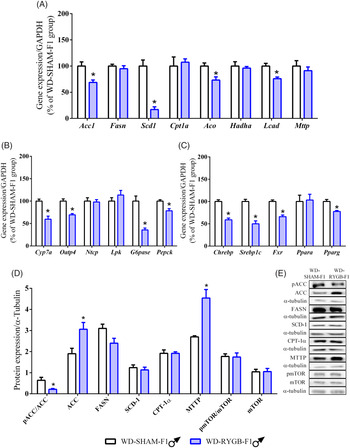
The mRNA levels of enzymes involved in de novo lipogenesis, such as Acc1 and Scd1, were reduced in the livers of WD-RYGB-F0 dams (p < 0.0001; Fig. 3A). In addition, the livers from WD-RYGB-F0 dams displayed downregulation of the gene expression of the β-oxidation enzymes, Cpt1a, Hadha, and Lcad (p < 0.001, p < 0.02 and p < 0.005, respectively; Fig. 3A) but upregulation of Aco mRNA (p < 0.02; Fig. 3A). WD-RYGB-F0 livers also exhibited reductions of 75%, 85%, 69%, and 193% in Cy7a, Oatp4, Ntcp, and G6pase mRNAs, respectively, when compared with the WD-SHAM-F0 rats (p < 0.003, p < 0.02, p < 0.0001, and p < 0.0001, respectively; Fig. 3B). Interestingly, all transcription factors involved in de novo lipogenesis, β-oxidation, and BA signaling that were evaluated were downregulated in WD-RYGB-F0 livers (p < 0.05; Fig. 3C).
Effect of maternal RYGB upon the expression of genes and proteins involved in lipid and glucose metabolisms, and in BA synthesis in WD female rats after pregnancy and lactation.
Means ± SEM of mRNA expression levels for enzymes involved in de novo lipogenesis and β-oxidation processes (A), bile acid synthesis and glucose metabolism (B) and for transcription factors and receptors (C) in the liver of WD-SHAM-F0 (n = 5) and WD-RYGB-F0 (n = 5) dams at one week after the end of the lactation period. Protein content (D) and representative Western blot bands for pACC/ACC, ACC, FASN, SCD-1, CPT-1α, MTTP, pmTOR/mTOR, and mTOR, in the liver of WD-SHAM-F0 (n = 5) and WD-RYGB-F0 (n = 5) dams at one week after the end of the lactation period. *p < 0.05 vs WD-SHAM-F0 group (Student’s t test).

Consistent with some of these hepatic mRNA alterations, the protein levels of the lipogenic enzymes, ACC, FASN, SCD-1, were reduced in the livers of WD-RYGB-F0 dams, when compared with WD-SHAM-F0 dams (p < 0.0001, p < 0.01, and p < 0.005, respectively; Fig. 3D and 3E). Furthermore, ACC, pACC, and MTTP hepatic protein levels were significantly lower in the WD-RYGB-F0 group (p < 0.01 and p < 0.04; Fig. 3D and 3E). However, the ratio of inactive/total ACC form (pACC/ACC) was not changed, indicating that active ACC content was similar between the groups. In contrast to the mRNA expression observed, the amount of CPT-1α protein in the liver of WD-RYGB-F0 dams was 114% higher than that observed in WD-SHAM-F0 livers (Fig. 3D and 3E).
It was recently demonstrated that RYGB improved hepatic steatosis in high-fat diet mice via activation of mTOR protein, phosphorylating the S6 ribosomal protein. This effect inhibits the Akt2 protein, resulting in activation of the Akt2-insulin-induced gene 2 (Insig2) and preventing SREBP-1c from leaving the endoplasmic reticulum and going to the Golgi for posttranslation modification, consequently reducing lipogenesis. Reference Pan, Qin and Gao27 However, no modifications in the amount of phosphorylated or in total mTOR content in the liver were observed in the groups (Fig. 3D).
Hepatic morphofunction and lipid profile in F1 offspring
Male and female WD-RYGB-F1 offspring did not display any modification in serum AST, ALT, and total CHOL concentrations when compared with their respective WD-SHAM-F1 groups (Fig. 4A, 4B and 4D). However, serum TG levels were reduced only in the male offspring of RYGB dams, compared to WD-SHAM-F1 rats (p < 0.05, Fig. 4C).
F1 offspring from WD-RYGB dams do not exhibit hepatic injury or steatosis in adulthood.
Means ± SEM of AST (A), ALT (B), and serum TG (C) and total CHOL (D) concentrations in male and female WD-SHAM-F1 (n = 13–10) and WD-RYGB-F1 (n = 9–10) at 120 days of age. Percentage hepatic steatosis score (E and F) and representative images of macroscopical and microscopical analyses of the livers from male and female WD-SHAM-F1 (n = 13–10) and WD-RYGB-F1 (n = 9–10) offspring G). Liver sections were stained with hematoxylin and eosin. Scale bars = 100 μm. Means ± SEM of liver weight (G), total lipid (H), TG (I) and total CHOL (J) contents in the livers of 120-day-old male and female WD-SHAM-F1 (n = 13–10) and WD-RYGB-F1 (n = 9–10) rats. *p < 0.05 vs the WD-SHAM-F1 group of the same gender (Student’s t test).

The liver weights did not differ between the offspring groups (Fig. 4H), and histopathological analyses demonstrated that male and female offspring of RYGB dams exhibited similar liver morphology to that of WD-SHAM-F1 offspring (Fig. 4G); hepatocytes were distributed in rows, delimited by connective tissue, and contained sinusoid capillaries. Additionally, the cells presented abundant cytoplasm without fat vacuoles, and the nucleus displayed a central position (Fig. 4G); as such, no steatosis and no differences in hepatic TG contents were observed in male or female WD-RYGB-F1 and WD-SHAM-F1 groups (Fig. 4E, 4F and 4I). In contrast, the hepatic CHOL content was reduced by 27% in just the male WD-RYGB-F1 group when compared with the male WD-SHAM-F1 group (Fig. 4J).
Expression of genes and proteins involved in hepatic lipid and glucose metabolism, and BA synthesis in F1 offspring
With regard to the hepatic expression of mRNA of the lipogenic enzymes, Acc1 and Scd1, a different profile was observed among WD-RYGB-F1 offspring, with a reduction in gene expression in males (p < 0.05; Fig. 5A) but an increase in females, when compared with their respective controls (p < 0.05; Fig. 6A). Gene expressions of Lcad and Aco were reduced in the livers of both male and female WD-RYGB-F1 (p < 0.05; Figs. 5A and 6A). Additionally, Cpt1a and Hadha mRNAs were also reduced, but only in the female WD-RYGB-F1 group, when compared with the WD-SHAM-F1 group (p < 0.02 and p < 0.01; Fig. 6A). Notably, the mRNA levels of proteins and enzymes involved in BA synthesis (Cyp7a and Oatp4) and gluconeogenesis (G6pase and Pepck) were downregulated in both male and female offspring from RYGB dams, when compared with their respective controls (p < 0.05; Figs. 5B and 6B). Furthermore, the expressions of the transcription factors, Chrebp and Pparg, and the receptor Fxr, were downregulated in both male and female WD-RYGB-F1 offspring (p < 0.05; Figs. 5C and 6C). However, Srebp1c gene displayed a reduced expression in male WD-RYGB-F1, but an increased expression in female WD-RYGB-F1 offspring (p < 0.05; Figs. 5C and 6C).
Male F1 offspring display a similar hepatic gene expression profile for lipogenic, BA synthesis and activity, and gluconeogenesis as that observed in the livers of WD-RYGB-F0 dams.
Means ± SEM of mRNA expression levels for enzymes involved in de novo lipogenesis and β-oxidation processes (A), BA synthesis and glucose metabolism (B) and for transcription factors and receptors (C) in the livers of male WD-SHAM-F1 (n = 5) and WD-RYGB-F1 (n = 6) offspring at 120 days of age. Protein content (D) and representative Western blot bands for pACC/ACC, ACC, FASN, SCD-1, CPT-1α, MTTP, pmTOR/mTOR, and mTOR in the livers of male WD-SHAM-F1 (n = 5) and WD-RYGB-F1 (n = 6) offspring. * p < 0.05 vs WD-SHAM-F1 group (Student’s t test).

Female F1 offspring exhibit upregulation of genes and proteins involved in de novo lipogenesis, but a similar downregulation of genes involved in BA physiology and gluconeogenesis to that observed for male F1 and WD-RYGB-F0 dams.
Means ± SEM of mRNA amounts for enzymes involved in de novo lipogenesis and β-oxidation processes (A), BA synthesis and glucose metabolism (B) and for transcription factors and receptors (C) in the livers of female WD-SHAM-F1 (n = 5) and WD-RYGB-F1 (n = 6) offspring at 120 days of age. Protein content (D) and representative western blotting bands (E) for pACC/ACC, ACC, FASN, SCD-1, CPT-1α, MTTP, pmTOR/mTOR, and mTOR in the liver of female WD-SHAM-F1 (n = 5) and WD-RYGB-F1 (n = 5) offspring. * p < 0.05 vs WD-SHAM-F1 group (Student’s t test).

Hepatic protein content of lipogenic enzymes in male WD-RYGB-F1 differed significantly from the gene expressions of these proteins. The expression of ACC and MTTP proteins was higher in the livers of male WD-RYGB-F1, while the hepatic content of the ratio of pACC/ACC was reduced when compared with male WD-SHAM-F1 (p < 0.05; p < 0.01 and p < 0.03; Fig. 5D and 5E). Such data indicate that possibly ACC enzyme was more active in the liver of male WD-RYGB-F1 rats. On the other hand, the livers of female WD-RYGB-F1 offspring exhibited increased protein contents of FASN and SCD-1 (p < 0.01 and p < 0.02; Fig. 6D and 6E), without changes in pACC/ACC or ACC protein amounts. However, the hepatic MTTP content was 48% lower in female WD-RYGB-F1 when compared to female WD-SHAM-F1 offspring (p < 0.005; Fig. 6D and 6E). Additionally, the hepatic protein amounts of the ratio of pmTOR/mTOR or mTOR were reduced only in female WD-RYGB-F1 offspring, when compared to WD-SHAM-F1 offspring (p < 0.005 and p < 0.001; Fig. 6D and 6E).
Discussion
RYGB reduces BW and adiposity in both humans and experimental rodents; Reference Pietrobon, Bertasso and Ribeiro22,Reference Mathes, Letourneau, Blonde, le Roux and Spector28 recently, we demonstrated that female rats that had previously undergone RYGB surgery exhibited, after pregnancy and lactation, reductions in BW and abdominal adiposity even when consuming a WD. Reference Pietrobon, Bertasso and Ribeiro22 However, herein demonstrated that the liver of WD-RYGB-F0 rat dams exhibited severe impairments in lipid metabolism, since macroscopic and microscopic analyses demonstrated aggravation of NAFLD in these rodents (Fig. 2). In contrast, the serum lipid profile of the WD-RYGB-F0 group was significantly reduced (Fig. 2), which is in accordance with other studies reporting that RYGB surgery improves dyslipidemia in humans Reference Carswell, Belgaumkar, Amiel and Patel29 and obese rodents, Reference Pan, Qin and Gao27,Reference Flynn, Albaugh and Cai30 an effect that involves reductions in intestinal CHOL absorption and hepatic de novo CHOL synthesis by this operation. Reference Pihlajamäki, Grönlund and Simonen31 Therefore, our results suggest which at least after pregnancy, the evaluation of plasma lipid profile can lead to confounding outcomes whether this bariatric procedure would cause improvements in lipid metabolism. Notably, WD-RYGB-F0 dams exhibited chronic signs of aggravated liver injury as higher serum ALT levels, hepatomegaly, macrovesicular steatosis, clusters of inflammatory cells, hyperemia, fibrosis, and necrotic and apoptotic hepatocytes. As such, some of our observations differ from those of other studies that demonstrate that RYGB surgery generally exerts benefits on NAFLD. Reference Pan, Qin and Gao27,Reference Kalinowski, Paluszkiewicz and Ziarkiewicz-Wroblewska32-Reference Silva-Morita, Ribeiro and Balbo34 But it is important to emphasize that the literature also has evidences that RYGB not improved NAFLD in some patients, Reference Schwenger, Fischer, Jackson, Okrainec and Allard33 and also can cause liver failure in some individuals. Reference Kalinowski, Paluszkiewicz and Ziarkiewicz-Wroblewska32,Reference Mahawar, Parmar and Graham35
Interestingly, the severe hepatic steatosis in WD-RYGB-F0 dams was associated with a reduction in de novo lipogenesis and VLDL assembly, since the hepatic gene expressions of Acc1, Fasn, Scd1, Srebp1c, and Chrebp and liver protein contents of total ACC, FASN, SCD-1, and MTTP were significantly reduced. The severe steatosis of the WD-RYGB-F0 liver cannot be explained just by a reduction in VLDL assembly and export, even though this mechanism contributes to NAFLD. Reference Berlanga, Guiu-Jurado, Porras and Auguet14 Therefore, since 60% of the TG content in the liver comes from FAs derived from the lipolysis of the adipose tissue, Reference Donnelly, Smith and Schwarzenberg11 and WD-RYGB-F0 displayed significantly reduced abdominal adiposity after pregnancy and lactation, Reference Pietrobon, Bertasso and Ribeiro22 it is possible that the severe steatosis observed in these rats may be due in part to increased hepatic FA uptake from the circulation. Consistent with this observation, increased lipolysis was reported after RYGB in obese rats Reference Jacobsen, Bojsen-Moller and Dirksen36 and humans. Reference Verna and Berk37 Notably, an aggravation of NAFLD after bariatric procedures has been reported in patients who lose weight very quickly. Reference Verna and Berk37 It is possible that RYGB also changes the lipolytic profile of adipose tissue, which usually augments to support pregnancy and lactation in female rats. Reference Aitchison, Clegg and Vernon38,Reference Pujol, Proenza, Llado and Roca39 Such effects may contribute to the higher abdominal adipose tissue depletion observed in WD-RYGB-F0 dams, Reference Pietrobon, Bertasso and Ribeiro22 which may overload the liver with FAs, aggravating TG accumulation in this organ. In this way, further investigations are necessary to demonstrate serum FAs and adipokines levels as well as adipose tissue lipolysis in WD-RYGB-F0 dams to confirm this hypothesis. Remarkably, the pathological features of the liver indicated that these dams displayed an aggravation of NAFLD since increase in infiltrating inflammatory cells, necrosis, apoptosis, fibrosis, hyperemia in liver parenchyma was consistent with NASH stage instead of only a simple steatosis. Reference Bessone, Razori and Roma40
Furthermore, despite the reduction in the expression of genes (Ppara, Pparg, Cpt1a, Aco, Hadha, and Lcad) and proteins involved in the β-oxidation process; the increased CPT-1α protein content in the liver of the WD-RYGB-F0 group could be a compensatory tentative to reduce TG accumulation in this organ. But it is important to highlight that β-oxidation also leads to superoxide, hydrogen peroxide, and hydroxyl radical production (molecules collectively termed as reactive oxygen species, ROS). Reference Basaranoglu, Basaranoglu and Senturk41 Therefore, the increase in hepatic supply of FAs to β-oxidation can overload ROS concentrations in the hepatocytes of WD-RYGB-F0 dams, which, although not addressed here, could contribute to NAFLD and liver injury in these rodents.
Some studies have reported increased serum levels Reference Risstad, Kristinsson and Fagerland42 and reduced excretion Reference de Siqueira Cardinelli, Torrinhas and Sala43 of BAs after RYGB. Here, we observed a reduction in Cyp7a, Oatp4, Ntcp, and Fxr mRNAs in the livers of WD-RYGB-F0 dams. The downregulation of these genes is expected after bariatric operations due to the modifications in BA physiology. As described in a recent review (see Ref. Reference Gloy, Briel and Bhatt17 ), newly synthesized BAs and BAs returning to the hepatocytes activate the FXR, which decreases CYP7A expression, Reference Gardes, Chaput and Staempfli44 inhibiting de novo BA synthesis and promoting BA secretion to the bile. In parallel, FXR downregulates NTCP expression, decreasing hepatic BA reuptake. Simultaneously, BAs activate ileal FXR during their intestinal transit to stimulate fibroblast growth factor 19 (FGF19) secretion, which in the liver also inhibits CYP7A. Reference Browning, Pessoa, Khoraki and Campos19 In addition to these effects on BA synthesis, FXR regulates hepatic lipid and glucose metabolism, reducing hepatic de novo lipogenesis and gluconeogenesis, but increasing β-oxidation. Reference Jiao, Lu and Li45 However, after RYGB, FXR expression is reduced. Reference Flynn, Albaugh and Cai30 Therefore, further studies are necessary to investigate the modification in the BAs/FXR/FGF19 pathways after pregnancy and lactation to better understand the maintenance of some effects of the FXR pathway, such as reduced lipogenesis and G6pase genes, even though Fxr mRNA levels are reduced in WD rats that have undergone RYGB.
As we previously demonstrated, for male F1 offspring of WD-RYGB-F0 rat dams, Reference Pietrobon, Bertasso and Ribeiro22 female WD-RYGB-F1 offspring also displayed reduced BW, food intake, nasoanal lengths, but demonstrated a reduction only in retroperitoneal fat accumulation (Supplementary Fig. S1). Reduced birth weight, Reference Decker, Swain, Crowell and Scolapio46,Reference Blume, Machado and da Rosa47 as well other gestational complications such as preterm birth, neonatal hypocalcemia, rickets, and fetal mental retardation, can potentially damage offspring as the result of reductions in iron, vitamin B12, and folic acid absorption in pregnant women that have been submitted to RYGB. Reference Decker, Swain, Crowell and Scolapio46 Importantly, lower BW at birth is also observed in obese mothers with NAFLD during gestation. Reference Hagstrom, Hoijer and Ludvigsson48 Therefore, the reduction in biometric parameters in F1 offspring may be due to the combination of malabsorption and severe hepatic steatosis in WD rat dams that have undergone RYGB.
Interestingly, serum biochemical parameters and liver histopathology did not indicate dyslipidemia or hepatic steatosis in either female or male F1 WD-RYGB offspring. Remarkably, the male WD-RYGB-F1 group exhibited significantly lower TG concentrations in the serum and reduced CHOL content in the liver. These effects were associated with similar reductions in hepatic mRNAs for enzymes and transcription factors involved in de novo lipogenesis and β-oxidation in male WD-RYGB-F1 as those observed in the liver of WD-RYGB-F0 dams (mRNA data are summarized in Fig. 7). In contrast, the amount of pACC/ACC and MTTP proteins was lower and higher, respectively, in the livers of male WD-RYGB-F1 rats. Possibly, the augmentation of MTTP counteracts any increase in hepatic FA production, by assembling VLDL to increase TG export in these rodents. On the other hand, female F1 offspring from WD-RYGB-F0 dams displayed a different profile of mRNA expression to those of the WD-RYGB-F1 and WD-RYGB-F0 groups, showing elevation of all lipogenic genes (Srebp1c, Acc1, Fasn, Scd1) but reductions in all mRNAs of enzymes that participate in β-oxidation (Fig. 7). These data were associated with augmentations in hepatic FASN and SCD-1 protein contents, together with a reduction in MTTP, indicating that maternal RYGB in WD dams can lead to a more deleterious modification in the hepatic lipid metabolism of their female F1, predisposing them to an early onset of NAFLD development at adulthood. These data are new but are somewhat worrying since several studies have reported that maternal obesity has more harmful deleterious programming on the lipid metabolism of male offspring. Reference Dahlhoff, Pfister and Blutke4,Reference Wankhade, Zhong and Kang7,Reference Lomas-Soria, Reyes-Castro and Rodriguez-Gonzalez8 Therefore, this differential upregulation of lipogenic genes and proteins, in the livers of female F1 offspring of WD-RYGB-F0 dams, indicates that this bariatric procedure leads to intergenerational modifications, in contrast to previous reports. Further investigations are necessary to dissect the differences in the epigenome of the male and female F1 offspring of WD-RYGB dams that may contribute to these sex-dependent effects. However, the reductions in pmTOR/mTOR and total mTOR content in the livers of female WD-RYGB-F1, but not in male WD-RYGB-F1 rats, indicate that reduced mTOR-Akt2-insig-2 pathway signaling may contribute to the increase in de novo lipogenesis only in female offspring.
Venn diagram representing overlap and differential mRNA expression profiles of maternal (F0) and the offspring (F1) groups for genes involved in de novo lipogenesis, β-oxidation, BA synthesis and activity, and gluconeogenesis.
After pregnancy and lactation, WD female rats that had been previously submitted to RYGB exhibited severe hepatic steatosis. Conversely, male and female F1 offspring did not present modifications in liver morphology. In contrast, the livers of WD-RYGB-F0 rat dams displayed a similar downregulation profile, for mRNAs involved in BA physiology and gluconeogenesis, to those observed in the livers of male and female F1 offspring. In addition, RYGB induced a gender specific differential genetic expression of genes of the lipogenic pathway in F1, with increasing amounts of hepatic mRNAs for enzymes and transcription factors involved in de novo lipogenesis only in female F1 descendants. This effect was associated with a reduced activation of the mTOR protein, indicating a risk for early onset of NAFLD in female, but not male, WD-RYGB-F1 offspring.

Interestingly, except for the Ntcp gene, both male and female F1 offspring from WD-RYGB-F0 dams exhibited a similar downregulation profile for the Fxr, Cyp7a and Oatp4 genes. The literature lacks information about the intergenerational impact of bariatric operations on BA physiology. We speculate that the downregulation of these BA-related genes is due to the effects of liver steatosis, in WD-RYGB-F0 dams, on their offspring, as studies exist to indicate an enhancement in BA concentrations and the expression of genes involved in BA synthesis in the offspring of dams that have consumed obesogenic diets. Reference Wankhade, Zhong and Kang7,Reference Thompson, Derse and Ferey49 Additionally, another study demonstrated that the F1 offspring from high-fat diet mice dams exhibited reduced FXR in the kidney, in association with higher renal expression of inflammatory markers and enhanced Srebp1c gene expression. Reference Glastras, Wong and Chen50 Although these data were not reported in offspring of dams that had undergone RYGB, it is possible that the reduction in mRNAs involved in BA physiology, in the F1 offspring of WD-RYGB-F0 dams, also enhances the risk of development of liver injury and impairments in hepatic lipid and glucose metabolism in offspring.
Various evidences indicate that alterations in the epigenome are implicated in intergenerational transmission of risk factors to chronic diseases to offspring. Reference Guenard, Deshaies and Cianflone51-Reference Wankhade, Zhong and Kang53 Some mechanisms related to maternal programming are being well studied such as microRNA, histones acetylation, and methylation but the exact mechanisms involved remain unknown. Therefore, modifications in the molecular pathways of hepatic metabolism in WD-RYGB-F1 rats, demonstrated by our study, were possibly due to the epigenetic alterations that program these male and female rodents, leading to metabolic disruptions through life. Therefore, additional studies are necessary to define which epigenetic mechanisms were altered by RYGB, and if they are sex-dependent.
In summary, we demonstrated, for the first time, that female WD rats previously had undergone RYGB surgery present progression of simple hepatic steatosis to NASH after pregnancy and lactation. This effect was associated with a reduction in hepatic de novo lipogenesis and VLDL assembly in WD-RYGB-F0 dams. Interestingly, the increase in CPT-1α protein in the liver of these rodents indicates an attempt to decrease the elevated TG accumulation. In contrast, both male and female F1 offspring of these dams, on a normolipid diet, did not present any histopathologic features of hepatic steatosis. However, at the molecular level, female WD-RYGB-F1 rats presented reduced mTOR activation, which was associated with an upregulation of genes and proteins of the lipogenic pathway, indicating a risk for the early development of NAFLD in female, but not in male, WD-RYGB-F1 offspring.
Acknowledgments
We are grateful to the technician, Assis Roberto Escher, UNIOESTE, for animal care and undergraduate student, Gabriela Alves Bronczek, for help throughout the experiments.
Financial support
This study forms part of the M.Sc. Thesis of Iala Milene Bertasso and was supported by grants from Fundação Araucária (convênio: 155/2013), CNPq (Processo nº447190/2014-8), Coordenação de Aperfeiçoamento de Pessoal de Nível Superior (CAPES, PROAP, number 001), and Fundação de Amparo à Pesquisa do Estado de São Paulo (FAPESP, 2015/12611-0).
Conflict of interest
The authors report no conflicts of interest.
Ethical standards
All procedures contributing to this work comply with the Ethical Principles for Animal Research established by the National Council for the Control of Animal Experimentation (CONCEA) and were approved by the Institutional Committee for Ethics in Animal Experimentation at UNIOESTE (CEUA/UNIOESTE) in 13/02/2015.
Supplementary material
To view supplementary material for this article, please visit https://doi.org/10.1017/S2040174421000271