Introduction
In 1979 Antonovsky developed the term “salutogenesis,” a neologism, derived from the Latin “salus,” which means health and the Greek “genesis,” which means origin (Antonovsky, Reference Antonovsky1979). His intention was to develop a new medical concept, which stresses the development and preservation of health and well-being, in marked contrast to the biomedical term of pathogenesis. The central justification for this concept was to develop a theoretical formulation, the Sense of Coherence (SOC). The SOC is a global orientation that expresses the extent to which a person has a pervasive and an enduring feeling of confidence that the internal and external environment is predictable and that there is a high probability that things will work out as well as can reasonably be expected. Antonovsky postulated that there were three important components, which determine whether a person can or cannot cope with a situation. First, the understanding of the cause for a certain situation, the comprehension, second the extent of the possibility to manage the situation, the manageability, and third the ability to find meaning in the situation, the meaningfulness. The SOC scale was developed to ascertain these three components (Antonovsky, Reference Antonovsky1993; Schumacher et al., Reference Schumacher, Wilz, Gunzelmann and Brähler2000).
According to Antonovsky (Antonovsky, Reference Antonovsky1987), the SOC develops during childhood and adolescence and is influenced by social and environmental factors, by internal and external changes, assimilation, and accommodation. The strength of coherence is defined as a balance between stress and relaxation during life. Antonovsky postulated the SOC concept as a dispositional orientation rather than a personality trait or a coping strategy. It reflects the personal capacity to respond to stressful situations. Experiences of trauma or stress over a long period of time can lead to disturbances, which then require intervention and stabilization. There are some discussions as to differences in SOC at different stages of life (Bengel et al., Reference Bengel, Strittmatter and Willman1999). Differing opinions exist especially concerning SOC in elderly people. Some postulate a decrease of SOC because of increased risk of chronic illness and the decrease of manageability of their life. Others state the opposite opinion. The SOC would increase over the years due to the experience of life events (Gunzelmann et al., Reference Gunzelmann, Schumacher and Brähler2000).
The concept of SOC also plays an important role in coping with chronic disease, a situation which can be seen as permanent stress. Patients need to know what kind of illness is responsible for their situation, they should be able to estimate how they can manage their disease, and they have to find some motivation in order to fight it or learn how to cope with it (Wiesmann et al., Reference Wiesmann, Wendlandt and Hannich2004). The role of SOC has been researched in patients suffering from rheumatism, cancer patients, and patients with psychiatric disorders (Nilsson et al., Reference Nilsson, Axelsson, Gustafson, Lundman and Norberg2001; Bengtsson-Tops et al., Reference Bengtsson-Tops, Brunt and Rask2005). In these studies, the authors agree that the SOC shows a strong correlation with psychological factors like depression and a weak or no correlation with movement restrictions.
In a recent study, elderly hospital-treated suicide attempters were rated with the SOC questionnaire and interviewed about social situation and health-related factors. While there were no relations between severe physical illness and SOC, the authors demonstrated associations between SOC and depression as well as social variables (Mellqvist et al., Reference Mellqvist, Wiktorsson, Joas, Ostling, Skoog and Waern2011). Another group (Caap-Ahlgren and Dehlin, Reference Caap-Ahlgren and Dehlin2004) were interested in objective and subjective changes of functions in patients with Parkinson disease (PD). The special interest in this group of chronic patients is based on the fact that subjects with PD suffer not only from extra pyramidal motor symptoms, like tremor, bradykinesia, and rigidity, but also from cognitive and psychiatric disturbances including hallucinations, delusions, as well as mood and sleep disturbances (Auff and Kalteis, Reference Auff, Kalteis, Lehrner, Pusswald, Fertl, Strubreither and Kryspin-Exner2010).
The authors mentioned above investigated several psychological functions such as mood, quality of life (QoL), physiological parameters, as well as vegetative and motor functions. Furthermore, they also used the SOC to obtain information on how the patients dealt with stress-related problems.
They were able to show that not only the QoL but also the SOC declined in line with the decrease of objective status.
The authors’ implications were that the knowledge concerning the patients’ SOC could give information on how they handle the stressful situation of being ill and, therefore, could help optimize care for PD patients. Our intention was to replicate these findings and then to find answers to some open questions. First, we compared the influence of psychological factors like mood, SOC, well-being, and coping mechanism in neurological patients, that is, patients with PD, as opposed to a non-neurological control group (CG) consisting of patients suffering from chronic diseases like diabetes mellitus or hypertension. Then, we examined the correlation between SOC and subjective appraisal of well-being, QoL, mood disorder, and coping mechanism in PD patients and in the CG.
Finally, the correlation between severity of motor syndromes and psychological parameters of patients with PD was examined. In a last step, we examined if the SOC determines outcome variables like coping strategies, QoL, and well-being.
The more general goal behind all these questions was to identify potential-specific psychological characteristics associated with SOC in patients with PD. Furthermore, we aimed to determine the extent of psychological resources of PD patients in order to optimize individual psychological therapy and care and, therefore, reduce the burden of this chronic disease.
Materials and methods
Participants
Fifty-one out of 57 consecutive patients who came to the movement disorder outpatient clinic for assessment of their movement disorder fulfilled the inclusion criteria and participated in the study. Included were patients with the diagnosis PD (UKPDS Brain Bank criteria), non-evidence of any other neurological diseases, or of history of any psychiatric disease or any medical condition that lead to severe cognitive deterioration. Six patients were excluded, two because of a diagnosis of dementia according to the DSM-IV, two because they showed severe symptoms of depression, and two because of difficulties in German language. All PD patients satisfied the UKPDS Brain Bank criteria. The PD group consisted of 22 women and 29 men, aged 67.71 ± 10.4, mean years of formal education were 12.11 ± 3.72. Mean PD duration was 6.61 ± 5.16, mean UPDRS-III Motor score was 25.09 ± 10.52. All patients were assessed on their regular dopaminergic medication. The CG consisted of 59 outpatients of the internal department suffering from non-neurological chronic diseases. Twenty-one of these control patients had primary essential hypertension and the other 38 were suffering from diabetes mellitus type 2. Both groups received medical treatment. Both groups showed no significant differences in the mean duration of disease and in social characteristics. The study protocol was approved by the Local Ethics Committee. Written consent to participate in this study was obtained from all patients.
Procedure
All patients were assessed through a medical routine examination, including collection of information regarding neurological status, onset of symptoms, duration of illness, measurement of motor disability with the Unified Parkinson Disease Rating Scale (Schädler et al., Reference Schädler2006), functional status with the Yahr and Hoehn scale (Goetz et al., Reference Goetz2004), and a cognitive screening with the Mini-Mental Status Test (Kessler et al., Reference Kessler, Markowisch and Denzler2000). For psychological examination, all subjects were asked to complete questionnaires.
For the Clinical Assessment the following questionnaires were used:
Sense of coherence (SOC-29)
To assess the SOC, we used the German version of the SOC Scale 29, the “Fragebogen zur Lebensorientierung” by Antonovsky and Franke (Antonovsky and Franke, Reference Antonovsky and Franke1997).
This questionnaire consists of 29 items, which are assigned to the three subscales of the three components: comprehensibility (11 items), manageability (10 items), and meaningfulness (8 items). Items are rated 1–7 with a total maximum score of 203; a high score indicates a strong SOC. The standardizing of the German version of the SOC, which presents a high reliability and validity, relates only to the total score (Schumacher et al., Reference Schumacher, Wilz, Gunzelmann and Brähler2000).
Well-being
To analyze autonomy, environmental mastery, self-acceptance, personal growth, positive relations with others, and the purpose in life we applied the Ryff's scale of Psychological Well-being (Ryff, Reference Ryff1989; Ryff and Keyes, Reference Ryff and Keyes1995). This inventory consists of 18 statements (short form), reflecting these six afore mentioned areas of psychological well-being (two statements per area). Respondents rate statements on a scale of 1–6, with 1 indicating strong disagreement and 6 indicating strong agreement. The subscales are calculated using the statements for each category; a high score indicates that the respondent has a mastery of that area in his or her life. Conversely, a low score suggests that the respondent struggles to feel comfortable with that particular concept.
The test–retest reliability and the internal consistency of the Ryff scale are moderate (Ryff and Keyes, Reference Ryff and Keyes1995).
Quality of life (QoL)
For assessing health-related QoL in PD we used the PDQ-39, which is a consistent instrument for the evaluation of physical, emotional, and psychosocial aspects of QoL in PD (Peto et al., Reference Peto, Jenkinson, Fitzpatrick and Greenhall1995). It consists of eight subscores: mobility (10 items), activities of daily living (6 items), emotions (6 items), stigma (4 items), social support (3 items), cognitions (4 items), communication (3 items), and bodily discomfort (3 items).
Patients are asked to indicate the frequency of each event or activity by selecting one of five options: never/occasionally/sometimes/often/always or cannot do at all. The higher a patients scores, the worse the QoL. A high reliability and validity was reached for the German version of the PDQ-39 (Berger et al., Reference Berger, Broll, Winklelmann, Heberlein, Müller and Ries1999), which was used in this study.
Coping
The Freiburger Krankheitsverarbeitungsbogen (FKV) was used to investigate the style of coping of the PD group. This questionnaire containing 35 items measures current coping strategies of patients with chronic diseases. Subjects rate their use of each coping strategy on a 5-point scale (strongly agree–strongly disagree); a higher score indicates a more frequent use of a certain coping strategy. The five standard scales are covered by 23 of the 35 items: depressive coping, active and problem-focused coping, distraction and self-affirmation, religiousness and search for meaning, dissimulation and wishful thinking (Muthny, Reference Muthny1989). All psychometric studies of the internal consistency and of construct validity (see, e.g. Hardt et al., Reference Hardt, Petrak, Egle, Kappis, Schulz and Küstner2003) indicated that this inventory is valid.
Depression
The Geriatric Depression Scale (GDS) was employed to provide a current index of depression (Bach et al., Reference Bach, Nikolaus, Oster and Schlierf1995), a brief instrument with 10 questions, to be answered with yes (1 point) or no (0 point). A total maximum score of 15 can be obtained. Scores ranging 0–5 are interpreted as “normal,” those ranging 5–10 indicate patients are “mildly depressed,” and 10–15 describe patients as “severely depressed.”
The clinical assessment took about 60 minutes.
Data analysis
Statistical analysis was performed with the SPSS statistical software package (Version 16 and 17). Correlations were calculated to determine connections between SOC, coping, and depression. We aimed to assess differences between the CG and the PD group in coping, SOC, and depression by using t-tests, U-tests, and the multivariate analysis. Multiple regressions were used to determine whether the SOC represents a predictor for outcome variables.
Results
Differences between PD group and control group (CG)
The participants of the CG and the PD group did not differ significantly regarding age, sex, or education. In both groups, there were no significant differences between men and women with regards to the scores for depression, SOC, well-being, and QoL.
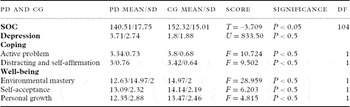
When considering both groups with regards to the factors depression, coping, well-being, and SOC, the following differences and similarities are revealed (Table 1).
Scores obtained (Mean and SD) for each scale and differences between PD and controls CG

PD: Parkinson Disease; CG: Control Group; SOC: Sense of Coherence.
Results show significant differences between PD and controls in the factors of depression, coping strategies (active problem-focused solving, distraction, and affirmation), and well-being (environmental mastery, self-acceptance, and personal growth).
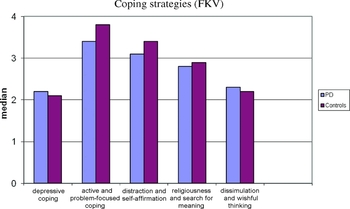
PD patients present significantly higher, clinically non-relevant depression scores compared to the control patients. PD patients also differ from the controls by presenting significantly lower coherence scores. Both groups use as most frequent coping strategy the active problem-focused coping, as second most frequent coping strategy distraction and self-affirmation. However, both groups significantly differ from one another with regards to the obtained values in both these coping categories, indicating higher rated use of both these coping strategies by the controls (Figure 1).
Significant differences between both groups concerning the obtained values of the coping strategies “problem-focused coping” and “distraction and self-affirmation.”

Correlation between SOC and other variables
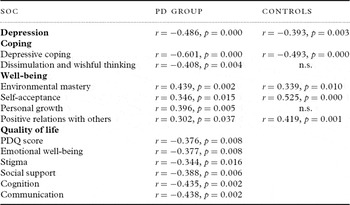
The correlation analysis between SOC scores and the following factors in the PD group revealed low but positive correlations: well-being: environmental mastery, self-acceptance, personal growth, and positive relation with others.
The same analysis was carried out in the CG and revealed low but positive correlations between SOC and coping factors as well as between SOC and the factor “well-being.” Negative correlations were calculated with depression, depressive coping and dissimulation, and wishful thinking in the PD group. The correlation with factors pertaining to QoL was negative with regards to emotional well-being, stigma, social support, cognition, and communication. That is, in PD patients, the lower the SOC, the lower are reported scores concerning the QoL in these different areas. In the CG, negative correlations were found when depressive tendencies and a depressive coping style were present (Table 2).
Correlations between SOC and depression, coping strategies, well-being, and QoL

SOC: Sense of Coherence; PD: Parkinson Disease.
The analysis revealed low but positive correlations between SOC and subscores of well-being and negative correlations with depression and depressive coping in both groups. The PD group showed negative correlation between SOC and quality of life.
Low and high SOC score in the PD group
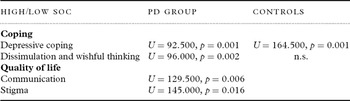
PD patients were split into two groups according to SOC score – low SOC score versus high SOC score – in order to compare them with regards to their manner of coming to terms with their illness, their subjective well-being, as well as their QoL. Patients were allocated to either group according to whether their SOC score was higher or lower than the median SOC score (high score ≥150, low score ≤149).
PD patients who had high scores on the SOC scale used neither depressive coping nor strategies such as dissimulation or wishful thinking to cope with their situation. We found no significant difference between the two SOC groups with regards to the factor “well-being.” Differences between these two groups were, however, present concerning the subscore “communication” of the factor “quality of life” in that patients with higher SOC scores reported higher satisfaction regarding “communication” (Table 3).
High/low scores and coping

SOC: Sense of Coherence; PD: Parkinson Disease.
The results show differences between PD patients with high and low SOC score concerning the coping mechanism, depressive coping, dissimulation and wishful thinking and the quality of life.
Regarding severity of motor syndromes as measured with the UPDRS, we found positive correlations with QoL (mobility r = 0.322, p = 0.010, activity of daily living r = 0.633, p = 0.000), negative correlations with items of well-being like personal growth (r = –0.435, p = 0.006), purpose in life (r = –0.340, p = 0.034), and no correlations with depression, special coping mechanisms, or total score of the SOC. Finally, analysis of the SOC data did not reveal any significant correlation between SOC and duration of illness, impairment, or any other medical characteristics.
In order to find out whether SOC predicts scores pertaining to the factors “well-being,” “quality of life,” and “coping mechanism” a stepwise multiple regression analysis was conducted for both groups. In the investigation of SOC as a possible predictor of scores of the factor “coping mechanism,” the variables age, sex, education, occupation, and depression were included in the regression analysis. The independent variables with the highest correlation were consecutively fed into the regression model.
The results suggest that SOC negatively determines use of a depressive coping style (PD group: R 2 = 0.432, F = 18.460, p = 0.000, B = –0.486; CG: R 2 = 0.189, F = 14.030, p = 0.000, B = –0.451) and of the strategy “dissimulation/wishful thinking” in the PD group (R 2 = 0.080, F = 4.920, p = 0.032, B = –0.317). That is, the lower the SOC, the more often these coping strategies will be used. A positive influence of SOC was found in the CG regarding the use of strategies “religiousness” and “search for meaning” (R 2 = 0.054, F = 4.171, p = 0.046, B = 0.265). For the analysis concerning SOC as a predictor of well-being, the variables age, sex, education, and depression were included. In both groups, the SOC was revealed as a positive influence only with regards to the well-being component “self-acceptance” (PD group: R 2 = 0.121, F = 7.490, p = 0.009; CG: R 2 = 0.29, F = 12.508, p = 0.00, B = 0.527). The evaluation concerning QoL in the PD group suggested that SOC represents a positive predictor for the scales emotional well-being (R 2 = 0.222, F = 7.709, p = 0.001, B = –0.358), stigma (R 2 = 0.106, F = 6.566, p = 0.014, B = –0.353), social support (R 2 = 0.1421, F = 8.560, p = 0.005, B = –0.400), cognition (R 2 = 0.275, F = 9.925, p = 0.000, B = –0.405), and communication (R 2 = 0.159, F = 9.902, p = 0.003, B = –0.421).
Discussion
In this study, we were interested in investigating specific psychological factors which help patients to deal with the burden of chronic disease. More specifically, we focused on the differences between neurological patients, that is, PD patients, and other non-neurological chronic patients with regards to their SOC, which means their way to comprehend, manage, and find a meaning to their disease.
To this purpose, we recruited a sample of PD patients, outpatients of the department of Neurology of the Medical University of Vienna as well as outpatients with non-neurological chronic diseases. The PD group were screened using a medical routine examination and both group received a psychological assessment consisting of self-rating questionnaires. Our results fit in with some well-known facts of several studies concerning the correlations between well-being, QoL, coping mechanism, and mood disturbances of chronic patients (Mancuso et al., Reference Mancuso, Peterson and Charlson2000). Furthermore, we were able to collect new information about coping mechanisms of patients with PD and the role of the SOC, which could be of help in counseling PD patients.
First, we found that PD patients show a higher risk for depression. As mentioned before, many PD patients suffer from psychiatric disorders, like hallucinations, anxiety, and mainly depression (Aarsland et al., Reference Aarsland, Marsh and Schrag2009). Reduced well-being and negative coping could be symptoms of depression. Another fact that needs to be kept in mind is the advanced age of patients of the PD group. Pseudodementia, an often highly recurrent psychiatric disorder in the elderly, represents a frequent second diagnosis when counseling elderly chronically ill patients (Wright and Persad, Reference Wright and Persad2007).
Second, we found that PD patients present a weaker SOC, which can be interpreted as a less positive attitude toward life, a lower comprehensibility, less management of one's own fate, and meaningfulness of life. As the German version of the SOC scale does include norms for the individual subfactors, a more precise analysis could not be carried out. Based on Mellqvist's study, there are strong correlations between SOC and major depression (Mellqvist et al., Reference Mellqvist, Wiktorsson, Joas, Ostling, Skoog and Waern2011).
Third, we found differences in coping mechanisms between PD and non-neurological patients: PD patients used active problem-focused coping strategies less frequently. One explanation for this result could be the cognitive decline of some PD patients. As many recent studies showed, neuropsychological impairments, especially memory problems, decline of executive functions, and alertness deficits are very common (Williams-Gray, Reference Williams-Gray2009; Timmermann et al., Reference Timmermann, Maier, Eggers, Schmidt and Kalbe2010). Finding alternatives for solving problems or coping with a situation require a significant amount of cognitive capacity. Unimpaired executive functions are an essential factor in putting positive coping strategies to use. A lack of flexibility, a reduced production of new ideas, as well as reduced verbal and figural fluency could hinder patients from handling difficult situations (Declerck et al., Reference Declerck, Boone and De Brabander2006). Subject who present depressive tendencies and use a depressive coping style tend to present a weaker SOC. PD patients with a weaker SOC also assess their QoL as reduced.
Furthermore, with regards to individual coping with the burden of the disease, we could show that the subjective appraisal of well-being and of severity of disease play a more important role than any objective parameter of severity of motor symptoms in PD patients. This fact is stressed by the finding that the SOC correlates only with psychological, but not with medical data, like the motor disability scale. This discrepancy between subjective and objective appraisal could be explained by the mental representations of illness, which determine the individual perception of one's subjective well-being. The concepts of the well-being-paradox or the Health Belief Model try to interpret these relations (Herschbach, Reference Herschbach2002). In the clinical routine situation, we often forget this important fact and overemphasize the importance of the medical status. As our data showed, SOC is above all a predictor for QoL, well-being, and coping. It would be important, precisely in PD patients, for which maintaining QoL is a priority in the treatment, to evaluate their attitude toward life as early as possible in order to establish a profile of their resources. This would represent a significant contribution to the development of the further psychological treatment.
Finally, we would like to mention the limitations of this study. Criticism could be expressed first of all regarding the recruitment of the patients, which was limited to outpatients of a hospital, therefore, excluding the collection of data from non-outpatients who are not in treatment. Second, the choice of the CG, a non-homogeneous group of chronically ill internal patients, also represents a possible source of discussion. Finally, the loss of information through the use of a German version of the SOC scale, which does not allow an analysis of the subscores, must also be mentioned. Future follow-up studies should include an amelioration of the analysis possibilities of the German version.
Conflict of interest
None.
Description of authors’ roles
G. Weber assisted with formulating the research questions. E. Auff edited the study. D. Haubenberger supervised the data collection. M. Fleck designed the study, collected the data, and was responsible for the statistical design. G. Pusswald assisted with collecting the data, carried out the statistical analysis, and wrote the paper. J. Lehrner assisted with writing the paper.
Acknowledgments
The authors would like to thank all study participants and colleagues of the Department of Neurology of the Medical University of Vienna for their assistance in data analysis. Furthermore, they would like to thank Dr Susannah Revkin for proofreading the paper.