Introduction
Panton–Valentine leukocidin is a toxin released by bacteria, rather than a bacterium itself. It is found mainly in Staphylococcus aureus. Panton–Valentine leukocidin positive S aureus usually causes simple, superficial infections such as boils and abscesses. These are usually very painful, and the symptoms may seem out of proportion to the cutaneous findings.Reference Holmes, Ganner, McGuane, Pitt, Cookson and Kearns1 These abscesses and boils are often recurrent, and these are the type of Panton–Valentine leukocidin S aureus infections likely to be encountered in the ENT setting.
Panton–Valentine leukocidin positive S aureus also has the potential to cause severe, invasive infections; there were seven reported deaths in the UK between 2006 and 2008.Reference McGrath, Rutledge and Broadfield2 Although these cases are rare, Panton–Valentine leukocidin S aureus can destroy the patient's white blood cells, and can cause infections resulting in extensive tissue necrosis, septic arthritis, and severe haemorrhagic pneumonia with a mortality of approximately 75 per cent. If Panton–Valentine leukocidin S aureus pneumonia is suspected, intensive therapy unit admission and intravenous antibiotics are required. Key features include multi-lobar infiltrates on the chest X-ray, leucopenia, and a C-reactive protein level of more than 250 nmol/L, together with haemoptysis and hypotension.Reference Morgan3
Panton–Valentine leukocidin S aureus is unusual in that it particularly targets children and young adults, especially those living in close proximity (e.g. university halls of residence, and military or school settings). Contact sports (e.g. rugby) and sharing contaminated items (e.g. towels) should raise suspicion, as should eczema and poor hand hygiene. At present, less than two per cent of S aureus strains are Panton–Valentine leukocidin positive, be they methicillin-sensitive or -resistant. Risk factors can be remembered using the ‘five Cs’: (1) contaminated items, (2) close contact, (3) crowding, (4) cleanliness, and (5) cuts and skin compromise.Reference Hawkes, Barton, Conly, Nicolle, Barry and Ford-Jones4
Panton–Valentine leukocidin is detected in clinical practice by obtaining a sample and using a polymerase chain reaction test (A Kearns, personal communication). However, it is not routinely assessed by most microbiology departments, unless advised of a clinical history suspicious of Panton–Valentine leukocidin S aureus infection.
Therefore, it is important that clinicians have a high index of clinical suspicion, particularly when patients present with severe or recurrent abscesses. As always, the history is vital. In suspected cases, it is important to liaise with the microbiology department, as local guidelines may differ.
This case report illustrates how these infections can present to a multitude of specialties, including ENT surgery.
Clinical presentation
A 35-year-old, Caucasian woman from Dubai, on holiday in the UK, presented with an abscess in the left alar region, approximately 14 mm in diameter, which had been present for three days. She was six weeks post-partum. She had suffered gestational diabetes during the pregnancy, and a breast abscess four weeks prior to presentation, but was otherwise fit and well.
The patient had been seen by a general practitioner two days prior to admission, who had prescribed oral co-amoxiclav. However, she had developed worsening symptoms and exquisite pain, and had been concerned when her lower eyelid had become swollen and erythematous, and so had attended our accident and emergency department.
On initial assessment, the patient informed the admitting accident and emergency doctor that the pus from the breast abscess, which had been drained in Dubai four weeks previously, had grown methicillin-resistant S aureus (MRSA).
She was reviewed by the ophthalmologists, who diagnosed pre-septal cellulitis secondary to the abscess, and decided to convert the patient's antibiotics to intravenous co-amoxiclav.
The ENT surgeons then aspirated the alar abscess and discussed the case with the microbiologist, given the nature of the recurrent abscess formation and previous isolation of MRSA from the patient's breast abscess.
The microbiologist suspected Panton–Valentine leukocidin positive S aureus infection and advised treating the patient as such, by undertaking polymerase chain reaction testing for Panton–Valentine leukocidin positive S aureus on the aspirated pus sample, adding oral doxycycline and rifampicin to the antibiotic regime, and using the topical MRSA decolonising agents Octenisan® and Bactroban®.
Culture results confirmed the presence of Panton–Valentine leukocidin positive, methicillin-resistant S aureus.
The patient was discharged following three days of intravenous antibiotics, and completed a 10-day course of oral doxycycline and rifampicin, as well as a full course of topical MRSA decolonising agents.
A week after discharge, the patient was seen in the clinic, prior to returning to Dubai. Her infection was observed to be resolving.
Discussion
The Panton–Valentine leukocidin toxin was first described in 1932 by Panton and Valentine. Since then, infections caused by Panton–Valentine leukocidin positive S aureus are thought to have increased in prevalence; however, this trend is still relatively unclear, and may be due to more frequent reporting of cases due to increased awareness.Reference Anonymous5
The majority of infections caused by Panton–Valentine leukocidin S aureus are mild skin or tissue infections, as in the case described, which are treated by drainage, swabs for antibiotic sensitivity testing, and appropriate antibiotics plus topical decolonisation agents, irrespective of whether the bacteria is believed to be methicillin-resistant or -sensitive.
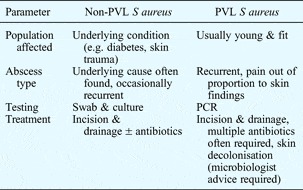
Table I shows the differences between infections caused by Panton–Valentine leukocidin and non-Panton–Valentine S aureus strains.
PVL S aureus vs non-PVL S aureus abscesses

PVL S aureus = Panton–Valentine leukocidin Staphylococcus aureus; PCR = polymerase chain reaction
Panton–Valentine leukocidin positive, methicillin-sensitive S aureus is usually sensitive to antibiotics effective against non-Panton–Valentine leukocidin S aureus, such as the penicillins and macrolides.Reference McCartney, Cookson, Dance, Day, Duerden and Elston6 However, a second agent, such as doxycycline or rifampicin, is recommended if it is thought that the infection may be caused by a Panton–Valentine leukocidin MRSA.Reference Anonymous7
The most severe infection caused by Panton–Valentine leukocidin S aureus is necrotising haemorrhagic pneumonia. This condition is less likely to be seen in the ENT setting, but it is important that clinicians are aware of it due to its high associated mortality. The UK Health Protection Agency currently recommends that severe infections be managed using linezolid plus rifampicin plus clindamycin. This is because these antibiotics have been shown to have the ability to ‘switch off’ the toxin-producing ability of the bacterium.Reference Coyle8
• Panton–Valentine leukocidin is a toxin released by bacteria, mainly Staphylococcus aureus
• Unusually, Panton–Valentine leukocidin S aureus targets children and young adults
• Panton–Valentine leukocidin methicillin-resistant S aureus infection is usually simple and superficial (e.g. abscesses), but may be life-threatening (e.g. necrotising pneumonia)
• Risk factors are: sharing contaminated items, close contact, crowding, poor hygiene, and cuts and skin compromise
• Identification usually requires DNA polymerase chain reaction testing
• These infections can be easily overlooked in acute admissions and out-patients
Polymerase chain reaction tests are now available which detect the Panton–Valentine leukocidin virulence gene and which differentiate methicillin-sensitive versus methicillin-resistant S aureus, all in the one test.Reference McClure, Conly, Lau, Elsayed, Louie and Hutchins9
There is no clear guidance on whether isolation is recommended for patients with Panton–Valentine leukocidin S aureus abscesses. However, it is mandatory for pneumonia caused by this bacterial strain, and the Health Protection Agency also recommends contacting the local infection control team.
Conclusion
Panton–Valentine leukocidin S aureus infection should always be suspected in patients (especially those of a young age) who present with recurrent skin or superficial infections with no obvious underlying cause. Liaison with local microbiology departments is important as local guidelines may vary. This includes discussion not only of antibiotic choice but also of test procedures for Panton–Valentine leukocidin; it may be the clinician's responsibility to include Panton–Valentine leukocidin testing on the request form. Hand-washing and basic infection control measures are also vital.