Navarro-Castillo began the Rancho Ojo de Agua Archaeological Project in 2015 with the goal of investigating low-ranking sites in the Lacanjá river basin in the Lacandon jungle. When local students notified project members about the deterioration of Prehispanic graffiti (by both human and natural agents) at the site of Plan de Ayutla, we visited it to record and preserve what remained. Seven incised images were rediscovered, some of which had been previously published by Martos (Reference Martos López2015:10–11). Video footage, photographs, and direct tracings were taken to fully document each image.
The site of Plan de Ayutla
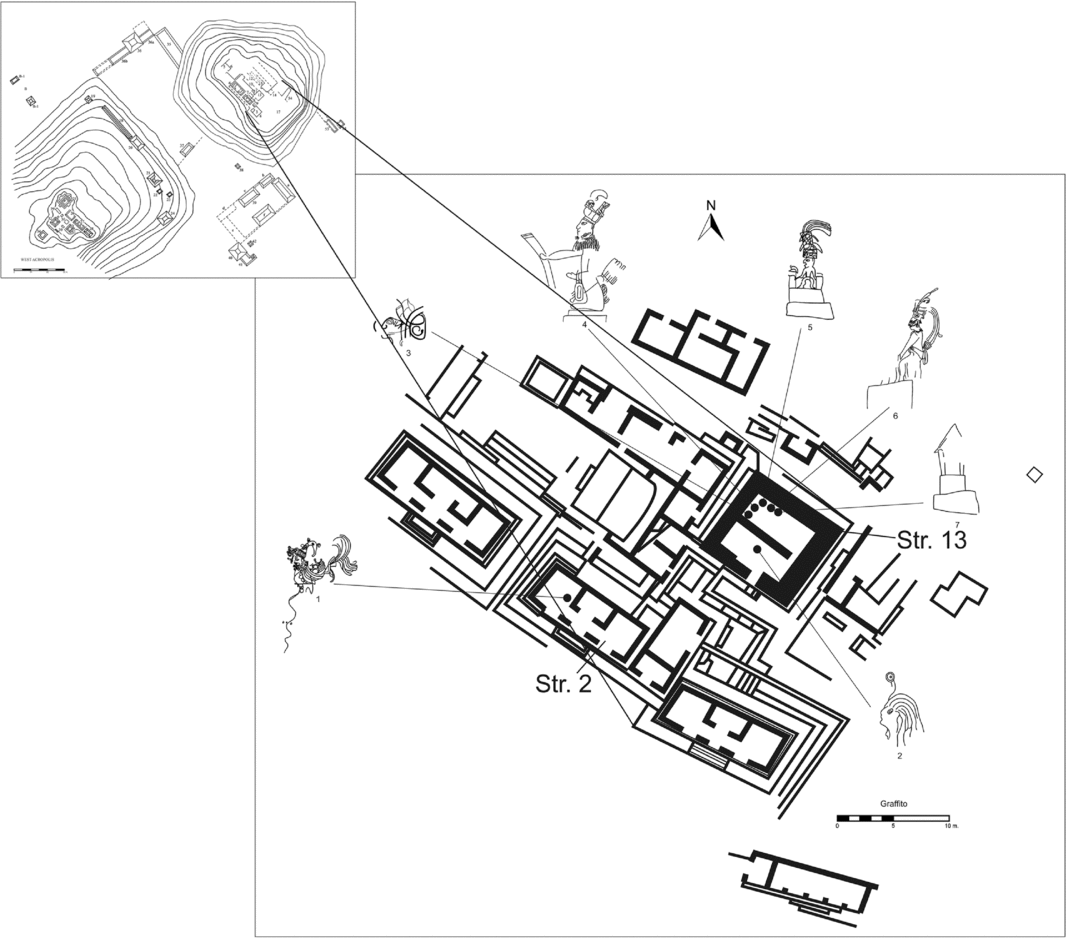
This Late Classic site is located in the ejido of the same name, near the town of Nueva Palestina. It encompasses about 25 ha, and includes 74 structures distributed across three acropoli. The graffiti are located in Structures 2 and 13, both of which are still standing in the North Acropolis (Figure 1).
Location of graffiti in the North Acropolis of Plan de Ayutla, based on Tovalín et al. Reference Tovalín Ahumada, Villareal and de León Collins2004. Graffiti drawn by Sophia Pincemin and Carlos Hoover.

Structure 2 is a three-room temple with three front entryways: a central door accessed by a small staircase and two flanking doors. The central door opens into a hallway through which one can access each of the three temple rooms. Each of the side rooms has two points of entry – one from the front of the building and a second from the central hallway. Access to the central room is more restricted. It can be entered through the single door at the back of the hallway, directly behind the main entrance.
Structure 13 is an administrative building composed of front and rear galleries connected by a narrow doorway at the eastern end. A single bench is located next to the entrance on the western side of the front gallery. Due to the layout of the building, the front gallery is well lit from the entrance, but the rear gallery is quite dark (Martos Reference Martos López2005, Reference Martos López2009, Reference Martos López2015; Tovalín Ahumada y Ortiz Villareal Reference Tovalín Ahumada and Villareal2003; Tovalín Ahumada et al. Reference Tovalín Ahumada, Villareal and de León Collins2004).
The Graffiti
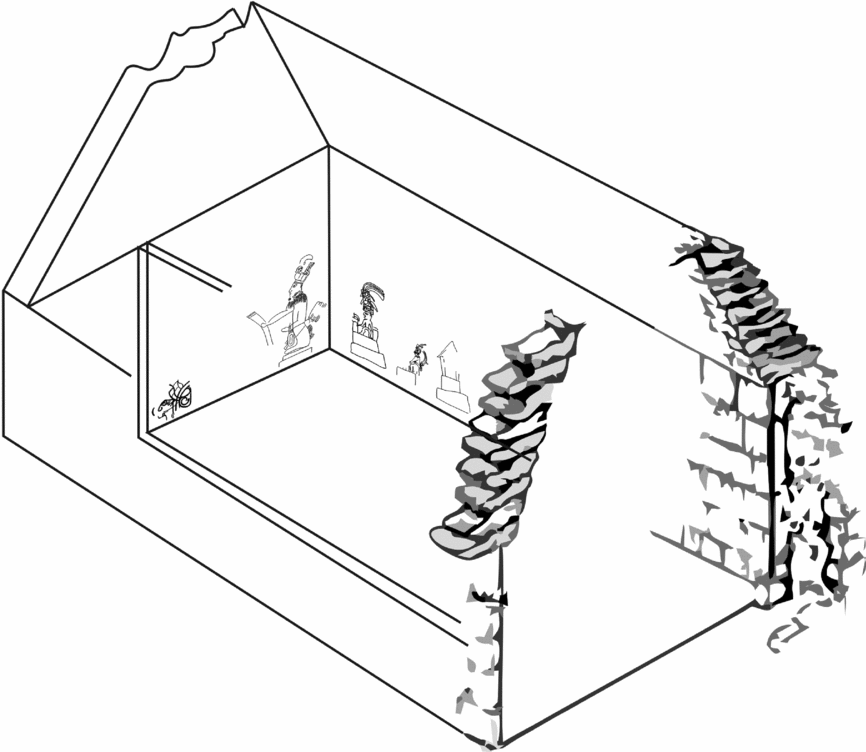
Structure 2 houses a single drawing located on the wall shared with the central room near both the outdoor and hallway entrances. Lighting is fair. Graffiti are found in both galleries of Structure 13 (Figure 2). The front gallery contains a single image located in a highly visible location directly across from the entrance to the building. The largest concentration of graffiti, however, consists of five images in the back corner of the rear gallery of Structure 13. Most are about 10 cm above the floor, although one is at ground level. Variation in the scale and style of the images, and in the perceived level of skill and tools used to create them, suggest that the graffiti were created by a variety of individuals.
3D location of Graffiti at Structure 13. Drawing by Carlos Hoover (figures not drawn to scale).

We assigned each graffito a number, starting with the image in Structure 2, then moving west to east through the front and rear galleries of Structure 13. We turn now to detailed descriptions of the images located at the Northern Acropolis.
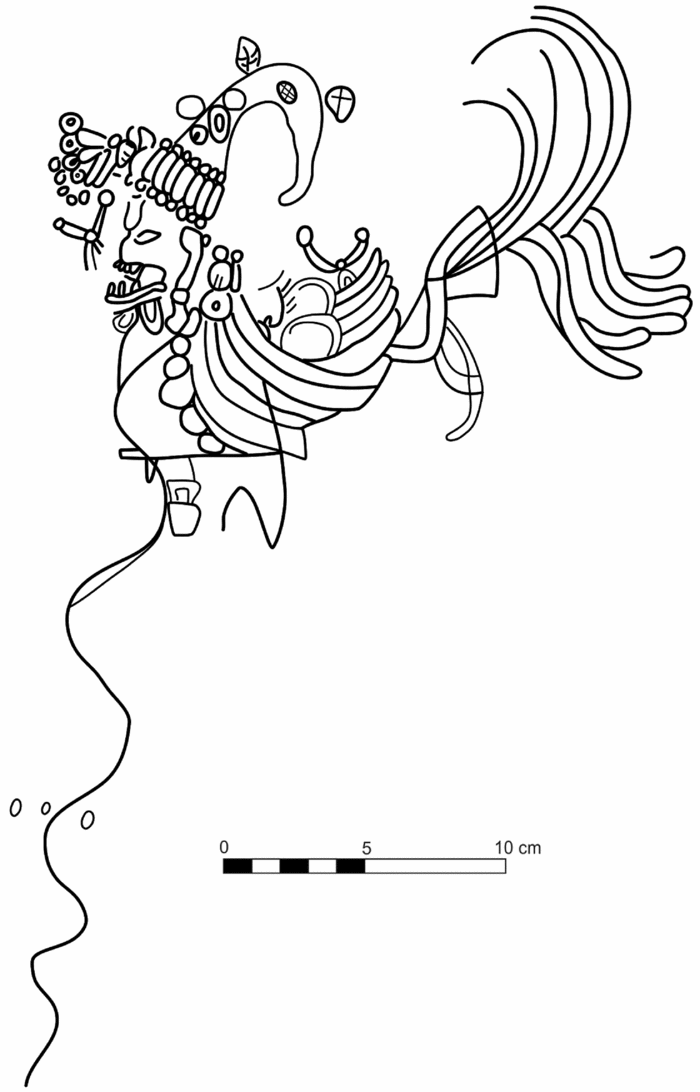
Graffito 1, the only image located in Structure 2, consists of a winged bird body with an elaborate tail and a human head (Figure 3). The face is shown in profile, facing left and displaying a single eye, nose, an open mouth lacking teeth, and an ear from which hangs a double earspool. The figure also wears a large beaded necklace and a headband with tubular and circular beads, from which a beaded fan hangs toward the face. A “jester” hat adorned with circles, some of which are hatched, protrudes from the beaded headband. This figure is thought to be a representation of the god Itzamnaj, frequently depicted on Classic Maya polychrome ceramics as the Principal Bird Deity. The image is 38.0 cm high by 21.2 cm wide, and it is positioned 1.65 m from the floor. It appears to have been created using a thin, sharp tool. It is likely the work of a professional artist, because the lines are clear and well executed, and the image adheres to iconographic canons. Kováč (Reference Kováč, Lorenzo and Cosme2014:38) describes a graffito (G131) with similar birdlike features at Tz'ibatnah, but it is not as finely executed. This figure appears as a recurring theme in the corpus of Maya graffiti.
Graffito 1. Drawing by Sophia Pincemin.

Graffito 2 is located in the front gallery of Structure 13. It is a crudely drawn human head shown in profile facing left, with an oval eye, an open mouth, and flowing hair, with an unidentified element extending from the forehead (see Figure 1). The image measures 25.0 cm high by 14.5 cm wide and begins 1.60 m above ground level. It was drawn freehand using a thick, blunt tool.
The remaining graffiti were drawn in the rear gallery of Structure 13. Graffito 3 is one of two images located on the northwest gallery wall. It is a left-facing profile of a human head wearing a headdress (see Figure 1). The face has two vertical incisions behind the mouth and two V-shaped incisions behind the eye, perhaps to represent age. The image measures 36.5 cm high by 40.0 cm wide and was crudely executed in open, rounded strokes, perhaps using an instrument with a wide, blunt tip. Some of the features of this drawing were damaged by previous archaeological consolidation.
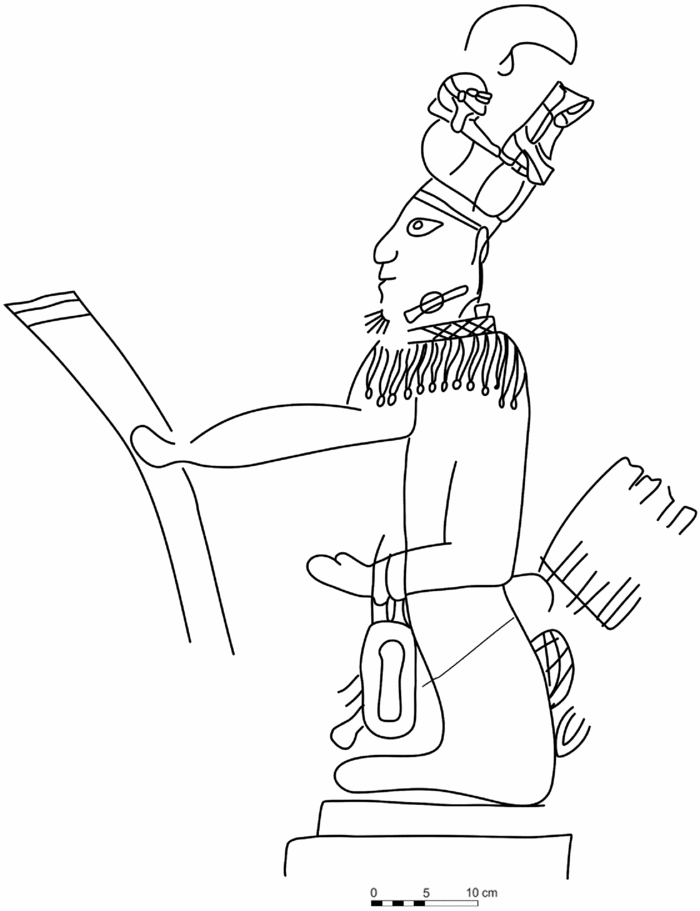
Graffito 4 is the second image on the northwest wall of the rear gallery. It is the profile of a male figure facing left, with facial hair on his chin (Figure 4). His left arm is bent, holding what appears to be an ornate bag, and his outstretched right arm holds a long, slender staff. The individual is wearing a complex headdress consisting of a rigid, partitioned diadem-like element, and seems to have a tubular earplug positioned low near his jawline. He is wearing a necklace composed of a band depicted with hatched lines—perhaps woven—from which hang thin, triangular strips of what may be cloth, each terminating in a single round bead. He wears a wrap around his waist with a feather-like fan coming out the back as in Graffito 6. The side of the left thigh is pictured as if the individual is sitting cross-legged atop two short steps. The image is 73.7 cm high by 91.2 cm wide, and it is situated at ground level. The strokes are fine and likely made with a thin, sharp tool.
Graffito 4. Drawing by Sophia Pincemin.

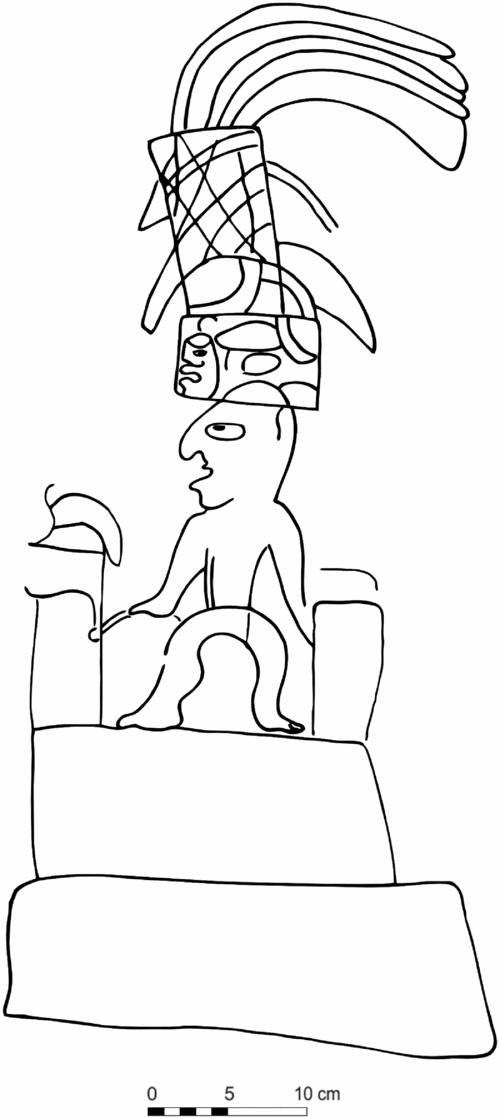
Graffito 5 is one of three located on the northeast wall in the rear gallery of Structure 13. It depicts a male whose head is rendered in profile facing left and whose body faces forward (Figure 5). It is unclear if he is seated or standing atop a throne-like structure consisting of two steps between two poles or blocks that come up to his torso. His arms are resting at either side, and his body is disproportionately small compared to his head. Both feet face outward. He is wearing an ornate headdress, the base of which is a rectangle with various designs. These include a skull similar to that worn by musicians depicted in Room 1 at Bonampak, and two oval-shaped elements. Atop the base of the headdress is a tall cylinder with intersecting oblique lines from which five large feather plumes extend. This image appears to depict a ruler, and it measures 66.5 cm high and 31.1 cm wide. The incision lines are thin, likely created using a sharp tool. Its execution is rough.
Graffito 5. Drawing by Sophia Pincemin.

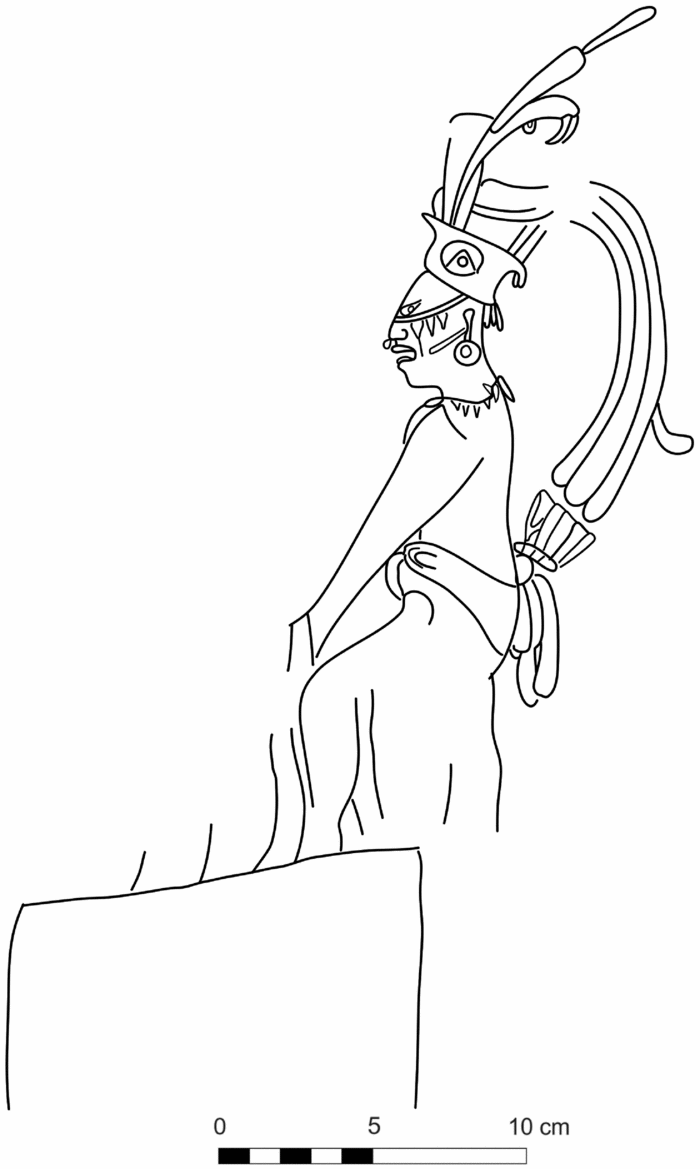
Graffito 6 also is on the northeast wall of the rear gallery of Structure 13. It is an image of a male drawn in left profile. He seems to sit on a bench atop a high platform (Figure 6). It is noteworthy that although the individual's feet rest on the platform, the bench appears suspended in midair above it. He wears a turban depicted with a jaw containing two upper fangs, beneath which four long feathers trail down his back. The artist took advantage of the wall on which the image was drawn; aspects of the stone are visible within the circle element of the turban. The individual's face is adorned with a design, perhaps achieved through scarification, consisting of a curved band extending from the headdress along the cheek bone, below his pupiled eye, and across the nose. Three triangles, similar in shape to the beads hanging from his collar, are suspended from this band. The character is richly attired, with a rounded nose plug, tubular earplug, and circular earspool. A skirt is tied around his waist and knotted at the back, from which a feather fan extends outward toward the headdress plumes. His left arm extends downward, seemingly grasping something soft. His expression is haughty and proud, likely that of a ruler. The image measures 33.5 cm high by 22.4 cm wide. The outline of this figure is rather shallow but masterfully crafted, perhaps the work of a professional artist. The thickness of the lines of the platform suggest it was made using a different instrument than the figure.
Graffito 6. Drawing by Sophia Pincemin.

Graffito 7 is depicted on the northeast wall of the rear gallery of Structure 13. It is a schematic representation of a structure with a high, vaulted ceiling situated atop two large steps, perhaps representing Structure 13 itself—it has the same external appearance (Martos Reference Martos López2015:11). The image measures 48.0 cm high by 24.1 cm wide. The incisions are deep and roughly executed.
Discussion
The themes represented in these graffiti coincide with those observed at other Maya sites: enthroned rulers, members of the nobility, supernatural beings, and architecture (Andrews Reference Andrews1980; Patrois and Nondédéo Reference Patrois, Nondédéo, Lorenzo and Cosme2009; Źrałka Reference Źrałka2014). As we now understand, these images depict events or locations important to elite individuals. The graffiti portray a more domestic perspective than the officially commissioned scenes depicted on polychromes or in mural paintings (Andrews Reference Andrews and Andrews1999:241; Mayer Reference Mayer, Lorenzo and Cosme2009:26–27; Patrois and Nondédéo Reference Patrois, Nondédéo, Lorenzo and Cosme2009:59). Thus, they provide evidence supporting the idea that their creators were residents of the Late Classic settlement, who rendered these images in a private setting (Andrews, Reference Andrews and Andrews1999:223; Kováč, Reference Kováč, Lorenzo and Cosme2014:41). Indeed, Maya graffiti tend to be located near the floor in places where inhabitants may have been sitting (Kampen Reference Kampen1978:163), which is the case for Structure 13. The representations of rulers depicted here suggest that the building may have been the residence of the governor of this political entity, as proposed by Martos (Reference Martos López2009). Considering the level of execution in most cases of graffiti, their creators were individuals without artistic training, as argued by Dominique Michelet (Reference Michelet, Lorenzo and Cosme2009:97). These representations may even have been created by relatives of the portrayed ruler. One exception may be the image of the seated ruler represented in Graffito 6, whose quality indicates that it may have been the work of a trained artist.
The interest of the nobility in representing issues related to their courtly life as private images suggests a desire to keep a visual record or family archive to retain memory of themes or perspectives that may have had no place in official or public art (Kováč Reference Kováč, Lorenzo and Cosme2014:41; Źrałka and Hermes Reference Źrałka, Hermes, Lorenzo and Cosme2009:155). Thus, graffiti could have been used to preserve these memories as private, personal “snapshots” or “family albums” (Vidal Lorenzo and Muñoz Cosme Reference Vidal Lorenzo, Cosme, Lorenzo and Cosme2009:116). Incidentally, the graffiti discussed here contain the only images we have of Plan de Ayutla royalty.
The presence of Graffito 1 in Structure 2 is noteworthy because the function of this structure was ritual rather than administrative. This graffito is the well-executed representation of the god Itzamnaj as an anthropomorphic bird, an image that also appears at the site of Tz'ibatnah, northeast of Uaxactun, although not inside a temple (Kováč Reference Kováč, Lorenzo and Cosme2014:38). The skill exhibited in Graffito 1 may indicate that only skilled artisans were allowed to decorate the temple. The fact that the graffito is located higher above the floor than most graffiti also is noteworthy. Unlike Patrois’ proposal (Reference Patrois2013), it seems that there is no association among height and mastery of the drawings at the site. All these specifics concerning Graffito 1, along with its location and iconographic content, provide evidence that this image had a ritual function that was different from those located in domestic architecture (Hermes et al. Reference Hermes, Olko and Źrałka2001:66).
Prior to the discovery of the Plan de Ayutla graffiti, we had limited information about this type of art in the Usumacinta basin. We can now incorporate images from this region into the existing corpus of Maya graffiti from other areas such as Palenque (Robertson Reference Robertson1983; Ruz Lhuiller Reference Ruz Lhuillier1955), La Mar, El Cayo, and Piedras Negras (Andrews Reference Andrews1980; Maler Reference Maler1903). This collection enables us to further delve into the peculiarities and richness of this artistic manifestation of the ancient Maya. The Plan de Ayutla graffiti additionally provide evidence regarding the cultural practices represented in the images, such as the participation of the site in political spheres extending beyond the regional level.
Acknowledgments
Funding for this investigation was provided by CONACYT and PRODEP. We wish to thank the residents of Nueva Palestina, especially Don Ramón Cruz and Camerino Valerio. We also appreciate the useful suggestions of Betsy Kohut and the anonymous reviewers.
Data Availability Statement
Materials recovered at Plan de Ayutla site in the Usumacinta region can be found in the Archaeology Department at UNICACH. For further information on the data presented in the article, please contact the authors.