




Crossref Citations

This article has been cited by the following publications. This list is generated based on data provided by Crossref.
Kuntz, Joana
Connell, Philippa
and
Näswall, Katharina
2017.
Workplace resources and employee resilience: the role of regulatory profiles.
Career Development International,
Vol. 22,
Issue. 4,
p.
419.
Brighi, Antonella
Mameli, Consuelo
Menin, Damiano
Guarini, Annalisa
Carpani, Francesca
and
Slee, Phillip T.
2019.
Coping with Cybervictimization: The Role of Direct Confrontation and Resilience on Adolescent Wellbeing.
International Journal of Environmental Research and Public Health,
Vol. 16,
Issue. 24,
p.
4893.
Fisher, David M.
Ragsdale, Jennifer M.
and
Fisher, Emily C.S.
2019.
The Importance of Definitional and Temporal Issues in the Study of Resilience.
Applied Psychology,
Vol. 68,
Issue. 4,
p.
583.
Stowers, Kimberly
Mehta, Yash
Huh, Youjeong
Brady, Lisa
and
Kasdaglis, Nicholas
2020.
Advances in Human Error, Reliability, Resilience, and Performance.
Vol. 956,
Issue. ,
p.
298.
Franken, Esme
Plimmer, Geoff
and
Malinen, Sanna
2020.
Paradoxical leadership in public sector organisations: Its role in fostering employee resilience.
Australian Journal of Public Administration,
Vol. 79,
Issue. 1,
p.
93.
Weinzimmer, Laurence G.
2021.
Work Life After Failure?: How Employees Bounce Back, Learn, and Recover from Work-Related Setbacks.
p.
109.
Mavrommatidou, Stavroula
Theriou, Georgios
and
Chatzoudes, Dimitrios
2022.
The Impact of Strategic Corporate Social Responsibility (SCSR) on Employees’ Perceived Job Security and Resilience in SMEs: The Moderating Role of Humble Leadership.
p.
25.
Jogulu, Uma
and
Franken, Esmé
2023.
The career resilience of senior women managers: A cross‐cultural perspective.
Gender, Work & Organization,
Vol. 30,
Issue. 1,
p.
280.
Manthey, Kate
2024.
Value of Resilience in Emotional Labor Work: The case of the property-casualty insurance adjuster.
Journal of Finance Issues,
Vol. 22,
Issue. 2,
p.
52.
Kanapeckaitė, Rosita
and
Bagdžiūnienė, Dalia
2024.
Relationships between team characteristics and soldiers’ organizational commitment and well-being: the mediating role of psychological resilience.
Frontiers in Psychology,
Vol. 15,
Issue. ,
Khan, Shahid
and
Thayil, Avani
2024.
Ripple Effects of Abusive Supervision.
Psychological Reports,
Vol. 127,
Issue. 1,
p.
365.
Cadete, Nuria
and
Ruggunan, Shaun
2024.
Self-Perceptions and Benefits of Psychological Resilience Among Women Academics in the Context of Working in South African Higher Education Institutions (SA-HEIs): A Mixed-Method Approach.
Sage Open,
Vol. 14,
Issue. 2,
M. James, Sarah
2025.
Literacy in the Field: Preservice Teachers’ Professional Experience Perspectives.
Literacy Research and Instruction,
p.
1.
Xie, Xiaoxia
Chun-Chung Chow, Julian
Jiang, Xiaoyao
and
Bai, Hui
2026.
Individual resilience and financial well-being early in the COVID-19 pandemic: does gender make a difference?.
China Journal of Social Work,
Vol. 19,
Issue. 1,
p.
41.
Lombardi, Sara
Pina e Cunha, Miguel
and
Giustiniano, Luca
2026.
Resilience as a process: Long term effects of COVID-19 interventions.
International Journal of Hospitality Management,
Vol. 133,
Issue. ,
p.
104517.
In the words of Winston Churchill, “When you're going through hell, keep going.” Britt, Shen, Sinclair, Grossman, and Klieger (Reference Britt, Shen, Sinclair, Grossman and Klieger2016) note several traits (e.g., individual resources), environmental factors (e.g., unit, family, and community resources), and processes (e.g., seeking help from others) that help individuals to “keep going” in the face of adversity. I would argue that the third category, which I would suggest be expanded to practices, is the most important going forward. Unfortunately, psychologists often tend to focus the most effort on the first two: traits and environmental factors, which often leave individuals feeling helpless because both are largely outside of their control. In the face of adversity, people instead want to know, “What can I do to keep going?” This is not to say that traits or environmental factors are not important. They are. However, the most powerful work in resilience will promote personal agency (Bandura, Reference Bandura2001) and confidence in one's ability to develop resilience (e.g., a growth mindset; Dweck, Reference Dweck2006).
Why Practices?
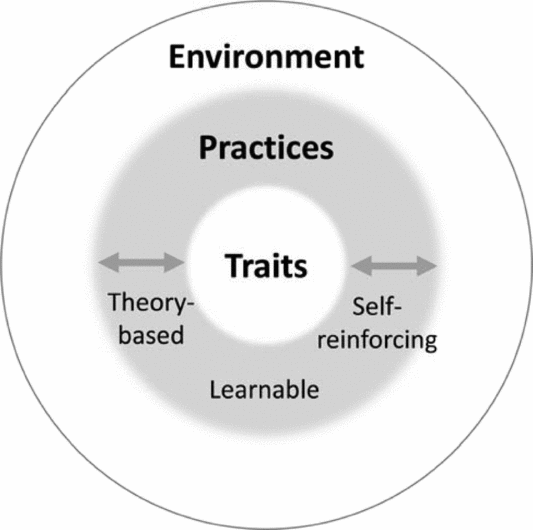
Resilience practices are important because they operate in the space between genetic predispositions and environmental determinants (see Figure 1). This is the region of agentic choice where actions and learned habits have the potential to grow and expand over time (Bandura, Reference Bandura2001; Wood & Neal, Reference Wood and Neal2007). “Practices” is a noun (a skill that is developed) and simultaneously points to the verb (to exercise a skill repeatedly to improve one's abilities); that is, practices can be learned through practice. Ericsson, Charness, Feltovich, and Hoffman (Reference Ericsson, Charness, Feltovich and Hoffman2006) have documented, for example, the critical role that practice plays in the development of expertise, especially deliberate practice (i.e., intentionally working to improve on tasks beyond one's current level of competence). Their research suggests that extended deliberate practice (10 years or 10,000 hours) trumps and ultimately transcends raw talent.
Resilience practices in the context of environment and traits.
Research in life satisfaction provides another great model of the role that resilience practices can play in the context of traits and environmental factors. Lyubomirsky, Sheldon, and Schkade (Reference Lyubomirsky, Sheldon and Schkade2005) note that traits account for up to 50% of the variance in one's life satisfaction; environment accounts for 10%, leaving 40% unaccounted for: a space where learned practices such as gratitude, leveraging one's signature strengths, and forgiveness can operate to boost one's life satisfaction. People with a resting life satisfaction that is low can adopt practices that temporarily elevate their life satisfaction levels. As long as they engage in the practices, their life satisfaction is elevated (Seligman, Steen, Park, & Peterson, Reference Seligman, Steen, Park and Peterson2005). The same could be true for resilience practices. Some people may have a low capacity for resilience through no fault of their own because of genetic predispositions or negative environmental conditions. Yet, resilience practices can be adopted that fill the gap and increase their cumulative resilience capacity.
Finally, practices are important because they have the potential to help all employees expand their resilience. As industrial–organizational psychologists, there is a temptation to take the easy way out and to default to traits, sorting people into the haves and have nots and creating systems that help organizations find the people with high resilience. (Of course, we would use the more acceptable term “high potentials” in our quest to sort out the “good” ones.) Britt et al. note the conceptual and practical problems in doing this. In addition, the most profound impact we can have on organizations is to find ways to help all employees increase their resilience capacity. Organizations where all employees are resilient are more likely to survive the shocks that are common in today's dynamic environment. A society where everyone is resilient is likely to serve the world better.
Practices in Action
If resilient practices are so important, this begs the next question: What are the practices that are likely to have the greatest potential to increase employee resilience? Taleb (Reference Taleb2014), in his book Antifragility, provides a thought-provoking way to frame the question. He suggests that systems under stress fall into three groups: (a) fragile systems that fracture and break down under pressure (e.g., a glass vase), (b) robust systems that are unchanged under pressure (e.g., a rock), and (c) antifragile systems that improve under stress (e.g., muscles that require stress to remain healthy and atrophy under low stress). The most promising resilience practices are likely to be in the second and especially the third group because they lead to system sustainability, growth, and system improvement over time.
Criteria for Antifragile Resilience Practices
Three properties are likely to characterize resilience practices that are antifragile: They are theory based, they can be learned, and they are self-reinforcing under stress. First, theory-based practices are “good bets” because they explain why the practices work and how they should be crafted (Walton, Reference Walton2014). Theories also direct attention toward additional practices that should be considered. Second, the most powerful resilience practices are ones that can be learned and developed. They should be within the learner's control. For example, growing evidence suggests that error management practices (i.e., actively encouraging learners to look for and make errors so they can learn from them) can be learned and in turn lead to better performance and an increased capacity to solve future problems (Keith & Frese, Reference Keith and Frese2008). Furthermore, practices like error management can operate at the organizational level (Van Dyck, Frese, Baer, & Sonnentag, Reference Van Dyck, Frese, Baer and Sonnentag2005). Finally, the practices should be self-reinforcing; that is, engaging in the practices should make it more likely that individuals will engage in them again in the future. For example, feedback seeking is likely to be a powerful behavior that will help individuals navigate through stressful situations, adapt to change, and perform well (Anseel, Beatty, Shen, Lievens, & Sackett, Reference Anseel, Beatty, Shen, Lievens and Sackett2015). But seeking and receiving feedback can also be a negative experience leading people to avoid it. There are approaches, however, such as the feedforward interview (Kluger & Nir, Reference Kluger and Nir2010) that should be self-reinforcing over time.
Promising Antifragile Resilience Practices
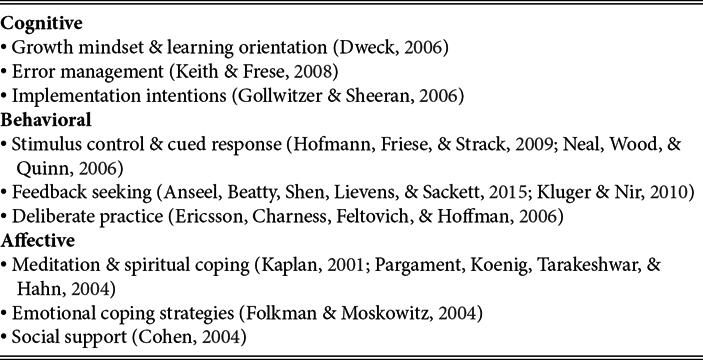
Table 1 lists several additional cognitive, behavioral, and affective practices that are promising. For example, Dweck's (2006) growth mindset is a good example of a cognitive resilience practice. Research suggests that individuals who set learning goals and adopt a growth mindset are much more likely in the face of failure to maintain high effort, remain persistent, and seek future challenges. Behavioral practices such as stimulus control (e.g., checklists for medical teams) provide ways that individuals in highly stressful environments can reduce cognitive load and perform well (Gawande, Reference Gawande2009; Hofmann, Friese, & Strack, Reference Hofmann, Friese and Strack2009). Checklists can be learned and can become self-reinforcing as they lead to successful outcomes. Affective resilience practices such as meditation and spiritual coping have been shown to promote emotional regulation and well-being (Kaplan, Reference Kaplan2001; Pargament, Koenig, Tarakeshwar, & Hahn, Reference Pargament, Koenig, Tarakeshwar and Hahn2004).
Theory-Based, Learnable, Self-Reinforcing, Practices To Increase Resilience Capacity (Examples)
Going Forward
We are entering a time in history where resilience is more important than ever, and industrial–organizational psychologists have the opportunity to be in the forefront of this work, to carry Churchill's banner forward, and to help all individuals to increase their resilience capacity and “keep going.”