Introduction
In the mid-eighteenth century, the Beekman family firm of New York, importers of dry goods from England and with ties to the Caribbean, were at the center of a growing transatlantic trading community. It was around this time that a prominent member of the family, William Beekman, a ship captain, settled in Liverpool with a view to strengthening the firm’s business on that side of the Atlantic.Footnote 1 This was achieved through meeting with manufacturers, building contacts in the local merchant community, and relaying important information on this market back to the New York firm. The Beekmans were not the only firms sending individuals abroad to access markets, other firms such as Greg, Cunningham & Co. also sought to do the same by establishing firm partners or agents between Belfast, Liverpool, and New York.Footnote 2 As trade and, subsequently, finance of international trade grew to become even more complex, firms that could afford to do so (and had the right personnel available) sent multiple individuals abroad to learn about new markets, network build, coordinate firm activities, and act as a conduit for information for the focal firm. Often referred to as agents, special resident agents, brokers, and middlemen, these individuals provided the crucial service of intermediation for firms engaging in long-distance trade and finance (these individuals will be referred to as intermediaries hereafter).
Another role that many of these intermediaries undertook was to advise on credit extension and debt recovery. This role became particularly central to the activities of merchant bankers of the late eighteenth and nineteenth century, such as N. M. Rothschild & Co., Baring Bros., and W. & J. Brown & Co., whose businesses centered on the supply of finance to various international firms engaged in trade, mining, railways, canal building, and a host of other pursuits on a global scale.Footnote 3 These firms built complex networks of clients in many distant locations, often securing trusted local correspondents or sending agents abroad to act as intermediaries in developing and monitoring their business interests.
In recent decades, the literature on the complexity of business networks, and financial networks in particular, has expanded. Particularly after the global financial crisis of 2007–2008, many have looked to the embeddedness of current global financial networks as a source of vulnerability.Footnote 4 However, scholars of early global business are well aware that complex financial networks that crossed borders and interacted with multiple actors are nothing new. The proliferation of merchant banks in the early nineteenth century drew cities, industrial districts, and regions together in complex credit and trade networks.Footnote 5 Similar to global connectivity today, the role of intermediation in expanding global trade and finance networks in the nineteenth century was crucial to international business but also created chains of vulnerability in which individual actors played a major role in business outcomes, both positive and negative. Crucially, in Latin America, access to financial tools and innovation such as credit and the establishment of early banks fueled expansion in many industries such as agriculture, mining, and railways.Footnote 6
This article is thus an attempt to further understand the complex role of intermediaries in merchant bank network building between 1825 and 1850 in markets both distant and unfamiliar to the focal firm. Using examples from the Latin American networks of prominent merchant banks N. M. Rothschild and the Baring Bros. (in Mexico and Cuba specifically), this article will examine different types of intermediaries (those external and internal to the focal firm) and differing network stages (those that were well developed and those that were in the initial stages of development). Access to trade and finance were especially important for these economies; in Mexico, a young financial system sought external access to capital to support industrial development, while in Cuba, a booming tobacco and coffee (later sugar) industry required access to markets outside the colonial metropole to dispose of the incredible surplus of these goods. While this article is far from a complete examination of the intricate webs woven by the numerous contacts of these merchant banks, it offers an important glimpse at some of the crucial links maintained by network actors that connected London-based merchant banks to distant markets, industries, and players in international trade and finance. Critically, rather than focusing on the narrative of one merchant bank from the perspective of the London-based firms as many historians have already done so masterfully, this article aims to provide insights from the periphery of these firms in an attempt to unravel the complexity of their networks and the role of intermediaries within these networks.
Intermediaries appeared in all forms and contexts, but their purpose was generally the same: to act as a conduit of information and opportunity for the focal firm. Footnote 7 Use of intermediaries proved successful for a number of firms; however, abuses of trust, bad decision making, and similar behaviors that trickled back to the focal firm made entrusting the business of particular markets to individuals at times a costly practice.Footnote 8 In markets unfamiliar to focal actor firms such as Rothschild and Baring Bros., the use of a resident intermediary (sometimes referred to as a resident agent) was the only means of accessing that market and its potential.
Through initial analysis of intermediaries operating on behalf of merchant bankers in various locations, a number of important research questions emerge. First, what were the backgrounds of these intermediaries and did those backgrounds have an impact on the responsibilities they were granted by the focal firm? Second, what were the various responsibilities of these individuals and to what extent did these intermediaries influence major business decisions on behalf of the firms they represented? Finally, how crucial were these individuals to the business of the merchant banks in these locations and how easily could they be replaced?
By investigating these research questions, this study addresses several gaps in the international business history literature. Much emphasis has been placed on merchant bankers of this period, but less has been said about the multitude of peripheral firms that extended their international reach or, on occasion, acted as a hindrance to expansion.Footnote 9 Adding to the novelty of this study is the focus on Mexico and Cuba in the first half of the nineteenth century, an area and era less frequently explored within the context of international business history despite the importance of international trade and finance to these locations.Footnote 10 This provides important insights into the role of international networks in developing and often turbulent economies. Particularly from a historical network perspective, while emphasis has often been placed upon central actors or wider network shape and structure,Footnote 11 the advancing literature suggests now is the time to take a longer look at components of these wider networks. Focus on the actions and behaviors of intermediaries allows a reorientation to the human factor in international business networks, which were certainly networks shaped by market conditions but also individual and group actions.
Methodology and Intermediary Literature
The first half of the nineteenth century yielded some extraordinary circumstances for global trade and finance growth. Given the turbulence of this period, it is a wonder that so many merchant banking houses with legacies into the twentieth century, and in some cases the twenty-first century, have their foundations in this period.Footnote 12 The transatlantic business community in particular faced a number of crises over these decades (1819, 1825–1826, 1837, 1847) as well as prolonged periods of depression, particularly after the Panic of 1837.Footnote 13 Political changes also shifted opportunities, and thus focal points, for business expansion. The Napoleonic Wars, the end of slavery in the British colonies, the repeal of the East India Company’s charter (and the subsequent opening up of Eastern trade) and numerous independence movements (in particular, in Latin America) provided opportunities for new ventures as well as heightened levels of uncertainty.Footnote 14
Above all, this was a transitionary period that caused upheavals and failures in international trade and finance; however, for some who were able to reap the rewards brought by new opportunities and survive the consecutive crises, it was a period of expansion and network building. This study examines intermediation as an offshoot of a network approach, although the role of intermediary has also cropped up in many literatures on brokerage, transaction costs economics, and agency.Footnote 15 If one views networks as “structures of inter-firm relationships that emerge and evolve through continuous interactive processes”Footnote 16 as described by Halinen and Törnroos, then the role of a firm or individual that links two distinct networks/firms becomes important for not only the firms but for the wider networks. Size, structure, and potential growth are impacted by the existence of this bridge, referred to here as an intermediary.
The use of networks as a methodology within business history is certainly nothing new. Over the years, an impressive literature has developed exemplifying the ways in which network analysis can add to our understanding of evolving business relationships and performance in many different contexts.Footnote 17 The network literature and its adaptation into business history research demonstrates the importance of individuals in business at both domestic and international levels; the crucial human factor. Aldo Musacchio and Ian Read have demonstrated the importance of the informal nature of networks to entrepreneurs in developing economies such as late nineteenth-century Mexico.Footnote 18 Others have examined business networks in leveraging a firm’s position, as strategy, as a way of transmitting information, and as a way of connecting groups in society.Footnote 19 These studies have illuminated the role of the network actor and how network membership can impact upon the business of the actor in various contexts and periods. Even within nonhistorical literature, there is precedent for taking a historical approach to network analysis.Footnote 20 A network, when viewed positively as a set of links (with trusted associates) that encourage ongoing exchange, access to resources, and risk mitigation, can be regarded as an essential apparatus through which firms engaged in long-distance trade and finance.Footnote 21 Interaction within networks is governed by trust, which is built up by both longevity of relationship and good reputation.Footnote 22 Networks in this and many other contexts become both an aim and product of doing business, which accounts for the increasing presence of this theme in business history research.
Despite the rising importance of social network theory in the business history literature, fewer studies have engaged in research that examines specific network roles. Most recently, Michael Aldous explored the presence of intermediaries in mid-nineteenth-century Anglo-Indian trade in relation to transaction cost economic theory, an important contribution to the business history literature on networks and transnational trade.Footnote 23 Aldous found that intermediaries were uniquely positioned to carry out a number of tasks, in particular the reduction of information asymmetry, which speaks to their persistence over time.Footnote 24 Hugo van Driel’s study of the coffee trade similarly focused on the functions of middlemen in absorbing risk, relaying information, and building expertise in a given trade.Footnote 25 Van Driel’s focus on the coffee trade demonstrated the need for intermediaries to have specific skills. Research into commission merchants operating in the early nineteenth century demonstrate the need for a multifarious skill set that might involve dealing with raw commodities, manufactured goods, and debt.Footnote 26
Beyond merchants, Juliette Levy has added to the literature on financial intermediation by exploring the role of notaries in the Yucatan as critical links between larger financial bodies and local business.Footnote 27 Certainly, merchant bankers, although involved in finance in many forms, also engaged in commodity trades, such as Baring Bros. in cotton and Rothschild in quicksilver. The spread of investment activities across industries and the broad scope of business similarly required these firms to be able to choose from a catalog of expert correspondents who could advise on these businesses. Importantly, work that has used the extensive Rothschild archive, such as that of Alma Parra, Anamaría Calavera Vayá, Tristan Platt, Elain Penn, and Miguel A. López-Morell and José M. O’Kean, has recognized the significance of agents and correspondents in Rothschild international business.Footnote 28 These studies provide crucial understanding of the role of these individuals as players in dynamic trade and finance webs. However, there is an opportunity to explore further, through multiple lenses of networks, influence, and decision making, the impact of these individuals, drawing out comparisons within firms and locations and between competitors.
Thus, incredible scope remains for the exploration of intermediation in different firms, business communities, and historical periods, particularly within the context of merchant banks, many of which have an impressive collection of surviving business documents and correspondence. This study uses qualitative material in the form of correspondence available through several archives in England.Footnote 29 These documents detail routine information such as the state of business or politics in a particular location, the timeline for repayments from other firms, predicted future opportunities, and details of associates. The opinions offered by intermediaries (often referred to as agents in the accounts used) are of particular interest here, as are the details of how they conducted (and expanded/contracted) business and their input in periods of critical decision making. Intermediaries were instilled with an enormous amount of trust, and thus their behavior and performance abroad impinged greatly on the global activity of merchant banks. That said, while their activity has been recognized in a number of studies on merchant banks,Footnote 30 specific analysis of these individuals as crucial bridges within a much larger network has been somewhat underemphasized. As such, this study proposes a more focused examination of the role of intermediaries and global networks in early nineteenth-century merchant bank activity. By focusing on these network, we have the opportunity to draw together histories of global connectedness and demonstrate that aspects of globalization and embeddedness so apparent in current discourse have deep historical roots; by understanding these foundations, we can better understand the directions globalization has taken up to the present day.
In the history of British merchant banks and related firms, this study pushes for a focus on the role of the individual in firm expansion and transformation. In terms of the geographic scope of the firm, areas to which they created links, when they created these links, and how/if these links extended or contracted can say much about the dynamic networks of these firms. Mexico and Cuba, which will be the principal geographic focus of this article, present an interesting opportunity to test geographic mobility over time, because each merchant banker had varying degrees of success in certain locations. Given the diversity of regions in Mexico, scholars have focused on various topics and the development of specific areas/trades.Footnote 31 Cuba’s economic history has had a more focused literature that has explored the complexities of the plantation economy, especially the booming sugar industry of the nineteenth century.Footnote 32 While the merchant bankers focused on here had dealings in locations such as New York, Boston, and New Orleans, it is interesting to see the ways in which they spread their networks through different port cities, inland markets, industrial regions, and mining districts of Latin America. Of course, there are also bigger questions with regard to differences and similarities in strategy, policy, and personnel that can perhaps only be answered partly here, but this paper serves as the beginning of integrating historical narratives of almost legendary firms into much more complex webs and discovering how they operated in a world that they helped make smaller.
Merchant Banking in the Nineteenth Century: Overview and Literature
Studies of merchant banks in the nineteenth century help to construct a picture of connectivity and integration on the early global economic stage. Many of these provide accurate representation of the complexity of networked relationships in this period without oversimplifying the nature of these firms and their business arrangements. That said, the merchant banking business was varied and often difficult to classify, and thus these firms continue to be a focus of research. Stanley Chapman wrote the first significant study that directly compared the development of merchant banks in this period.Footnote 33 His overview of the structure, capabilities, and activities of merchant banks, and N. M. Rothschild and the Baring Bros. in particular, highlights the importance of these firms in early global financial activity. Other authors have provided significant surveys of the development of European banking, some starting from the late nineteenth century onward and some reaching back into the eighteenth century and the age of early international trade financing.Footnote 34
Significant work by other scholars such as Jones, Roberts, and Lisle-Williams furthered our understanding of merchant banks.Footnote 35 These works have served to analyze the roots of merchant banking as a companion to international trading activities as well as to explore many specific strategies and policies employed by merchant banks in various contexts. In terms of prominent merchant banking firms, the Baring Bros., N. M. Rothschild, Morgan, Grenfell & Co., and Schroders, have been the subject of monumental monographs that detail their evolution over the nineteenth and twentieth centuries. Work on the Rothschilds’ many branches is extensive and has led to more theoretically adventurous work being undertaken on their networking strategy.Footnote 36 While more classic studies, such as that of Herbert H. Kaplan, examines the development and expansion of N. M. Rothschild & Son, others take a specific view of strategy and important players in the wider Rothschild network.Footnote 37 For instance, López-Morell and O’Kean examined the firm in their Spanish operations and the efforts expended by the firm in establishing relationships there.Footnote 38 In this study, the authors describe the importance of both internal networks (board, branches, or agents) and external networks (correspondents and partners). López-Morell and O’Kean recognize the importance of intermediaries (or agents) in building networks, especially in regard to Rothschild, while also emphasizing the difficulty in entrusting decisions to individuals in distant locations.
Similarly, Anamaría Calavera Vayá writes in detail about crucial agents conducting business on behalf of the Rothschilds in Madrid and Cuba, demonstrating the importance of individuals such as Karl Scharfenberg, who linked multiple locations to access markets and commodities, particularly Cuba and its many opportunities.Footnote 39 Also exploring the Rothschilds’ activities in Latin America are significant works by López-Morell and Inés Roldan de Montaud that examine links to Mexico, Chile, Peru, and Cuba.Footnote 40 Adding to the theme of networks and the Rothschilds, Rainer Liedtke’s study of the Rothschild information network focuses on the role of agents in controlling the flow of information and decision making on behalf of the central firm. Importantly, it examines aspects of trust, loyalty, and reputation in aiding the Rothschilds in monitoring and controlling these agents.Footnote 41 Importantly, and pertinent to the themes of this article, the impressive collection at the Rothschild archive has produced a number of important articles by scholars who have drawn upon the records on various topics such as the Spanish agents, involvement in the quicksilver trade, and the role of the agent in Mexico.Footnote 42 This period in the history of N. M. Rothschild was remarkable for its network building, and for this, the firm remained reliant on a number of crucial agents such as Karl Scharfenberg, Daniel Weisweiller, and Lionel Davidson.Footnote 43
In building upon this literature, this study shall look at the role of Lionel Davidson and William de Drusina in N. M. Rothschild’s entry into Mexico and Francisco de Goyri’s role as a new intermediary for the firm in Havana. The work on the Baring Bros. firms has likewise been spread across time and space. Initially, Ralph W. Hidy’s work on the House of Baring in North America provided a detailed (if dated) source.Footnote 44 This has been revisited through the work of John Orbell and Philip Ziegler and, most recently, Peter Austin, whose work provides a more analytical approach to activity and decision making of the firm from its early years, albeit from a much more centrally focused perspective.Footnote 45 In the context of this study, the Baring Bros. networks in Mexico will be examined through their principal connections, Manning & Marshall, an agent inherited by the firm who had already established a sizable network in the region. It is the aim of this and future work to bring the peripheral firms of these legendary merchant banks into clearer focus, exploring the role that intermediaries, whether agents or correspondents, played in shaping merchant bank networks and directing strategy.
Global Activity and Global Networks
Merchant banks were engaged in a number of activities on a global scale, and to aid them in transacting at a distance, they possessed diverse portfolios of correspondents. Merchandise was a common feature of their business alongside traditional merchant bank activities such as the finance of international trade and other credit advances.Footnote 46 Government and state loans of varying amounts were also an aspect of merchant bank activities, albeit not as important as they would become in the later half of the nineteenth century. In the 1820s, these loans could be quite substantial and influential depending on the country; for example, Latin American governments frequently became indebted to British merchant banks (most defaulting on loans), which impacted upon the speed of their industrial and commercial development through the nineteenth century.Footnote 47 The links many of the merchant banks possessed to Latin America were intimately tied to commerce; while some investment in other industries was occurring (mining for instance), it was not until later that the diversity of investment increased.Footnote 48 Barings, a prominent London merchant bank active in international trade and finance since the late eighteenth century, participated in many traditional merchant bank activities but has been recognized in particular for its reach into American markets as well as the astounding diversity of commercial activities and financing in which it was involved.Footnote 49 N. M. Rothschild, who established a London house in the second decade of the nineteenth century, has also been recognized for activity in a range of international markets, but in particular for the firm’s involvement in the trade in bullion and other precious metals as well as government loans.Footnote 50 These merchant banks, along with a great number of others from the Anglo-American sphere (Brown Brothers, Prime, Ward & King, J. Schroders & Co., and George Peabody to name a few) greatly influenced the availability of credit in many parts of the world in this period. Merchant bankers often combined several different avenues of investment and banking to grow their influence, networks, and profits.
The different houses of Rothschild spread through significant capitals of finance, such as London (N. M. Rothschild), Frankfurt (M. A. von Rothschild & Söhne), and Paris (de Rothschild Frères), gave the firm a strong and stable base from which to extend their networks into multiple geographic regions and industries.Footnote 51 The Rothschilds’ extended agent network was predominantly composed of family members or long-term employees/friends when and where possible. In situations in which such an individual was not sent out, they utilized well-connected and experienced individuals, as was the case in the temporary employment of William de Drusina and Francisco de Goyri. This strategy yielded varying results, some not always positive, as in the case of key American markets within which they failed to embed themselves.Footnote 52 Through their Latin American network, they entered many businesses, most notably government finance and procurement of precious metals. Beyond precious metals, the business of bill-broking and insurance for the Rothschilds, and indeed any merchant bank, naturally connected them to various merchandise trades and inland industries. N. M. Rothschild found occasion to enter certain commercial trades such as tobacco in Cuba and cotton in New Orleans. Despite multiple crises in the first half of the nineteenth century and occasional financial difficulties, the Rothschild houses were able to persevere because of the diversity of investments and the stable support structure created by the European houses (who often bailed one another out when required).Footnote 53
Similarly, the Barings had a network of sister houses in Baltimore, London, Liverpool, and New York that supported one another; they acted alongside agent houses in various key locations.Footnote 54 Like the Rothschilds, the Barings’ businesses varied, usually according to location. For example, their Liverpool house predominantly dealt with the bill-broking business related to the American trade, while their London house had a much greater involvement in government finance and liaisons with the Bank of England.Footnote 55 As discussed later, in Mexico, the business of the Barings was not particularly varied; being the creditors of the Mexican government was an all-consuming task and left little time to venture into other industries in that particular country. As with the Rothschilds’ varied business pursuits, Latin American government finance was one element of a very large portfolio of investments controlled by the Baring houses and offered them access into wider markets as well as an opportunity to build networks and spread risk.
While merchant banks had as their geographic base large European cities (and in some instances, North American cities), their networks allowed for their activities and sphere of influence to stretch well beyond these locations. Individuals commonly referred to as “special resident agents,” can be viewed as footholds into particular locations, often acting as springboards into local and regional markets.Footnote 56 Much like the focal firms’ portfolios of correspondents, each resident agent also maintained an extensive collection of contacts, thus stretching the reach of the firm further through various chains of merchants, producers, mining engineers, and mint owners, among others. In addition, in locations where an official “agent” was not present but the bank maintained business interests, trusted correspondents often functioned as resident agents.Footnote 57 For instance, N. M. Rothschild operated in locations such as New York, New Orleans, Havana, and Mexico City through the use of agents, each possessing varying levels of responsibility. N. M. Rothschild’s first close contact in Mexico, William Drusina, allowed Rothschild to access particular points in the Mexican economy, beginning first with the distribution of quicksilver to the mining districts and then to Mexican bonds, property, and the export of dyestuffs and precious metals.Footnote 58 The intimate relationships established with such individuals abroad leads one to reflect on how we might determine the geographic limits of the central firm. As networks expand, contract, and transform over time, these distinctions become increasingly fluid and thus warrant an in-depth examination beyond central merchant bank activities or accounts to one that will take into account the complex web of relationships sustained by intermediaries and the correspondents of intermediaries.
In particular, the business of lending required constant and accurate monitoring of market conditions, opportunities, and debtor firms. The extension of credit required the presence of a degree of trust that debts would be repaid; the greater the surety that an individual or firm had the capability (and willingness) to pay back debts, the more lenient the credit terms and, often, the greater the sum loaned.Footnote 59 Merchant banks were in the business of lending, more so than any other firm in the mercantile communities of the late eighteenth and early nineteenth centuries. Information they required concerned not only market conditions but also the character of actors within that sphere. From the seventeenth century, the concept of credit became the glue that bound many firms transatlantically in relationships governed by obligation, reciprocity, and debt.Footnote 60 Creditworthiness, often synonymous with business reputation, was crucial in these complex trade and finance networks, where knowing the other players and their history of dealings or, alternatively, knowing someone who knows someone was the only means available to judge the surety of transactions.Footnote 61 Thus, networks acted as an important organizational form within informal commercial communities to ensure accountability and an informal code of conduct for monitoring behavior. Furthermore, intermediaries within these networks acted as gatekeepers to the focal firm for those wishing to obtain credit and monitors of those already in debt. However, despite the many benefits that networks accrued to their members in ideal situations in which all members adhered to the “social contract” governing member behavior, in times of crises (or when fraudulent/bad business behavior was prevalent), the embedded chains of firms spread uncertainty and vulnerability widely and rapidly.Footnote 62
Latin America in the Nineteenth Century
Merchant bankers sought to extend their reach to markets that offered lucrative opportunities for investment. At the beginning of the nineteenth century, certain areas of Latin America offered much promise to merchant banks looking to spread their investments and tap into emerging economies. The development of Latin America, especially following waves of independence, has been a topic of interest for scholars of imperialism and economic/business history. Latin America provides an important setting for the activity of these early merchant banks. The diversity of development in the region and the growth of many of these newly independent economies presented merchant banks with ample opportunity to finance projects and firms across industries. Victor Bulmer-Thomas’s general work on the economic history of Latin American countries demonstrates how the nineteenth century encompassed a period of both political turbulence and economic prosperity for many of these countries.Footnote 63
Most of Latin America had secured independence by the 1820s after years of European and extra-European conflict and instability. By 1823, Central America had separated from Mexico, followed by Texas in 1836 and Yucatan in 1839.Footnote 64 Both Mexico and Cuba experienced economic growth in the early nineteenth century, capitalizing on their own combination of industries and connections to international markets. The first decades of the nineteenth century were most notable in terms of Mexican economic growth at 1.34 percent from 1810 to 1830 and slowing to −0.32 percent in the two decades after that (1830–1850). In Cuba, growth continued above the Latin American average at 1.00 percent from 1810 to 1830 and 1.55 percent from 1830 to 1855, which can be attributed to the booming sugar and tobacco trades.Footnote 65 Despite instances of uneven growth and political instability, independence opened many avenues for the movement of goods and capital across borders. The presence of major players from Latin American economies in the wider global economy of the nineteenth century has been illuminated by a number of important scholars.Footnote 66 Most recently, scholars have made important strides toward revealing the interconnectivity between Great Britain and Latin America. The work of Graciela Iglesias-Rogers has highlighted the many individuals who bound together the “Hispanic Anglosphere.”Footnote 67 This research has exposed a multitude of links of varying qualities but clearly highlights the importance of commercial ties in this period.
Certain locations such as Brazil, Chile, and Peru have featured more prominently in the literature. That said, there is a burgeoning literature covering aspects of Mexico’s and Cuba’s development. Literature on the economic development of Mexico focuses on the development of port cities and mining districts in the period following independence (1820s); for example, John Mayo’s work on merchant activity on the west coast.Footnote 68 Much of the work on the early Mexican economy has focused on factors that impeded Mexican economic growth, such as lack of credit and legal and political constraints.Footnote 69 Perhaps a large part of this was the power wielded by foreign merchants and the illiquidity of the government in the decades after independence. Historians of Mexican financial development have illuminated a number of crucial aspects of banking and credit in nineteenth-century Mexico. Carlos Marichal points out the flurry of work that has been produced on Latin American banking recently, as many have come to recognize the region as neglected within the scope of financial history, propelled by the use of excellent sources made available at various archives.Footnote 70 Levy’s work on financial innovation through notaries in Yucatan has contributed greatly to our understanding of Mexican credit markets, albeit for a later period than we are focusing on here.Footnote 71 Like Levy, a number of scholars have produced works that focus on Mexican economic and financial development in the latter half of the nineteenth century and early twentieth century, starting with Fred Rippy’s work on British investment.Footnote 72 Importantly, Rippy demonstrates the variety of industries established in Latin America and the spread of investment through these industries; many of which emerged in the earlier part of the nineteenth century.Footnote 73
Banking was one of the oldest industries in Latin America, often tied to Europe and providing a fundamental base through which other businesses could establish themselves by creating greater access to credit and financial tools.Footnote 74 According to Marichal, banking in Mexico expanded from the 1820s, fueled by burgeoning industries that required access to capital; for example, silver miners in the Zacatecas region attempted to set up a bank to support their activities there.Footnote 75 Crucially for this study, the opening up of Mexico to European merchant banking interests occurred almost directly after independence, the first-movers being the Barings (Francis Baring even purchased land in Mexico as early as 1825) and Barclay, Herring, Richardson & Co.; however, banking facilities and foreign financial interests had been present in Mexico earlier.Footnote 76 Mexican independence did not bring prosperity and growth to Mexico in the same way it had the United States, for two reasons: first, Mexico lacked a developed or accessible inland transportation system to connect productive areas, and second, Mexico was seen as having inefficient economic organization, a result of restrictive policies that impeded the mobility of labor and capital and constrained entrepreneurial activity.Footnote 77
Thus Mexico provided the ideal opportunity for investment after independence with its substantial natural resources and the need for financial innovation and access to credit.Footnote 78 The first merchant bankers in Mexico centered their houses in Mexico City and Vera Cruz and became entrenched in politics as financiers of the Mexican government. Through a chain of intermediaries that included British consuls and agents, in particular the firm of Manning & Marshall, representative first for the Barclay firm and then for the Barings, negotiated a loan to the young Mexican government, financed by bondholders in London.Footnote 79 In 1827, a year of widespread crisis, the Mexican government defaulted on this loan, severely damaging its reputation among Anglo-American merchant banking networks and the financial community in London. On multiple occasions, Manning & Marshall expressed their irritation with the Mexican government to Baring Bros. and relayed conversations held with officials during the period of default (August 11, 1827):
We reminded him [the Mexican minister of finance] of the discredit which would accrue to this government if a house of your standing and character were to break off its contact. We observe that times had gone by when houses in Europe were so eager of obtaining agencies of these Republics. We very distinctly pointed out to him the serious results which would follow the nonpayment of their dividends.Footnote 80
Manning & Marshall also commented on matters of government expenditure on the military (October 9, 1827):
As long as they continue to entertain their present foolish ideas of grandeur and the great expenditure it incurs and which is so incompatible with the institutions of a new Republican Government, we shall always be in hot water and surrounded by necessities … The President’s excuse for not adopting such salutary measures is the military position he is obliged to maintain on account of the non-recognition of their country by Spain.Footnote 81
N. M. Rothschild’s activity in Mexico started later than that of the Barings, first through the mercury (referred to as quicksilver) and other merchandise trade in the 1830s, using William de Drusina and Lameyer & Co. as their correspondents/agents in Mexico City and Vera Cruz, respectively. Rothschild used a well-developed European network to gain a foothold in particular trades and access to particular regions (such as Latin America). For example, access to the quicksilver mines of Almaden in Spain and a monopoly over its supply gave N. M. Rothschild’s agents in Mexico an advantageous position in the silver- and gold-mining regions of the interior. Quicksilver was added to ground ore alongside salt and magistral, allowing the silver to be procured from this mixture, and thus making quicksilver an essential part of the extraction process.Footnote 82 N. M. Rothschild’s involvement in metal trades was well established through the nineteenth century, exemplified by links to many mining regions and involvement in mints throughout Europe.Footnote 83 In the first half of the century, a turbulent period for the Spanish Crown led to outside bankers and investors attempting to take control of lucrative Spanish assets, one of these being the Almaden mercury auction. While a struggle ensued to retain control, the government eventually saw the benefits in co-opting an agent to sell mercury abroad, a task that fell first to Iñigo Ezpeleta, a merchant established in Bordeaux.Footnote 84 N. M. Rothschild’s ties to Iñigo Ezpeleta put the bank in an extremely advantageous position in this particular trade, and in 1835, when the mercury business became buoyant again after a period of stagnation, it was in a prime position to have the contract passed along to it.Footnote 85
Given the need for quicksilver in the silver-extraction process, the product was in high demand in the expanding silver-mining districts of Mexico. On this end of the chain, Huth & Co. were particularly dominant, trading in mercury successfully from 1829. However, with the advantage of the contract, N. M. Rothschild was able to come to agreement with the rival London bankers to allow for distribution in Mexico, while Huth & Co retained control over the Peruvian and Chilean markets. Thus, Rothschild started operations with the former agent of Huth & Co., Drusina, William & Co., who was charged with distributing mercury through branches in San Luis Potosi, Zacatecas, Guanajuato, and Tamipco (together with Lameyer & Co. in this location).Footnote 86 Until the introduction of Davidson in 1843, Rothschild shared the business with Huth & Co., giving it 40 percent of the final net profits; an arrangement that Rothschild was keen to end.Footnote 87
Development and industries in Cuba differed from those of Mexico, as Cuba was a Spanish colony focused mainly on the production and export of agricultural products, namely coffee, tobacco, and later, sugar. A number of seminal works have been produced that explore the plantation economy of Cuba, in particular the development of sugar production on the island and its export through Havana.Footnote 88 The growth of Cuba’s economy from the late eighteenth century can be attributed to the development of a complex plantation system that advanced sugar production through the decades. Antonio Santamaria argues that plantations, slaves, and later, the railroad were the core of the Cuban economy, with the supply of sugar increasing 550 percent between 1760 and 1810.Footnote 89 A study by Roland Ely emphasizes the international links of the Cuban sugar economy, particularly to crucial North American commercial centers.Footnote 90 At the end of the eighteenth century, Cuba benefited greatly from the Haitian revolution, which provided access to slaves. By 1837, the first railway was constructed, financed by private capital and linking Havana to the Mantanzas region, one of the more lucrative plantation regions.Footnote 91 To support the growing production of sugar, Spain allowed Cuban merchants and planters more freedom to trade and obtain finance. Still, Spain maintained a special relationship with Cuban plantations through contracts for tobacco.Footnote 92
The Spanish government relied on the collection of taxes from Cuba to finance government projects, and therefore the sustainability of business there was of high importance to maintaining this source of revenue.Footnote 93 As a result of Civil War in Spain, the government held an enormous debt and was in need of funds; thus, the Rothschilds became lenders to the Spanish government through intermediary Daniel Weisweiller. The agent in Madrid, Karl Scharfenberg, was sent to Havana in 1838 to operate there on behalf of N. M. Rothschild and the Spanish government, and although he left in 1840, he returned shortly after to handle the burgeoning tobacco business.Footnote 94 For Cuba, the importance of intermediation was tied to both business and political interests, and individuals who became key intermediaries for merchant banks, such as Francisco de Goyri, were often connected to both business and political circles.Footnote 95 By the nineteenth century, Cuba’s economy was integrated into the world market, ahead of other Latin American countries. Spain’s loose grip on Cuba and its growing economy created a need for financial innovation, and banks in particular, as many, including the state, had been engaging in international borrowing for decades.
Cuba, and activity in Havana in particular, offers a different perspective on merchant bank involvement in Latin America. Unlike Mexico in the second quarter of the nineteenth century, Havana was not undergoing independence and did not experience the same turbulence brought about by changes in government. In fact, commercial reforms that began in Cuba in the eighteenth century built the foundation for it to become one of the principal sugar-producing islands of the nineteenth century.Footnote 96 However, because of Cuba’s position as a colony, British merchant banks needed a local intermediary, even more so than in Mexico. Thus the business undertaken by merchant banks in Havana in the early nineteenth century, aided by local agents and correspondents, tapped into the lucrative trade in sugar and coffee as well as credit extension to firms based there and involved in these trades. From 1844, N. M. Rothschilds activities in Cuba centered on the merchandise trades and sugar. This activity is revealed in the correspondence records of N. M. Rothschild, whose contacts—Scharfenberg, Tolme & Co. and Francisco de Goyri—relayed information pertaining to the trade in these goods as well as political relations with Spain, which played a large role in governing the island.Footnote 97 From the late 1820s, the Barings also had a number of clients in Havana and Mantanzas, most of whom were either sugar or coffee merchants; however, unlike N. M. Rothschild, it does not appear that the Baring Bros. possessed a Cuban agent.Footnote 98 By the 1850s in Cuba, Schroders also emerged as an important merchant bank and investor in Cuba, investing in infrastructure such as railways, with nearly fifty-three clients (second highest concentration of Schroders’ clients after Hamburg), including Scharfenberg, Tolme & Co., previously N. M. Rothschild’s agent.Footnote 99 Although not covered here, this type of transfer of activity from one prominent merchant bank to another offers an opportunity to examine the role of networks in this transition.
The reputation of Latin America differed greatly from the established North American port cities where Anglo-American merchant banks had been active since the eighteenth century, in particular New York, Philadelphia, Baltimore, and later New Orleans. Merchant bankers were wary of conducting business not only with firms based in Latin America, but also with Latin American governments. Yet, as mentioned earlier, Latin America’s expanding economies promised many new opportunities that included a new channel for short-term “uncovered” credit business, introduction or expansion of new crops (coffee), heightened demand for other natural products such as dyestuffs in relation to the booming textile industries, the growth of mining districts, the trade in quicksilver, and new governments looking to borrow money.Footnote 100 Liedtke and Llorca-Jaña noted the differences in the geographic spread of merchant bankers’ business, with some being more limited than others.Footnote 101 Certain Latin American activities of particular merchant bankers are well known, certainly with respect to the Rothschilds in Brazil. However, there is still significant scope for delving back into the archives to pick apart the networks they possess there, in particular the role of individuals in facilitating network creation and maintenance. The following section will focus on the intermediaries of the Baring and Rothschild networks in Mexico and Havana.
The Importance of Intermediaries
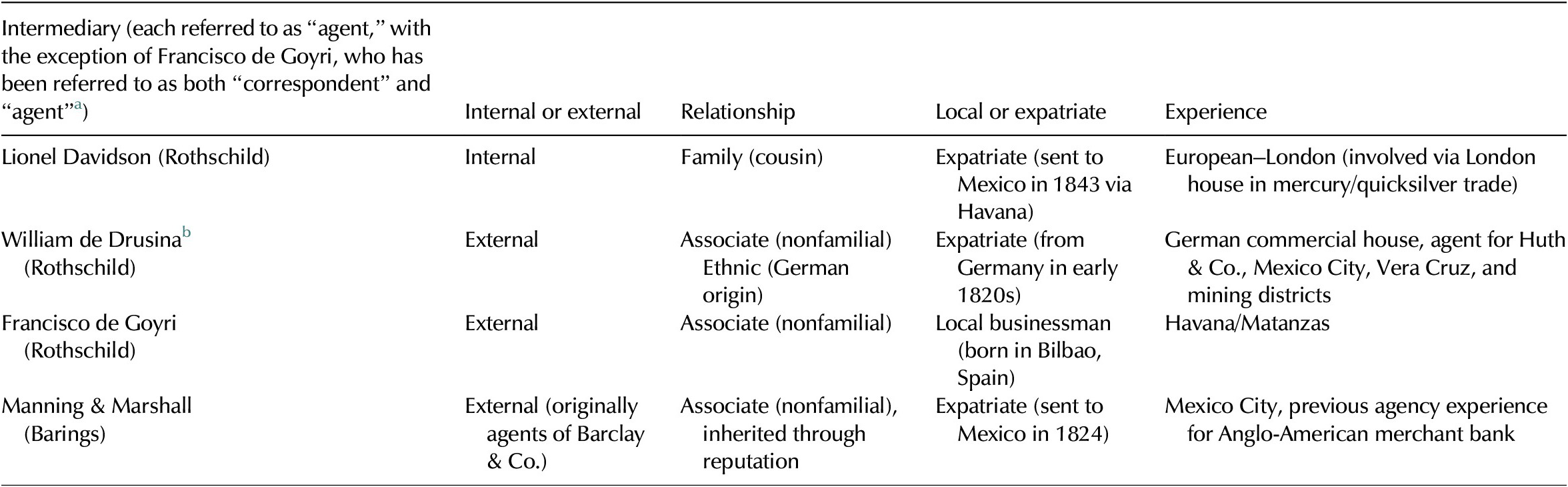
Intermediaries are a necessary actor in many forms of networks because they bridge clusters, regions, and other actors. While they bring many benefits to themselves and the actors to which they are linked, they also possess an astounding amount of influence in the overall network structure and function. While the benefits of being a central actor in a larger network, much like the central merchant bank firms, can be quite explicit (e.g., access to resources both tangible and intangible, established reputation, and ability to spread risk), the benefits of the intermediary position within networks are more varied, given the dynamic nature of the role and the diversity of network structure.Footnote 102 In instances in which an actor creates a single bridge between two networks (for instance, between the core merchant banking network and a network of correspondents in the mining districts in Mexico), this actor becomes essential to ongoing transactions and information transmission between the two networks and can thus possess specialized capabilities useful to the central firm.Footnote 103 Therefore, in situations in which the merchant bank is reliant solely on this individual, the intermediary occupies quite an influential position in the network. Table 1 offers an outline of the intermediaries discussed in this study.
Description of intermediaries for Rothschild and Barings in Mexico and Cuba

Source: Rothschild Archive London XI/38/76A; Rothschild Archive London XI/38/88A; Rothschild Archive London XI/38/125A; Barings Archive, ING, HC 4.5.2.3a; HC 4.5.2.6b; HC 4.5.2.33.
a Goyri is referred to as an agent by Roldan de Montaud. Roldan de Montaud, “La dirección del Banco Español de Cuba,” 260. Correspondence reveals a period in which Goyri was given many responsibilities once belonging to former agents of Rothschild in Havana. Rothschild Archive London XI/38/76A.
b Drusina is included in the list of intermediaries here. While formal agents are the more obvious intermediaries we can see, some individuals such as Drusina occupy more of a gray space, where they possess many of the responsibilities of the agent but are not always referred to as such.
As seen in Table 1, only one of the intermediaries can be deemed as internal, meaning that person was sent by the merchant bank to establish himself in a particular location; similar to the move undertaken by William Beekman in Liverpool and Waddell Cunningham (on behalf of Greg, Cunningham & Co.) in New York, mentioned earlier. Most are, however, European expatriates, which implies a preexisting connection based on mutual ties, perhaps related to ethnicity; for example, the shared German ethnicity of Rothschild and Drusina.
The resident agent has long been recognized as a crucial intermediary in many merchant bankers’ international networks.Footnote 104 Resident agents were given responsibilities only granted to trusted, known, and (mostly) experienced individuals. They also received certain benefits from the central firm—a salary, shares, setup costs, subsistence, and so on. In some locations, merchant banks did not have these individuals, relying solely on correspondents or having their own branches in place; for example, the Browns, whose family members established branches in critical British and American locations such as Liverpool and New York and who had agents in places such as Boston and New Orleans.Footnote 105 The necessity of intermediaries has often overshadowed the negative consequences of such a relationship. This has long been recognized in the literature on agency.Footnote 106 The principal-agent problem is one that applies in many respects to these early long-distance trade and finance intermediary relationships. However, examining agency within the context of networks provides a more complex view. Intermediaries existed within a wider web of connections, and their relationships governed their network positions, especially when those connections became highly embedded as a result of duration of relationship, debt, reputation, and a whole host of other relationship characteristics (referred to by Ranjay Gulati and Sameer B. Srivastava as constrained agency).Footnote 107
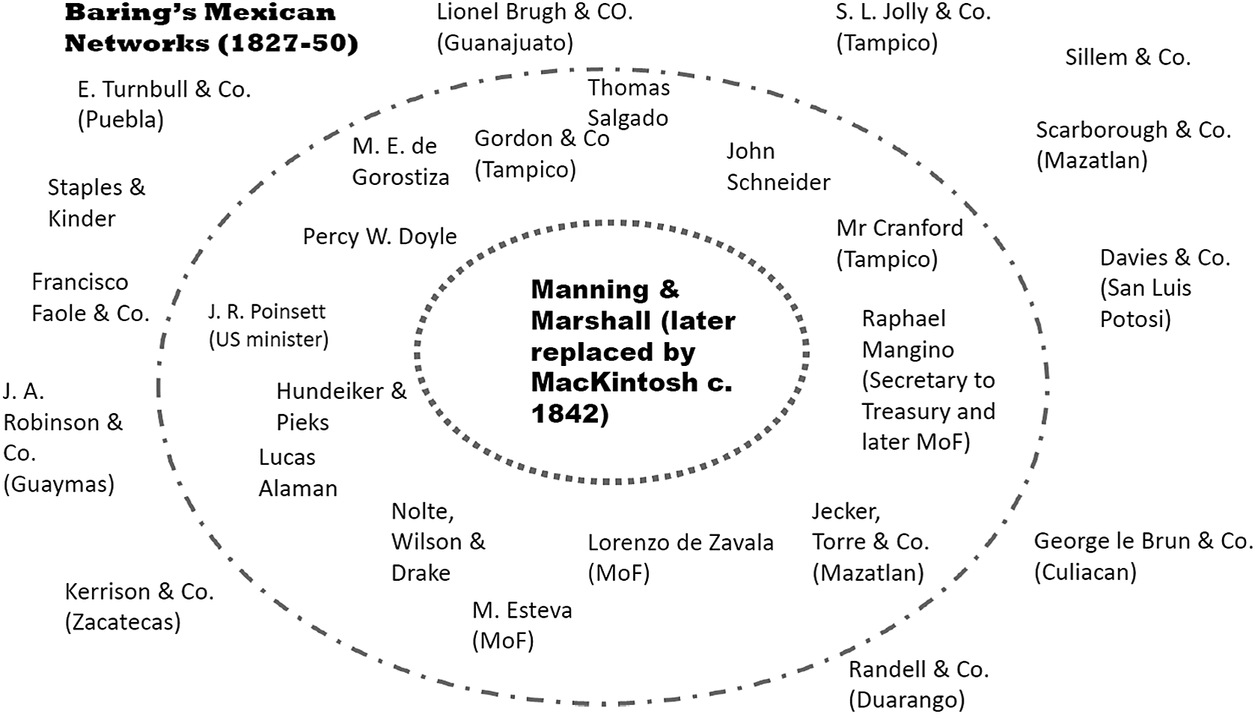
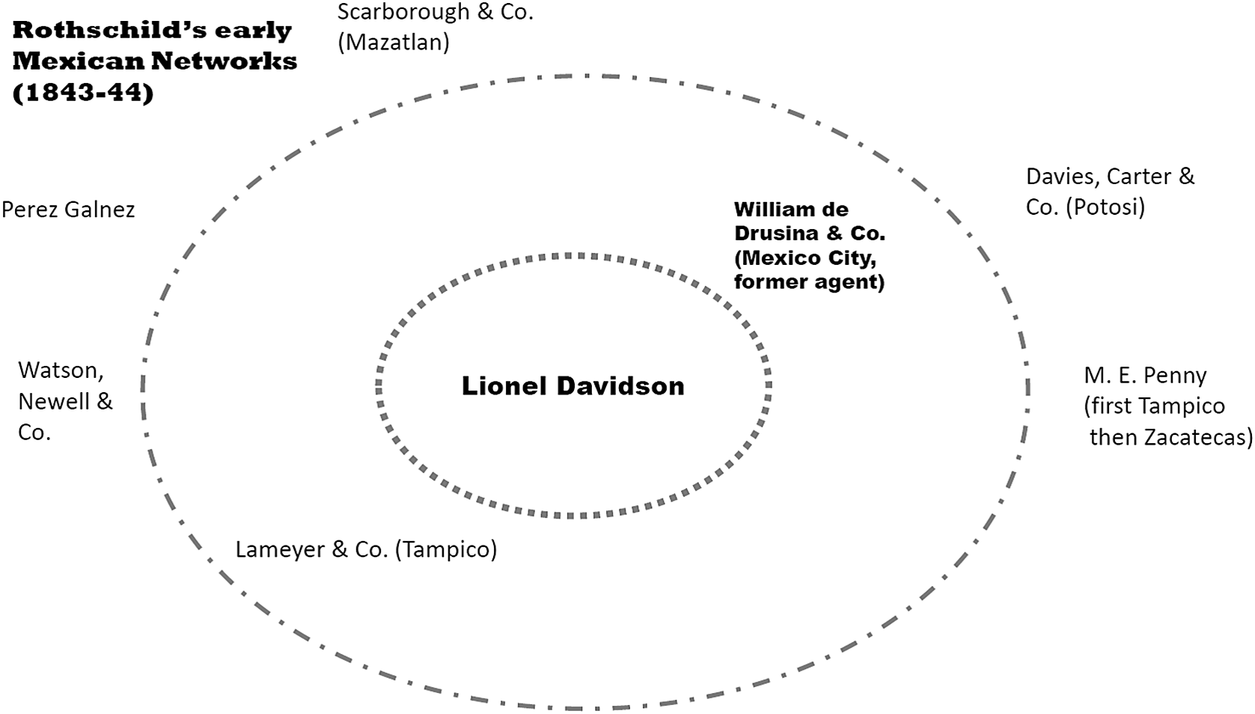
When examining the Spanish networks of the Rothschilds, López-Morrell and O’Kean constructed an internal and external network of contacts, with internal being agents/sister houses and external consisting of correspondents.Footnote 108 However, the categorization of these individuals as well as correspondents is fluid, as personal relationships develop and change over time. The boundaries between internal and external networks become permeable if we consider how frequently they change, how often correspondents are made agents and vice versa, as was seen in the case of Francisco de Goyri, who appears to have moved temporarily from correspondent to agent and back again; this is why the term intermediary has been chosen by the author. Keeping this in mind, while also applying López-Morrell and O’Kean’s idea of these network layers or hierarchy, highlights not only the extension and contraction of the network geographically and in terms of size, but also the movement between layers denoting interesting aspects of relationship progression, transformation, and renegotiation over time. Figures 1 and 2 illustrate the internal (agents/intermediaries, in center bold) and external (correspondents, second ring) networks of the Baring network in Mexico from 1825 to 1850 and N. M. Rothschild’s early network in Mexico. However, an additional layer (outside second ring) beyond the external network could be added for correspondents who were linked to the merchant bank through the agent alone and did not correspond directly with the central firm.
The Baring Bros. Mexican network (1825–1850)

N. M. Rothschild’s Mexican network (1843–1844)

Manning & Marshall (Marshall was replaced by MacKintosh in 1842 to create Manning & MacKintosh) secured an extremely advantageous position for the Barings in Mexico, despite problematic relations with the government. Through early network building with ministers and consuls, they fostered a reputation as the “ones to watch” in the Mexican merchant community.Footnote 109 Their activity also appears in a letter of Drusina to N. M. Rothschild in January of 1837, when he writes:
Messr Baring Bros & Co. have for years received very heavy amounts of specie because their agents here, Manning & Marshall have unlimited authority to draw upon them whenever they consider the Exchange and time favourable, and make remittances when and as best they can.Footnote 110
As can be seen in Figure 1, through Manning & Marshall, the Barings were linked to a number of firms scattered throughout Mexico (primarily in port towns or mining districts). As seen in the correspondence detailed earlier, Manning & Marshall held an influential position in their relations with the various ministers of finance and similar government officials, a position bridged to the Barings through intermediation. N. M. Rothschild’s entry into Mexico was much more incremental than that of the Barings and with far less involvement with the Mexican government. Before 1843 they possessed a correspondent-agent in Mexico City, William de Drusina & Co., but it was through Lionel Davidson, a special agent sent to Mexico City, that they attempted to network build in that region and move the network internally by extending the familial connection of Davidson to that region. Drusina was the perfect initial springboard into Mexico for N. M. Rothschild’s, having arrived from Germany in the 1820s as part of the first German commercial house located there. Through his work for Huth & Co. in the region, Drusina gained the necessary experience and connections to operate knowledgeably and skillfully in Mexico.Footnote 111 As detailed earlier, while Drusina was a crucial intermediary for the firm, he was not an agent in a formal sense, most obviously exemplified by the fact that he worked on the behalf of rival merchant bankers, specifically Huth & Co., and as mentioned, N. M. Rothschild was obliged to compensate the other London merchant bank a portion of the profits Drusina’s agency brought them.Footnote 112 That said, before Davidson’s arrival, Drusina possessed many of the same responsibilities as the later internally sourced intermediary. In relation to the quote on the leniency granted to Manning & Marshall by the Barings, Drusina wrote, “If it should suit your needs to act upon the same principle, we could send you a constant succession of shipments of specie.”Footnote 113 Drusina continues on to suggest that the risks in allowing the Mexican firm to draw greater amounts of credit from Rothschild would be limited. The following year, after the turbulence of the Panic of 1837, it is clear that Drusina’s firm is continually being urged to limit its activity. In response, Drusina writes:
We note that for the present you wish your credit to us for specie operations to stand as mentioned in your letter of 16 April and today we must only repeat that we will desist from all operations in specie on our joint account until the differences with FranceFootnote 114 shall be settled as under the present circumstances we cannot make quite sure that we can cover our drafts against Specie placed in the Interior by the Packet immediately following that which advised the drafts. We do not wish that you should experience any disappointment in this respect. When trade resumes its usual course we trust we shall be able to operate upon a secure and mutually advantageous footing.Footnote 115
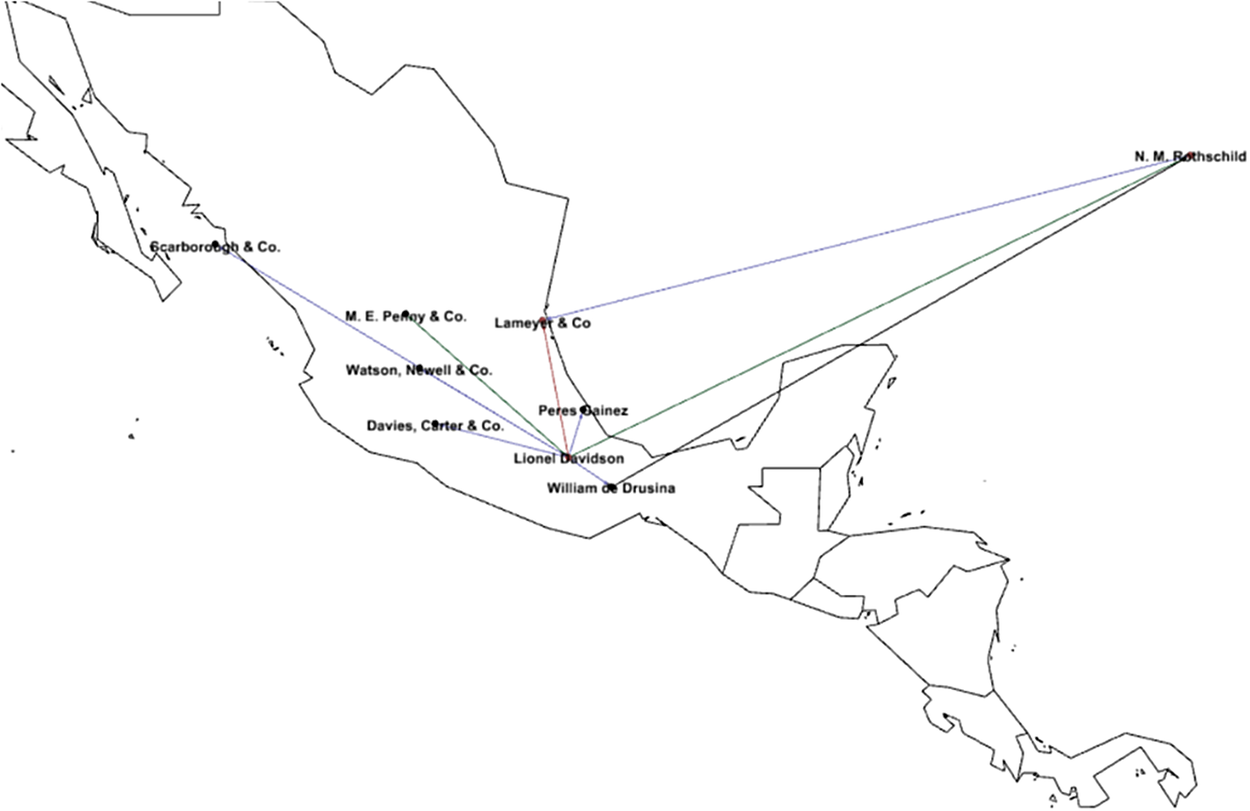
It is clear from Drusina’s letters that his firm continually exercises caution, waits for instructions from Rothschild, and does not overstep its responsibilities in the Mexican capital. The reason for the strict adherence to the “rules” implemented by the focal firm might be the less-embedded nature of their relationship. Drusina, while well-connected, is external to the firm; maintaining an amicable relationship is as beneficial (perhaps more so) to Drusina as to Rothschild, particularly because of the access to finance. As argued by van Driel and Devos, this form of network relationship created a “cooperative form of governance”; firms adhered to rules, because in doing so, they ensured themselves ongoing interaction with a well-positioned and well-connected firm.Footnote 116 The primary interest of the Rothschild firm in Mexico was the oft-mentioned specie trade; in particular, they sought access to the expanding silver-mining regions of central Mexico (e.g., Zacatecas, San Luis Potosi, and Guanajuato; see map in Figure 3). It is not entirely clear why Rothschild decided to bring in an internal intermediary to take on many of the responsibilities Drusina possessed, but it appears highly likely that the reasoning was twofold. First, N. M. Rothschild clearly wanted to expand its interests in the precious metals trade and had an advantageous position due to its involvement in the quicksilver trade. Expanding the business would require an individual with more experience operating internationally and perhaps a more trusted relationship with the firm. Second, N. M. Rothschild had been transacting with Drusina for many years and perhaps, given the drive to expand the business, it saw the limits or barriers this relationship provided. It becomes clear from the later letters of Davidson, the relationship of Davidson to N. M. Rothschild was one that allocated Davidson much more freedom and influence in decision making. This can be attributed to the closer social distance in the relationship between the focal firm and Davidson; familiarity in this and many similar relationships broke down barriers of formality that at times included strict adherence to codes of conduct (or rules).Footnote 117
Geographic representation of N. M. Rothschild–Lionel Davidson network in Mexico (created using Gephi)

When Davidson arrived in Mexico City in the summer of 1843, it was clear that it was Drusina’s obligation to pass on the duties of intermediation by providing an introduction into the Mexican business. Upon Davidson’s arrival, Drusina wrote Rothschild to express satisfaction with the handover:
We shall be happy to continue giving him all the information and assistance in our power, and we have expressed to him our readiness to offer such facilities as may be required for the purpose of rendering our intercourse with your much esteemed house at once important and advantageous. He will himself submit to you the results of our conversations of the moment on topics of principal importance to you.Footnote 118
This temporary triad would allow Davidson to carry on the business with the required knowledge to make decisions on behalf of Rothschild, as Drusina had done. Meanwhile, Drusina would remain linked to N. M. Rothschild by carrying on a much smaller merchandise trade business.Footnote 119 While Davidson enjoyed the contacts of William de Drusina & Co., he was essentially starting from scratch when he arrived with only Drusina to make introductions and give advice pertinent to local economic activity. Thus, while one can see here the potential to replace intermediaries in distant markets, the process was time-consuming and required access to resources, namely information. In situations in which the intermediary needed to be replaced because of failure or bad business behavior, this sort of induction process might not have been available to the focal firm.
As outlined by Roger Gould and Roberto Fernandez, the broker, which essentially equates to intermediary, possesses five main functions: coordinator, consultant, gatekeeper, representative, and liaison.Footnote 120 While the intermediaries discussed in this study can be seen to occupy all of these roles to some degree, in long-distance trade and finance, access to accurate information and knowledge of market conditions was paramount.Footnote 121 Thus the role of consultant was one that comes through most in the correspondence and in which one can see the most evidence of intermediary decision making. The following discussion will provide some examples of intermediary decision making in both the Rothschild and Baring networks, particularly pertaining to critical decisions involving debt repayment and local business activity. In critical decisions, we see the most evidence of the intermediaries’ activity and influence. In instances when decisions are not time sensitive, options are provided by the agent alongside a “trusted” opinion of which to pick. For example, the decision on where and how to set up an agent in Mexico:
These considerations have led me to the conclusion* that it would not be in your interest for me to establish myself here as an independent agent. But to conduct your business through a house like that of Drusina upon such a basis as I shall hereafter lay before you, and this for 2 Reasons:
1 A business confined to the city of Mexico must necessarily be so limited that it would not I think be worth your while.
2 Whilst on the other hand, a business conducted through correspondents in the Coast and in the interior, upon the plan I have been discussing with Mr. Drusina, might I think be carried on to my great advantage. But this would require such an intimate knowledge of the Country and of the people, that I consider that any stranger entering upon it by himself alone must necessarily mean great risks, nor could a man by remaining at that time in the country gain sufficient experience, unless during that time he were actually engaged in the trade.
*You will please bear in mind however that not having been in this place yet a week, what I write today are my first impressions, which it is very possible that a little experience may greatly modify.Footnote 122
Here, Davidson initially advises N. M. Rothschild against setting up a resident agent in Mexico, giving a rather negative opinion of the place and availability of opportunity. He also includes the caveat that this is an initial observation, subject to change. Perhaps this was influenced by the observation that Drusina’s business had failed to expand in his time with the firm. However, this initial observation was either changed or dismissed by the focal firm, as Davidson continues to pursue business through Mexico City.
In instances when agents were compelled to make decisions without consultation, justifications are provided after the decisions are made. In a number of instances, Manning & Marshall, given their long-term relationship with the government, make decisions on behalf of Baring Bros. related to ongoing business with the state and manner of debt repayment:
We take due note of your instructions and authorisation relative to the prospect of copper coin, respecting which we have had some conference with the Minister of Finance, but we fear we shall not be able to carry it into effect—for the only way we shall be induced to enter into business by the Government is if they pay us in cash immediately on the delivery of the amounts we might introduce into the country.Footnote 123
In the following passage, Manning & Marshall argue that they enacted a plan to accept payment from government in any form for the following reasons:
1. The [role] returned to your lender protest would serve you no purpose.
2. We know the state of the Treasury here where there is hardly cash enough to pay the troops
3. We do not like to give the Minister the opportunity at present of consulting the Chambers as to how their payments should be made … as consultation would take many months.Footnote 124
Exercising this type of initiative without consultation occurred not only because Manning & Marshall did not have the time to wait for a reply, which could take months, but because of the length of their experience with the Mexican government and their position in that local network. Because Manning & Marshall was an agency inherited by the Barings, it possessed a certain degree of seniority in its position. Thus, in this instance, the Barings would find it difficult to replace this intermediary should the relationship unravel. In certain situations, the intermediaries made decisions not acceptable to the central merchant bank firm, in which case, the intermediary provided justification after the fact. For example, Davidson was seen by the firm to rely too heavily on Drusina in his first few months in Mexico, giving him too large a percentage for his role as a commission merchant of Davidson.
Related to this Davidson wrote:
Ever since my arrival my object has been to make myself as independent of others as possible, arrangements with Drusina are of a temporary nature. By means of these however I have been enjoying the full benefit of his experience to initiate me in all the details of the business—and by the apparent willingness with which I at first enticed with all his propositions, I fully conciliated his good will.Footnote 125
Davidson argues that he secured Drusina’s service on the best terms possible; however, if Rothschild disagrees with continuing this relationship, Davidson indicates that he should cut off all communication with Drusina, since he will not be pleased with the new arrangement. Thus Rothschild was stuck here, Drusina being such an important contact in accessing the interior of Mexico and various knowledge resources, he has no choice but to go along with Davidson’s terms.
The records of correspondence of Francisco de Goyri in Havana to N. M Rothschild offer an interesting comparative perspective and an example of the process undertaken when adding an intermediary to an established network. In this instance, it is clear that de Goyri had to meet not only with the approval of Rothschild but of the agent already in place in Havana, Charles Tolme; the satisfaction of both parties was necessary. Given that Tolme was experiencing hardships, Rothschild needed to install someone else to handle matters in Havana. In response to the handing over of this responsibility, de Goyri writes:
It has afforded me pleasure that you are satisfied with Mr. Tolme having turned over to me such of your property as they held and I beg to assure you that in the management of the same, as well as of all business you may confide to me, I shall devote such attention to it as to merit also I hope the high satisfaction you are pleased to express as to the conduct of my friend, Mr Tolme.Footnote 126
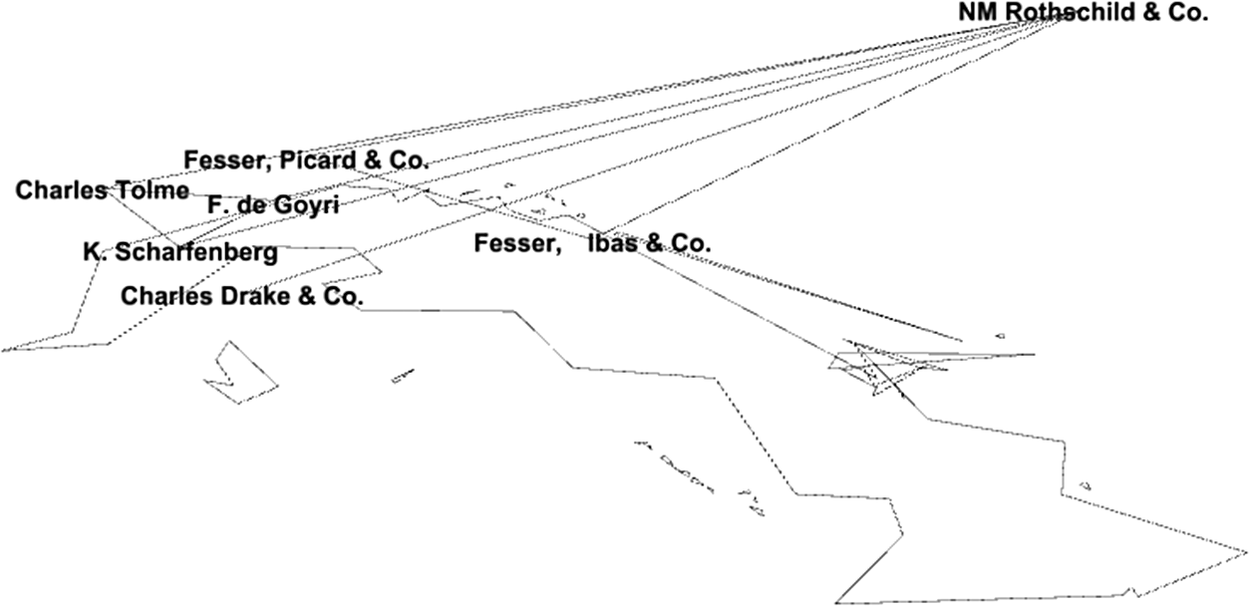
Figure 4 details the geographic spread of N. M. Rothschild’s principal direct correspondent network, through which it would have had access to clients located throughout Cuba. In some instances, the wider network also provided insights; in a letter to Rothschild, Davidson praises the merits of Tolme, regarding de Goyri as “a man of a different stamp” who leaves most of the responsibility of the business in the hands of Tolme.Footnote 127 That said, it is clear from Goyri’s pedigree why he was chosen to undertake this temporary role on behalf of Rothschild. Not only did he possess many crucial ties to the political elite in Spain, he was a well-known face on the board of the Banco Espanol de Cuba and commissioner of the Banco de San Fernando in Havana.Footnote 128 In 1846, when Scharfenberg returned to Havana, he went on to form Scharfenberg, Tolme & Co., and de Goyri was seemingly removed from the business (perhaps following the observations of Davidson). This demonstrates the difficult in placing a new external contact as a bridge into a well-established network; in this instance, it appears to have been a process of trial and error.
Geographic representation of N. M. Rothschild correspondent network in Cuba (created using Gephi)

With so much responsibility in the hands of intermediaries such as Drusina, Davidson, Manning & Marshall, and the various Cuban agents, what power did the central banking house have in controlling decisions made on the ground in these markets? Particularly as these firms expanded operations, further embedding themselves into the trading centers of the port cities and into the interior through ownership of mining companies and mints, intermediaries became essential, perhaps irreplaceable, network actors. The untangling of relations and winding up of business would certainly have been a lengthy process and the level of insubordination tolerated must come into question. Situations in which a network linked to the focal firm was already established, such as the case of N. M. Rothschild in Cuba, allowed for more flexibility on the part of the central merchant bank firm, because they were less reliant on one link into that region. In other networks, replacing an intermediary required a transitionary period, aided by the resources of the former intermediary. What can also be observed in these relationships is that social distance between focal firm and intermediary or preeminence in local networks greatly influenced the freedom of decision making for intermediaries and influence on the focal firm. In terms of avoiding agency problems, it is clear that in these and multiple other cases (Rothschilds’ New York agent August Belmont, for example), agency problems were at times unavoidable. However, the firms did their best to safeguard themselves against bad business practices by communicating their wishes clearly and often picking trusted associates and relying on agents to monitor one another, as seen in the example of Davidson and Goyri. Additionally, the intermediaries obtained many advantages from being associated with reputable British merchant banks and therefore benefited from maintaining good and amicable relationships.
Final Conclusions and Future Implications
Unlike Austin’s in-depth study of strategy and the Baring Bros., this paper focuses on peripheral firms in the merchant bankers’ international network. As integral players in wider merchant bank activity, these intermediaries provide interesting insights into the role of networks and individuals in the expansion and contraction of international business. In returning to the original research questions, it is clear that intermediaries possessed varied backgrounds and preexisting relationships with the focal firms, at times being sourced internally through familial or long-standing friendship connections (Davidson), externally inherited based on reputation (Manning & Marshall), external with ties to similar firms (Drusina), or entirely external (de Goyri). These differing types of relationships had the power to govern the relationship dynamics based on longevity of prior relationship and reputational standing. Those with larger business interests outside the focal banking firm would have a stake in protecting these as well.
Intermediaries also had multiple functions that were utilized to different degrees depending on the nature of the business and trust (often dictated by relationship longevity or reputation). They had the capability to expand networks in locations previously unknown to the merchant banks and, through their presence in distant locations, had access to important information pertaining to both economic and political conditions. The provision of this information and advice from the intermediary was used by the focal firm to make decisions regarding the direction of the business. As has been demonstrated, the advantageous position of the intermediaries allowed them a certain degree of independence in their activities in these locations, and they often made decisions for the benefit of the central firm, thus wielding a substantial amount of power in that relationship, especially in instances in which they represented the sole link between a given market or region and the central merchant bank. They also acted as liaisons, representatives, and gatekeepers for the merchant banks.Footnote 129 They found clients, extended financing, and chased up debts when necessary.Footnote 130 The ability of the focal firm to replace these intermediaries was dictated by a number of factors: the nature of the relationship with the prior intermediary, the intermediary’s position within local networks, and the focal firm’s preexisting familiarity with the market. To replace an intermediary, the focal firm required access to a flexible, open local network and a replacement intermediary who already possessed knowledge of the intended market or had access to crucial knowledge resources. Either way, the process was time-consuming and costly. Given the complexity and necessity of intermediaries in international trade and finance networks, this study serves to highlight the importance of these actors in the global activity of early merchant banks.
The cases presented in this article represent a fraction of the examples of intermediaries in the Rothschild, Baring, and other merchant bank firms extensive networks, and thus there is great scope for research into a host of comparative examples illuminating further network dynamics and strategies of some of the largest nineteenth-century merchant banks. Thus, many questions arise that further investigation into intermediaries could aid in answering; for example, did the focal firm manage networks in a holistic perspective or in different ways depending upon location or network actors. Unraveling these complex networks would serve to illuminate interesting aspects of the entrepreneurial activity of network intermediaries, allowing one to compare the effectiveness of intermediary activity in similar contexts and observe change over time in different merchant bank networks. Also important are the instances of failure among the community of merchant bankers; for example, in instances when merchant banks failed, what was the role of their wider network? Or in instances when intermediaries failed, what action was taken by the focal firm? Moving forward, it is the intent of this study to provide a foundation on which further examples from different geographic contexts and climates can build in order to construct a more complete and representative depiction of Anglo-American merchant bank activity. This will serve to demonstrate that merchant banks of the early nineteenth century created a small and interlinked world that was heavily intertwined and vulnerable to change, not unlike the global financial markets of today.