The velocity of the pulse wave is an important haemodynamic parameter with which to detect a healthy artery, or the degree of damage of a diseased artery.Reference Asmar, Benetos and Topouchian1 Reduced distensibility is associated with coronary arterial disease, hypertension, and cerebrovascular disease.Reference Stefanadis, Wooley, Bush, Kolibash and Boudoulas2, Reference Dart, Silagy, Dewar, Jennings and McNeil3 Arterial distensibility is at least partially controlled by vascular tone.Reference Panza, Epstein and Quyyumi4 Vascular tone, along with underlying physiological factors such as sympathetic neural activity and the levels of catecholamines and cortisol in the plasma, have been shown to follow diurnal variations.Reference Panza, Epstein and Quyyumi4, Reference Weitzman, Fukushima, Nogeire, Roffwarg, Gallagher and Hellman5
Melatonin, 5-methoxy-N-acetyltryptamine, regulates several physiologic functions, including cardiac rhythms, arterial blood pressure, heart rate, immune function, and sleep. It is a neurohormone produced in the pineal gland by stimulation of adrenergic β1 and α1 receptors, and it affects a variety of cardiac functions.Reference Scheer, van Doornen and Buijs6 In a normal environment, melatonin is secreted during the night in healthy humans.Reference Fourtillan, Brisson, Fourtillan, Ingrand, Decourt and Girault7 The average maximum levels attained in plasma in adults are of the order of 60 to 70 picograms per millilitre when measured with high-specificity assays. Minimum concentration in the plasma is usually below 5 picograms per millilitre. The peak concentrations normally occur between 02.00 and 04.00 hours. The onset of secretion is usually around 21.00 to 22.00 hours, with secretion ceasing in the period from 07.00 to 09.00 hours in adults living in temperate zones. The agent has been shown, in rats, to inhibit the central sympatho-adrenomedullary outflow.Reference Wang, Yokotani, Nakamura, Murakami, Okada and Osumi8 Several studies have suggested that sympathetic neural control affects not only small resistance arteries, but also the mechanical properties of large arteries.Reference Mangoni, Mircoli, Giannattasio, Mancia and Ferrari9–Reference Grassi, Giannattasio and Failla15
Noninvasive ultrasonic techniques are now used to evaluate cardiovascular health. One such technique, pulse wave velocity, uses the velocity of the arterial pulse as it moves through arterial lumens as an indicator of arterial elasticity. The technique has an important clinical role in identifying patients at high cardiovascular risk.Reference Asmar, Benetos and Topouchian1, Reference Asmar, Rudnichi, Blacher, London and Safar16 The velocity of the pulse wave is inversely correlated with arterial distensibility and relative arterial compliance. Theoretically, the velocity of the wave, C0, in a thin-walled, uniform, elastic vessel containing an incompressible, inviscous fluid, with no reflections, can be expressed by the Moens-Korteweg equation.Reference Moens17, Reference Korteweg18
The equation is C0 is equal to √Eh/2ρR, where E is Young’s modulus of elasticity, h is the mural thickness, R is the mean radius of the vessel, and ρ is the density of blood. Bramwell and HillReference Bramwell and Hill19 showed that the equation can also be expressed as C0 is equal to √dPV/dVρ where P is pressure, V the volume of tube per unit length, and dV/VdP represent the volume compliance of the tube. In this equation, the square of the wave velocity is associated with the inverse of the volume compliance, which represents the total arterial stiffness.
The aim of our study was to investigate the effects of endogenous levels of melatonin in the plasma on arterial distensibility in healthy young students by using the velocity of the aortic pulse wave measured in the supine position.
Methods
Population studied
We performed the study in the Cardiology Department of Medical Faculty of Trakya University. We studied 29 healthy young students, aged from 18 to 27 years, 19 of whom were male, and all being nonsmokers and not taking any medications or alcohol. All participants were healthy as determined by their history and a routine examination. Written informed consent was obtained from all subjects. The investigation conforms with the principles outlined in the Declaration of Helsinki. The study was approved by the ethics committee of Medical Faculty of Trakya University.
Protocol
Participants had regular schedules of sleeping, and typically consumed low amounts of caffeine, less than 50 milligrams, as verified using a log in the week prior to the study. All subjects were requested to relax in the supine position in an environment of low noise and low light, less than 25 lux, levels which have been shown to have little or no entraining effect on the circadian pacemaker.Reference Boivin, Duffy, Kronauer and Czeisler20 The environment was maintained at a constant temperature of 20 to 22°C, the subjects having consumed a light meal free of caffeine-containing beverages. The period of sleeping was scheduled to last from 23.00 to 08.00 hours. A full clinical evaluation, including measurements of vital sign and routine laboratory tests was performed 1 week before the start of the study.
The velocity of the aortic pulse wave between the carotid and femoral arteries, blood pressure, heart rate and levels of melatonin in the plasma were measured in all the subjects at two time points, namely between 01.30 and 02.30, and 13:30 and 14:30, during a single day. Samples of blood to measure levels of melatonin were taken with a 2-way stopcock heparinized polyethylene cannula inserted into a vein in the forearm. After centrifugation at 2000 to 3000 revolutions, the samples of plasma were immediately frozen at −20°C until analysis.
Body mass index and ratio of waist to hip
The body mass index in kilograms per meter-squared was calculated dividing body weight in kilograms by the square of body height in metres. We also calculated the ratio of the circumference of the waist to the hips.
Measurements of blood pressure and the velocity of the pulse wave
In each subject, the velocity of the pulse wave and arterial blood pressures were measured by the same observer after the subject had rested for at least 20 minutes. Blood pressures were measured using a mercury sphygmomanometer with a cuff appropriate to the circumference of the arm, using the first phase of Korotkov sounds for systolic blood pressure, and the fifth for diastolic levels. We performed 2 measurements in each subject, taking the mean pressure as the systolic pressure plus twice the diastolic pressure divided by 3.
Arterial distensibility was assessed using the Complior Colson device produced by Createch Industrie, France. The technical characteristics of this device have been described, and inter and intra observer coefficient values for repeatability calculated at greater than 0.9.Reference Asmar, Benetos and Topouchian1 The system is designed to determine the arterial distensibility by measuring the time interval and velocity of the pulse wave. Two acoustic sensors deliver the signals of the pulse wave to the acquisition board. A pedal triggers the data acquisition. The computer measures the velocity of the pulse wave along the aorta using two ultrasonic or strain-gauge transducers fixed transcutaneously over a pair of arteries separated by a known distance, namely the femoral and right common carotid arteries. During preprocessing, the gain of each waveform was adjusted to obtain an equal signal for the two wave forms. During measurements, having recorded waveforms of sufficient quality, digitisation was initiated by the operator, permitting automatic calculation of the time delay between the two upstrokes. Measurement was repeated over 10 different cardiac cycles, and the mean value was used for the final analysis.
Assays
Assessment of the levels of melatonin in the plasma was performed within 1 month from sampling, using a commercially available radioimmunoassay kit (RE 293 01, IBL, Hamburg, Germany). Samples of from each subject were processed in the same assay to eliminate interassay variability. The assay has a sensitivity of less than 3.5 picograms per millilitre, and an intraassay coefficient of variation of less than 8%.
Laboratory measurements
Overnight-fasting blood samples were taken in the morning from the antecubital vein. Biochemical parameters, specifically fasting blood glucose, triglyceride, total cholesterol, high-density lipoprotein and low-density lipoprotein cholesterol, all in the serum, were measured using an Abbott C8000 (Abbott, Japan) automatic analyzer. Glucose was analysed using the hexokinase method. Total cholesterol, high-density lipoprotein, low-density lipoprotein cholesterol and triglycerides were measured by enzymatic methods in all samples.
Criterions for exclusion
We excluded any student having dysfunction of the liver, kidneys, heart or any other system of organs, along with any taking multivitamins, any drugs, or alcohol. We also excluded any students found, on a surface electrocardiogram, to have atrial fibrillation or atrioventricular blocking of second or third degree, any with a body mass index greater than 30 kg/m2, and those with a ratio of waist to hips greater than 1.
Statistical analysis
Analysis was performed using the ready-to-use programme of SPSS version 8.0. All the values were expressed as mean plus or minus standard deviations. The results were assessed using the Mann-Whitney and Wilcoxon Signed Ranks Test. Correlations were calculated with Pearson’s test. A p value of less than 0.05 was considered significant.
Results
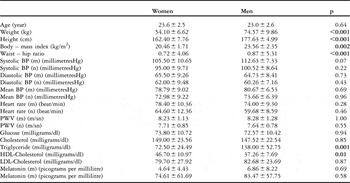
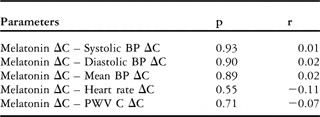
Anthropometric and blood chemical parameters are shown in Table 1. Although the velocity of the pulse wave, and systolic, diastolic and mean blood pressures and heart rate were all increased in the morning relative to values obtained later in the day, levels of melatonin in the plasma were increased at night (Table 2). There was negative correlation between diurnal levels of melatonin and the diurnal variation in the velocity of the pulse wave (Table 3).
Anthropometric, haemodynamic and blood chemistry parameters.

BP: Blood pressure, (m): Morning, (n): Night, PWV: Pulse wave velocity, HDL: High-density lipoprotein, LDL: Low-density lipoprotein.
Levels of melatonin and haemodynamic values in the morning compared to the night.

|ΔC (m−n)|: Morning-Night changed, m: Morning, n: Night, BP: Blood Pressure, PWV: Pulse wave velocity.
The correlation between diurnal changes in melatonin with the changes in the haemodynamic parameters.

ΔC: Morning-Night changed, BP: Blood Pressure, PWV: Pulse wave velocity.
Discussion
While body weight, body height, body mass index, the ratio of waist to hips, and levels of triglyceride were all decreased, levels of high-density lipoprotein cholesterol were increased, in our female subjects. Women are known to have higher levels of high-density lipoprotein cholesterol prior to menopause because this level is raised by oestrogens.Reference Manninen, Huttunen, Heinonen, Tenkanen and Frick21 In the age range of our subjects, the body mass index of males is usually greater than for females. An increased body mass index might adversely affect cardiovascular health through association with hyperlipidemia, increased arterial blood pressure, and inflammation. An increase in the body mass index and hyperlipidaemia are traditional cardiovascular risk factors, can be markers of inactivity, and could represent insulin resistance. They might also exert adverse affects on the vascular system by decreasing arterial elasticity.Reference Anuurad, Shiwaku and Nogi22 Arteries become less elastic with an increasing body mass index, and arterial stiffening is also observed. Some authors investigated the correlation between height and the velocity of the pulse wave.Reference Smulyan, Marchais, Pannier, Guerin, Safar and London23–Reference Hayward and Kelly26 As predicted, short stature is associated with decreased size of the carotid arteries, with a correlation between carotid arterial compliance and the measured systemic compliance.Reference Smulyan, Marchais, Pannier, Guerin, Safar and London23 Short stature is important in determining the increased carotid arterial flow index in women.Reference London, Guerin, Pannier, Marchais and Stimpel25, Reference Hayward and Kelly26 Short stature in females compared to males is also related to lower left ventricular stroke volumes, cardiac index, the diameter of the left ventricular outflow tract, and left ventricular mass.Reference Smulyan, Asmar, Rudnicki, London and Safar27, Reference Sudhir, Jennings, Funder and Komesaroff28
We found that the velocity of the aortic pulse wave, when used as an index of arterial distensibility, showed significant changes in healthy young students, along with blood pressures, heart rate, and levels of melatonin in the plasma. Although these values were increased in the morning, levels of melatonin in the plasma were increased at night. Sympathetic neural activity increases in the morning hours, and possibly affects the velocity of the pulse wave.Reference Panza, Epstein and Quyyumi4 This activity is likely increased by physical activity in the morning.Reference Bodlaj, Berg and Biesenbach29 To minimize the influence of physical activity, therefore, we rested our subjects in the supine position for 20 minutes prior to the initiation of measurements. A significant diurnal variation in the aortic augmentation index has recently been shown in healthy young men.Reference Bodlaj, Berg and Biesenbach30 Like the velocity of the pulse wave, this index is a measure of arterial stiffness, but in contrast to the velocity, the index depends additionally on stiffness of small arteries and the magnitude of the reflection of the wave from the periphery.
The velocity of the pulse wave is known to detect patients at high cardiovascular risk.Reference Asmar, Benetos and Topouchian1 The most important factor contributing to its increase in human populations is age, with arterial stiffness increased by medial calcification, increases in collagenous material, and loss of arterial elasticity.Reference Learoyd and Taylor31, Reference Olivetti, Anversa, Melissari and Loud32 In addition to the role of age, the velocity of the wave is higher at high blood pressure, lower at low blood pressure, and reflects heart rate and sympathetic stimulation.Reference Asmar, Benetos and Topouchian1, Reference Blacher, Asmar, Djane, London and Safar33–Reference Albaladejo, Copie and Boutouyrie35 Varying correlation coefficients have been reported between the velocity of the pulse wave and systolic, diastolic, and mean blood pressures.Reference Blacher, Asmar, Djane, London and Safar33, Reference Mackenzie, Wilkinson and Cockcroft34 Although the mean arterial blood pressure is determined by cardiac output and the total peripheral resistance produced by the arterioles, pulse pressure is influenced by left ventricular ejection, the elasticity of the large arteries, the timing of the reflected waves, and heart rate.Reference Mackenzie, Wilkinson and Cockcroft34 Elastic large arteries absorb energy during systole, and thereby reduce the cardiac work for a given cardiac output.Reference Asmar, Benetos and Topouchian1, Reference Mackenzie, Wilkinson and Cockcroft34 With the resultant increase in arterial stiffness with advancing age, this buffer effect is lost, with a concomitant increase in systolic blood pressure. In addition, there is loss of normal elastic recoil during diastole, and the diastolic blood pressure tends to fall.Reference Mackenzie, Wilkinson and Cockcroft34 Because coronary arterial perfusion occurs predominantly in diastole, the reduction in diastolic blood pressure may cause myocardial ischaemia.Reference Mackenzie, Wilkinson and Cockcroft34
Melatonin may have an inhibitory effect on sympathetic tone.Reference Wang, Yokotani, Nakamura, Murakami, Okada and Osumi8, Reference Yildiz, Sahin and Sahin36–Reference Abete, Bianco and Calabrese38 An exaggerated response of the sympathetic tone to a decreased stroke volume on the peripheral arterial system may increase the velocity of the pulse wave. Sympathetic neural control affects small resistance arteries and the mechanical properties of large arteries. Activation of the sympathetic nervous system, furthermore, has been shown to reduce distensibility of small and medium size arteries in animals and humans.Reference Cox11–Reference Giannattasio, Mangoni, Stella, Carugo, Grassi and Mancia13
Increased release of melatonin during the night may affect vascular function and lead to a decrease in the velocity of the arterial pulse wave. Melatonin is produced especially at night in the pineal gland. Its secretion is stimulated by the dark and inhibited by light. The suprachiasmatic nucleuses of the hypothalamus have melatonin receptors, and melatonin may have a direct action on these centres to influence circadian rhythms.Reference Fourtillan, Brisson, Fourtillan, Ingrand, Decourt and Girault7 Acute administration of oral melatonin in healthy men was shown to reduce the pulsatility index in the internal carotid artery, the levels of norepinephrine, and blood pressure.Reference Arangino, Cagnacci and Angiolucci37 Melatonin was also shown to anatogonise sympathetic activity in the isolated papillary muscle of rats, an experimental model where central nervous system control and other hormonal influences are excluded.Reference Abete, Bianco and Calabrese38
In our study, there was negative correlation between diurnal levels of melatonin and the velocity of the aortic pulse wave. The study, however, has limitations. Making the measurements during the night is minimally influenced by the non-sleeping state of the subjects. Also, we cannot provide a clear explanation of our findings. Further studies are needed of larger groups, to include the evaluation of sympathetic versus parasympathetic activity in order better to understand the possible interactions of melatonin and sympathetic activity. Finally, we assessed the levels of melatonin only twice daily. It may have been better to make measures more frequently, but we were constrained by technical issues and cost-effectiveness.
Acknowledgments
We acknowledge the assistance provided by Professor Armagan Altun, from the Department of Cardiology, Medical Faculty, Trakya University, Edirne, Turkey, and Alparslan Sahin from the School of Medicine, Gazi University.