Physical Activity
Physical activity, movement resulting in energy expenditure, is a critical component of health maintenance and the improvement of many health conditions (Caspersen, Powell, & Christenson, Reference Caspersen, Powell and Christenson1985). Physical inactivity, or engaging in physical activity that is not vigorous or long enough in duration to result in energy expense, is associated with deteriorating health, reduced life expectancy, and obesity (National Institutes of Health [NIH], 2000). Obesity, a potential consequence of inactivity (combined with poor diet), has been characterised as a national health threat and is a risk factor for a variety of health problems, including coronary heart disease, hypertension, stroke, type 2 diabetes, certain types of cancer, and premature death (Centers for Disease Control and Prevention [CDC], 2012). Even individuals who are not obese, but who live physically inactive lifestyles, are at elevated risk for coronary heart disease, type 2 diabetes, hypertension, and colon cancer relative to individuals who engage in active lifestyles (CDC, 2001). Thus, the primary threats to health remain chronic, and in some cases preventable, diseases (Bickel & Vuchinich, Reference Bickel and Vuchinich2000). To reduce the likelihood of developing these chronic diseases, the U.S. Department of Agriculture Dietary Guidelines for Americans (2010) suggests participating in at least 150 minutes of moderate-intensity physical activity or 75 minutes of vigorous-intensity physical activity per week in combination with strength training twice or more weekly, is a potential protective factor from several of the chronic conditions noted above (Paffenberger et al., 1993; Walsh, Pressman, & Cauley, Reference Walsh, Pressman and Cauley2001).
Exercise
Exercise includes physical activity that is ‘planned, structured, and repetitive and has as a final or an intermediate objective of the improvement or maintenance of physical fitness’ (Caspersen et al., Reference Caspersen, Powell and Christenson1985, p. 127). The benefits of regular exercise, combined with limiting caloric intake, are associated with better health, even if exercise does not promote weight loss (Andersen, Reference Andersen1999; Lee, Blair, & Jackson, Reference Lee, Blair and Jackson1999; Hopkins, King, & Blundell, Reference Hopkins, King and Blundell2010). The consequences of engaging (or not engaging) in exercise have the potential for impact in a variety of domains, not only affecting physiological functioning, but also psychological health, including decreasing symptoms of depression, anxiety, and instances of substance use (Brownell, Reference Brownell, Brownell and Fairburn1995; Kayman, Bruvold, & Stern, Reference Kayman, Bruvold and Stern1990; Smits et al., Reference Smits, Berry, Rosenfield, Powers, Behar and Otto2008; Weinstock, Barry, & Petry, Reference Weinstock, Barry and Petry2008). Despite increased public awareness related to exercise and health, a sizeable percentage (26%) of the U.S. population continues to live physically inactive lifestyles (CDC, 2003). A majority of people who do engage in some physical activity are not active enough to experience the health benefits associated with exercise such that improved strategies for inducing exercise are warranted (CDC, 2003; U.S. Department of Health and Human Services, 2008).
Behavioral Interventions to Induce Exercise
One potential intervention to increase physical activity among inactive individuals is an incentive-based procedure such as contingency management (CM). CM has largely been used to study substance use and was recently found to be the most effective psychosocial intervention for illicit drug use (Dutra et al., Reference Dutra, Stathopoulou, Basden, Leyro, Powers and Otto2008). Although primarily studied with respect to substance use, the operant principles at work in CM can be applied readily to any verifiable behaviours, including exercise. CM involves access to putative reinforcers (e.g., access to monetary payment) contingent on a specified target behavior and withholding of access to reinforcers in the absence of the target behaviour (e.g., Higgins, Heil, & Lussier, Reference Higgins, Heil and Lussier2003; Stitzer & Petry, Reference Stitzer and Petry2006). CM is not intended to be a long-term program but rather a method to help individuals initiate behaviour change so that natural reinforcers can be experienced and so they may ultimately maintain behaviour in the long term. Although CM has been used to effectively reduce substance use and increase treatment compliance and attendance, few other health risk behaviours, such as inactivity, have been studied using CM (e.g., Defulio, Donlin, Wong, & Silverman, Reference Defulio, Donlin, Wong and Silverman2009; Rosen et al., Reference Rosen, Dieckhaus, McMahon, Valdes, Petry, Cramer and Rounsaville2007).
Several early studies demonstrated the potential for behavioural interventions to increase physical activity or exercise. Researchers have shown that a system offering tokens exchangeable for potential reinforcers contingent on exercise increased physical activity when used with behavioural contracting (Libb & Clements, Reference Libb and Clements1969). Others showed that contingency contracts between parents and children led to increases in physical activity among children (Taggart, Taggart, & Siedentop, Reference Taggart, Taggart and Siedentop1986), and contracts between researchers and participants led to higher rates of attendance to exercise sessions than did those with no planned contingencies (Epstein, Saelens, Myers, & Vito, Reference Epstein, Saelens, Myers and Vito1997).
More recently, investigators have examined the utility of behavioural interventions for exercise. For example, Cohen, Paradis, and LeMura (Reference Cohen, Paradis and Lemura2007) found that offering college students money contingent upon cycling in a laboratory setting greatly increased participants’ workout effort, duration, and the rate compared to the other conditions in which money was not available contingent upon cycling. Although Cohen and colleagues demonstrated that CM increased exercise in the form of cycling, they did not measure behaviour beyond one experimental session. Charness and Gneezy (Reference Charness and Gneezy2008) offered college students monetary incentives for brief (once in 1 week) gym attendance and longer-term (eight times within 4 weeks) gym attendance and found that gym attendance during intervention and post-intervention was significantly higher for those who could earn money over the course of 4 weeks relative to 1 week; both incentive groups had higher gym attendance than controls who could not earn incentives. Charness and Gneezy's study suggests that an incentive-based intervention could be effective to increase exercise; however, the researchers relied on self-report data with respect to exercise, so it is unclear whether participants attending the gym actually exercised.
An expected byproduct of exercise is weight loss and researchers have studied CM for weight loss among obese adults. Volpp et al. (Reference Volpp, John, Troxel, Norton, Fassbender and Loewenstein2008) studied 57 overweight but otherwise healthy adult participants in one of three randomly assigned groups, including a weigh-in group for which no incentive was available, a lottery incentive group for which weight loss earned drawings from a fishbowl of prizes, or deposit contract for which participants deposited money and avoided losing the money in the event of weight loss. Results revealed that after 16 weeks mean weight loss was greater in each of the incentive groups (lottery incentive and deposit contract) compared to the weigh-in group. Volpp and colleagues demonstrated the effectiveness of a CM procedure with overweight individuals for whom exercise may have more immediate and meaningful consequences (i.e., weight loss). A follow-up trial found similar results for weight loss among veterans (John et al., Reference John, Loewenstein, Troxel, Norton, Fassbender and Volpp2011). However, weight loss in Volpp et al.'s and John et al.'s studies may have occurred in the absence of exercise by adjusting diet. Further, although these studies present compelling data to support the efficacy of CM as a weight loss intervention, many physically inactive individuals are not overweight nor do they desire to lose weight such that interventions for inactivity are still warranted.
With growing concern over physical inactivity, behavioural interventions deserve further consideration as a means for initiating exercise. Establishing active lifestyles may be of particular importance among college students in that the college years are often when young adults initiate patterns of behaviour that are maintained into adulthood (Buckworth & Nigg, Reference Buckworth and Nigg2004). Further, obesity rates among young adults (ages 18–29) have increased threefold in the last three decades (CDC, 2009). The purpose of the current study was to test the feasibility of implementing CM to determine if such procedures would be successful in increasing exercise among physically inactive otherwise healthy young adult college students.
Method
Participants
We invited 10 participants, identified from an initial screening of 117 college students enrolled in upper level psychology courses, to attend an intake session. Of these 10, 8 completed intake (1 withdrew before intervention because of new employment) and 7 enrolled in the intervention (women = 6). Inclusion criteria for invitation to an intake session to determine study eligibility were that participants (a) self-reported that they were physically inactive (defined as exercising [engaging in 30 minutes or more of physical activity] less than 1 day a week on average for at least 1 month before the start of the study); (b) self-reported that they were not currently engaged in and had no plans to engage in efforts to increase exercise; (c) self-reported not suffering from any physical problems for which physical activity is contraindicated; and (d) had a Body Mass Index (BMI) between 18.5 and 29.9 (i.e., not underweight or obese). We excluded obese individuals to reduce the potential reinforcing effects of possible weight loss on behavior.
Materials
Self-report measures
We used a variety of self-report measures to determine that participants’ typical exercise patterns met our criteria for physical inactivity. Screening questionnaires included a demographics questionnaire and a Health Status Questionnaire (HSQ) used to screen for overall health of potential participants. We developed the Exercise Behavior Questionnaire (EBQ) to assess typical exercise patterns for a period of 1 month previous to screening that included numerous types of exercise that participants could endorse having engaged in, as well as how frequently and for how long they performed the activity. During intake and all subsequent phases of the study the Daily Exercise Report (DER), developed by the current study authors, was used to evaluate recent patterns of behaviour. The DER included questions about frequency and type of strenuous and moderate exercise of at least 30 minutes in duration since last visit to the laboratory. Self-report data were not used for any decisions regarding access to reinforcers, but were a secondary means of characterizing the participants’ behavior.
Physical fitness analysis instruments and measures
Participants were given access to a laboratory in a psychology building located on campus. The setting was a small room located in the psychology building with one treadmill, a few free weights, and a computer. The room was private and only one session with one participant was conducted at any time, and the door was open just far enough so the researcher could constantly observe the participant without being intrusive. For the current study, ‘exercise’ refers to a bout of physical activity lasting 30 minutes or more during which time a target heart rate is met and maintained. We used a variety of measures to assess physical fitness, including a digital scale, a body fat analyzer, and a wrist heart rate monitor. We used a digital scale to measure current weight in kilograms. An Omron BodyLogic Pro Hand Held Body Fat Monitor (Omron Healthcare) was used to record height, weight, and age in order to determine BMI and body fat percentage of total body weight. A Timex IRONMAN Road Trainer wrist heart rate monitor with a lightweight Digital Heart Rate Sensor (Time Group USA, Inc.) recorded continuous heart rate via wetted electrodes, which were secured on the participant's breastbone.
Procedures
Intake
Potential participants (N = 10) who qualified were invited to enrol in the study and attended intake sessions individually. After providing informed consent, participants completed the demographics questionnaire and EBQ, and we recorded their height in inches, weight in pounds, BMI, and body fat percentage. Participants received instructions for the contingencies in place for the remainder of the study and instructions on how to schedule further sessions. Eight participants elected to enroll in the study. Participants received $10.00 for attending the session.
Baseline (variable length)
During baseline, all participants had access to a treadmill and free weights in our lab for the duration of baseline, and physical activity in the lab was monitored (participants signed up via a web-based calendar to use the space; only individual use of the space was permitted). Participants were randomly assigned to experience differing lengths of baseline (range = 6–12 days). Engaging in exercise during baseline did not result in access to reinforcement. If participants exceeded one bout of physical activity per week during baseline (either verified by lab use or self-reported), they were not invited to enrol in the intervention. This criterion for exclusion from the intervention was not made evident to participants during baseline. One participant reported engaging in exercise twice during baseline and she was withdrawn from the study.
Intervention (4 weeks)
Following baseline, seven of the ten participants enrolled in the intervention phase. The 4 weeks immediately following baseline (regardless of baseline length) constituted the contingency phase, during which a changing criterion intervention was implemented. During each week of the contingency phase, participants were told that they could earn money to attend sessions three times per week (the target minimum number of days for exercise according to the U.S. Department of Agriculture Dietary Guidelines for Americans [2010]) in our facilities. We chose to impose a restriction on the setting for exercise in this study (as opposed to attempting to verify behavior that occurred outside of our lab) for two reasons: (1) if participants engage in the target behaviour even when behavioural costs are higher than typical (i.e., not only engaging in physical activity but doing so in a specific location) then the contingencies will likely work well with lower behavioural costs; and (2) restricting location allowed for improved ability to verify behaviour. During each session of the contingency phase, participants completed the DEQ, and weight and body fat percentage were recorded weekly. A research assistant was present for each session to verify behaviour. Participants could earn access to $10 worth of vouchers ($2 for attendance and $8 for meeting criteria) to be exchanged for money at the end of the study for every session during which behavioural criteria were met. If participants did not meet the behavioural criteria for the session, they earned an attendance payment of $2. During Week 1, participants were asked to use the treadmill for 5 minutes during the first session, 10 minutes during the second session, and 15 minutes during the third session in order to meet behavioural criteria for payment. During Week 2, participants were asked to use the treadmill for 20 minutes during the first session, 25 minutes during the second session, and 30 minutes during the third session. Beginning with Week 3, we provided participants with wrist monitors to measure their heart rates. For Weeks 1 and 2, the only behavioural criteria that participants needed to meet in order to gain access to payment was to use the treadmill (i.e., walk or run) for a requisite number of minutes on the treadmill for the given session. During Weeks 3 and 4, participants received instructions that in order to gain access to payment, they would be required to reach and maintain a specified target heart rate (50–85% of maximum heart rate for cardiovascular exercise; American Heart Association, 2011) within a 30-minute session. For all sessions, instructions included a reminder of the contingencies in place for that session and directions to walk or run on the treadmill. Participants were allowed to bring MP3 players and/or DVDs to view on a computer situated in front of the treadmill. If participants were not wearing proper attire (e.g., tennis shoes) they were asked to reschedule.
Two-week follow-up
Following the contingency phase, participants no longer received access to monetary reinforcement for each session; however, they maintained access to the lab during this time. Participants then returned to the laboratory for a scheduled follow-up session during which researchers measured weight, BMI, and body fat percentage and participants completed the EBQ and were paid $15 for attending the session, regardless of exercise during the weeks following intervention.
Results
In total, seven participants (women = 6) with an average age of 20.14 years (SD = .69) completed the study. One participant attended all baseline sessions, and met criteria for the first 2 weeks of the intervention but withdrew because of new employment. Analyses include data from participants who completed the study. For the purposes of analysis, ‘exercise’ refers to a bout of physical activity, verified by the researchers, lasting 30 minutes or more during which time target heart rate is met and maintained for at least half that period of time. Behaviour not meeting criteria for exercise, but involving the use of our lab facilities to engage in physical activity will be referred to as ‘physical activity’.
Change in Exercise as a Function of Study Phase
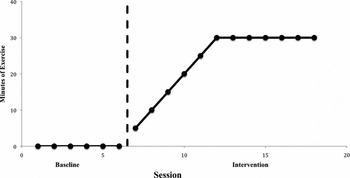
Visual analysis was the primary method of examining behaviour change across study phases. After intake, baseline and intervention levels of physical activity and exercise in the laboratory (30 minutes or more per bout) were observed by a researcher, while self-reported occasions of exercise outside of the lab were recorded. Figure 1 depicts minutes per week using our lab facility to walk on a treadmill (as verified by researchers) by study phase. Regardless of length of baseline (minimum = 6 days, maximum = 12 days), all participants engaged in exercise one or fewer times per week during their baseline phases. During intervention, all participants met behavioural criteria to gain access to contingent payments across all sessions for which these criteria were in place. During follow-up, no participants used our lab, although participants maintained access to our facility. Participants exhibited variable maintenance (M = 47.14 minutes, SD = 54.37; range = 0 to 150 minutes) of physical activity post-intervention (according to self-report); all but one participant self-reported maintaining physical activity levels above baseline at the 2-week follow-up.
Number of verified minutes of physical activity and/or exercise across study weeks. Data were identical across individuals such that only one line of data appears to represent all participants (and thus no error bars are necessary).

Effect on BMI and Body Fat Percentage
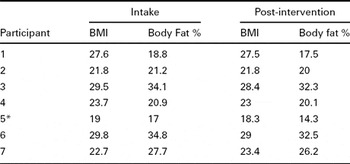
Inferential statistics to examine differences between verified behaviour in baseline and intervention could not be conducted because there was no variability during baseline or during intervention. We conducted dependent t tests to determine if participants’ BMI and body fat percentage changed from baseline to follow-up. There were no statistical differences between baseline, M = 24.87, SD = 4.2, and follow-up in participants’ BMI, M = 24.49, SD = 3.9, t(6) = 1.62, p = .16; however, there was a significant decrease in participants’ body fat percentage, t(6) = 4.86, p = .003 from baseline, M = 24.92, SD = 7.3, to follow-up, M = 23.27, SD = 7.2. See Table 1 for details by individual participant.
Pre- and Post-intervention BMI and Body Fat Percentage

Note: * indicates male participant.
Discussion
We implemented a multiple-baseline changing-criterion CM intervention to increase exercise among six physically inactive, but otherwise healthy, college-aged participants to test the feasibility of such procedures. All participants increased physical activity from physically inactive to exercising 3 days per week (at least 30 minutes per session) during the intervention. These results suggest that a changing criterion CM procedure is a feasible means to promote increased physical activity among physically inactive college students.
Study Strengths
Previous studies have shown that incentive-based procedures may increase duration, magnitude, effort, and rate of pedalling on a cycle within one session (Cohen et al., Reference Cohen, Paradis and Lemura2007), increase gym attendance (Charness & Gneezy, Reference Charness and Gneezy2008), and promote weight loss in overweight individuals (John et al., Reference John, Loewenstein, Troxel, Norton, Fassbender and Volpp2011; Volpp et al., Reference Volpp, John, Troxel, Norton, Fassbender and Loewenstein2008). The current study extends knowledge of CM's effectiveness for intervening with a novel population, physically inactive college students. Further, we examined the effectiveness of CM when a changing-criterion procedure is employed. The changing-criterion procedure appears to be a potentially effective strategy for employing CM among physically inactive individuals. By reinforcing incremental changes towards the target behaviour (at least 30 minutes of exercise), participants were more likely to meet criteria and contact reinforcers (Lamb, Kirby, Morral, Galbicka, & Iguchi, Reference Lamb, Kirby, Morral, Galbicka and Iguchi2010). If participants had been asked to immediately begin exercising for 30 minutes three times per week, many may not have been able to reach criteria, thus contact with reinforcers would not be experienced and could have no impact on behavior. Failure to contact the CM reinforcers effectively prohibits the possibility that natural reinforcers associated with exercise might emerge and ultimately maintain target behavior.
In addition to providing support for the efficacy of CM, many studies have shown that CM procedures have higher attendance rates (e.g., Ledgerwood, Alessi, Hanson, Godley, & Petry, Reference Ledgerwood, Alessi, Hanson, Godley and Petry2008) relative to other methods available, and our study mirrored those findings (e.g., Petry, Reference Petry2000). We assume that perfect attendance for participants in this study was a function of the potential monetary reinforcement available for both attendance (as is typical in CM studies) to sessions and meeting behavioural criteria for exercise during those sessions. However, other variables, such as social contingencies could have contributed to attendance rates. We can expect that social contingencies are available during most interventions, thus it is an unlikely the sole explanation for behavior change in the current study although we recognise its potential for influence. Further, Dallery, Glenn, and Raiff (Reference Dallery, Glenn and Raiff2007) used web-based CM procedures that included few, if any, social contingencies and yielded similar success rates for smoking cessation as typical CM formats (that necessarily include social interaction).
Study Limitations
Our findings suggest that CM can initiate exercise among physically inactive college students to levels within range of that promoted by the U.S. Department of Agriculture Dietary Guidelines for Americans (i.e., 75–150 minutes per week; 2010); however, there are several aspects of the study that should be considered critically. Although behavioural criteria required participants to reach and maintain a specified target heart rate (during the final 2 weeks of the intervention) to earn access to potential reinforcement, it may have been possible (although unlikely) for some participants to engage in less than moderate exercise (e.g., walking) while still maintaining the target heart rate criterion. In addition, our participants all had a BMI ranging from 18.5–29.9. Although this criterion was implemented for control purposes (to minimise the potential for weight loss confounding the intervention), it is possible that such an intervention strategy would be less effective for obese individuals for whom changes in activity level may be more challenging. Further, although there was a decrease in body fat percentage, there was not a consistent trend in BMI reduction from pre- to post-intervention. This finding is not surprising given that our intervention was relatively brief, our participants were not obese, and the intervention was not targeting weight loss (thus it is possible that participants may have increased caloric intake to compensate for increased activity; Hopkins et al., Reference Hopkins, King and Blundell2010).
Other limitations relate to the duration of the intervention/follow-up and the sample studied. First, the length of the intervention (i.e., 4 weeks) and follow-up period (i.e., 2 weeks) were chosen because this study is a feasibility study, thus there would be no need for a longer intervention if it did not induce behaviour change. A longer intervention (e.g., 2 months) would be more consistent with prior exercise work, and potentially more likely lead to improved exercise adherence post-intervention (American College of Sports Medicine, 1990; Dishman, Reference Dishman1991). Similarly, a longer follow-up (e.g., 3 or 6 months), with verification of behaviour, would allow for determination of whether CM is efficacious beyond initiation and short-term maintenance of behaviour change. Second, though the present study employed a multiple baseline procedure for control, replication within the context of a larger clinical trial among a more diverse sample is warranted.
The most significant and limiting challenge in the present study was the verification of all exercise throughout baseline, intervention, and follow-up. Without verification, researchers (and clinicians in applied settings) cannot be certain that the target behaviour occurred. We verified that participants did or did not exercise at our facility during the study phases, but not whether they exercised outside of the laboratory setting. Although there are several technologies that seemingly permit improved verification of exercise such as the Nike + iPod Sport Kit, Fitbit pedometers, or 3-D accelerometers, these do not necessarily improve verification in that all can be worn by someone other than the participant and there are instances of study participants placing pedometers on dog collars (Gorgan, Reference Gorgan2009). These technologies, used in tandem with efforts to verify behavior, may certainly improve precision of data collection. Future research will need to test the efficacy of techniques for verifying behavior in exercise interventions beyond the laboratory setting (e.g., video recording; Dallery et al., Reference Dallery, Glenn and Raiff2007; Dallery & Raiff, Reference Dallery and Raiff2011). Importantly, CM is an ideal tool for clinical settings that involve inpatient or intensive outpatient procedures during which behavior may likely be readily detected. Studies or programs conducted within a gym setting would also reduce the strain on ability to detect behavior, and thus offer promise for ecologically valid research as well as real-world implementation of CM for exercise.
A global concern related to incentive-based interventions is the cost-effectiveness of the intervention. Such interventions are often expensive to implement when using monetary reinforcers. Researchers have attempted to implement CM using goods and/or services but intervention costs (e.g., money, vouchers, goods, or services) have the potential to be high (Reilly, Roll, & Downey, Reference Reilly, Roll and Downey2000). Individual participants in the current study earned a total of $145 (including attendance and follow-up payments) over a 7-week period. Although expensive in the short term, this amount is small when compared to the costs of the potential negative health effects associated with a physically inactive lifestyle.
Clinical Implications
The rise in obesity rates has been steady and intervention strategies to date have focused on large and long-lasting changes in physical activity and diet that many individuals are unable to make or maintain (Hill & Wyatt, Reference Hill and Wyatt2002; Hill, Reference Hill2004). Changes in physical activity may be more challenging for those who are obese such that incremental changes are likely to be initiated and maintained relative to larger changes. As such, the Joint Task Force of the American Society for Nutrition, Institute of Food Technologists, and International Food Information Council have suggested that a small changes framework to address obesity may be most effective to increase physical activity levels and improve overall health among Americans (Hill & Wyatt, Reference Hill and Wyatt2002). In keeping with this recommendation, a changing-criterion incentive-based intervention (like those procedures employed in the current investigation) to increase physical activity may be an effective way to induce small but immediate and meaningful changes in behaviour that have the potential for long-term maintenance. Although individuals who are obese may stand to benefit more from exercise than healthy weight individuals, exercise is a protective factor for a variety of conditions regardless of weight such that CM for exercise may be beneficial to a variety of populations (CDC, 2012). For example, implementing CM to increase exercise among young adults might serve as a preventative strategy for future health risks, including obesity. CM procedures involving changing-criteria may also be particularly well suited for aiding post-operative cardiac or respiratory patients to resume physical activity safely.
Finally, as it is estimated that the external costs of a physically inactive lifestyle stem from additional resources received by physically inactive individuals from financed programs such as health insurance, sick-leave coverage, disability insurance, and group life insurance (Keeler, Manning, Newhouse, Sloss, & Wasserman, Reference Keeler, Manning, Newhouse, Sloss and Wasserman1989; Sturm, Reference Sturm2005), CM interventions to induce exercise may lead to downstream healthcare cost savings. Future work would benefit from understanding downstream healthcare utilisation among individuals who engage in CM to induce or increase exercise.
Conclusion and Future Directions
The present study demonstrated that a CM intervention can be effective for initiating exercise among non-obese weight, physically inactive individuals. The results of the current study are promising and suggest that incentive-based interventions can effectively initiate increased physical activity among previously physically inactive college students. Further research is necessary to fully realise the potential of CM for increasing exercise among a variety of populations and under what conditions the intervention can be best implemented and most effective.
Acknowledgements
The authors would like to acknowledge the Department of Psychology and the College of Integrated Science and Technology for the financial support to conduct this research. Also, we thank Drs Tracy Zinn, Monica Reis-Bergen, and Bryan Saville for their input on the current work. Finally we would like to thank the members of the Irons Research Laboratory Team for all their work.