Introduction
Numerous studies have observed how territorial reforms have (re)entered many countries’ policy agendas over the last decades. The amalgamationFootnote 1 of municipalities has often been employed as a policy tool for territorial rationalisation reforms. The advantages and disadvantages of enlarging the size of municipal jurisdictions have been widely investigated, along with its causes, drivers, and possible determinants (Baldersheim and Rose, Reference Baldersheim and Rose2010; Askim et al., Reference Askim, Klausen, Vabo, Bjurstrøm, Kuhlmann and Bouckaert2016).
On the other hand, the outcomes of this policy process, after its implementation, still needs further exploration. Studies are mostly country-specific (Steiner et al., Reference Steiner, Kaiser, Eythórsson, Kuhlmann and Bouckaert2016). They frequently focus on effects over economic performances – including economies of scale and quality of local services (Dollery et al., Reference Dollery, Byrnes and Crase2008; Blesse and Baskaran, Reference Blesse and Baskaran2016; Blom-Hansen et al., Reference Blom-Hansen, Houlberg and Serritzlew2021).
Based on the size-and-democracy paradigm (Dahl and Tufte, Reference Dahl and Tufte1973), the effects of amalgamations on democratic activities (Askim et al., Reference Askim, Klausen, Vabo, Bjurstrøm, Kuhlmann and Bouckaert2016) and their efficacy (Strandberg and Lindell, Reference Strandberg and Lindell2020) have also raised attention. In particular, concerning the effect of amalgamation on voter turnout, most studies find a negative effect, while a minority of them detect a null or even positive effect. Studies indicating a detrimental impact of amalgamation on turnout mainly investigate Northern European cases, although the same trend was observed in non-European countries too – e.g., Japan and Israel. However, a few studies examining Southern Europe show mixed evidence, with negative (Portugal) and positive effects (Italy).
This brief overview suggests a more complex, probably nonlinear (Kraaykamp et al., Reference Kraaykamp, van Dam and Toonen2001) relation between merger and turnout. Most studies are single-case analyses, while cross-country comparative analyses looking for regularities are extremely rare (Denters et al., Reference Denters, Goldsmith, Ladner, Mouritzen and Rose2014; Blesse and Roesel, Reference Blesse and Roesel2019). This inevitably reduces the range of possible predictors to characteristics varying within-country at the municipal level, without the possibility to assess the impact of country-level variables.
This article aims to fill this gap by providing an original dataset of municipal amalgamations occurred during the last decades in ten European countries (Albania, Austria, Denmark, Finland, Germany, Iceland, Italy, Luxembourg, the Netherlands, and Norway). We selected these countries to maximise variance on specific predictors related to municipal amalgamation processes, geographical area, and institutional features. This allows uncovering the possible explicative role of the characteristics of the particular amalgamation processes on voter turnout. To compose a unified theoretical framework, we considered several municipal-level and country-level features of the amalgamations – alongside other classical institutional, cultural, and second-order explicative factors.
Since we are interested in assessing the impact that the varying features of the amalgamation processes may have on turnout variation, we focus on the merged municipalities in the ten countries and look at how the different merging treatments influence turnout at the post-amalgamation elections. As such, our research design is a most-different systems design: amalgamation is constant in all cases, and there is much variation on the predictors expected to influence the impact of this common condition on electoral participation.
The contribution of this article is, therefore, both empirical and theoretical. Theoretically, it proposes a common and consistent theoretical framework, clarifies the shortcut between size and amalgamation, disentangles the multiple nature of size, and outlines clear testable hypotheses related to the features of the amalgamation as a policy process. Empirically, it provides a comparative dataset designed to make sense of the current incongruences in the literature on amalgamation and turnout, allowing us to test the hypotheses properly.
The chosen countries (1) have all experienced amalgamation processes in recent decades, (2) come from all the main European subregions (i.e., Northern, Continental, Southern, and Eastern Europe), and (3) present variation on the features of the amalgamation processes, which is essential to assess the expected effects.
Our findings highlight the relevance of crucial features of such processes. Specifically, in the case of amalgamations forced by the national government, turnout is particularly low. The same happens when the amalgamation takes place on its own, separately from a wide reform plan. Furthermore, post-amalgamation turnout is higher when the number of merged municipalities is larger and when the amalgamated municipalities had a similar population size before merging. Moreover, we empirically confirm the importance of some traditional predictors of turnout in municipal elections. Namely, turnout is higher when powers of the municipal level are high and when the number of municipalities voting together increases. In turn, the final dimension of post-amalgamation municipalities is not a significant predictor of turnout in municipal elections after amalgamation – which sheds new light on the size-and-democracy paradigm, at least with specific reference to such elections.
The article is structured as follows. The next section reviews the literature on the amalgamation/size and turnout relation. Then we illustrate our theoretical framework and our hypotheses. “Data, design, and methods” is devoted to the measurement and methodological aspects of our investigation. The subsequent section discusses the findings obtained from regression analysis. “Conclusion” follows.
Amalgamation and size (increase) – two faces of the same coin or not?
As Gendźwiłł et al. (Reference Gendźwiłł, Kurni, ewicz and Swianiewicz2020: 2) state, ‘cross-national comparative studies of municipal amalgamations (…) are rare’ since almost all contributions are single-case studies. From a non-exhaustive but accurate review of over 100 articles published on the size, merger, and local democracy relations since the early 2000s, little less than 90% focus on a single country.Footnote 2
Moreover, the existing comparative analyses are usually devoted to single out the drivers of territorial reforms (Baldersheim and Rose, Reference Baldersheim and Rose2010; Askim et al., Reference Askim, Klausen, Vabo and Bjurstrøm2017) or to exploring the different strategies (Steiner et al., Reference Steiner, Kaiser, Eythórsson, Kuhlmann and Bouckaert2016) and paths in their implementation (Sancton, Reference Sancton2000; Swianiewicz, Reference Swianiewicz2010; Reingewertz, Reference Reingewertz2012) – rather than their consequences. Evidence on the impact of the amalgamation reforms on different aspects of local government remains, at best, unclear and unsystematic (Swianiewicz et al., Reference Swianiewicz, Gendźwiłł and Zardi2017; Tavares, Reference Tavares2018). However, recently, some studies have started addressing the consequences of mergers on some aspects of the local government. They primarily focus on the economic performances – considering, for instance, the aggregate effects of consolidation and size on efficiency gains and cost/expenditure reduction (Reingewertz, Reference Reingewertz2012; Bel and Warner, Reference Bel and Warner2016; Blesse and Baskaran, Reference Blesse and Baskaran2016; Blom-Hansen et al., Reference Blom-Hansen, Houlberg, Serritzlew and Treisman2016; Harjunen et al., Reference Harjunen, Saarimaa and Tukiainen2021), on the costs of public services provision (Solé-Ollé and Bosch, Reference Solé-Ollé and Bosch2005), on the economies of scale (Dollery et al., Reference Dollery, Byrnes and Crase2008; Soukopová et al., Reference Soukopová, Nemec, Matějová and Struk2014; Drew et al., Reference Drew, Kortt and Dollery2016), or local taxation (Allers and Geertsema, Reference Allers and Geertsema2016).
Voter turnout variation has also raised scientific interest as a potential consequence of amalgamation. A large majority of the studies on this aspect observe a detrimental effect of the enlarged size on electoral participation (Fritz and Feld, Reference Fritz and Feld2015; Koch and Rochat, Reference Koch and Rochat2017). Other studies show that information costs for electoral participation are higher (Lapointe et al., Reference Lapointe, Saarimaa and Tukiainen2018), thus implying lower turnout rates – which is more evident in the first election after a merger (Koch and Rochat, Reference Koch and Rochat2017; Heinisch et al., Reference Heinisch, Lehner, Mühlböck and Schimpf2018). Studies revealing a detrimental effect of size increase on turnout are mostly Continental-European cases – Germany (Fritz and Feld, Reference Fritz and Feld2015; Roesel, Reference Roesel2017), Austria (Heinisch and Mühlböck, Reference Heinisch and Mühlböck2016; Heinisch et al., Reference Heinisch, Lehner, Mühlböck and Schimpf2018), Switzerland (Ladner, Reference Ladner2002; Koch and Rochat, Reference Koch and Rochat2017), Netherlands (van Houwelingen, Reference van Houwelingen2017; Allers et al., Reference Allers, de Natris, Rienks and de Greef2021) – but the same negative effect was also observed elsewhere, e.g., in Japan (Horiuchi et al., Reference Horiuchi, Saito and Yamada2015), and Israel (Zeedan, Reference Zeedan2017).
Nonetheless, the overall picture is not entirely consistent: a null effect was observed in South Africa (Cameron and Milne, Reference Cameron and Milne2013), Japan (Mabuchi, Reference Mabuchi2001), and Finland (Lapointe et al., Reference Lapointe, Saarimaa and Tukiainen2018); while some positive, albeit limited, effects were found in the Netherlands (Kraaykamp et al., Reference Kraaykamp, van Dam and Toonen2001), Canada (Hicks, Reference Hicks2006), and Denmark (Bhatti and Hansen, Reference Bhatti and Hansen2019). Southern Europe shows few but, again, mixed pieces of evidence. While in Italy, Bolgherini and Mollisi (Reference Bolgherini and Mollisi2021) find a positive effect on turnout after amalgamation, in Portugal, Rodrigues and Tavares (Reference Rodrigues and Tavares2020) observe a negative impact – although referring to sub-municipal units.
Significant cross-country inconsistencies are therefore evident. They may reflect specific conditions in individual countries, such as legal/institutional or political factors. Thus, we posit that these inconsistencies derive from the single-country focus and the lack of a comparative perspective, which this article instead provides. Moreover, literature so far has devoted its attention to the (positive or negative) effect of amalgamation on turnout. We argue that, while interesting, this strategy is somewhat limited, as the actual effect of the process of amalgamation results from the specific characteristics of that particular process. Indeed, different countries show different features in the amalgamation policy process, such as average municipal size (both pre- and post-merger), timings, and type of mergers. Thus instead, we believe it is more fruitful to comparatively investigate the different amalgamation processes in different countries to make sense of the apparent idiosyncrasies by including various features of the reform process and assessing their predictive power over voter turnout.
Amalgamation is not (only) enlarged size
Any municipal amalgamation implies an increase in the size of the municipality, which, however, can vary in meaningful ways. This is often assumed in the studies on the amalgamation/turnout relation but rarely thoroughly discussed in its implications, which is indeed essential to make sense of the complexity of the effects of amalgamation on municipal electoral participation.
We can trace back the link between size and turnout to the well-known argument on the relation between the size of the community and the level of democracy posed by Dahl and Tufte (Reference Dahl and Tufte1973). In a nutshell, a smaller size should favour control by the citizens over the politicians, responsiveness, political efficacy, and thus, a better functioning of democratic ties. Larger sizes should foster systemic capacity, service delivery, efficiency, and hence a higher level of public services, but also a wider distance between citizens and institutions. Therefore, the former should favour higher political and electoral participation (and thus higher turnout levels), while the latter should lead to the opposite.
Size seems to matter at the local level more than at the national level (Dahl and Tufte, Reference Dahl and Tufte1973; Gaardsted, Reference Gaardsted2002) as far as turnout is concerned. This relation has been repeatedly investigated and as nearly as often confirmed but, again, in single-case studies, while comparative studies remain exceptions.
In the case of amalgamation, there is indeed a size increase, but this can be highly differentiated, and some theoretical caveats are in order. First, the concepts of size and amalgamation suffer from a critical bias. The trivial fact that amalgamation implies enlarged size led to a shortcut between the effect on turnout of size per se and that of amalgamation as a process. As a result, size is often used as a proxy for amalgamation when exploring the effects of amalgamation on various phenomena – turnout, quality of service delivery, economies of scale, etc. – and therefore, it is often the effect of size that is measured (Kraaykamp et al., Reference Kraaykamp, van Dam and Toonen2001, 415). Though amalgamation undoubtedly implies increased size, it also means much more. Politically, amalgamation may entail enlarged powers and competences (Allers and Geertsema, Reference Allers and Geertsema2016). Legally, it may imply various constitutional/institutional prerogatives (e.g., different electoral systems) and thus distinct political competition, and it also may trigger several political and social – let alone economic – dynamics. This means that effects on turnout are multifaceted. While size per se entails mid- and long-term effects (e.g., municipal powers may be larger in more populous municipalities), amalgamation effects are more short-termed (e.g., citizens’ reactions towards the merger and its policy process, perceptions concerning the loss of representation/gain of critical mass). Thus, turnout is affected by all these combined effects, especially in the first post-merger election. Several studies are devoted to time series analyses and to the mid- and long-term effects on turnout (Koch and Rochat, Reference Koch and Rochat2017; Roesel, Reference Roesel2017; Zeedan, Reference Zeedan2017; Bhatti and Hansen, Reference Bhatti and Hansen2019; Rodrigues and Tavares, Reference Rodrigues and Tavares2020; Allers et al., Reference Allers, de Natris, Rienks and de Greef2021). Instead, we focus on disentangling the various aspects of size and therefore pick a single post-merger electionFootnote 3 in order not to put another element (time) on top of this disentanglement in the upcoming regression models.
Secondly, size has a multifaceted nature.Footnote 4 First, we start from the premise that municipal size largely differs among European countries: a small pre-amalgamation Danish/Dutch municipality would be considered relatively big in Germany also after a merger; similarly, those considered as superior municipalities in Italy (over 15,000 inhabitants), a size hardly attained also after a merger, would be rather small in the Netherlands or Denmark, even before amalgamation. Moreover, Eythórsson (Reference Eythórsson, Baldacchino, Greenwood and Felt2009) suggests that, besides absolute size, relative/proportional size matters too, in particular in terms of voters’ attitudes towards the amalgamation. Jenny and Ennser-Jedenastik (Reference Jenny and Ennser-Jedenastik2014) find that when a small village merges with a larger town, the opposition is more likely to come from the former than from the latter. Some pioneering studies in the Scandinavian countries stressed how the expected power position in the post-amalgamation municipality is the strongest explanatory variable for attitudes pro or against mergers (Eythórsson and Jóhannesson, Reference Eythórsson and Jóhannesson2002 on Iceland; Kjær, Reference Kjær2002 on Denmark).
Thus, when it comes to municipal amalgamations, size has at least two sides: an input and an output side. The output side simply consists of the final dimension attained by the post-amalgamation municipality because of the amalgamation itself. In contrast, the input side reflects the relation between the municipalities’ pre-amalgamation population sizes. In other words, after amalgamation, we can have a final unit composed of two small municipalities, or five small municipalities, or one large municipality and one small one, or else one large with four small municipalities. These different combinations are what the input side of size looks at, regardless of the population of the final unit (which constitutes the output side).
The features of the member municipalities contribute to form those of the final unit, and thus the output-side size. However, the point is that final units with similar (output-side) populations may derive from different combinations in the input side, and we argue that this may lead to different effects on turnout. Distinguishing these two sides, and being aware of how they impact turnout differently, can help explain why the amalgamation-turnout relation is not straightforward and why the literature thus far has found mixed evidence.
Crucially for our investigation, as we shall discuss more thoroughly in the next section, the relative population ratio of each municipality also plays a role concerning turnout (Gaardsted, Reference Gaardsted2002; Koch and Rochat, Reference Koch and Rochat2017; Voda and Svačinová, Reference Voda and Svačinová2020).
Theoretical framework
This article aims at making sense of the apparent idiosyncrasies in the effects of municipal amalgamation on municipal electoral participation emerged in the literature, by investigating this variance in a comparative cross-country setting and focussing on the explicative role of the features of the amalgamation processes. Are there characteristics of these processes within the various countries (which could not be controlled for in case studies) that account for (part of) the turnout variation? And which ones? Furthermore, turnout after amalgamation varies significantly within country as well. Our comparative dataset is helpful to investigate this too, again focussing on the characteristics of the specific process of amalgamation occurring in each municipality – in which direction, to what extent, and under which circumstances do these elements impact turnout?
With this in mind, in this section, the theoretical framework employed to conduct our empirical investigation is outlined. It combines the above-reviewed literature arguments about size, municipal amalgamations, and their specific (national and local) features with classical predictors of electoral participation in municipal elections. First, we consider some characteristics of the amalgamation process at the national level, which are constant within each national electoral wave but vary across countries and by different national waves within our dataset. Analysing these, serves to evaluate the explicative ability of the type of reform enacted by each country over turnout and to assess under which circumstances amalgamations have different effects on municipal electoral participation. Amalgamation reforms can occur in different ways. The literature commonly stresses two main types of merging processes: compulsory vs. voluntary and massive vs. gradual. Massive indicates a comprehensive reform involving all municipalities in a country, while gradual refers to incremental, step-by-step reform. A compulsory amalgamation reform implies a top-down imposed decision, while voluntary reform entitles the single (groups of) municipalities to decide (with guidelines varying in strictness) if, when, and with whom to merge.Footnote 5
Previous studies have found these elements to be particularly important (Steiner et al., Reference Steiner, Kaiser, Eythórsson, Kuhlmann and Bouckaert2016). Top-down reforms are more likely to meet resistance at the local level (Baldersheim and Rose, Reference Baldersheim and Rose2010) since they can be considered as power-gathering by the central government. On the contrary, resistance to amalgamations may decrease if the reforms are introduced bottom-up (Eythórsson, Reference Eythórsson, Baldacchino, Greenwood and Felt2009). Voluntary amalgamation processes are considered more successful. When the initiative is bottom-up, the process towards the amalgamation is more rapid (ibidem). Moreover, Steiner et al. (Reference Steiner, Kaiser, Eythórsson, Kuhlmann and Bouckaert2016) argue that top-down compulsory amalgamations are likely to trigger conflicts. This could imply a higher level of dissatisfaction. We still need to understand how this translates into effects on turnout. It could be both ways, as Denters et al. (Reference Denters, Goldsmith, Ladner, Mouritzen and Rose2014: 231) stress the unpredictability of the direction of (dis)satisfaction on the likelihood to vote since voting may be an expression of both satisfaction and dissatisfaction. However, we believe that in the case of low-stake, second-order municipal elections, dissatisfaction leads more probably to de-mobilisation than to mobilisation. Municipal elections are usually considered second-order elections (Reif and Schmitt, Reference Reif and Schmitt1980). Hence, regarding the electoral consequences of post-merger conflicts and dissatisfaction, we can reasonably expect apathy and a consequent de-mobilisation, because of the amalgamation, to prevail over mobilisation. Therefore, in general terms, to recall Hirschman’s (Reference Hirschman1970) classic concepts, we assume an exit strategy (de-mobilisation) as prevalent over a voice strategy (which might, in turn, lead to an increase in electoral participation). Thus, we expect a depressive effect of more conflictual (forced) amalgamations on turnout. Hence, we hypothesise that:
HYPOTHESIS 1: Ceteris paribus, opposed to a voluntary amalgamation, a forced amalgamation process will have a negative effect on voter turnout in municipal elections after amalgamation.
Analogous mechanisms can be expected for the overall scope of the amalgamation process, namely the portion of national municipalities involved in it. We argue that the scope of a particular amalgamation reform wave may be (inversely) related to the reaction triggered by it. We start by considering that the reaction to the policy decision to amalgamate is prevalently negative,Footnote 6 consistently with most previous studies that found a negative variation in voter turnout after amalgamation. Against this backdrop, voters might be expected to react less negatively when the whole country is affected (massive process), while they could oppose more fiercely the amalgamation when they are ‘alone’ (gradual process) in suffering the loss of their previous municipal home.Footnote 7 The reasoning behind this claim can be traced back to Wilson’s (Reference Wilson1973) classic argument that conflict tends to be lower when the costs of a policy are distributed rather than concentrated, as individuals feel less (or more) closely related to the policy. This classic claim has been widely applied to policy feedback studies, which emphasise the importance of perception of proximity as a key element in understanding citizens’ reactions to a policy, also with specific reference to the micro level (Larsen, Reference Larsen2019).
As for the previous hypothesis, how this translates into turnout variation is somewhat ambiguous. It depends on whether dissatisfied voters will turn out to the polls more (mobilisation hypothesis) or less (de-mobilisation hypothesis) than the others. Again, we argue that de-mobilisation is the most likely translation of such dissatisfaction in low-stake, second-order municipal elections. Thus, we expect that:
HYPOTHESIS 2: Ceteris paribus, the overall scope of the amalgamation wave will have a positive effect on voter turnout in municipal elections after amalgamation.
We now shift to the local features of the amalgamation. A crucial element is clearly the size of the constituent units, as many of the fundamental mechanisms discussed in the literature review are connected (directly or indirectly) with it. Hence, considering that the role of a different size (either absolute or relative) of the merged local units on the reform outcomes remains severely underexplored, we aim to analyse exactly this ‘heterogeneity of effects’ (Gendźwill et al., Reference Gendźwiłł, Kurni, ewicz and Swianiewicz2020: 13). We articulate the size-effect on turnout by employing the distinction between the input and output sides of municipal size introduced in the previous section.
First, we look at the output side by starting from the classical size-and-democracy argument posed by Dahl and Tufte (Reference Dahl and Tufte1973). Smaller size should favour higher turnout levels by enhancing political efficacy, while larger size should lead to lower turnout by putting a larger distance between citizens and institutions. As anticipated, this relation has been repeatedly tested and very often confirmed. Quite straightforwardly, our hypothesis thus sounds as:
HYPOTHESIS 3: Ceteris paribus, post-amalgamation municipal size will have a negative effect on voter turnout in municipal elections after amalgamation.
Besides the output side of size, we consider two aspects of the input side: the number of constituent units and the cross-unit population polarisation, which refers to the size relations among pre-amalgamation municipal units. Lapointe et al. (Reference Lapointe, Saarimaa and Tukiainen2018) and Koch and Rochat (Reference Koch and Rochat2017) both found that turnout was primarily affected in the small pre-merger municipalities. Considering this, we need to understand how these patterns translate into turnout variation in the post-amalgamation municipal units. While focussing on the pre-merger municipalities, the mechanisms highlighted by these studies can nicely serve our aim of building a theoretical framework that accounts for turnout variations in post-amalgamation units. On the one hand, we can expect higher population polarisation among pre-amalgamation constituent units (namely, mergers occurring among a bigger unit and much smaller ones) to lead to a stronger effect on turnout propensity operating on a limited population (that of the smallest units). In the opposite case of low population polarisation (when merging units are more balanced in population), mergers may have a weaker effect on turnout propensity, which however operates on a larger population.
Still, we need to consider the overall expected effects on turnout taking place in the final units. Some studies have specifically looked at this aspect. Jakobsen and Kjaer (Reference Jakobsen and Kjaer2016) found that (in Denmark) the struggle for representation in amalgamated municipalities is affected by the relative sizes of the former jurisdictions, with higher mobilisation when municipalities of similar size amalgamate. Moreover, the degree of mobilisation of the amalgamated units is more similar in medium cases, in contrast to amalgamated jurisdictions characterised by concentration.Footnote 8
This evidence leads us to hypothesise a dual dynamic linking cross-unit population polarisation to turnout variation, a dynamic that presents maximum and minimum expected points. On the one hand, we can expect that turnout after amalgamation will be highest when polarisation is lowest – i.e., when equal-size municipalities are merged (lowest depressive effect). On the other hand, the highest depressive effect on the overall post-amalgamation municipality is not expected to be found at the opposite extreme (i.e., when polarisation is highest). In such a case, the strong depressive effect on turnout operates on a too tiny fraction of the overall post-amalgamation unit (namely, voters of the small units that represent a smaller portion of the final overall population) to be appreciated, and hence, instead, a depressive effect of intermediate strength is expected. To appreciate a remarkable decrease in the post-amalgamation municipality (which can be expected to produce the highest depressive effect on turnout), the population on which the depressive effect operates needs to be large enough. The expected trend thus assumes a sort of v-shape.Footnote 9 In formal terms, we then expect that:
HYPOTHESIS 4: Ceteris paribus, cross-unit population polarization will have a v-shaped effect on turnout after amalgamation, with highest marginal effect for minimum polarization values.
Besides the cross-unit population polarisation aspect, amalgamations result from the merger of a varying number of municipalities. This amalgamation feature is also an important element to include in our framework, as recently suggested by Allers et al. (Reference Allers, de Natris, Rienks and de Greef2021). The reasoning behind this is that, in line with the instrumental voting theory, (some) voters turn out to the polls hoping to affect policy outcomes with their vote. From this perspective, amalgamation reduces the probability that one’s vote matters. This reduction increases as more jurisdictions are included. Moreover, the (perception of) internal political efficacy (Niemi et al., Reference Niemi, Craig and Mattei1991) is expected to decrease with the increase of size (here, the number of involved units) since the marginal weight of a single vote on a larger aggregate tends to vanish (Lassen and Serritzlew, Reference Lassen and Serritzlew2011).Footnote 10 Therefore we hypothesize that:
HYPOTHESIS 5: Ceteris paribus, the number of amalgamated units will have a negative effect on voter turnout in municipal elections after amalgamation.
As anticipated, our theoretical reflection needs to consider classic predictors of electoral participation in municipal elections, regardless of the presence of amalgamations. Gaardsted (Reference Gaardsted2002) argued that a cross-national comparison of the relation between size and local electoral participation is especially interesting when the countries compared differ for structural variables, such as size of the local authority, electoral system, and scope of government – which is exactly the case of our set of 10 countries. For instance, Gaardsted (Reference Gaardsted2002: 858) pointed out that the relatively high autonomy and scope of functions of local governments in the Nordic countries may be related to relatively high local election turnout. Furthermore, as Cancela and Geys (Reference Cancela and Geys2016) stated, on top of population size and composition, concurrent elections and the electoral system play an important role in explaining turnout in subnational elections. More generally, municipal elections are perfect examples of second-order elections (Reif and Schmitt, Reference Reif and Schmitt1980). As such, their turnout is expected to be influenced by the powers of the municipal government, the placement within the national electoral cycle, and the number of municipalities voting together (Bolgherini et al., Reference Bolgherini, Grimaldi and Paparo2021).
Are these features also relevant in cases of municipal merge? Our empirical investigation will reveal the factual answer to this research question. Nonetheless, the core of our scientific contribution lies in the assessment of the effects of the features of the amalgamation process on turnout. Hence, we do not formulate specific hypotheses on these classic predictors of electoral participation in municipal elections as their (dis)confirmation would not add very much to the existing literature. Instead, our framework includes these elements (as our regression models will) as controls, to make sure that our evidence on the hypotheses concerning the effects of the (local and national) amalgamation process is as robust as possible and to assess the impact of the amalgamation process’ characteristics net of the effects of all traditional turnout predictors. Although they do not vary before or after the amalgamation, they can be expected to interfere with the effects that amalgamation features have on voter turnout. It is therefore appropriate, when assessing the theoretically expected effects of the different amalgamation features, to control for them.
Finally, we believe that national political culture needs to be considered, as it may influence the electoral reactions to the amalgamation processes across different countries. Namely, polities more prone to passively accept decisions by the authority may show lower variations in municipal turnout after the introduction of a territorial policy change like the municipal amalgamation.
Data, design, and methods
To empirically assess the outlined hypotheses about the variegated effects of the municipal amalgamation processes on turnout in municipal elections, we have assembled an original dataset consisting of ten European countries –Albania, Austria, Denmark, Finland, Germany, Iceland, Italy, Luxembourg, the Netherlands, and Norway.Footnote 11 The pool of countries includes Northern, Southern, Eastern, and continental European countries, and it is large enough to perform a multi-level analysis – required given the nature of our data.Footnote 12 Moreover, the selection of these national cases was driven by the necessity to maximise variance on the amalgamation processes’ crucial features highlighted by our theoretical framework– voluntary v. compulsory; massive v. gradual; more or less municipal merging units; more similar- or more different-sized units. Finally, we were forced by data availability – crucially on both the municipal elections and the amalgamations enacted.Footnote 13 We have included all municipalities amalgamated in the period 1991–2019 in the selected countries.Footnote 14
Our dataset features 1,204 post-amalgamation municipalities, constituting the units of analysis of this study, which have merged 4,348 pre-amalgamation municipalities (see Table 1). Thus, on average, each post-amalgamation unit is formed by roughly four constituent municipalities. However, we note relevant cross-country variance. Germany and Albania merged, on average, more than four municipalities into one, Denmark is in line with the pooled mean value, and all remaining countries merged no more than three units.
Municipalities involved in amalgamation processes included in our dataset and turnout variation

For each country, we have consistently measured the electoral data, which will constitute our dependent variable, along with the predictors – both at the lower (municipal) and at the higher (country) level – emerging from our theoretical framework. A discussion about the specific operationalisation of our DV is necessary. Our hypotheses revolve around voter turnout in municipal elections after amalgamation. Consistently with previous amalgamation literature (trying to assess the treatment effect of being amalgamated), it is here operationalised as the turnout variation between pre- and post-amalgamation municipal elections. Although we argue that no single amalgamation treatment effect exists – rather, there are different treatments with different expected effects on turnout – we need to look at the variation to disentangle these different treatment effects. Consequently, we constructed our main DV by subtracting the turnout percentage in pre-amalgamation municipal elections from the turnout percentage in post-amalgamation elections.Footnote 15 Post-amalgamation turnout percentage was calculated by dividing the number of voters that went to the polls by the number of registered voters in the post-amalgamation unit (and then multiplying by 100).Footnote 16 We computed the turnout percentage in the pre-amalgamation elections by dividing the sum of the participating voters in the merging municipalities (multiplied by 100) by the sum of the registered voters in those municipalities.Footnote 17
Overall, the process of municipal amalgamation results in a decline in electoral participation in municipal elections (−2.9 percentage points on average). However, Table 1 reveals remarkable variations across countries. In Denmark and the Netherlands, turnout decreases are way above the mean value (15 and 9 points drop on average); in Italy, Austria, and Albania, on average, turnout decreases similarly to the overall mean; in the remaining countries, the average variation is virtually null or even positive (i.e., turnout increased).
This variance in the turnout after amalgamation (which is not limited to a cross-country comparison – as also indicated by the high values of the standard deviation for each national mean, last column) is particularly interesting to our analytic purposes. Indeed, this article attempts to model this variance according to the predictors highlighted by our theoretical framework with a rigorous cross-national multi-level empirical investigation.
We focus on the amalgamated municipalities only (and not on the comparison between merged and non-merged units),Footnote 18 as we are interested in the different effects on turnout of different treatments (i.e., different amalgamation processes) – and not in isolating a unified effect of treatment. We have argued that no such treatment exists, precisely as the treatments are different in nature. Conversely, varying expected consequences of the differences in the type of treatments can be meaningfully empirically verified. To this end, we choose a most-different-system design, in which amalgamation is a constant across all the municipal cases included in the dataset, which vary remarkably in terms of the predictors expected (according to our theoretical framework) to influence the impact of amalgamation on electoral participation. Our design strategy is methodologically particularly well-suited to empirically assess how different constellations of municipal amalgamation features impact turnout in the subsequent local-level election, which is the analytic goal of our article. To such end, we need to maximise variance on these process features.
Moving now to the specific measurement choice for our predictors, we point out that they consist of municipal-level variables (measured on post-amalgamation units) and country-level variables (on which values for post-amalgamation units are clustered by country – though often differentiated within country by year of election).Footnote 19 As selected predictors are at two different levels, and our DV is continuous, we will perform multi-level mixed regression with random intercepts at the country level, which allows the estimation of the effects for the country-level indicators, while best coping with the multi-level clustering of the observations.Footnote 20
We discuss here the measurement strategy for the predictors highlighted by our theoretical framework, whose effects on municipal turnout are in the hypotheses, while the online Appendix A reports similar information concerning the control variables included in our models. Starting with the municipal-level variables pertaining to the characteristics of the amalgamation process in each municipality, we included the number of merging municipal units and the population polarisation. The former simply counts the number of merged municipalities, ranging from 2 to 30. The latter implements the threefold classification proposed by Jakobsen and Kjaer (Reference Jakobsen and Kjaer2016), which distinguishes between amalgamation among equals (score = 3), characterised by one large municipality (=1), or mixed (=2) according to the relative size of the largest, second-largest and smallest pre-amalgamation municipalities. Namely, ‘one large’ represents cases of high cross-unit polarisation – when the largest of the former municipalities is more than twice as large as the second largest; the amalgamation is ‘mixed’ in cases of medium polarisation – when the largest of the former municipalities is more than twice the size of the smallest, but less than twice as large as the second largest; and ‘equal’ is when polarisation is low – the largest of the former municipalities is less than twice as large as the smallest municipality (Jakobsen and Kjaer, Reference Jakobsen and Kjaer2016: 216).Footnote 21 At the country level, we include a dummy indicator scoring 1 for municipal elections following forced amalgamations (when a higher-ranked authority has, if willing, the power to impose the amalgamation) and 0 for voluntary amalgamation processes (when either the municipal authority or the citizens have the final say on amalgamation)Footnote 22 ; and a continuous predictor indicating the scope of the specific amalgamation wave within the country. This is calculated as the fraction of the registered voters involved in the amalgamation wave on the overall national voters.Footnote 23
Findings
We now present and discuss the empirical evidence concerning the hypothesis testing for the effects of the features of the municipal amalgamation over turnout (variation) after amalgamation. Through these analyses, we can answer the focal research question of this study – what accounts for differences in turnout at municipal elections after municipal amalgamations? Are there significant effects for the characteristics of the amalgamation process? Which ones?
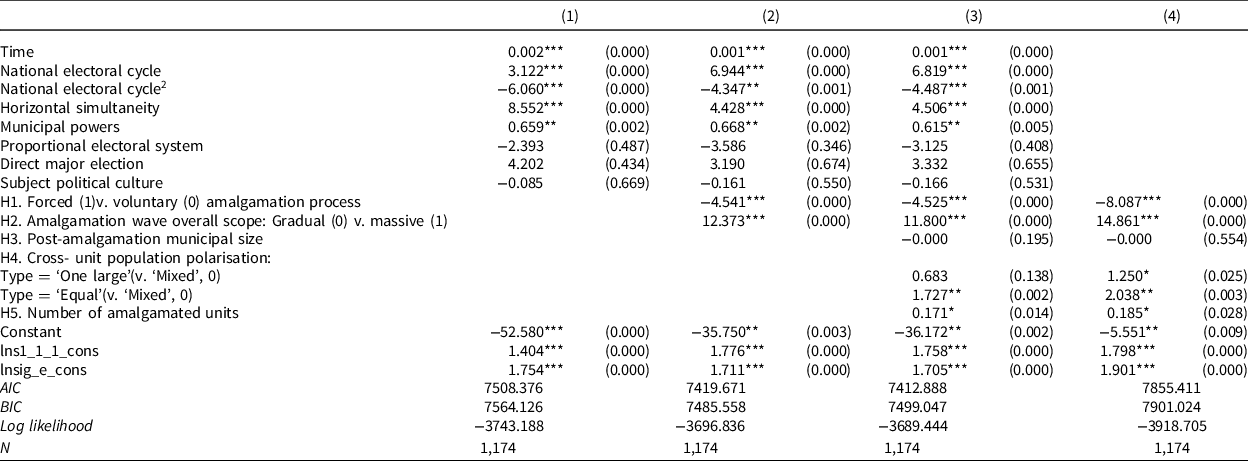
The relevant models – also including a control for the flowing of time within the period of observation (days since January 1, 1991) – are reported in Table 2. In a nutshell, they reveal the decisive role of the (national and municipal) characteristics of the amalgamation process. Compared to a baseline model (Model 1) only including the multi-level specification and the control variables, we find that the addition of the national features of the amalgamation (Model 2) reveals how, when the amalgamation is imposed by the national government, net of everything else, this translates into a highly statistically significant negative effect (4.5 percentage points large). The significant negative effect for the dichotomous indicator separating forced amalgamation processes from voluntary ones is a strong empirical confirmation for H1. Voters appear demotivated to participate in the local electoral process when they endure an imposed amalgamation as opposed to when they are included in the decision-making process.
Predictors of turnout variation compared with previous municipal elections in post-amalgamation municipalities

P-values in parentheses. *P < 0.05, **P < 0.01, ***P < 0.001. ICC coefficient for an analogously specified multi-level null model is 0.32.
However, this is counterbalanced by the large, highly significant, positive effect of the continuous indicator measuring the overall (nation-wide) scope of the amalgamation wave. The coefficient indicates that one municipality included in a country-wide reform of municipal boundaries (fully massive reform, 1) has a turnout variation around 12 points higher than a municipality identical on all other aspects but merged alone (gradual reform, almost 0).Footnote 24 This empirically corroborates H2. Voters appear to be particularly dissatisfied with their amalgamation when this is isolated, which brings de-mobilisation and depresses turnout. Yet, they are much less prone to feel alienated when they are not alone in losing their own old municipal entity. In other words, gradual amalgamations are particularly detrimental for turnout compared to large-scale reforms.
Furthermore, the addition (in Model 3) of the local characteristics of the amalgamation process, namely the output and input sides of municipal size, confirms the robustness of the effects of national-level amalgamation features. Moreover, Model 3 indicates the importance of the input-side features – number of units and cross-unit population polarisation. In fact, we find an empirical confirmation for H4, hypothesizing a v-shaped effect of polarisation on turnout. In particular, our analysis unveils that the baseline mixed type has the most depressive effect on turnout, precisely as H4 predicts.Footnote 25 To recall, the mixed type is intermediate in terms of polarisation – namely, the largest of the former municipalities is more than twice the size of the smallest, but less than twice as large as the second largest. On the other end, the two extreme types (‘one large’ and ‘equal’) both show higher levels of voter turnout. The significant positive coefficient for the ‘equal’ amalgamation type suggests that, when similar-sized municipalities are merged, a power struggle between the constituent units (for instance, to control the resources of the new municipal entity) might arise, and that this struggle might have a mobilising effect on voters. This is in line with our arguments that voters in smaller municipalities that are merged with much larger ones do feel less motivated than before to participate in local electionsFootnote 26 ; but that, in order to appreciate the depressive effect on turnout variation, the smaller units need to be not too small – otherwise, the lower participation rate of their former inhabitants risks passing unnoticed/unperceived.Footnote 27 It shall be noted that the effect of moving from ‘mixed’ to ‘one large’ is only marginally positive and the P-value is not significant. However, we deem this not to contradict the overall confirmation of the v-shaped hypothesis as the coefficient is in the expected direction, its P-value close to the .1 slight significance threshold, and considered the lower number of observations used to compute that P-value (not including the ‘equal’ type cases). Moreover, H4 expects the ‘one large’ type to fall in between ‘mixed’ and ‘equal’ (see Appendix B, Figure B1), which is exactly what is found in Model 3. Furthermore, Model 4 (without control variables, see below) indicates a full confirmation for H4 in terms of both statistical significance and ranking of the effects.
Moreover, Model 3 shows that the number of units constituting the post-amalgamation municipality has a positive and significant effect, indicating that the more units are merged, the less turnout tends to decrease. This is contrary to H5, which thus must be rejected. This piece of evidence might appear counterintuitive at a first glance. However, we argue that it can be interpreted as the manifestation of a mechanism possibly traced back to instrumental voting theory. Indeed, as Allers et al. (Reference Allers, de Natris, Rienks and de Greef2021) point out, the amalgamation is also an increase in voters’ power to affect policy through their vote, as the post-amalgamation municipality has more resources than pre-amalgamation ones. This is even more true the higher the number of the amalgamating units. Hence, the positive and significant effect emerging for the number of merged units suggests that voters weigh the increase in value of their vote in terms of higher resources at stake more than the loss of power of their vote due to its dispersion in a larger municipal unit.
Surprisingly, the indicator for the final dimension of the post-amalgamation unit (output-side size), while showing an effect in the expected negative direction, does not yield a significant effect. Thus, we have to reject H3: once national and local characteristics of the amalgamation process are included, overall size is not a significant predictor of turnout in municipal elections. This is a very relevant piece of evidence, which suggests a careful reconsideration of the classic argument about the relation between (local) size and democracy, seminally proposed by Dahl and Tufte.
Finally, Model 4 serves as a crucial robustness test for our hypothesis testing. By replicating the full model without the control variables, we make sure that no result is due to the encompassing control strategy adopted. Model 4 shows the robustness of our findings.Footnote 28 All significant effects are confirmed, while post-amalgamation population is clearly not relevant, thus making the rejection of H3 even stronger. Moreover, Model 4 corroborates the empirical confirmation for H4, as the coefficient for the effect of experiencing a ‘one large’ amalgamation (as opposed to the ‘mixed’ type) is fully statistically significant – but still lower than the ‘equal’ v. ‘mixed’ effect, exactly as expected. In short, in the case of a ‘mixed’ amalgamation, turnout variation will be roughly 2 points lower than in an ‘equal’-type amalgamation, and roughly half of that lower than a ‘one-large’ amalgamation. Thus, exactly as H4 argues, the least detrimental effect on turnout emerges for minimum cross-unit population polarisation values, and the most detrimental effect is found at medium polarisation values.
Overall, our empirical evidence provides a clear confirmation of the explicative role of the features of the specific amalgamation process over municipal electoral turnout. As we have hypothesised, different types of amalgamations do translate into different effects over electoral participation, which vary according to predictable dynamics responding to clear mechanisms. This is something that only a large cross-country comparative investigation, such as the one at hand, could unveil.
Our empirical analyses also reveal some interesting points concerning the classic predictors of electoral participation in municipal elections, included here as control variables. Net of all other variables in the models, the characteristics of the municipal electoral system do not play a role. Both the coefficients for the proportional electoral system and the direct mayoral elections are far from suggesting any statistically relevant effect. The composed marginal effect of the (linear and quadratic indicators for the) placement of the municipal elections within the national electoral cycle is also not significant.Footnote 29 Moreover, national political culture is not significant.Footnote 30
On the other hand, the powers of the municipal level yield a statistically significant effect. In line with the second-order elections theory, the coefficient is positive, indicating that, also after amalgamation, lower local autonomy depresses turnout. Furthermore, a highly significant positive effect emerges for horizontal simultaneity, which confirms that, also with specific reference to post-amalgamation municipalities, holding their municipal elections together with more municipalities increases electoral participation.
Conclusion
In this article, we investigated what accounts for variations in the effect of the municipal amalgamation process on voter turnout in municipal elections. To this end, we assembled an original dataset comprising around 1,200 amalgamated municipalities in 10 European countries.
Preliminarily, our descriptive evidence shed new light on the open debate concerning the amalgamation/turnout relation. The amalgamation process indeed results in a decline in participation in the subsequent municipal elections. At the same time, it challenged the approach usually employed to explore municipal amalgamation as a uniform phenomenon, by showing how such an effect is, in fact, very much variegated both across and within countries.
Consequently, we have investigated the variance in the municipal turnout according to a theoretical framework we have elaborated, which focuses on crucial features of the amalgamation process itself – both at the municipal and at the national level. National case studies published so far could not successfully disentangle the effects of the latter and were much more limited in terms of variance also on municipal-level amalgamation characteristics.
Our findings reveal the crucial importance of the specific features of the amalgamation process on electoral turnout, be they national or local. Indeed, turnout is more negatively affected – voters participate less – when the amalgamation is forced by the national government (rather than voluntary), when municipalities are included in a gradual amalgamation reform (rather than in a massive amalgamation wave), when larger units are merged with not-too-small ones (rather than equal-size units), and when fewer municipalities are merged. Other relevant features are the level of local autonomy and the simultaneity of the municipal elections, which instead boost post-amalgamation turnout levels.
In particular, national features of the amalgamation process matter greatly. Forced and gradual processes considerably depress municipal turnout in amalgamated municipalities. Indeed, the compulsoriness and the scope of the territorial reform are the most powerful explanatory factors, net of other institutional and political–cultural variables – and this is robust against several controls. Hence, a major contribution of this article rests in the clear policy recommendation that these features are carefully scrutinised when governments intend to pursue amalgamation reforms.
Besides the policy dimension, these results also present numerous important implications for the scientific debate on the effects of amalgamations on voter turnout. First, both our theoretical reflection and empirical evidence show that amalgamation, while implying a size enlargement, is neither a uniform phenomenon nor a monolithic/fixed/invariant treatment in itself – as often implied in the size-and-democracy literature. This distinction should be carefully considered in any further research on this topic.
Secondly, while amalgamation is indeed a variegated and multifaceted policy process, its effects on voter turnout vary according to predictable patterns – which pertain to its specific features. This means that any attempt to investigate the amalgamation/turnout relation, even single case studies, should encompass the peculiar characteristics of the amalgamations under scrutiny.
Third, (post-amalgamation) municipal size per se does not hamper turnout after amalgamation. Hence, the main size-and-democracy assumption must be somewhat reconsidered, at least with specific reference to the municipal merger phenomenon.
Fourth, the detrimental effect of merger process graduality on turnout is in line with Wilson’s (Reference Wilson1973) idea of concentrated policy costs of a proximate policy generating higher conflict, which appears to translate into de-mobilisation through the expected exit strategy (Hirschman, Reference Hirschman1970) – just as it happens with the dissatisfaction produced by amalgamations imposed by the national government.
Fifth, we see confirmation of a particular perspective of instrumental voting theory emerging from the significant increase in turnout when the number of amalgamated units is larger. This suggests that the increase in municipal efficacy after amalgamating is larger (in voters’ minds) than the decrease in the probability of each individual vote to matter, making voting in municipal elections more worthwhile when the number of amalgamated units increases.
Finally, our analysis indicates that post-merger municipal elections are second-order elections, as suggested by the significant reduction in turnout when the number of municipalities voting together, or municipal powers, are lower.
Moreover, from a territorial policy perspective, our findings may be of some interest as policy advice for national and local policymakers striving for evidence on the effects of territorial reforms and, more specifically, for the consequences of the different procedural choices when implementing a process of amalgamation.
Thus, overall, the first large comparative cross-country investigation conducted here provides a meaningful contribution to the literature. Nevertheless, several points still need to be explored. Further research is needed to assess whether these findings, specifically related to the first post-amalgamation municipal elections, do hold in subsequent elections, thus disentangling the shock and long-term effects of the amalgamation process. Moreover, we believe that additional elements could be fruitfully added to the picture. We do not argue to have exhausted the possible explicative factors of the turnout variance in post-amalgamation municipal elections. Future studies could profitably complement the theoretical framework with additional relevant dimensions. Furthermore, upcoming analyses should verify the robustness of our findings, increasing the number of countries investigated and employing alternative research designs – possibly including non-amalgamated municipalities through a matching strategy.
Supplementary material
To view supplementary material for this article, please visit https://doi.org/10.1017/S175577392300005X.
Acknowledgements
Earlier versions of this article were presented at the ECPR General Conference, Virtual event, 31 August 2021, and at the Brown Bag Seminars on Politics, Sapienza University, Rome, 24 November 2021. We would like to thank Paolo Bellucci, Stefano Costalli, Vincenzo Emanuele, and the anonymous reviewers for very valuable comments.
This manuscript has been read and approved by all authors: Silvia Bolgherini and Aldo Paparo.
We confirm that this work is original and has not been published elsewhere, nor is it currently under consideration for publication elsewhere.
Conflicts of interest
The author(s) declare none.