Why do clients support politicians they deem unreliable when they could punish these politicians at the ballot box? Traditionally, scholars have assumed that clientelism is more prevalent where voters are poor and are not able to punish bad patrons because they fear being cut off from future benefits by brokers who can monitor their behavior (Stokes et al. Reference Stokes, Dunning, Nazareno and Brusco2013; Stokes Reference Stokes2005; Nichter 2008; Reference Nichter2018; Gans-Morse et al. Reference Gans-Morse, Mazzuca and Nichter2014; Magaloni et al. Reference Magaloni, Díaz-Cayeros and Estevez2007; Chandra Reference Chandra2007; Szwarcberg Reference Szwarcberg2015; Nichter and Peress Reference Nichter and Peress2017; Brusco et al. Reference Brusco, Nazareno and Carol Stokes2004).Footnote 1 More recent scholarship has argued that clients have more freedom of choice and that they do exercise accountability. Specifically, scholars have found that under competitive clientelism, clients support the patrons they find the most capable and reliable (Auerbach and Thachil Reference Auerbach and Thachil2018; Kramon Reference Kramon2016) and punish the unresponsive (Nichter Reference Nichter2018).
The depiction of clients as either coerced actors or rational actors who vote for the best available patron cannot capture the choices of poor voters observed during months of ethnographic fieldwork in the Sertão of Bahia, Brazil.Footnote 2 Poor voters in the Sertão are immersed in a context of competitive clientelism. However, despite having the freedom to punish unreliable patrons, some clients still support candidates they deem corrupt and unresponsive.
How can we make sense of clients’ voluntary support for unreliable patrons? To explain this seeming anomaly, this study proposes a new way of thinking about clients’ choices under competitive clientelism. Clients’ puzzling vote choice in the Sertão suggests that competitive clientelism can be sustained by dynamics that are not entirely captured by clients’ rational calculations and material interests. This article argues that to better account for voters’ choice under competitive clientelism, scholars need to consider clients’ interpretations of their political world and their strategies for negotiating with politicians. To legitimize their future requests for politicians, clients in Sertão support candidates they perceive to be likely winners, even if it means voting for candidates they know are (and expect to be) unreliable patrons.
While voting for a known unreliable patron might appear illogical at first, from the client’s perspective, voting for likely winners allows voters to affirm their identities as deserving clients and embody the sense of entitlement that follows from feeling that they had contributed to a politician’s victory. This dynamic points to the importance of culture, especially socially constructed conceptions of citizenship and symbolic rewards, in determining the dynamics of clientelist relations.
The claims of this article are based on ethnographic immersion among low-income voters in the Sertão of Bahia. In 2014 and 2015, I engaged in participant observation among low-income voters by living in a public housing project in the region. Living for a long period among low-income voters allowed me to observe poor voters in their everyday lives. Such access was essential for me to observe the inconsistency between voters’ stated preferences for reliable patrons and their support for unreliable patrons.
This article contributes to scholarship on clientelism and political behavior. It provides a more nuanced picture of voters’ agency by showing that clients’ choices can be curtailed by the strategies that clients implement to gain symbolic power in their negotiations with politicians rather than overt threats from brokers. It also proposes an alternative mechanism through which clientelism can survive without monitoring mechanisms or a positive attitude of voters toward patrons. Furthermore, it adds another mechanism to existing studies that contend that clients consider candidates’ electoral viability to decide their vote (Kramon Reference Kramon2016; Muñoz 2019; Reference Muñoz2014).
The article also contributes to the growing literature in political science that argues for the need to account for how individuals perceive their context, as opposed to considering only rational calculations and strategic interactions, to understand their political behavior (Cramer Reference Cramer2012; Simmons Reference Simmons2016; Pearlman Reference Pearlman2016; Wood Reference Wood2003; Soss Reference Soss1999; Wedeen Reference Wedeen2009b; Chabal and Daloz Reference Chabal and Daloz2006; Parkinson Reference Parkinson2016; Kubik Reference Kubik2009; Yanow and Schwartz-Shea Reference Yanow and Schwartz-Shea2006; Schaffer Reference Schaffer2000; Bevir Reference Bevir2006; Schatz Reference Schatz2009; Schaffer Reference Schaffer2014). Furthermore, this study shows the importance of considering the everyday strategies individual voters implement to respond to their context and how those strategies shape voters’ identities as citizens.
Clients’ Choices in Current Studies of Clientelism
The most influential model of clientelism assumes that material and institutional constraints hinder voters’ ability to vote according to their preferences. These studies argue that low-income voters support vote-buying candidates and leave their programmatic preferences aside because they fear being cut out of benefits (Stokes Reference Stokes2005; Stokes et al. Reference Stokes, Dunning, Nazareno and Brusco2013). This model of clientelism assumes that clients vote against their preferences; thus, clientelism would be effective only in places where brokers can monitor voters’ behavior and punish defectors (González-Ocantos et al. Reference González-Ocantos, Chad Kiewiet de Jonge, Osorio and Nickerson2012; Magaloni et al. Reference Magaloni, Díaz-Cayeros and Estevez2007; Szwarcberg Reference Szwarcberg2014; Nichter Reference Nichter2008; Kitschelt and Wilkinson Reference Kitschelt and Wilkinson2007; Chandra Reference Chandra2007).
Other studies, however, have argued that clientelism does not necessarily depend on the use of coercion to secure voters’ compliance. These studies demonstrate that clients might support patrons voluntarily, either because they believe that their patrons are the best and most qualified candidates (Zarazaga Reference Zarazaga2014; Baldwin Reference Baldwin2013; Auerbach and Thachil Reference Auerbach and Thachil2018; Kramon Reference Kramon2016; Muñoz Reference Muñoz2014; Nichter Reference Nichter2018) or because they feel morally obliged to return favors from patrons (Finan and Schechter Reference Finan and Schechter2012; Lawson and Greene Reference Lawson and Greene2014). Therefore, this strand of the literature assumes that clients support patrons voluntarily either because of positive attitudes toward patrons or the prevalence of reciprocity among voters.
The puzzling behavior of voters in the Sertão challenges these two main explanations for the persistence of clientelism amid ballot secrecy. This article offers predictions about the logic underlying vote choices under competitive clientelism that differ from those provided by coercive or positive attitude approaches. Instead of fear of retribution, positive attitudes toward patrons, or positive expectations of future material gains, the explanation advanced here predicts that clients’ pursuit of symbolic power to negotiate with patrons will shape clients’ behavior. As such, clients will not necessarily support the candidate they evaluate as the most qualified but rather the one who better enables them to assert their identity as deserving clients.
This explanation allows us to understand why under competitive clientelism, where clients can choose among competing patrons and where they can punish unresponsive patrons, clients might continue to deliver their votes for unreliable patrons. In addition, by situating voters’ support for likely winners within clients’ strategies to negotiate with patrons, this article offers a different explanation to the literature that contends that clients consider a candidate’s electoral viability in their vote choice (Kramon Reference Kramon2016; Muñoz Reference Muñoz2014, Reference Muñoz2019).
Case and Methods
This study also differs from existing studies in how it assesses clients’ behavior. Most studies about clients’ attitudes and behavior rely on survey methods that ask respondents about intended voting choices (Kramon Reference Kramon2016; Auerbach and Thachil Reference Auerbach and Thachil2018; Baldwin Reference Baldwin2013; Muñoz Reference Muñoz2019; Weitz-Shapiro Reference Weitz-Shapiro2014) or past voting choices (Nichter Reference Nichter2018, 170–76). While these methods can provide insights into voters’ ideal choices, they should not be interpreted as direct evidence of how clients have indeed voted. Clients’ actual behavior might differ from their stated intention for numerous reasons. Social stigma might hinder clients from acknowledging their involvement in clientelist deals, but clients might also feel ashamed to report that they vote for a candidate described in a survey as engaging in vote buying, or for a patron who has previously denied them assistance.
Unlike most studies of clientelism in political science, this study relies on an ethnographic immersion among low-income voters. By following individuals throughout their daily lives, ethnography enables researchers to observes what individuals say and what they do (Jerolmack and Khan Reference Jerolmack and Khan2014; Wedeen Reference Wedeen2009a). This access to individuals’ stated attitudes and behavior is particularly crucial for research projects like this study, which deal with socially sensitive topics like clientelism.
I conducted ethnographic research in the Sertão of Bahia from August through December 2014 and in the summer of 2015. My immersion in the Sertão can be divided into two broad categories of participant observation: I lived among low-income voters and interacted with brokers and local politicians. My commitment to living in the Sertão among poor voters was essential for building trust and rapport with my informants, voters, and politicians.
In contrast to most studies on clientelism, which focus on political elites and brokers, I sought to investigate the experiences of individuals outside the realm of organized politics. To pursue this goal, during my first stay in the Sertão, I lived in a public housing project (the Cruzeiro residential complex, referred to hereafter as the Cruzeiro) in Pedrinhas.Footnote 3 By residing at Cruzeiro, I was able to gain access to ordinary citizens and follow them in their everyday lives. These citizens were diverse in age and gender, but they shared some correlates of poverty in Brazil: lower levels of education and income and lower formal employment rates. After learning the regional vocabulary used to talk about politics and the main politicians of the region, I also conducted ordinary language interviews with local citizens.Footnote 4
In addition to my participant observation among voters, I observed politicians and party activists, mainly from the local Workers’ Party (PT). I also worked closely with two candidates for the state legislature, Amélia and Ramiro, during the last three weeks of the 2014 campaign. To gather information about local politicians from other parties, I collected (and continue to collect) extensive archival documentation of the local media coverage of local politics. This documentation was extracted from Bahian newspapers, local bloggers who are also broadcasters on the regional radio stations, and social media accounts of the region’s political actors.
I observed the same voters in different circumstances by spending time with them, such as in private conversations about politicians and their public interactions with politicians. The long-term immersion among voters and politicians also allowed me to observe similar situations with different actors, such as politicians attending to requests from voters of different backgrounds. The multiplicity of real-life situations from both voters and politicians that I observed allowed me to note my informants’ objects of attention during the elections and to document the inconsistency between their narratives and behavior. I used an interpretive approach to make sense of that inconsistency.Footnote 5 Instead of interpreting those inconsistencies as lies, I used them to identify the patterns of thought and behavior that structure voters’ line of actions by revealing how one aspect of the meaning-making process structures various situations that local actors encounter (Tavory and Timmermans Reference Tavory and Timmermans2013, 692).
The long history of clientelistic politics in the Sertão of Bahia makes it an appropriate case for studying voting under competitive clientelism. The existence of clientelism in poor rural areas of Brazil like the Sertão of Bahia has been extensively documented (Leal Reference Leal1997; Vilaça and Albuquerque Reference Vilaça and Cavalcanti de Albuquerque1978; Ames Reference Ames2001; Montero Reference Montero2012; Van Dyck and Montero Reference Van Dyck and Montero2015; Borges Reference Borges2011; Power Reference Power2000; Alves Reference Alves2018; Alves and Hunter Reference Alves and Hunter2017). However, the existence of high levels of political competition in these areas is less well established. The appendix provides further historical background information about the politics of Bahia and electoral data to show the high levels of political competition at the state and municipal levels.
Frames, Strategies, and Identities: How Culture Shapes Vote Choices
Studies on competitive clientelism have demonstrated that clients value reliable patrons (Auerbach and Thachil Reference Auerbach and Thachil2018). Clients’ material interests could explain why they value reliable patrons but are not enough to predict clients’ votes. Knowing what voters want or value is not the same as knowing what strategies clients will adopt to achieve what they want or what choices they perceive are available to them. Beyond institutional constraints, cultural contexts also shape clients’ tools to navigate their political context and their interactions with patrons. To understand how voters approach voting, it is also essential to consider how voters interpret elections and what strategies they use in their daily lives to navigate patron-client relations.
In political science, culture is traditionally understood as the set of values and norms that direct behavior (Almond and Verba Reference Almond and Verba1989; Laitin Reference Laitin1986; Putnam et al. Reference Putnam, Leonardi and Nanetti1994). Instead of understanding culture as a set of deeply held values, this study adopts Swidler’s definition of culture as a toolkit from which individuals draw to construct lines of action (Swidler Reference Swidler1986). Culture as a toolkit highlights the role of culture as a resource that enables and constrains individuals to act in the world. Therefore, culture as a toolkit shapes action by providing individuals the ability and the means to understand and manage their social world rather than providing a set of norms that guides behavior.
Culture provides individuals with the ability to act in the world by offering individuals “ideas and images that constitute a view of the world” (Swidler Reference Swidler2001, 75), which cultural scholars refer to as frames. Because frames encompass an individual’s stock of knowledge about “how the world works” (Young Reference Young2006, 13), they play a crucial role in defining an individual’s ideas about what is possible, probable, desirable, or even imaginable. As such, frames make some courses of action seem more likely than others, rather than directly affecting social action.
The Sertão of Bahia’s case exemplifies the role that frames can play in making people perceive some lines of action as less pertinent than others. Voters in the Sertão perceived elections as rigged in favor of vote-buying candidates and those candidates as less likely to be reliable patrons once elected. According to these broader beliefs about how elections work, those in the Sertão who understand how politics works know that “good politicians” have little chance to win an election (Villela Reference Villela2005, 285). In that context, voting for a good candidate was perceived to be the naïve option.
The perception that elections are rigged in favor of unreliable politicians makes voting to help a good patron get elected less appealing. However, it fails to provide voters with a clear alternative. To understand why some voters choose to vote for unreliable politicians they believe will win, we also need to consider the everyday strategies clients rely on to deal with politicians.
The idea of a repertoire of strategies is related to the notion of habit, as it emphasizes the “ways actors routinely go about attaining their goals” (Swidler Reference Swidler2001, 82). These larger patterns of action are learned through socialization and are easily taken for granted (Swidler Reference Swidler2001, 81). As Auyero and Benzecry note, clientelism “occurs in everyday life” through routine interactions between clients, brokers, and politicians (2017, 182). These regular interactions produce a specific “understanding of politics as a form of solving daily private and public problems that is highly personalized” (Auyero and Benzecry Reference Auyero and Benzecry2017, 182). Besides, I argue, these routine interactions between clients, brokers, and politicians also socialize voters with strategies to negotiate with politicians and brokers.
In the Sertão, voters developed strategies to increase their symbolic power in such interactions. One popular strategy was to appropriate elite narratives of political deservedness. As the work of James C. Scott (Reference Scott1990) shows, subordinate groups have historically appealed to the narratives of the dominant to advance their interests. Similarly, poor voters in the Sertão recast elite notions of political deservedness to promote the legitimacy of their requests for personal assistance from politicians. In this narrative, local politicians and brokers legitimize their claims for continuous access to the spoils of office on the basis of the idea that they have contributed to a politician’s gaining office (Borges Martins da Silva Reference Martins da Silva2019, 129–33). Poor citizens adapted the elite language of political deservedness by expanding the notion of what counts as a contribution to include their individual votes.
Voters produced a series of narratives and actions to symbolically invert traditional hierarchies of power to legitimize their claim for assistance from politicians. In this upside-down world (Scott Reference Scott1990), the voter occupies the position of the benefactor. Voters approached politicians with a defiant attitude, threatening to punish those who denied them a hearing. They sought to enhance the value of their contribution to these politicians by frequently gossiping about the money that politicians can make in office or telling stories about how one vote can make all the difference in an election. They framed their vote as assistance they lent to politicians to help them get elected to office by literally replacing the verb to vote with the verb to help in their ordinary language.
This upside-down-world talk had little effect on making politicians more responsive to voters’ demands. However, it affected how the individuals who engaged in these narratives came to constitute their social identities as voters. Social identities are not a predeterminate fact based on a fixed social category, such as race, gender, or class. Instead, social identities result from everyday performances of public narratives and actions (Wedeen Reference Wedeen2009b; Arendt Reference Arendt1998; Somers Reference Somers1994; Butler Reference Butler2011). Through the daily performance of narratives and deeds associated with political deservedness, voters constituted their identities as deserving clients, as political beings who feel and act as if they have the right to receive assistance from a politician they have helped win office. Clients reaffirmed and embodied their identity as deserving clients by siding with likely winners. This socially constructed notion of citizenship weighed more on their vote than their evaluations of a candidate’s qualifications as a patron.
The following empirical sections will bring ethnographic evidence to support the claim that this voting logic is reflected in clients’ survival strategies and perceptions. The first empirical section discusses how voters interpreted the political context in which they were operating. It demonstrates widespread assumptions that elections were rigged in favor of heavily vote-buying candidates and that vote-buying candidates would become unreliable patrons once in power. The second empirical section examines the strategies that voters implemented in their everyday interactions with brokers and politicians to legitimize their requests and gain a modicum of symbolic power. The third section delves more deeply into cases of voters who supported candidates they perceived to be likely winners even if they knew those politicians were unreliable patrons. The comparison shows that, despite having different kinds of ties with patrons, what these clients shared was a fierce defense of their identities as deserving clients.
Frames: Clients’ Perspectives on Elections and Politicians
In the Sertão, comments about who had força na política (literally, strength in politics), which mostly meant who had a chance of winning, permeated discussions during the election. A candidate’s display of money through vote buying was often used as a marker of strength.Footnote 6 In this study, vote buying is defined as the distribution of favors, goods, or money from politicians to voters during the electoral period.Footnote 7 Voters and politicians alike shared the perception that money, often displayed through a candidate’s capacity to buy votes, was the main factor that decided a candidate’s chances to win an election.
For example, for Graciane, a self-employed resident of the Cruzeiro, nonincumbent candidates were not able to win elections because they did not have access to the same level of public resources incumbents controlled and used to buy votes.
The person who is buying votes is not being honest to the other candidate. Why will the other candidate lose? Because a mayor, he has resources. These resources are not from the mayor; they are from a public project that the mayor is illegally using to buy votes to get reelected. And the other candidate, who is waiting the four years, will not have the same amount of money to buy votes; and so he will never be able to get elected because he does not have the money.
Even though incumbents do not perform well in her city, Graciane, as do many other voters and politicians in the region, believes that only those who can display money and buy votes can win.
Voters used different proxies to determine a candidate’s chances of winning elections. Still, these proxies invariably involved commenting on a candidate’s resources to engage in vote buying. Cida, a resident of the Cruzeiro, for example, was sure that she could tell whether a candidate would win by comparing the vote-buying capacities of the local candidates and parties.
Cida: The PT is strong, because the PT has [she rubs her index finger and thumb together]. They have [she does it again]. They have dough.
Author: Do you think the other parties do not have money?
Cida: They do. But I say this because Dilma [Rousseff, then president of Brazil] is on the front, isn’t she? They are loaded. Haven’t you seen on TV her earrings, how many millions they are worth? …
Author: Would you vote for a politician who was poor?
Cida: I would if he were honest. But what happens is that those who are honest, people do not want to vote for them because they will not win….
Author: What about Diadorim [the then-mayor who supported Ramiro]?
Cida: Look, it is not about whether Diadorim is honest. It is simply that the PT is going to win anyway. They give to one person, then to another and another…. This is why Ramiro won, my dear….
Although former President Rousseff’s earrings were worth far less than the millions of reais Cida claimed, they gave Cida the impression that Rousseff was wealthy.Footnote 8 The massive vote buying Cida had observed by the PT candidates of Pedrinhas served the same function as President Rousseff’s earrings: it cemented the impression that the local PT candidates were wealthy and would therefore get elected. These narratives of voters reveal an assumption taken for granted by voters that only those with the resources to buy votes during the election could win, even though that was not necessarily always the case.
The first direct consequence of this general belief was that the voters did not believe that a candidate’s quality as a politician mattered for the outcome of an election. According to Cida, whether Diadorim was an honest politician did not matter because he was going to win that election as a candidate with more financial power. Cida also pointed out another consequence of the belief that elections are rigged in favor of heavily vote-buying candidates: the assumption that “honest” candidates have no chance of winning elections, and therefore, voting for an honest candidate is a naïve, if not useless, option. Implied in Cida’s statement is that “honest” candidates do not engage in the dirty dealings of vote buying, and for this very reason, everyone takes for granted that they do not stand a chance in the election and therefore are not even to be considered.
Cida’s statement also reveals that voters in the Sertão perceive vote buying as corrupt and evaluate the candidates who engage in this practice as dishonest. The distribution of any good or favor for voters during the electoral period in Brazil is illegal, which undoubtedly contributes to the association of vote buying with dishonest politicians. However, another dimension contributes to the stigma around vote buying: the perceived opposition between engaging in vote buying and being a reliable patron. As other anthropologists of Brazil’s backland areas have found (Ansell Reference Ansell2014, 80; Villela Reference Villela2005, 273; Villela and Marques Reference Villela and Marques2002, 91; Palmeira Reference Palmeira1996, 49), individuals in the Sertão perceive vote buying as immoral because they fear these exchanges could hamper their future access to a politician’s assistance. The idea that politicians could perceive their duty to voters as fulfilled by the goods they distributed during the electoral period was often raised by voters to explain why vote buying was wrong.
The stigma of vote buying was directly linked with the temporal dimension of the exchange, not with the types of goods politicans distributed. This does not mean that some goods made the electoral payouts’ instrumental goal more explicit than others. Some goods, such as paying for medical tests, that directly assisted voters with their urgent needs were more morally ambivalent than others, such as cash or booze (Ansell Reference Ansell2014), which made the gift’s instrumental purpose more explicit. Nevertheless, from the voters’ perspective, even goods that assisted voters with urgent matters could signal the instrumental purpose of candidates if distributed during the electoral period and, as such, could signal that a politician could be unresponsive to voters after winning office. One voter’s words: “A politician who is being honest cannot pay anything (for someone) during the electoral period. He could give after the election is over to show gratitude.” From this voter’s perspective, the timing of the distribution during and after the electoral period, not the type of favor distributed, distinguishes between a moral and immoral exchange.
In voters’ talk about vote buying, the fear that politicians could interpret their duty to voters as fulfilled by the goods they distributed during the electoral period was always present. Given this underlying threat, many voters publicly vowed to avoid asking politicians for things during the campaign. When I was canvassing with Amélia and Ramiro, voters’ first reaction when the two candidates approached was the following: “I do not need anything now, but in the times of need, then I will need your help.” That some voters pledged to refuse to receive goods during the campaign in the hope of keeping their access in the future should not be interpreted as evidence of their actual behavior. I observed many voters who had initially belittled election payouts take Ramiro or Amélia to a more private room to negotiate a certain kind of help from the candidate to the family. Instead of a proxy for their actual behavior, voters’ public pledges to refuse vote-buying goods should be interpreted as evidence of the threat vote buying represented to the long-term assistance they expected from politicians and the effort voters made to dissociate themselves from the practice symbolically.
The stigma of vote buying directly affected voters’ perception of candidates who engaged in the practice. For voters in the Sertão, politicians elected based on their capacity to buy votes were the ones abandoning voters after the election. For Léia, a young small farmer from Umbuzeiro, there were two types of politicians: those who “gave” and those who “assisted.” The first, she explained, were politicians who would distribute money during the election but then disappear from the community. The politicians who assisted were always present in the community and available to assist voters with their needs. Léia’s categorization of politicians as two distinct types reveals how voters assumed a strict opposition between engaging in vote buying and being a responsive patron.
Strategies: The Narratives of Political Deservedness
If dissatisfaction with vote-buying politicians is widespread among voters, why do voters keep electing them? The key to understanding voters’ support for vote-buying candidates lies in the strategies they implement in their daily lives to navigate a context in which they distrust their local patrons. When patrons are perceived as unreliable, voters understand their access to local politicians as fragile. In their attempt to pressure patrons, clients in Sertão resorted to the only weapon they had available to gain a modicum of symbolic power against politicians: the reenactment of elite narratives of political deservedness.
Elite narratives of political deservedness are based on the idea that brokers and local politicians deserve to have their demands met by higher-ranking politicians because they contributed to getting a politician elected to office through financial donations or delivering many votes (Borges Martins da Silva Reference Martins da Silva2019, 129–33). Some clients in the Sertão have reenacted this elite narrative by expanding the idea of what counts as a contribution to include their individual votes. To perform their role as the benefactor of the political class, voters enacted various strategies to overvalue their contributions to politicians and highlight their power to withdraw their assistance.
One of these strategies was to tell stories about how one vote could decide an election. Cida made it very clear that she understood how elections work: they are decided by a candidate’s capacity to buy votes. At the same time, she sent a different message by saying that a single vote could make all the difference.
Author: Have you ever received any of those things [goods and favors] during the electoral period?
Cida: Yes, I have. To be honest with you, this is in a way vote buying, isn’t it? But I am not crazy; just a bag of cement is not enough for a vote. A vote is a lot, because, you see, you can win or lose because of one vote. So, one vote is not worth just a little; one vote is worth a lot.
Cida’s contradictory statements do not mean that she was lying, but it is necessary to explore the context in which each of these statements was made to make sense of it. When she said that an election was determined by a party’s capacity to distribute electoral handouts, she was trying to show that she understood how elections work. When she contradicted that statement by saying that her vote could make all the difference, she was attempting to symbolically occupy the benefactor’s role and disassociate herself from the practice of vote buying. Cida’s narrative about the value of her vote exemplifies a statement frequently repeated by voters that “one vote is worth a lot of money” (Villela Reference Villela2005, 278). By overvaluing the importance of their votes, clients highlighted their contributions to politicians and, even if only symbolically, inverted the traditional notion that politicians are the ones helping voters.
In oral language, voters often replaced the verb to vote with the verb to help.Footnote 9 This was yet another discursive strategy aimed to invert traditional hierarchies of power by putting voters as the benefactors. “We help them, and we don’t ask for a lot; … so the mayor does not say no to us, he knows us,” a farmer from Brasilândia told me. Then he added, “Those who have helped us in times of need are the ones we help [with the vote].”
Another discursive strategy that voters used to gain symbolic power over politicians was to compare the value of one vote with what politicians could gain when elected. How much a politician and their family were enriched after obtaining office was a constant topic of conversation among voters: the big house where the mayor lived, the new business their family opened, the expensive car purchased by a nephew, the school in Salvador that the once poor teacher owned after becoming secretary of education. These were all rumors that I heard when voters chatted about local politicians. The accuracy of this gossip did not matter; voters admitted they did not know whether the rumored wealth was real. However, talking about politicians profiting from holding office helped clients highlight their contributions to politicians.
The logic underlying the narrative of political deservedness was straightforward: voters help politicians win office; therefore, politicians should help voters back.Footnote 10 While this narrative seeks to establish politicians’ duty, it also implies that deservedness is gained only by helping a politician gain office. Not surprisingly, asking a favor from a candidate for whom one has not voted or who has not won was considered immoral. One small farmer who lived in an area on the frontier of two municipalities told me that it would be correct for a public hospital from the city where she does not vote to deny her care, since “they do not have the votes from Umbuzeiro [district where she lives].”Footnote 11 Furthermore, when I asked another small farmer whether he would seek assistance from a politician for whom he voted but who was not elected, he replied, “if the politician does not win, I will not seek his help because he owes me nothing.”
Another way voters symbolically inverted traditional notions of power was by threatening to punish politicians at the ballot box if they denied requests. While canvassing with Ramiro and Amélia, I was surprised by the voters’ boldness and aggressive tone. Ramiro would often comment during private conversations about episodes in which voters grew angry with him when he refused a request. Ramiro would sometimes say that he could not help before the election with the requests made in public because it could be characterized as vote buying. Some voters would react angrily to this answer, as they thought it was a brush-off. On one such occasion, a young woman angrily confronted Ramiro after he denied her request: “How do you think you will get votes if you do not help now?” Episodes like this one repeatedly occurred with both Amélia and Ramiro. Other, more circumspect voters would threaten to vote for another candidate or to leave their ballot blank if the politician was not willing to help them at that moment.
The threats did not help voters get the desired favor or good. Besides, these overt threats to punish politicians should not be taken at face value. Some voters in the Sertão ended up supporting politicians who had denied them assistance in the past and with whom they were resentful and angry. This threatening talk is better understood within the strategies that voters implemented to gain symbolic power in their interactions with politicians. Through this defiant and threatening talk, voters came to occupy, even if momentarily during the electoral period, the position of power of those who can give and withdraw a valuable good if their demands are not fulfilled.
Social Identities and Voting
Voters’ attempt to legitimize their requests did not necessarily make politicians more responsive to their demands. However, it did affect how voters came to constitute their identities as voters, and ultimately how they approached their electoral choices. Voters who drew from the narrative of political deservedness defended their identities as deserving clients; that is, as voters worthy of receiving assistance from politicians beyond the electoral period. These voters had different kinds of ties with the politicians they supported, but not enough to be considered part of a candidate’s inner circle. Most of them expressed frustration with their current patrons for past demands that had gone unattended. However, by supporting powerful but unreliable patrons, they all defended their right to receive the assistance of the politicians they helped with their votes. For these voters, the ability to reaffirm their identity as deserving clients weighed more in their electoral choice than their evaluations of candidates’ reliability.
Cida, like many other voters in the Sertão, had hoped that politicians could help her find a job. However, she did not have a close connection to any local politicians that might allow her to aspire to a patronage job. Despite eventually getting paid to hold flags and distribute fliers for different campaigns associated with the political group of Diadorim, this type of job was not enough to make her part of the team of lideranças (local leaders) who support a politician and who could aspire to a job with the municipal administration. Nevertheless, Cida claimed that her numerous votes (in three elections) for the local patron, Diadorim, granted her the right to seek his assistance. When I asked her why she still voted for Diadorim’s candidate, Ramiro, given that she was frustrated with Diadorim and that she had privately confessed to disliking Ramiro, she responded:
I voted, and what I thought, I don’t know if they will do it, was that they would open factories, jobs, because there is a lot of unemployment…. I, during this time, worked twice in the last two campaigns for mayor. The mayor got elected, then reelected, and I still just have a promise of a job. If you come from a good family, are from high society, and have something, you get all the jobs. Everything is easy! Now, for us who are humble …, I told the mayor, and I say that anytime, I went there [to City Hall] to look for a job, and someone said: “Oh no, but these jobs are only for those who took the public exam.” Then I told them: “OK, but why haven’t you asked if my vote was a public exam?” Because my vote was already given, and now I need a job, and I don’t have the public exam. So, one day I told this to the mayor by phone, and I went there personally to argue with him. They told me to find them again after the electoral period is over…. I will pester Diadorim 24 hours a day for my job. If not, I will tell him that I will go and live with him—me, my husband, and my kids and everything—because I want my job. I’ve voted so many times for him already, I am tired. Three votes!
Cida justified her continuing support for Diadorim’s group by saying that she expected to receive a job from Diadorim. However, from her previous experience, she knew that she would probably not get a job, as she does not come from a “good family.” Therefore, it was not the hope of actually receiving assistance that led her to support Diadorim’s candidate, Ramiro, in 2014. Instead, Cida’s support for Ramiro is better understood by how her continuous support for the probable winning group allows her to reclaim her identity as a deserving client. Had she given her vote to Felipe, for example, a candidate she viewed as more honest but unlikely to win, it is improbable that she would feel as entitled to “pester Diadorim 24 hours a day” for a job. After all, it was through her “three votes” given to Diadorim’s group that Cida legitimized her demand for a job from the then-mayor.
If voters from the urban area, like Cida, were mostly frustrated with local politicians for the lack of employment, rural voters were most bitter about the difficulty in accessing health care. Being far away from medical facilities, rural voters often depended on rides provided by local politicians and brokers to get to a hospital in cases of emergency. When I met Dona Cleuza and her grandniece Léia, the small farmer mentioned above, they were outraged with the alderman who served their community, José. In the past, Dona Cleuza said, José had been very helpful. Now, he visited the community only while campaigning. A neighbor of Dona Cleuza’s who listened to our conversation also complained about José. He said that the alderman did not attend to his request for help with a health issue.
Although Dona Cleuza, Léia, and the neighbor shared the same disappointment in the alderman, they disagreed about whether they would continue voting for him. Having voted four times for José, Dona Cleuza said that she would not support him anymore. The neighbor, however, still supported the alderman. When Léia accused him of having sold his vote to José, he defended himself by saying that one can only vote for candidates with money because only they will win. As Léia continued to confront him, he said he was no fool: he knew how much money a politician makes once elected, and therefore he did not hesitate to go after the politician he supported. “If I give you the vote; tomorrow I will ask you to pay me back,” he said.
The neighbor’s response to Léia’s accusation of having sold his vote to a known unreliable patron indicates that he followed a strategy similar to Cida’s: siding with likely winners despite knowing firsthand that those candidates were unreliable. When responding to Léia’s attempt to shame him for his vote, the neighbor justified his continuous support for an unreliable patron by referencing his entitlement to seek the help of this politician in the future. The neighbor also justified his decision because voting for the candidates who have money (the unreliable patrons) was the only viable option, since the elections were rigged in their favor.
Cida and the neighbor lacked the elite signs of political deservedness. They were known in their community for having received gifts from politicians during the election, which could hinder their right to seek a politician’s assistance in the future, according to local moral norms. Nevertheless, both drew on the narratives of political deservedness—and on their vote for a winning candidate—to defend their entitlement to seek the assistance of the candidate they supported.
These cases contradict the expectations of some scholars that voters will support candidates who have the reputation of being reliable patrons (Zarazaga Reference Zarazaga2014) or refuse to vote for candidates who have denied their requests (Nichter Reference Nichter2018, 167–69). Cida and Léia’s neighbor overlooked their frustration with their patrons, and they continued to support these unreliable politicians because they still perceived their current patrons as the likely winners.
Both these voters used their impressions of a candidate’s ability to spend money during the campaign to evaluate a candidate’s viability. Not all voters had the same certainty that one candidate was sure to win an election. However, not knowing which side was the strongest did not impede voters from leveraging the narratives of political deservedness. Voters who were unsure about which candidate would win would split the votes in their household to the two competing sides to ensure that they cast at least one vote for the winner. This strategy of “splitting the vote” in a household allowed voters to claim that they, too, had helped a candidate win office.Footnote 12
For example, a farmer from Brasilândia avoided taking the side of one candidate because he could never tell who would win in the end. By splitting the vote of his household among the competing sides of an election, the farmer was able to claim that at least one vote was given to the winning side in his home. Because his family was a small one consisting only of him, his wife, and his daughter, splitting the vote meant that he had “helped” the politician with only one or two votes. Despite not being able to claim that he could influence a large number of votes, this farmer leveraged the narratives of political deservedness to legitimize his requests: “I do not like to go ask for things for them [politicians], but in the cases that we cannot solve the problem by ourselves, we have to go after the politicians. We help them, … so the mayor does not say no to us.”
While Cida could demonstrate public support for candidates, having campaigned, the voters who claimed to split their votes, like this farmer, had only their word. That is because the strategy of helping both sides demanded that voters stay publicly silent about their vote during the election. Even public support was fragile, as voters repeatedly claimed that they could get gifts from one candidate but still vote for whomever they wished at the ballot box. In this way, even as I observed Cida’s public support for the candidates she claimed to vote for, I could not be sure that she voted for the candidate she publicly supported and privately confessed to disliking.
The fragility of these public acts of support and the need for the neutrality of the “split the vote” strategy reveals that if voters feel compelled to vote for a particular candidate, it is not because they fear retribution. Instead, the appeal of siding with likely winners is that it allows all these voters to reaffirm their identity as deserving clients. By voting in ways consistent with the image of deserving clients, these voters embodied the sense of entitlement that followed from feeling they had contributed to a politician’s victory.
The Strategy in Perspective
The narrative of political deservedness was one predominant language to talk about politics among the poor. Still, it was not the only one. As I explore in another piece (Borges Martins da Silva Reference Borges Martins da Silva2022), poor voters differed in how they understood politics and managed their relationship with local politicians. For the voters involved in the programmatic social movements of the region, the logic of grudgingly siding with likely winners made little sense. Among those who participated in clientelist politics, some low-income voters responded to the distrust of politicians by disengaging from politics. In addition, it is also possible that some disappointed voters, like Léia and Dona Cleuza, punished the patrons who did not fulfill their requests, as Nichter (Reference Nichter2018) has documented in his work in the region.
Therefore, the question remains how extensive the phenomenon is. The ethnographic data on which this article is based do not allow us to construct a precise estimate for this question. However, other pieces of data provide further evidence that the strategy of disgruntledly siding with likely winners is an essential part of poor voters’ portfolio of tactics. If the logic of siding with candidates with whom voters are dissatisfied but who can project electoral strength is common, we should observe at least two dynamics.
First, voters’ dissatisfaction with politicians should not lead them to disengage from politics. Public opinion data from national surveys in Brazil show widespread voter discontent with politicians. In a national online survey during the 2020 elections, almost 90 percent of voters believed that most politicians were not responsive to their needs (Borges Martins da Silva and Gatto Reference Borges Martins da Silva and Gatto2021). With such a high level of distrust of all politicians, we should expect that there would be high levels of disengagement through protest voting. However, protest voting in Brazil remains relatively low at the national and local levels.
Since voting is compulsory in Brazil, blank and null votes are a better indicator of protest voting than abstention. For example, in the state legislative elections of 2014, there were 13.87 percent null and blank votes nationally, and in Pedrinhas, that figure was even lower: 9.83 percent.Footnote 13 These figures mean that even though most Brazilians believe that politicians are not responsive to their needs, most of them do not disengage from participation, and on the contrary, purposely choose one candidate.
Second, despite their frustration with politicians, if voters are looking to support candidates who are likely winners, we should observe a concentration of votes for a few candidates. While this is easily the case for majoritarian electoral systems, it is not true for proportional systems with open lists, especially in Brazil, where the electoral district’s magnitude is an entire state. In practice, this means that voters in Brazil choose among hundreds of candidates. In the election of 2014, 552 candidates were running for the state legislature in Bahia. Despite this vast number of candidates, only two candidates concentrated about 60 percent of the votes in the city of Pedrinhas. Similarly, two to four candidates gathered about 60 percent of the valid votes in the region’s other cities. This electoral pattern, alongside high levels of distrust, means that despite their discontent, voters are concentrating their votes on a handful of candidates, even as they have many choices, including protest voting.
This dynamic is, of course, not enough to prove the predominance of the logic of siding with likely winners. Other logics of voting can also fit this pattern. However, the prevalence of this electoral pattern is necessary if the logic of siding with likely winners is common. Therefore, while not definite proof, these observed electoral dynamics add further evidence to the ethnographic data described in this article that point to the importance of the strategy of grudgingly siding with likely winners.
Conclusions
So far, political scientists have been working under the assumption that if clients support patrons they dislike, it is because they are forced to do so. By looking at voting dynamics in the Sertão of Bahia, Brazil, this article shows that this is not always bound to be the case. Even in the absence of monitoring mechanisms and under competitive clientelism, clients may voluntarily support politicians they dislike and evaluate as corrupt and unreliable patrons.
This article elucidates the puzzling vote of clients in the Sertão by putting clients’ choices in the context of the everyday strategies they put in place to gain a modicum of power in their negotiations with brokers and politicians. Clients used their votes to claim that they had helped a politician win office. Even if it meant supporting patrons whom clients knew to be unreliable, siding with likely winners allowed clients to embody the sense of entitlement that followed from feeling that they had contributed to a politician’s victory, reaffirming their identity as deserving clients.
By making sense of clients’ choices in the Sertão, the goal of this article has been to show how a predominant culture, in the form of frames, strategies, and identities, structures how voters think about their electoral choices. The goal, therefore, was not to explain why some clients craft narratives of entitlement, but rather to show how the way some voters think about politics and their place in their political environment makes some choices look more pertinent than others. Similarly, the goal was not to describe how vote buying takes place and how politicians organize this practice but rather to reveal how voters’ perceptions of this practice influence their way of thinking about politics and how they make their choices.
It is essential to emphasize that the strategy of siding with likely winners cannot be generalized to all poor voters in the Sertão of Bahia. Even though, as this article attempts to demonstrate, the logic of siding with likely winners was common, poor voters varied in the ways they managed their relationship with politicians. Further research is needed to explore clients’ variety of strategies and their determinants. In addition to whether the underlying logic of vote choices described in this article works in other contexts of competitive clientelism, research from the quantitative tradition can explore whether such negative attitudes toward patrons are also prevalent in other contexts of competitive clientelism.
This article also illustrates the contribution that ethnographic methods can bring to studying electoral behavior. By observing what individuals say and what they do (Jerolmack and Khan Reference Jerolmack and Khan2014; Hagene Reference Hagene2015, 3; Wedeen Reference Wedeen2009a, 85), ethnography offers a more complete understanding of social action in the context of sensitive behavior. In addition, the study illustrates the importance to political science of incorporating participant observation methods attuned to voters’ perspectives (Cramer Reference Cramer2012) and their everyday practices to better account for political behavior.
Appendix: A Case of Competitive Clientelism: The Sertão of Bahia
In places where clientelism depends on the control of voters’ behavior, dominant political machines provide the organizational infrastructure that allows party bosses to ensure that brokers behave as party agents rather than independent agents. A political machine is a hierarchical political organization in which a political boss “commands a hierarchy of organized brokers” (Muñoz Reference Muñoz2014, 82). The monopolistic control of resources allows party bosses to punish disloyal brokers. In places with unstable party systems, where political bosses do not have monopolistic control of resources, bosses have more difficulty punishing brokers’ disloyalty. In countries and subnational units where parties are weak and there are high levels of political volatility, brokers are more likely to be free agents who switch sides frequently than agents of their party (Holland and Palmer-Rubin Reference Holland and Palmer-Rubin2015; Novaes Reference Novaes2018; Muñoz Reference Muñoz2019).
There are at least two levels for brokering political support at the subnational level. At one level, local notables provide political support for party bosses at the state level, but local notables themselves are local patrons at the municipal level and depend on the mobilization and support of local-level brokers. This appendix provides further historical background about the politics of Bahia and electoral data to argue that Bahia’s state- and municipal-level politics are better classified as cases of competitive clientelism rather than a dominant political machine. Electoral data from both state and municipal levels reveal that patrons’ control of the executive and legislative branches is much more fragile than in dominant political machines, which give voters and brokers more opportunities to defect without fearing being punished by patrons.
In Bahia, the idea that a subnational machine dominated the state was mostly associated with the relative strength of the conservative party controlled by Bahia’s former governor Antônio Carlos Magalhães (ACM) during the 1990s and early 2000s (Alves and Hunter Reference Alves and Hunter2017, 444; Van Dyck and Montero Reference Van Dyck and Montero2015). However, despite ACM’s national fame as Brazil’s last coronel, his party, the former Partido da Frente Liberal (PFL) and current União Brasil, was far from being a dominant party, especially after Brazil’s redemocratization. The PFL held the gubernatorial seat in Bahia from 1991 to 2006, four consecutive terms.
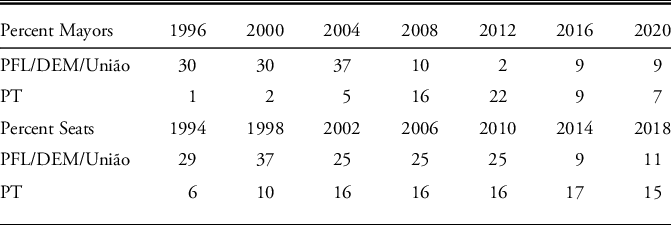
During this period, ACM’s party was the strongest in the state, but never strong enough to rule alone. Instead of the dominance of one party, and reflecting the high party fragmentation at the national level, subnational politics in Bahia, too, are characterized by high levels of political fragmentation, with an average of 9.6 parties in the State Assembly.Footnote 14 To deal with these conditions, ACM’s party depended on allying with other parties to form a governing majority during its hold on power. As Dantas Neto (Reference Neto and Fábio2003, 236) argues, alliance making was at the core of ACM’s politics in Bahia. As table 1 shows, even when it held the executive branch in Bahia, the PFL could never capture most mayors in Bahia or a majority at the State Assembly.
Percentage of Mayors and of Seats in the State Assembly of Bahia, by Party

In contrast to uncompetitive contexts, the support of local allies for strong subnational parties is far from guaranteed, as local notables rapidly shift sides depending on the balance of power at the executive level (Novaes Reference Novaes2018). Subnational politics in Bahia is also characterized by high levels of electoral volatility, with a median of 26.1 percent from 2002 to 2018 for the State Assembly. The steep decline of PFL’s power at the municipal level after losing the gubernatorial race to the PT in 2006, as shown in table 1, reflects not only the party’s electoral losses but also the party switching that took place, with local notables affiliated with the PFL migrating to parties allied with the new government of the day.
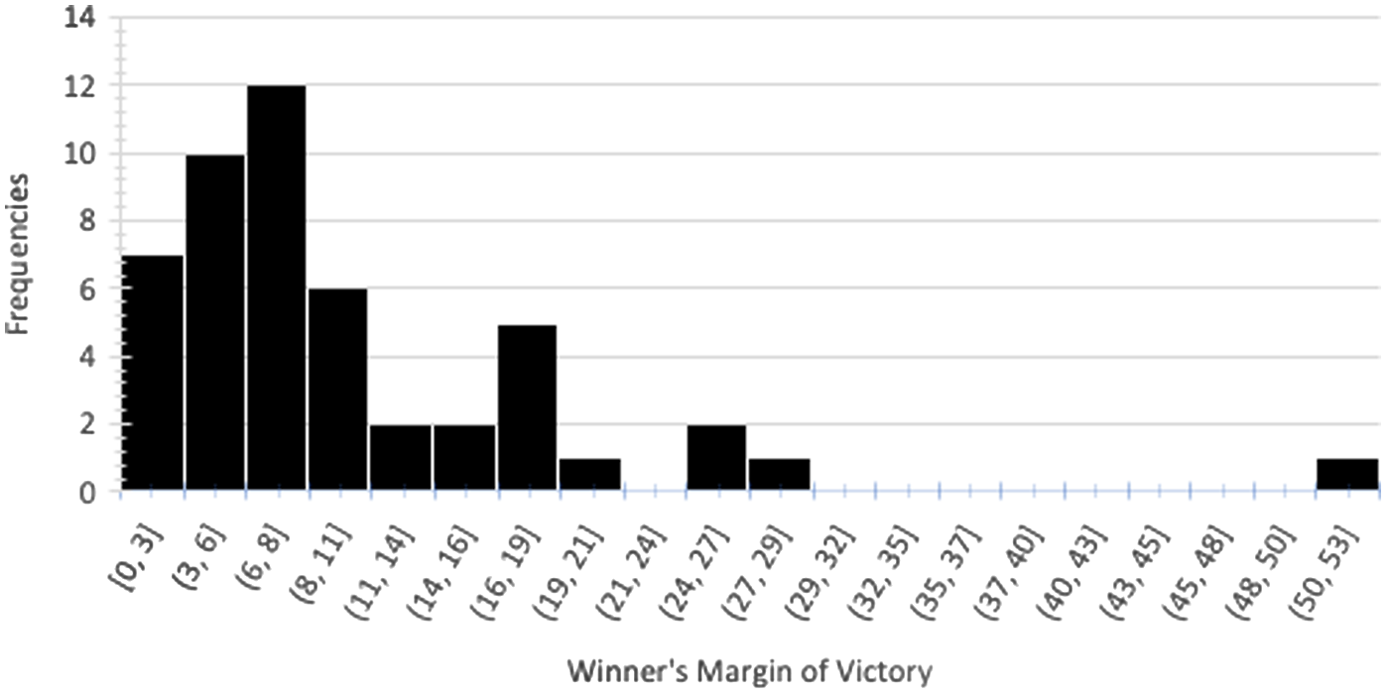
At the municipal level, despite the stereotypical view of Brazilians, local notables in rural Brazil are far from holding uncontested power. Instead of one powerful boss controlling one municipality, politics in the interior of Brazil is characterized by intense political competition among rival clans (Palmeira Reference Palmeira1996, 45; Ricci and Porto Zulini Reference Ricci and Porto Zulini2017, 260–61). Studies have reported that mayors in Brazil suffered from an incumbency disadvantage between 2000 and 2006 (Magalhaes Reference Magalhaes2015; Klašnja and Titiunik Reference Klašnja and Titiunik2017). The low reelection rates of mayors in the Sertão of Bahia reflect a similar incumbency disadvantage and attest to the lack of dominance of one clan in these rural municipalities. From the seven towns of the Sertão of Bahia where I collected historical data about the trajectories of rival clans, only about 30 percent of incumbent mayors won reelection.Footnote 15 Moreover, and similar to mayoral elections in Brazil (Klašnja and Titiunik Reference Klašnja and Titiunik2017), mayoral elections in the municipalities of the Sertão of Bahia are highly competitive, as figure 1 shows. In contrast to uncompetitive settings, in the overwhelming majority of the seven towns’ mayoral races, the margin of victory by the winning party was below 11 percentage points.
Margin of Victory in Percent of Mayoral Elections in Seven Towns, Sertão of Bahia, 1996–2020

In sum, the low reelection rates of incumbents and the high levels of political competition in the municipalities of the Sertão of Bahia, together with the lack of dominance of the governing parties in Bahia, alongside the long history of clientelism in the Northeast, make the Sertão of Bahia a case suitable to investigate the decision-making process of clients under competitive clientelism.
Acknowledgment
For comments and advice on previous versions of this article, I would like to thank Octavio Amorim, Edward Gibson, Ezequiel Gonzáles-Ocantos, Robert Gregory Michener, James Mahoney, Timothy Power, Monica Prasad, Silvia Otero, Wendy Pearlman, David Rueda, and Cesar Zucco. Most of all, I am indebted to the individuals in Sertão of Bahia who welcomed me into their homes and lives, shared their time with me, and were patient in answering my endless questions. Although I cannot name them here to protect their identities, I am grateful for their generosity, without which this work would not exist. This project has received funding from Capes Foundation, Ministry of Education of Brazil (Grant 1025/12-0).