Introduction
Historians have long been using the history of psychoanalysis as a paradigmatic case that opens a window onto the anatomy and vicissitudes of scientific and social ideas far from their origins. Thorough investigations into this case have thus shed light on the evolution of psychoanalysis as an institutionalized form of therapy, as well as, and more importantly, on the discipline as a multidimensional phenomenon of cultural history. The establishment of psychoanalysis in Vienna in the period prior to World War I (cf. Marinelli and Mayer Reference Marinelli and Mayer2003) was significantly different from its institutionalization, based exclusively on “applied psychoanalysis,” at Kazan in southeastern Russia (cf. Métraux Reference Métraux1993), and the latter shows itself to have been again immensely different from the growth of psychoanalysis in Latin America (cf. Plotkin Reference Plotkin2001 and Reference Plotkin2003; Damousi and Plotkin Reference Damousi and Plotkin2009). Thus, the study of (broadly speaking) regional (i.e., national, local, etc.) psychoanalytic movements illuminates not only the history of psychoanalysis, but also the events within cultural spaces and scientific traditions where this “new science” was implanted and disseminated. Russian revolutionaries, American psychiatrists, writers influenced by the British Bloomsbury circle, French existentialists, and also Jewish intellectuals and pioneers in Mandate Palestine – these, as well as other more or less heterogeneous groups, developed their own version of Freud (see Damousi Reference Damousi2005; Decker Reference Decker1977; Hale Reference Hale1995; Hartnack Reference Hartnack1990; Hinshelwood Reference Hinshelwood1995; Hollander Reference Hollander1990; Miller Reference Miller1998; Timms and Segal Reference Timms and Segal1988; Turkle Reference Turkle1992).
Though Freud's teachings gained footing in many countries almost parallel to their inception in Vienna, the fate of psychoanalysis as an institutionalized form of treatment was markedly shaped by migrant German-speaking psychoanalysts in the 1930s and 1940s. Indeed, during the short period from 1932 to 1939, the majority of Central European psychoanalysts emigrated to areas external to the impact of German culture. The migratory waves had far-reaching effects both on the organizational aspect of the psychoanalytic movement, and on the single psychoanalytic societies that accepted immigrants into their ranks. The encounter with the Nazi regime and its brutal anti-Semitism, the forced migration to countries with different intellectual and scientific traditions, and, finally, Freud's death in 1939, were closely intertwined during the period when psychoanalysis entered its post-Freudian epoch (cf. Ash Reference Ash and Mosse1991; Ash and Stiller Reference Ash and Söllner1996; Peters Reference Peters1992; Fermi Reference Fermi1968; Martin Reference Martin1986; Haynal Reference Haynal1994; Kurzweil Reference Kurzweil, Mitchel and Söllner1996; Steiner, Reference Steiner1989, Reference Steiner2010; Makari Reference Makari2008).
The present essay aims at identifying different levels of reception of psychoanalysis before, during, and after the migration of German-speaking Freudians to Mandatory Palestine. The period of time referred to here spans from approximately 1905 to roughly 1950. During this period, the reception of psychoanalysis was anything but straightforward. It thus resembled the heteronomic reception in other parts of the world. The historian's task, however, is to articulate the specificities of the local reception of psychoanalysis in Mandatory Palestine. I shall therefore first try to identify several points of entry of psychoanalysis into Hebrew culture; then, I shall argue that, hidden beneath the elective affinity which early Zionists professed to find in Freud's theory, an inherent tension, at times even an evident contradiction in terms, began to emerge.
Freudian Man and the “New Man” of the Zionist Revolution
As the place of origin of the dynamic unconscious, Freud's Vienna stood at the crossroad between several frontiers: It stood at the frontier between East and West; it stood at the frontier between enlightenment and romanticism no less than at the frontier of modernity. It also stood at the frontier between socialism and anti-Semitism,Footnote 1 and finally, at the frontier between psychoanalysis and Jewish nationalism (Theodor Herzl).
The contributions of Joseph Breuer, Wilhelm Fliess, and Sigmund Freud are often examined in the light of the scientific discourse on race that flooded European thought in the second half of the nineteenth century. The interest in the human body and in sexuality did not fail to impinge upon the self-perception of the leading figures in Zionist thought. Thus, both the neurologist Max Nordau and Theodor Herzl addressed in their writings, explicitly or implicitly, the issue of the sexual identity of the Jew and reflected upon its consequences on the historical fate of the Jewish people (Gluzman Reference Gluzman1997; Bunzl Reference Bunzl, Timms and Robertson1997; Boyarin Reference Boyarin1997). At the Second Zionist Congress held in Basel in 1898, Nordau referred to Zionism as being the main political remedy for the resurrection of the young Jew, whose body had been ravaged by eighteen centuries of exile in the Diaspora. He described the Jew as a sick and degenerate being, much in need of a healthy relationship with his homeland and a stable marriage. Despite its biologistic rhetoric, the degeneracy paradigm was not as deterministic as it might seem. One could, for instance, alleviate or even stop the degenerative process by living virtuously, that is, by adopting a life-style based on principles of moral rigor, health, normalcy, beauty, self-discipline, responsibility and duty, cleanliness, and masculine strength. These ideals were promoted in hygiene societies, leagues against prostitution, temperance movements, associations for eugenic policies, and clubs for physical education such as Max Nordau's liberal Zionist Maccabi which was supposed to produce healthy “muscle Jews” (Brunner Reference Brunner1991; Berkowitz Reference Berkowitz1993; Gilman Reference Gilman1993; Hart Reference Hart2000; Efron Reference Efron2001).
Freud's early writings present a striking contrast to both the established paradigm and the Jewish response. With the completion of Studies on Hysteria in 1895, explicit rejection of hereditary conceptions of neuroses had become a regular feature in Freud's writings. He forcefully disapproved of ethno-racial and even historical explanations for mental problems and harshly criticized those among his disciples who tried to tie the problems of the Jewish people to his teachings. According to Freud, psychological problems should be articulated in psychological terms, whilst the term “degeneration” expressed an historical view, which held that there had once existed a perfect race whose offspring had slowly deteriorated. This “perfect people” never existed, thus the term “degenerate”must not be used to describe either oneself or others (cf. Spiegel Reference Spiegel1986). Furthermore, this preoccupation with the Jewish question, even under a scientific pretense, might exile psychoanalysis to the fringe of the intellectual and scientific discourse of the time, and Freud's followers were often warned not to transform psychoanalysis into a “national Jewish issue.”Footnote 2
A case in point is Max Eitingon's initial encounter with Freud in 1907. At the age of twenty-six, Eitingon came to Vienna and participated as the first guest from abroad in two of the psychoanalytic Wednesday Meetings. The record of the meetings captured a telling exchange between Freud and the young resident in psychiatry from Zurich. In response to Eitingon's questions whether Jews were especially prone to suffer from neurosis and whether a virtual “social factor” should be postulated, along with sexual motives, in the development of neurosis, Freud remarked that “the questions raised by Mr. Eitingon are indicative of the tendency of our Swiss colleagues to deny the theory regarding the sexual etiology of the neuroses.”Footnote 3
Eitingon's ethnic and social sensibilities may have interfered at that time with his ability to grasp the radical essence of Freud's conception of sexuality. However, both his future activities within the psychoanalytic movement and his early identification with the Zionist idea bear witness to his preoccupation with Jewish identity and social solidarity.Footnote 4
Notwithstanding Freud's reservations, psychoanalysis was all the more popular among the champions of Jewish-national particularism, who considered the new discipline as a fusion of radicalism and tradition and tried to enlist it for their own political ends. The relation of Jewish particularism to the universalism of the European Enlightenment here also gained expression when Freud's early positivist ideas were welcomed as a form of quasi-scientific support for Zionism's romantic endeavor of reconstructing a unified (and unifying) national past.
The tension between the cultural heritage and past of individual immigrants, on the one hand, and, on the other hand, the tendency of Zionist ideology to construct a collective past has been frequently discussed in the historiography of the Jewish society of émigrés in the British Mandate (cf. Wistrich and Ohana Reference Wistrich and Ohana1995; Sternhell Reference Sternhell1998). From the onset of political Zionism, the need to build a society with a fixed, distinct identity presupposed the creation of a Zionist “supernarrative,” that is to say, a narrative capable of embracing and overshadowing manifold historical experiences, cultural affiliations, and ethnic sensibilities, which, however, would still tend to emerge from beneath the surface. As is possible to observe in national movements in general, the Zionist movement developed an instrumental relation to the past, thereby attempting to give its followers the impression of a collective present and future through the construction of a unitary collective-mythological past. The emerging image of the Jewish immigrant to Mandate Palestine itself served this purpose. This image was that of a newcomer who had freed himself from the chains of an oppressive past, that is, a person presented in terms that were in part historical, in part abstract and mythical, who could henceforth determine his or her own fate.
In spite of the attempts of the founding psychoanalysts to prevent the nascent “science of the soul” from becoming part of the Jewish question, it was only natural that the developing psychoanalytic discourse would echo, implicitly or explicitly, the self-perception of those who formed the image of the “New Man” of the Zionist Revolution. After all, among the images of the new Jew, sexuality and gender played a central role. Sexuality, in the Freudian sense of the word, served as the means thanks to which the young Jew would transcend the barriers both of the previous generations and of tradition.
Even before the incorporation of psychoanalytic ideas into the ideological repertoire of the leaders of the Zionist Youth movement, Freud's followers were often given the chance for careful observation of the manipulation and use of “the master's” teachings by revolutionaries and idealistic reformers. The first attempts to translate Freud's teachings into the construction of the Socialist Man were made in Russia subsequent to the revolution of 1905. A brief look at the first reception of psychoanalysis in Russia is here useful. Though this shift in focus leads away from the events in Mandate Palestine properly, one should keep in mind that the Russian reception of psychoanalysis reflected itself in the socio-cultural composition of the Yishuv, the pre-1948 Jewish community in Palestine. More specifically, the Russian reception of psychoanalysis offers a wider context for understanding the ideological-cultural discourse framing the debate over psychoanalytic ideas in Palestine during the formative years of this scientifico-therapeutic movement.
Dubbed the “Second Aliya” and “Third Aliya” by Zionist historiographers, the double wave of Jewish immigration to Palestine − first between 1905 and 1914, then between 1918 and 1923 − contributed in a decisive way to the ideological foundations of the Jewish immigrant community of Palestine under the British Mandate (1918–1948). One of the chief accomplishments of those who immigrated, whose views in many respects represented those of the Russian intelligentsia, was the transformation of utopian-egalitarian ideas and socialist myths from Eastern Europe into concrete schemas for action for the Zionist movement. To be sure, the first encounter between psychoanalysis and the Yishuv cannot be considered a precise mirroring of the encounter between psychoanalytic theory and Russian Marxism. It did, however, bear the most prominent markers of that theory's Russian reception. The revolutionary impulses released by the advent of psychoanalytic theory, along with the possibilities at work in psychoanalysis as both Kulturwissenschaft and “healer of sick souls,” rendered the psychoanalytic movement a welcome element in the discourse of many a young communist, whose conceptual world offered space for a notion of “soul” not bound to class or nationality. In this manner, psychoanalytic therapy was granted a place of honor as a way to liberate victims of bourgeois society's repressive mechanisms from their past-centered angst. Even after the October revolution, and as long as it was possible to uphold the analogy between individual mechanisms of repression and those of bourgeois society, revolutionaries such as Trotsky and Joffe fashioned psychoanalysis into a scientific-ideological party instrument in view of a reconciliation of the “new science of the soul” with Pavlovian physiology. Oscillating between their admonitions in favor of sexual abstention (and the condemnation of the sexual drive as an impediment in the individual's ability to dedicate himself to the mission of building society) and calls for total liberation from any bourgeois inhibitions that block sexual freedom, Russian sexologists, psychologists, and the first psychoanalysts stripped the soul of its determinist and unconscious elements. The Odessa-born Moishe Wolf (Wulff), one of the founders of the Russian Psychoanalytic Association, even offered some observations on the sexual function of bus drivers and streetcar conductors in Moscow (cf. Wulff Reference Wulff1928). This research, carried out prior to Wolf's emigration to Berlin, demonstrated some of the characteristics of Marxist dialecticism. However, once it become clear that the “Freudian Man” was devoid of any utopist yearnings, revolutionary discourse in its Soviet version turned away from Freud's teachings and psychoanalysis was officially removed from the party's ideological armamentarium (cf. Etkind Reference Etkind1997; Rice, Reference Rice1993; Miller Reference Miller1998; Kloocke Reference Kloocke2002).
The disappointment that awaited those who sought to merge the doctrines of Freud and Marx in the USSR did not prevent the Zionists among them from mobilizing Freudian theory for their ideological ends. As early as 1920, Ernest Jones reported to Freud a conversation he had held with Chaim Weizmann, in which the Zionist leader took pride in those “poor Galician immigrants” who arrive in Palestine with no clothes but with “one hand holding Marx's Capital, and in the other, Freud's Interpretation of Dreams.”Footnote 5 Despite the essential conflict between the constructivist-utopian characteristics of socialism in its Soviet version and the social pessimism manifest in Freud's later writings, Zionist readers visiting psychoanalytic publications preferred to bridge the gap between these different perceptions of Man by a highly selective reading of psychoanalytic theory. The Zionist folklorist and historian Alther Druyanov, in 1910, sought to direct Freud's attention to the similarities between the novel theory formulated in the Interpretation of Dreams, and the interpretations of dreams in Kabbalist and Talmudic literature. “Personally I find a more striking resemblance between my ideas on dreams and those of the ancient Greeks” was Freud's response to Druyanov, thus indicating his preference for a universalistic rather than for a particularistic stance.Footnote 6
Oedipus in the Kibbutz
In the first half of the 1920s, three of Freud's followers, viz. Siegfried Bernfeld, David Eder, and Dorian Feigenbaum, attempted to reconcile their activities in the Zionist movement with their commitment to the ideas of psychoanalysis (cf. Hobman Reference Hobman1945).Footnote 7 After World War I, the presence of Jewish war refugees in Vienna enabled Siegfried Bernfeld to bring together ideas from the fields of philanthropy, Marxism, Jewish nationalism, and progressive education (Ekstein Reference Ekstein, Alexander, Eisenstein and Grotjahn1979; Hoffer Reference Hoffer and Brierly1981; Bunzl Reference Bunzl, Fallend and Reichmayer1992). Bernfeld repeatedly emphasized that youth are naturally endowed with moral and spiritual sensitivity, and that they are graced with natural rebellion against injustice. Bernfeld's “Jewish Order of Youth” had a central role in transferring the content and terminology of the German cultural youth movement to the Zionist youth movement Ha-Shomer Ha-Zair (The Youth Guard).Footnote 8 The psychological-historical analysis offered by Bernfeld of the problem of the split self-identity of Jewish-German youth was based on the Freudian concept of repression. He was recognized at the time as the thinker who had found the key to the hearts of the youth, the main target audience of the Zionist movement. When twenty-three year old Meir Yaari, co-founder of the Viennese branch of Ha-Shomer Ha-Zair, arrived in Palestine in 1920 with a group of young settlers, the impact of Bernfeld's and Freud's ideas on his social outlook was evident:
I want you to become acquainted with Freud and his school in a precise fashion, I don't know whether many of us can accurately grasp his theory, yet I hope that it will at least cleanse the charged atmosphere. I want to sanctify the drive through this experience. Please be aware of the power in you, when masculine eroticism unites you in spite of your inner resistance.Footnote 9
The drive, or the libido, served Yaari as a synonym for inner truth. With his colorful language Yaari represented the tension experienced by Freud's romantic readers between their rationalism on the one hand, and the concept of the Unconscious, on the other:
I must dissect and cut into the thought like a cold razor. Yet I become aware that psychoanalysis, in its determinist manner, delves into the depths, elucidating them only to further enhance their mystery. . . . Without a spark of creativity, without unhindered obsession, without an act of autonomic free will, one will not penetrate into the core, will not experience and will not create. . . . I seek with all my might to penetrate into my Unconscious world and expose myself. I feel this is the only way to independence, only in this manner can one grow. As you see, I am speaking in Freud's words. (Mintz Reference Mintz1995, 302)
It is doubtful whether Yaari's faith in the ability of the autonomous free will to penetrate into the core could be designated as particularly Freudian. His romantic version of the Freudian sexual revolution was marked by excessive optimism. The emphasis on the repressive role of society or on the inherent flaws in the model of the nuclear family were far from Freud's heart, although to his early followers it had seemed that he might have been a possible partner for reformist appeals. The youth movement's role was to put an end to sexual hypocrisy and lies, and to remove the creative powerlessness which hindered the path of development of young men and women, the very same erotic dullness which stereotypically characterized the young Jew. Meir Yaari spoke often of the pure and open-hearted generation which had arrived in Palestine, a generation which had freed itself from the hysterical nervousness of its parents as well as from the sanctimonious-bourgeois corruption of the instincts.
In the early 1920s, as members of Ha-Shomer Ha-Zair settled in agriculturally based collectives known as kibbutzim, the educational leadership of the movement argued that psychoanalytically informed education was the key to raising children free of bourgeois neuroses. They established strong ties with several European analysts, translated and published psychoanalytic texts, insisted that educators be analyzed or, at least, psychoanalytically informed, and built a complex educational system founded on their particular understanding of Freudian insights. According to their firm conviction, psychoanalysis was to be seen as an overall prophylactic means that was meant to safeguard the mental health of the community as a whole. In accordance with this conviction, they had the children in the kibbutz spend most of their waking hours in the company of nurses, educators, and teachers – the parents were allowed to see their children usually for two hours at most every day. This reflected the belief of kibbutz pedagogues that parental influence on children be lessened. The pedagogues believed indeed that under such conditions an essential change in the oedipal situation would yield and that the children's exposure to the “primal scene” would be minimal. Under the pretext of “solving oedipal conflicts” and of ensuring youth's independence, the children's homes in the kibbutz became in fact greenhouses in which children were trained for their full and harmonic integration into kibbutz society, which from the 1940s onwards was looking for Russian models in addition to the German models in matters both ideological and practical. Thus, the child's first encounter with the urge to abandon his will in accordance with the group's demands took place along with the displacement from his parent's home and becoming a member of a tribal group of children of the same age, which would be an inseparable part of his life until he reached adulthood. In those years, the child incorporated one of the most important principles that would accompany him throughout his adult life: one's own superego and the ideals of the group are one and the same (cf. Rapaport Reference Rapaport1958; Bettelheim Reference Bettelheim1969; Berman Reference Berman1988; Liban and Goldman Reference Liban and Goldman2000; Peled Reference Peled2002).
Early Freudians and Their Analysands
As seen in the case of communal child rearing in the kibbutz, through psychoanalysis, certain practices in the fields of education and health were implemented, which were seen to serve different rational and ideological goals. While kibbutz pedagogues were trying to find a place for psychoanalysis in the socialist and romantic ethos of collective education, two of Freud's students attempted to bring clinical psychoanalysis to other segments of the Yishuv. In the early 1920s, the debate on the tenets of psychoanalysis took place at the watershed of two conceptions – an ideological-political conception on the one hand, and a scientific-therapeutic conception on the other hand. The division between these two facets of Freudianism was far from clear-cut. It still does not necessarily represent the congruency that existed between the scientific-therapeutic and the ideological discourse. Additionally, the medical-therapeutic discourse was itself also strongly shaped by the ideological leanings of physicians of the time. Freud's teachings proposed a perception of Man that enabled disentangling as well as reconstructing the boundaries of different discourses at the same time.
The psychoanalytic meetings were led by two men: David Eder (1866–1936), a founding member of the London Psychoanalytic Society and chairman of the Zionist Executive Council from 1919 to 1924, who spent part of his time in Palestine as a member of one of the Zionist Commissions, and Dorian Feigenbaum, a psychoanalyst from Vienna. They were joined by the philosopher Hugo Bergman, the ophthalmologist Arie Feigenbaum, Siegfried Van Friesland, an advocate from Rotterdam who had served as Dutch diplomatic attaché and later as treasurer of the Zionist Agency, and the educator Gerta Obernik. The group began to meet in 1922 on a regular basis, reading and discussing psychoanalytic literature, in what seemed to be the beginning of psychoanalytic activity according to the founding Viennese model (Bergman Reference Bergman and Sambursky1985, 171–172).Footnote 10 Eder and Dorian Feigenbaum gave a number of introductory lectures on the analysis of dreams and on the investigations into various forms of parapraxis. However, the meetings came to an end sometime in 1924 with Eder's departure to London.
Bergman, who went into analysis with Feigenbaum, had expressed his regret that he had not learned psychoanalysis first-hand before his immigration to Palestine. In a letter to his close friend Robert Weltsch, he wrote of his new discovery:
I'm suffering from the conditions you describe to such an extent that I turned to an analyst among my friends and asked him to analyze me. He began two weeks ago. I'm expecting very much from this, as I have become convinced recently through interactions with my analyst as well as through the reading of some books on psychoanalysis that the latter is of utmost significance not only for the individual human being, but also for the psychological condition of the masses and the insight of politicians, and above all for education. I now very much regret not to have studied this in the sources while still in Europe, though the psyche is so to speak my genuine subject. At any rate, I hope to receive much self-illumination and more comprehension of my confused life through this matter [psychoanalysis]. (Ibid., I, 171)Footnote 11
Dorian Feigenbaum, who had been appointed director of the psychiatric hospital Ezrat Nashim in Jerusalem (the only mental institution in Mandate Palestine), attempted to introduce the local medical community to psychoanalytic theory. He delivered a number of lectures on the interpretation of dreams and the psychopathology of everyday life. In April 1923, he was invited to deliver a lecture series on psychoanalysis for a Jerusalem audience which included physicians, educators, and German delegates visiting Palestine. The lecture series was entitled “The Mind in Mental Illness and Health”; it was to include three lectures, “The Unconscious,” “Freudian Dream Theory,” and “The Modern Theory of Neuroses.” The outraged responses to Feigenbaum's first lecture, however, led the hospital's directorship to stop the lecture series. Shortly thereafter, Feigenbaum was fired from his job (“an act of villainy has been committed,” wrote Bergman in his diary) and left for New-York.Footnote 12 Thus, the first attempt to incorporate psychoanalytic theory into the clinical framework was brought to an abrupt end (Bergman Reference Bergman and Sambursky1985; Moses Reference Moses1998; Rolnik Reference Rolnik2002 and Reference Rolnik2007; Windhager Reference Windhager2002).
It appears that Feigenbaum had already been aware of the need to alert his audience to the danger of a superficial and trendy implementation of psychoanalysis, of the kind he would see thriving among the young immigrants. Indeed, in 1924, shortly before Eder and Dorian Feigenbaum left Palestine, the official English-language journal of the psychoanalytic movement published a review article on psychoanalysis in Palestine in which the anonymous author declared:
in certain quarters (especially among the young immigrants) there is a tendency to introduce so-called “psychoanalysis” far too carelessly, and in a “fashionable” and vulgarized form. This, quite obviously, is doing harm, and it is most necessary that psychoanalysis should interfere in the direction of correct exposition and, above all, in checking this injurious growth. (Anonymous Reference Anonymous1924, 101)
The pioneering attempts by Feigenbaum and Eder to strengthen psychoanalytic theory in Palestine did not blossom into the foundation of a local association which would be the center of clinical activity. Freud's name at the time therefore remained linked to the social and utopian aspirations of the Zionist youth movements of the time.
Freud in Hebrew
The collectivist ethos that had developed in the Jewish settlements in Palestine – that peculiar blend of the Central European youth movement romanticism and the Russian version of the “New Man” – was not found solely within Ha-Shomer Ha-Zair.
So that the comparison between the individual's mental ailments and the plight of the nation not rest only on metaphors, a scientific connection had to be established between the private and the public spheres, between individual sickness and collective disturbances. Freud's sociological essays offered a pathway laden with scientific theory. According to the Freudian approach, the individual psyche contained in shorthand the whole history of humanity – from the childhood oedipal romance within the family to the archaic fantasy world inherited from the forebearers. Freud developed his political and social theories of liberalism-authortarianism-patriarchalism in three texts: Totem and Taboo of 1913, Group Psychology and the Analysis of the Ego of 1921, and Moses and Monotheism of 1939. These were also the texts through which Hebrew-language readers of the period would become familiar with psychoanalysis. Freud may have found it difficult to understand why the Hebrew Teachers Association in Palestine had chosen his Group Psychology and the Analysis of the Ego to be his first work translated into Hebrew, but his response was warm:
I hold in my hands with utmost satisfaction the translation of Group Psychology in our Holy Language. As an ignorant child of pre-Zionist times, I am unable to read this language, but I rejoice at your assurance that this translation will serve a readership for whom the German or English edition would have been entirely devoid of meaning. Your assurance that this translation of a short article chosen from a small collection of my writings will not remain solitary fills me with even greater delight. I may thus hope that the feeling of astonishment that used to accompany a first encounter with a book of psychoanalysis will soon give way to another, more friendly feeling.Footnote 13
An essay that presents in the language of scientific positivism the process by which the individual becomes attached to society, in terms of drive, seemed to cater to the needs of the educators in Palestine. Freud's language, although devoid of ideology, was entirely compatible with the world-view of these pedagogues. It provided the scientific underpinning for the collectivist self-understanding of the members of the Yishuv. Individuals were recognized only when they represented the desire to unite with group members and improve the group's cohesion. A reading of this work was recommended especially for those “who took part in nationalist propaganda and in the dissemination of new ideas,” claimed one of the reviews written in honor of its publication (quoted in Rolnik Reference Rolnik2007, 252).Footnote 14
The call to divest Freudian theory from potential bourgeois interpretations characterized a number of critiques published soon after Totem and Taboo was published in Hebrew translation, 1936. In one of the main journals of the labor movement, a critic called upon Hebrew readers to “review and scrutinize the sociological psychoanalytic research and draw from it all that is important and helpful to our proletarian world-view” (quoted in ibid., 262). Nevertheless, Yehuda Dvir Dvossis, who translated the work, had his own agenda. Indeed, he deemed it important to base Freud's text on sources of Jewish origin. He therefore informed Freud of his intention to add to the translation of Totem and Taboo a number of comments from the Biblical and Talmudic literature in order to “strengthen and verify your claims, and to occasionally show them in a new light.”Footnote 15
As could be expected, many of Freud's critics were strongly interested in the question concerning the relation between the Jewish origins of the founder of psychoanalysis and his teachings. Some even went so far as to claim that his concept of repression should be viewed as an acknowledgment of his faith. In 1942 the poet S. Shalom (Shalom Josef Shapira) published a truly distraught article (it coincided with the publication of the Hebrew translation of Psychopathology of Everyday Life). This article claimed that the “repressed Jewishness” of Freud and his contemporaries was at the basis of psychoanalytic theory, and that “the secret of Freud's life and work is the secret of all the Anusim [forced converts]” (quoted in ibid., 269). These harsh words were written at the height of the Second World War, at a time when many of the leaders and prominent thinkers of the Jewish settlement in Palestine found it difficult to renounce their ambivalent attitude towards immigrants from Central Europe, and found it necessary to express, together with their empathy and solidarity, their reproach of the assimilation of the German-speaking Jewry into the cultural life of Germany.
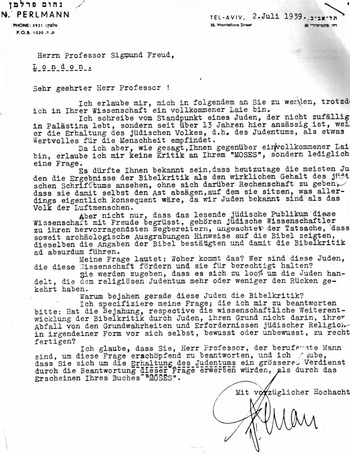
The brunt of the rage against Freud during the period of World War II was directed specifically towards Moses and Monotheism. Freud's last work provided the proof that the founder of psychoanalysis had an intellectual agenda that grossly diverged from that of most of his Hebrew readers in Mandate Palestine. Enraged responses were voiced against the historical thesis of the Egyptian origins of Moses, the founding figure of the Jewish people. In an open letter entitled “Sigmund Freud and ‘Made in Israel’,” the orchard owner Nachum Perlman attacked Freud's attempt to “cast our spiritual assets into the depths of the ocean and to open our spiritual affairs before the eyes of those entirely foreign to Judaism.”Footnote 16 He expressed his wish that Freud would contribute to the salvage of Judaism not by publishing texts such as Moses and Monotheism, but rather by making an attempt to explain in modern times why the Jewish religion was reduced to a skeptical attitude towards the Torah (see fig. 1).
Letter from a Jewish orchard owner from Palestine reproaching Freud for his essay on Moses and Monotheism (Freud Museum, London).

A blend of enthusiasm, outrage, and misunderstanding characterized the initial reception of Freud's works by readers in Zion. Allegorically, passion and frustration also stood at the heart of the first clinical paper that originated in Tel-Aviv and was accepted for publication in an official journal of the psychoanalytic movement. It bore the title, “An Analysis of a Coitus Interruptus Dream.” Its author was Curt Jacoby (cf. Jacoby Reference Jacoby1927). In fact, dreams of Jewish settlers in Palestine kept pouring into psychoanalytic journals.
Immanuel Velikovsky was among the first German-speaking psychiatrists working in Palestine to share his clinical experiences with the international community of psychoanalysts. His conclusions regarding the connection between his patients’ unconscious and the revival of the Hebrew language appeared in the journal Imago, which was edited by Freud, under the title: “Can a Newly Acquired Language Become the Speech of the Unconscious?” Velikovsky claimed in the article that for a person with a limited command of Hebrew, the symbolic meanings of the language are dictated by the sound of words and not by their literal meaning. Thus, the Hebrew puns that appear in a dream of a patient who speaks Russian, Arabic, or Yiddish are actually sounds associated with both the languages he speaks.
A Yiddish-speaking patient may dream, for example, of “mice” on the evening before a lottery drawing. The Yiddish word for mice is maislech, whereas in Hebrew the word mazlekh (your luck) expresses the patient's wish that the winning lottery ticket be hers. Another patient dreams that “mice are rummaging in his body,” that is, that his conscience is bothering him. Mice, Velikovsky points out, are rodents, and the Russian equivalent for pangs of conscience is “the gnawing of conscience,” and in the unconscious language of symbols these would present as the image of a mouse gnawing at the dreamer's body.
Another case of a dream being solved by Velikovsky purely through lexicography involved a married man who was suffering from impotence, and who stayed in Tel Aviv for a few weeks on his own to undergo psychotherapy. In his dream, a man approaches him with a request to buy lime from him. What do you need lime for, the dreamer wonders in the dream, after all, in the place where you come from, your home, there is a pit full of lime. On hearing the dream, Velikovsky swiftly asked the patient whether he had recently given a gift to a woman in order to secure her favors. The patient appeared embarrassed. Until now he had always been faithful to his wife, who remained at the family farm up north. And now, during his sojourn in the city, he had met a lady whom he tried to win over by means of a gift. He quieted his conscience by telling himself that he must verify the results of the therapy (the return of sexual potency). However the lady did not respond to his wooing. Velikovsky explained to the patient how the dream had encoded the entire story: Sit means “lady” in Arabic, and in the dream he wants to buy sid (the Hebrew word for “lime”), in other words, a woman, and he answers himself, in the voice of his conscience, you have lime at home.
Another of Velikovsky's patients was waging legal battles with his Arab neighbors over the question of ownership of a plot of land. One night he dreamt about mice that fall into a pail and are trying to get out by jumping through a hole in the lid. He is worried lest they escape, and covers the hole with a paving tile. This dream is a masterpiece of wordplay in Hebrew and Arabic: The akhbar (“mouse” in Hebrew) is khbar (a “litigant” in Arabic), a standard motif in the dreams of Arabic speakers who are engaged in legal disputes; and indeed the Arabs had tried to “jump” on his lands in Hor al-Wasa (hor means “hole” in Hebrew) and seize them, so it was appropriate lehapil otam bapah (a Hebrew expression meaning “to set them up,” or “to make them fall into a trap,” but literally “to make them fall into a tin [pail]”). And just recently, the patient had thought of a way he might be able to convince the authorities that the disputed land in fact belonged to him. His plan was to “pave” the path leading to the place − to Hor al-Wasa − and thereby strengthen his ownership claim. Velikovsky summed up his contribution to dream interpretation in Palestine thus: It “is probably connected with the manner of thinking of the Jewish race; the tendency to comparisons and jokes is also derived from the same source” (cf. Velikowsky Reference Velikowsky1934). In Jewish Palestine, the Unconscious was not structured just like any language, as Lacan would have guessed; rather, it was structured after the language of the Prophets.
It is in his correspondence with those who were not among his disciples that Freud generally comes across as a curious and generous interlocutor, whose fame had not gone to his head. He does not make do with pleasantries, but rather treats even the unfounded assumptions of laymen seriously, and makes use of them to clarify his ideas.
Dr. Yochanan Lewinson, a dentist who immigrated from Berlin to Palestine in 1933, where he joined kibbutz Givat Brenner, wanted to thank Freud, first and foremost. Thanks to psychoanalysis, he reveals in his letter, he was able to make a number of fateful life decisions and give up an academic career in Germany in favor of life in a cooperative community in the Land of Israel. Lewinson dealt with three main professional issues in the letter he sent Freud on August 5, 1936, that refer to the first chapters in the series “New Introductory Lectures on Psychoanalysis,” which Freud had published three years earlier. The first issue pertains to the status of night terror – a sleep disorder in which a person quickly awakens from sleep in a terrified state – in basic psychoanalytic dream theory.
These dreams, which rob the slumber of those who are suffering with traumatic neurosis (or in current psychiatric jargon, “post-traumatic stress disorder”), ostensibly contradict the fundamental formula of “dream interpretation,” according to which the primary motive for dreaming is to fulfill unconscious wishes. Despite the difficulty one may have in identifying any pleasurable wish in night terrors, Lewinson, like Freud, was hoping to find a place for the phenomenon within the conceptual framework of standard historic dream theory, and pointed to the mental function that these painful experiences could serve in those who suffer from traumatic neurosis. These dreams, he contends, reconstruct the traumatic experience so as to allow the mental mechanism to release the emotional excess that is one of the hallmarks of the traumatizing situation.
The second issue Lewinson discussed in his letter to Freud related to another chapter in the “New Introductory Lectures.” Under the heading “Dreams and Occultism,” Freud discusses, among other things, the phenomenon of telepathy. During the bloody events of the 1936–39 Arab Revolt, Lewinson had reached the conclusion that a handful of Arab villagers in Palestine were blessed with telepathic powers:
I have no doubt that the only method of transmitting information that was available to the Arabs was by means of thought transference. There is evidence that certain people among them broadcast the messages while others receive them. . . . I can imagine that these phenomena might constitute an especially fruitful field of research for the psychoanalyst, but he must be familiar with the language and culture of the Arab population in question.Footnote 17
Lewinson ended his letter to Freud on a personal note. As someone who had himself known periods of deep depression and of extremely high spirits, he permitted himself to disagree with things written by Freud in the chapter “Dissection of the Psychical Personality.” While Freud left open the question of what causes the cyclical nature of moods, Lewinson was positive that manic-depressive illness was a constitutional disturbance with a hereditary basis. As evidence of this, he noted that many on his father's side of the family suffered from a similar mental disturbance. In the first part of his response letter to Lewinson, Freud states that the concept of dreaming in psychoanalysis should be expanded to include additional functions besides wish fulfillment. According to his thinking, early signs of which are evident in the letter, psychoanalysis is capable of restoring the ability to dream even to those who have lost it and are presently “beyond the pleasure principle.”Footnote 18
Freud's letter to Yochanan Lewinson of Kibbutz Givat Brenner
Prof. Dr. Freud Vienna IX Berggasse 19, August 18, 1936.
Dear Doctor,
I willingly reply to your letter, since it is a pleasure for me to discuss with a reader of such understanding.
As to your first comment: I agree with you completely. These anxiety dreams are attempts to cope by means of abreaction. I am aware of this, and I have certainly expressed my opinion on this matter somewhere. I no longer know why I avoided mentioning this fact in the chapter “Revision of the Theory of Dreams.” However, we must not forget that the basic definition of “dreaming,” in its Aristotelian interpretation, is any spiritual activity that occurs during sleep, and therefore we ought to agree to include in dreaming also goals that do not serve wish fulfillment. It can therefore be said of this coping that it is “beyond the pleasure principle,” and that it also influences the choice of dreaming materials. In the nature of things the dream will repeat the disturbing traumatic content for the purpose of turning it into wish fulfillment, however in the absence of analytic help this attempt will usually fail.
As for the second matter: Your enlightening words deserve my gratitude! You have surely noticed that when it comes to matters of telepathy I have been guided by the intention to keep to a minimum the admission that it exists. Here is how things stand: I believe in telepathy but I do not do so willingly. I have not yet managed to overcome completely my distaste for what is termed the occult, and therefore I continue to demand further evidence of its existence, and indeed you indicate possible ways of obtaining such evidence. Ever since I learned to observe my dear chow chow dog's behavior in certain situations, my disbelief in telepathy has softened somewhat.
As for the third matter: I shall say nothing about this. On this matter you evidently know more than I.
Respectfully and faithfully,
Yours,
Freud
The failed attempts to establish clinical psychoanalysis in Mandatory Palestine during the 1920s indicated that bringing Freudian theory to clinical circles and guarding it from degradation to some cultural and/or ideological curiosity, would require a special brand of analysts whose identity would not fall short of their Zionist convictions. Max Eitingon, for that matter, certainly epitomized this profile.
German Speaking Analysts in Palestine: An Outline of Psychoanalytic Prosopography
The second, decisive phase in the establishment of psychoanalysis in pre-state Israel as a therapeutic discipline began with the onset of the “Fifth Aliya,” the large migratory wave to Palestine which started in 1929 and continued until the outbreak of the Second World War. Although it was again driven mostly from Eastern Europe it brought with it some 90,000 German-speaking Jews who fled Europe following the Nazis’ rise to power in 1933, and following Germany's annexation of Austria and the Sudetenland.
Max Eitingon (1881–1943), who founded the Berlin psychoanalytic Policlinic in 1920 and the Palestine Psychoanalytic Society in 1933, certainly epitomized the new combination of a committed political Zionist who is also an unyielding adherent of psychoanalysis in its clinical and lesser ideological version. Until his emigration from Berlin, the Russian-born son of the “Pelzkönig from Leipzig” (king of the fur industry) was mostly known by his associates as the first analyst who underwent “training analysis” by the old master; as Freud's most loyal representative in the so-called Secret Committee, and as the movement's main financial benefactor. By 1933 he had assumed a number of important administrative functions and key positions in the psychoanalytic movement in addition to his historically most significant role as the founder of the first psychoanalytic out-patient clinic which was also the psychoanalytic movement's most esteemed training facility. Funded predominantly from Max Eitingon's own resources, the Berlin Psychoanalytic Policlinic offered poorer members of the population therapeutic counseling either free of charge or at reasonable prices (cf. Danto Reference Danto2005). This facility also served as a training institution for the new generation of psychoanalysts, and was later responsible for the development of the fundamental structures, still valid today in most analytic training institutes and known as “The Eitingon Model,” of a regular, institutionalized training resting on the three pillars of training analysis, theoretical instruction, and control analyses (cf. Schröter Reference Schröter2002 and Reference Schröter2008).
In April 1933, the necessity of Eitingon's leaving Germany was raised for the first time. In the letters to Freud, Eitingon emphasized his identification with the Institute he had founded; he also expressed his determination to not leave Berlin except under constraints.
It would be unfair to my colleagues here if I were to cast any doubt whatsoever in the continuous existence of the institute by expressing any intention of taking the institute with me if I were in fact forced to leave my workplace and the country where I have been living for forty years. I truly mean “forced,” because I would in no way consider leaving even a single second earlier, and only under considerable pressure.Footnote 19
However, Aryanization all over the Reich advanced rapidly. Two of Eitingon's non-Jewish colleagues hurried to Vienna to try to convince Freud to appoint them as legal directors of the Institute (Lockot Reference Lockot1994). But on August 23, 1933, Freud wrote Ernest Jones that “we have lost Berlin.”Footnote 20 In contrast to many veteran analysts from Vienna or Berlin, who barely managed to save the symbolic capital they had accumulated while working close to Freud, Eitingon's opportunities as soon-to-be emigré were many and diverse. Rumors regarding his emigration to Palestine took wing, and soon a chorus of objections was raised. Unexpectedly, a voice from outside the psychoanalytic community joined the chorus. Albert Einstein, who had left Berlin for the United States in 1932, attempted to portray in bleak colors the future Eitingon would endure in Palestine. The very thought of taking part in psychoanalytic activities in Palestine seemed to the Nobel prize laureate to be an outrageous prospect. With the large number of physicians emigrating to Palestine, the pitiable condition of the Hebrew University, and the tendency of Jewish intellectuals to “hinder the development of each other,” claimed Einstein, Eitingon would most likely be deprived of an opportunity to continue with his psychoanalytic work, and would be unable to take part either in private practice or in the academic framework.Footnote 21
Albert Einstein's letter to Max Eitingon
Dear Mr. Eitingon,
You are probably surprised to be receiving a letter from me at all, let alone one meddling in your most private affairs. Nonetheless, I am certain you will understand.
These are the days when each of us must take a good, hard look at the possibilities open to intellectuals seeking suitable employment, be it here or elsewhere. In fact, I have noticed a lack here of serious, knowledgeable professionals in the field of mental therapeutic methods. Yet I have heard that you are looking into establishing your professional base in tiny Palestine, which has naturally been inundated with doctors in every field. That being the case, I feel obliged to urge you to strongly consider settling in America, rather than Palestine. I am convinced that you would have an easier time finding a broader and more satisfying niche here than in Palestine, where intellectuals merely hinder one another. I wouldn't consider making such a claim to a doctor in any other field, since America's urban centers are teeming with such doctors, and there is no real lack of luminaries.
As for the university in Jerusalem, I am sorry to say that this institution, whose importance for the entire Jewish intellectual world is so great, and whose realization I myself worked so hard for, is not exactly in good hands. I have been fighting to replace the administration for years, but have yet to see results. While I have managed to get a Committee of Inquiry convened, I have little faith in the ability of the current powers that be to bring about real change for the better. So far, the university's best have also been the ones to turn their backs on the place in bitter anger. Why would you want to put yourself through that?
Even if you decide to limit yourself to a private practice, the points I mentioned above still stand. If you find it forward of me to be offering you all of this unsolicited advice, just put this letter away. Still, I could not keep myself from telling you what I see.
Yours truly,
Albert Einstein
(Wishing you all the best – Elsa Einstein)
Eitingon left Berlin and reached Palestine in October 1933, holding a letter of recommendation from Freud designed to facilitate the receipt of a work permit. Although generous and sympathetic in his letter, Freud did not fail to mention his hopes that Eitingon's departure to Palestine would be only temporary.Footnote 22 The psychoanalytic immigrant soon gathered a handful of former colleagues from Berlin. Within four weeks from his arrival, he reported to Freud that the Palestine Psychoanalytic Society (PPS) had been founded. Anna Freud's letter to Jones put the news into its proper historical perspective: “My father had a letter from Eitingon today. You will soon hear from him about the formation of a new group in Palestine. The members are mostly or all old Berlin members. New groups used to be a pleasure. They are not just now.”Footnote 23
A brief typology of the migration of German speaking Jewry to Palestine should help qualify the group of analysts who founded the Palestine/Israel Psychoanalytic Society. Some 90,000 Jews arrived in Palestine from Europe after January 30, 1933 (the date of the Nazis’ rise to power, and later on the annexation of Austria and of the Sudetenland, etc.). While the political circumstances that drove these emigrants to leave Europe were obvious, the way in which they came to integrate into the Yishuv depended significantly on their ideological background. Among the “New Zionists,” as they came to be called, were all those immigrants who identified with the Zionist idea as a direct function of the discrimination and displacement they had endured in their countries of origin. Highly motivated to integrate into the Yishuv, these immigrants adapted to life in Palestine quite well. In fact, it was the “Old-time Zionists” who found it the hardest to reconcile the German-Austrian-Czeck Zionist dream of their youth with the reality they met in Mandatory Palestine. They developed an overwhelmingly critical attitude towards the Eastern European hegemony in the Yishuv, taking up various means of expressing their unique, Central European brand of Zionism. Another group of German-speaking immigrants lacked any allegiance to Zionism. Persons belonging to this category saw themselves merely as refugees, or even exiles, who had come to Palestine because they had no other choice – their deep intention was to return to Europe once the danger had vanished. People of this group – some of them renowned writers such as Arnold Zweig, Max Brod, Elsa Lasker-Schüller, or the much younger Wolfgang Hildesheimer – also perceived themselves as part of a worldwide “humanist front” against German fascism. They were, as it was, “Germans (rather than Jews) in exile.” Nearly all were outspoken anti-Zionists; most were intellectuals; some were devout Communists; all recoiled from Jewish nationalism in its eastern European version, and from the “New Hebrew” culture that had flourished under eastern European banners. For quite a few of these immigrants, psychoanalysis served as a substitute identity. The analysis Wolfgang Hildesheimer underwent in Jerusalem in 1940 when he was 23 years old came to be considered by Mozart's biographer as sort of a “training analysis” which provided him crucial insights into the nature of the human mind and especially into creative phenomena and processes of aesthetic transformation: “My analysis took place thirty-five years ago, I therefore cannot refer to Freud as readily as before. I couldn't profit from this analysis throughout my life, but neither could I mentally conceive of myself at all without it. I could wish that many colleagues had undergone a similar experience, however, for most of them, it is already much too late” (quoted in Buchholz Reference Buchholz2008, 150).
Max Eitingon had visited Palestine for the first time in 1910 and sympathized with Zionism from very early on. The leaders of the various Zionist political, cultural, and scientific elite – Ahad Ha'am (Asher Ginzburg), Arthur Ruppin, Henrietta Szold, Albert Einstein, and Agnon – all sought his advice on matters both private and public.Footnote 24 Eitingon's letters and public persona indicate that life in Palestine did not turn him into a disillusioned “Old Zionist” or an idealistic “New Zionist.” Although he supported the Palestine Communist Party (PKK) for many years, he was certainly not an Anti-Zionist.Footnote 25 He belonged to the fairly small circle of Berlin Zionists, whose successful acclimatization in Palestine was aided by a strong sense of solidarity with the east-European socialist version of Zionism. As his letters to Anna and Sigmund Freud show, Eitingon's identification with “Constructive Zionism” differed significantly from Freud's somehow loose solidarity with the fate of the Jews in Palestine, and from Einstein's mainly spiritual and cultural version of Zionism.Footnote 26 Even Freud's son, Ernst, was soon to discover that a visa to Palestine was not likely to be granted someone who was not well versed in the basics of Zionism. The boy made a miserable impression on the committee examining his suitability for a Palestine certificate. It turned out that he hardly knew anything about Judaism let alone Zionist problems; and it took a great deal of good will on the part of the examiners to decide that he knew who Herzl was.Footnote 27 The Jewish community of Palestine did not like to think of itself as just a sanctuary for any refugee. In 1933, Prof. Martin Pappenheim – a renowned neurologist and psychoanalyst from Vienna – was being considered for the post of director of the psychiatric clinic planned to be opened in the town of Bnei Brak. But following receipt by the Tel Aviv city administration of letters warning of the “non-Zionist motives” for Pappenheim's candidacy, the Mayor Meir Dizengoff and Vice Mayor Israel Rokach, agreed to end their contacts with the candidate. Pappenheim, the letters asserted, had left the Jewish community in Vienna; certain voices had even suggested he intended to convert. And other voices had suggested that had the Tel Aviv opportunity not come up, his closeness to communism would have led him to try his luck in Russia, a sure sign of an absence of genuine Zionist engagement. The city administration broke off its negotiations with Pappenheim and declared in an open letter to the newspaper Die Neue Welt that it had committed itself to “maintaining no contact with those considered traitors to our people.”Footnote 28
Regarding the absorption of the psychoanalysts in Palestine, it is important to note that the founders of the PPS were nearly all German-speaking professionals who were originally from Eastern Europe. Anna Smilansky, Moishe Wolf, Ilya Shalit, Max Eitingon and Fania Lowetzky (the sister of the Russian philosopher Lev Shestov, who also called himself Léon Chestov) were native Russian speakers. The years spent in Germany as students in Marburg, Freiburg im Breisgau, or Heidelberg, or as practicing psychoanalysts in Zurich, Vienna, or Berlin, had not weakened their ties to Russian culture and to the east European version of Jewish ethnicity. In other words, work at the Psychoanalytic Institute in Berlin and the dire political circumstances which had forced their emigration, can be seen in hindsight as conditions that were necessary for the foundation of the Palestine Psychoanalytic Institute (PPI), but these conditions were not yet sufficient. The Russian roots of these analysts undoubtedly played a role in their identification with Zionism. It may thus have strongly motivated their choice of Palestine as a place suitable for immigration. A letter to Freud, written shortly after Eitingon's arrival in Palestine from Berlin, directly supports our interpretation, for it expresses Eitingon's determination to not let historical and societal circumstances interfere with the establishment of psychoanalysis in Palestine: “The intensive building that characterizes this place forces us to follow our own private path and not become absorbed too early in public life, after all, it is the same people, with the same problems we had been used to dealing with, as clearly neither orthodox Jews nor Arabs are suitable in any way for psychoanalysis.”Footnote 29 That same group of analysts who had chosen to continue their professional activities in Palestine manifested the creation of an ethos, or an alternative narrative, that widened the circle of reference and the historical memories of Freud's students beyond the small group of immigrants from Germany. Eitingon and his colleagues were interested in viewing Freud's works not only as the German version of the Jewish canonical works, but also a canonical work of reference for immigrants from Russia, Poland, and Galicia, and even for the earlier Jewish settlements in Palestine. Similarly, the population treated was not only comprised of German speakers. The analysts from Berlin did not rely on the willingness of the German émigrés to adopt psychoanalysis, as though it were a Germanic spiritual asset facilitating adaptation to the Palestine environment. In fact, over thirty per cent of the 130 analyses at the Jerusalem Institute during the first seven years subsequent to its establishment were done in either Yiddish or Hebrew; this supports the hypothesis that Eitingon and his colleagues might increase the number of persons interested in psychoanalysis (cf. Brandt Reference Brandt1941). Indeed, several failed attempts to bring psychoanalysis to the Hebrew University would serve to remind the émigré analysts that the “German model” on which the Hebrew University was founded and based, could hardly make the Hebrew academe any more receptive to Freud's ideas than the German academe had been.
The founding of the Hebrew University in Jerusalem was a key development in the history of the Yishuv during the 1920s, and led to a sea change in the complex relationship between the leadership of the Yishuv and Zionist movement and non-Zionist elements in the Diaspora. While the Yishuv saw the University's establishment as proof that Jews in the Diaspora were willing to support Zionism's nationalist aspirations, the young institution's non-Zionist benefactors felt they could draw a distinction between Jewish nationalism in its controversial, territorial sense, and an intellectual-cultural endeavor aimed at serving as a focal point for Jewish brainpower around the world. The tension between those who saw the University as a pawn in the hands of the Zionist project and those who preferred to view it outside the context of political Zionism had been there from the beginning and this tension informed its decision-making process during its formative years (Goren Reference Goren1982). Chaim Weizmann and Judah Leon Magnes were the two most prominent leaders who set the tone for the Hebrew University's development. While Weizmann was frequenting the halls of British power and building up an entourage of Jewish scientists the likes of Albert Einstein and Paul Ehrlich, Magnes was gaining the trust of both American Jewish philanthropists and the University's Board of Governors in Jerusalem. Unlike Freud, who had not participated actively in the politics of the University since he joined its Board of Trustees in 1920 (prior to its actual opening), Einstein was fully steeped in the controversies surrounding the University's financial, ideological, and scientific ethos, as well as the decisions regarding the first appointments to the University's teaching staff. Einstein delivered the inaugural lecture of the Hebrew University and undertook to edit the university's first scientific journal. Einstein not only identified with the scientific ethos that Weizmann represented, but also identified with his positions regarding the University's administration. He openly doubted the ability of the University's local leadership to plan and manage so complex an institution. A continuous tension between Magnes, Weizmann, and Einstein shaped the academic policies between 1925 and 1935. They involved issues of fund raising, academic appointments, and the intermingling of political issues in the university's public manifesto. In 1933, Einstein, who already had resigned from the University's board of directors, published two newspaper articles publicly declining an official invitation from the university. He threatened to continue his public criticism and to disrupt any attempt to raise money for the university unless an impartial investigation committee was summoned (Cohen Reference Cohen2006, 72–77). It is in this vein that one should also read Einstein's letter to Eitingon we quoted above.
In the first twenty-five years after the Hebrew University's establishment, a decisive majority of the academic faculty had been educated in German-speaking parts of Europe; the general atmosphere was nearly a replica of Central Europe. From early on, the founders of the Hebrew University in Jerusalem were aware of the unique place accorded to psychoanalysis and its founding father in Jewish public opinion. Contacts between the University and several of Freud's students began to take shape in the early 1920s, a result of Freud's willingness to join the ranks of those prominent Jews who had joined the University's Board of Trustees and, more importantly, mediation on the part of the British Zionist and psychoanalyst David Eder, who as early as 1925 had supported Siegfried Bernfeld's bid to teach psychoanalysis at the University. Bernfeld's early deliberations with Magnes ended with no results.Footnote 30 It is beyond the scope of this paper to recap and analyze the University's longstanding unwillingness to open its gates officially to psychoanalysis, a reluctance that did not abate until the late 1970s with the establishment of the Sigmund Freud Research Center (Rosenbaum Reference Rosenbaum1954; Rolnik Reference Rolnik2007, 189–200). However, it is important to note that during the 1920s and 1930s Freud's stance towards the University was not particularly forthcoming and appeared to have been strictly declarative. A case in point would be Freud's reluctance to endow his manuscripts to the Hebrew University after his death,Footnote 31 or indeed his refusal to contribute an essay to the first volume of the University's Year Book. Freud's letter to Emanuel Velikowsky, the representative of the University with whom he would exchange several other letters during the 1930s, is worth quoting:
I have never made a secret of my sympathies for the cause of Judaism as well as for the cause of the University in Jerusalem. But the publication of contributions from the most various fields of scholarship looks to me like some demonstration rather than an event useful for the promotion of science, in as much these contributions are not truly comprehensible for everybody. I publish my works stemming from the special field of psychoanalysis in the journals I edit, Imago and International Journal of Psychoanalysis, or in the Journal of Psychoanalysis I direct. One would not look for these works in other places; they would be lost for my readers, whereas they must remain incomprehensible for the readers of the Hebrew journal. I therefore have no right to offer you my services as permanent contributor.Footnote 32
Berlin in Jerusalem
Notwithstanding the need to open up the analytic institute to wider sections of the population, Eitingon's involvement as the founder of the Berlin Institute enabled the immigrant analysts to foster a shared belief that eased their adaptation to the new homeland. The analysts in Palestine saw themselves as the rightful heirs of the Berlin Institute, whose activities, though on a much smaller scale, had now been transferred to Jerusalem. A great number of pictures and furniture, all belonging to Eitingon, had been shipped from the Berlin Institute to Jerusalem; the Berlin Institute's library, also mostly consisting of Eitingon's huge private collection, reached Jerusalem without loss, as did the Institute's files from Berlin. These were the material objects that enhanced the self-image the founders of the Jerusalem Institute shared. According to this image, what had come to an abrupt and painful end in Berlin had found its continuation in Jerusalem. This implied the notion that the Berlin Institute, though still in existence, had in fact lost its connections with the psychoanalytic movement, both formally and materially. The rapid access of the small Jerusalem group to the International Psychoanalytic Association (IPA), a process that would have taken years under normal historical circumstance, was an important factor in creating a basic feeling of continuity that was so crucial to the émigré analysts in their new environment. The transformation of the Institute in Jerusalem into the offspring of the Berlin Institute had thus a great impact on both the analysts and their analysands who felt that they had succeeded in creating for themselves, under the tragic circumstances that had led to their arrival in Palestine, a “Berlin microcosm” that eased their acclimatization to their new home. Additionally, the formal organizational process increased the prestige of the immigrants from Europe. From this moment on, the analysts were no longer merely “agents of knowledge” – they had become the embodiment of psychoanalytic knowledge as such.
A look at the regulations they had formulated for the group reveals that, in their wish to ensure that none would use the name of Freud's theory in vain, Eitingon and his colleagues agreed to add an unusually strict clause. It stipulated that any member who wished to give a public lecture on any psychoanalytically relevant topic, must inform the committee in advance and receive the committee's consent.Footnote 33
Demand for the services of analysts was constantly rising. The Hebrew-language newspapers reported the fate of Freud's family following the annexation of Austria and this even increased the visibility of the immigrant analysts working in Mandate Palestine – a fact to which Eitingon attributed the large rise in number of persons who sought therapy in the second half of 1938. Although some of the patients were disappointed that the new “healers of the soul” did not offer them charms and potions, the analysts, in turn, showed flexibility and often agreed to incorporate hypnotic therapy into “classic” psychoanalytic treatment, thus significantly shortening the length of time of therapies.
It is likely that demographic changes do not fully explain the considerable interest in psychoanalysis as a method for relieving the suffering of an individual during that period. Clearly, as the ethnic and social composition of the population in Mandatory Palestine underwent changes, the number of requests to undergo analysis grew. But this phenomenon of growth is somewhat more complex. Psychoanalysis held the promise that reality, however harsh and painful, was never dissociated from one's inner, mental, symbolic world. When a person familiarizes oneself with this inner world and turns it into something less intimidating, encounters with reality become easier and the ability to cope may improve. Paradoxically, when reality was shaped by an essentialist fascist ideology that discarded the dynamic concept of the mind, psychoanalysis offered the immigrant the ability to reexamine the borders between inside and out, between her inner fantasy world and the reality outside of it.
The few analysts who sought shelter in Palestine had to first present themselves before Eitingon, so that he might evaluate “their level of suitability for the unique conditions of this country.”Footnote 34 Two renowned analysts such as Wilhelm Reich and Theodore Reik, who had traveled throughout Europe during the thirties, might well also have arrived in Palestine already in 1933, if it hadn't been for Eitingon's objection. He was concerned with the Communist identity of Reich, and the notorious rebelliousness of Reik. The latter, however, did arrive in Palestine for a visit; he lectured before the members of the Jerusalem group, but his critical approach towards Jewish customs, as it came to be expressed in his books, not only were far from Eitingon's personal leanings, whose own affinity to the Jewish tradition was growing only now, but might also have endangered the neutral and unobjectionable public image the former leader of the Berlin group attempted to foster amongst his fellow analysts in Mandate Palestine (Rolnik Reference Rolnik2008b).
Anna Freud was extremely interested in the fate of the group working in Tel Aviv, Jerusalem, and some other spots in the Palestinian Levant. Eitingon, practical and often reserved, wrote to her of his journeys in the country, of his memorable excursions into the desert and at Petra, the intoxicating smells of the citrus trees blossoming, and the excellent weather conditions. Often he sent to Vienna crates of oranges or grapefruits, and received news telling him that “such grapefruits, unlike any sold in Vienna, even Papa devours with rapture, although he is forbidden to eat fruit.”Footnote 35
Classic Analysis
The analysts had plenty of patients to treat even during their first two years in Palestine. Eitingon was treating nine patients at the time. The small psychoanalytic society managed somehow to maintain an image of solidarity even during periods when some members had to face a disciplinary committee under the claim that they had strayed from “classic Freudian psychoanalysis.” This was an accusation the analysts often hurled at one another within the society; it even helped to keep alive ancient rituals and memories from Berlin and Vienna. The seminars for teachers and pedagogues, which were held by some fellows from the Psychoanalytic Institute, increasingly became more suspect of straying from the original spirit of psychoanalysis. Moishe Wolff, who became Eitingon's successor as chairman of the analytic association, was apparently shocked by what Fania Lowetzky wrote in 1950 in the popular newsletter for pedagogues Mental Hygiene; he suspected her of instructing the kindergarten teachers she trained to “spoil the children.” Subsequently the psychoanalyst was summoned to appear before a special committee and to prove that her theoretical positions did not stray from those of classic Freudianism. But having refused to appear before the committee, she was stripped of her training position.
What was that “classic analysis” which was supposed to unite the members of the Jerusalem Institute, and which, if not upheld, would be grounds to question the very use of the word “psychoanalysis”? Arguably, this question, which had accompanied the psychoanalytic movement since Freud had written On the History of the Psychoanalytic Movement in 1914, received a special signification after the emigration of the psychoanalyses from Europe and the closing of the two Institutes in Berlin and Vienna. The term “classic” may have carried with it an additional symbolic and psychological meaning for those who had been severed from their work environment, their language, and their culture. “Classic psychoanalysis” served the émigrés as an alternative identity signifier during the years in which they had to establish themselves in their new environment.Footnote 36
But regardless of how “classic” each and every analyst wished to perceive themselves, in Mandate Palestine the old battles of psychoanalysis had to be fought again and again on a daily basis. Strong opponents to psychoanalysis such as Martin Buber or Gershom Scholem had to be dealt with cautiously. Not a single critique of Freud's theory that appeared in the Hebrew press would be ignored. Financial and professional support was given by Eitingon on a regular basis to various welfare projects such as Youth Aliyah, the organization that rescued 22,000 Jewish children from the Nazis during the Third Reich. Yet critical voices from within the psychoanalytic association had begun to be voiced: The analysts that settled here are undergoing “privatization,” one of them, who also happened to be a kibbutz member, complained in a letter to Otto Fenichel: “Dr. Eitingon wants to continue the noble Berlin tradition and is leading the society in accordance with the principal of ‘touch me not.’ The public can wait, he says, all we need to do is let people come and seek us. He is avoiding any active struggle, deliberately refraining from any popularization of psychoanalysis.”Footnote 37 What the author of this letter could not know was that years later Eitingon (who had relentlessly targeted Wilhelm Reich's political activism in Berlin) would be identified as the main benefactor of the Palestine Communist Party (cf. Dotan Reference Dotan1991, 385–387)!
Internal struggles and theoretical purges continued to accompany the everyday life of the psychoanalytic associations from the time they were first established. Yet, in what ways was the Institute in Palestine different from that in Vienna or Berlin? Even Anna Freud wanted to know whether the future of the Jewish nation in the “Land of Israel” would also affect the state of psychoanalysis, and whether the new ties to the land and earth would cause the Berlin analysts in Palestine to suddenly become landowners or even farmers. The idyllic descriptions of the natural setting and the views of the land sent by Eitingon echoed in Anna Freud's heart: psychoanalysis and oranges, Jerusalem figuring in one of her dreams: “Last night I had a vivid dream of Jerusalem. But it was a mixture of Vienna Forrest and Berchtesgaden. It seems that my imagination cannot reach any further than that.”Footnote 38
The gradual dissemination and acceptance of analytic practice in the society of Mandatory Palestine made it necessary to consider several formal questions and issues of judicial precedence. Questions of the minimum fees analysts would charge their patients nearly led to a clash between the psychoanalysts and the Physicians'Union, one of the most powerful organizations in the Yishuv; at last a compromise was reached, however. It permitted the analysts to preserve the unique philanthropic character of the Institute and give, in cases of need, “gratis treatment,” whilst the private clinics would abide by the minimum fees set by the Physicians’ Union.Footnote 39
The ideological and nationalist issues at the heart of the events of the time soon became part of academic activities offered by the fledgling Institute to its members. The lecture given by Mrs. Obernik-Reiner, “On the Contribution of Individual Observations in Groups of Children to the Construction of Collective Education,” and even Eitingon's own paper, “Sexuality and Dreams in the Talmud,” were two instances of the ethnic-nationalist context that characterized the meetings of the Institute during its first years. Modern Jewish nationalism, as radical and revolutionary as it may have been during its early years, was not overly tolerant towards those who questioned the basic tenets of Zionism. The amalgam of utopian ideals with actual Zionist activities led to a renouncement of everything not directly identified with constructivist activism. “More deeds, less words” had been the motto of the immigrants in Palestine who viewed philosophy, criticism, or reflection as a sort of antithesis to change and construction (cf. Shapira Reference Shapira1996). As we have seen, the critical psychoanalytic discourse of the Ha-Shomer Ha-Zair educators in fact rapidly distanced psychoanalysis from attending to the psychological needs of the individual and turned it into an instrument to fulfill the ideological needs of the group. Paradoxically, in an ideological environment that tended to appropriate the private sphere of the individual for the benefit of public interests, Freudian psychoanalysis offered the immigrant an instrument to reexamine the borders between inside and out, between his inner world and the reality outside of it.
This raises a question of whether the price paid for the establishment of psychoanalysis in Palestine did not entail relinquishing its critical aspects. Did the desire to ensure a wide consensus regarding the merits of Freud's theory in the collectivist and ideologist atmosphere of pre-state Israel bring Eitingon and his successors to steer psychoanalysis onto a pronounced anti-intellectual path, leading to a narrowing of its horizons? The formative years of psychoanalysis in Israel were consequently shaped by perpetual conflict. While popular psychoanalytic discourse worked ceaselessly towards defusing the social pessimism that was part of Freud's works (as well as Freud's well-documented skepticism regarding political Zionism), it was left for the analysts to safeguard the therapeutic position of psychoanalysis. While inwardly Eitingon demonstrated a great deal of flexibility in allowing the reality in Palestine and nationalist Jewish sentiments to influence the lecture program at the Institute, in the yearly reports sent to the International Psychoanalytic Association, he particularly emphasized psychotherapy as the mainstay of the Institute's interests.
Concluding Remarks
The historical perspective offered in this paper permits us to view the history of psychoanalysis as it migrated to Mandate Palestine and was accepted in, or by, the Yishuv not only as a process of continuity by which the cross-cultural validity of Freud's theory came to be confirmed, but also as a process of separation, crisis, and re-interpretation. The elective affinity that early Zionists confessed to find in psychoanalysis'revolutionary nature did not suffice to ensure the development of “classic psychoanalysis” in the land of Israel. Those students of Freud who identified with the Zionist movement often found themselves in a position of conflicted loyalties. This conflict called for redefining their identification with the European psychoanalytic ethos. In juxtaposing the “New Man” of Zionist ideology with the “Freudian Man,” Hebrew nation-builders developed a particular image that shaped the reception of Freud's followers in educational, medical, and scientific circles. Hebrew culture facilitated a particular hybridization between the “Russian Freud” – to whom constructivist-collectivistic aspirations have been ascribed – and the “German Freud” – notorious for his individualistic and pessimistic Weltanschauung. In the course of time, psychoanalysis could gradually regain its unique therapeutic position. For quite a few immigrants it offered an alternative view on questions that were otherwise idealized and considered to be self-evident by Zionist ideology.
Currently celebrating its seventy-fifth anniversary, the Israel Psychoanalytic Society – one of the largest in the European Psychoanalytic Federation – finds itself thriving, both in numbers of members and candidates as well as applicants for training. It is flourishing no less in terms of theoretical diversity. If analysts in Israel seem to have relinquished the search for a common ground in matters of theory or technique, they have not given up the desire to remain under the same roof, however loosely associated. It is beyond the scope of this essay to tackle the question of whether the Israeli experience has given rise to a particular brand of psychoanalysis. If terror and persecution are notorious for probing the limits of mental and historical representation of individuals and societies,Footnote 40 then working analytically at the frontier of militant nationalism and religious fanaticism still poses a unique challenge for those seeking to translate their patients’ concrete situations of horror into meaningful psychic experience and to convey the notion that reality, however harsh and painful it might be, is never dissociated from one's unconscious inner world.