In a range of systems, studies on mistletoe distribution on the host plant have documented a number of factors that affect their occurrence and spread (Aukema & Martinez del Rio Reference AUKEMA and MARTINEZ DEL RIO2002a, Bowie & Ward Reference BOWIE and WARD2004, Overton Reference OVERTON1996, Reid et al. Reference REID, SMITH, YAN, Lowman and Nadkarni1995). These patterns can be determined by host specificity, environmental conditions, host plant characteristics (Martinez del Rio et al. Reference MARTINEZ DEL RIO, HOURDEQUIN, SILVA and MEDEL1995) and the movement patterns of dispersal agents (Aukema & Martinez del Rio Reference AUKEMA and MARTINEZ DEL RIO2002a, Reference AUKEMA and MARTINEZ DEL RIO2002b). In mistletoe plants, host choice can be considerably influenced by the advantages of interacting with relatively abundant hosts (Norton & Carpenter Reference NORTON and CARPENTER1998, Norton & De Lange Reference NORTON and DE LANGE1999). Besides the relative abundance of host species, characteristics such as branch size, age and height can have a strong effect on mistletoe attachment resulting in size-related mistletoe infection patterns (Overton Reference OVERTON1994). Generally positive relationships between mistletoe infection and host size have been demonstrated worldwide (Donohue Reference DONOHUE1995, Martinez del Rio et al. Reference MARTINEZ DEL RIO, MEDEL and HOURDEQUIN1996, Norton et al. Reference NORTON, LADLEY and SPARROW1997, Reid & Stafford Smith Reference REID and STAFFORD SMITH2000) and they have been interpreted in terms of the preferences by dispersing birds to perch and feed in taller trees (Aukema & Martinez del Rio Reference AUKEMA and MARTINEZ DEL RIO2002a) and trees accumulating infections as they age (Overton Reference OVERTON1994). Aukema & Martinez del Rio (Reference AUKEMA and MARTINEZ DEL RIO2002a) reported more frequent perching in taller-than-average trees by the phainopepla (Phainopepla nitens), which is the principal disperser of the desert mistletoe Phoradendron californicum. Thus, visits by mistletoe-seed-dispersing birds, and therefore mistletoe seeds received, tend to increase with tree height (Aukema & Martinez del Rio Reference AUKEMA and MARTINEZ DEL RIO2002a). Using a simple metapopulation model, Overton (Reference OVERTON1994) predicted the frequency of parasitized trees to increase with host age. Therefore, assuming that size is a good proxy for age, large trees are likely to be more infected than smaller trees. Reid & Stafford Smith (2000), using experimentally disinfected trees, found that larger trees were disproportionately re-infected with mistletoes. This size–intensity relationship may be used to describe mistletoe infection patterns. However, several previous studies have shown size–intensity relationships to be weak (Aukema & Martinez del Rio Reference AUKEMA and MARTINEZ DEL RIO2002a, Donohue Reference DONOHUE1995, Overton Reference OVERTON1994, Reid & Stafford Smith Reference REID and STAFFORD SMITH2000). This indicates that other factors may be important in determining mistletoe infection intensity, including that already parasitized hosts of a specific height are more likely to receive seeds than non-parasitized hosts of the same height or dispersers are likely to be attracted to trees for reasons other than size (Aukema & Martinez del Rio Reference AUKEMA and MARTINEZ DEL RIO2002a).
The work presented here investigated the patterns of mistletoe infection of Acacia trees in a semi-arid savanna. We wanted to explore, by measuring trunk diameter and height, the size-intensity relations between mistletoe infection and Acacia trees. We hypothesized that mistletoe infection and re-infection (in experimentally disinfected trees) would increase with tree size. In this study we focused on three mistletoe species, Erianthemum ngamicum (Sprague) Danser (Loranthaceae), Plicosepalus kalachariensis (Schinz) Danser (Loranthaceae) and Viscum verrucosum Harv. (Viscaceae), common on Acacia tree species in south-western Zimbabwe (Mapaura & Timberlake Reference MAPAURA and TIMBERLAKE2004).
The study was carried out at Matopos Research Station (20°23ʹS, 28°28ʹE) situated in south-west Zimbabwe (Ward et al. Reference WARD, RICHARDSON, DENNY and DYE1979). Mean annual rainfall averages 600 mm and rainy season is from November to March. The mean annual temperature is 23.6 °C. The area is characterized by low humidity and high temperatures observed in October (Dye & Walker Reference DYE and WALKER1987). The vegetation on predominantly red soils has been described as an Acacia tree–bush savanna of varying density, dominated by Acacia karroo, Acacia nilotica, Acacia gerrardii, Acacia rehmanniana, Acacia nigrescens and Maytenus senegalensis (Rattray Reference RATTRAY1957). Grass cover is almost 100% and grades from annual- to perennial-dominated swards. The common grasses are Heteropogon contortus, Hyparrhenia filipendula, Hyperthelia dissoluta, Themeda triandra and Cymbopogon plurinodes. Setaria incrassata also occurs, especially on wetter areas (Rattray Reference RATTRAY1957).
Mistletoe-infected Acacia trees were surveyed in a 30-ha plot in October 2010. Species, height, diameter at breast height and tree intensity of infection were recorded for a total of 331 surveyed trees (A. gerrardii: 145, A. karroo: 57, A. nilotica: 51, A. robusta: 78) within the woodland. A mistletoe was defined as an adult when it had several large axial branches with numerous side branches (Norton et al. Reference NORTON, LADLEY and SPARROW1997). On 36% of the occasions E. ngamicum occurred as an epiparasite on P. kalachariensis and these were excluded from our analyses. To determine the influence of tree size on mistletoe infection, trees were assigned to size categories, small (> 0.8 to ≤ 0.12 m) and large (> 0.12 m), based on trunk diameter. For each species ten trees of each size category were experimentally disinfected and the number of re-infections recorded over 3 mo.
All data were tested for normality before analysis. Data for mistletoe intensity, tree height and trunk diameter were skewed and were log-transformed before analysis (Zar Reference ZAR1984). An independent-sample t-test was used to compare the mistletoe infection and re-infections between larger and smaller trees. A regression analysis was used to test the relationship between mistletoe infection intensity and trunk diameter. Data are expressed as mean ± SE. In all our tests α = 0.05. Statistical tests were conducted using SPSS 16 for Windows (SPSS Inc., Chicago, IL, USA).
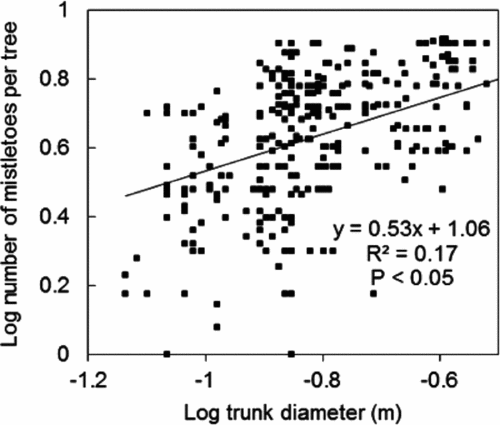
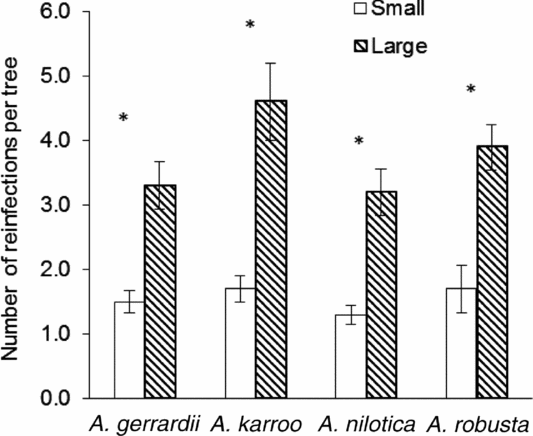
The mean (± SE) number of mistletoes per tree was significantly higher (F3, 327 = 15.8, P < 0.001) in A. robusta (5.71 ± 0.21) than the other species (A. gerrardii: 4.47 ± 0.13, A. karroo: 4.65 ± 0.25, A. nilotica: 3.80 ± 0.16). The tree species also differed significantly in tree height (A. robusta: 6.17 ± 0.16 m, A. gerrardii: 4.82 ± 0.13 m, A. karroo: 5.17 ± 0.22 m, A. nilotica: 4.30 ± 0.19 m; F3, 327 = 90.6, P < 0.001) and trunk diameter (A. robusta: 0.22 ± 0.01 m, A. gerrardii: 0.16 ± 0.003 m, A. karroo: 0.13 ± 0.01 m, A. nilotica: 0.12 ± 0.004 m; F3, 327 = 19.3, P < 0.001). There was a marked variation in mistletoe infection between large and small trees in Plicosepalus kalachariensis (t329 = 6.54, P < 0.001) and Viscum verrucosum (t329 = 7.07, P < 0.001), but not in Erianthemum ngamicum (t329 = 1.06, P > 0.05). The mean (± SE) number of mistletoes per tree were: Erianthemum ngamicum (large: 0.84 ± 0.06, small: 0.74 ± 0.05), Plicosepalus kalachariensis (large: 1.78 ± 0.06, small: 1.21 ± 0.07) and Viscum verrucosum (large: 2.47 ± 0.07, small: 1.71 ± 0.06). Mistletoe infection had a weak (r2 = 0.17, P < 0.05) positive relationship with trunk diameter (Figure 1). Tree height and mistletoe infection were also positively related (r2 = 0.08, P < 0.05). In experimentally disinfected trees, larger trees had more mistletoe re-infections than smaller trees in all tree species, Acacia gerrardii (t18 = 4.47, P < 0.001), Acacia karroo (t18 = 4.73, P < 0.001), Acacia nilotica (t18 = 4.87, P < 0.001) and Acacia robusta (t18 = 4.35, P < 0.001) (Figure 2).
The relationship between mistletoe infection (log number of mistletoes per tree) and Acacia tree size (log trunk diameter) (n = 331) in a semi-arid savanna.

The mean (± SE) number of reinfections per tree between large and small Acacia trees in a semi-arid savanna. Tree sizes based on trunk diameter, small (> 0.8 to ≤ 0.12 m) and large (> 0.12 m).*, indicate significant differences at P < 0.001.

Mistletoe infection varied among the tree species and A. robusta trees were more infected than the other species. Generally mistletoes tend to interact with relatively abundant hosts (Norton & Carpenter Reference NORTON and CARPENTER1998, Norton & De Lange Reference NORTON and DE LANGE1999). In contrast, the most abundant species in the study area A. gerrardii was less heavily infected than A. robusta. Although we have no data on which to assess the specific mechanisms involved, between-tree differences may therefore reflect variation in tree susceptibility to mistletoe establishment and needs to be examined. In addition, this may also point to a long association between the mistletoes and A. robusta or the benefits of parasitizing A. robusta may outweigh the disadvantage of interacting with other host species. We also found that A. robusta trees were larger and taller than the other tree species suggesting that mistletoe infection may be related to differences in size among the tree species. Roxburgh & Nicolson (2008) reported better mistletoe survival on tall trees than short trees. Therefore, adult mistletoe persistence might have been better on A. robusta than on the other tree species.
In support of our initial hypothesis, the results showed that mistletoe infection increased with tree size. Regression analysis revealed that mistletoe infection was positively related to trunk diameter conforming to the general pattern suggesting that mistletoe infection is higher in large trees than smaller trees (López de Buen et al. 2002). Similar to our findings, Roxburgh & Nicolson (2005) also found Plicosepalus kalachariensis infection intensity to vary with tree size. This could be attributed to preferences by dispersal birds to perch and feed in larger than smaller trees (Aukema & Martinez del Rio Reference AUKEMA and MARTINEZ DEL RIO2002b). In addition to differential dispersal, differential germination of seeds and differential survival of established mistletoes on tall than shorter trees may also occur (Roxburgh & Nicolson Reference ROXBURGH and NICOLSON2005, Reference ROXBURGH and NICOLSON2008). Aukema & Martinez del Rio (Reference AUKEMA and MARTINEZ DEL RIO2002a) found that the probability of dispersers visiting a tree increased with both tree height and mistletoe load. In this study, the intensity of mistletoe infection also increased with tree height. In addition, larger trees have larger surface area to receive seed resulting in more mistletoe plants in larger than smaller trees (Godschalk Reference GODSCHALK, Calder and Bernhardt1983, Martinez del Rio et al. Reference MARTINEZ DEL RIO, MEDEL and HOURDEQUIN1996). In experimentally disinfected trees, similar to Reid & Stafford Smith (2000), re-infections were elevated in larger than smaller trees.
Typically mistletoes have higher water demands than their hosts (Ullmann et al. Reference ULLMANN, LANGE, ZIEGLER, EHLERINGER, SCHULZ and COWAN1985) and are likely to survive better on a host with a more reliable water supply. Large trees may therefore act as better hosts than small trees because they can provide a more reliable water supply for mistletoes (Norton et al. Reference NORTON, LADLEY and SPARROW1997). Taller or larger trees presumably have a well-developed root system able to access a lower water table during the dry season. Infection intensity varied with tree size in Plicosepalus kalachariensis and Viscum verrucosum but not in Erianthemum ngamicum suggesting that mistletoe infection patterns may be species specific. Therefore positive size–intensity relationships may not be a general pattern in all mistletoe–host relations.
As in our work, several other studies have reported a weak relationship between host size and infection intensity (Aukema & Martinez del Rio Reference AUKEMA and MARTINEZ DEL RIO2002a, Donohue Reference DONOHUE1995, Overton Reference OVERTON1994, Reid & Stafford Smith Reference REID and STAFFORD SMITH2000, Roxburgh & Nicolson Reference ROXBURGH and NICOLSON2008). Thus, at least some of the variation in infection intensity may be related to host size, but other factors may be important in determining mistletoe infection. Based on the weak size–intensity relationships we conclude that mistletoe infection intensity in this system, including among host species, is partially explained by differences in tree size. This indicates that other factors such as host compatibility, interaction with disperser birds and seedling establishment (López de Buen et al. 2002, Roxburgh & Nicolson Reference ROXBURGH and NICOLSON2008) may be more important in determining mistletoe infection patterns and suggest possible future research directions.
ACKNOWLEDGEMENTS
Special thanks to two anonymous reviewers for their comments on earlier versions of this manuscript.