1 Introduction
This article investigates variant forms of the demonstrative ‘that’ and the adjectiveFootnote 2 in the Caligula Manuscript of Laȝamon's Brut Footnote 3 in order to establish whether or not the variation between -ne and -Vn (where V stands for any vowel) is morphosyntactically conditioned, the former serving as an accusative marker and the latter as a dative marker. The text, consisting of over 16,000 lines, is among the longest documents of the Early Middle English period, when category distinctions between cases were being lost, and is one of the most important for the study of the case-marking system at that time. The archaic or archaistic features of the text (see Stanley Reference Stanley1968, Reference Stanley1969), while hindering exact chronological placement and therefore proper interpretation of the language, are actually beneficial in research on a decaying system such as this, because it allows us to trace the direction of linguistic change in progress at the time in that elements of a new system of the scribes or the author can occasionally be identified in a generally traditional system.Footnote 4 This potentially adds to the importance of the text.
Considering its probable date of composition of ‘1189 to some time not very early in the second half of the thirteenth century’ (Stanley Reference Stanley1968: 88), Caligula retains a surprisingly rich case-marking system. However, the relationship between the case categories and the case-marking forms is at times not clear. Allen (Reference Allen1995: 198) convincingly demonstrates a living dative–accusative category distinction in Caligula chiefly on the evidence of pronominal usage, but regarding the originally accusative singular masculine attributive -ne termination, which is the main concern of the present study, she questions the validity of treating it ‘as one suffix which always carried the same case information’, since ‘this suffix was so rarely used with adjectives or the [demonstrative] stem þe- in anything other than an accusative function, while the same suffix was frequently used in dative functions with the stem þa-’. She also points out that anne and nanne, the historically expected reflexes of the Old English masculine accusative singular forms of the nasal stems ān ‘an’ and nān ‘no’, often appear with historically feminine nouns. She therefore has doubts about the idea that these spellings represent the originally masculine suffix -ne and suggests that they may instead represent cases of n-doubling not triggered by morphology and carrying little significance as to case or gender (Allen Reference Allen1995: 198, fn. 41).
Allen's arguments seem to weaken the claim that -ne is a specific marker of the accusative case. Nevertheless, a more detailed analysis of -ne and related forms suggests that the status of the suffix as an accusative case marker is stronger than it might seem at first sight. The argument for this case will be made in the following sections.
The present article can be viewed as an expansion on a point made regarding variant forms of dative -Vn and accusative -ne in Shinkawa (Reference Shinkawa2012: 109–15), which traces the loss of grammatical gender in English through an analysis of unhistorical gender assignment within the noun phrase in Laȝamon's Brut. Since gender and case are realized on the same elements, such as demonstratives, adjectives and personal pronouns, changes in one system necessarily have implications for the other, and therefore studies on gender and case complement each other. It is hoped that this article, a spin-off of a work on gender, sheds some light on the development of case proper in Early Middle English.
2 The health of the accusative–dative distinction: the demonstrative ‘that’
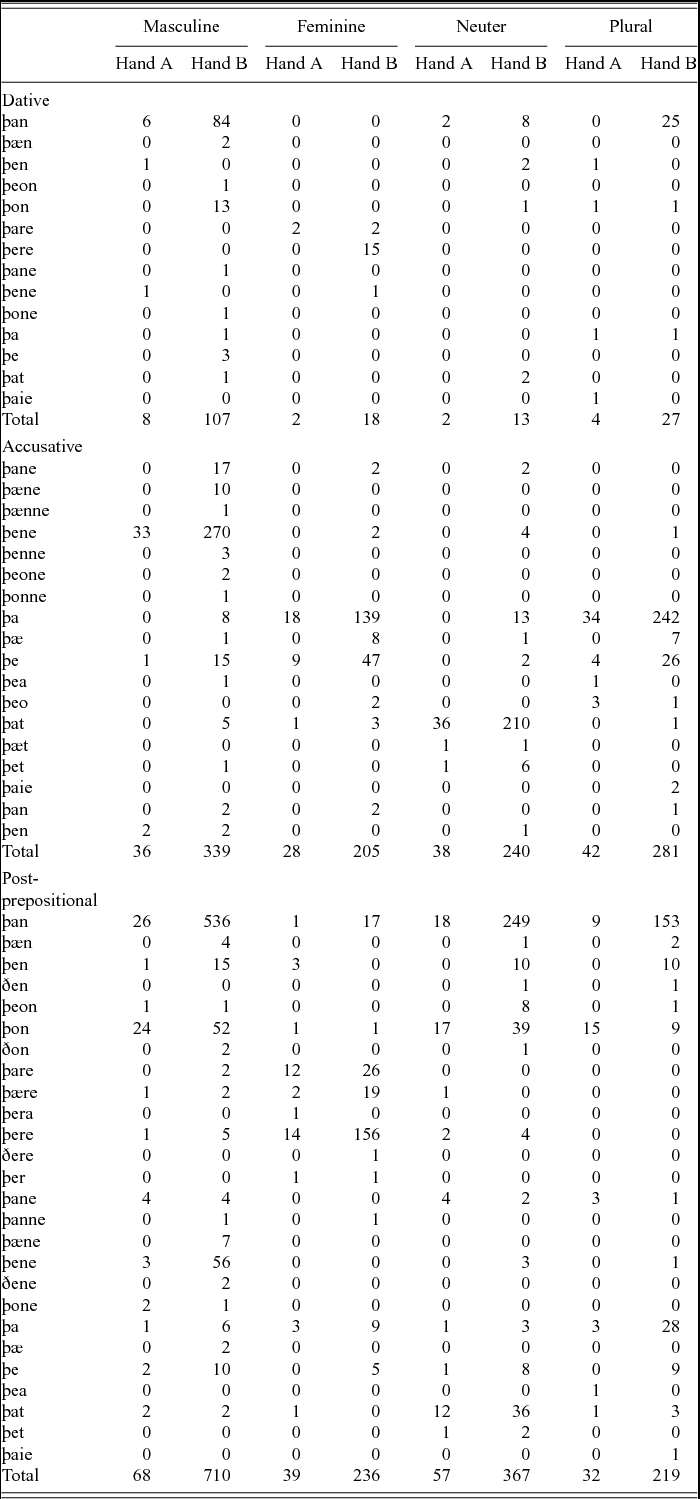
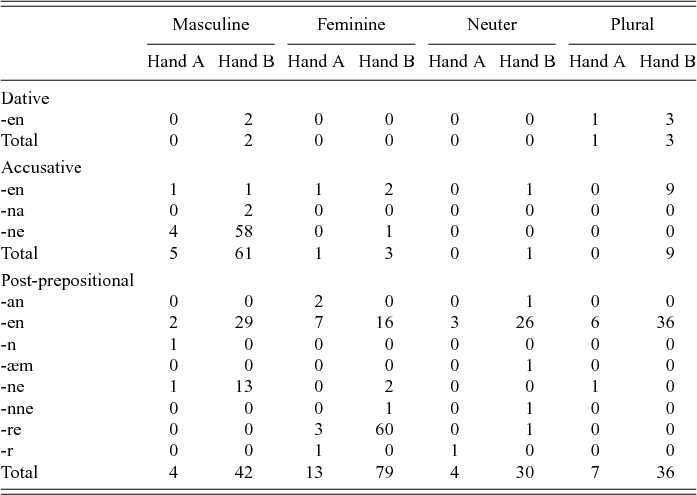
To see any patterning that may occur in the data, it is necessary to examine the occurrence of various forms of the demonstrative ‘that’ in dative, accusative and post-prepositional case contexts in Caligula, mapped against the historical gender of the nouns with which they are explicitly in construction.Footnote 5 The full data for this are given in table 1. There are two scribes involved in the production of the manuscript. Hand B is the main hand, while Hand A is responsible for just under a tenth of the manuscript.Footnote 6 The occurrence of forms used by the two scribes is listed separately. By dative and accusative contexts are meant contexts where in Old English dative and accusative forms are normally expected: the dative is used for the indirect object, the direct object of some verbs, with most prepositions, and adverbially in various expressions where English today requires the use of prepositions; the accusative is used for the direct object of most verbs, with some prepositions, and adverbially, especially in expressions of time or space. However, the instances appearing after (or before) prepositions are collectively treated as ‘post-prepositional’, since different case forms in such contexts tend to be neutralized in favor of the numerically superior dative form.Footnote 7
Distribution of forms of the demonstrative ‘that’ in dative, accusative and post-prepositional case contexts

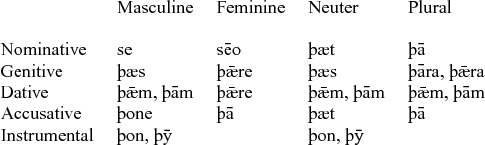
In dative singular contexts, þVn, the reflex of the Old English dative singular masculine or neuter (see appendix 1 for the Old English forms of the demonstrative ‘that’), is used with masculines or neuters 90.0% (9/10) of the time by Hand A and 92.5% (111/120) of the time by Hand B. Of the þVn forms here, þan is by far the most frequent, making up 88.9% (8/9) and 82.9% (92/111) of their total in the two respective hands. In accusative singular contexts, þVne, the reflex of the Old English accusative singular masculine, appears with masculine nouns 91.7% (33/36) and 88.2% (299/339) of the time respectively in A and B. Of the þVne forms here, þene is dominant, being the only form employed by Hand A (33 occurrences) and accounting for 90.3% (270/299) of their total in B. Judging from these numbers, the dative–accusative distinction seems to be clearly maintained, with þan and þene being the most representative markers of respective case categories. It is highly probable that the different stem vowels in the þVn or þVne forms are reduced ones and reflect not the speech, but an orthographical convention, of the time.Footnote 8 Different preferences for the stem vowel in dative and accusative forms, however, should be noted, since they potentially serve to add to the dativeness of þVn or to the accusativeness of þVne, and, in case of possible confusion of the two forms, help determine which case function is intended in the particular example.
After prepositions, originally dative þVn appears respectively 76.5% (52/68) and 61.4% (35/57) of the time in A and 85.9% (610/710) and 84.2% (309/367) of the time in B with singular masculines and neuters.Footnote 9 Hand A prefers þan and þon equally strongly, the former representing respectively 50.0% (26/52) and 51.4% (18/35), and the latter 46.2% (24/52) and 48.6% (17/35), of the total post-prepositional þVn forms found with masculine and neuter nouns. In B, þan accounts for 87.9% (536/610) with masculines and 80.6% (249/309) with neuters, and þon 8.9% (54/610) with masculines and 12.9% (40/309) with neuters. Hand A's stronger preference for þon is not clear in dative contexts, probably because of the lack of data available. Historically accusative masculine þVne comprises only 13.2% (9/68) in A and 9.9% (70/710) in B of the total post-prepositional forms constructed with singular masculines, and accusative neuter þVt 22.8% (13/57) in A and 10.4% (38/367) in B of those constructed with singular neuters. Thus it appears that the post-prepositional instances largely have the same forms as in dative contexts. This does not, however, mean that the accusative–dative distinction is completely neutralized after prepositions: thurgh ‘through’,Footnote 10 for example, which generally takes accusative in Old English, is followed twelve times by a masculine singular noun with originally accusative þVne and three times by one with historically dative þVn in B. The Brut data therefore appear to reflect a continuation of the Old English situation, where most prepositions take dative but a few take accusative.
3 Cases with ‘dative’ þVne and ‘accusative’ þVn
Despite the general pattern of historically motivated use of accusative and dative forms, there are sporadic unexpected occurrences of þVne in dative contexts and of þVn in accusative contexts. ‘Dative’ þVne is employed only with masculine nouns. All the examples are given below:
(1) <Wa> wrðe auer þene smið‘. (A 783a)
‘Woe be ever to the smith’
(2) Galoes wes feirest‘. of alle þan oðren.
leouest þone kinge‘. (B 1358–9a)
‘Galoes was the fairest of all the others, dearest to the king’
(3) Þa andswarede Merlin‘. þane kinge þe spac wið him. (B 7995)
‘Then answered Merlin to the king who spoke with him.’
Allen (Reference Allen1995: 198–9) proposes that such examples should be explained by a considerable time lag between the composition of the Brut and its copying: the scribes, who most probably did not have the same old dative–accusative system as the exemplar any longer, were likely to make hypercorrections. In example (1), þene, an accusative form, is used with a head noun lacking a dative ending probably as a general object marker.Footnote 11 The same explanation could also apply to examples (2) and (3), but they might reveal another phenomenon. Note that they both involve minority þVne forms, þane and þone. The former accounts for only 5.7% (17/299) of the total þVne forms in B constructed with masculine nouns in accusative singular contexts, and the latter is never found in the relevant contexts. They respectively have the same stem vowel as þan and þon, the most and the second most frequent form in dative singular contexts. Moreover, their head nouns have a dative ending. It is therefore possible that the scribes, faced with a language that has a different orthographical and morphological system from their own, introduced unhistorical -e in dative þVn forms.
Post-prepositional instances of þVne, especially in A, lend some support to this argument. While þene is the sole þVne form found with masculine nouns in accusative singular contexts (33 occurrences) in A, it accounts for a mere 33.3% (3/9) of the total þVne forms post-prepositionally. Here þane and þone, which do not occur in accusative contexts, make up respectively 44.4% (4/9) and 22.2% (2/9); all their head nouns have a dative ending, e.g., to þane kinge ‘to the king’ (A 467) and æfter þone kinge ‘after the king’ (A 1026). This can be compared with post-prepositional instances of þene, where none of the head nouns has a dative ending, e.g., for þene almiten Godd ‘for the almighty God’ (A 30). These examples suggest that some þVne forms in post-prepositional contexts, especially those that have the same stem vowel as the normal dative forms and whose head nouns have a dative ending, should be analyzed as being dative þVn with optional final e, rather than as accusative þVne. In B, the percentage of both normal þene and minority þane among the total þVne forms is not very different in accusative and post-prepositional contexts, standing respectively at 90.3% (270/299) and 82.9% (58/70) in the case of the former form and 5.7% (17/299) and 5.7% (4/70) in that of the latter, but þone, which does not occur in accusative contexts, appears once in a post-prepositional context. The head nouns of þene, as expected, have an unambiguous dative ending in only four cases out of 58. Those of þane and þone together appear once each with an unambiguous dative and an ambiguous stem or dative ending, and three times with no ending, indicating no particularly strong preference for the dative.
The instances of ‘accusative’ þVn may reflect the same uncertainty about the inflectional ending on the part of the scribes, who, in this case, possibly left out final e. There are two occurrences of þen in A and two each of þen and þan in B. Examples are:
(4) Þar com Eneas‘. & grette þen alde king. (A 68)
‘There came Aeneas and greeted the old king.’
(5) and alle ich wulle for-don‘. þa biluueden þen swike-dom. (B 14066)
‘and all I will destroy who approved the treachery.’
(6) þer-to weoren ilaðede‘. his leond-cnihtes alle.
riche men and hæne‘. to hæȝen þan king. (B 9963–4)
‘Thereto were invited all his land-knights, rich men and poor, to honor the king.’
Such an interpretation is favored by the fact that none of their head nouns has a dative ending and the form þen with the same stem vowel as the normal accusative form þene is here more frequent than þan, which elsewhere outnumbers it.Footnote 12
Next, let us consider instances of þVne in post-prepositional plural contexts and of þer in post-prepositional singular feminine contexts (see table 1), where respectively þVn and þere are normally expected. Here the presence or absence of final e does not obscure the distinction between the dative and the accusative, the accusative case form of both the plural and the feminine being þV. It appears that unhistorical final e can sometimes be added or historical final e deleted.Footnote 13 When þVne forms are found where the dative form is historically expected, especially those with the same stem vowel as the usual dative forms, they should therefore be interpreted as dative þVn with optional addition of -e rather than as accusative þVne. Similarly, þVn forms in accusative contexts, especially those that have the same stem vowel as the usual accusative form, should be interpreted as accusative þVne with optional deletion of -e rather than as dative þVn.
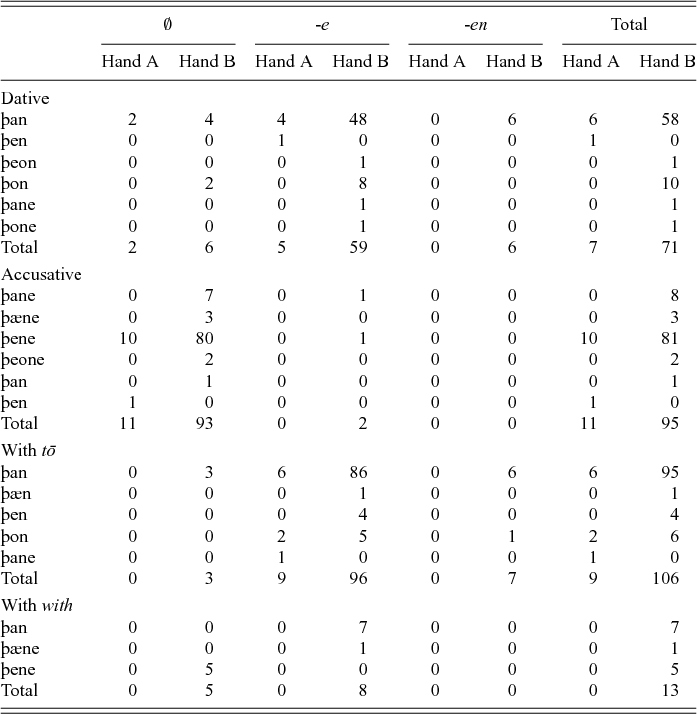
To demonstrate the extent of the variability of final e, which also affects nouns, table 2 provides data for relevant instances constructed with the very frequent noun king. The word is a masculine a-stem and historically distinguishes the accusative and the dative singular by the absence in the former, and presence in the latter, of the ending -e; unhistorical -en is occasionally found for expected -e in Caligula and in effect serves as a dative marker (see fn. 11). The table shows with which form of king the þVn and þVne forms are found in dative, accusative and post-prepositional singular contexts. Post-prepositional instances are represented by those used with tō ‘to’ and with, of which the former historically governs the dative and the latter the dative and accusative.
Distribution of þVn and þVne forms constructed with king in dative, accusative and post-prepositional case contexts
Both demonstrative and noun have a historically expected form in 71.4% (5/7) in A and 80.3% (57/71) in B of the instances in dative contexts, and 90.9% (10/11) in A and 96.8% (92/95) in B of those in accusative contexts. All instances of the nominal form with unhistorical -en, found only in B, are employed with þan, a normal dative form of the demonstrative. Unhistorical final e or lack thereof occurs only marginally: twice in B on the demonstrative form and twice in A and six times in B on the nominal form in dative contexts, and once each in A and B on the demonstrative form and twice in B on the nominal form in accusative contexts, and never on the demonstrative and the noun at the same time. These unhistorical forms might be thought to be signs of the complete breakdown of the formal dative–accusative distinction. However, this would be an incorrect interpretation. In each case, an unhistorical case form of the noun is accompanied by a historical case form of the demonstrative, or an unhistorical case form of the demonstrative, which usually has the stem vowel that is preferred by the historical form, is followed by a historical case form of the noun. Unsystematic addition or deletion of final e thus appears to be one of the factors that occasionally confuse the generally well-maintained accusative–dative distinction, though it is minimally disruptive of the overall case system.
Post-prepositional instances corroborate the preceding argument. Those found with tō, which historically takes dative, confirm the situation in dative contexts. After with, which traditionally governs dative and accusative, the demonstrative and the noun both have a dative form seven times and an accusative form five times. There is only a single instance of the demonstrative and the noun having conflicting case forms, which appears with the verb spēken ‘speak’. In combination with this verb, the preposition is elsewhere used twice each with consistently dative, and consistently accusative, nominal and demonstrative forms apparently without difference in meaning. It is important to note that even where both cases are equally possible, once the one or the other is chosen, the choice is in general expressed on both demonstrative and noun, which seems to indicate that these case forms are still being distinguished.
4 Optional final e and n-doubling on adjective forms
The same optionality of final e can be observed also in adjective morphology, both weak and strong. The relevant forms here are -ne, the reflex of the Old English strong accusative singular masculine -ne, and -en, the reflex of the strong dative singular masculine or neuter and the strong or weak dative plural -um and also of the weak form -an, which covers more than half of the categories in the paradigm of weak adjectives (see appendix 3 for the Old English adjectival declensions). The neuter word, for example, occurs in weak positions in post-prepositional plural contexts twice with an adjective with -en as in mid milden his worden ‘with his mild words’ (A 598) and once with an adjective that has -ene, in mid godene heore worden ‘with their good words’ (A 334), in A. The form -en is the normal development of Old English -um, from which -ene would not result organically. It is hardly possible that -ene here represents the strong accusative singular masculine -ne, and in the highly unlikely event that it does, the form is unusual: it should be godne, not godene. What is much more likely is that the form godene represents goden with unhistorical addition of -e.
These endings appear to have been further confused with -ne owing to the general instability of vowels in weak syllables. In B, -ne is found instead of -en twice in dative contexts as in (7), and, conversely, -en instead of -ne once in a strong position in an accusative context, in (8), against historical expectations:
(7) auerelcne cnihte‘. he ȝef ȝeoue brihte. (B 3841)
‘To every knight he gave a bright gift.’
(8) & þa he sculde of liue wende‘. he hæfde feiren ende. (B 3415)
‘and when he should depart from life, he had a fair end.’
In both instances of -ne in dative contexts, the head noun has an expected dative ending. In the only instance of -en in an accusative context, the head noun has stem-final e, which is not informative as to case.
More relevant in this context, however, may be the doubling of n suggested by Allen (Reference Allen1995: 198, fn. 41). Indeed, most instances of unhistorical -ne concern adjectives and possessives with stem-final n such as an (a), mīn ‘my’ and thīn ‘thy’. Occasional occurrences of such forms as þVnne for þVne (B 2205, 2293, 2831, etc.) and Vnnes for anes, the genitive singular masculine or neuter form of an (A 785; B 4333, 5249), support Allen's suggestion. The following example, where ane and anne are found juxtaposed with each other in similar contexts, is the most diagnostic:
(9) whær he wes in anne wude‘. in ane wilderne‘. (B 6135)
‘where he was in a wood, in a wilderness’
The preposition in traditionally takes dative in the sense of ‘rest in a place’ and accusative in the sense of ‘motion toward a place’. In the contexts represented by ane and anne in (9), where the sense of ‘rest in a place’ is relevant, Old English would have dative ānum.Footnote 14 Its reflex in Caligula is ane, probably through an intermediate stage of anen. So anne with double n in example (9) is unhistorical. The same phrase is also found in the sense of ‘motion toward a place’:
(10) þat he com in ane wude‘. in ane wilderne. (B 10093)
‘that he came into a wood, into a wilderness’
Here ane, not expected accusative anne, is employed without historicity, which shows that simplification of double n also occurs.Footnote 15 Whatever their phonetic or phonological value, ane and anne in these examples appear to be interchangeable with each other.
These unexpected occurrences of ane and anne may alternatively be regarded as wrong choices of forms in the paradigm. Such errors are consistent with the sort of mistakes that are likely to be made by scribes copying an exemplar with a language different from their own. Whatever their origin, they are used only occasionally, and when they are, they usually appear with a head noun that has the expected case form. For example, king in accusative singular contexts occurs five times with expected anne or its variant and once with unhistorical ane in B, and is always in the accusative form; and castēl ‘castle’ in the singular after the preposition tō ‘to’, which governs dative in Caligula as well as in Old English, is found four times with expected ane and twice with unhistorical anne or its variant in B, and always has a dative ending. Occasional doubling or simplification of nasals, or a wrong choice of inflectional forms, thus appears to be another factor that disturbs the accusative–dative distinction, though its impact on the case system as a whole seems to be very much limited. More details of the situation regarding adjectives will be given in the following sections.
5 The health of the accusative–dative distinction: the adjective
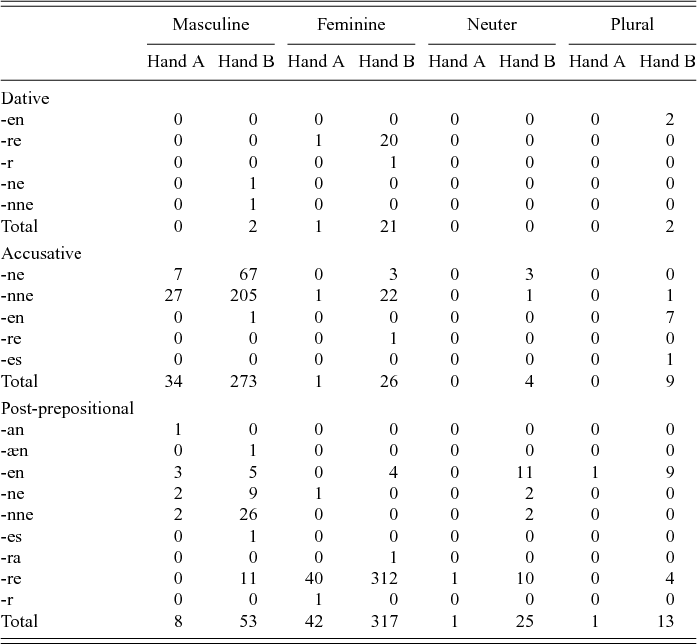
Adjectives are more susceptible to phonetic reduction than demonstratives, and their historically distinctive endings are often replaced by a leveled or zero form. The endings that remain and serve to distinguish cases are the following: -es, -en, -ne and -re, which are respectively the reflexes of the Old English strong genitive singular masculine or neuter -es, the strong dative singular masculine or neuter and the strong or weak dative plural -um, the strong accusative singular masculine -ne, and the strong genitive or dative singular feminine -re or the strong or weak genitive plural -ra. The ending -en poses a problem. As mentioned in section 4, it could be a development not only of dative -um, but also of the weak form -an with its distribution extending into other case contexts. The distinction between the two, however, is still signaled syntactically: in Old English, adjectives are declined weak when accompanied by a demonstrative, possessive or noun genitive, but strong without such an element.Footnote 16 When discussing the Middle English -en suffix, its double origin should always be kept in mind. There is a further complication in that Caligula shows the peculiarity of adding final n unhistorically to nouns and adjectives among several other parts of speech (for this ‘nunnation’, see Madden Reference Madden1847: 1, xxix), which, coupled with the optional addition and deletion of final e discussed above, obscures the status of -ne and -en. Further still, some examples of what appears to be the suffix -ne may actually represent a combination of doubled stem-final n and the ending -e. In the tables and discussions that follow, -nne of whatever origin will be distinguished from -ne for the sake of effective argument, not because they are held to be distinct as morphemes. Tables 3 and 4 show the distribution of adjectives with the remnant case-distinctive suffixes in dative, accusative and post-prepositional contexts respectively in strong and weak positions.
Distribution of the reflexes of surviving case-distinctive adjectival inflections in dative, accusative and post-prepositional case contexts: strong positions
Distribution of the reflexes of surviving case-distinctive adjectival inflections in dative, accusative and post-prepositional case contexts: weak positions
Of -en, -(n)ne and -re, the three strong forms relevant in these contexts,Footnote 17 the first suffers most seriously from phonetic reduction. The fact that Old English ānum, the dative singular masculine or neuter form of ān ‘an’, does not give anen but is further reduced to ane is briefly touched upon in section 4. This is generally the case with other adjectives, and it explains the limited occurrence of -en in both strong and weak positions. The development of the demonstrative ‘this’, which is outside the scope of this study, is also revealing. The dative singular masculine or neuter form, þissum in Old English, is often þisse rather than þissen in Caligula (see Shinkawa Reference Shinkawa2012: 78, 80, 83). Thus even if -en proves to remain a distinctive dative or weak form, it is no longer the main marker of either function.
The other strong forms, -(n)ne and -re, on the other hand, appear robust in accusative, and dative and post-prepositional contexts respectively, so much so as to spill over into weak positions, where -en is historically expected. Concentrating on accusative -(n)ne, it shows no instance in A of confusion with dative -en in accusative singular masculine contexts and only a single instance against 272 of historical -(n)ne in B (see example (8)). Given also its marginal status in the adjective paradigm, -en is not a threat to the health of -(n)ne as an accusative case marker.
Post-prepositional occurrences of -(n)ne, too, indicate its health as an accusative marker. Those constructed with masculine nouns in A are found with prepositions that traditionally govern (a) either accusative or dative (for, umbe ‘about’) and (b) accusative in the particular contexts concerned (in ‘into’, on ‘on to’). The head nouns that follow the type (a) prepositions have no dative ending, and those used with the type (b) prepositions appear with an endingless form and a dative form once each. Thus -(n)ne can be seen to be associated strongly with the accusative. In B, the prepositions involved are those that take (a) either accusative or dative (for, onyēn ‘against’, thurgh ‘through’, with), (b) accusative in the particular contexts concerned (in ‘into’, on ‘on to’, ōver ‘over’), and (c) dative either generally or in the particular contexts concerned (amid(de) ‘amid’, tō ‘to’, in-tō ‘into’; in, on, ōver ‘over’). The head nouns governed by the type (a) prepositions occur thirteen times in an endingless form and once each with an ambiguous stem or dative ending and an unambiguous dative ending. Those found with the type (b) prepositions occur seven times in an endingless form, three times with an ambiguous stem or dative ending, and once in an unambiguous dative form. Those following the type (c) prepositions occur once in an endingless form and four times each with an ambiguous stem or dative ending and an unambiguous dative ending. With the exception of those that are governed by type (c) prepositions, -(n)ne forms are strongly associated with the accusative. All the exceptional, or non-accusative, instances of -(n)ne here involve anne or its variant, which, as discussed in section 4, is probably a variation of ane with double n or a form wrongly chosen for ane. However, they are rare and unlikely to have adversely affected the status of -ne as a marker of the accusative case.
Post-prepositional -en and its variants occur only rarely in strong positions, but when they do, they tend to mark the dative distinctively. The instances in A of -en and -an constructed with singular masculines (there is no neuter instance) appear three times with mid ‘with’, which traditionally takes dative, and once with for, which governs either dative or accusative. Their head nouns have an ambiguous stem or dative ending three times and probably dative -en once. In B, -æn is found once with a singular masculine, and -en five times with singular masculines and eleven times with singular neuters. Most follow prepositions that historically take dative either generally or in the particular contexts concerned (mid ‘with’, of, tō ‘to’; on), the only exception being one preceded by for, which can take accusative as well as dative. Their head nouns appear nine times in an unambiguous dative form, three times with an ambiguous stem or dative ending, twice each with probably dative -en and with no ending, and once in a genitive form.Footnote 18 It thus appears that -en, as well as its variants, for the most part represents the dative.
The formal reduction of the dative form does not obscure the dative–accusative distinction, unless the accusative form, too, suffers from reduction and loses its distinctiveness, which has not happened in Caligula. The conclusion can therefore be that the distinction is still healthy in adjective morphology despite occasional instances of optional final e, unhistorical double or single n, and a wrong choice of inflectional forms.
6 Attributive suffixes -Vn and -ne as gender-neutral case markers
Unhistorical anne for ane has been shown to be, on the whole, uncommon, but its occurrence with feminine nouns in accusative singular contexts, where ane is historical, is too frequent to be neglected. Here the ratio between anne and ane (including their variants) is 1 to 23 in A and 19 to 72 in B. The ratio between the two forms found with neuter nouns in post-prepositional singular contexts, where dative ane is expected to be predominant and accusative an to occur only occasionally, for example, is 0 to 7 in A and 2 to 47 in B. The considerably greater frequency of the double n form with feminines in accusative singular contexts suggests that this particular deviation is not random. It may be explained as spillover into the feminine domain of accusative singular masculine anne as a gender-insensitive accusative marker. The double n form also occurs once with a neuter noun in an accusative singular context, where an is historically expected:
(11) þer-inne he bulde ænne bur. (B 14581b)
‘therein he built a chamber’
Since ænne here is highly unlikely to have developed from an by phonetic, phonological or orthographical processes as it could possibly have done from ane, it most probably represents an extension of the accusative singular masculine form.
Unhistorical examples of -nne in accusative singular contexts are confined to the word anne and its variants, including its negative versions such as nenne, and they may represent a change in this particular word, not a general extension of accusative -ne. Examples of -nne in general, however, are almost exclusively of anne or its associated forms, and the other -nne forms may just happen not to occur in the relevant contexts. Moreover, the suffix -ne in demonstratives and adjectives occasionally appears to mark the accusative irrespective of gender as the following examples show:
(12) He luuede þane sunne‘. (B 14392a)
‘He loved the sin’
(13) ouer-al me brac þene grið‘. (B 2013b)
‘Everywhere men broke the peace.’
(14) þat þu æi hæhne burhȝe‘. hæðene monne habbe bi-tæht. (B 7083)
‘that you may have given any high city to a heathen man.’
(15) he dude þer muchelne wunde((r))‘. (B 3735)
‘He did there a great wonder.’
Accusative singular masculine þVne is constructed with a feminine noun in (12) and with a neuter noun in (13), and the adjective suffix -ne in a strong position with a feminine noun in (14)Footnote 19 and with a neuter noun in (15). In the following example, -ne is extended even to a plural context, possibly showing its number insensitivity:
(16) & falden þene ælden nomen‘. æfter heore wille. (B 3552)
‘and abolished the old names after their will’
In view of these examples of the gender- and possibly number-neutral attributive suffix -ne in accusative contexts, unhistorical accusative anne is probably best treated as part of -ne extension rather than as representing a change in this particular word.
Dative singular masculine or neuter -Vn, too, shows some cases of extension to the feminine domain in post-prepositional contexts as in the following examples:
(17) Þa me mihte bihalden‘. þe þer bihalues weoren.
folc a þan uolde‘. feondliche adredde. (B 11917–18)
‘Then men who happened to be there beside might have seen the folk on the land immensely frightened.’
(18) Wunden in-to widen sæ‘. þeines wunder bliðe. (B 12747)
‘Thanes wondrously blithe wound into the wide sea.’
These developments of -Vn and -ne as well as similar gender-insensitive uses of -es as a genitive marker, which is not discussed in this study, constitute what is traditionally called ‘masculinization’, but discussion of this lies outside the scope of this study.Footnote 20 For present purposes, it suffices to point out that -Vn and -ne as case markers are stable enough to possibly begin to develop a system or subsystem of indicating case regardless of gender considerations either in the original of the Brut or as an innovation introduced by the scribes. Either way, such a development presupposes that there is a systematic distinction between the dative and accusative cases.
7 Conclusion
The conclusion to be drawn from the detailed analysis of case forms presented in this article is that Caligula retains the traditional category distinction between the accusative and the dative very well, confirming Allen's (Reference Allen1995: 196) views. The demonstrative ‘that’ and the adjective to a large extent distinguish the two cases by the use of the endings -ne and -Vn, even though these suffixes occasionally suffer phonetic reduction and the adjective ending -Vn is often reduced to -e, which gives little information as to case. Other factors that to some extent confuse the overall picture are the optional addition or deletion of final e, occasional doubling or simplification of nasals, and wrong choice of forms in the paradigm. These seem to have been introduced rather mechanically by scribes copying an exemplar with a language different from their own. In the process, they are also likely to have made some hypercorrections. These ‘mistakes’, which led Allen (Reference Allen1995: 198) to express reservations about treating -ne as one distinct suffix, can indeed undermine the formal accusative–dative distinction. However, their impact is less serious than it might appear, because they have rather low frequency of occurrence, there is usually a ‘correct’ case form of their accompanying head noun, and in the case of the demonstrative ‘that’, additional marking is achieved by the contrast in the stem vowel preferentially associated with each of the two cases. The status of accusative -ne and dative -Vn, in fact, appears to be surprisingly stable, even to the point that they are occasionally generalized as gender-neutral case markers in their respective case contexts. These suffixes can therefore be treated validly as consistent case markers so long as the occasional occurrence of optional final e, unhistorical double or single n, and wrong choice of inflectional forms are allowed for.
It would not be appropriate to generalize the findings of this study, which deals with only a single text, and an ‘idiosyncratic’ one at that, to formulate any theory regarding the mechanics of the syncretism of the dative–accusative case categories in Early Middle English. Such an endeavor requires an examination of a much larger corpus. Broad-scale studies of that sort, owing to the limited availability of material from the relevant periods, would necessarily have to address an incoherent body of texts involving different areas, periods and genres, which would be difficult to interpret: geographical, chronological and genre features would not be easily distinguishable from one another. Moreover, works that cover a large number of texts tend to oversimplify and see each text as reflecting a single system, whereas there might be multiple systems underlying the forms used in the text concerned. Crucial details might be missed out or glossed over in such studies. Details of that sort can be expected to be furnished not by large-scale corpus studies, but by individual case studies. Thus philological and linguistic works complement each other. It is hoped that this research helps in fine-tuning the findings of large corpus studies such as Allen (Reference Allen1995).
Appendix
1 Forms of the demonstrative ‘that’ in Old English
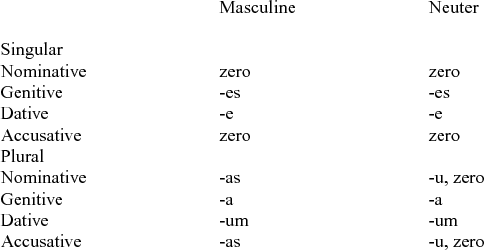
2 Forms of a-nouns in Old English
3 Adjectival endings in Old English
3.1 The strong declension
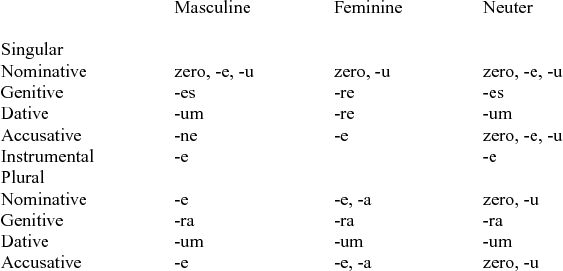
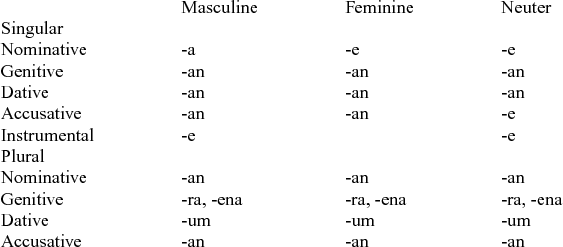
3.2 The weak declension