Introduction
Media reporting on disasters and humanitarian responses traditionally has been characterized by intense amounts of coverage during the early stages of the event, followed by a rapid reduction in coverage. 1 , Reference Brown and Minty 2 From the perspective of informational accuracy, this places the media in a position of saying the most when the least is known, and saying progressively less as more is learned. In addition to providing information, media reports also may serve to motivate people to modify their behaviors. Mass media campaigns have been linked with increased interest in, and uptake of, vaccinations when stories are positive,Reference Grilli, Ramsay and Minozzi 3 , Reference Danovaro-Holliday, Wood and LeBaron 4 and a decline in vaccination rates when media reports are negative.Reference Mason and Donnelly 5
The Elaboration Likelihood Model of Persuasion (ELM) posits a framework linking news media coverage and public behaviors that is relevant to understanding the impact of both traditional (television, radio, print) and new (digital) media methods on public engagement in humanitarian charitable giving.Reference Petty and Cacioppo 6 Central to this model is the theory that attitudes are influenced by peripheral processing based upon superficial analysis and core processing based upon deeper analysis. This framework asserts that individuals pay more attention to information that is both easily understood through peripheral processing and deemed to be relevant to them. Theoretically, new/social media (such as Twitter, Facebook, online news sites, blogs, and text messaging campaigns) have the potential to focus users’ attention by bombarding them with easily understood messages that are made relevant to the user by the media's social and interactive character. When well-deployed, these social media messages often are viewed as presenting more authentic and honest portrayals than traditional news media, despite (and in some cases because of) their lower production value. 7
While there is a lack of agreement among humanitarian responders about the accuracy of media coverage,Reference Lobb and Mock 8 , Reference Voorhees, Vick and Perkins 9 or how much is the right amount, one clear product of media coverage is the generation of public awareness necessary to inspire charitable giving.Reference Brown and Minty 2 The link between reporting and charitable giving is being established gradually. After the 2004 tsunami-caused disaster in Southeast Asia, for example, each additional minute of nightly television news coverage, or each additional print story of >700 words, was associated with a 16.5% to 20.8% increase in donations made on the Internet.Reference Brown and Minty 2
The evolving role of social media, such as Facebook, Twitter and text messaging, rapidly is changing not only the way that people are informed about world events, but also how they make charitable donations.Reference Sherlock 10
The purposes of this study were to explore some metrics of media coverage of the January 12, 2010 earthquake in Haiti in order to assess changes in media intensity during the first four weeks following the event, and to link this information to data on aggregate and daily contributions to emergency assistance donors to determine the impact of media upon post-disaster charitable giving.
Methods
Data on media coverage of the Haiti earthquake were compiled via a NexisLexis search of US newspapers and wires for the terms “Haiti” and “earthquake,” for the period of January 12 through February 7, 2010. From this, the total number of “newswires and press releases,” and “newspaper stories” was noted. The specific measures of media coverage included:
-
(1) Number of US newswire reports and press releases;
-
(2) Number of television stories on ABC News;
-
(3) Number of words in ABC News television transcripts;
-
(4) Number of stories and number of words in The New York Times; and
-
(5) Percentage of Twitter posts related to Haiti.
The New York Times and ABC News were singled out to represent examples of major providers of international printed and television news to US media consumers. Because of the increasing reliance of newspapers on wire reports, and the possibility that a single wire report may appear in multiple newspapers, the NexisLexis figures on newspaper stories and newswire reports may overstate counts of the total number of different stories appearing in papers across the US. Nonetheless, such counts are useful to represent changes in the overall intensity of media coverage over time. Further, the broad uptake of these articles represents increased reach of the articles to more communities.
The New York Times and ABC News transcripts were searched using the same terms and strategy, with the total number of stories noted, and the total number of words per story totaled for each day.
Twitter data represented the peak percentage of Twitter messages (tweets) dedicated to Haiti each day, as measured by Trendistic.com (http://twitter.com/#!/trendistic). Data from Twitter were singled out for analysis because of Twitter's convenience, and the rapidly-growing nature of this medium.
Information on the uses of other social media was gathered using the Google search engine and MEDLINE research database. Search terms included “Haiti,” “earthquake,” “humanitarian response,” “new media,” “text messaging,” “Facebook,” and “Twitter.” The social and digital media tracking service trendrr.com (http://www.trendrr.com) provided data on Facebook usage (data not shown).
Data on the total amount of charitable giving to Haiti recovery efforts were gathered from the website of the Center for Philanthropy at Indiana University (http://www.philanthropy.iupui.edu/research/disaster.aspx). The Center for Philanthropy data reflect US contributions from individuals, corporations, and foundations to registered 501(c)(3) organizations involved in Haiti relief efforts. The data do not include aid from the US government. Data were gathered from reports from recipient organizations including websites and press releases, reports from organizations such as The Chronicle of Philanthropy and the US Chamber of Commerce, and other news stories. Since data were displayed as an accumulated total, the daily amount was calculated as the difference in the accumulated total from one day to the next. Because data on charitable contributions were not available for all days, a smoothing procedure was undertaken using the command “tssmooth” in Stata Version 11.0 (StataCorp, College Station, Texas USA). Smoothed daily contributions were calculated using two lag terms and three forward terms. Alternative combinations of lag terms and forward terms also were applied, though none improved on the original.
Linear regression analysis was used to test associations between daily charitable contributions and measures of media coverage of the earthquake.Reference Lütkepohl 11 Each day during the period from January 12, 2010 through February 7, 2010 was treated as a single observation. Four separate models were estimated, focusing in the first three models on a specific type of medium—newspaper, television or Twitter—and then including all three measures in a single model to test for the relative contribution of each medium to charitable contributions. Specifically, the first three models regressed daily charitable contributions on: (Model 1) the peak percentage of Twitter messages (tweets) dedicated to Haiti each day; (Model 2) the number of newspaper stories about Haiti on a given day; or (Model 3) the number of ABC News stories on a given day. Previous-day values of each medium were also included in the models to account for the possibility that donors did not respond immediately to news reports. These models also contained values of charitable contributions lagged from the previous day and two days prior. Each model was estimated using the var command for multivariate time series second order vector autoregressive model.Reference Granger 12
Results
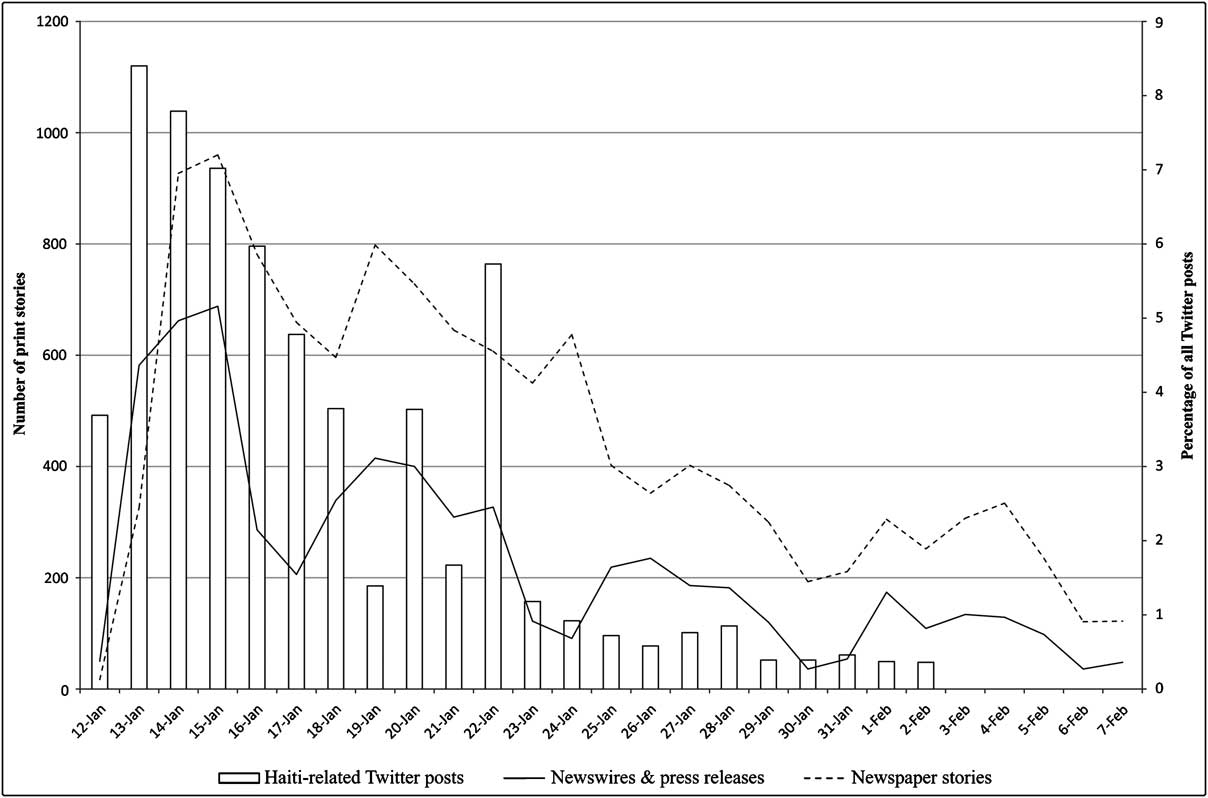
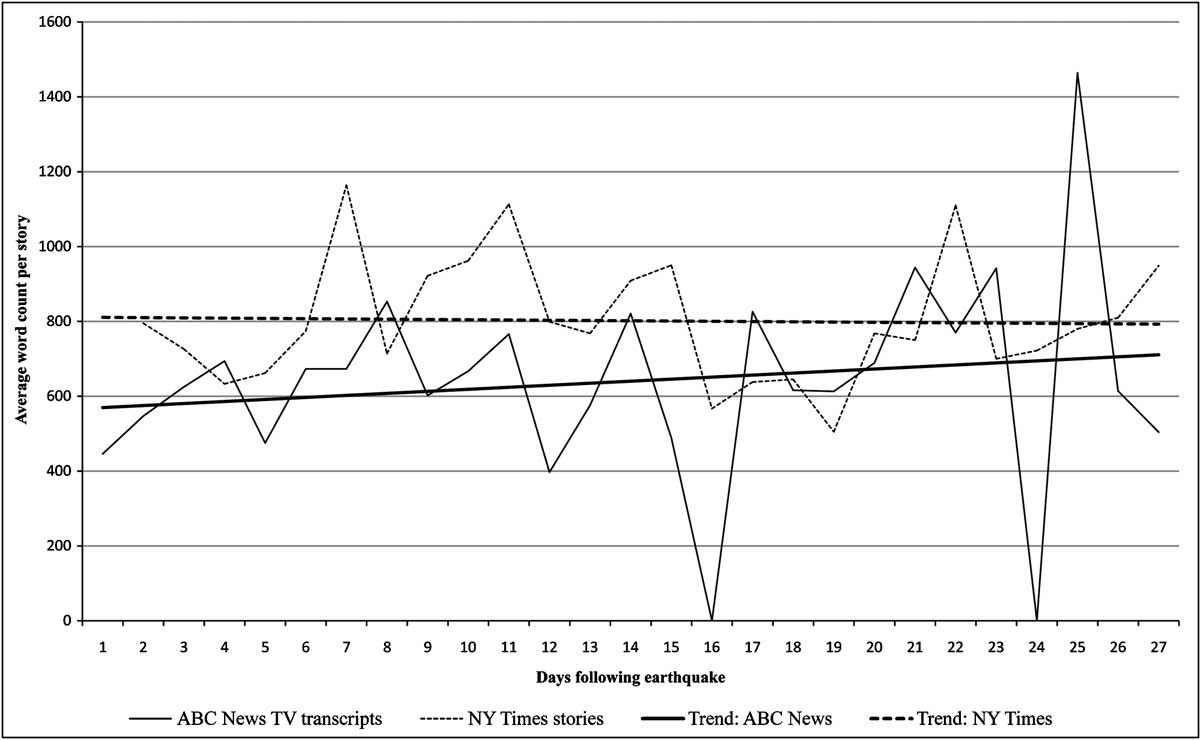
Media-intensity, as measured by total newspaper and newswire stories, reached its peak in the first week after the earthquake in Haiti, (960 and 688, respectively, both on the third day after the event) and then declined over the following three weeks (Figure 1). The intensity of Haiti-related tweets peaked earlier, at about 8.5% of all Twitter traffic, and declined more quickly, amounting to less than 1% of Twitter traffic within two weeks (Figure 1). Coverage of the earthquake on ABC News and The New York Times followed a similar trend of the overall coverage, in terms of total number of stories (data not shown). The average number of words dedicated to each story remained constant for The New York Times at around 800 words, and for ABC News television transcripts, increased slightly from roughly 600 to 700 words per story (Figure 2).
Twitter and Print Media Coverage of the 2010 Earthquake in Haiti

Number of Words per Haiti-Related News Story, Select Media

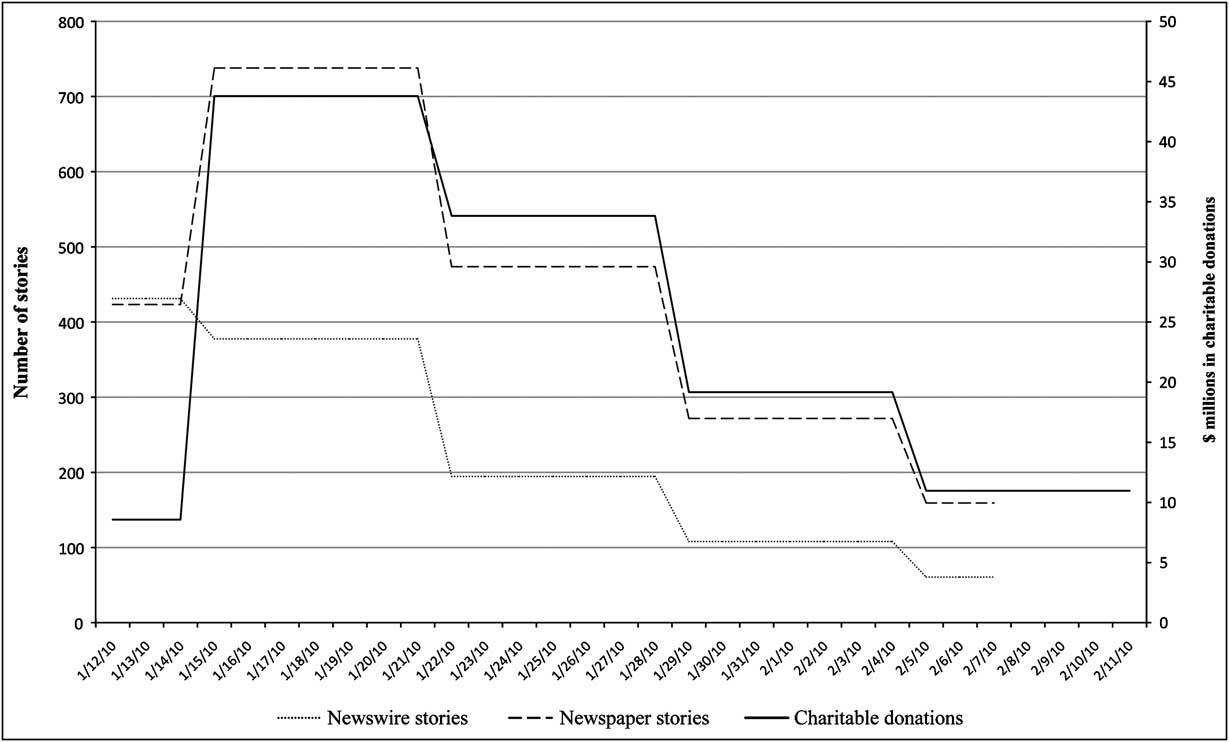
Daily charitable donations also peaked during the first week after the event at approximately US $43.79 million per day. By the fourth week, this amount had declined to approximately US $10.97 million per day. Presenting raw, unadjusted news coverage as daily averages per week provides easy visual comparison with charitable donation figures, and reduces dramatic day-to-day fluctuations, which may be influenced by factors such as day of the week, and by sudden new events within the larger story such as an after-shock or involvement of a celebrity (Figure 3).
Average Daily Charitable Donations for Haitian Recovery, and Average Number of Daily Media Reports, per Week

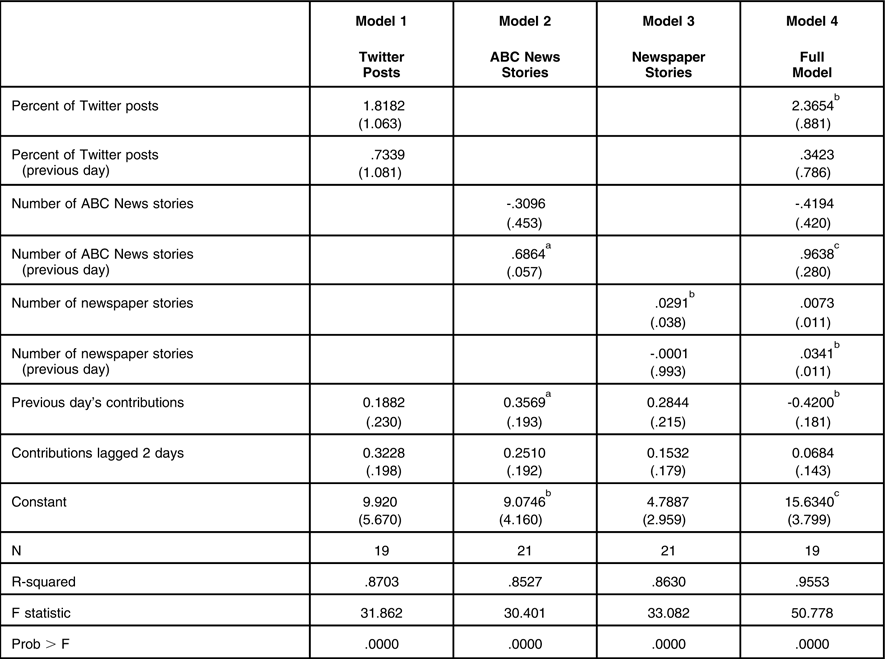
The results from the linear regression analysis (Table 1, Models 1-4) indicate that daily charitable contributions were positively correlated with all media (Table 1, Models 1-4). For example, every additional 10% share of earthquake-related Twitter posts was associated with a US $181,820 increase in charitable contributions (although this result is not statistically significant, Model 1), while each ABC daily news story about the earthquake was associated with an additional US $686,400 in charitable contributions on the following day (Model 2, not statistically significant). In Model 3, with every additional 10 newspaper stories covering the earthquake, charitable contributions increased by US $291,000 (a statistically significant result). In the final full model including all of the media (Model 4), each additional 10% share of Twitter posts relative to the peak percentage was associated with an additional US $236,540 in contributions. The effects for television were considerably larger; each additional ABC News story was associated with an additional US $963,800 in contributions. Both results are statistically significant.
Comparison of Models Determining Charitable Contribution

Standard Errors in parentheses. P values denoted by letters: a P < .10, b P < .05, c P < .01.
Note that all models are 2nd order vector auto-regressive models using one- and two-period lagged values for charitable contributions.
Discussion
Previous analyses have reported that charitable giving may be motivated by news coverage, peaking soon after the event, and then diminishing over time as stories recede from front pages. 1 , Reference Brown and Minty 2 Data on total newspaper and newswire stories of the earthquake in Haiti appear to support this assertion, with the most intense coverage occurring during the week after the quake, then steadily declining. New media coverage—as represented by Twitter traffic—peaked earlier and declined quicker. Analyses of the number of words dedicated to coverage of the Haiti disaster by two major news outlets, ABC News and The New York Times, suggest that depth of individual stories may not have increased over time, even though overall knowledge about the event grew over time.
Charitable donations mirrored the trend of traditional media, peaking during the first week following the event and declining thereafter. This association appears to be causal, rather than mediated by spurious factors. Findings from research of previous disasters has suggested a causal link, with increased news coverage leading to increased donations on the same day as the coverage.Reference Brown and Minty 2 From a theoretical and logical perspective, media generally is the first and only source of post-disaster information available to most citizens, although Internet and new/social media sources increasingly are available and relevant to those who may be particularly cause-oriented. These findings place a great obligation on traditional media to adhere to ethical standards with respect to reporting, including the implications of reporting for humanitarian initiatives.
Disasters receive more attention from distant populations that feel affected by the crisis, or somehow are tied to the area or people directly involved in the event.Reference Proudlock and Ramalingam 13 This coincides with the theoretical underpinnings posited by ELM. Social media may be especially well-suited to building a sense of personal investment, specifically because of their informal, social, and interactive nature. Twitter began carrying disaster-related traffic almost immediately, without pre-planning or coordination, and was used to provide field updates on recovery efforts to those outside of Haiti, as a means of communication among recovery teams on the ground, and as a way for recovery workers to gather useful information from persons outside of Haiti. For example, Twitter was used to aid identification of the deceased (http://bit.ly/twt4haiti). Retrospective analysis also has found that the volume of traffic on Twitter about H1N1 correlated well with disease incidence data during the 2009 H1N1 flu epidemic, and traffic peaks aligned with major news stories.Reference Chew and Eysenbach 14 This likely is enabled, in large part, by the media's ubiquity and ease of use: in 2010, 175 million Twitter users posted some 25 billion tweets. 15 And while eight percent of American adults who use the Internet also use Twitter,Reference Smith and Rainie 16 the findings from this study suggest that Twitter users lost focus on Haiti sooner than did the traditional media. Thus, Twitter may not be the best medium for longer-term engagement.
Text messaging was used for the first time as a means of large-scale fund-raising following the Haiti earthquake. In the first seven days after the earthquake, US $275 million was donated to charitable organizations. Of this amount, US $24 million was raised in US $10 donations by the American Red Cross via a text messaging effort (by texting to a specific number, the donation was charged to the donors’ phone bills).Reference Sherlock 10 Among adult American cell phone users, 11% report making charitable donations via text message.Reference Smith 17
The Haiti-based non-governmental organization, Partners in Health (PiH), used Facebook to provide ongoing news and updates about Haiti recovery efforts, in addition to fund-raising information. Even as mainstream news coverage fell to around 10% of its post-earthquake peak during the early weeks of February, data from trendrr.com showed that PiH continued to add new followers on Facebook at a rate of about 1,000 per month (data from trendrr.com not shown). This suggests that Facebook may be better-suited for longer-term engagement than other media. In 2010, the number of Facebook subscribers increased by 250 million, to a total of approximately 600 million. 15 Facebook users spend over 700 billion minutes sharing over 30 billion pieces of content each month. 18
YouTube provides individuals and organizations an inexpensive outlet for broadcasting video directly to the public. Content can be linked to Facebook and other websites, and is searchable using search engines such as Google. Followers also can subscribe to YouTube channels, and recent upgrades have removed time limits for video length. The use of YouTube has become mainstream, with entities such as the White House and the Vatican using it for official communiqués. Each day, approximately two billion videos are viewed on YouTube. 15
Conclusions
Media coverage of the 2010 earthquake in Haiti spiked during the first few days after the event, then declined rapidly over the following three weeks. Charitable giving mirrored this trend. New/social media, such as Twitter, exhibited a similar, albeit exaggerated trend that peaked sooner and dissipated more quickly. Text messaging proved to be a powerful tool for fundraising, and Facebook may provide a medium for longer-term engagement.
Humanitarian and development organizations interested in leveraging social media as a means of informing supporters and the general public about their efforts and the welfare of the populations they serve should consider a strategy that utilizes multiple media. For example, ramping up early engagement with Twitter, utilizing text messaging for fund-raising, and using Facebook to continue to tell the story of recovery to interested people and potential donors around the world, long after the mainstream news sources have lost interest in covering the story.
Abbreviations
- ABC:
-
American Broadcasting Corporation
- ELM:
-
Elaboration Likelihood Model of Persuasion
- PiH:
-
Partners in Health