Antibiotic resistance is a serious public health threat around the world. 1,2 Among nursing home residents, urinary tract infections (UTIs) are common, accounting for up to 20% of infections reported and 50% of antibiotic treatment starts. Reference Genao and Buhr3 Understanding the prevalence of antibiotic resistant pathogens causing UTIs in nursing homes informs both infection prevention and antibiotic stewardship. Large European studies have described higher levels of resistance to fluoroquinolones and cephalosporins among uropathogens isolated from nursing home residents compared to community-dwelling older adults. Reference Pulcini, Clerc-Urmes, Attinsounon, Fougnot and Thilly4,Reference Rosello, Hayward and Hopkins5 However, fewer studies describe antibiotic resistance among uropathogens from residents of US nursing homes. Reference Lautenbach, Marsicano, Tolomeo, Heard, Serrano and Stieritz6,Reference Das, Perrelli, Towle, Van Ness and Juthani-Mehta7
The Centers for Disease Control and Prevention (CDC) National Healthcare Safety Network (NHSN) provides surveillance infrastructure for tracking healthcare-associated infections and antibiotic-resistant pathogens in US healthcare facilities. Using these data, the CDC has published reports describing the prevalence of antibiotic-resistant pathogens in acute-care hospitals. Reference Weiner-Lastinger, Abner and Edwards8,Reference Weiner, Webb and Limbago9 In 2012, the NHSN expanded, allowing US nursing homes the ability to report data on UTI-causative pathogens and their antibiotic susceptibility testing results utilizing the Long-Term Care Facility (LTCF) component. To improve knowledge on antibiotic resistance in nursing homes, we applied existing methods developed for the analysis of NHSN acute-care hospital data Reference Weiner-Lastinger, Abner and Edwards8 to describe selected antibiotic resistance phenotypes among pathogens associated with UTI events reported to NHSN LTCF by nursing homes.
Methods
We used data reported from Centers of Medicare and Medicaid (CMS) certified nursing homes on UTI events that occurred between January 2013 and December 2017. All nursing homes that reported at least 1 complete month of UTI surveillance data, both numerator (UTI events) and denominator (resident days and catheter days), were included.
UTI surveillance methods
Facilities performing monthly UTI event surveillance collect and report both clinical signs and symptoms and urine culture microbiology results. UTI events are based on the revised McGeer definitions for LTCF infection surveillance Reference Stone, Ashraf and Calder10 and are defined in the NHSN UTI event reporting protocol. 11 The 3 types of reportable UTI events are symptomatic UTI (SUTI), indwelling urinary catheter-associated symptomatic UTI (CA-SUTI), and asymptomatic bacteremic UTI (ABUTI). ABUTI events were excluded from our analysis due to their low frequency.
Pathogens and susceptibility data
For each UTI event, up to 3 causative pathogens may be reported. For selected pathogens, NHSN requires users to provide susceptibility results for certain antibiotic agents. Users also have the option to enter susceptibility data on other antibiotic agents. Susceptibility is reported categorically as either “susceptible” (S), “intermediate” (I), “resistant” (R), or “not tested” (N). Consistent with Clinical and Laboratory Standards Institute recommendations, 12 only pathogens with ≥30 isolates reported were included in our analysis. Nitrofurantoin, while not a required drug for NHSN reporting, is a commonly used antibiotic in nursing homes and was included in our analysis. In 2015, NHSN revised the UTI event definition to exclude funguria. As a result, we excluded UTI events listing Candida or other yeast species as the only pathogen from our analysis to be consistent with this definitional change.
Selected antibiotic resistance phenotypes
We grouped pathogens and defined antibiotic resistance phenotypes using criteria previously established by the NHSN (Box 1), Reference Weiner-Lastinger, Abner and Edwards8 and we used criteria for defining multidrug resistance (MDR) based on published standard definitions. Reference Magiorakos, Srinivasan and Carey13 To be defined as MDR, a pathogen must have been reported as intermediate (I) or resistant (R) to at least 1 agent in ≥3 antibiotic categories or classes.
National Healthcare Safety Network Antibiotic Resistance Phenotypes

Note: I, intermediate, R, resistant.
Statistical analysis
Characteristics of the reporting nursing homes and the frequencies and distributions of UTI pathogens by event type (SUTI or CA-SUTI) were summarized. For each pathogen-antibiotic class phenotype, the percentage of pathogens tested for susceptibility was calculated as the sum of pathogens tested for susceptibility divided by the sum of total isolates reported and multiplied by 100. The pooled mean rate of resistance was calculated as the sum of isolates that tested resistant divided by the sum of isolates tested for susceptibility and multiplied by 100. The resistance rate for all UTI events was calculated as the sum of UTI events with any resistant pathogen (as defined in Box 1) divided by the sum of UTIs reported and multiplied by 100. Data were analyzed using SAS version 9.4 software (SAS Institute, Cary, NC).
Results
In total, 243 nursing homes from 46 states reported at least 1 month of UTI surveillance data to NHSN. The median nursing home size was 91 beds (range, 9–801); average occupancy was 87%; 220 nursing homes (90%) were dual certified by Medicare and Medicaid; 121 nursing homes (50%) were nonprofit facilities and 80 nursing homes (33%) were independent, freestanding facilities. Most (196, 81%) had laboratory testing performed outside the facility.
Distribution of UTI by type and pathogen
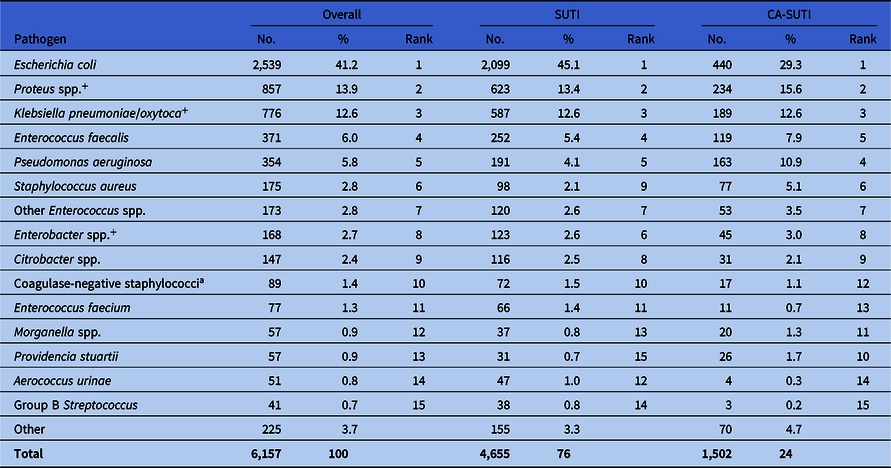
In total, 5,485 UTI events were reported: 4,261 (78%) were SUTIs and 1,224 (22%) were CA-SUTIs, for a total of 6,157 pathogens reported (an average of 1.1 per UTI event). The 3 most commonly reported pathogens, Escherichia coli, Proteus spp, and Klebsiella pneumoniae/oxytoca (Table 1), accounted for 68% of all UTI pathogens, and the frequency ranking was the same for SUTI and CA-SUTI events. However, P. aeruginosa and S. aureus ranked higher among CA-SUTIs, whereas Enterococcus faecalis and Enterobacter spp ranked higher among SUTI events.
Distribution and Rank Order of Selected Urinary Tract (UTI) Pathogens Reported to the National Healthcare Safety Network, Long-Term Care Facility Component, Overall and by UTI Type, 2013–2017 (n=6,157)

Note: SUTI, symptomatic urinary tract infection; CA-SUTI, catheter-associated symptomatic urinary tract infection. The most common pathogens with ≥30 reported isolates are listed in this table and are ranked according to reporting frequency of all pathogens reported to the NHSN LTCF module.
a Among reported pathogens, the following species were frequently reported but were considered part of a larger pathogen group for this table Proteus mirabilis (n=835), Klebsiella pneumoniae (n=704), Enterobacter cloacae complex (n=110), and Staphylococcus epidermidis (n=45).
Susceptibility testing and antibiotic resistance rates
The overall percentage of individual pathogens with susceptibility testing performed (ie, with a susceptibility result not equal to N [not tested] or missing) for specific antibiotic agents ranged from 72.6% to 98.9% (Table 2). The highest proportion of antibiotic classes with susceptibility testing reported were aminoglycosides (range, 94.0%–98.9%), vancomycin (range, 93.0%–96.1%), and fluroquinolones (range, 86.9%–98.0%). Susceptibility of pathogens tested against nitrofurantoin could not be summarized because optional reporting of susceptibility testing was low (between 0 and 28%).
Pathogens (N=4,460) Reported from Urinary Tract Infections (UTIs) (n=4,091) That Were Resistant to Selected Antibiotic Agents, by UTI Type, 2013–2017

Note: OX/METH/CEFOX, oxacillin-methicillin-cefoxitin; VAN, vancomycin; ESC4, extended-spectrum cephalosporin (cefepime, cefotaxime, ceftazidime, ceftriaxone); CARB (imipenem, meropenem, doripenem, ertapenem); MDR, multidrug resistant (must test either intermediate (I) or resistant (R) to at least 1 drug in 3 of the 5 following classes [ESC4, FQ3, AMINO, CARB, & PIP/PIPTAZ]; FQ3, fluoroquinolones (ciprofloxacin, levofloxacin, moxifloxacin); AMINOS, aminoglycosides (amikacin, gentamicin, tobramycin); ESC2, extended-cephalosporin (cefepime, ceftazidime); FQ2, fluoroquinolones (ciprofloxacin, levofloxacin); PIP, piperacillin; PIP/TAZ, piperacillin-tazobactam; CARB1, carbapenems (imipenem, meropenem, doripenem); MDR2, multidrug-resistance (must test either I or R to at least 1 drug in 3 of the 5 following classes [ESC2, FQ2, AMINOS, CARB1, PIP/PIPTAZ]. If the percentage of isolates tested is <70%, caution should be used when interpreting the rate of resistance.
Overall, high levels of resistance were seen in S. aureus (67.1% resistant to methicillin), E. faecium (59.5% vancomycin resistance), and E. coli (49.9% fluoroquinolone resistance) (Table 2). Resistance to extended-spectrum cephalosporins was highest in E. coli (20.2%) and carbapenem resistance was highest in P. aeruginosa (15.8%). Compared to pathogens from SUTI, those from CA-SUTI events had higher levels of vancomycin resistance in E. faecium (81.8% vs 55.6%), and resistance to extended-spectrum cephalosporins (26% vs 10.5%) as well as carbapenems (13% vs 3.7%) in K. pneumoniae or oxytoca. The rates of MDR among K. pneumoniae or oxytoca, E. coli, Enterobacter spp, and P. aeruginosa ranged between 5.9% and 11.0% and occurred more frequently among CA-SUTIs than SUTIs (Table 2). Of the 5,485 UTIs reported, 1,983 (36%) were due to a pathogen with resistance to 1 or more of the pathogen-antibiotic phenotypes summarized.
Discussion
This report is the first to summarize the pathogens and antibiotic resistance in UTI events reported by nursing homes to the NHSN LTCF component. The most common UTI causative pathogens identified were E. coli, Proteus spp, and Klebsiella spp, comprising approximately two-thirds of all UTI pathogens. These results are similar to common pathogens reported from either UTI or urine cultures from nursing home residents in other studies. Reference Pulcini, Clerc-Urmes, Attinsounon, Fougnot and Thilly4,Reference Fagan, Lindbæk and Grude14-Reference Laupland, Ross, Pitout, Church and Gregson18 Within nursing homes, levels of antibiotic resistance, including MDR, were generally higher among the CA-SUTI events than UTIs not associated with catheters, most notably for vancomycin resistance in E. faecium and extended-spectrum cephalosporin and carbapenem resistance in Klebsiella spp. These differences observed among nursing-home UTI event types may be explained by the role that biofilm formation on indwelling devices plays in the selection and emergence of antibiotic resistance. Reference Trautner and Darouiche19 Importantly, these findings highlight the differences in types of pathogens commonly reported as causes of UTI in nursing homes versus hospitals and the rates of antibiotic resistance in infections associated with CA-SUTIs versus SUTIs. Nursing-home data are needed to inform future nursing-home UTI surveillance, infection prevention, and antibiotic stewardship activities, rather than relying on acute-care hospital data as a proxy.
The levels of antibiotic resistance observed demonstrate the importance of monitoring nursing homes and implementing nursing home–specific antibiotic stewardship activities. 1 Notably, approximately half of E. coli isolates from nursing homes were fluroquinolone resistant in both SUTI and CA-SUTI events. Recent publications have reported that fluoroquinolones are the most commonly used antibiotic for UTIs among US nursing home residents and elderly outpatients Reference Kabbani, Hersh, Shapiro, Fleming-Dutra, Pavia and Hicks20-Reference Thompson, Penna and Eure22 and have been associated with severe adverse events in the elderly. Reference Kabbani, Hersh, Shapiro, Fleming-Dutra, Pavia and Hicks20 The high rate of fluoroquinolone resistance highlights a need for public health officials, infection preventionists, and clinical providers to further reinforce antibiotic stewardship activities aimed at curbing the inappropriate use of fluoroquinolones for UTIs in nursing homes. Reference Kabbani, Hersh, Shapiro, Fleming-Dutra, Pavia and Hicks20
The new regulatory expectations for nursing-home infection prevention programs now include antibiotic stewardship activities. 23 NHSN UTI event reporting can serve as a useful tool for tracking infections, causative pathogens, and antibiotic susceptibility data—all recommended activities for nursing-home antibiotic stewardship programs. 1 In addition, the reporting of pathogens and accompanying susceptibility data to the NHSN allows the generation of regional and national summaries, such as this one, that improve our knowledge and understanding of antibiotic resistance in nursing homes. Individual nursing homes may be unable to generate sufficient susceptibility data within a year to create reliable, facility-specific antibiograms. Reference Fridkin, Pack and Licitra16,Reference Nace and Fridkin24 Therefore, pooling of susceptibility data from nursing homes within a geographic region or nationally to track and identify important changes in antibiotic resistance in nursing homes will be necessary.
Our study had several limitations. First, we included data from 243 nursing homes, which represents <2% of Centers for Medicare and Medicaid Services certified nursing homes in the United States. Therefore, these findings may not be generalizable all nursing home facilities. Second, antimicrobial resistance data captured in NHSN represent a variety of laboratories across the country. Differences may exist in the testing and reporting methods among laboratories that could cause inconsistencies in the reported data. The NHSN captures only the category interpretation and not the measured minimum inhibitory concentration; therefore, we were unable to account for differences in the interpretations of breakpoints between laboratories. Third, antimicrobial susceptibility reporting in the LTCF component is based on NHSN acute-care reporting practices. Consequently, antimicrobial susceptibility data for Proteus spp, a key UTI pathogen in nursing homes, could not be summarized because reporting was not required. In addition, because reporting of susceptibility testing results for nitrofurantoin was also not required, limited data on nitrofurantoin were available and susceptibility data were not reported. These observations highlight NHSN system changes that are needed to improve the completeness of data reported and to maximize the usefulness of NHSN susceptibility data for nursing home stakeholders. Finally, due to the low numbers of UTI events reported in the early years of the analysis time period, we did not assess changes in resistance rates over time. We anticipate that, with increasing use of NHSN by nursing homes for UTI surveillance, future data will allow this type of analysis.
Antibiotic resistance is a serious and growing threat in healthcare. 1,2,25 Among a geographically diverse group of nursing homes participating in surveillance for UTI, ~1 in 3 (36%) UTIs were caused by resistant pathogens. Furthermore, the levels of resistance observed are similar to or higher than those reported by acute-care hospitals. Opportunities to modify current NHSN surveillance reporting requirements were identified that will improve the usefulness of the pathogen and susceptibility data generated from the LTCF component. Increased participation in NHSN UTI event reporting by nursing homes has the potential to further our understanding of antibiotic resistance and identify areas to target for intervention within individual facilities, geographic regions, and nationally.
Acknowledgments
We thank the NHSN participants and infection control community for their ongoing efforts to monitor urinary tract infections in the nursing home setting to improve patient safety and increase knowledge. We also would like to acknowledge our fellow colleagues in the Division of Healthcare Quality Promotion who work to support this component. The findings and conclusions in this report are those of the authors and do not necessarily represent the official position of the CDC or the Agency for Toxic Substance and Diseases Registry.
Financial support
The NHSN surveillance system is supported by the Division of Healthcare Quality Promotion, CDC.
Conflicts of interest
All authors report no conflicts of interest relevant to this article.