


Introduction
Working memory is the process of temporarily storing and updating information in service of goal-directed behavior.Reference Goldman-Rakic 1 Spatial working memory (SWM), a subtype of working memory, comprises the ability to retain, continually refresh, and utilize information regarding spatial locations in the short-term to guide behavior. One of multiple key processes making up executive function, the holding of information “online” in SWM is essential to the execution of planned behavior in relation to the external environment.Reference Goldman-Rakic 2 SWM is essential to the execution of various behaviors and activities instrumental to daily living, ranging from navigation to reading and writing. Mechanistically, SWM is thought to involve the utilization of visuospatial memory by the prefrontal cortex (PFC), with catecholamine modulation through cortical and subcortical projections playing an essential role in working memory function.Reference Goldman-Rakic 2 , Reference Arnsten 3
Deficits in SWM specifically have been implicated in a range of psychiatric disorders, including psychotic,Reference Piskulic, Olver, Norman and Maruff 4 mood,Reference Snyder 5 neurodevelopmental,Reference Dowson, McLean and Bazanis 6 and obsessive-compulsive disorders.Reference Purcell, Maruff, Kyrios and Pantelis 7 , Reference Snyder, Kaiser, Warren and Heller 8 Notably, SWM has been proposed as a potential specific phenotypic marker of schizophrenia during both acute psychosis and remission, perhaps underlying certain elements of cognitive dysfunction observed in the disorder.Reference Carter, Robertson, Nordahl, Chaderjian, Kraft and O’Shora-Celaya 9 , Reference Park, Püschel, Sauter, Rentsch and Hell 10 A landmark study demonstrated that in patients with schizophrenia, SWM was impaired but verbal working memory, voluntary attention, and external cue processing were intact; patients with bipolar disorder showed no SWM deficits in this study, suggesting that SWM may have some degree of diagnostic specificity.Reference Park and Holzman 11
While SWM has been well-established as a core element of cognitive deficits in schizophrenia, as well as implicated in several other psychiatric disorders, quantification of these impairments across disorders in a unified dataset has yet to be accomplished. Prior transdiagnostic studies have suggested working memory, but not SWM specifically, to be a common risk factor across several psychiatric disorders.Reference Snyder, Miyake and Hankin 12 , Reference Yaple, Tolomeo and Yu 13 The studies that have examined SWM across disorders mostly incorporate a limited number of psychiatric conditions, and thus it is not entirely clear how SWM may compare between psychiatric illnesses at large.Reference Barnes-Scheufler, Passow and Rösler 14 , Reference Kravariti, Fragkaki and Georgiades 15 SWM dysfunction has been associated with decreased daily functional capacity, social functioning, and academic performance.Reference Aronen, Vuontela, Steenari, Salmi and Carlson 16 –Reference Takahashi, Iwase and Nakahachi 18 The potential of SWM to serve as a transdiagnostic element of various psychiatric disorders, as well as its relevance to real-world outcomes, makes it a target of interest for cross-diagnostic study.
The present study utilizes the SWM task from the Cambridge Neuropsychological Test Automated Battery (CANTAB).Reference Robbins, James, Owen, Sahakian, McInnes and Rabbitt 19 In the computerized SWM task, participants search through a series of boxes to uncover a hidden token; once a box is found to contain a token, it will never contain a token again. To complete the task with the fewest number of errors, subjects must remember which boxes have already contained a token, providing a systematic and objective assessment of executive functioning. This task offers a standardized measure of SWM specifically, requiring participants to retain and apply visuospatial information online in working memory. The CANTAB SWM task has been used to evaluate cognitive function in individual psychiatric disorders such as schizophrenia and major depressive disorder,Reference Arnone, Ramaraj and Östlundh 20 , Reference Levaux, Potvin, Sepehry, Sablier, Mendrek and Stip 21 but to date there are no studies utilizing the task in a broad, cross-diagnostic approach.
The aim of this study was to explore how SWM, measured by errors and strategy in the SWM task, varies across psychiatric disorders. We hypothesize that errors and strategy will be impaired across most psychiatric disorders, and that the greatest impairments will be observed in psychotic disorders.
Methods
Study design
This is a cross-sectional study investigating SWM across psychiatric disorders in young adults aged 18–29 years. This age range was selected to reduce risk of confounding by age-related neurocognitive decline. Media advertisements were used to recruit 575 participants from the Chicago and Minneapolis metropolitan areas, seeking individuals who endorsed having gambled on at least five occasions over the past year (that is as a proxy for some level of impulsivity). Participant criteria included ability to perform the cognitive task and take part in an on-site interview. Exclusion criteria included hearing or vision impairments precluding task completion and inability to provide informed consent. Study participation was compensated with a $50 gift card.
The Institutional Review Board of the University of Chicago approved this study (#IRB12-1237) and the informed consent procedure. The authors assert that all procedures contributing to this work comply with the ethical standards of the relevant national and institutional committees on human experimentation, and with the Helsinki Declaration of 1975, as revised in 2008. After a comprehensive explanation of study procedures and an opportunity to ask any questions, all participants provided written informed consent.
Clinical assessments
Demographic information of participants—including age, sex, and highest level of education—was collected. A board-certified psychiatrist assessed each participant using several structured psychiatric interviews, including the Mini International Neuropsychiatric Interview (MINI),Reference Sheehan, Lecrubier and Sheehan 22 the Minnesota Impulsive Disorders Interview (MIDI),Reference Chamberlain and Grant 23 , Reference Grant 24 and the Structured Clinical Interview for Gambling Disorder (SCI-GD).Reference Grant, Steinberg, Kim, Rounsaville and Potenza 25
Cognitive assessments
Participants completed the computerized SWM task from the CANTAB assessment software.Reference Navarro, Gordon and Bennett 26 During each trial, participants were presented with an array of boxes on the computer screen and instructed to search through the boxes by clicking on them to discover yellow “tokens” hidden within, using a process of elimination. Upon uncovering a token, subjects were to move the token to a “home” column on the right side of the screen by clicking on the column, which served to document the progress of tokens collected throughout the trial. The next token would then be hidden behind a different box in the arrangement. Subjects were informed that, upon containing a token once, a box would never again contain another token. The total number of tokens hidden in each trial was equal to the number of boxes. The objective of each trial was to uncover the tokens hidden behind all the boxes on the screen without repeating any boxes that had contained a token prior. Participants began with a training trial involving three boxes and proceeded to complete assessment trials of increasing difficulty involving four, six, and eight boxes, respectively. Between each trial, the arrangement and color of the boxes were switched to reduce stereotyped search strategies.
Outcome measures of the task include total errors and strategy. Total errors comprised several subtypes of errors: a “between search error” involving selection of a box that had already contained a token, a “within search error” involving selection of a box that was already revealed as empty, and a “double error” involving errors meeting criteria for both a within and a between error. Total errors were calculated as: between errors + within errors – double errors. A lower value for each error type, as well as for total errors, indicated higher performance. Strategy was measured as the number of times a participant started a new search by selecting a different box from that used as the starting box in the prior search, measured using only the trials involving six or eight boxes. Starting every search from the same box suggests that a subject is using a planned strategy and has been associated with fewer between search errors.Reference Owen, Downes, Sahakian, Polkey and Robbins 27 Thus, a lower value for strategy indicated higher performance.
Data analysis
The analysis included psychiatric disorders only if they were present in 1% or more of participants. The control group included all participants with negative screenings using the MINI, MIDI, and Structured Clinical Interview for Gambling Disorder. Z-scores were calculated to quantify the outcome measures of total errors and strategy in the SWM task for each psychiatric disorder compared with controls. Lower z-scores for total errors represented higher SWM accuracy. Lower z-scores for strategy represented more consistent application of planned strategy. Given the calculation of Z-scores in comparison to controls, Z-scores were functionally equivalent to Cohen’s d effect sizes. The thresholds used were 0.3 for small effect size, 0.5 for moderate effect size, and 0.8 for large effect size.
Results
Study population
The final study sample included 575 participants. The control group contained 231 subjects, all of whom had negative screenings across the MINI, MIDI, and SCI-GD. The mean age of all subjects was 22.3 years, with a range of 18–29 years. The sample contained 199 women (34.6%) and 376 men (65.4%); racial identities of participants included White (73.4%), Black (15.7%), Asian (6.3%), Hispanic/Latino (3.3%), and other racial groups. Most participants had completed at least some college-level education (88.7%); 34.3% were currently full-time students, 22.3% were both students and employed, and 20.2% were employed full-time. In total, 20 disorders were included in the final analysis. Disorders accounting for <1% of participants were excluded from the final analysis; these included bipolar disorder, psychotic disorder, anorexia nervosa, kleptomania, trichotillomania, and pyromania. Full demographic information is provided in Table 1.
Gender, age, race/ethnicity, education, and employment/occupation of study participants

Table 1. Long description
The table is organized into two columns: Characteristic and N (%).
* Gender: Male 376 (65.4%); Female 199 (34.6%).
* Age: The mean age is 22.27 years. The distribution ranges from 18 to 29 years old, with the largest group being 18-year-olds at 104 (18.1%) and the smallest being 27-year-olds at 29 (5.0%).
* Race/Ethnicity: White 413 (72.2%); Black 84 (14.7%); Asian 36 (6.3%); Hispanic/Latino 19 (3.3%); Native American 6 (1.0%); Black/Hispanic/Latino 5 (0.9%); White/Black 4 (0.7%); White/Asian 2 (0.3%); White/Native American 2 (0.3%); Middle Eastern 1 (0.2%).
* Education: Some college 358 (62.3%); College 102 (17.7%); Greater than college 50 (8.7%); High school graduate/G E D 43 (7.5%); Less than high school 22 (3.8%).
* Employment/Occupation: Student 197 (34.3%); Student and Employed 128 (22.3%); Full-time 116 (20.2%); Unemployed 69 (12.0%); Part-time 63 (11.0%); Retired 1 (0.2%).
Spatial working memory: Strategy
Table 2 displays the SWM strategy means, standard deviations, confidence intervals, and z-scores as compared to controls for all studied psychiatric disorders.
Spatial working memory strategy means, standard deviations, confidence intervals, and mean Z-scores as compared to controls
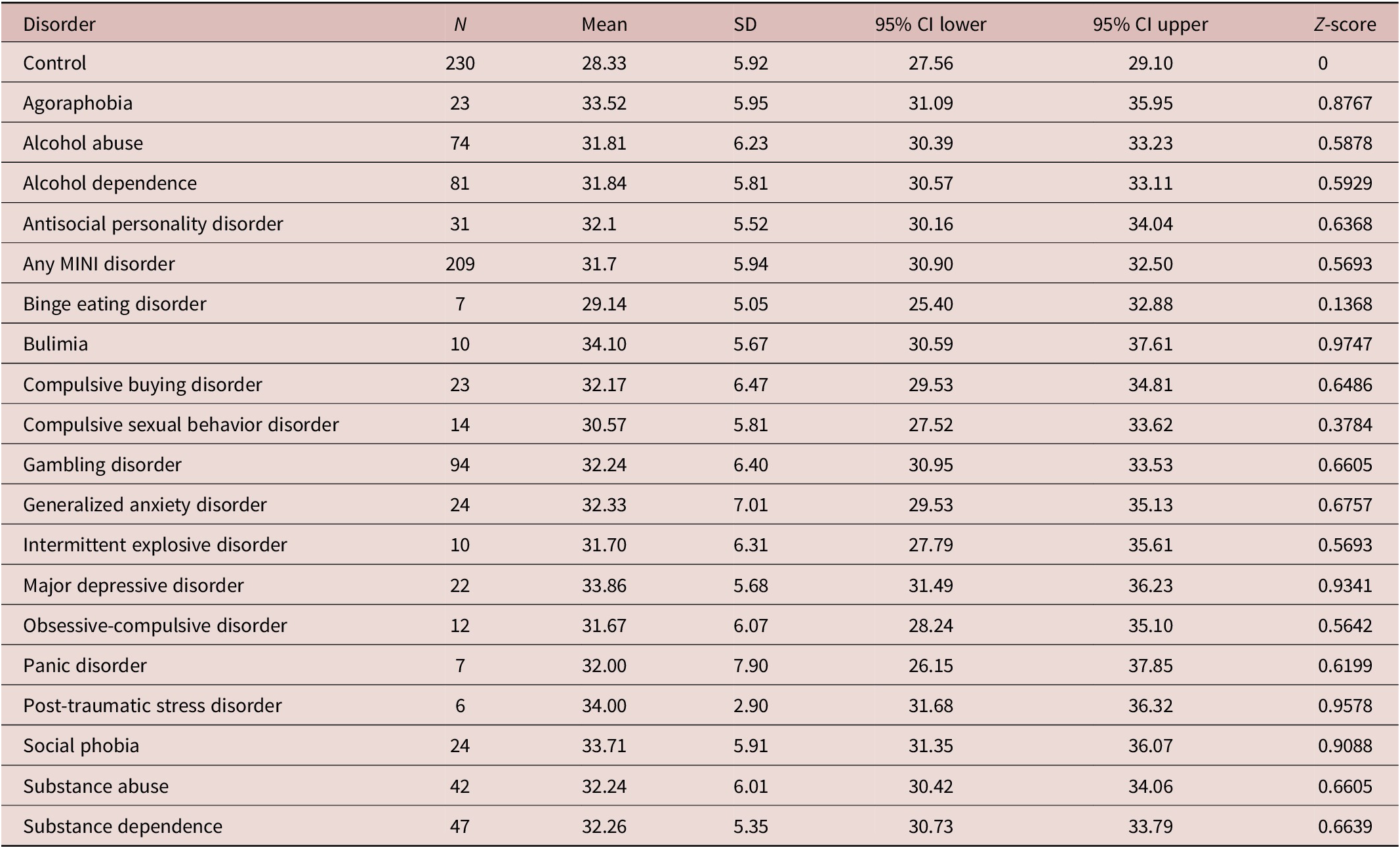
Table 2. Long description
The table consists of seven columns: Disorder, N (sample size), Mean, S D (Standard Deviation), 95% C I lower, 95% C I upper, and Z-score.
* Control: N 230, Mean 28.33, S D 5.92, C I 27.56 to 29.10, Z-score 0.
* Agoraphobia: N 23, Mean 33.52, S D 5.95, C I 31.09 to 35.95, Z-score 0.8767.
* Alcohol abuse: N 74, Mean 31.81, S D 6.23, C I 30.39 to 33.23, Z-score 0.5878.
* Alcohol dependence: N 81, Mean 31.84, S D 5.81, C I 30.57 to 33.11, Z-score 0.5929.
* Antisocial personality disorder: N 31, Mean 32.1, S D 5.52, C I 30.16 to 34.04, Z-score 0.6368.
* Any M I N I disorder: N 209, Mean 31.7, S D 5.94, C I 30.90 to 32.50, Z-score 0.5693.
* Binge eating disorder: N 7, Mean 29.14, S D 5.05, C I 25.40 to 32.88, Z-score 0.1368.
* Bulimia: N 10, Mean 34.10, S D 5.67, C I 30.59 to 37.61, Z-score 0.9747.
* Compulsive buying disorder: N 23, Mean 32.17, S D 6.47, C I 29.53 to 34.81, Z-score 0.6486.
* Compulsive sexual behavior disorder: N 14, Mean 30.57, S D 5.81, C I 27.52 to 33.62, Z-score 0.3784.
* Gambling disorder: N 94, Mean 32.24, S D 6.40, C I 30.95 to 33.53, Z-score 0.6605.
* Generalized anxiety disorder: N 24, Mean 32.33, S D 7.01, C I 29.53 to 35.13, Z-score 0.6757.
* Intermittent explosive disorder: N 10, Mean 31.70, S D 6.31, C I 27.79 to 35.61, Z-score 0.5693.
* Major depressive disorder: N 22, Mean 33.86, S D 5.68, C I 31.49 to 36.23, Z-score 0.9341.
* Obsessive-compulsive disorder: N 12, Mean 31.67, S D 6.07, C I 28.24 to 35.10, Z-score 0.5642.
* Panic disorder: N 7, Mean 32.00, S D 7.90, C I 26.15 to 37.85, Z-score 0.6199.
* Post-traumatic stress disorder: N 6, Mean 34.00, S D 2.90, C I 31.68 to 36.32, Z-score 0.9578.
* Social phobia: N 24, Mean 33.71, S D 5.91, C I 31.35 to 36.07, Z-score 0.9088.
* Substance abuse: N 42, Mean 32.24, S D 6.01, C I 30.42 to 34.06, Z-score 0.6605.
* Substance dependence: N 47, Mean 32.26, S D 5.35, C I 30.73 to 33.79, Z-score 0.6639.
A note at the bottom states that greater Z-scores indicate lower performance.
Note: Greater z-scores indicate lower performance.
Those disorders associated with impairment in strategy on the SWM, with large effect sizes, were bulimia nervosa (n = 10, z = 0.97), post-traumatic stress disorder (n = 6, z = 0.96), major depressive disorder (n = 22, z = 0.93), social phobia (n = 24, z = 0.91), and agoraphobia (n = 23, z = 0.88) (Figures 1 and 2).
Mean Z-scores of SWM strategy across psychiatric disorders. Bars are colored according to effect size, with effect size thresholds of 0.3, 0.5, and 0.8 for small, moderate, and large effect sizes, respectively.

Figure 1. Long description
The x-axis is labeled Mean Z Score S W M Strategy and ranges from 0.0 to 1.2. The y-axis lists 20 categories. The bars are color-coded by effect size thresholds.
* Dark green bars (Large effect size, greater than 0.8):
- Bulimia: approximately 0.98
- Post-Traumatic Stress Disorder: approximately 0.96
- Major Depressive Disorder: approximately 0.94
- Social Phobia: approximately 0.91
- Agoraphobia: approximately 0.88
* Medium green bars (Moderate effect size, 0.5 to 0.8):
- Generalized Anxiety Disorder: 0.68
- Substance Dependence: 0.67
- Gambling Disorder: 0.66
- Substance Abuse: 0.66
- Compulsive Buying Disorder: 0.65
- Antisocial Personality Disorder: 0.64
- Panic Disorder: 0.62
- Alcohol Dependence: 0.60
- Alcohol Abuse: 0.59
- Intermittent Explosive Disorder: 0.57
- Any M I N I Disorder: 0.57
- Obsessive-Compulsive Disorder: 0.56
* Light green bar (Small effect size, 0.3 to 0.5):
- Compulsive Sexual Behavior Disorder: 0.38
* Grey bars (Below 0.3 threshold):
- Binge Eating Disorder: 0.14
- Control: 0.00
Mean Z-scores of SWM total errors across psychiatric disorders. Bars are colored according to effect size, with effect size thresholds of 0.3, 0.5, and 0.8 for small, moderate, and large effect sizes, respectively.

Figure 2. Long description
The X axis represents Mean Z Score: S W M Total Errors, ranging from 0 to 1.4 in increments of 0.2. The Y axis lists 20 categories.
From top to bottom, the disorders and their approximate Z scores are:
* Agoraphobia: 1.25 (dark green)
* Major Depressive Disorder: 1.15 (dark green)
* Social Phobia: 1.1 (dark green)
* Intermittent Explosive Disorder: 1.1 (dark green)
* Obsessive-Compulsive Disorder: 0.9 (dark green)
* Bulimia: 0.9 (dark green)
* Post-Traumatic Stress Disorder: 0.9 (dark green)
* Gambling Disorder: 0.82 (medium green)
* Generalized Anxiety Disorder: 0.78 (medium green)
* Substance Abuse: 0.77 (medium green)
* Antisocial Personality Disorder: 0.73 (medium green)
* Compulsive Buying Disorder: 0.72 (medium green)
* Panic Disorder: 0.67 (medium green)
* Substance Dependence: 0.61 (medium green)
* Alcohol Dependence: 0.56 (medium green)
* Any M I N I Disorder: 0.54 (medium green)
* Alcohol Abuse: 0.49 (light green)
* Binge Eating Disorder: 0.43 (light green)
* Compulsive Sexual Behavior Disorder: 0.27 (light grey)
* Control: 0.0 (no bar)
The color coding indicates effect size thresholds: dark green for large (above 0.8), medium green for moderate (0.5 to 0.8), light green for small (0.3 to 0.5), and light grey for below 0.3.
Moderate effect sizes were observed for generalized anxiety disorder (n = 24, z = 0.68), substance dependence (n = 47, z = 0.66), substance abuse (n = 42, z = 0.66), gambling disorder (n = 94, z = 0.66), compulsive buying disorder (n = 23, z = 0.65), antisocial personality disorder (n = 31, z = 0.64), panic disorder (n = 7, z = 0.62), alcohol dependence (n = 81, z = 0.59), *alcohol abuse (n = 74, z = 0.59), participants with “any MINI disorder” (n = 209, z = 0.57), intermittent explosive disorder (n = 10, z = 0.57), and obsessive-compulsive disorder (n = 12, z = 0.56).
A small effect size was observed for compulsive sexual behavior disorder (n = 14, z = 0.38). A near-normal effect size was observed for binge-eating disorder (n = 7, z = 0.14).
*We acknowledge that the term “alcohol abuse” is outdated and stigmatizing, with “alcohol use disorder” now serving as the preferred term and a single diagnosis for the previously separately classified “alcohol abuse” and “alcohol dependence” disorders. These prior diagnoses are used in this paper as participants were screened prior to this transition, at a time when they remained distinct disorders on the MINI.
Spatial working memory: Total errors
Table 3 displays the SWM total error means, standard deviations, confidence intervals, and z-scores as compared to controls for all studied psychiatric disorders.
Spatial working memory total error means, standard deviations, confidence intervals, and mean Z-scores as compared to controls

Table 3. Long description
The table contains seven columns: Disorder, N (sample size), Mean, S D (standard deviation), 95% C I lower, 95% C I upper, and Z-score.
* Control: N 230, Mean 14.43, S D 14.91, C I 12.50 to 16.36, Z-score 0.
* Agoraphobia: N 23, Mean 32.83, S D 30.11, C I 20.52 to 45.14, Z-score 1.2344.
* Alcohol abuse: N 74, Mean 21.73, S D 18.98, C I 17.41 to 26.05, Z-score 0.4897.
* Alcohol dependence: N 81, Mean 22.74, S D 18.94, C I 18.62 to 26.86, Z-score 0.5575.
* Antisocial personality disorder: N 31, Mean 25.35, S D 19.04, C I 18.65 to 32.05, Z-score 0.7326.
* Any M I N I disorder: N 209, Mean 22.52, S D 19.87, C I 19.83 to 25.21, Z-score 0.5427.
* Binge-eating disorder: N 7, Mean 20.86, S D 14.74, C I 9.94 to 31.78, Z-score 0.4314.
* Bulimia: N 10, Mean 28.00, S D 20.53, C I 15.28 to 40.72, Z-score 0.9104.
* Compulsive buying disorder: N 23, Mean 25.22, S D 21.24, C I 16.54 to 33.90, Z-score 0.7239.
* Compulsive sexual behavior disorder: N 14, Mean 18.50, S D 14.54, C I 10.88 to 26.12, Z-score 0.2730.
* Gambling disorder: N 94, Mean 26.73, S D 25.07, C I 21.66 to 31.80, Z-score 0.8252.
* Generalized anxiety disorder: N 24, Mean 26.21, S D 22.09, C I 17.37 to 35.05, Z-score 0.7903.
* Intermittent explosive disorder: N 10, Mean 30.60, S D 14.66, C I 21.51 to 39.69, Z-score 1.0848.
* Major depressive disorder: N 22, Mean 31.86, S D 22.24, C I 22.57 to 41.15, Z-score 1.1693.
* Obsessive-compulsive disorder: N 12, Mean 28.08, S D 18.66, C I 17.52 to 38.64, Z-score 0.9157.
* Panic disorder: N 7, Mean 24.42, S D 19.56, C I 9.94 to 38.92, Z-score 0.6709.
* Post-traumatic stress disorder: N 6, Mean 27.83, S D 12.38, C I 17.92 to 37.74, Z-score 0.8990.
* Social phobia: N 24, Mean 30.71, S D 22.05, C I 21.89 to 39.53, Z-score 1.0922.
* Substance abuse: N 42, Mean 26.07, S D 19.76, C I 20.09 to 32.05, Z-score 0.7809.
* Substance dependence: N 47, Mean 23.55, S D 18.87, C I 18.16 to 28.94, Z-score 0.6118.
Note: Greater Z-scores indicate lower performance.
Note: Greater z-scores indicate lower performance.
Those disorders associated with SWM total errors, with large effect sizes, were agoraphobia (n = 23, z = 1.23), major depressive disorder (n = 22, z = 1.17), social phobia (n = 24, z = 1.09), intermittent explosive disorder (n = 10, z = 1.08), obsessive-compulsive disorder (n = 12, z = 0.92), bulimia (n = 10, z = 0.91), post-traumatic stress disorder (n = 6, z = 0.90), and gambling disorder (n = 94, z = 0.83).
Moderate effect sizes were observed for generalized anxiety disorder (n = 24, z = 0.79), substance abuse (n = 42, z = 0.78), antisocial personality disorder (n = 31, z = 0.73), compulsive buying disorder (n = 23, z = 0.72), panic disorder (n = 7, z = 0.67), substance dependence (n = 47, z = 0.61), alcohol dependence (n = 81, z = 0.56), and any MINI disorder (n = 209, z = 0.54).
Small effect sizes were observed for alcohol abuse (n = 74, z = 0.49) and binge-eating disorder (n = 7, z = 0.43). A near-normal effect size was observed for compulsive sexual behavior disorder (n = 14, z = 0.27).
Discussion
This study found that SWM strategy and total errors were impaired across most psychiatric disorders when compared against healthy controls in a large sample of young adults. These findings suggest that deficits in SWM may be considered a transdiagnostic feature of psychiatric illness, with varying levels of impairment in different disorders. Notably, the five disorders found to have impairments of large effect sizes in both strategy and total errors—bulimia, post-traumatic stress disorder, major depressive disorder, agoraphobia, and social phobia—span several different diagnostic categories. Given that SWM is one of several types of working memory, these results are not generalizable to working memory or executive functioning broadly.
The increased SWM strategy and total error scores observed in this study are consistent with prior studies reporting executive dysfunction in individual psychiatric disorders including major depressive disorder,Reference Snyder 5 obsessive-compulsive disorder,Reference Purcell, Maruff, Kyrios and Pantelis 7 generalized anxiety disorder,Reference Nguyen, Walters, Hutchinson, Liu, Li and Gudmundsson 28 other anxiety disorders including social phobia,Reference Vance, Ferrin, Winther and Gomez 29 post-traumatic stress disorder,Reference Aupperle, Melrose, Stein and Paulus 30 bulimia,Reference Hirst, Beard, Colby, Quittner, Mills and Lavender 31 binge-eating disorder,Reference Cury, Berberian, Scarpato, Kerr-Gaffney, Santos and Claudino 32 substance use disorders,Reference Verdejo-García, Bechara, Recknor and Pérez-García 33 alcohol use disorder,Reference Yang, Singla, Maheshwari, Fontaine and Gil-Mohapel 34 and antisocial personality disorder.Reference Ogilvie, Stewart, Chan and Shum 35 There are no prior reports of impairments in executive functioning, particularly in SWM, for compulsive sexual behavior disorder, agoraphobia, or intermittent explosive disorder. There is inconsistent evidence of executive dysfunction in the existing literature on gambling disorderReference Peixoto, Dores, Monteiro, Marques and Barbosa 36 and compulsive buying disorder.Reference Heffernan, Hamilton and Neave 37 , Reference Black, Shaw, McCormick, Bayless and Allen 38 Our findings are inconsistent with a prior review which concluded that executive function is preserved in patients with panic disorder.Reference Giomi, Siri and Ferro 39
The SWM deficits observed across disorders at varying severities suggest some level of disorder specificity, which may be a function of other, non-mutually exclusive cognitive issues such as impaired processing speedReference Hartog, Derix, Bemmel, Kremer and Jolles 40 or stress responseReference Yang, Singla, Maheshwari, Fontaine and Gil-Mohapel 34, which were not examined in this study. Our finding that SWM is impaired in the majority of psychiatric disorders studied in a large sample of young adults suggests that it may be a vulnerability marker for psychiatric disorders broadly. Thus, future work should examine whether SWM deficits predate symptom onset of psychiatric disorders, which would support broad utilization of SWM assessments as mental health screening in clinical settings. Because working memory dysfunction may contribute to impaired social functioningReference Chun, Cooper and Ellman 41 and instrumental activities of daily living such as driving,Reference Zhang, Guo, Yuan and Li 42 proactive evaluation of SWM may guide further workup and targeted rehabilitation of patients demonstrating initial deficits. Working memory has been shown to be a predictor of poor functional outcomes in new-onset psychosis,Reference González-Ortega, de Los Mozos and Echeburúa 43 and may also serve as a predictor of functional outcomes for other psychiatric disorders. Regarding management, cognitive remediation has demonstrated promise in improving cognition, including working memory;Reference Cella, Price, Corboy, Onwumere, Shergill and Preti 44 targeted remediation in patients with SWM dysfunction may facilitate greater overall therapeutic response and better outcomes.
Limitations of this study include the exclusion of several psychiatric disorders (eg, psychotic disorders, bipolar disorder, trichotillomania) as well as small sample sizes for certain disorders included in the final analysis. Exclusion of psychotic disorders is a particularly notable limitation, given that a significant bulk of prior literature on SWM deficits in psychiatric disorders has focused on psychotic disorders, with evidence that impaired SWM may be specific to schizophrenia.Reference Park and Holzman 11 In addition, each disorder group included participants with comorbid psychiatric disorders, making it difficult to fully isolate SWM deficits to the individual disorders examined. The small number of subjects with psychotic disorder precluded any comparison of the degree of SWM dysfunction between psychotic disorder and other psychiatric illnesses. The utilization of a cross-sectional study design prevents the elucidation of any causal relationships between SWM deficits and psychiatric illnesses. An additional limitation is the designation of psychiatric diagnoses using screening tools, which have potential for misclassification of disorders. Future studies should examine the predictive value of SWM assessment for functional outcomes and how this may differ between disorders. The efficacy of targeted cognitive remediation in improving SWM is also an area of interest, as is the question of whether other domains of cognitive function such as sustained attention may serve as transdiagnostic features of psychiatric illness.
Conclusion
Our findings suggest that SWM is a component of executive function that is impaired across several psychiatric disorders, serving as a transdiagnostic element or vulnerability marker of psychiatric illness. Performance on the CANTAB SWM test was compromised in various conditions including mood, anxiety, obsessive-compulsive, impulse-control, addictive, and eating disorders. These results support the pursuit of early assessment and targeted intervention of SWM in patients with a range of psychiatric illnesses. Future studies should explore a wider range of disorders, in particular incorporating a comparison of psychotic disorders against other diagnoses, as well as whether targeted rehabilitation of SWM may improve functional outcomes.
Author contribution
Formal analysis: K.W., J.E.G.; Writing - original draft: K.W., J.E.G.; Writing - review & editing: K.W., J.E.G.; Conceptualization: J.E.G.; Data curation: J.E.G.; Investigation: J.E.G.; Methodology: J.E.G.; Project administration: J.E.G.; Supervision: J.E.G.
Financial support
This research was funded by the National Center for Responsible Gaming (NCRG) Center of Excellence grant to J.E.G.
Disclosures
K.S.W. has no competing interests to disclose. J.E.G. has received research grants from Janssen and Biohaven Pharmaceuticals. He has received royalties from Oxford University Press, American Psychiatric Publishing, Inc., Norton Press, and McGraw Hill, and he receives yearly compensation for acting as editor-in-chief of CNS Spectrums.



 Open access

