Implications
The results of this study in part support a strategy of supplementing pregnant gilts with a stable form of n-3 long-chain polyunsaturated fatty acids (LCPUFA) from mid-gestation onwards to improve litter growth in the early postnatal period, which is independent of effects on actual birth weight. Together with already published information, the results of this study do not support strategic use of n-3 LCPUFA supplementation after weaning and rebreeding in sows to improve fertility when reproductive performance in the existing sow population is already acceptable.
Introduction
Studies in sows have shown benefits of n-3 long-chain polyunsaturated fatty acid (LCPUFA) supplementation on postnatal growth (Rooke et al., Reference Rooke, Shanks and Edwards2000 and Reference Rooke, Sinclair and Edwards2001b; Mateo et al., Reference Mateo, Carroll, Hyun, Smith and Kim2009) and pre-weaning mortality of the litter (Rooke et al., Reference Rooke, Sinclair, Edwards, Cordoba, Pkiyach, Penny, Penny, Finch and Horgan2001a). Others report an increase in live pigs born to gilts (Edwards and Pike, Reference Edwards and Pike1997; Spencer et al., Reference Spencer, Wilson, Webel, Moser and Webel2004) and sows (Webel et al., Reference Webel, Otto, Webel, Moser, Spencer and Orr2003 and Reference Webel, Otto-Tice, Moser and Orr2004; Smits et al., Reference Smits, Luxford, Mitchell and Nottle2011) when supplementing with n-3 LCPUFA at various stages of gestation, lactation and/or during rebreeding, and Webel et al. (Reference Webel, Otto-Tice, Moser and Orr2004) hypothesized that the observed increased litter size was because of improved embryonic survival at day 30 of gestation, rather than differences in ovulation rate. However, others report no effects of n-3 LCPUFA supplementation to sows on litter size at birth (Rooke et al., Reference Rooke, Sinclair, Edwards, Cordoba, Pkiyach, Penny, Penny, Finch and Horgan2001a; Estienne et al., Reference Estienne, Harper and Estienne2006) or on embryonic survival (Estienne et al., Reference Estienne, Harper and Estienne2006). Even when only comparing trials that used a protected source of n-3 LCPUFA and/or that measured n-3 LCPUFA uptake in the body, results are inconsistent. Therefore, it is important to further define situations in which positive effects of n-3 LCPUFA supplementation on reproductive performance and litter characteristics might be expected.
In the present study, which used a source of n-3 LCPUFA stabilized against auto-oxidation, two hypotheses were tested: (1) that feeding a marine oil-based supplement rich in stabilized n-3 LCPUFAs to gilts in established gestation would improve the growth performance of their litters; and (2) that continued feeding of the supplement during lactation and after weaning would offset the negative effects of lactational catabolism induced, using an established experimental model involving feed restriction of primiparous sows in late lactation (Patterson et al., Reference Patterson, Smit, Novak, Wellen and Foxcroft2011). The fatty acid composition of sow serum, recovered embryos and corpora lutea (CL), was used to confirm effective transfer of n-3 LCPUFAs to potential target tissues.
Material and methods
Animals and treatments
This study was conducted according to Canadian Council on Animal Care guidelines and with approval of the Faculty Animal Care and Use Committee – Livestock, University of Alberta (Protocol 2006-11C). Primiparous Large White × Landrace terminal-line sows (n = 117; Genex Hybrid; Hypor, Regina, SK, Canada) used between August 2008 and May 2009 were managed according to approved protocols at the Swine Research and Technology Centre (SRTC), University of Alberta. Herd protocols target gilts to be bred at least at second oestrus and within a weight range of 135 to 150 kg (mean breeding weight for this study = 139.2 ± 9.8 kg). At day 60 of gestation, gilts were pair-matched within breeding group by BW, and when possible by litter of origin, and within a pair (n = 54) randomly allocated to be fed either standard SRTC gestation and lactation diets (CON; Supplementary Material 1), or the same diets top-dressed daily with 84 g of a n-3 LCPUFA supplement (LCPUFA; Supplementary Material 1). The n-3 LCPUFA product used (Sow Fat Pack 10; JBS United Inc., Sheridan, IN, USA) was a marine oil-based supplement rich in eicosapentaenoic acid (EPA) and docosahexaenoic acid (DHA) that was stabilized to prevent auto-oxidation and fed from day 60 of gestation, through a 21-day lactation, and until euthanasia of sows at day 30 of their second gestation. Nine gilts not allocated to a pair because of uneven numbers of gilts in some breeding groups were considered an ‘incomplete pair’ in the analysis.
Management during gestation
Bred gilts were housed in individual stalls until confirmed pregnant at approximately day 30 of their first gestation, and then as breed groups in ‘free access’ gestation pens, consisting of 12 individual walk in/walk out stalls accessed from a common lounging area. Although sow pairs (treatments) within a breed group were located in the same gestation pen, access to the common area was alternated between the two treatment groups by locking gilts of the same treatment into individual stalls for alternating 7-day periods to facilitate hand-feeding of the LCPUFA supplement. Sows were offered between 2.0 and 2.8 kg/day of the standard SRTC gestation diet (Supplementary Material 1) during gestation, based on BW and backfat thickness at breeding (see Matrix in Supplementary Material 2). A standard 2 kg amount of feed was automatically dropped into individual feeders, and gilts were then hand-fed the balance of their allowance.
Management during lactation and after weaning
Management of sows and litters in lactation, and sow management after weaning, followed the protocols described for the Restrict sows in the study of Patterson et al. (Reference Patterson, Smit, Novak, Wellen and Foxcroft2011) with the following modifications. To facilitate farrowing room management and to standardize lactation length, sows that did not show signs of farrowing by day 113 of gestation (calculated from the first artificial insemination (AI) date) were induced to farrow using prostaglandin F2α injections (Estrumate, Intervet Canada Corp., Kirkland, QC, Canada). Within 48 h after farrowing, litter size was standardized to 10 to 13 piglets per sow by cross-fostering within treatment groups where possible. For nine litters, cross-fostering between treatments occurred and was recorded. In lactation, treated sows had to fully consume the LCPUFA top-dressed feed first offered each morning before further fresh feed was distributed. Litters were weaned on day 21.4 ± 1.5 of lactation.
Sow management after weaning until breeding was as described previously (Patterson et al., Reference Patterson, Smit, Novak, Wellen and Foxcroft2011), but LCPUFA sows were again offered the LCPUFA supplement with a limited amount of feed each morning and required to consume this feed before further feed was offered to appetite. During their second gestation until slaughter, sows were housed in individual stalls and fed the standard gestation diet between 2.2 and 3.0 kg/day, again taking into account BW and backfat thickness at breeding (see Matrix in Supplementary Material 2). Sows were provided with front stall exposure to a rotation of mature boars once a day for 30 min during the first 3 days after weaning. From day 4 after weaning, sows were heat checked as previously described (Patterson et al., Reference Patterson, Smit, Novak, Wellen and Foxcroft2011). From October to mid-December, sows were bred by AI using fresh, pooled semen (3 × 10⁹ spermatozoa/dose) collected on-site from proven terminal-line Duroc boars (Hypor Magnus, Hypor, Regina, SK, Canada). Each pool contained equal numbers of sperm from at least three different boars. From mid-December until the end of the trial in April, sows were switched to single-sire inseminations (2 × 10⁹ spermatozoa/dose) using semen from one of two proven terminal-line boars, ensuring that the distribution of boars was equal between treatments. All semen was used within 3 days of collection and extended in BTS medium (Minitube of America Inc., Verona, WI, USA).
At day 30.3 ± 0.8 of gestation (counting the time of the last AI as day 1), pregnant sows were euthanized on-site by qualified staff using approved necropsy procedures, and their reproductive tracts were recovered for dissection.
Litter management after weaning
After weaning, piglets were moved to an assigned nursery room and penned by litter if possible. However, if there were more litters than pens, some litters were divided over several pens within treatment. Pens were 147.3 cm by 223.5 cm, with fully slatted plastic flooring. Nursery pigs were fed with a phase-feeding programme according to SRTC nursery guidelines (see Supplementary Material 3) and water was freely available at all times.
Calculations of energy input and output in lactation
Metabolic state of lactating sows was calculated as described by Bergsma et al. (Reference Bergsma, Kanis, Verstegen, Van der Peet-Schwering and Knol2009) and characterized using the approach described by Patterson et al. (Reference Patterson, Smit, Novak, Wellen and Foxcroft2011). In summary, energy input consisted of energy from total feed intake and body tissue mobilization of the sow, minus energy needed for maintenance. Energy output was calculated as energy needed for piglet growth and maintenance. As described by Patterson et al. (Reference Patterson, Smit, Novak, Wellen and Foxcroft2011), a subpopulation of sows were identified that mobilized higher amounts of body tissues to support litter weight gain and were considered at risk of inducing negative effects on embryonic development of the subsequent litter.
Progesterone assay
Heparinized blood samples collected 60 to 72 h after expected time of ovulation from each sow by jugular venipuncture during nose-snare restraint, were centrifuged (GPKR centrifuge; Beckman, Fullerton, CA, USA) at 569 × g and 4°C for 15 min, and plasma harvested and frozen at −20°C until assayed in triplicate using the method of Mao and Foxcroft (Reference Mao and Foxcroft1998). The volume of sample taken to assay was 0.1 ml of a 10-fold dilution of plasma in a buffer from the Progesterone kit. Assay sensitivity for the three assays completed, defined as 85.66%, 91.29% and 89.55% of total bound, respectively, averaged 0.0086 ng/tube, equivalent to 0.86 ng/ml for the diluted samples. None of the diluted samples fell below assay sensitivity. The intra-assay CVs were 3.90%, 3.57% and 1.09%, respectively, for the three assays, and the inter-assay CV for a standard internal control plasma sample run in each assay was 6.04%. A serially diluted plasma pool showed parallel inhibition to the standard curve.
Fatty acid composition in the LCPUFA supplement
Two feed samples from each of the two batches of Sow Fat Pack 10 used in the trial were taken at the end of each batch and sent to the University of Missouri (Columbia, MO, USA) for fatty acid analysis.
Fatty acid composition analysis in serum and tissues
Additional blood samples were taken by jugular venipuncture at days 60 and 110 of first gestation and at day 30 of second gestation (euthanasia) to measure fatty acid composition of blood. Blood samples were collected into non-heparinized vacutainer tubes (BD, Fisher Scientific, Ottawa, ON, Canada), centrifuged at 569 × g and 4°C for 15 min, and serum was harvested and frozen at −20°C until further analysis. Samples from 10 sow pairs were randomly chosen for analysis of fatty acid composition in serum at day 110 of first gestation and day 30 of second gestation, and in luteal and embryonic tissues collected at day 30 of gestation.
All chemicals used were obtained from Fisher Scientific, unless otherwise stated. Lipids were extracted by mixing 2 ml of each serum sample with 10 ml methanol and 20 ml chloroform. After shaking, the samples were allowed to sit for 1 h and then 4 ml 0.88% (w/v) NaCl was added and the samples were centrifuged at 327 × g for 5 min to separate layers. Ten millilitres of the chloroform layer was transferred to another tube and evaporated to dryness under nitrogen. The extracted lipids were dissolved in a recorded volume of between 100 and 150 μl of chloroform and 50 μl was transferred to a different tube. Methylation of fatty acids then occurred by adding 2 ml of methanolic HCl (Sigma-Aldrich Inc., St. Louis, MO, USA) and the samples were placed in a water bath for 2 h at 60°C with frequent vortexing. After cooling, 2 ml water, 3 ml hexane and 100 μl of an internal standard (containing 1 mg C17:0 per ml of hexane) were added and after shaking, samples were centrifuged at 581 × g for 5 min to separate layers. The majority of the upper hexane layer was transferred to another tube containing a pinch of anhydrous sodium sulphate (Sigma-Aldrich Inc.). Samples were centrifuged again at 581 × g for 2 min and ∼1 ml was transferred to chromatography vials.
Four embryos of average size were chosen for analysis of each selected sow (two embryos from the middle of the left uterine horn and two embryos from the middle of the right uterine horn), and all frozen CLs (two from the left and two from the right ovary) of each selected sow were used for tissue analysis. Individual embryos and CLs were ground under liquid nitrogen with a mortar and pestle, weighed, lyophilized and weighed again. Embryonic and luteal samples were then pooled within sow, and triplicates of 25 mg per sample were directly methylated using 2 ml of methanolic HCl as described above. The samples were then diluted in hexane by a factor 3.3 for embryos and a factor 4 for CL before gas chromatography.
Fatty acids were analyzed by a gas chromatograph (model Varian 3400; Varian Inc., Mississauga, ON, Canada), equipped with a Varian 8100 auto sampler and using a SP-2560 fused silica capillary column (100 m × 0.25 mm i.d. × 0.2 μm film thickness; Supelco Inc., Bellefonte, PA, USA). Hydrogen was the carrier gas. A cool on-column injection was used. The injector programme started at 50°C and was immediately increased to 230°C at 150°C/min and held for 83 min. The column was operated at 45°C for 4 min, then temperature-programmed at 13°C/min to 175°C, held there for 27 min, programmed at 4°C/min to 215°C and finally held there for 35 min; total run time was 86 min. The identity of each fatty acid peak was determined by comparison of peak retention time with authentic lipid standards (463 fatty acid methyl ester, Nu-Chek, Elysian, MN, USA). Data were integrated using Galaxie Chromatography Data System (Varian Inc.). The relative amount of each fatty acid (% of total fatty acids) was quantified by integrating the area under the peak and by dividing the result by the total area for all fatty acids extracted. To calculate the actual amount of each fatty acid (μg/ml serum or μg/g embryo), an internal standard (C17:0) was used.
Statistical analysis
Data were analyzed using the MIXED procedure of SAS (SAS Institute, Cary, NC, USA) as a randomized incomplete block design, with blocks based on sow pairs. If one sow of a pair was taken off trial, the other sow of the pair stayed on trial and was considered an incomplete block. The model included treatment (CON or LCPUFA) as a fixed effect and pair as a random effect. Sow was used as the experimental unit for all parameters tested, including determining treatment effects on litter growth and on reproductive traits at day 30 of gestation, and all individual measurements of piglets, embryos and CL were averaged within a litter (sow) before statistical analysis. Repeated measures analysis was used for sow weight, backfat and for piglet BW. An appropriate covariance structure was selected by comparing the goodness-of-fit measures of different structures. The Kenwardroger approximation was used for the denominator degrees of freedom. Categorical data such as breeding rate, pregnancy rate and pre-weaning mortality were analyzed separately using the generalized logit function (PROC CATMOD in SAS).
To account for small differences in energy input due to the additional 84 g/day of supplement provided to LCPUFA sows during lactation, energy input from feed in the last 7 days of lactation was used as covariate for analyzing treatment effects on piglet BW. Positive linear relationships were found between day of gestation at euthanasia and average embryo weight per litter for CON (−8.42 + 0.35 gestation day; R = 0.80; P < 0.001) and LCPUFA (−6.11 + 0.27 gestation day; R = 0.76; P < 0.001). Therefore, day of gestation was used as a covariate for embryonic weight, embryo crown-rump length and allanto-chorionic fluid volume.
Data in the text are given as least square means ± s.e.m., unless otherwise stated, and data in the figures as means. P-values < 0.05 were considered significant and values < 0.10 were used to describe trends.
Results
Of the 117 sows allocated to treatment, data from nine sows were removed from all analyses because of cross-fostering of litters between treatments (see section ‘Discussion’). Of the 108 sows remaining, 104 sows (52 CON and 52 LCPUFA) farrowed normally (one CON and one LCPUFA sow aborted, one LCPUFA sow was taken off trial because of lameness and one LCPUFA sow farrowed in the gestation room). During lactation, four sows (all LCPUFA) were taken off trial because of low feed intake (two sows) or health reasons (two sows). At weaning, four sows (all CON) were taken off trial because of demands of other research projects. One CON and two LCPUFA sows did not return to oestrus after weaning and five sows (two CON and three LCPUFA) were not pregnant. This resulted in 45 CON and 43 LCPUFA sows being available for study at day 30 of second gestation.
Sow feed intake and sow measurements in lactation
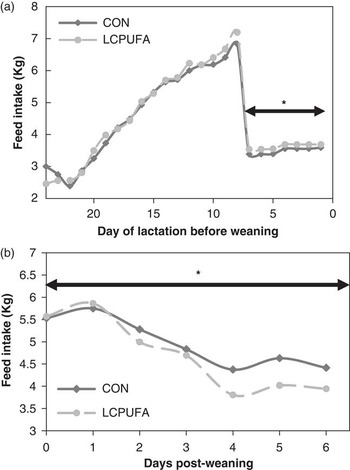
Feed intake was similar between treatments during the first 2 weeks of lactation (Figure 1a). Although feed intake during the 3 days before restriction was not different for CON and LCPUFA sows (6.53 ± 0.15 v. 6.76 ± 0.15 kg/day, respectively), LCPUFA sows had higher (P < 0.05) feed intake (3.63 ± 0.04 kg/day) than CON sows (3.51 ± 0.04 kg/day) during the restriction period (Figure 1a). This was followed by a lower (P < 0.05) feed intake in LCPUFA (4.61 ± 0.14 kg/day) than in CON (5.04 ± 0.14 kg/day) sows in the 6 days after weaning (Figure 1b).
Feed intake during lactation (a: n = 47 for (control) CON and 43 for (long-chain polyunsaturated fatty acid) LCPUFA sows) and feed intake during rebreeding (b: n = 42 for CON and 42 for LCPUFA sows) for sows fed standard gestation and lactation diets with (LCPUFA) or without (CON) 84 g/day of a LCPUFA rich supplement from day 60 of first gestation onwards. *Significant difference between CON and LCPUFA sows during the last week of lactation and during the rebreeding period (P < 0.05).

Sow backfat thickness was not different between treatments at any time during the trial (Supplementary Material 4). There was an interaction between sow BW and time (P = 0.05). LCPUFA sows tended to have higher BW at day 1 of lactation than CON sows (181 v. 179 kg, respectively, P = 0.08), whereas there was no difference in BW between treatments at other time points during the trial (Supplementary Material 4). Weight loss during lactation was on average 18.9 ± 6.3 kg (mean ± s.d.) and was similar between treatments.
Litter measurements
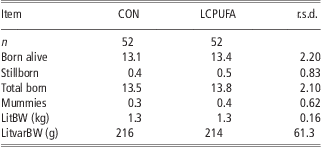
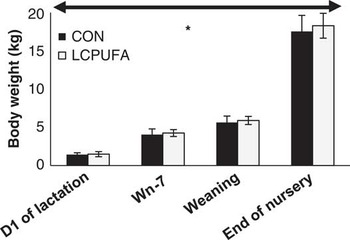
The total number of pigs born, pigs born alive, stillborn and mummified per litter, and average litter birth weights were similar between treatments (Table 1). Pre-weaning mortality was higher (P = 0.05) in LCPUFA (13.2%) than CON litters (9.6%). For both treatments, the biggest contribution to pre-weaning mortality was piglets crushed by the sow (45.0% for CON and 48.1% for LCPUFA litters, respectively). There was a strong tendency (P = 0.06) for litters from LCPUFA sows to have improved overall growth performance (average piglet weight) to the end of the nursery stage (34 days after weaning) compared with litters from CON sows (Figure 2).
Effects of n-3 LCPUFA supplementation in gilts on litter characteristics at birth
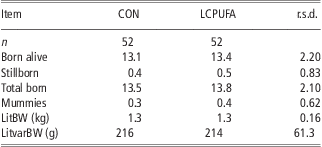
LCPUFA = long-chain polyunsaturated fatty acids; CON = control; r.s.d. = residual standard deviation; LitBW = litter average birth weight; litvarBW = within-litter variation in birth weight.
Gilts were fed standard gestation and lactation diets with (LCPUFA) or without (CON) 84 g/day of a LCPUFA rich supplement from day 60 of gestation onwards. Data are the least square means.
Average piglet weight per litter (kg) at different time points from birth to the end of the nursery period (Wn-7 = 7 days before weaning) for sows fed standard gestation and lactation diets with (long-chain polyunsaturated fatty acids (LCPUFA)) or without (control (CON)) 84 g/day of a LCPUFA rich supplement from day 60 of first gestation until weaning. Bars represent the means. *P-value for Treatment: 0.06 and for Time: <0.001. No significant interaction.

Sow reproductive characteristics
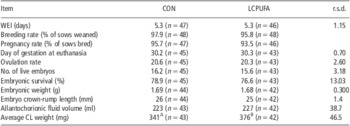
The weaning-to-oestrus interval, breeding rate, pregnancy rate and day of gestation at euthanasia were similar between groups (Table 2). Treatment did not affect ovulation rate, number of live embryos, embryonic survival, embryonic weight, embryo crown-rump length or allanto-chorionic fluid volume (Table 2). However, average CL weight was higher (P < 0.05) in LCPUFA than CON sows (Table 2).
Effects of n-3 LCPUFA supplementation in gilts on subsequent reproductive performance after weaning

LCPUFA = long-chain polyunsaturated fatty acids; CON = control sows; r.s.d. = residual standard deviation; WEI = weaning-to-oestrus interval; CL = corpora lutea.
Gilts were fed standard gestation and lactation diets with (LCPUFA) or without (CON) 84 g/day of a LCPUFA rich supplement from day 60 of gestation onwards. Data are the least square means.
A,BMeans within a row with different superscripts are significantly different at P < 0.001.
Progesterone concentrations in plasma 60 to 72 h after calculated time of ovulation (9.94 ± 0.62 mg/l for CON (n = 36) and 9.17 ± 0.64 mg/l for LCPUFA (n = 33)) were not different (P = 0.36).
Fatty acid composition in the LCPUFA supplement
Mean ( ± s.d.) EPA and DHA concentration of the LCPUFA supplement was 11.62 ± 0.14% and 9.28 ± 1.17% of total fat, respectively, and the n6:n3 ratio of the product was 0.25 ± 0.01. More details are provided in Supplementary Material 5.
Fatty acid concentration in sow serum, embryos and CL
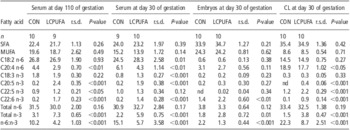
Concentrations of EPA and DHA in serum were higher, and concentrations of n6-PUFA arachidonic acid (AA) were lower in LCPUFA than CON sows at day 110 of first gestation and at euthanasia at day 30 of the second gestation (Table 3 and Supplementary Material 6). In embryos, only DHA was higher in LCPUFA compared with CON sows, whereas in CL, both EPA and DHA were higher in LCPUFA than CON sows (Table 3 and Supplementary Material 6). Total n-3 LCPUFA increased in LCPUFA compared with CON sows in serum at day 110 and euthanasia, and in embryos and CL, causing the n6:n3 ratio to decrease for LCPUFA v. CON sows in all samples (Table 3 and Supplementary Material 6).
Effects of n-3 LCPUFA supplementation in gilts on fatty acid composition (as % of total fatty acids) of sow serum (day 110 of first gestation and day 30 of second gestation), embryos and CL (day 30 of second gestation)

LCPUFA = long-chain polyunsaturated fatty acids; CL = corpora lutea; CON = control; r.s.d. = residual standard deviation; SFA = saturated fatty acids; MUFA = mono-unsaturated fatty acids; nd = non-detectable.
Gilts were fed standard gestation and lactation diets with (LCPUFA) or without (CON) 84 g/day of a LCPUFA rich supplement from day 60 of first gestation onwards. Data are the least square means.
Concentrations of both DHA and AA in embryos and serum at euthanasia were correlated (DHA, R = 0.66, P < 0.01; AA, R = 0.65, P < 0.01), whereas only a trend for a correlation between DHA concentrations in CL and in serum at euthanasia was established (R = 0.39, P = 0.10).
Sow energy input and output calculations in lactation
For all energy input and output calculations, only sows with all data available were used (CON: n = 40 and LCPUFA: n = 35). Energy input from feed was similar in the first 2 weeks of lactation, whereas energy input from tissue mobilization tended to be higher in CON than LCPUFA sows (P = 0.10) and energy used for maintenance was higher in LCPUFA than CON sows (P < 0.001; Supplementary Material 7). Nonetheless, total estimated energy input to the litter for CON and LCPUFA sows was not different between treatments. Estimated energy requirements for litter maintenance and growth, and hence total energy outputs to the litter for CON and LCPUFA sows, were not different (Supplementary Material 7). Lactation efficiency of CON and LCPUFA sows, defined as the energy efficiency of sows during lactation (output × 100/input; Bergsma et al., Reference Bergsma, Kanis, Verstegen, Van der Peet-Schwering and Knol2009), was also not different in the first 2 weeks of lactation. During the last 7 days of lactation, energy input from feed tended to be higher in LCPUFA sows compared with CON sows (P = 0.09; Supplementary Material 7), energy input from tissue mobilization was not different and energy used for maintenance was higher (P < 0.01) in LCPUFA than CON sows. Estimated total energy input to the litter and energy output for litter maintenance, growth and total output did not differ between treatments. Lactation efficiency during the last week of lactation was similar between treatments and was higher than for the first 2 weeks of lactation (Supplementary Material 7).
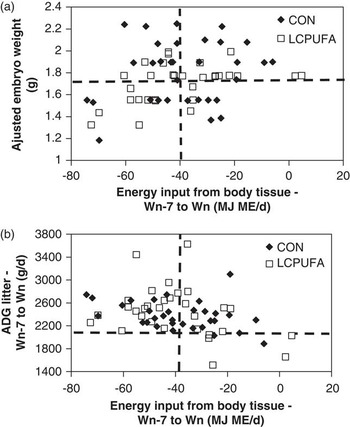
The relationship between energy input from body tissue mobilization during the last week of lactation and embryo weight is shown in Figure 3a: embryos tended to be heavier (P = 0.09) in CON than LCPUFA sows in this subset. Figure 3b shows the relationship between energy input from sow body tissue mobilization during the last week of lactation and average daily gain (ADG) of the litter. No effect of treatment on litter weight weaned was seen in this subset of sows.
Overall relationship between sow energy input from body tissue mobilization during the last 7 days of lactation (Wn-7 = 7 days before weaning; Wn = weaning) and (a) adjusted (by day of gestation) embryo weight, and (b) average daily gain (ADG) of the litter, for sows fed standard gestation and lactation diets with (long-chain polyunsaturated fatty acids (LCPUFA)) or without (control (CON)) 84 g/day of a LCPUFA rich supplement from day 60 of first gestation onwards. Thresholds for ‘Risk’ sows is set at −40 MJ ME/day (see Patterson et al., Reference Patterson, Smit, Novak, Wellen and Foxcroft2011). The mean population adjusted embryo weight is shown at 1.76 g (a), and the threshold for litter daily weight gain is set at ∼2100 g/day (b).

Discussion
Auto-oxidation of fish oil in prepared feeds can be a problem if no precautions are taken (Fritsche and Johnston, Reference Fritsche and Johnston1988). The validity of data from studies not reporting stability of n-3 LCPUFAs and evidence for availability and/or transfer must be called to question. The marine oil product used in the current trial was processed to stabilize the n-3 LCPUFAs, and EPA and DHA levels were monitored and analyzed throughout the trial (see Supplementary Material 5).
Evidence that n-3 LCPUFAs in the sow's diet are taken up into the blood stream (Fritsche et al., Reference Fritsche, Huang and Cassity1993; Rooke et al., Reference Rooke, Shanks and Edwards2000; Brazle et al., Reference Brazle, Johnson, Webel, Rathbun and Davis2009) was confirmed by a 10-fold increase in serum EPA and DHA of n-3 LCPUFA supplemented sows in the present study, and as also reported by Rooke et al. (Reference Rooke, Shanks and Edwards2000), was associated with a decrease in serum n-6 LCPUFA AA concentrations, whereas saturated fatty acids and mono-unsaturated fatty acids were not different in blood, embryos or CL. An increase in only DHA in embryos at day 30 of gestation in the present study is consistent with the results of Brazle et al. (Reference Brazle, Johnson, Webel, Rathbun and Davis2009). This confirms that either DHA is taken up through the placenta into the embryo during early pregnancy or that more EPA was taken up by the embryo and then converted to DHA. As tissues of pigs from n-3 LCPUFA supplemented sows also showed higher EPA and DHA levels at birth than pigs from Control sows (Rooke et al., Reference Rooke, Sinclair and Edwards2001b and Reference Rooke, Sinclair and Ewen2001c), it is likely that n-3 LCPUFA uptake continues throughout gestation, although Amusquivar et al. (Reference Amusquivar, Laws, Clarke and Herrera2010) showed that n-3 LCPUFA levels were increased in sow milk and pig plasma when sows were only supplemented with n-3 LCPUFA during the first half of gestation (days 1 to 60), suggesting that n-3 LCPUFAs can be stored in maternal adipose tissue and mobilized during milk production. When sows were supplemented with n-3 LCPUFAs in gestation and lactation, n-3 LCPUFA levels were also higher in colostrum and milk (Taugbol et al., Reference Taugbol, Framstad and Saarem1993; Rooke et al., Reference Rooke, Shanks and Edwards2000 and Reference Rooke, Sinclair, Edwards, Cordoba, Pkiyach, Penny, Penny, Finch and Horgan2001a). Overall, therefore, piglets can benefit from n-3 LCPUFA supplementation to the sow in two ways; (1) prenatally, when developing embryos have access to DHA, and (2) postnatally, when litters consume colostrum and milk containing elevated concentrations of EPA and DHA. The growth of pigs that receive n-3 LCPUFAs only in gestation (through the placenta), or lactation (through milk), or both might, therefore, differ, although Gabler et al. (Reference Gabler, Radcliffe, Spencer, Webel and Spurlock2009) reported increased ex vivo active glucose uptake by the proximal jejunum of 21-day old pigs from sows fed n-3 LCPUFA supplements during gestation, during lactation or both. Moreover, Rooke et al. (Reference Rooke, Sinclair and Ewen2001c) reported that when sows were only fed with n-3 LCPUFAs from salmon oil during the last part of gestation, piglets still grew faster after birth. On this basis, it was decided to exclude all data from the nine sows and litters in the present study in which cross-fostering between treatments occurred.
Providing 84 g/day of the n-3 LCPUFA rich supplement in addition to the standard gestation and lactation diets in the present study may have contributed to the tendency for a higher BW at farrowing in treated sows. During the last 7 days of lactation, energy intake was higher for treated than control sows. Because of the possible confounding effects of increased energy intake on piglet growth of treated sows, energy intake during the last 7 days of restriction was used as a covariate in analyzing possible effects of LCPUFA treatment on piglet weight and ADG.
Piglet birth weight was similar between Control and sows fed n-3 LCPUFA from day 60 of gestation onwards, consistent with the results of Mateo et al. (Reference Mateo, Carroll, Hyun, Smith and Kim2009). BW from birth until the end of the nursery period (34 days after weaning) tended to be higher in litters from n-3 LCPUFA fed sows in the present study, again consistent with earlier studies (Rooke et al., Reference Rooke, Shanks and Edwards2000 and Reference Rooke, Sinclair and Edwards2001b; Mateo et al., Reference Mateo, Carroll, Hyun, Smith and Kim2009). As Taugbol et al. (Reference Taugbol, Framstad and Saarem1993) and Fritsche et al. (Reference Fritsche, Huang and Cassity1993) did not find an effect on weaning weight when n-3 LCPUFA supplementation started at day 107 of gestation, and Smits et al. (Reference Smits, Luxford, Mitchell and Nottle2011) did not find an effect on piglet growth and weaning weight when feeding n-3 LCPUFAs from 8 days before farrowing, longer periods of supplementation may be needed in gestation to produce positive effects on litter weaning weight.
Several mechanisms have been suggested as mediating effects of n-3 LCPUFAs on growth performance and survival, either through direct incorporation of n-3 LCPUFAs in tissues of offspring, or through expression of lipogenic enzymes in those tissues, which affects the biosynthesis of LCPUFAs from dietary precursors. Indeed, Missotten et al. (Reference Missotten, De Smet, Raes and Doran2009) showed that expression of Δ5- and Δ6-desaturase was tissue-specific, which the authors suggested was, at least partially, the reason for differences seen in n-3 LCPUFA levels between tissues.
A mechanism through which n-3 LCPUFAs can influence growth performance and survival is by improving the immune system. Immunoglobulin G (IgG) in colostrum is the main source of antibodies that boosts the neonatal pigs’ passive immune system, and colostral IgG concentrations were greater in sows fed a n-3 LCPUFA rich diet (Mateo et al., Reference Mateo, Carroll, Hyun, Smith and Kim2009) and fatty acids influenced the expression of immune related genes (Jump and Clarke, Reference Jump and Clarke1999; Kitajka et al., Reference Kitajka, Sinclair, Weisinger, Weisinger, Mathai, Jayasooriya, Halver and Puskas2004). As discussed earlier, LCPUFAs also influence postnatal growth by improving gut development and integrity (Gabler et al., Reference Gabler, Spencer, Webel and Spurlock2007 and Reference Gabler, Radcliffe, Spencer, Webel and Spurlock2009), and feeding n-3 LCPUFA to sows from day 109 of gestation until weaning decreased Escherichia coli numbers in the caecum and increased villous height in the ileum (Leonard et al., Reference Leonard, Sweeney, Bahar, Lynch and O'Doherty2011), suggesting an improved gastrointestinal environment. Finally, n-3 LCPUFA can influence postnatal growth rate and survival through a change in piglet behaviour. DHA is important for brain development (Innis, Reference Innis2007) and in central dopamine metabolism (Ng and Innis, Reference Ng and Innis2003), which in turn affects feeding behaviour (McEntee and Crook, Reference McEntee and Crook1991). Rooke et al. (Reference Rooke, Sinclair, Edwards, Cordoba, Pkiyach, Penny, Penny, Finch and Horgan2001a) showed that inclusion of salmon oil (rich in n-3 LCPUFA) in the sow's diet decreased pre-weaning mortality from 11.7% to 10.2%, mainly because of a reduction in piglets crushed by the sow. This is in contrast with findings from the present study, where pre-weaning mortality was higher in n-3 LCPUFA supplemented sows than control sows. Although not in itself significantly different between groups, the higher pre-weaning mortality in n-3 LCPUFA supplemented sows was mainly accounted for by a higher number of piglets crushed by the sow. It is not clear why this happened. However, interpretation of effects of n-3 LCPUFA treatment on survivability may be difficult due to confounding effects of gestation length and the use of induced farrowing in this study, as discussed earlier by Rooke et al. (Reference Rooke, Shanks and Edwards2000 and Reference Rooke, Sinclair, Edwards, Cordoba, Pkiyach, Penny, Penny, Finch and Horgan2001a).
The hypothesis behind the present study was that the feed restriction model used by Patterson et al. (Reference Patterson, Smit, Novak, Wellen and Foxcroft2011) would provide a standard background challenge against which to determine beneficial effects of n-3 LCPUFA supplementation on both lactation performance and subsequent reproduction. However, even when comparing the reproductive performance of Control animals in the current trial with the equivalent Restricted group in the study of Patterson et al. (Reference Patterson, Smit, Novak, Wellen and Foxcroft2011), higher breeding and pregnancy rates, and a similar ovulation rate but a higher number of live embryos because of a higher early embryonic survival rate, was observed (see Table 2). The excellent reproductive performance in Control sows in the current trial probably explains the lack of a positive effect of n-3 LCPUFA supplementation on subsequent reproduction.
Our data are not consistent with earlier reports of increased litter sizes as a result of feeding n-3 LCPUFAs to gilts and sows (Webel et al., Reference Webel, Otto, Webel, Moser, Spencer and Orr2003; Spencer et al., Reference Spencer, Wilson, Webel, Moser and Webel2004; Smits et al., Reference Smits, Luxford, Mitchell and Nottle2011). One possible reason for these inconsistencies is the amount of n-3 LCPUFAs fed in the different studies, and different feedstuffs used for the basal diet. Webel et al. (Reference Webel, Otto, Webel, Moser, Spencer and Orr2003) and Spencer et al. (Reference Spencer, Wilson, Webel, Moser and Webel2004) used a corn/soyabean diet, which is higher in n-6 PUFAs than the wheat/barley-based diets, and adding fish oil to corn/soyabean based diets may therefore decrease the n6:n3 ratio to a greater extent. However, Smits et al. (Reference Smits, Luxford, Mitchell and Nottle2011) also used wheat/barley in the basal diet, and the amount of n-3 LCPUFA fed per day was similar to the current trial. Another confounding factor may be the level of embryonic mortality in control sow populations in the different studies. In the study of Webel et al. (Reference Webel, Otto-Tice, Moser and Orr2004), control sows had an embryonic survival of only 59% and n-3 LCPUFA supplementation improved embryonic survival to 71%. Consistent with our results, Estienne et al. (Reference Estienne, Harper and Estienne2006) did not show an effect of n-3 LCPUFA supplementation on reproductive performance when embryonic survival of their control animals was already 83%. As both Webel et al. (Reference Webel, Otto-Tice, Moser and Orr2004) and Estienne et al. (Reference Estienne, Harper and Estienne2006) used the same marine oil-based supplement as in the current trial (Fertilium and Sow Fat Pack 10 are different registered names for the same product), the collective data suggest that this product may improve reproductive performance when embryonic survival is a problem.
We are not aware of any previous reports on fatty acid levels in luteal tissue in pigs. Leskanich and Noble (Reference Leskanich and Noble1999) reported that ovaries and Graafian follicles contained a relatively high concentration of AA, whereas levels of other LCPUFA are relatively low, consistent with our findings in luteal tissue. The higher EPA and DHA and lower AA in luteal tissue in our n-3 LCPUFA supplemented sows may be associated with the heavier CL observed.
In the analysis of their data, Patterson et al. (Reference Patterson, Smit, Novak, Wellen and Foxcroft2011) identified a subset of Restrict-fed Risk sows that mobilized excessive body tissues to support milk production for the nursing litter, which then had negative consequences for the quality of embryos in the subsequent litter. Similar associations were explored in the present study (Figure 3a and b) and suggest that even in the highly catabolic Risk sows, no beneficial effect of n-3 LCPUFA supplementation was evident either for the weight of the litter weaned or for embryonic development of the subsequent litter.
In conclusion, in the absence of an effect on litter size or birth weight, feeding gilts with a marine oil-based supplement high in n-3 LCPUFAs from day 60 of first gestation, through a 21-day lactation, tended to improve piglet BW gain from birth until 34 days after weaning. It did not affect energy utilization by the sow during lactation and thus the catabolic state of the sows. Supplementation from weaning until day 30 of second gestation did not have an effect on overall subsequent reproductive performance, but did increase CL weight.
Acknowledgements
The authors would like to thank the staff of the University of Alberta Swine Research & Technology Centre for their dedication in the maintenance and care of the experimental animals, and Charlane Gorsak, Joan Turchinsky, Kelvin Lien and Rose O'Donoghue for technical support. We recognize contributions from NSERC, ALMA, Alberta Pork and Hypor and from the CRC Program through appointment of GRF to a Canada Research Chair in Swine Reproductive Physiology.
Supplementary materials
For supplementary materials referred to in this article, please visit http://dx.doi.org/doi:10.1017/S1751731112002236