Introduction
Delirium characterized by abrupt and fluctuating disturbances in alertness or attention and cognition caused by underlying etiologies is the most common neuropsychiatric disorder in the medical setting (American Psychiatric Association, 2013).
However, several shortcomings in the reported prevalence rates have to be noted: most studies focused on incidence rates during hospitalization and few on prevalence rates (Gonzalez et al., Reference Gonzalez, Martinez and Calderon2009; Ryan et al., Reference Ryan, O'Regan and Caoimh2013; Meagher et al., Reference Meagher, O'Regan and Ryan2014; Bellelli et al., Reference Bellelli, Morandi and Di Santo2016; McCoy et al., Reference McCoy, Snapper and Stern2016). Furthermore, it has been legitimately criticized that prevalence rates have only been estimated and been limited to specific patient populations, single-center studies, and pooled findings (Ryan et al., Reference Ryan, O'Regan and Caoimh2013; Bellelli et al., Reference Bellelli, Morandi and Di Santo2016). In a point prevalence study on delirium rates of a single day across 108 acute and 12 rehabilitation floors, among patients aged 65 and more, 22.9% out of 1,867 of patients were delirious (Bellelli et al., Reference Bellelli, Morandi and Di Santo2016). Delirium was most commonly diagnosed on neurological (28.5%) and geriatric services (24.7%), followed by orthopedic (20.6%) and general medical services (21.4%) with lower rates in rehabilitation (14%).
Current evidence indicates a general prevalence of delirium in every fifth patient (Ryan et al., Reference Ryan, O'Regan and Caoimh2013; Meagher et al., Reference Meagher, O'Regan and Ryan2014; Bellelli et al., Reference Bellelli, Morandi and Di Santo2016; McCoy et al., Reference McCoy, Snapper and Stern2016) and in specific settings, palliative and intensive care services, four out of five patients (Lawlor et al., Reference Lawlor, Gagnon and Mancini2000; Vasilevskis et al., Reference Vasilevskis, Han and Hughes2012; Inouye et al., Reference Inouye, Westendorp and Saczynski2014; Maldonado, Reference Maldonado2017). For specific services, evidence for risk of delirium is generally scarce, however, indicates increased risks: admission to neurology (OR 2) (Bellelli et al., Reference Bellelli, Morandi and Di Santo2016), admission to trauma and neurosurgery intensive care (OR 3.4 and 4.5, respectively), and management in non-cardiac thoracic surgery (OR 3.5) (Inouye et al., Reference Inouye, Westendorp and Saczynski2014).
Although age and dementia are among the most influential risk factors for the development of delirium (Inouye et al., Reference Inouye, Westendorp and Saczynski2014; Maldonado, Reference Maldonado2017), their role in specific age groups remains elusive. For patients older than 80 years, the prevalence of delirium was 34.8%, and in all delirious patients between 34 and 100 years, pre-existent dementia was documented in 50.9% (Ryan et al., Reference Ryan, O'Regan and Caoimh2013).
In today's aging society, the healthcare system faces an increasing amount of very old patients, including those 90 years and older, but the data about this population are scarce.
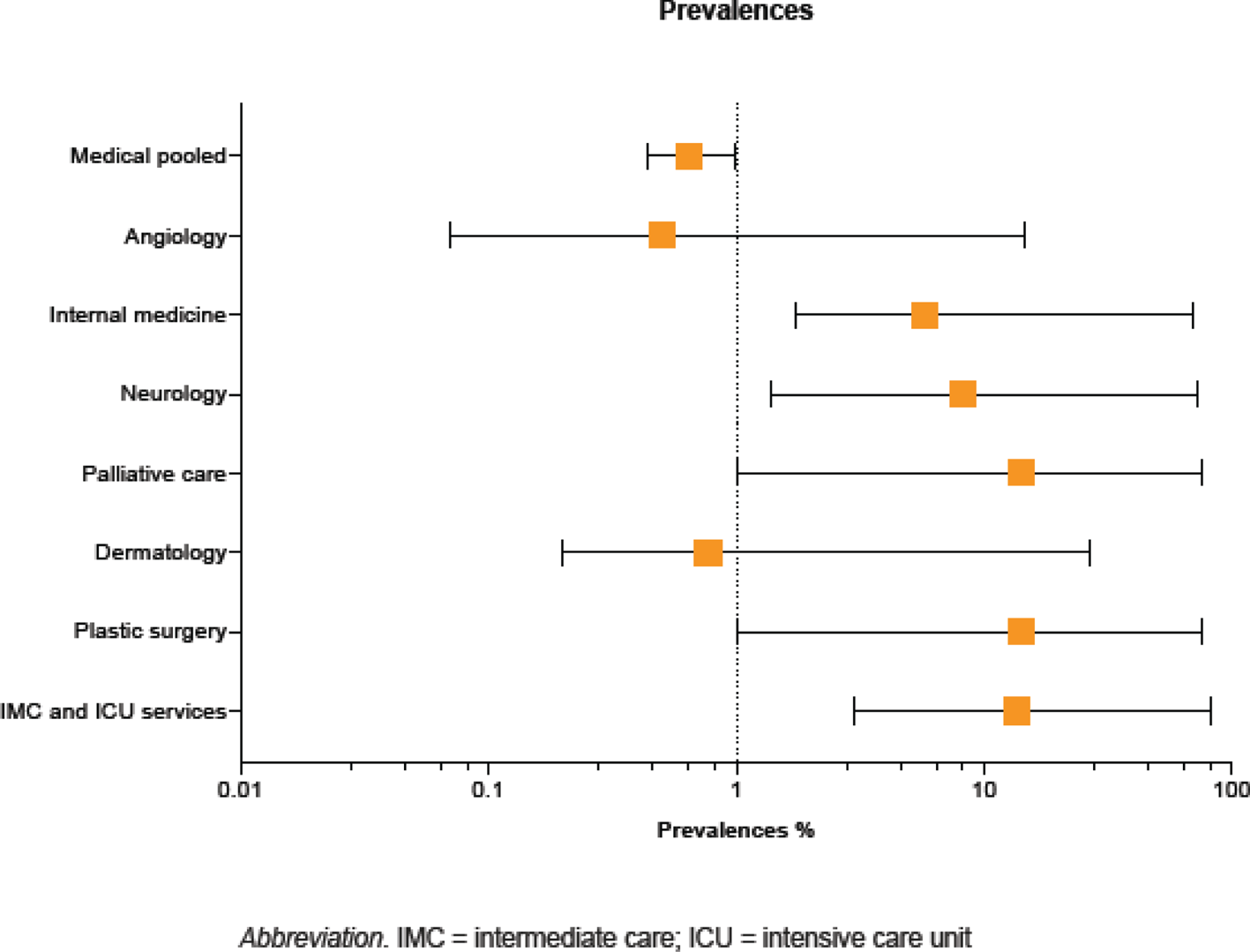
Thus, this study aimed to explore the overall and service-specific prevalence rates of delirium in patients older than 90 years, in addition to shedding light on their trajectories, residence prior admission, hospitalization, and residence post-discharge (Figures 1 and 2).
Graphic representation of odds ratios of admission and medical characteristics, as well as discharge destinations including death.

Graphic representation of prevalence rates of delirium for managing services.

Methods
Patients and procedures
Between January 1 and December 31, 2014, as part of a quality improvement initiative, the DelirPath (Schubert et al., Reference Schubert, Schurch and Boettger2018), data in this prospective cohort study was collected at the University Hospital Zurich, a tertiary care center. In total, 39,442 patients were registered in this initiative, after application of the exclusion criteria were age < 90, length of stay (LOS) < 1 day, and missing data, 472 eligible patients remained.
The DelirPath implements the Delirium Observation Screening Scale (DOS; Schuurmans et al., Reference Schuurmans, Shortridge-Baggett and Duursma2003) and Intensive Care Delirium Screening Checklist (ICDSC; Bergeron et al., Reference Bergeron, Dubois and Dumont2001). On regular floors, the DOS was routinely administered thrice daily for the first three days of hospitalization and on suspicion of incident delirium. On the ICUs, the ICDSC was routinely performed thrice daily.
These instruments were performed by nursing specifically trained via case reports, state-of-the-art lectures on epidemiology, diagnostic criteria of delirium, in addition to eLearning, literature research and courses. Nursing also assessed various medical and functional parameters with the electronic Patient Assessment-Acute Care (ePA-AC) daily (Hunstein et al., Reference Hunstein, Sippel and Rode2012).
All information presented was automatically retrieved from the electronic medical chart (Klinikinformationssystem, KISIM, CisTec AG, Zurich) and reporting followed the STROBE statement (Vandenbroucke et al., Reference Vandenbroucke, von Elm and Altman2014).
This study was approved by the ethics committee of the Canton of Zurich (KEK-ZH-Nr. 2012-0263) and a waiver of informed consent obtained.
Determination of delirium
The primary evaluation of delirium was based on the DOS (Schuurmans et al., Reference Schuurmans, Shortridge-Baggett and Duursma2003), ICDSC (Bergeron et al., Reference Bergeron, Dubois and Dumont2001), and DSM 5 (Diagnostic and Statistical Manual) (American Psychiatric Association, 2013) construct based on the ePA-AC (Hunstein et al., Reference Hunstein, Sippel and Rode2012).
The DOS (Schuurmans et al., Reference Schuurmans, Shortridge-Baggett and Duursma2003) is a validated 13-item instrument screening for delirium according to the DSM-IV criteria (American Psychiatric Association, 1994) representing disturbances of consciousness (1), attention (2–4), thought processes (5 and 6), orientation (7 and 8), memory (9), psychomotor behavior (10, 11, and 13), and affect (12). Items are rated as not existent (0), sometimes to always existent (1), and unable to assess (–). The maximum score is 13, the cutoff for delirium is ≥3, and values were aggregated throughout recordings.
The ICDSC (Bergeron et al., Reference Bergeron, Dubois and Dumont2001) is an 8-item screening instrument also based on the DSM-IV criteria (American Psychiatric Association, 1994) specifically designed for the intensive care setting and limited communication abilities. Items describe 1 — consciousness (comatose, soporose, awake, or hypervigilant), 2 — orientation, 3 — hallucinations or delusions, 4 — psychomotor activity, 5 — inappropriate speech or mood, 6 — attentiveness, 7 — sleep–wake cycle disturbances, and 8 — fluctuation of symptomatology with two points — absent (0) or present (1). The maximum score is eight, the cutoff for delirium ≥3, and values were aggregated throughout recordings.
The ePA-AC (Hunstein et al., Reference Hunstein, Sippel and Rode2012) is a daily administered nursing instrument assessing mobility, personal care and dressing, feeding, elimination, cognition and alertness, communication and interaction, sleeping, breathing, pain, pressure ulcers, and wounds. The respective DSM 5-relevant diagnostic parameters (American Psychiatric Association, 2013), disturbances of consciousness or inattention and cognition were chosen and aggregated throughout recordings.
Statistical methods
Data analyses were performed with the Statistical Package for the Social Sciences (SPSS) version 25 and R statistical software version 3.5.2 for Windows. Descriptive characteristics are summarized using means and standard deviations or medians and interquartile ranges for continuous variables, as well as percentages for categorical variables.
The data were tested with Shapiro–Wilk's for distribution of normality. Inter-group differences for continuous variables were computed using Mann–Whitney U-test depending and for categorical variables with Pearson's-χ 2 test. Then, simple logistic regressions were calculated to determine the socio-demographic/medical trajectories, and prevalence rates of delirium for individual services and respective odds ratios (ORs) and with confidence intervals (CIs). Insufficient data, i.e., empty cells, was omitted.
For all inferential tests, two-tailed tests were chosen when applicable and the significance level alpha (α) set at P < 0.05.
Results
Characteristics of delirious patients
The socio-demographic and medical characteristics of the delirious patients older than 90 years are displayed in Table 1. Neither inter-group differences in age nor gender distribution were apparent. However, dementia predicted delirium (OR 36.05) and delirious patients less commonly resided at home (OR 0.47) vs. assisted living (OR 2.24). These patients were rather admitted as emergencies (OR 3.24) than electively (OR 0.3).
Socio-demographic and management characteristics of delirious vs. non-delirious patients at age >90 years

a Mean, standard deviation – median, interquartile range.
OR, odds ratio; CI, confidence interval.
At this age, patients with delirium were hospitalized longer; however, differences were marginal. More interestingly, delirious patients were apparently sicker as evidenced by increased rates of intensive care management (OR 2.12), requirement for ventilation (OR 5.56), also in excess of 24 h (OR 8.33).
At discharge, the delirious patients were often transferred to assisted living (OR 2.63), indicating functional impairment, or deceased (OR 47.76), indicating critical illness. Less than half of patients admitted from assisted living returned to assisted living (16/38). Although two-thirds of delirium patients were admitted from home, only one-third were able to return home — vs. the non-delirious, corresponding to 78% of a less likely return home. In total, more than one-third delirious patients (69/194) admitted from their own residence did not return.
Prevalence rates of delirium in general and across services
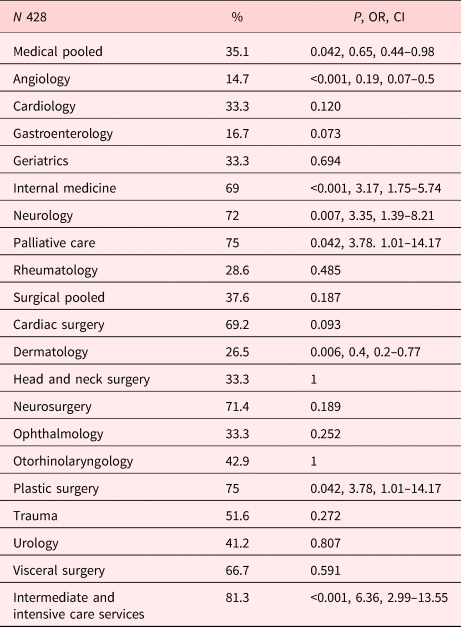
Overall, almost half of patients older than 90 years developed delirium (45.2%) and prevalence rates were substantial across clinical services with few exceptions (Table 2). Throughout clinical services, the prevalence rate of 35.1% was lower than for the entire sample (OR 0.65, 45.2%). On the one side, patients in angiology were less likely to become delirious (14.7%, OR 0.19), whereas at the other end, patients, in internal medicine (69%, OR 1.75), neurology (72%, OR 3.35), and palliative care (75%, OR 3.78) were more likely to be delirious. For the remaining services, prevalence rates did not differ from the average of the entire sample, nonetheless, were substantial.
Prevalence rates and odds for developing delirium at age >90 years

OR, odds ratio; CI, confidence interval.
Across surgical services, the prevalence of delirium was high although not different from that of the entire sample with two exceptions: patients in dermatology were less likely (26.5%, OR 0.4) and patients in plastic surgery more likely to be delirious (75%, OR 3.78). For the remaining services, prevalence rates ranged between 33.3% and 69.2%, again not different from the entire sample. Across intermediate and intensive care services, most patients were delirious (81.3%, OR 8.36).
Discussion
Summary of main findings
At age older than 90 years, patients are at substantial risk for delirium and its sequelae. The prevalence rate was 45.2% and delirium occurred irrespective of age and gender. Pre-existent dementia was the strongest predictor for developing delirium and delirious patients were functionally impaired as evidenced by lower admission rates from home and higher admission rates from assisted living. Apparently, at this age, delirious patients were also more severely ill as evidenced by emergent rather than elective admissions, marginally prolonged hospitalization, requirement for intensive care management and ventilation. Moreover, delirium had harmful effects at discharge: patients did not return home, were rather transferred to assisted living or deceased. In detail, one-third of patients admitted from their own residence and almost half of patients admitted from assisted living did not return to their prior residence.
For various medical settings, the prevalence rate matched the overall rate with few exceptions. Increased rates were noted in the intermediate and intensive care services, plastic surgery, palliative care, neurology, and internal medicine, whereas lower rates were observed in dermatology and angiology.
Comparison to the existing literature
There is no literature evaluating delirium, its risk factors and sequelae at this age. However, a comparison to the literature at large regarding risk factors and prevalence rates is possible. It is known that patients from assisted living have a worse outcome than those dwelling in the community (Friedman et al., Reference Friedman, Mendelson and Bingham2008). At age older than 90 years, neither age nor gender were relevant risk factors for delirium, although generally accepted. Conversely, pre-existent dementia also predicted delirium, at this age the strongest predisposing factor for delirium. The general dementia prevalence rate in patients admitted to the hospital is 15–42% (Handley et al., Reference Handley, Bunn and Goodman2019). Our study has similar findings (23.7%), with a different age population.
As for any delirious patient, regardless of age, the probability to return home was reduced and the probability to be transferred to institutions or decease was increased (Siddiqi et al., Reference Siddiqi, House and Holmes2006; Vasilevskis et al., Reference Vasilevskis, Han and Hughes2012; Inouye et al., Reference Inouye, Westendorp and Saczynski2014; Maldonado, Reference Maldonado2017).
The general prevalence rate of delirium biased to the elderly, >65 years, is 20% (Gonzalez et al., Reference Gonzalez, Martinez and Calderon2009; Meagher et al., Reference Meagher, O'Regan and Ryan2014; Bellelli et al., Reference Bellelli, Morandi and Di Santo2016; McCoy et al., Reference McCoy, Snapper and Stern2016) and at older than 80 years is 34.8% (Ryan et al., Reference Ryan, O'Regan and Caoimh2013). At age older than 90 years, this rate has more than doubled (45.2%) vs. those older than 65 years, or increased by more than 10% vs. those older than 80 years, or increased by 10% for every decade.
Compared with patients older than 65 years (Bellelli et al., Reference Bellelli, Morandi and Di Santo2016), delirium was more common on neurological (28.5% and 72%) and internal medicine services (21.4% vs. 69%), and lower in rehabilitation (14% vs. 28.6); however, prevalence rates doubled and tripled at age older than 90 years.
For specific services, the risk for developing delirium was also increased to a greater extent: admission to vs. management on neurological service (OR 2 and OR 3.35) (Bellelli et al., Reference Bellelli, Morandi and Di Santo2016), admission to trauma and neurosurgery intensive care vs. intermediate and intensive care management (OR 3.4–4.5 and OR 6.36) (Inouye et al., Reference Inouye, Westendorp and Saczynski2014).
Implications
At age >90 years, patients are at substantial risk for developing delirium irrespective of service, so screening for delirium is of urgent clinical need. In particular, dementia and functional impairment predispose to delirium, whereas severity of illness, prolonged hospitalization, intensive care management, and ventilation precipitate delirium. The consequences of delirium are detrimental as many patients 90 years or older did not return home, but to assisted living, or were institutionalized, or deceased.
Strengths and limitations
This study has several strengths and few limitations. First, a large sample including all eligible consecutive patients across departments over 1 year was used. Second, it was possible to comprehensively describe these patients with respect to their socio-demographic and medical characteristics. On the downside, the patients’ population was representative of a tertiary care center and the generalizability to other settings remains to be studied. Furthermore, pre-existent dementias were also retrieved from the medical records which approach is, however, considered legitimate (Sommerlad et al., Reference Sommerlad, Perera and Singh-Manoux2018). In the context of an increasing aging society, future studies are required to investigate this age group further in order to reduce the sequelae of delirium
Conclusion
In summary, at age older than 90 years, the prevalence of delirium is substantial. Dementia and functional impairment predisposed to the development of delirium and severity of illness precipitated delirium. Once delirium has occurred, the sequelae are dire, as patients did not return home, were rather institutionalized or deceased.
Conflicts of interest
There are no conflicts of interest.