


INTRODUCTION: PRESERVING A UNION BY BUYING OFF RESTIVE REGIONS?
To control restive regions, authoritarian states may use force or side payments. However, it has been noted in the literature that the center would prefer using side payments whenever possible, as military suppression is costly for the national center (Hale Reference Hale2008). Side payments come in many forms, such as interregional fiscal transfers (Beramendi Reference Beramendi2012, 37–38; Hale Reference Hale2008), concession of economic powers (Bolton and Roland Reference Bolton and Roland1997; Cunningham Reference Cunningham2011) among others. One great tool is Unionist Economic Integration (UEI) programs. Unlike the international economic integration that is usually referenced in the political economy literature (Alesina and Spolaore Reference Alesina and Spolaore1997, Reference Alesina and Spolaore2003; Alesina, Spolaore, and Wacziarg Reference Alesina, Spolaore and Wacziarg2000; Suesse Reference Suesse2018; Coufalova Reference Coufalova2019), UEIs focus on merging domestic economic markets in a union. As a domestic market expands to cover the restive region, that region comes to share a “mutual economic advantage” with the sovereign state. Because these regions are also benefiting from the union, their case for more autonomy or outright secession is less justified (Rokkan and Urwin Reference Rokkan and Urwin1983, 94; Miller Reference Miller2000).
The current literature on UEIs runs suffers from at least two problems. First, discussion of UEIs tends to focus on the democratic context. Discussions in both political science and economics tend to focus on utility maximization at the level of voters across regions (Alesina and Spolaore Reference Alesina and Spolaore2003, Reference Alesina and Spolaore1997; Alesina, Spolaore, and Wacziarg Reference Alesina, Spolaore and Wacziarg2000; Bolton and Roland Reference Bolton and Roland1997; Abbink and Brandts Reference Abbink and Brandts2016). Focus then shifts to the comparisons of utility between the majority and the minority (Alesina, Spolaore, and Wacziarg Reference Alesina, Spolaore and Wacziarg2000; Beramendi Reference Beramendi2012). But this does not help explain union maintenance in authoritarian contexts, where the role of a leviathan authoritarian government at the national center is crucial (Hale Reference Hale2005).
Second, the comparative literature fails to explain why UEIs work in some regions but not others in the same polity. In our empirical example, the current comparative literature alludes to differences between Hong Kong and Macau in colonial experiences and the composition of the bureaucracy (Mendes Reference Mendes2013; Gunn Reference Gunn1996; Fong Reference Fong2015), but it does not explain how these factors interact with UEIs. Although conceptually the UEI seems to be a powerful means to co-opt the regional populace, it does not follow that it has the same effectiveness across all regions. In the case of China, it is notable that Hong Kong is more restive than Macau: Hong Kong has gone through three major episodes of social movements: the 2003 July First March, the 2014 Umbrella revolution and the recent 2019 Anti-extradition bill movement. Macau has had almost no protests. This article aims to address this puzzle: In the authoritarian state, why could UEIs reduce social unrest in some regions but not others?
I argue that the key to solving the puzzle lies in the concept of economic dependence of the regional populace to the national center. Drawing from the commercial peace literature (Barbieri Reference Barbieri1996; Gartzke and Westerwinter Reference Gartzke and Westerwinter2016), I argue that it is a region's dependence on the national economy that determines the effectiveness of UEIs. This has to do with the mechanism through which UEI reduces social unrest—it adds to the expected cost of contention. Economic Dependence changes the baseline cost of contention—a less dependent region would have a lower baseline cost, so that whatever has been added by UEIs might remain insignificant enough that the regional population do not care about the increased cost of contention. For a region that is dependent on the national economy, then that baseline may be much higher, and the regional population may shy away from protesting, given the higher expected cost of contention.
In this article I exploit the introduction of the Closer Economic Cooperation Agreement (CEPA) in Hong Kong and Macau. I show that, given the equivalent UEI package at roughly the same moment, the differing levels of economic dependence on the Chinese economy in Hong Kong and Macau explains the different trajectories of social unrest in the two regions. I then extend this argument to other Chinese provinces. The same effect direction is present yet the estimation uncertainty is much higher.
ECONOMIC INTEGRATION AND SOCIAL UNREST
What makes or breaks the effect of economic integration on unrest suppression? The secessionism literature argues that domestic market integration helps mitigate the secession-inducing effects from international economic integration. In this literature, secessionism is a result of economic globalization: increasing trade flows followed by international economic integration make the income of the regional populace much less dependent on good relations with the national center. The region no longer needs to trade as much with the national center, so it may risk worsening relations, or even breaking off from the union to further tap into the benefits of international economic integration (Alesina and Spolaore Reference Alesina and Spolaore2003, Reference Alesina and Spolaore1997; Alesina, Spolaore, and Wacziarg Reference Alesina, Spolaore and Wacziarg2000).
For the authoritarian state, one way to prevent secession would be to integrate the regional economies with that of the center such that trade within the union outweighs international trade. Again, because good relations with the national center increases income, one could argue that such concessions could eliminate the secessionist threat arising from international economic integration.
This is the logic behind what I call Unionist Economic Integration (UEI) institutions. UEIs refer to economic institutions for the construction of a common economic entity within the same political union. As per the definition of institution, these are rules or procedures for promoting economic integration with the center (Jepperson Reference Jepperson, Powell and Dimaggio1991; North Reference North1990, 3). Because of territorial expansion and recession, histories of domination and colonialism, and political decentralization and centralization, the regional market may be isolated from or developed on the sidelines of the national economy. Through UEIs, the state attempts to harmonize economic practices and facilitate flows of labor, capital, goods, and market between the peripheral region and the national center. UEIs speak to Bolton and Roland's (Reference Bolton and Roland1997) idea of the removal of intra-union trade barriers. For Bolton and Roland (Reference Bolton and Roland1997), this would imply that tax preference differences across regions would disappear, such that voters across regions would be happy to stay within the political union. Appeasement through UEI is also discussed in the works of theorist David Miller, who argued that the region would now share a “mutual economic advantage” with the national center so they have a weaker case for secession (Miller Reference Miller2000). Stein Rokkan also wrote that the earlier a common labor market was constructed the more likely the domination of that common labor market over others in peripheral regions was likely to be (Rokkan and Urwin Reference Rokkan and Urwin1983, 96).
Like other institutions, UEIs can be institutionalized to various degrees, ranging from weak institutionalization with no formal rules written or provisions written into law to strong institutionalization with provisions clearly written into law, specialized agencies created to conduct economic integration, and so forth.
Throughout history there have been a limited number of examples of UEIs.Footnote 1 For example, the US–Hawaii Reciprocity Treaty enabled the integration of Hawaii's sugar market with that of the US. The elimination of sugar tariffs created a special interest class that supported annexation (La Croix Reference La Croix2019, 14). Outside of the context of Western industrialized democracies, the highly integrated oil and gas market in the Russian Federation enabled Boris Yeltsin to award loyal regions with cheap oil and gas prices, and to punish disloyal regions by raising them (Hale Reference Hale2005, 59). Following the annexation of the Portuguese possessions by India, the Indian government has also used economic assistance programs to reconciliate wage and price differences (Rubinoff Reference Rubinoff1995, 44).
However, not all regions are appeased by UEIs. Even more puzzling is that, in the case of China, both Hong Kong and Macau are relatively well-off compared to other peripheral regions like Tibet and Xinjiang. They are also equally exposed to the increasingly globalized economy, after inheriting capitalistic economic systems from the United Kingdom and Portugal respectively. To explain peculiar cases like these, we will have to focus on the region's overall level of dependence on the national economy.
HOW ECONOMIC DEPENDENCE SHAPES THE EFFECTIVENESS OF UEIS
The mechanism through which UEIs can suppress dissent is to increase the expected cost of contention. In other words, these economic linkages mean that there is a higher economic cost to confronting the national center. This idea can be traced to the commercial peace literature. The main claim of this literature is that under some conditions, trade can reduce international conflict (Barbieri Reference Barbieri1996; Gartzke and Westerwinter Reference Gartzke and Westerwinter2016). One common prediction from this literature is the asymmetry of the trade relationship between two countries. When one trade partner is much more dependent on the other, the likelihood of militarized conflict increases. But if the two trade partners are equally dependent on one another, increasing trade between two partners is said to be conflict-reducing because it adds loss of trade to the potential harm conflict can cause to both parties.
Of course, we cannot expect trade dependence to be exactly the same as UEIs. Nor should we equate regional dissent with militarized conflict or secessionism. This is precisely why UEIs may have different effect directions on regional dissent. First, quite often “dependence” refers to the regional periphery being dependent on the national center (Rokkan and Urwin Reference Rokkan and Urwin1983; Miller Reference Miller2000), which is unlike trade dependence, which can work in both directions. Second, UEIs are usually imposed. Third, in the case of a region that is highly dependent on the national economy, the national center could threaten the withdrawal of UEIs from disloyal regions (Cunningham Reference Cunningham2011). In our context of UEI in a non-democracy, there exists a leviathan capable of creating asymmetrical economic relations. The leviathan can use both carrots and sticks strategically such that the dependent region would rather stay loyal, and the independent region is indifferent to the difference between staying loyal or not (Hale Reference Hale2005). Taking these concerns together, we cannot simply take the theoretical expectations from the international relations literature for granted, when discussing UEIs.
In this sense, the way that economic dependence determines the effectiveness of UEIs in dissent suppression is as follows: UEIs increase economic dependence uniformly. However, the initial level of economic dependence sets different baselines of the expected cost of contention. Only if the baseline is high enough and when UEIs add to that baseline (in the case of a highly dependent region) would UEI be effective in dampening unrest. For regions with a low level of dependence the increased cost of contention can be hedged by domestic economic activities and international trade. The increased cost is only large enough to deter people from protesting in highly dependent regions, where international trade or other domestic economic activities are not sufficient to cover the increased cost of contention. In other words, the key term for the causal effect is indifference. In low-dependence regions, the increase in the expected cost of contention introduced in UEIs is negligible enough that people are indifferent to UEIs, which thus do not dampen unrest. In high-dependence regions, that increase is substantial, given the already high initial level of economic dependence, so UEIs work.
The effectiveness of UEIs is path dependent (Pierson Reference Pierson2000b, Reference Pierson2000a). Highly dependent regions will become less resistant to increased dependence. In the highly dependent case, UEIs create a positive feedback loop for cooperation with the national center (Pierson Reference Pierson2000a) so, over time, citizens living in highly dependent peripherals will be more likely to accept further integration and less likely to mobilize for protest. These citizens are likely to overlook any negative impact UEIs might have on the domestic economy. However, less dependent regions may grow resistant to increased dependence. Because the regional citizens are indifferent to UEIs, there is no positive feedback loop to sustain the UEIs. However, the negative impacts of UEIs on the domestic economy can be amplified (e.g. trade diversion, increased competition from national businesses, etc.). Pushing unwanted UEIs in less dependent regions might lead to more public backlash, even when economic dependence is increasing. In this case, UEIs now appear as a harmful institution to the regional economy, with little benefits to the regional citizens. Citizens may declare unwanted trade agreements as an attempt to restrict trade activity in the region, or declare unwanted visa agreements as failure to control immigration. To overcome the path dependence in less dependent regions, the national center has to provide a variety of highly institutionalized UEIs all at once at the risk of even more backlash.
WHY (NOT) UEIS?
For the national center, UEIs are useful tools to avoid using coercion on unrest or fighting antisecessionist wars (Hale Reference Hale2005; Cunningham Reference Cunningham2011). Authoritarian governments do not want to use the coercive apparatus when it is not necessary, because doing so might signal regime instability. Coercion can also be difficult because it is difficult for the regime to distinguish loyalist peripheral citizens from activist ones. Untargeted persecution not only hints at regime instability, it also leads to further public backlash resulting in more citizens sympathizing with the resistance (Xu Reference Xu2020). Ceteris paribus, if by creating economic institutions like UEIs could buy the hearts and minds of peripheral citizens, then the authoritarian state would always prefer UEIs over armed suppression. However, the authoritarian state may switch to other strategies if UEIs are no longer useful to them. For example, UEIs can be ineffective in some regions, and the authoritarian state thus may switch to more coercive tactics to subjugate the region. Alternatively, advances in surveillance capabilities may allow the authoritarian state to conduct targeted persecution with little visibility, making targeted persecution a preferred strategy over UEIs (Diamond Reference Diamond2019; Xu Reference Xu2020).
The regional opposition to UEIs may seem paradoxical at first: opponents of UEIs want to cut economic ties with the center, because they do not want the national center to be in a position to threaten to cut economic ties. This seems self-defeating at first glance. I argue that the underlying motivation is similar to the prediction from the Obsolescing Bargaining Model (OBM), where a party avoids signing an agreement that is hard to change in the future (Eden, Lenway, and Schuler Reference Eden, Lenway, Schuler and Grosse2005). The regional citizens want to avoid UEIs given that the institutionalization of the UEIs may make it difficult to modify other political institutions governing the relations between the national center and the periphery. Once UEIs are institutionalized, the national center can always threaten to remove economic ties in future constitutional bargaining.
Alternatively, opposition to UEIs can be elite-driven as well. Ethnic entrepreneurs can always claim to represent their own kin more by outbidding against other elites (Chandra Reference Chandra2005; Zuber Reference Zuber2011). Ethnic entrepreneurs can declare that UEIs are “selling off” the economic interests of one's kin in favor of the national center to gain support in elections. Compared to the OBM explanation, this argument does not assume that the regional citizen always wants to renegotiate with the national center for better constitutional arrangements.
In short, UEIs reduce social unrest by increasing economic dependence. However, their effectiveness hinges on the initial level of a region's economic dependence on the national center. People's acceptance of UEIs is path dependent. The center wants to use UEIs as a low-risk appeasement strategy to reduce social unrest, but the regional citizens may oppose them since 1) they do not want to involve themselves in obsolescing bargaining; or 2) some regional groups have been mobilized to oppose the national center due to ethnic outbidding.
If all this is true, then we may hypothesize that:
H1 The more institutionalized UEIs are in a region, the less social unrest is in that region.
H2 Conditional on higher levels of dependence on the national economy, the more institutionalized UEIs are in a region, the less social unrest is in that region.
EMPIRICAL ANALYSIS
THE CASE OF HONG KONG AND MACAU
Hong Kong and Macau are officially “Special Autonomous Regions” (SARs) within the People's Republic of China. Before joining China, Hong Kong and Macau were under British and Portuguese colonial rule respectively, and they were transferred to Chinese rule in 1997 (Hong Kong) and 1999 (Macau). The two SARs have been ruled by the “One Country, Two Systems” (1C2S), a system agreed between the British and the Chinese in the 1984 Sino-British Joint Declaration. The 1C2S mandates that the capitalist order in the former colonies shall continue, while mainland China will practice socialism, although together they will constitute one single country. The Basic Laws of the Hong Kong SAR and Macau SAR further expanded on this concept, in which the principles of “Hong Kong/ Macau people ruling Hong Kong/Macau,” “High Degree of Autonomy,” and that the 1C2S shall remain unchanged for 50 years were written into the Basic Law. If one reads the two basic laws legalistically, one would find out that the two regions are granted high levels of autonomy including, but not limited to, independent taxation authority, the authority to make an independent monetary policy, and independent budgeting authority. The only two areas where authority is reserved for China are foreign policy and national defense. Hong Kong and Macau may attend some international events under the alias “Hong Kong, China” and “Macau, China” respectively, and China's People's Liberation Army (PLA) maintains active garrisons in Hong Kong and Macau.
The imperative of Economic Integration as a co-optation tool first came up after the 2003 First of July protest. Prior to the adoption of any economic integration, the fundamental tenet of the “One Country, Two Systems” principle was to “keep Hong Kong and Macau from Mainland China at a certain distance” (So Reference So, Ku and Ngai2004; Ma Reference Ma2015; Fong Reference Fong2015; Cheung Reference Cheung2007). This is best summarized by the famous quotation from the then-Chinese premier Zhou Enlai on Hong Kong, that China would “formulate long-term plans and make maximum use of the place” (Chanqi Dasuan, Chongfen Liyong) (Fong Reference Fong2015, 107). Mainland China's recognition of the pre-retrocession ‘One Country, Two Systems principle was evident in its treatment of Hong Kong and Macauc citizens as “outsiders” who were required to apply for a visa to enter China (Cheung, Reference Cheung2007, p.89).
There were few mass protests in the two regions immediately after the handover. But in 2003, a protest involving some 500,000 Hong Kong citizens erupted. Mass protests erupted against the drafting of a National Security Law that would have allowed the state to prosecute political opponents. The Central Liaison Office (CLO) failed to predict the scale of the protest and was busy looking for remedies (So Reference So, Ku and Ngai2004, 21–22). Meanwhile, the economies of the two SARs were damaged by the SARS outbreak. Beijing then decided to slow its pace of united front work. Instead of launching political initiatives, economic integration initiatives were proposed so that the economy of the SARs would become more dependent on the mainland (Peter Chiu Reference Chiu2006; Lo Reference Lo2008, 11–12, 51–52; Rezvani Reference Rezvani2012, 99–100; Ma Reference Ma2015; Yuen Reference Yuen2014) According to Yuen (Reference Yuen2014), he quoted Ke Dai, a United Front worker, saying that CEPA is a process introduced to speed up the return of Hong Kong people's hearts and minds (Renxi Huigui).
The first of such initiatives is a free trade agreement called the Closer Economic Partnership Agreement (CEPA). The first iterations were signed in 2003 and 2004 with Macau and Hong Kong respectively. Ten supplements were added thereafter to further liberalize the trade of goods and services between China and the two territories. As CEPA deepens, trade tilts towards China intensively. In Hong Kong, domestic exports have been gradually leveling out, reaching an all-time low at 0.57 percent in 2015, a figure even lower than the 1980s level in the Chinese reform era. Aggregated re-exports to China dominated, as they made up half of all Hong Kong exports by 2009. In Macau, regardless of the share of exports to China, actual export volume toppled in 2008–2009 amid the financial crisis and has not recovered to pre-crisis levels. Imports from China by the two SARs have been increasing at an even faster pace after CEPA, as Chinese imports make up of some 49.03 percent of the total imports of Hong Kong. Macau may have diversified its imports, but Chinese imports still reached an all-time high at 3 billion MOP. In this way, CEPA has been more successful in tilting trade of the two SARs with China than improving bilateral trade.
Other forms of UEI include the Individual Visit Scheme (IVS), a visa liberalization scheme for Chinese citizens living in selected cities (Ma Reference Ma2015; Yuen Reference Yuen2014); the various stock market integration programs between Chinese financial markets and the Hong Kong Exchange (HKEx). Last but not least, in 2017, the Chinese government started to talk about the concept of a “Greater Bay Area.” Looking to the San Francisco Bay Area and Tokyo Bay Area, the Chinese government wants to deepen the integration of the two SARs and nearby Chinese cities in the Pearl River Delta.
Previous literature has mostly focused on historical and institutional differences between Hong Kong and Macau despite the homogeneity in the constitutions (Gunn Reference Gunn1996; Mendes Reference Mendes2013; Fong Reference Fong2015). While these studies could explain why contention can be observed in Hong Kong but not Macau, they do not provide a mechanism through which UEIs reduce or fail to reduce social unrest in the periphery. In the next, empirical, section I will show that the mechanism is the change in the expected cost of contention conditional on the degree of economic dependence.
IMPACT OF TRADE LIBERALIZATION ON SOCIAL UNREST IN HONG KONG AND MACAU, 1994–2018.
In the first empirical study, I focus on the CEPA in Hong Kong and Macau. I chose to study CEPA for three reasons: first, the case of CEPA constitutes a quasi-experimental setup: the equivalent agreement has been applied to both Hong Kong and Macau at roughly the same time, thus the CEPA constitutes a treatment. If we treat Hong Kong, a highly globalized, independent economy, as the control group, then the highly dependent Macau economy would be the treated group. This quasi-experimental setup allows the identification of causal effects directly. Second, it has the longest history across all UEI variants in Hong Kong and Macau. If social unrest takes time to develop, then we could identify the effect of UEI given its longer history compared to newer variants like the stock connects or infrastructure projects that have only been launched in the last 10 years. Last but not least, Hong Kong and Macau constitute a great case of paired comparison. This is a unique situation where, within authoritarian China, there exist two regions with clearly-inked autonomy arrangements. Studying these two regions allow us to control for numerous background variables: they have a similar culture, they are both capitalistic societies, and their constitutional structures are also highly similar. Having only economic dependence vary between these two regions thus allow the identification of causal effects from economic dependence.
The varying levels of economic dependence lies in the economic structure of the two regions. Macau's economy is structured around the gaming industry, while Hong Kong's economy is structured around the financial industry. Hong Kong's economy is also much larger than Macau's, with Hong Kong's GDP at $362 billion and Macau's at only $54 billion (World Bank 2018). Hong Kong's financial sector is highly globalized and integrated with the international markets, while the Macau economy is mostly geared towards the service and gaming industry for Chinese and Hong Kong citizens.
Compared to Taiwan, which China claims as part of its periphery, Hong Kong and Macau are more suitable cases, as the UEIs in the two cases are imposed. Citizens in these two regions had no way to stop the agreement from being enacted. This allows us to avoid the scenario where the citizens protest against integration with China for the purpose of renegotiating for better terms in the agreement, rather than protesting to voice their disapproval to further integration with China.
DATA AND METHODS
In this study I analyze an original dataset on the dissent over the 1C2S and intensity of protests in Hong Kong and Macau between 1994 and 2018.
DEPENDENT VARIABLE
I measure social unrest in two ways. The first is to look at the yearly aggregated mean of approval of the 1C2S system for the two regions. In Hong Kong and Macau, the Public Opinion Research Institute (PORI) conducts a yearly study of residents’ confidence in the 1C2S autonomy arrangement that goes back to 1993 (1999 for Macau). I code as the level of dissent the yearly percentage of citizens who feel not confident in the 1C2S. When multiple surveys were conducted in the same year, I take the average value for that year. The range of the study period with the largest number of observations is between 1994 and 2018.
Second, I regress the yearly count of protest events identified in Hong Kong and Macau. Protest events are identified from the GDELT 2.0 Events Database. The GDELT 2.0 Events Database is a real-time event monitoring system that captures breaking events and reaction every 15 minutes in the world (The GDELT Project 2015). I obtained the yearly count of protest events from citizens directed at the Chinese government in the two regions. This data has a study period between 1997 and 2019.
INDEPENDENT VARIABLES
The covariate of interest, economic dependence, can be calculated by trade data (Barbieri Reference Barbieri1996). At the moment I utilize the trade intensity index (Dale Reference Dale, Chai, Kueh and Tisdell1997; Flörkemeier Reference Flörkemeier2002). This index measures regional trade bias vis-à-vis global trade. It has no upper boundary. A higher index refers to the increased bias of country i to j when trading (one could imagine in a set of possible trading partners, i is much more likely to trade with j than with other countries −j). Following Dale (Reference Dale, Chai, Kueh and Tisdell1997), the index for country i's bias to country j is defined as:
 $$l_{ij}^{} = \displaystyle{{x_{ij}} \over {X_i}}\left/ \displaystyle{{M_j} \over T}$$
where x ij is the total exports of country i to country j; X i is the total exports of country i; M j is the total imports of country j; and T is the world's total imports. In words, this is a ratio of two separate ratios: on the left-hand-side: a ratio of exports from i to j to i's total exports, and the right-hand-side: a ratio of imports of j to the world total imports. The ratio thus gives a rough sense of how much bias country i has with respect to j when choosing all possible export destinations in the world, controlling for the number of imports of the destination country j.Footnote 2 I rely on data from the National Bureau of Statistics of China, the Hong Kong Statistical Yearbook, the Macau Statistical Yearbook and the World Bank to calculate this index. Only trade in goods is used, as trade in services data is not available for Macau.
I operationalize UEI institutionalization as the trade intensity ratio of China with respect to Hong Kong and Macau. This can help us pick up the preferential treatment of China to Hong Kong and Macau in the form of additional flow of goods. Because UEIs are created to increase economic ties from the national center to the periphery, we can measure the degree of the institutionalization of UEIs by looking at how much dependence China is creating in Hong Kong and Macau.
Similarly, I operationalize dependence as the trade intensity ratio of Hong Kong and Macau with respect to China. Reversing i and j in the trade intensity ratio means that we are now looking at the regional bias emerging from Hong Kong and Macau when choosing over trade partners. I stipulate that when the region is highly dependent on trading with China, this quantity will be extremely high. When calculating the trade intensity ratios, only data on trade in goods is used. The data on trade in services is unavailable for Macau so I used only the data for trade in goods.
Last but not least, I included several control variables. First, I included the total trade volume since it is the openness to trade that motivated citizens to express secessionist tendencies (Alesina and Spolaore Reference Alesina and Spolaore2003; Alesina, Spolaore, and Wacziarg Reference Alesina, Spolaore and Wacziarg2000). Second, I included the yearly FDI volume between China and Hong Kong/Macau since CEPA could also lead to an increase in FDI activity between the center and the periphery. Third, I accounted for the joint movement of China and Hong Kong/Macau's stock markets. At time point t, this quantity is computed as the absolute difference of the net change of stock indices between region k's stock market composite index and China's stock market composite Index from t − 1 to t. The motivation behind this quantity is to measure the joint movement between region k's stock market prices and China's stock market prices. If the difference is low, then we can argue that the two markets are well integrated. For Hong Kong, I used the yearly close prices for the Hang Sang Composite Index (HSI). For China, I used the yearly end date prices for the Shanghai Composite Index (SCI). No such composite index exists for Macau, so I calculated one with four main Macau-based companies listed on the Hong Kong Stock Exchange. This Macau composite Index consists of prices of yearly end date prices for four companies: Galaxy, SJM, Wynn Macau, and Sands China. The index is constructed by weighting the yearly end date prices of each of these companies by their relative capitalization each year. Finally, I included several event dummies to indicate the initialization and completion of special infrastructure projects aiming to promote economic integration with China. While these cannot be identified as UEIs since they are not institutions, these are economic integration projects that could potentially serve as confounders in the analysis. These include the event dummies for the debate and completion for the HZMB, the Hong Kong-Shenzhen ERL. I have also controlled for the announcement of co-development projects on the Hengqing Island by the Macau government. Each of these events are entered into the regression model as a pulse intervention. This means that they are entered as dummy variable with a value of “1” on the year that the event took place, with all other years set to “0.” Table 1 reports the descriptive statistics in this study. Descriptive statistics by region is available in the appendix.
Descriptive Statistics of the Hong Kong/Macau Analysis

ESTIMATION TECHNIQUE
I fitted a multi-level linear regression model to predict the degree of discontent with the 1C2S. The protest count data cannot be predicted using the linear model since count data do not follow the normal distribution, so I fitted a multi-level zero-inflated negative binomial (ZINB) model instead. I included a random intercept for both the year and country levels. The 1C2S model is fitted using the lme4 package in R. The model for protest counts failed to achieve convergence under frequentist estimation, so I estimated the model using the Bayesian approach via the brms package in R. I have allowed the covariance matrix of the error to follow the AR(1) process, such that non-independence across times can be captured by the error term. A detailed discussion of the Bayesian models and regression coefficients is available in the appendix.
RESULTS
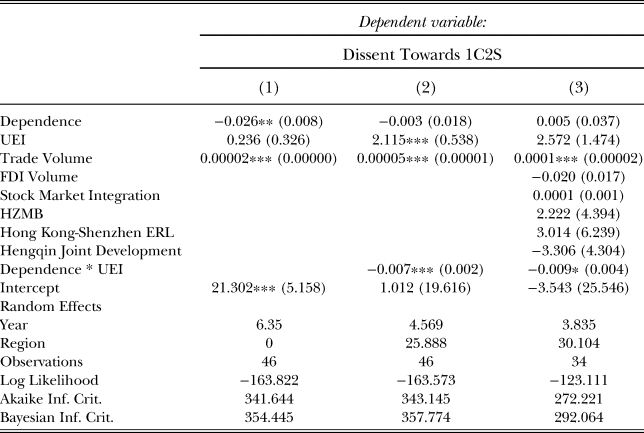
Table 2 reports the results of the models on the level of dissent towards the 1C2S, and Figure 1 shows the result from the observed value prediction of dissent towards 1C2S, conditioning on the level of dependence to the minimum and maximum observed levels in the data. From Figure 1 we can see that at minimal levels of UEI institutionalization, the difference in the predicted percentage of people unsatisfied with 1C2S is subtle between the cases of low and high economic dependence. As UEI institutionalization increases, the predicted effect direction differs. We see that, for regions with low level of dependence, the percentage of dissent towards 1C2S increases as UEI increases, while that relationship is negative for regions with high levels of dependence. At middle levels of UEI institutionalization, highly dependent regions have reached nearly 0 percent of dissent towards 1C2S expressed, while for independent regions that figure is slowly climbing towards 50 percent.
Estimating the level of dissent towards 1C2S

Note: ∗p < 0.05; ∗∗p < 0.01; ∗∗∗p < 0.001 Reported are estimates obtained from a multi-level linear regression model. Standard errors are in Parenthesis.
Predicting dissent towards 1C2S

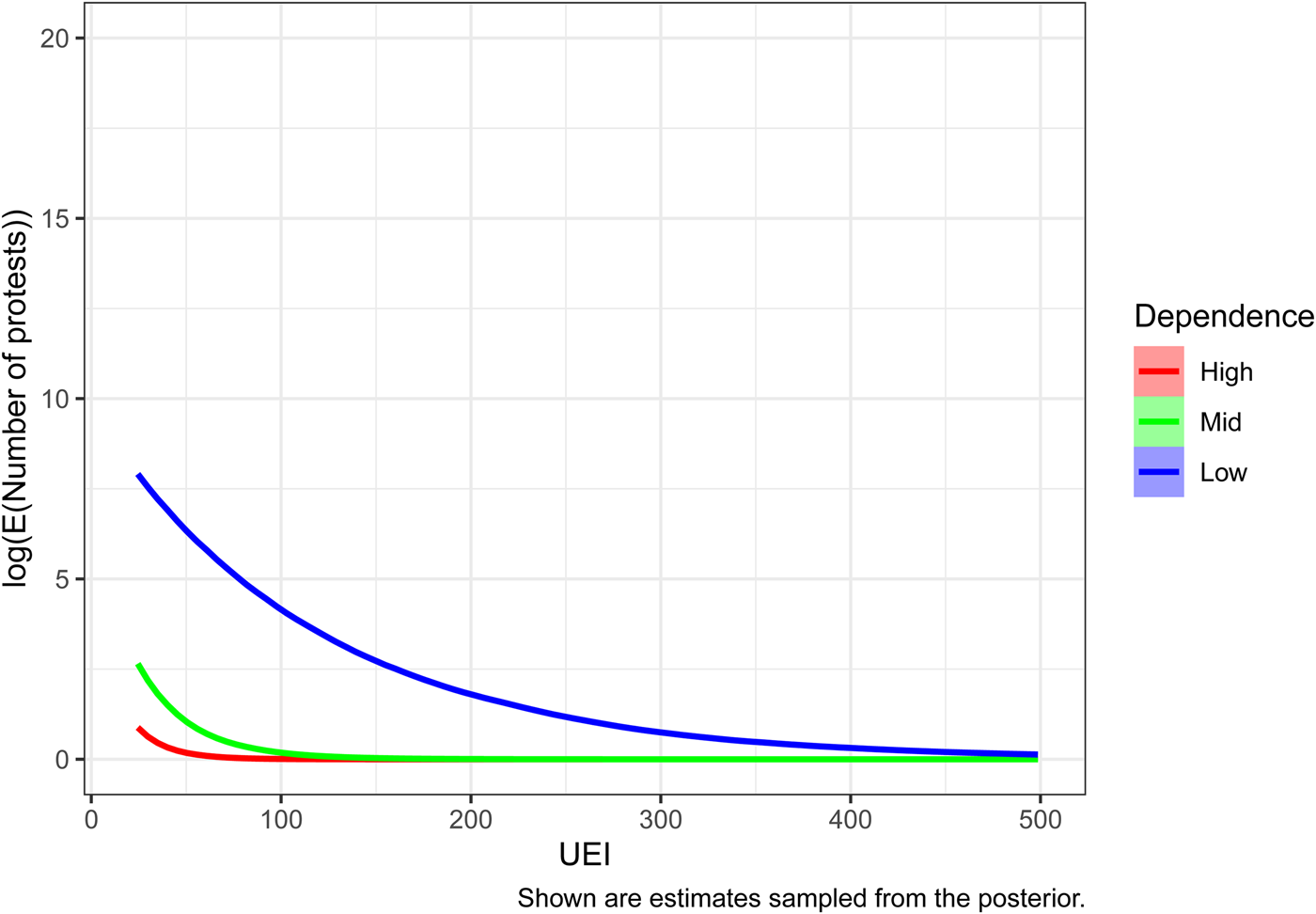
Figure 2 shows the result of the predicted effects from the model on the number of protests observed in a year. The minimum, mean, and maximum levels of dependence have been used to produce three predictions for regions with low, medium, and high dependence respectively. While the estimates are prone to error due to a small sample size, we can still see the same effect shown in Figure 1—given high levels of dependence, basically the region would never protest; given low levels of dependence, the reduction effects of UEI is still present, yet it only works at much higher levels of UEI institutionalization (>50).
Predicting the mean number of protests per year in Hong Kong and Macau

In Figures 1 and 2 we have found support for both H1 and H2. One could argue that the result is an artifact of the difference in prosperity of the two regions. However, the relative deprivation argument would suggest that it is Macau that should see more unrest. In the appendix, I show the models with the log of GDP per capita added in the estimation. Results show that the effect direction observed still holds, albeit the interaction variable between Dependence and UEI lost significance. However, given that GDP correlates strongly with the trade data I am using, those results should be taken with a grain of salt. GDP should matter in the same way as the total trade volume as a measure of economic alternatives should they revolt against the national center. The distribution of this coefficient is almost identical in the Bayesian model.
Alternatively, one could argue that it is the difference in income inequality between the two regions that explain the different levels of social unrest. This could be true, as some protests might be related to rising income inequality. In the appendix I re-estimated the models with the gini coefficient added in. The data for gini coefficient is not available at a yearly interval, so I extrapolated the gaps in between observations. I found that in the 1C2S dissent model, the interaction variable lost significance, but with a p-value of around .126, which is very close to the p < .10 significance threshold. The distribution of this coefficient is almost identical in the Bayesian model, so the interaction effect for the protest count model holds.
HOW UEIS INCREASE THE EXPECTED COST OF CONTENTION IN HONG KONG AND MACAU
Now that we know UEIs do suppress dissent conditional on the level of economic dependence, the question that arises is how they work. In this case study section I will examine whether the empirical patterns discovered above apply in Hong Kong and Macau.
HONG KONG: UEIS FAILED TO INCREASE THE COST OF CONTENTION
As discussed above, the CEPA was launched at a time of economic turmoil (So Reference So, Ku and Ngai2004; Ma Reference Ma2015; Fong Reference Fong2015; Cheung Reference Cheung2007). The Hong Kong government was quick to sign the agreement for the trade liberalization scheme, and that laid the foundation for further integration. The first sign that CEPA led to increased dissent against China is the issue of inter-border trade. CEPA enables the free movement of goods, and this led to a sudden rise in demand for Hong Kong goods in the Mainland. Together with the Individual Visit Scheme (IVS), Chinese citizens could now purchase goods in Hong Kong and bring them back to China. This led to a rise of parallel trading on the Northern border of Hong Kong, which deprived of Hong Kongers of goods in the early 2010s.
Popular sentiment against China peaked around 2012, when the parallel trading problem was combined with the issue of birth tourism: Chinese mothers travelling to Hong Kong to give birth (Tsang Reference Tsang2012; “Duli Meiti” 2012; ON.CC 2013; Ma Reference Ma2015). Groups advocating for local rights began to arise, such as the North District Parallel Imports Concern Group, Hong Kong Indigenous, Hong Kong Local Power, and the Claudia Mo-led Hong Kong Local (Yuen and Chung Reference Yuen and Chung2018). Some of these groups first advocated for the protection of the Hong Kong market from parallel traders, yet eventually they took the matter to the streets, launching protests against the government's immigration policy regarding Chinese citizens. During the 2016 legislative election there was heavy outbidding from localist parties against the traditional pan-democrats. For example, Civic Passion ran a mostly negative campaign attacking the Democratic Party for launching talks with Beijing officials in 2010. They claimed the talks had constrained the opposition's options in the future, just as the OBM had predicted. They eventually captured one seat in the New Territories West Constituency. Youngspiration, another localist party, captured two seats in the legislature.
In response to mass mobilization of the umbrella movement, the Chinese government enacted stock market integration between Shenzhen, Shanghai, and Hong Kong in 2016. However, Hong Kong investors were not as keen as Chinese investors in utilizing the stock connect. Most of the capital flows tend to come from Chinese investors buying in Hong Kong (ON.CC 2015). It has also been speculated that Beijing might have two ulterior motives on stock market integration: The first was to encourage Hong Kongers to adopt the 2015 Constitutional Reform. If Hong Kongers rejected the 2015 reform, then Beijing would command Chinese companies to cease investing in Hong Kong (Lian Reference Lian2014; Lam and Wong Reference Lam and Wong2015). The second was to extend Beijing's reach of Hong Kong's financial markets through Chinese companies, many of which belonged to the State-owned Assets Supervision and Administration Committee (SASAC) (Donald, Wang, and Vanderwolk Reference Donald, Wang and Vanderwolk2014, 89). For instance, the SASAC as a whole held a 74.08 percent stake of China Mobile, the most prominent red-chip firm listed in Hong Kong at the time. The SASAC reports to the State Council (Donald, Wang, and Vanderwolk Reference Donald, Wang and Vanderwolk2014, 236–237). This speaks to the predictions of the OBM: China did use the stock-connects to push through the 2015 reform. In response, the localist opposition launched various protests, reminding the locals that China might break the promise of offering universal suffrage in 2017 (BBC 2015).
Recently, the Hong Kong government has been pushing for integration within the “Greater Bay Area” with Guangdong. It created a new office for the Greater Bay Area Development. The Hong Kong government allocated land for the construction of a Hongkong-Shenzhen Innovation & Technology Park (HSITP), and created a board of directors for the project. The project received public backlash due to the massive delays and cost overrun. Even pro-China lawmakers like Michael Tien and Leung Che-Cheung have raised concerns about the project cost and potential moral hazards down the road (ON.CC 2020).
In Hong Kong, UEIs failed to increase the expected cost of contention in various occasions. The CEPA, combined with the IVS, provided opportunities for some segments of the business community but did not benefit all Hong Kongers much. The under-utilization of the stock-connects followed the same trajectory, as Hong Kong investors were indifferent to the new project. New institutions on the Greater Bay Area project invited criticism even from pro-China legislators. If anything, UEIs seem to have added to public backlash, as parallel trading disrupted the supply of goods in Hong Kong and gave rise to the localist opposition in Hong Kong.
MACAU: UEIS INCREASE THE COST OF CONTENTION TO AN ALREADY HIGH BASELINE
The situation is drastically different in Macau. Historians pointed out that the Macau people were frustrated with the colonial Portuguese administration. Crime was rampant and they saw transition to Chinese rule as an opportunity to improve law and order (Gunn Reference Gunn1996; Mendes Reference Mendes2013).
Macau's heavy economic dependence on China comes from its structural reliance on tourism and the gaming industry. Macau's gaming industry is inward-looking, mostly geared towards serving Chinese tourists (Liu et al. Reference Liu, Chang, Loi and Chan2015; Lo Reference Lo, Yu and Chan2014). In 2015, Gaming Tax Income constituted up to 83.5 percent of Macau's total tax income (Liu et al. Reference Liu, Chang, Loi and Chan2015, 500). Because of this structural reliance, there are not many alternatives to economic cooperation with China.
Perhaps the addition to the expected cost of contention is most obvious in the joint development of the Hengqin Island, between Zhuhai and Macau. In the 2000s, the Macau administration had been in contact with the Zhuhai administration for possible joint rule on Hengqin Island, an island to the West of Macau that is within Zhuhai's city limits. Eventually, the Chinese government allowed the Macau administration to co-develop a small section to the East of the island with the Zhuhai government. Due to Macau's limited land mass and industrial diversity, the Macau government decided to focus on non-gaming development on Hengqin Island (Fan et al. Reference Fan, Ren, Wang, Pan, Huang, Chen, Zhan, Yang, Luo, Jian and Wu2013, 1301; Liu et al. Reference Liu, Chang, Loi and Chan2015, 509; Lo Reference Lo, Yu and Chan2014, 82– 83; Zheng Reference Zheng2010). Macau went ahead and constructed a new University of Macau campus on Hengqin island in 2013 (Jiang Reference Jiang2013). Pro-China forces applauded the Hengqin Island project as an example of Sino-Macau cooperation, arguing that cooperating with China helps Macau's development. In this particular case, it helped Macau extend its borders (Jiang Reference Jiang2013; Yu Reference Yu and Yep2013).
The cost of opposition was immediately felt when journalists asked about the implementation of 1C2S on Hengqin Island. Specifically, a journalist asked the University of Macau what happens when students organize June 4th memorial meetings. The university gave no direct response, but stressed that Macau laws apply on campus (Jiang Reference Jiang2013). If massive protests were to occur on Hengqin or Macau, the Chinese government would have all the rights to revoke the administrative rights of Macau on the island.
Compared to Hong Kong, Macau's baseline cost of contention is much higher. Its economy is structurally reliant on China's, so it lacks alternatives to economic integration with China. If protests were to occur, then China's economic retaliation would hurt Macau much more than it does Hong Kong, since Macau would not be able to divert its economic activity with another country. UEIs add to this already high baseline cost, as suggested in the Hengqin case. If Macau revolts against China, it will lose all its extra holdings on Hengqin Island. Considering that the Hengqin development area is nearly of the same size as Macau, that would imply a huge economic cost.
FISCAL DECENTRALIZATION, ECONOMIC DEPENDENCE AND PROTESTS IN CHINA, 2000–2019
While the results from the Hong Kong–Macau paired comparison shows the moderating effect of economic dependence on the effectiveness of UEIs, it is unclear to what extent this finding travels. Hong Kong and Macau are still peculiar regions not only in China but in the world—not many regions share the situation of these two regions.
To examine the validity of my findings, I test my claim in all Chinese provinces in the years 2000–2019. I exploit the Chinese Fiscal Decentralization system, which gives us a rough measure of how much UEI and how much economic dependence is in each of the provinces. Fiscal Decentralization in China means that almost all taxable income at the provincial level is shared, with a few exemptions (Montinola, Qian, and Weingast Reference Montinola, Qian and Weingast1995). I measure the level of UEIs as special fiscal transfers from the central government to the provinces. These special transfers include various subsidies such as gas price subsidies or food price subsidies. Then, I measure the level of dependence as the total of shared tax income. The motivation is from the hypothetical scenario in which the province breaks away from China: if they break away, then they lose the shared income tax with the national government. The potential amount the province could lose could be a good indication of how dependent a province is on the Chinese state. Table 3 presents the descriptive statistics of these measures.
Descriptive Statistics of the Chinese Provincial Analysis

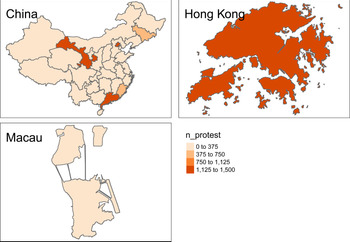
The dependent variable is the protest count data acquired from the GDELT 2.0 Events Database. Because the GDELT Data is geocoded, it is possible to reverse geocode the data and identify the provinces in which protest has taken place. I then calculate the yearly aggregate of protests for each province. Figure 3 plots the distribution of all protest events captured by GDELT 2.0 across China in the study period.
Aggregated Number of Protests between 2000–2018 across China, Hong Kong, and Macau

Due to data limitations, I can only control for the total trade volume disaggregated at the provincial level. The Chinese statistical authority does not break down trade in services by region, so I continue using trade in goods data only.
As in the Hong Kong–Macau study, I fitted a multi-level ZINB model with year and country intercepts. Hong Kong and Macau are excluded from this study, since this is a validation task. One could think of this extension as using Chinese provincial data to test the out-of-sample validity of my findings. If the same pattern holds, then my theory should be able to travel beyond Hong Kong and Macau.
Figure 4 shows the predicted mean counts of protest as a function of economic dependence to the center. It shows the predicted mean number of protests for the three groups: those with maximal amount of shared income, mean amount, and minimal amount of shared income. Like the Hong Kong–Macau study, a large part of the posterior distribution of the coefficient for the interaction between UEI and economic dependence remains in the negative, however its 95 percent Bayesian Critical Interval crosses 0 (-.57, .22). Thus one should take the results of the plot with a grain of salt. While the group means are not that different as they cluster around 0 protests a year, the range of possibilities varies by group. One can observe that at low levels of UEI institutionalization, the high-dependence group is the one most likely to protest. However, as UEI increases, the group order switches place—now the low-dependence group is most likely to protest as my theory suggests.
Predicting the Mean Number of Protests in Chinese Provinces

In this study, UEI has a somewhat consistent negative effect. Recall that this coefficient denotes the conditional effect of UEI on the mean number of protest when there is absolutely no economic dependence. The 95 percent Bayesian Critical Interval for UEI is at (-1.31, .03), with a mean point estimate at -.57. This suggests that for every additional 100 million yuan added to the demeaned subsidies amount, the mean number of protest in that particular province should reduce by around .43 per year. Therefore, when a region is economically independent from the center, it takes approximately 232.558 million yuan of subsidies to reduce the mean number of protest by 1. A plot of the predicted effects is available in the appendix.
Albeit less accurate, this validation exercise suggests that my theory might travel to the rest of China as well. The estimated coefficients in the China model follow the same trajectory of that estimated in the Hong Kong/Macau model.
DISCUSSION
In this article, I have attempted to explain why UEIs might reduce social unrest in some regions but not in others. I argue that the key is to look at how dependent the regional economy is on the national economy. If the region becomes highly dependent on the national economy, then the regional population will be much less likely to express dissent in the autonomy agreement between the national center and the region in question. In the Hong Kong–Macau study, I found this to be true for both regional dissent on the 1C2S and the number of protests. In the extension to China, the same pattern holds, albeit the uncertainty of the estimation is much higher.
The article has made three main contributions to the literature. First, I showed that economic integration can be used for authoritarian control. It is a tool devised to impose extra costs on contention much like the use of social co-optation strategies like social welfare (Xu Reference Xu2020). If economic integration with the rest of the world creates centrifugal forces from the center (Alesina, Spolaore, and Wacziarg Reference Alesina, Spolaore and Wacziarg2000; Alesina and Spolaore Reference Alesina and Spolaore1997, Reference Alesina and Spolaore2003; Coufalova Reference Coufalova2019), then the authoritarian state could also produce centripetal forces towards the center with UEIs. If the authoritarian state could pay off a degree of UEI that produces more centripetal forces than the centrifugal forces from international economic integration, then they would be able to appease restive regions.
Second, and most importantly, the article has provided an initial explanation why economic integration might sometimes appease regional unrest and sometimes not. I showed that economic dependence is the key driving force for the effectiveness of UEIs in peripheral regions. The crux of the problem in implementing UEIs is that the regions have different baselines in terms of their economic relationship with the authoritarian center. If UEIs serve to increase the expected cost of contention, then the next question to ask is how large that expected cost was to begin with. If the starting point is low, then the authoritarian state needs to institutionalize UEI a lot more to induce the region to pay attention to the economic costs of contention. The starting point of this expected cost is going to be higher for regions like Macau, whose economy is geared towards Chinese tourism and the gaming industry (Liu et al. Reference Liu, Chang, Loi and Chan2015; Lo Reference Lo, Yu and Chan2014; Yee Reference Yee2001). Compared to regions like Hong Kong, whose economy is more outward looking and independent from the national economy, their initial expected cost is going to be much lower. With empirical evidence, I showed that the central government needs to pay roughly 232 million yuan of subsidies a year to a region with absolutely no prior economic dependence if the authoritarian state wishes to reduce the mean number of protests by at least one. This cost can run extremely high if the authoritarian state wishes to suppress dissent entirely in regions like Hong Kong, in which the year 2019 saw nearly 900 protest events during the anti-extradition bill movement. In many ways, this alludes to the commercial peace theory in International Relations, which suggests that trade asymmetry is a common reason for interstate conflict (Barbieri Reference Barbieri1996; Gartzke and Westerwinter Reference Gartzke and Westerwinter2016). We also see that, given low dependence, localists in Hong Kong opposed new UEIs, as they avoid entering into an obsolescing bargain as they had in 2015, and they outbid other moderate oppositions in the 2016 legislative elections.
Third, I showed that it takes time for UEI to have an effect. In the Hong Kong/Macau model we see that the effects of UEI institutionalization is more obvious for UEIs that have been implemented for a longer time (e.g. FDI and Trade Steering as part of CEPA). For more recent UEIs, such as Stock Market Integration, the effect is more subtle. Since UEIs ultimately alter the expected cost of contention, it is likely that the effect of UEIs is compounded. Therefore, the longer the UEI is in place, the stronger its appeasement effect. Note that in the China model we see that UEI alone has a consistent negative effect. Since fiscal decentralization has been in place in China for a much longer time than the CEPA in Hong Kong/ Macau, this could speak to how UEIs would have developed a consistent reductive effect over time.
That being said, this article is only the first step towards explaining the effectiveness of UEIs in authoritarian contexts. It certainly has its share of weaknesses that can be addressed in future work. First, we will need more regional data to refit the China model. One likely reason that estimation uncertainty is higher for that model is the quality of the data available. It is likely that authoritarian statistics are prone to falsification. This is a particularly endemic problem in China, as the bureaucracy awards economic performance via promotion to middle tiers of office (Shih, Adolph, and Liu Reference Shih, Adolph and Liu2012). Another source of measurement error in the China model is the lack of disaggregation in the many indicators used. Recall that the dependence measure is operationalized as the total shared income, but we have only a rough estimate of how large the shared income segment is. With more quality data on economic dependence and UEIs, we should be able to see a clearer effect than that reported here. More data on income inequality in Chinese provinces could also help us control for the role of inequality in explaining the number of protests.
Second, we need to unravel the causal story further. In this article I have shown the causal mechanism of UEIs at the regional level, but at the individual level, UEIs could be used to turn supporters into winners and the opposition into losers in the economic realm. As the classical long views of democratization focus so much on the role of inequality (Acemoglu and Robinson Reference Acemoglu and Robinson2006; Boix Reference Boix2003), one might believe that by gaming the rent (re-)distribution to the extreme, the authoritarian state would be able to hold together the income inequality that impedes the democratization of the state (Magaloni Reference Magaloni2006). In this sense, the concept of UEI is no different: it aims to create winners and losers from economic integration. More economic engagement with the national center might bring business opportunities that turn those business-owners into regime supporters. For those who have no stake in the Chinese economy, like younger people or workers employed by a Hong Kong-based business, UEIs may mean the loss of whatever economic autonomy the region might have. This thus pits the regional population against one another, increasing the severity of the collective action problem at the regional level. Perhaps this is why when mass protests erupted in Hong Kong in 2014 and 2019, they did not spread en masse up North as the regional populations up north failed to mitigate the collective action problem.
Third, the article has offered very few insights into what might happen when UEIs do not work. Considering the sheer number of UEIs required to appease an economically independent region, the authoritarian state might simply want to switch to more repressive strategies. For example, Xu (Reference Xu2020) shows that the Chinese state has now switched to targeted persecution powered by mass surveillance from co-opting counties with social welfare. Information throttling and flooding of irrelevant information has also served to distract political discussion online in China (Roberts Reference Roberts2018). The 2020 National Security Law imposed on Hong Kong is a strong indication that the Chinese state has grown frustrated with the ineffectiveness of social co-optation strategies like the UEIs. As a result, Beijing decided to adopt a full-blown iron fist approach. Future research should assess where the breaking point is, that is, at what point the authoritarian state switches from UEIs to other repressive strategies to manage social unrest in the periphery.
CONCLUSION
The authoritarian state can use UEIs to manage social unrest in the periphery, but the effectiveness of this strategy hinges upon the degree of economic dependence of those regions. UEIs add to the expected cost of contention, and thus one must also incorporate the baseline expected cost at the regional level. UEIs may not be helpful when the region has no prior economic relationship to the authoritarian center and the peripheral population is thus indifferent to the added costs of contention. The effectiveness of UEI is path dependent: More dependent regions are open to accepting more UEIs, whereas less dependent regions may oppose UEIs, as they do not want to enter into an obsolescing bargain, or because UEIs induce ethnic outbidding within the region. In the comparison of Hong Kong and Macau, China gave the same degree of UEIs to both regions. Macau was less restive after exposure to UEIs because they had a very high initial level of economic dependence to China, thus UEIs increased the expected cost of contention in Macau substantially. In Hong Kong, the low initial levels of economic dependence undermined the effectiveness of UEIs since the increase in the expected cost of contention created by UEIs was offset by international trade.
It remains interesting to see how well the findings travel beyond the Greater China region. I have showed empirical evidence that my findings not only apply in Hong Kong and Macau, but possibly to all provinces of China. Moreover, this article introduces a broad story of economic dependence that could apply broadly to free trade agreements within and between countries. The article could very well speak to the ongoing research agenda on the leverage of Free Trade Agreements (FTAs) in International Relations. In the case of China's increasing global influence, one could think of how the Belt & Road Initiative (BRI) builds economic dependence in the destination country, and thus making it more difficult for the citizens there to express discontent with China's increasing influence in the world (Rabena Reference Rabena2018; Ferdinand Reference Ferdinand2016). China's participation in the newly signed Regional Comprehensive Economic Partnership (RCEP) agreement may further constrain opposition to China in the international arena following the argument of economic dependence.
ACKNOWLEDGMENTS
The author is indebted to the valuable feedback from Kang Yi, Graeme Robertson, the Editor and the two anonymous reviewers. The author also thanks the participants of the University of North Carolina at Chapel Hill's Comparative Politics Working Group in 2019 for providing their comments on an earlier draft of this article.
CONFLICTS OF INTEREST
The author declares none.
SUPPLEMENTARY MATERIAL
The supplementary material for this article can be found at https://doi.org/10.1017/jea.2021.23.