Introduction
Delirium is a common and serious problem among older adults in acute- and long-term care settings. Most prior research on delirium has been conducted in acute-care settings, where the presence of prevalent and/or incident delirium predicts increased morbidity and mortality, independent of age, physical illness, and other risk factors for these outcomes (Inouye et al., Reference Inouye, Rushing, Foreman, Palmer and Pompei1998; McCusker et al., Reference McCusker, Cole, Dendukuri, Belzile and Primeau2001). In one large cohort of nursing home patients, delirium predicted mortality and hospitalization (Dosa et al., Reference Dosa, Intrator, McNicoll, Cang and Teno2007).
Clinically, a diagnosis of delirium is made using multiple sources of information: patient observations; informants, including clinical staff and family members; and review of the medical chart. In an acute-care setting, a consensus diagnosis involving several independent observers or a diagnosis by a trained rater using multiple points of observation were more sensitive than a rating by a single clinician (Zou et al., Reference Zou, Cole, Primeau, McCusker, Bellavance and Laplante1998). When validated against a research diagnosis of delirium, interviews with acute-care nurses generally have low sensitivity but high specificity (Inouye et al., Reference Inouye, Foreman, Mion, Katz and Cooney2001) while a chart-based method of abstracting delirium symptoms had higher sensitivity but lower specificity (Inouye et al., Reference Inouye, Leo-Summers, Zhang, Bogardus, Leslie and Agostini2005).
Long-term care (LTC) residents are generally older and have a higher prevalence of dementia than those in acute care; both these factors are linked to under-recognition of delirium by nurses (Inouye et al., Reference Inouye, Foreman, Mion, Katz and Cooney2001). Offsetting these potential barriers to detection are the greater medical stability of LTC residents, and the longer periods over which nursing staff have the opportunity to observe mental status changes that may indicate delirium.
In this study, we explored the use of non-standardized, clinical observations of symptoms of delirium by nursing staff to diagnose delirium. The specific aims were: (1) to describe the effect of using nurse-observed symptoms on the overall prevalence of delirium symptoms and diagnoses in LTC facilities, and (2) to compare the predictive validity of delirium diagnoses based on research-observed symptoms alone with those based on research- and nurse-observed symptoms.
Methods
This study was a secondary analysis of data collected for a prospective, observational study conducted at seven LTC facilities in the province of Quebec, Canada. Recruitment procedures have been described (McCusker et al., Reference McCusker2010). Trained research assistants (RAs) consecutively recruited residents aged 65 years and over, admitted for LTC, from resident lists. Competence to consent to the study was based on the clinical impression of the primary nurse. The RA invited competent residents to participate in the study. A letter describing the study was sent to the legal guardian (if designated) or the responsible family member of incompetent residents. The legal guardian/family member informed the nurse if they were willing to meet the RA. The study protocol was approved by the research ethics boards of McGill University and those sites with a research ethics committee.
RAs conducted initial and weekly follow-up assessments for up to 6 months. The primary nurse was interviewed as soon as possible after every monthly assessment. The residents' charts were reviewed at the end of the study by a clinical researcher who was blind to the RAs' data.
Measures of delirium
We used the first monthly follow-up assessment point as the baseline (T0) for measuring delirium symptoms, for two reasons: (1) acute onset could be coded in comparison with previous nursing notes (see below), and (2) as the baseline levels of the outcomes were measured one month prior to the baseline for delirium symptoms, they were less likely to by affected by the presence of delirium. We used three data sources to identify symptoms of delirium: research assessments, nurse interviews, and nursing chart notes. We used the Confusion Assessment Method (CAM) criteria to identify delirium symptoms and to make diagnoses of delirium (Inouye et al., Reference Inouye, VanDyck, Alessi, Balkin, Siegal and Horwitz1990). The CAM (DSM-III-R criteria) is a widely used, validated diagnostic measure for delirium (Wei et al., Reference Wei, Fearing, Sternberg and Inouye2008) which is appropriate for use in nursing homes (Voyer et al., Reference Voyer, Richard, Doucet and Carmichael2009). CAM criteria for definite delirium require: (1) acute onset, (2) fluctuation, (3) inattention, and (4) either disorganized thinking or altered consciousness. CAM criteria for probable delirium require either acute onset or fluctuation, plus the other symptoms.
We used a similar reference period for all data sources: 90% of nurse interviews were conducted on the same day or the day after the RA interviews, 6% between 2–7 days after the RA, and 4% were conducted up to 7 days before the RA interview. Nursing notes were abstracted for the week before the RA interview.
Research assessments
Research assessments of delirium symptoms were made by RAs at weekly visits. The RA reviewed the resident's chart for the previous week to assess acute onset and sleep-wake disturbance. Residents were assessed for delirium symptoms (inattention, thought disorder, disorientation, impaired memory, altered consciousness, hypo- or hyperactivity, perceptual disturbance, fluctuation) using the CAM (Inouye et al., Reference Inouye, VanDyck, Alessi, Balkin, Siegal and Horwitz1990). These ratings were based, at a minimum, on administration of Mini-mental State Examination (MMSE) questions 1–5 (assessing orientation and memory). Presence of a symptom was defined as a score of mild or greater for all symptoms except attention, for which a rating of moderate or greater was required (the criterion for mild inattention was at least one error in spelling “world” backwards, which was very common in this population). The RAs were supervised by the study psychiatrist (MC) who conducted periodic inter-rater reliability sessions. Kappa values for individual symptoms that contributed to a delirium diagnosis (n = 29) were: fluctuation 0.30; inattention 0.57, disorganized thinking 0.87, altered level of consciousness 0.52. These values are comparable to those reported in another study of delirium symptoms (Albert et al., Reference Albert1992).
Nurse interviews
A questionnaire on delirium symptoms using the CAM (Inouye et al., Reference Inouye, VanDyck, Alessi, Balkin, Siegal and Horwitz1990) was completed by the primary nurse at baseline and at monthly intervals. The nurse was blind to the RAs' observations.
Nursing notes
At the end of the study, a trained research clinician abstracted data from nursing notes for the entire follow-up period, blind to the RA or nurse assessments. The following delirium symptoms (or their synonyms) were identified: inattention (e.g. easily distracted, questions or instructions need to be repeated, loss of concentration); altered level of consciousness (e.g. sleepy, startles easily, lethargic, semi-comatose, unaware of surroundings); and disorganized thinking (e.g. incoherent, behaviors difficult to understand, unable to express self clearly, unable to follow simple instructions, rambling). Acute onset was defined as new onset of one or more of these latter three symptoms since the previous week; acute onset was not coded for the first study week, as previous nursing notes were not available.
Outcome measures
The outcomes that were measured over the six-month follow-up (five months from the baseline delirium assessment) were: death, and change in cognitive and physical function from the initial (pre-baseline) level to the last follow-up assessment. Cognitive function was assessed by the RA using the Hierarchic Dementia Scale (HDS) (Cole and Dastoor, Reference Cole and Dastoor1987), a scale that can be used among individuals with mild or severe cognitive impairment (Boller et al., Reference Boller, Verny, Hugonot-Diener and Saxton2002), has been validated in LTC residents (Rönnberg and Ericsson, Reference Rönnberg and Ericsson1994), and is sensitive to change over time (Bickel, Reference Bickel1996). HDS scores range from 0 to 200, and were grouped into four severity categories: severe (0–39), moderate (40–99), mild (100–159), and none/minimal (160+). We measured physical function with the Barthel Index (BI) (Mahoney and Barthel, Reference Mahoney and Barthel1965), using an expanded scoring method (Shah et al., Reference Shah, Vanclay and Cooper1989). Scores were categorized as severe (0–19), moderate (20–59), and mild to no disability (60–100).
Covariates
We extracted information on sociodemographic variables and medical problems from medical charts. Duration of residence at the facility was grouped into three categories: short (less than 2 months), intermediate (2–12 months), and long (more than 12 months), and whether the resident had been admitted from hospital, other LTC facility, or home. Medical problems were extracted from medical charts for the period between admission and the baseline interview. These data were used to compute the Charlson Comorbidity Index (CCI) (Charlson et al., Reference Charlson, Pompei, Ales and MacKenzie1987; Field et al., Reference Field2001), validated as a predictive index for survival in two elderly nursing home cohorts (Bravo et al., Reference Bravo, Dubois, Hébert, De Wals and Messier2002; Buntinx et al., Reference Buntinx, Niclaes, Suetens, Jans, Mertens and Van Den Akker2002). CCI scores were categorized as low (0–1), medium (2–3), and high (4–15).
Statistical methods
Prevalence rates for delirium symptoms and diagnoses were calculated at baseline for each data source separately and for the three sources combined. We computed improvement ratios (ratios of delirium prevalence using all sources to prevalence using only the RA assessment) and their 95% confidence intervals (Bonett and Price, Reference Bonett and Price2006). We used multiple logistic regression (Hosmer and Lemeshow, Reference Hosmer and Lemeshow1989) to study the relationship between delirium detection by research observations only versus research and nurse observations for four outcomes: death, HDS decline of 10 or more points from baseline to six months; Barthel decline of 10 or more points from baseline to the last completed nurse follow-up interview; and a composite outcome measure defined as one or more of these three outcomes. Odds ratio and 95% confidence intervals from univariate and multivariate models were converted to relative risks (RR) (Zhang and Yu, Reference Zhang and Yu1998). All calculations were performed using SAS version 9.2.
Results
Of 928 eligible residents screened for the study, 278 (30.0%) had legal guardians/family members who could not be contacted, and consent to participate was obtained for 283/650 (40.5%) of the remainder. Of these, 235 (83.0%) completed both the initial and one month assessments, 11 died, 8 withdrew, and 29 were not assessed because research staff were not available. In the study cohort of 235 residents at six-month follow-up, 196 (83.4%) completed the HDS, 209 (88.9%) completed the Barthel Index(190 at 6 months, 11 at 4–5 months, 8 at 2–3 months), and 17 (7.2%) died.
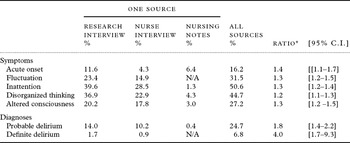
Table 1 shows the frequency of delirium symptoms and diagnoses by source. Note that the “all sources” column combines symptoms from all sources. Thus the prevalence of delirium from all sources may be greater than the prevalence of delirium from each source separately. For example, if an RA observed inattention and altered consciousness and the nurse observed fluctuations, a diagnosis of delirium could be made by combining the symptoms, although neither the RA or nurse alone could make a diagnosis of delirium. Although the use of all sources produced modest increases in the prevalence of each symptom (ratios of 1.2 to 1.4), the increases in delirium diagnoses, particularly definite delirium, were more substantial. Acute onset was identified more frequently from nursing notes than nurse interviews, while the reverse was true for the other symptoms.
Prevalence of delirium symptoms, probable and definite delirium, by 3 data sources, alone and in combination (n = 235)

*Prevalence from all sources/prevalence from research interview.
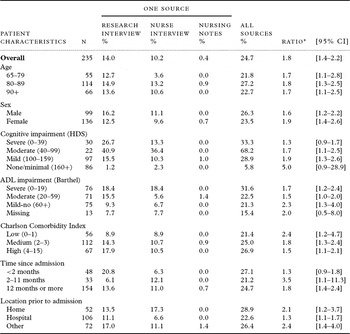
Table 2 shows the prevalence of probable delirium using each source separately and all sources combined, by characteristics of the sample at enrolment. The ratio of all source delirium vs RA delirium was 1.8 (95% CI 1.4 to 2.2). Proportionately, the largest increases in prevalence from research-observed symptoms only to research- and nurse-observed symptoms were seen for residents with minimal cognitive impairment, low levels of comorbidity, admitted from a location other than acute care hospital, and 2–11 months from admission.
Prevalence of probable delirium based on symptoms observed by three sources alone and in combination, by patient characteristics at enrolment

*Prevalence from all sources/prevalence from research interview.
HDS = Hierarchic Dementia Scale.
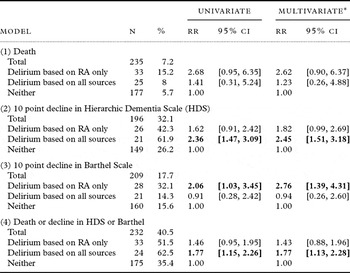
Table 3 shows the outcomes for three groups of residents: those with delirium diagnosed from research-observed symptoms only, additional cases of delirium diagnosed from research- and nurse-observed symptoms, and no delirium diagnosis. Death was predicted better from the research-observed symptoms only, although the confidence intervals included unity. HDS decline was strongly predicted by research- and nurse-observed symptoms; for research-observed symptoms alone the confidence interval included unity. A decline in Barthel score was predicted strongly using research-observed symptoms alone; the addition of the other sources did not improve the prediction of the BI. The addition of nurse-observed symptoms improved the prediction of the composite outcome (death or decline in HDS or BI).
Outcomes by sources of data on delirium symptoms

*Adjusted for: age, sex, prior location, time since admission, comorbidity, and baseline score of the outcome(s).
RA = Research Assistant.
Discussion
In a multi-site cohort of LTC residents aged 65 years and over, we found a substantial increase in the prevalence of delirium when nurse-observed symptoms (interviews and chart notes) were combined with symptoms observed by research staff alone. Furthermore, a diagnosis based on both sources appears to have good predictive validity for poor outcomes, particularly cognitive decline, during the subsequent five months.
We based the diagnosis of delirium in this study on the CAM, perhaps the most widely-used instrument for assessing delirium and one that is suited to administration by trained, non-psychiatric staff (Wei et al., Reference Wei, Fearing, Sternberg and Inouye2008). The CAM criteria were developed and validated in acute-care settings but have not been validated in nursing homes or other LTC settings. The results of this study provide evidence for the predictive validity of CAM criteria for probable delirium in LTC, for death, cognitive decline, and functional decline. A composite outcome that included death, cognitive and functional decline appeared to be best predicted by probable delirium based on symptoms detected by research and nurse observations. Definite delirium was diagnosed in a much smaller proportion of the sample (1.7% using research observations and 6.8% using all sources). Further validation of the CAM criteria for LTC should be conducted, using a psychiatrist/geriatrician diagnosis as the gold standard.
In evaluating the contribution of nurse interviews versus nursing notes, the former clearly contributed the most delirium symptoms not detected in the research assessments. Unlike previous research in acute-care settings, where detection of symptoms by nurses has low sensitivity but high specificity (Inouye et al., Reference Inouye, Foreman, Mion, Katz and Cooney2001), nurse interviews yielded many symptoms of delirium not detected by research staff. Nursing notes, however, contributed few additional symptoms, except for acute onset, defined as new notes on one of the symptoms of interest (inattention, altered level of consciousness, or disorganized thinking) in comparison with the previous week. Nursing notes in LTC facilities may be less useful for detecting delirium than in acute care settings (Inouye et al., Reference Inouye, Leo-Summers, Zhang, Bogardus, Leslie and Agostini2005). The use of standardized checklists for delirium symptoms may improve the value of this data source.
There are several limitations of this study. We used only three data sources for delirium symptoms: research staff, nurse interviews, and nursing notes. We did not interview family members, companions or physicians because these individuals were not available for most residents and documentation of delirium symptoms by physician was rare. The sample was underpowered to detect some clinically significant effects. Although nurse interviews were conducted by the same research assistant who assessed the resident, the interviews were standardized and all except 4% were conducted after the research assessments. Finally, we did not attempt to distinguish between symptoms of delirium and dementia in this study.
Overall, the results of the study indicate that CAM criteria for probable delirium have good predictive validity in LTC when based on symptoms observed by both research and nursing personnel. These results should be validated in other LTC settings. Further exploration is needed of the optimal use of LTC nursing notes to identify delirium symptoms and, possibly, of incorporating family member/companion observations when available.
Conflict of interest
None.
Description of authors' roles
Jane McCusker designed the study, obtained funding, supervised data collection and analysis, and prepared the initial and final drafts of the paper. Martin Cole contributed to the study design, helped obtain funding, helped with supervising data collection and analysis, provided feedback on the paper, and approved the final draft. Philippe Voyer contributed to the study design, helped obtain funding, helped with recruitment of the participating facilities, helped with supervising data collection, provided feedback on the paper, and approved the final draft. Johanne Monette contributed to the study design, helped obtain funding, helped with recruitment of the participating facilities, provided feedback on the paper, and approved the final draft. Nathalie Champoux contributed to the study design, helped obtain funding, helped with supervising data collection, provided feedback on the paper, and approved the final draft. Antonio Ciampi contributed to the study design, helped obtain funding, was responsible for the statistical analysis, provided feedback on the paper, and approved the final draft. Minh Vu contributed to the study design, helped with data collection and coding, provided feedback on the paper, and approved the final draft. Eric Belzile supervised the data management, conducted the statistical analysis, provided feedback on the paper, and approved the final draft.
Acknowledgment
This work was supported by the Canadian Institutes of Health Research (IAO69519), Canadian Institute of Aging & Institute of Gender and Health (CRG-82953), the Alzheimer Society of Canada and the Canadian Nurses Foundation (07-91).