One of the most important principles in a democracy is that those in power are accountable to the people. If the people disapprove of the government policy, they must be able to remove from office those who are held accountable. In other words, the political system should provide an opportunity for there to be an alternation in power. If the voters are satisfied with the government, they are likely to support the government in the next elections. If this is the case, the government has still been held accountable even though no transfer of power has taken place. Thus, accountability and chance for alternation may be regarded as highly desirable from the citizens' point of view. As Manin, Przeworski and Stokes point out, ‘we need electoral institutions that enhance clarity of responsibility and make it easy for citizens to reward or punish those responsible’. Certainly, they argue that elections are not an adequate instrument of control over decision-makers, but that does not make accountability through elections less important.Footnote 1 While acknowledging that responsiveness is not the sole democratic virtue, Powell nevertheless maintains that ‘elections should lead to the selection of policymakers in a way that clearly follows from the citizens' votes’.Footnote 2
The aim of this article is twofold. First, patterns of alternation in government in connection with parliamentary elections are analysed. How often does alternation take place, and how much alternation in terms of turnover of governmental parties based on seat share in the legislature does occur in different types of democracies? Alternation is closely related to the concept of accountability. Indeed, from the citizens' point of view, what really matters is accountability rather than alternation in government. Therefore, the accountability mechanism (that is, the connection between aggregate election results for governmental parties and the occurrence of subsequent alternation) in established parliamentary democracies is also examined. This latter purpose takes precedence over the former. It should be observed that we are dealing with indirect accountability since in parliamentary democracy the executive is responsible to the legislature.
An article written by Kaiser, Lehnert, Miller and Sieberer, published in Political Studies in 2002, constitutes the theoretical frame of reference.Footnote 3 The article, entitled ‘The Democratic Quality of Institutional Regimes: A Conceptual Framework’, deals with inclusiveness and responsibility in three different types of democracies: pluralitarian, majoritarian and consensus democracies. The authors of that article assert that there is a trade-off between the input variables of inclusiveness and responsibility, and that majoritarian democracies provide for an optimal combination of the two. They conclude that ‘majoritarian democracies have the highest democratic quality’.Footnote 4 This work deals with the responsibility dimension that the author team conceptualizes as the chance of alternation. Kaiser et al. argue that these three democracy types offer varying opportunities for alternation. In this respect, this current study constitutes an empirical test of Kaiser et al.'s theoretical reasoning on the chance of alternation in pluralitarian, majoritarian and consensus democracies. The results may confirm, disconfirm or modify their theoretical argument. Since alternation and accountability are interrelated, the latter may easily be included in the design. In fact, to a greater extent than Kaiser et al., this article emphasizes the importance of accountability (output) compared with the chance of alternation (input).
CONCEPTUAL FRAMEWORK: ACCOUNTABILITY AND ALTERNATION
Accountability and alternation concern citizen influence on those who govern. The term ‘accountability’ is used in different ways. Accountability may be a process of control on the one hand, or a type of outcome on the other. This article uses the ‘control’ definition of accountability: ‘An agent is accountable to a principal if the principal can exercise control over the agent and delegation is not accountable if the principal is unable to exercise control.’Footnote 5 Bergman, Müller, Strom and Blomgren define the accountability mechanism as ‘…any device by which a principal (a) can get information about an agent's intentions, skills, and behaviour or (b) can sanction or reward the agent’.Footnote 6 Consequently, with regard to elections and the composition of government, voters should be able to: first, distinguish who is responsible for the governmental actions; and, second, bring about alternation or express renewed confidence in the incumbent government. Bergman et al. refer to democratic governance as a system of delegation and accountability. For them, the chain of delegation and accountability consists of four stages: (1) from voters to parliamentarians; (2) from parliamentarians to prime minister and cabinet; (3) within the cabinet, from chief executive to individual ministers; and finally (4) from individual cabinet ministers to civil servants.Footnote 7 This work is concerned with the first two stages. Delegation of powers from citizens to elected representatives constitutes the nucleus of representative democracy. Alternation in power is, in turn, regarded as a key to executive accountability.Footnote 8
There are two basic kinds of voting perspective: the accountability model and the mandate view. According to the accountability model, also known as the retrospective voting perspective, voters hold those who govern responsible for their achievements during the last election term. If voters are satisfied with the government's actions, they can reward the incumbent parties; if they are dissatisfied, they can punish the government by voting for the opposition. The second model, also called prospective voting, asserts that voters make their voting decisions on the basis of campaigns and electoral pledges rather than past government performance.Footnote 9 Powell maintains that both views are valuable in helping citizens to influence the political process.Footnote 10 Retrospective control may limit the abuse of political power, whereas prospective voting may motivate politicians to take actions that citizens wish to be taken. The present article is more relevant to the retrospective voting model than to the prospective view. Still, regardless of which model applies, political systems should offer a chance of alternation when the electorate clearly wishes it. In this regard, the study also bears relevance to the prospective voting perspective. I largely agree with Downs, who considers voting as a combination of both models; voters use information about the performance of the incumbent government and, if available, of the opposition for the purpose of choosing the best possible government in the future.Footnote 11 Even though the voters use their votes prospectively, they are well-advised to rely on retrospective information. If uncertainty about policy outcomes prevails, voters should rely to a great extent on information about past performance.
Mair proposes that there are three basic patterns of alternation: wholesale, partial and non-alternation.Footnote 12 Wholesale alternation implies that all government members are replaced by a former opposition – the British case is the most obvious example. Wholesale alternation may also occur in fragmented party systems. In Norway, for example, shifts between a single-party labour government and a multiparty bourgeois coalition have been somewhat common. Yet, according to Mair, fragmented systems are more often associated with partial alternation, which means that at least one incumbent party continues in the new government. Germany and the Netherlands are mentioned as two cases in point. Non-alternation implies that the same party or parties remain in control of government over a lengthy period, and this is likely to occur in predominant party systems, as in Japan from 1955 to 1993 and India from 1952 to 1977. I shall return to the Mair typology in the analytical framework.
Kaiser et al. evaluate democratic quality on the basis of two dimensions: inclusiveness (the percentage of the total vote that brought the acting government into office) and responsibility (the chance of alternation). They argue that the broader the inclusiveness, the smaller the extent of responsibility and alternation in power; when responsibility is shared by everyone, accountability and alternation is impossible. A low level of inclusiveness, by contrast, produces alternation too easily. The critical question is: how many voters must vote differently compared to the last elections in order to bring about alternation in executive power? A minimal criterion of alternation is, according to the authors, that a leading party is replaced by another.
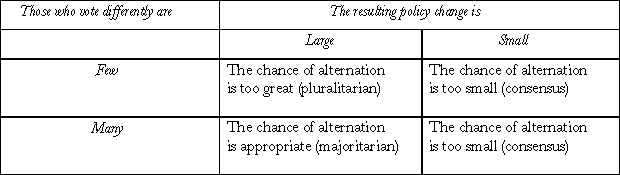
From this follows a categorization of democracies into three basic types: pluralitarian, majoritarian and consensus democracies. Kaiser et al. argue that Lijphart's distinction between majoritarian and consensus systems – the crucial difference being whether a majority of preferences or practically all preferences are taken into account when decisions are made – is insufficient when responsibility is added to the picture.Footnote 13 Kaiser et al.'s conception of majoritarian democracy is derived from Nagel's notion of real majoritarianism, requiring majority support by contrast with the first-past-the-post electoral system, which creates majority governments by means of the plurality rule.Footnote 14 In Figure 1 Kaiser et al.'s theoretical reasoning is illustrated along two dimensions: how many people vote differently and the extent of policy change after elections.
Four Theoretical Scenarios of Alternation

Source: Translated from the original figure in Dag Anckar, ‘Ansvarsinnehav och ansvarsbyte’, in Åsa Bengtsson and Kimmo Grönlund (eds), Partier och ansvar, Stockholm, SNS Förlag, 2004, pp. 25–44, at p. 29.
The cells to the right in Figure 1 represent a situation where the political system does not provide for effective alternation in power. Irrespective of whether those who vote differently are few or many, the resulting policy change is small. Such systems in which responsibility is shared by ‘everyone’ are called consensus democracies. Since they aim at broad coalitions representing as many preferences as possible, they offer very little potential for governmental change. By contrast, when relatively small changes in votes result in large policy changes, the chance of alternation is too high. Political systems with a low level of inclusiveness and a high chance of alternation are called pluralitarian democracies. An ideal form of polity, called a majoritarian democracy, is attained when both the level of inclusiveness and the chance of alternation are of medium size. Kaiser et al. put forward the idea that majoritarian democracies, which most often use proportional electoral systems, ‘…reflect modern society more realistically by allowing a more diverse spectrum of political interests to enter the legislative arena’.Footnote 15 The tendency towards minimal-winning coalitions in majoritarian democracies, they continue, is aimed at producing political stability but at the same time maintaining flexibility and being adaptive to new situations and problems. In contrast to consensus democracies, in which a real opposition does not exist, majoritarian democracies provide for efficient opposition parties that may challenge the government and bring about alternation in executive power.
ANALYTICAL FRAMEWORK
In the following, the concepts of accountability and alternation in government as well as democracy types are operationalized. The entire model of independent and dependent variables is also elaborated. It should be observed that the causal association consists of more variables than are empirically examined here. The causal chain of variables is: electoral system–party system–clarity of responsibility–accountability–alternation.
Electoral Systems and Party Systems
Kaiser et al. propose that two institutional factors are particularly relevant to the chance of alternation: the electoral system and the party system.Footnote 16 The degree of disproportionality of the electoral system and the number of relevant parties are decisive in this respect. However, the strong association between electoral systems and party systems is not fully recognized. Two-party systems are largely a consequence of plurality electoral systems, whereas proportional elections usually create fragmented party systems. Party system fragmentation is hence a consequence of the disproportionality of electoral systems. I nevertheless prefer to use party system rather than electoral system as a point of departure, because the degree of party system fragmentation varies within electoral system categories. In a similar manner, Kaiser et al.'s concept of different democracy types is based on party system structure. They regard Sartori's distinction between the three main types – two-party systems, moderate pluralism and polarized pluralism – as best suited to illustrate the influence of the party system on the opportunity for alternation.Footnote 17 The main characteristic of a two-party system is centripetal competition between two major parties competing for a majority of the parliamentary seats. A system of moderate pluralism consists of three to five relevant parties. It is characterized by the government of alternative coalitions, which to some degree decreases the chance of alternation. The term ‘polarized pluralism’ is used for systems with more than five ideologically polarized parties. Since these systems usually consist of the bilateral opposition of highly ideological parties and anti-system parties, the number of potential governing parties becomes smaller. As a consequence, in Kaiser et al.'s theoretical model, the likelihood of alternation is minimal.Footnote 18
Party system structure determines the type of democracy. Two-party systems represent pluralitarian democracy, moderate pluralism constitutes majoritarian systems, and polarized pluralism is akin to consensus democracy. Kaiser et al. do not use conventional indicators of the effective number of parties by arguing that it is the logic of competition and not the mere number of parties that is crucial. However, the operationalization of the logic of competition is marred by some difficulties. Sartori argues that a party becomes relevant in two circumstances: when it gets parliamentary representation and when it has either coalition or blackmail potential.Footnote 19 For one thing, a small party that gains representation for the first time is definitely not as relevant as an established party. Established parties also differ from each other; some are more relevant than others. Second, a party may have blackmail potential in one election but be irrelevant in this respect in another election.
After all, Kaiser et al. point out that the chance of alternation decreases as the number of relevant parties increases and as the party system becomes more and more polarized. Sartori also claims that the number of parties matters. The crucial task is to identify the relevant parties and thus relate the question ‘how many?’ to ‘how strong?’. A continuous measure facilitates a macro-comparative empirical analysis of accountability and alternation, and therefore the effective number of parliamentary parties – an index constructed by Laakso and Taagepera – is applied as a measure of party system structure.Footnote 20 A specific value may certainly represent different constellations, but in most cases the index provides a rather good picture of the party system structure. A large party contributes a good deal to a single value, whereas a small party only marginally affects the index. The cut-off points are decided in the next section, dealing with the research population.
Clarity of Responsibility and Accountability
The critical condition for the retrospective view is clarity of responsibility.Footnote 21 According to this model, limited knowledge is required of the voters. They do not have to worry about the credibility of proposals and promises; they only need to know who is responsible for the policies in recent times. Clarity of responsibility is regarded as an intermediate link between party system and accountability. Plurality electoral systems tend to create two-party systems, which in turn are associated with a clear pattern of responsibility. Proportional systems, on the other hand, produce multiparty systems, which often lead to an ill-defined pattern of responsibility.Footnote 22 Clarity of responsibility prevails when a single party with a majority of the legislative seats governs alone, whereas minority and coalition governments are associated with an unclear pattern of responsibility. Coalition governments and to a lesser extent minority governments, which are dependent on one or several opposition parties, obscure accountability and make it difficult for the electorate to assign blame.Footnote 23
In a study of majoritarian and proportional systems, Powell finds that five of a total of six majoritarian countries constitute the top five with regard to clarity of responsibility. Four countries with predominantly proportional designs are in the bottom five.Footnote 24 Powell and Whitten have demonstrated that countries with an unclear pattern of responsibility are characterized by a lower degree of accountability than countries with a clear pattern of responsibility.Footnote 25 Bengtsson has also shown that patterns of responsibility matter in relation to whether voters hold the government accountable or not.Footnote 26 Narud and Valen hypothesize that coalition governments do better in elections than single-party governments, because responsibility is clearer in the latter. The proposition does not receive any support.Footnote 27 However, they fail to recognize that clarity of responsibility also makes it easier for the voters to award the incumbents if they are satisfied with their achievements.
Alternation
Two different operationalizations of alternation are used: categorical and continuous. Categorical alternation is when patterns of alternation in different types of democracies are detected. Alternation is treated as a continuous phenomenon when accountability is in focus. Since electoral results are measured on a continuous scale, it is reasonable to treat alternation in a similar way. Patterns of alternation are analysed using the Mair typology. Wholesale alternation implies that the new government consists of parties that were in opposition before the elections, whereas non-alternation means that the previous government continues in office. Hence partial alternation is an intermediate situation. However, if a minor party is exchanged for another minor party and the other coalition parties continue in government, we can hardly consider it to be partial alternation. Likewise, if a small party stays in a government position, while the rest of the government is renewed, we are in effect witnessing wholesale rather than partial alternation. Accordingly, we need some criteria for separating partial alternation from wholesale and non-alternation. I set the limit so that more than 20 per cent and less than 80 per cent of the legislative seats have to change status from government to opposition or vice versa in order to qualify as partial alternation.
For example, before the Icelandic elections in 1983 the government consisted of the Progressive Party, the Independence Party and People's Alliance. The first two continued in office after the elections while the People's Alliance, which received 16.7 per cent of the total seat share, went into opposition. I consider this as a non-alternation scenario. Prior to the Italian elections in 1987 the Christian Democrats governed alone. After the elections they formed a coalition with four smaller parties that together had won 23 per cent of the legislative seats. I regard this as partial alternation. The 20 per cent cut-off also applies at the other end. After the general elections in Iceland in 1978 the Progressive Party continued in office, the Independence Party resigned and the Social Democratic Party and the People's Alliance entered the government. I regard this as partial rather than wholesale alternation, because the Progressive Party received 20 per cent of the seats in the legislature.
However, we need one more criterion, because the size of the government varies to a great extent. In cases where a small party enters the government or continues in office we must compare the size of the party to the other coalition parties. For example, prior to the general elections in 1979, Sweden had a single-party minority government. After the elections the ruling Liberal People's Party formed a coalition with the Moderate Party and the Centre Party. The Liberal People's Party won only 10.9 per cent of parliamentary seats but in the government coalition its share of the legislative seats was 21.7 per cent. Again, I shall use 20 per cent as a dividing line at either end. Admittedly, the cut-off points are somewhat arbitrary, but the main point is not to establish a definitive cut-off but to discern patterns of alternation in different systems. Moreover, the classification into wholesale, partial and non-alternation is not applied when accountability is analysed. Nonetheless, in the empirical analysis, alternative cut-offs are taken into account.
Strom has constructed an alternation index on a continuous scale from 0 to 1.00.Footnote 28 This accounts for the aggregate proportion of parliamentary seats held by parties changing status between government and opposition during the change of government. The index is clarified with a hypothetical example of three parties in a given legislature. Party A gets 40 per cent, party B 35 per cent, and party C 25 per cent of the seats in general elections. Party B rules alone in government I. Government II is formed after the elections. Party A becomes the ruling party, which means that A and B have changed status, and the alternation score as a result of the elections is 0.40 + 0.35 = 0.75. If party C had entered the new government together with party A, all parties would have changed status and the alternation score would have been 1.00. The Strom index is applied in the statistical analysis.
Hypothetical Reasoning
The assumption is as follows: the larger the decrease in electoral support for governing parties, the higher the degree of alternation. The strength of this relationship determines how responsive the system is – that is, a strong correlation implies a high degree of accountability. The degree of accountability is expected to vary between different types of democracies. To assume a continuous relationship between governmental parties' electoral success and the index of alternation may appear controversial. I emphasize that every minor aggregate electoral loss for the government is not, in practice, assumed to result in some degree of alternation. Rather, the crucial point is that a clear disapproval of the incumbent government and increased support for opposition parties should lead to alternation in executive power. Large aggregate losses of the incumbent government are assumed to correlate with high values on the index of alternation, whereas electoral gains of governmental parties are assumed to correlate with low alternation scores. Therefore, a continuous as well as a categorical operationalization of alternation is applied.
Kaiser et al. argue that the chance of alternation is too high in pluralitarian democracies. Consequently, taking into account the fact that governmental parties lose more often than they win, we should expect a high degree of wholesale alternation. Also, since a victory for the incumbent government in a two-party system does not result in alternation, we might assume that the degree of accountability is high. In consensus democracies, by contrast, the extent of alternation should be small. Kaiser et al. maintain that the strongest centre party may change its partners now and then but complete alternation is impossible within the limits of a democratic system. Similarly, no strong association between election results for governments and alternation should be found. In majoritarian systems many people need to vote differently in order to bring about a real policy change. Accordingly, wholesale alternation should be the result of larger shifts in votes. Smaller changes in votes should at the most lead to a change of coalition partners. Alternation rates are expected to be higher than in consensus but lower than in pluralitarian democracies. In addition, one might expect that all three kinds of alternation are rather well represented. Since majoritarian systems, according to Kaiser et al., are the most responsive, the degree of accountability should be higher than in the other systems.
Both absolute and relative changes in vote shares are initially observed. However, when governmental parties' aggregate election results are related to alternation scores, it is more reasonable to observe relative changes in vote shares rather than nominal changes, because majority governments have more votes to lose than minority governments. Minority governments certainly have more votes to win as well – however, parties in government tend to lose more often than they win. Empirical findings on the average loss for incumbent governments vary. Some studies report values between 1 and 2 per cent, whereas others report greater losses – Strom, for instance, found an average loss of 3.15 per cent.Footnote 29
Admittedly, government formation is also influenced by institutional features that cannot be taken into consideration within the framework of the study. There may, for instance, be constitutional clauses regarding decision rules in the legislature and government formation, particularly concerning which party should get the prime ministerial portfolio. Investiture and recognition rules, as well as the constructive vote of no confidence, may also affect coalition bargaining.Footnote 30 However, from the citizens' point of view, such constraints should not prevent citizens from holding policymakers responsible for their actions.
THE DATASET
Since this study is concerned with political participation and effects with regard to government composition, it is natural to focus on cases in which there is an evident theoretical link between party systems, election results, accountability and alternation in government. In presidential systems executive power is vested in just one person. The president certainly appoints a government but the ministers should primarily be seen as the president's advisers. Thus, if the voters disapprove of government policy, they can easily identify who should be held accountable. Therefore, within the framework of the present study, presidential regimes are not of interest. In parliamentary systems, by contrast, legislative elections are the only means by which the people can directly express whether the government has their confidence or not.
There are also intermediate political regimes, usually called semi-presidential systems, in which executive power is shared between a president and a prime minister. In these countries the demand for transfer of power manifested in parliamentary elections only concerns one of the two leaders of the executive – the prime minister (and his government). To be sure, accountability and opportunities of alternation in government are also desirable in semi-presidential countries, but since the president has considerable power he may influence the government formation and therefore semi-presidential countries are also excluded.
The empirical analysis is based on elections in established parliamentary democracies, including countries that became democratic at the beginning of the third wave of democratization. First, however, we need to distinguish between semi-presidential and parliamentary regimes. I shall rely on Sartori's concept of semi-presidentialism as described in the highly acclaimed volume Comparative Constitutional Engineering:Footnote 31
-
The president is elected by popular vote, either directly or indirectly.
-
The head of state shares the executive power with a prime minister. The defining criteria of the dual structure are:
-
The president is independent from the legislature but is not entitled to govern alone or directly.
-
The prime minister and his cabinet are independent from the president but they need the support of a parliamentary majority.
-
The dual authority structure allows for different balances and shifting balance of power within the executive.
In the same work Sartori discusses some cases that Duverger classifies as semi-presidential.Footnote 32 There is unanimity about France: the French Fifth Republic is regarded as a prototype of semi-presidentialism. Although Austria, Iceland and Ireland have popularly elected presidents, the political practice is parliamentary and their respective presidents act as figureheads. Therefore, Sartori moves them to the parliamentary category. Regarding Finland (before 2000), he points out that the president effectively chooses the prime minister and influences the coalitional composition of governments. Finland deviates from a typical semi-presidential system only in one respect: the indirect election of its president. I consider Finland before the 2000 constitution as semi-presidential.Footnote 33 Lastly, the semi-presidential era in Portugal, Sartori says, lasted from 1976 to 1982.Footnote 34 The 1982 constitution abolished the presidential power to dismiss cabinets and ministers and all his legislative powers. In practice, as of 1982, the role of the president has been ceremonial.Footnote 35 Portuguese elections are included as of 1985. The dataset consists of 309 parliamentary elections during the postwar era in the following 19 established democracies: Australia, Austria, Belgium, Canada, Denmark, (West) Germany, Greece, Iceland, Ireland, Italy, Japan, Luxembourg, the Netherlands, New Zealand, Norway, Portugal, Spain, Sweden and the United Kingdom. Countries that have undergone a democratization process during this period are included from their second democratic elections.Footnote 36
The data show that Sartori's cut-off between moderate and polarized pluralism is rather inappropriate in an empirical sense. Merely 9 per cent of the elections in established parliamentary democracies have resulted in party systems with a higher index than 5. Therefore, the value of 4.5 on the index of party system fragmentation is chosen as the cut-off between moderate and polarized pluralism. The value of 2.5 constitutes the borderline between two-party systems and moderate pluralism. The degree of fragmentation is measured after the elections that brought the incumbent government to power. Two-party systems have been produced by 107 elections, 164 elections have created moderate pluralism and 38 elections have resulted in polarized pluralism. It might seem inconsistent to refer to different democratic systems, because alternation scores and patterns of alternation are related to party system fragmentation irrespective of which country (and system) a particular case belongs to. However, if the chance of alternation and accountability are dependent on the party system, an analysis of party system fragmentation and indicators of responsiveness in order to establish the association between them is justified. In the empirical analysis country fixed effects are controlled for.
EMPIRICAL ANALYSIS
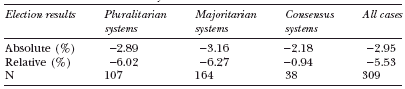
To begin with, the aggregate electoral gain/loss for governmental parties in pluralitarian, majoritarian and consensus democracies is presented. The results in Table 1 show that governmental parties on average tend to lose more votes than they win. The average nominal loss for governments in the research population is nearly 3 per cent, which is in line with previous findings. Governments in consensus democracies perform better than governments in less fragmented party systems, the average loss being slightly larger than 2 per cent in absolute terms. Governments in majoritarian systems perform somewhat worse than governments in two-party systems. Surprisingly, the relative electoral loss in consensus systems is smaller than the nominal loss. However, this is due to one election only, namely the 1975 elections in Denmark, in which the ruling Venstre increased its vote share from 12.3 to 23.3 per cent; hence the relative electoral gain for the incumbent government was 89 per cent. Nonetheless, if this election is excluded from the analysis, cabinets in consensus systems still perform better than those in pluralitarian and majoritarian ones.
Election Results for Governments in Pluralitarian, Majoritarian and Consensus Systems: Mean Values

Sources: Chronicle of Parliamentary Elections, different editions, Geneva, Inter-Parliamentary Union; Hans Keman and Peter Mair (eds), European Journal of Political Research. Special Issue: Political Data Yearbook, 36: 3–4 (1999); Hans Keman and Peter Mair (eds), European Journal of Political Research. Special Issue: Political Data Yearbook, 38: 3–4 (2000); Thomas T. Mackie and Richard Rose, The International Almanac of Electoral History, London, Macmillan, 1991; Inter-Parliamentary Union, Parline Database, available at http://www.ipu.org/parline-e/parlinesearch.asp; Wolfram Nordsiek, ‘Parties and Elections in Europe’, available at http://www.parties-andelections.de/; Jaap Woldendorp, Hans Keman and Ian Budge, Party Government in 48 Democracies (1945–1998), Dordrecht, Kluwer Academic, 2000.Footnote 37
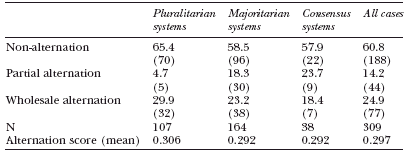
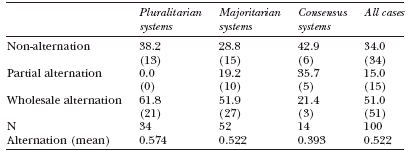
In Table 2 patterns of alternation are given. Roughly 60 per cent of all elections have not brought about alternation in government, and wholesale alternation occurs more frequently than partial alternation. Wholesale alternation is most common in pluralitarian systems – yet it has occurred in only 30 per cent of the cases. Contrary to the theoretical premise, non-alternation is also most common in pluralitarian systems. Since two major parties compete for governmental power, partial alternation rarely happens. Surprisingly, majoritarian and consensus systems have rather similar alternation profiles. Partial alternation is a bit more common in consensus systems than in majoritarian systems at the expense of foremost wholesale alternation.
Patterns of Alternation in Pluralitarian, Majoritarian and Consensus Systems: Cross-Tabulation, Pearson Chi-Square

Sources: As for Table 1.
Note: Cross-tabulation: chi-square value 13.629, significance at the p < .01 level. Cells show percentage of alternation type. N in parenthesis.
That being said, there is still a consistent pattern that puts majoritarian systems between the other two. The extent of non-alternation as well as wholesale alternation decreases as we move from two-party systems to moderate and further onto polarized pluralism. The share of partial alternation, by contrast, increases as the level of party system fragmentation increases. Accordingly, the alternation profile of majoritarian systems is closest to the mean of the total research population. The association between democracy type and patterns of alternation is significant at the 0.01 level. Interestingly enough, the mean alternation index is practically the same in all categories. According to Kaiser et al.'s theoretical premise, two-party systems should be characterized by a high degree of alternation, whereas the extent of alternation in polarized party systems should be modest. The analysis shows that alternation is definitely not rare in consensus democracies, even though the change of government is more often partial than complete.
What if some other cut-off points had been used? A change of cut-offs from 20 to 15 per cent at either end does not change the outcome much. It results in four more cases of partial alternation, three of which are majoritarian. The significance value is 0.013 and the overall tendencies remain the same. Pluralitarian democracies are not affected by the change of cut-offs. If we consider 30 per cent as the dividing line at both ends, eight cases switch from partial to non-alternation; five are majoritarian cases and three represent consensus systems. Again, pluralitarian systems are not affected and the overall tendencies are similar. The main difference between majoritarian and consensus democracies is that the former is characterized by more wholesale and less non-alternation than the latter. The model is significant at the 0.001 level. In other words, different cut-offs provide roughly the same results.
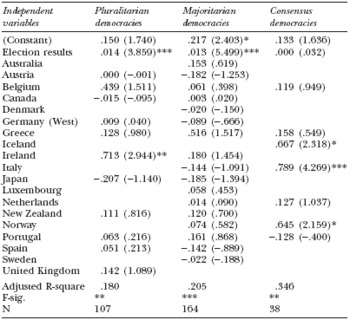
Next, election results for governments are related to alternation scores in order to evaluate the degree of accountability in different kinds of democracies. The scale of the alternation index is reversed. As we see in Table 3, there is a strong association in both pluralitarian and majoritarian systems, whereas the connection in consensus systems is much weaker. Again, however, the exceptional Danish parliamentary elections in 1975 largely affect the results. Not only did the incumbent one-party minority government almost double its vote share but a change of government took place as well. If this highly deviant case is excluded from the analysis, the correlation coefficient for consensus systems rises from 0.227 to 0.383, close to that of two-party systems, and becomes statistically significant. However, the regression analysis in Table 4 tells a different story. When country fixed effects are controlled for, accountability in consensus systems fails to reach any level of significance. Election results for governments have no effect whatsoever on alternation. In pluralitarian and majoritarian systems, by contrast, the impact of election results on alternation is significant at the 0.001 level.
Accountability in Pluralitarian, Majoritarian and Consensus Systems: Correlation Analysis, Pearson's r

Sources: As for Table 1.
Note: ***= significance at the .001 level.
Accountability (Effect of Governments' Election Results on Alternation) in Pluralitarian, Majoritarian and Consensus Democracies: OLS Regression

Sources: As for Table 1.
Notes: The regression coefficient and the T-value (in brackets) are reported. *= sig. < 0.05, **= sig. < 0.01, ***= sig. < 0.001. Pluralitarian democracies: Australia is excluded;Footnote 38 majoritarian democracies: Iceland is excluded; consensus democracies: Denmark is excluded. The VIF-test shows that no multicollinearity is present.
In the following, two samples are analysed: one consists of major losses and other is where the government has increased its vote share relative to the previous elections. In cases where the government has been narrowly defeated, it is difficult to decide whether the voters have moved a vote of no confidence. We must bear in mind that the government formation is influenced by other things as well. Moreover, the main government option may also have lost some voter support. Obviously, there is no natural cut-off point between a major and a minor electoral defeat. I shall in any case regard an aggregated loss of at least 10 per cent of the vote share as a major defeat. Again, relative differences are preferred to absolute differences.
If accountability works, a large part of the elections in the group of major losses should result in partial or wholesale alternation. The share of non-, partial and wholesale alternation as well as the mean alternation score is given in Table 5. About half of all cases have resulted in wholesale alternation, whereas one-third of the elections have put the incumbent government back in office. As in the total research sample, the largest share of wholesale alternation is found in pluralitarian systems. However, when partial alternation is taken into account, majoritarian democracy stands out as the most responsive system. Accordingly, the smallest share of deviant cases is observed in this category. The relationship between democracy type and patterns of alternation is significant at the 0.01 level. The mean level of alternation is considerably lower in consensus systems than in the other categories.
Patterns of Alternation in Pluralitarian, Majoritarian and Consensus Systems, Cases of Major Governmental Defeat: Cross-Tabulation, Pearson Chi-Square

Sources: As for Table 1.
Notes: Cross-tabulation: chi-square value 13.816, significance at the p < .01 level. Cells show percentage of alternation type. N in parenthesis.
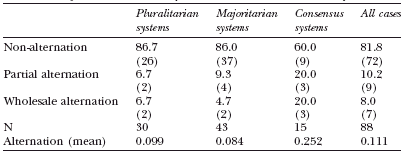
In the sample of governmental victory we should find a great deal of non-alternation and little wholesale alternation. Table 6 shows that both pluralitarian and majoritarian systems are responsive, whereas consensus systems are characterized by a considerable share of partial as well as wholesale alternation. The mean alternation score is also higher in consensus systems than in the other categories. Yet, the differences between groups are not statistically significant. Nonetheless, these two samples further prove that the level of responsiveness is rather high in pluralitarian and majoritarian democracy as opposed to consensus democracy.
Patterns of Alternation in Pluralitarian, Majoritarian and Consensus Systems, Cases of Governmental Victory: Cross-Tabulation, Pearson Chi-Square

Sources: As for Table 1.
Note:-Cross-tabulation: chi-square value 6.25. Cells show percentage of alternation type. N in parenthesis.
CONCLUSION
This article has examined one of the core values in a democracy: the potential for citizens to bring about alternation in executive power where there is discontent with the incumbent government. Democratic systems differ from each other; some offer better chances of accountability than others. Kaiser et al.'s theoretical premise of patterns of responsibility in three basic types of democracy – pluralitarian, majoritarian and consensus systems – has been used as a frame of reference. Party system structure (two-party system, modest pluralism or polarized pluralism) determines the type of democracy. It should be recalled that Kaiser et al.'s theory of the democratic quality of institutional regimes is concerned with more than has been examined in this article. The analysis has dealt with issues of responsibility, namely accountability and alternation, the former being considered more important than the latter with regard to citizen influence. In this regard, their theoretical argument on responsiveness in different kinds of democracies has been empirically tested.
Kaiser et al. maintain that the theory of responsibility (and inclusiveness) does not necessarily correspond very well to empirical cases. Nevertheless, in order to hold any validity, some similarities between theoretical assumptions and the empirical world must exist. The statement that pluralitarian systems are marked by too much alternation is not supported by the analysis. Neither is it true that there is a lack of alternation in consensus systems, although there certainly is less of it than in the other types of democracy. Contrary to the theoretical argument, pluralitarian systems perform almost as well as majoritarian ones on the accountability dimension. Hence, in this respect, Kaiser et al.'s argument has been modified. Yet, some substantial differences between the three groups of democracies appear, most of which are in accordance with their theoretical reasoning. Pluralitarian democracy generates the highest share of both wholesale and non-alternation, whereas partial alternation is very rare in two-party systems. The smallest share of wholesale as well as non-alternation is observed in consensus systems; majoritarian democracy thereby takes an intermediate position. The average degree of alternation is basically the same in all categories. Yet, when alternation is related to election results, majoritarian democracy stands out as the most responsive. Accordingly, the empirical analysis confirms Kaiser et al.'s main argument. When country effects are controlled for, accountability still works well in pluralitarian and majoritarian systems, whereas consensus democracy performs very poorly. In order to shed more light on accountability and patterns of alternation, two smaller samples were analysed: one consisting of cases where the government has suffered major losses and another sample made up of elections where the government has been victorious. In accordance with the results above, pluralitarian and majoritarian systems are much more responsive than consensus systems.
Lijphart regards responsiveness as the core virtue of democracy, defining it as ‘government in accordance with the people's preferences’, and equates responsiveness with ‘inclusion of preferences’.Footnote 39 Kaiser et al. argue that inclusiveness does not automatically lead to responsiveness, and therefore they introduce ‘chance of alternation’ as another dimension, maintaining that there is a trade-off between inclusiveness and chance of alternation. However, from the citizens' perspective, what really matters is the output side, that is, the extent to which patterns of alternation correspond to the election results. Interestingly, in the conducted analysis the degree of accountability is highest among majoritarian systems, even though the mean alternation score for majoritarian democracy is slightly lower than the average of the total research population. This clearly illustrates that a high degree of alternation does not necessarily imply a higher degree of responsiveness.