INTRODUCTION
The issue of oceans and human health (OHH) requires a cross-cutting multidisciplinary team to analyse it effectively. Humans are playing an ever-increasing role in the marine ecosystem and their creation, the legal system, in its own way is intrinsic to marine biology, as the law potentially controls and defines human activity. Marine ecosystems are impacted by the maze of legal relationships we have created: shipping and insurance law have been one of the central conduits for the transoceanic passage of marine organisms; the laws of the sea dictate the shape of national and institutional controls over marine spaces; and marine property rights (or the absence of them) dictate human reactions to, and interactions with, the marine environment. It is then clear that the law relates to marine biology, but why is there a need to relate the biological-legal nexus to human health? OHH research takes a transverse slice across this relationship using a multidisciplinary team in a given parameter. An OHH analysis reveals the nature of the biological/legal/human relationship in a practical context, much in the same way that a core sample reveals the different depositional strata on the seabed. This permits the researcher to reflect upon the nature of this relationship and perhaps suggest solutions to problems, which in a more focused study might not have been revealed. Many of the issues raised in this paper came together at a conference on OHH in Bedruthan, Cornwall in March 2014, which led to the delegates agreeing the ‘message from Bedruthan’ (European Centre for Environment and Human Health, 2014). The delegates present shared the view that human health and well-being were intrinsically connected with the health of the oceans. The purpose of this paper is not to produce a systematic review of all the legislation which may affect human health and the marine environment, as this would require an assessment of water security (United Nations, online), environmental security (United Nations Environmental Programme, online) and health and safety regulation (Health and Safety Executive, online) to name but a few. Instead, the intent is to look at three case studies from different research areas and thus demonstrate how the OHH approach can lead to the generation of impactful research through the application of a multidisciplinary team including marine ecologists, lawyers and health researchers.
MATERIALS AND METHODS
Background
OHH research takes two subtly different forms on either side of the Atlantic. In the US, Congress set about defining its parameters in the 2005 Oceans and Human Health Act (online):
(A) vector- and water-borne diseases of humans and marine organisms, including marine mammals and fish;
(B) harmful algal blooms and hypoxia (through the Inter-Agency Task Force on Harmful Algal Blooms and Hypoxia);
(C) marine-derived pharmaceuticals;
(D) marine organisms as models for biomedical research and as indicators of marine environmental health;
(E) marine environmental microbiology;
(F) bioaccumulative and endocrine-disrupting chemical contaminants; and
(G) predictive models based on indicators of marine environmental health or public health threats.
With the exception of potential useful biomedical research the US OHH approach dealt firmly with threats to the human population arising from the oceans. An attempt to develop this agenda with an Oceans and Human Health Reauthorization Bill in 2011 unsuccessfully sought to extend the programme but did not expand its scope too far.
In Europe the European Marine Board (2013, p. 5) has set a wider interpretation on the research area:
(1) Innovative monitoring and surveillance techniques which allow much greater provision of relevant and accurate datasets (e.g. remote observation systems for coastal and marine ecosystems, detection of chemical/material pollutants, biogenic and microbial toxins and human pathogens, and improved testing for seafood and water safety).
(2) Improved understanding of the physical, chemical and biological processes involved in the transport and transmission of toxic chemicals and pathogenic organisms through the marine environment to humans.
(3) Improved understanding of the direct and indirect causal relationships between degradation of the marine environment and the incidence of human disease.
(4) Improved environmental models to determine the patterns and extent of natural dispersion of sewage, agricultural effluents and industrial waste.
(5) Expert systems to link existing models with our experience and knowledge of the connectivity between the marine environment and human health.
(6) Appropriate indicators in support of sustainable development where environmental, social and economic measures are linked.
(7) Methods and mechanisms which demonstrate the value (economic, cultural, aesthetic, etc.) to human well-being of marine environments from coastal seas to global oceans.
The European approach expands OHH research to include some important additional elements, both humans’ effects on the oceans, particularly where they negatively impact back on humans and potentially important human benefits from oceans such as well-being. The emphasis for European research proposals is on connectivity rather than straightforward cause and effect.
Research design
Legal research can take a number of forms, from a pure investigation of the law itself (known as doctrinal or expository research) to a more socio-legal approach which reflects on the law in its social context. Figure 1 sets out the various established routes of conducting legal research. All the research reviewed in this paper will be doctrinal research explaining the law in an applied context.
Legal research styles (Arthurs, Reference Arthurs1983).

In understanding OHH in a legal context three distinct (and contrasting) case studies have been used:
(1) Biomedical research
(2) Marine litter
(3) OHH and human well-being
The marine litter strand will expand on a simple explanation of the legal issues, the ‘black letter approach’ (Chynoweth, Reference Chynoweth2009) with aspects of action research. Action research (Figure 2) permits the researcher to take an active role in the research topic, in this case by lobbying a pharmaceutical company to make changes to its product design. This demonstrates that because of the multidisciplinary skills that underpin OHH research it can have real direct impact in the world beyond academia.
Relationship between participation action and research (Hughes, Reference Hughes, Reason and Bradbury2008, p. 385).
The three case studies have been chosen because they demonstrate the breadth of OHH research. Biomedical research shows the opportunities for human health; marine litter shows the vulnerability of the oceans to human agency and the potential threat of marine plastics to both humans and the marine environment; and human well-being takes a purely European approach exploring some of the less-appreciated health benefits of the marine environment.
Case study 1 – biomedical research
There is a professional discipline around the law of intellectual property and patent medicine. The pharmaceutical industry is a colossus comprising some of the world's largest companies. The potential for marine biomedical research is enormous. Research by the Global Oceans Commission (2013, p. 1) found:
‘Today, about 18,000 natural products have been reported from marine organisms relating to about 4800 named species. The number of natural products from marine species has been growing at 4% per year. The increase in the rate is largely due to technological advances in exploring the ocean and the genetic diversity it contains.’
These marine natural products have a greater tendency to lead to medical breakthroughs. Research by the US National Cancer Institute found that 1% of samples from marine animals tested in a laboratory had anti-tumour potential compared with 0.01% from terrestrial samples (Global Oceans Commission, 2013, p. 2). This is the foundation of an industry which now has a turnover of billions of dollars (Arnaud-Haond et al., Reference Arnaud-Haond, Arrieta and Duarte2011, p. 1521).
The broad principles which govern marine biomedical research are set out in the United Nations Convention on the Laws of the Sea (UNCLOS). Under Article 4, coastal states’ territorial waters extend to 12 nautical miles from their baseline (an approximation of the shoreline). As part of their territory, coastal states can regulate the practical development of patentable materials in any manner they see fit subject to international agreements. Outside the 12 mile limit to the edge of a coastal state's exclusive economic zone (EEZ), up to 200 nautical miles from the baseline the state has sovereignty; article 56(1) of UNCLOS gives coastal states: ‘sovereign rights for the purpose of exploring and exploiting, conserving and managing the natural resources, whether living or non-living’.
Within both territorial waters and the EEZ rights to conduct bioprospecting are controlled by the coastal state.
Where coastal states have a continental shelf which extends beyond the exclusive economic zone, under article 77 of UNCLOS they also have some sovereignty over natural resources but these only extend to ‘sedentary species’. Mossop (Reference Mossop2007) makes the point that:
‘The general rule is that states must have [the relevant] coastal state['s] consent to conduct marine scientific research in the[ir] exclusive economic zone and on the continental shelf. There is an expectation that coastal states will grant consent for marine scientific research conducted for peaceful purposes and to increase the scientific knowledge of the marine environment for the benefit of humanity. If the research is of significance for resource exploitation in the coastal state's jurisdiction, the coastal state may generally withhold consent for the project if it so wishes.’
Mossop (Reference Mossop2007), citing a number of sources, goes on to raise particular problems associated with the ‘vexed question’ of whether bioprospecting is a scientific or harvesting activity. This has implications in the way the activity is regulated, as coastal states have less power to control marine scientific research on their outer continental shelf under article 246(6) of UNCLOS, than they do to control other commercial activities, so coastal states tend to argue that bioprospecting is a commercial operation on the continental shelf. There are limited options for a state to challenge a refusal of consent for bioprospecting.
In the areas beyond national jurisdiction (the high seas and waters over the continental shelf) there are fewer limits on bioprospecting. Article 136 of UNCLOS established that this area is part of the common heritage of mankind, but did not go on to establish an explicit management regime (as it did with mineral extraction by the International Seabed Authority under article 137(3)). So whether there needs to be a licensing regime and some form of compensation paid via a representative body for the exploitation of this global common or whether mankind is benefiting enough from the discovery and application of new products remains a live issue (Global Oceans Commission, 2014, p. 16).
The lack of governance in areas beyond national jurisdiction raises obvious issues, but, even where there is a clear national regulator, Oldham et al. (Reference Oldham, Hall and Forero2012) argue that the current legal framework contains some major issues for the future of scientific development and appropriate human benefits. Under article 27 of the Agreement on Trade-Related Aspects of Intellectual Property Rights there is an established framework for the development of international monopoly rights for the commercial exploitation of invention which contain an ‘inventive step’ and which are capable of ‘industrial application’. The creation of long-term monopoly rights is seen by industry as being vital to justify the enormous cost of bringing drugs to market, but the patent system significantly affects the whole development of the market in biomedical products.
However, there are some real problems in the detail. One major difficulty is whether genetic sequences are patentable. Both the EU and US accept that gene sequences may be patented but there are differences in how these patents arise and are applicable (Odell-West, Reference Odell-West2011). Since the Supreme Court ruling in the case of Association for Medical Pathology v USPTO and Myriad and the Directors of the University of Utah Research Foundation (AMP) [2013] No. 12–398, US law has confirmed that genetic sequences per se are not patentable if they are performing the function they already performed in nature. This contrasts with EU law where the isolation of a gene sequence for a specific function is patentable, although only for that identified function (Monsanto Technology LLC v Cefetra BV (C-428/08) [2011] All E.R. (EC) 209). It is difficult to understate the importance of these cases. Inventions can attract patent protection but scientific discoveries, however important, do not, unless they attract patent protection through some form of legally established inventive step.
Oldham et al. (Reference Oldham, Hall and Forero2012) highlight six major issues with patenting:
• Distortion of the freedom, orientation and basic cost of scientific research;
• Prohibitive property rights or ‘patent thickets’ around some areas of research;
• Ethical problems relating to the morality of the patenting and creation of life;
• Protection of indigenous communities (both for their distinctive genes and use of traditional medicines);
• Fair access to the application of research for developing countries;
• Protection from biopiracy.
These are all issues, which to a greater or lesser extent, shape marine research. Oldham et al. (Reference Oldham, Hall and Forero2012) go on to point out that international law has made some attempt to redress this balance via The Nagoya Protocol on Access to Genetic Resources and the Fair and Equitable Sharing of Benefits Arising from their Utilization (the Nagoya Protocol). The Nagoya Protocol established three principles:
• prior informed consent from the relevant government (article 6);
• prior informed consent from relevant indigenous and local communities (article 7); and
• benefit-sharing agreement on mutually agreed terms (article 5).
Protocols like this are not necessarily legally binding, particularly when the agents involved may be corporations rather than nations, but the expense involved in marine and pharmaceutical research means that public funding is often part of the research process. Breaching this sort of international law means that public bodies (and private corporations) face considerable reputational risk if not direct legal challenge. The Nagoya protocol and the Convention on Biological Biodiversity with which it is associated favour a conciliatory approach in respect of any breaches as parties have to explicitly agree in their accession document to submission to arbitration or the International Court of Justice. At present the protocol has only 54 signatories, which exclude inter alia the US and the UK, but includes the European Union as a whole (Convention on Biological Diversity, 2015).
Oldham et al. conclude their analysis:
‘We have argued that what is required is greater attention to opening up biodiversity to research and development to serve human needs based on the principles of equitable benefit-sharing, respect for the objectives of the Convention on Biological Diversity, human rights and ethics.’
This is a justifiable conclusion as commercial biomedical research on its own will not meet all the opportunities which marine research can give human health.
Case study 2 – Marine Litter
The United Nations Environment Programme states that ‘marine litter poses a vast and growing threat to the marine and coastal environment’ (United Nations Environment Programme, 2005). If no action is taken litter will continue to accumulate and increase in the marine environment and on our beaches. Marine litter can harm and kill wildlife through entanglement and ingestion; beach litter can impact on human health and local economies and costs millions to clean up.
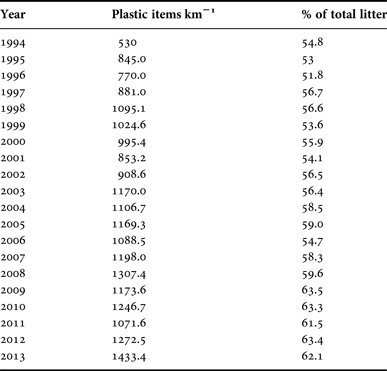
The Marine Conservation Society (MCS) has coordinated a UK-wide beach litter survey and clean up since 1994. Through these surveys they have recorded an increase in the amount of plastic litter on UK beaches and this trend is reflected in a number of other surveys throughout the world. Plastic items have always dominated the litter found during MCS Beachwatch surveys and consistently account for over 50% of all litter. The amount of plastic litter items km−1 in the same period has increased by over 120% (now ~2000 items km−1).
It should also be noted that most items of sewage-related debris (SRD) are now entirely or partially made of plastic including polystyrene. In 2013 these accounted for 4.3 and 9.5% of all litter respectively. Table 1 sets out that the percentage of beach litter caused by all plastics is over 70% (MCS, 2014).
Comparison of plastic items recorded during MCS Beachwatch Big Weekends 1994–2013. (Percentages and items km−1 are recorded to 1 decimal place).
Note: excludes polystyrene and sewage-related debris.
Whilst plastics can be extremely useful and are now a part of everyday life, the material attributes that have led to the extensive use of plastics in the packaging, consumer and fishing industries have unfortunately also made them one of the most pervasive, persistent and hazardous forms of litter in the marine environment.
Plastics are made of long chain hydrocarbons that few micro-organisms can break down. Plastics at sea break down at a much slower rate than plastics exposed to weathering on land (Packforsk, 1989) mainly because temperatures at sea will generally be lower, thus slowing the degradation process. The rate of breakdown can be further reduced by chemical or biological fouling (Andrady, Reference Andrady2000).
Estimates for plastic degradation at sea range from 450 to 1000 years. However, plastics may never fully degrade; they simply break down into smaller and smaller fragments and ultimately into microscopic plastic pieces or plastic dust.
Laist (Reference Laist, Coe and Rogers1997) stated that plastic has been reported to affect 267 species worldwide, including 86% of sea turtle species, 44% of all seabird species and 43% of all marine mammal species. Since this list was compiled further affected species have been reported, including killer whales, white-beaked dolphin and the northern bottlenose whale (Baird & Hooker, Reference Baird and Hooker2000).
The sub-lethal effects such as difficulties in feeding following litter ingestion, or increased energy needed for swimming following entanglement in litter, which can lead to a decreased ability to survive and/or reproduce, are difficult to estimate, but are probably more common than lethal effects (Ryan, Reference Ryan, Connell and Gardener1990; Pemberton et al., Reference Pemberton, Brothers and Kirkwood1992).
It is difficult to assess the true rate of entanglement or ingestion of litter by marine wildlife as many animals that die as a result of entanglement or ingestion may sink to the seafloor, or be consumed by predators before being found and only a minority of animals will be washed up on our shores. Therefore entanglement and ingestion records represent an unknown proportion of all those that occur and present a conservative estimate of the actual scale of the problem.
Microscopic plastics have also been found in plankton samples and show a significant increase in abundance from the 1960s to the present day (Thompson et al., Reference Thompson, Olsen, Mitchell, Davis, Rowland, John, McGonigle and Russell2004). Toxic compounds are incorporated into plastic pellets during production as plasticizers and other additives (Mato et al., Reference Mato, Isobe, Takada, Kanehiro, Ohtake and Kaminuma2001). Plastic particles and pellets in the marine environment can therefore carry two categories of organic micropollutants. Firstly, the additives and their degraded products such as nonylphenols (an endocrine disruptor), and secondly pollutants adsorbed from seawater such as polychlorinated biphenyls (PCBs) and dichlorodiphenyldichloroethylenes (DDEs) (Takada et al., Reference Takada, Mato, Endo, Yamashita and Zakaria2006). Pellets and particles can concentrate PCBs and DDEs from seawater to levels up to a million times greater than in the surrounding seawater, posing a potential hazard for birds and fish which mistake the pellets for food such as fish eggs (Ananthaswamy, Reference Ananthaswamy2001).
PCBs have also been linked to the masculinization of female polar bears and spontaneous abortions and declines in seal populations (Reijnders, Reference Reijnders1982; Wiig et al., Reference Wiig, Derocher, Cronin and Skaare1998). Ryan et al. (Reference Ryan, Connell and Gardener1990) obtained evidence that PCBs in the tissues of Great Shearwaters were derived from ingested plastic particles (from Derraik, Reference Derraik2002).
Toxins adsorbed onto plastic may be ingested by filter feeders (Thompson et al., Reference Thompson, Olsen, Mitchell, Davis, Rowland, John, McGonigle and Russell2004), and passed up the food chain to fish and ultimately to human consumers. The accumulation of microscopic plastic fibres in sand substrates may leach out toxins such as PCBs and heavy metals (Thompson & Hoare, Reference Thompson and Hoare1997). These can be absorbed by micro-algae and thus also potentially enter the food chain.
We know that plastics have been found inside a wide variety of marine organisms including invertebrates, fish, birds and mammals and that microplastics are now distributed throughout the oceans from the Arctic to the Antarctic. There is emerging evidence of transfer of chemicals from ingested plastics into tissues so whilst plastics bring us considerable benefits, our approach to their production, use and disposal are not sustainable and present serious concerns for wildlife and human health.
Article 194 of UNCLOS has some provisions relating to marine litter:
‘States shall take, individually or jointly as appropriate, all measures consistent with this Convention that are necessary to prevent, reduce and control pollution of the marine environment from any source, using for this purpose the best practicable means at their disposal and in accordance with their capabilities, and they shall endeavour to harmonize their policies in this connection.’
At the international level the International Maritime Association has overseen the Convention on the Prevention of Marine Pollution by Dumping of Wastes and Other Matter (the London Convention) and its subsequent protocol. However, this relates to pollution from ships, and while there are a maze of international treaties concerning water use between nations there is a real lack of specific regulations at the UN level relating to the responsibility for cleaning the oceans in the face of this vast unprecedented spread of marine plastic pollutants.
At the EU level the leading water pollution regulation is set out in the Water Framework Directive (2000/60/EU); its aim is described in article 1 and is inter alia:
‘achieving the objectives of relevant international agreements, including those which aim to prevent and eliminate pollution of the marine environment, by Community action under Article 16(3) to cease or phase out discharges, emissions and losses of priority hazardous substances, with the ultimate aim of achieving concentrations in the marine environment near background values for naturally occurring substances and close to zero for man-made synthetic substances.’
The Directive also has the broader aim:
‘at enhanced protection and improvement of the aquatic environment, inter alia, through specific measures for the progressive reduction of discharges, emissions and losses of priority substances and the cessation or phasing-out of discharges, emissions and losses of the priority hazardous substances.’
A key aim of the Directive is set out in article 4:
‘Member States shall protect, enhance and restore all bodies of surface water, subject to the application of subparagraph (iii) for artificial and heavily modified bodies of water, with the aim of achieving good surface water status at the latest 15 years after the date of entry into force of this Directive, in accordance with the provisions laid down in Annex V, subject to the application of extensions determined in accordance with paragraph 4 and to the application of paragraphs 5, 6 and 7 without prejudice to paragraph 8 …’
The definition of ‘surface waters’ in article 2 includes coastal waters out to one nautical mile.
As a key source of plastics Europe's rivers (a major supplier of marine plastic pollution) should be free of plastic pollution by this year, but a glance at the legislation shows a number of important exemptions. The effectiveness of the Directive is somewhat restricted to ‘priority substances’ and ‘priority hazardous substances’, so the impetus is to prove the harm of these substances before they can be added to an ever-growing list of priority substances annexed to the Directive (European Commission, 2015). However this approach can have the effect of creating ever more complicated substances rather than simply stopping the production of polluting products at source, and of course a chemical needs to be added to the list before it is banned, rather than actively applying the precautionary principle.
In its investigation into water pollution the UK House of Commons Science and Technology Committee (2013, p. 15) heard:
‘Witnesses agreed that reducing the release of micro-plastics at source would be the most effective way of preventing their accumulation in the marine environment. We heard that in many cases there were alternatives to their use, especially in cosmetics, or there was “no need for these items to be there in the first place”.’
This is an approach echoed in the literature (Gouda, Reference Gouda2014). A major issue here is that there is no regulation relating to the use of plastic in many products, so when manufacturers have switched from biodegradable to plastic materials there has been no legal disincentive. For many products the transition has been unremarkable but for some this transition has significant problems. A common pollutant found on UK beaches is the plastic stalk of a cotton bud (Williams et al., Reference Williams, Tudor and Randerson2003). Cotton buds are disposed by users via the lavatory and therefore the sewerage system. The design of the cotton bud means that they are not removed via the sewage screening process and they are a known problem around UK coasts, particularly in times of high flow through the system. There is clearly industrial awareness of the issue as Johnson & Johnson, a major manufacturer of cotton buds, has attached a logo on the packaging instructing users to ‘bag it in a bin, don't flush it.’ The Marine Conservation Society and leading marine academics wrote to Johnson & Johnson (Appleby, Reference Appleby2014) pointing out that the evidence showed that substantial amounts of cotton buds were still be disposed of by the sewerage system and the resultant plastic pollution was a product design as much as a consumer issue. This correspondence raised a novel approach that there could be some legal liability attached to Johnson & Johnson via the ancient common law remedy of public nuisance:
‘An act that endangers the life, health, property, morals or comfort of the public or obstructs the public in the exercise or enjoyment of rights common to all.’ (Practical Law Company, 2014)
The accretion of cotton bud stalks on the foreshore harms property which is largely owned and enjoyed by the public (The Crown Estate, 2015). Moreover such litter is unsightly and thus interferes with the use and enjoyment of the beach by the public, so it is conceivable that a nuisance action might be constructed, particularly as the manufactures are aware that there is a problem or they would not label their products with the ‘bag it don't bin it’ logo.
Whether a public nuisance action can in practice be sustained remains to be seen but it is clear that there has been a failure to alter the established public practice in this area and detailed legal intervention may be necessary to remedy the problem at source.
Case study 3 – Oceans and human health and well-being
A wealth of research has developed over the last few decades regarding the ‘salutogenic’ (health creating) effects of nature (Hartig et al., Reference Hartig, Mitchell, de Vries and Frumkin2014). Mechanisms proposed for these potential health benefits include providing opportunity and motivation for physical activity, recovery from stress, cognitive psychological restoration, and supporting social contact. Much of the research has considered ‘green space’ – primarily in urban areas – but more recently evidence has started to appear on the salutogenic effects of ‘blue space’ (environments with water as a significant component). Research carried out under a programme of work on coastal environments and human health at the European Centre for Environment and Human Health (http://www.ecehh.org) has indicated that there may well be psychological and physical health benefits of coastal environments in particular.
For example, a geographic study using data from the UK's 2001 Census found that in areas nearer the coast, populations tended to be more likely to report ‘good’ general health, after accounting for age, sex, indices of area socio-economic deprivation and green-space density (Wheeler et al., Reference Wheeler, White, Stahl-Timmins and Depledge2012). It also suggested that the association was strongest in the most socio-economically deprived areas. A subsequent study used individual-level data from the British Household Panel Survey. Following these individuals over time, an analysis was carried out to address the question: ‘Do people report better mental health when they live closer to the coast?’ After accounting for many individual and area characteristics, the analysis suggested that in those years that people lived close to the coast, compared with living further inland, they did report better mental health (White et al., Reference White, Alcock, Wheeler and Depledge2013).
The extent of physical activity of around 180,000 people from the Monitor of Engagement with the Natural Environment programme analysed by Natural England (2013) indicated that people living closer to the coast were more likely to report meeting government guidelines for physical activity, again after accounting for various other circumstances that could influence physical activity (such as socio-economic status) (White et al., Reference White, Wheeler, Herbert, Alcock and Depledge2014). More in-depth, qualitative research has further investigated the beach as a setting for family health promotion. This study highlighted the complex means by which time at the beach could provide an opportunity for healthy activities amongst children and their families, and was consistent with the physical, psychological and social mechanisms proposed to link health and nature (Ashbullby et al., Reference Ashbullby, Pahl, Webley and White2013).
Under section 1 of the National Health Service Act 2006 it is the duty of the Secretary of State for Health in England to continue the promotion in England of a comprehensive health service designed to secure improvement –
(a) in the physical and mental health of the people of England, and
(b) in the prevention, diagnosis and treatment of physical and mental illness.
This is an important definition because it means that English health care (and almost certainly health care in other parts of the UK) relates to the improvement of health generally rather than just the provision of some health care services. In the US, which has a rather more complicated approach to health care, section 4001 of the Compilation of Patient Protection and Affordable Care Act (Consolidated to 2010) provides for the creation of the National Prevention, Health Promotion and Public Health Council which inter alia:
‘provides coordination and leadership at the Federal level, and among all Federal departments and agencies, with respect to prevention, wellness and health promotion practices, the public health system, and integrative health care in the United States.’
It is clear therefore that there are government agencies on both sides of the Atlantic charged with assessing and implementing potential benefits which arise from using the blue space. However, while it may be a cheap and enjoyable method of promoting health (for example, by a walk on the beach) there are real issues in terms of the way government is structured. As in the USA the UK system is geared towards curative health through surgeon-led teams in hospitals and in general practice. It may be more sensible and cost effective to prescribe a walk on the beach rather than antidepressants, but it is not traditionally the preserve of the health care system to advocate access to the foreshore.
In the UK access to the foreshore is largely controlled via the Crown Estate (who own most of the foreshore and permit public access), local authorities and charities such as the National Trust. Access is governed by the laws of property, planning and more recently marine planning. Moreover planning laws, although often geared to the provision of public access, also seek to regulate spaces to protect the environment from too much human interference. To obtain real public health benefits there will be a requirement to involve not just traditional ‘health providers’ but also these other public bodies and civil society groups which do not traditionally view themselves as involved in health care. There are institutional hurdles from getting these differing public agencies with widely different approaches to coordinate their activities, and so there is a real need for academia to make the case for the provision of access to the blue space to overcome that inertia.
CONCLUSIONS
OHH research uses a cross-cutting, multidisciplinary approach in order to understand human interactions with the marine environment. The law is a good guide as to how that human relationship with the marine environment is managed. Not all law is adhered to, nor is it perfect, but it does reflect a model of human behaviour. A healthy life in a healthy ecosystem is a legitimate human aspiration, in the same way that America's Founding Fathers sought life, liberty and the pursuit of happiness. However, because of the organizational nature of humans as a species we have had to break down the parts of this ideal to make it attainable. The OHH strategy aims to assemble those parts back together again and analyse how successful we have been in achieving that aspiration. The case studies outlined above are an attempt to begin that process.
Biomedical research seems to have an established legal framework within which it takes place and a clear forward structure with the continued adoption of the Nagoya Protocol and sound principles on which such research takes place. However, this masks deeper problems associated with the creation of private monopoly rights and whether it is better to fund such research publicly and make its results open access or operate via the private sector and make later consumers pay for the fruits of the research. It is clear that commercial development in this area alone will not sustain commercial investment for all the necessary research, particularly in the light of Association for Medical Pathology v USPTO and Myriad and the Directors of the University of Utah Research Foundation (AMP) [2013] No. 12–398, as such research requires patentable outcomes to be commercially viable, and not all breakthroughs will be patentable.
The transition from naturally occurring biodegradable materials to the use of cheap but complex plastics has left a legacy of pollution in the world's seas and oceans. The health effects of these chemicals on human and marine life are not always known, although in some cases damage and toxicity are clear and it is abundantly clear that they have negatively impacted marine ecosystems. UNCLOS places clear duties on coastal states to manage this pollution and although the EU's Water Framework Directive is a useful piece of legislation, the fact that something as ubiquitous as a cotton bud persists as a significant plastic pollutant in the marine environment despite the regulation is very alarming. There is a sad irony that it is a sanitary product which has such an unsanitary effect on the environment, and it is a great pity that marine charities and academics are having to resort to direct confrontation in order to redress this obvious problem.
A legal analysis of the benefits of blue space shows the difficulty inherent in public medicine of achieving change outside of the control of the commissioning agency. Effective access to blue space needs input to planning policy, transport, labour legislation and laws relating to the ownership of the foreshore. It means that the communication of the scientific research needs to be beyond traditional academic biomedical journals and directly into the spaces where policy is formulated for those other sectors.
FINANCIAL SUPPORT
The International Water Security Network is funded by Lloyd's Register Foundation, a charitable foundation helping to protect life and property by supporting engineering-related education, public engagement and the application of research. For more information, see: www.lrfoundation.org.uk.
The European Centre for Environment and Human Health (ECEHH), part of the University of Exeter Medical School, is supported by the European Regional Development Fund and the European Social Fund Convergence Programme for Cornwall and the Isles of Scilly.