Many journalists and politicians believe that during the Bush administration, a majority of Americans supported torture if they were assured that it would prevent a terrorist attack. As Mark Danner wrote in the April Reference Danner2009 New York Review of Books, “Polls tend to show that a majority of Americans are willing to support torture only when they are assured that it will ‘thwart a terrorist attack.’” This view was repeated frequently in both left- and right-leaning articles and blogs, as well as in European papers (Sharrock Reference Sharrock2008; Judd Reference Judd2008; Koppelman Reference Koppelman2009; Liberation 2008). There was a consensus, in other words, that throughout the years of the Bush administration, public opinion surveys tended to show a pro-torture American majority.
But this view was a misperception. Using a new survey dataset on torture collected during the 2008 election, combined with a comprehensive archive of public opinion on torture, we show here that a majority of Americans were opposed to torture throughout the Bush presidency. This stance was true even when respondents were asked about an imminent terrorist attack, even when enhanced interrogation techniques were not called torture, and even when Americans were assured that torture would work to get crucial information. Opposition to torture remained stable and consistent during the entire Bush presidency. Even soldiers serving in Iraq opposed the use of torture in these conditions. As we show in the following, a public majority in favor of torture did not appear until, interestingly, six months into the Obama administration.
Why have so many politicians and journalists so badly misread the strong majorities opposed to torture? A recent survey we commissioned helps shine a light on this question. Psychologists describe a process of misperception—“false consensus”—whereby an individual mistakenly believes that his or her viewpoint represents the public majority. False consensus has a long legacy in social psychological research, but our survey is unique in that it examines, for the first time, how false consensus may have shaped the public debate over torture. Our survey shows that this false consensus pervades the opinions of those who support torture, leading them to significantly overestimate the proportion of the public that agrees with them. Those people opposed to torture, in contrast, have remarkably accurate perceptions of the rest of the public.
AMERICAN PUBLIC OPINION ON TORTURE
Much of the debate over torture in the past few years has implied, either implicitly or explicitly, that the American public supports torture. In some cases, these claims have included the proviso “if torture works.” In general, these commentaries have failed to include any references to the actual state of public opinion on this important issue. In response, we have assembled an archive of public opinion polls that queried the public about the use of torture between 2001 and 2009. We unearthed 32 polls administered by a variety of survey and media organizations. These polls represent the opinions of approximately 30,000 Americans over the past nine years. The archive includes a poll with items tailored to examine the reasons why perceptions about public opinion are so erroneous. We discuss the reasons for such misperceptions in the final section of this article.
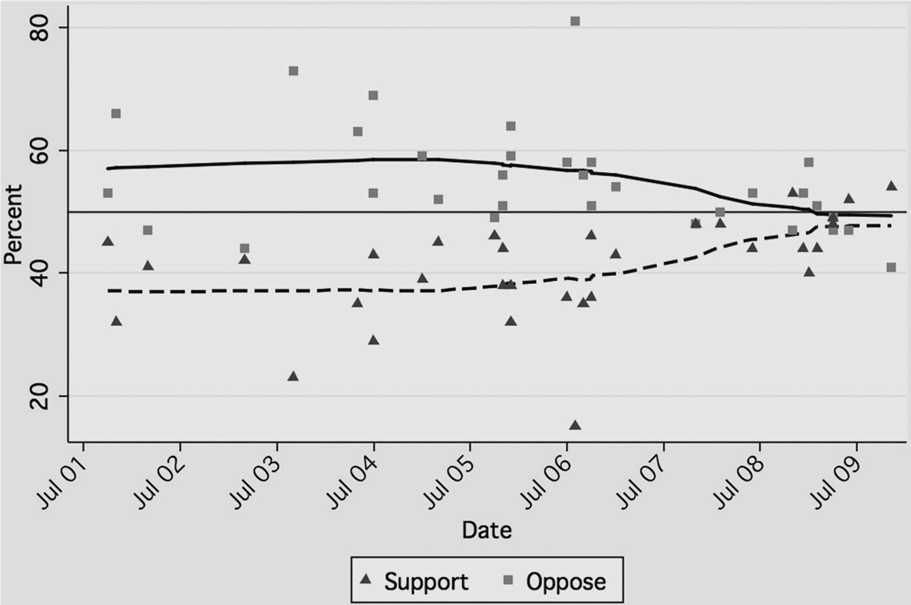
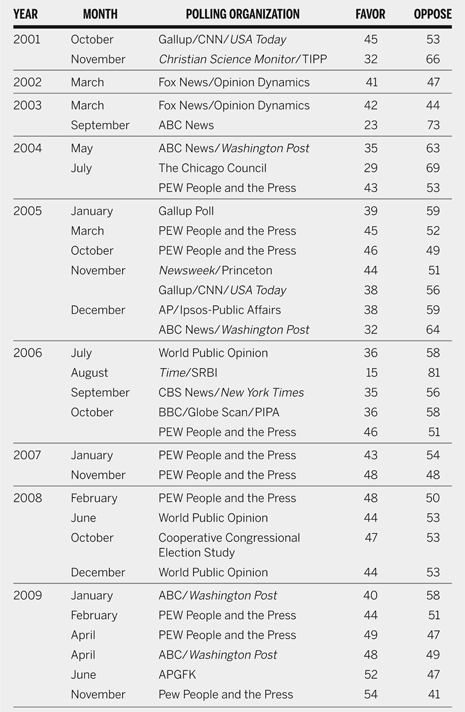
Figure 1 plots the smoothed trend of public opinion regarding torture.Footnote 1 This is the first comprehensive record of public opinion surveys that ask respondents about the use of torture on suspected terrorists in order to gain information or save lives. The individual poll results are listed in table 1; poll questions are listed in appendix A.Footnote 2 As the data make clear, not once during this nine-year period was there a majority in favor of the use of torture. Approximately 55% of the public expressed opposition to torture during this period, even during the three years preceding the revelations of and subsequent public debate over Abu Ghraib.
Public Opposition to Torture, 2001–2009

Public Opinion regarding Torture, 2001–2009

Note. For specific questions posed, see appendix A.
Although the surveys sometimes ask different questions, they have several points in common. Crucially, in these surveys, the respondent is not asked whether they think torture is effective. The effectiveness of torture is presumed in the question. Respondents are told that the person in custody may be a terrorist and may have information about future terrorist attacks. The questions ask or imply that torture would gain accurate information and could save American lives. They present various versions, in other words, of the famed “ticking time bomb” situation, allegedly the most favorable scenario to sanction torture. These are conditions in which it would seem almost patriotic to affirm torture (and dangerous to oppose it). Even in these survey-based scenarios and during this historical period, however, a majority of the American people never favored the use of torture.
In all but two surveys, opposition to torture exceeds support. The mean over the nine-year period is 55% in opposition to and 40.8% in favor of the use of torture. The Time/SRBI poll (see table 1) is unusual in that the opposition stands at 81%, but removing this poll from the analysis makes only a slight difference in results: without Time/SRBI, the means sit at 54.16% opposed to torture and 41.68% in support of torture.
Opposition to torture has declined in the past few years. November 2007 was the first time point at which there was an equal number of respondents who supported and opposed torture, but this survey seems to have been an anomaly. A majority supporting torture did not emerge until June 2009, six months after the inauguration of President Barack Obama, and simultaneous with the reappearance of former Vice President Dick Cheney on the public stage to defend the use of coercive interrogation techniques. The appearance of a public majority who favors torture is a very recent phenomenon. We believe that torture may have become a partisan symbol, distinguishing Republicans from Democrats, that demonstrates hawkishness on national security in the same way that being supportive of the death penalty indicates that a person is tough on crime. A survey conducted by World Public Opinion in June 2009 supports this hypothesis. The most notable aspects of this survey are its findings of a considerable contraction in opposition to torture among Republicans, from 66% in 2004 to 59% in 2009, and an increase of those who said a ban on torture would be too restrictive, from 30% to 39%.Footnote 3 Ironically, however, when asked about specific coercive techniques that Republicans endorse, more Republicans have become more restrictive in terms of what they regard as acceptable (WorldPublicOpinion.org 2009).
MILITARY OPINIONS ABOUT TORTURE
Soldiers in Iraq are surely among those people who have the strongest interest in approving torture. They, more so than the policymakers in Washington, are in harm's way. They often must take swift and sometimes violent action to save the lives of their fellow soldiers.
One might therefore think that this group would be especially likely to endorse torture, but they do not—and wisely so, given that torture has a high cost for soldiers who are asked to perform it (Rejali Reference Rejali2007). Studies of Greek, French, and Brazilian torturers show that participating in torture may induce atrocity-related trauma, as well as leading to, among other outcomes, alcoholism, suicide, and inexplicable violence toward others. The more directly involved a person is with the conduct of torture, the more likely they are to develop posttraumatic stress disorder, depression, or anxiety. These soldiers also experience job burnout and family problems, and sometimes participate in asocial or criminal behavior. Even those soldiers who merely witness torture but do not participate in it can develop these problems. Torture causes all these effects by inducing toxic levels of guilt and shame. Alarming reports of atrocity-related trauma and suicide rates among returning veterans have already emerged (Phillips Reference Phillips2010; Montgomery and Phillips Reference Montgomery and Phillips2009; Benjamin and de Yoanna Reference Benjamin and de Yoanna2009).
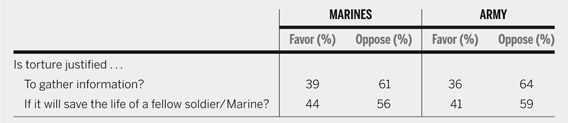
Table 2 shows the opinions on torture of members of the U.S. military currently serving in Iraq. Military personnel oppose torture in even higher numbers than do civilians. Above all, people who are asked to torture by politicians feel a deep sense of betrayal by those who ask them to do terrible things that are beyond what can or should be demanded of a professional soldier. Military leaders are aware of the strong deprofessionalization effects of torture, and that soldiers who have been involved in torture are harder to assign to other responsibilities. Other soldiers do not accept them back into their ranks because they are perceived as undisciplined and lacking in ethical values.
Attitudes toward Torture among Marine and Army Soldiers Serving in Iraq, 2006

PUBLIC OPINION ABOUT INTERROGATION TECHNIQUES DESCRIBED IN THE “TORTURE MEMOS”
Perhaps nuances in public opinion have been overlooked in these data. After all, the surveys cited above all use the word “torture” in the survey prompt, while political leaders counter that the techniques used by the CIA and the military do not constitute “torture” at all. Of course, we are told, the United States does not torture; instead, we deploy “enhanced interrogation” techniques to obtain important intelligence information from known or suspected terrorists.
The Bybee and Bradbury memoranda reject the characterization of “enhanced interrogation techniques” as torture, either separately or in combination with each other.Footnote 4 The Bybee memorandum examines 10 interrogation techniques and the Bradbury memorandum examines 13 techniques. Does public approval change when painful interrogation techniques are not called torture?
Within our survey dataset, we examined three polls that asked respondents about their approval of various techniques of interrogation. Among the “enhanced interrogation” techniques mentioned in the Bybee and Bradbury memos, four are, we would argue, identical to those mentioned in the polls. These are waterboarding, nudity, stress positions, and sleep deprivation. An additional six techniques mentioned in the memos closely approximate those techniques mentioned in the polls. These approved techniques are wall standing,Footnote 5 facial slap,Footnote 6 abdominal slap,Footnote 7 walling,Footnote 8 cramped confinement,Footnote 9 and dietary manipulation.Footnote 10 (For full histories of most of these techniques, their precise effects, and consequences, see Rejali Reference Rejali2007, Rejali Reference Rejali2009, and Rejali Reference Rejali2004.)
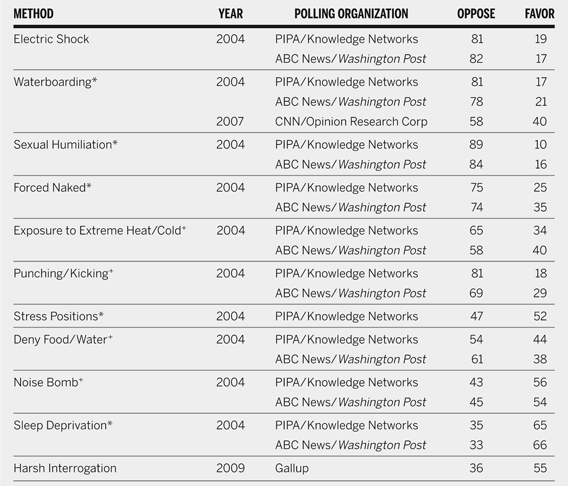
Figure 2 shows the public's approval or disapproval of specific techniques, even when they are not called torture.Footnote 11 Clearly, wide majorities oppose most of the approved techniques, especially waterboarding. Disapproval of waterboarding approaches that of electroshock, which is for many the worst and most extreme form of physical coercion. Few approved techniques garner much public support beyond sleep deprivation, stress positions, and “noise bomb.”
False Consensus About Torture

It is also notable that the PIPA and the ABC News/Washington Post surveys have very similar results. This is surprising, because the two framed their questions very differently. ABC News/Washington Post asked, “As part of the U.S. campaign against terrorism, please tell me if you think each item I name is acceptable in some cases as a method of getting information from prisoners, or is unacceptable in all cases: (1) not allowing a suspect to sleep …” while PIPA strove to find the scenarios in which torture might be approved. It included questions that assure the respondent that the prisoner has critical information and the technique has a higher chance of success. These are the extreme circumstances that pundits often use to justify torture—what might be called “Jack Bauer” conditions—in which the prisoner's information is crucial and torture is effective. PIPA included two variables in their questioning. The first variable was about the degree of certainty that the detainee had information. Half of the participants were told that “intelligence sources say that there is a modest chance” that the detainee has crucial information and the other half were told that there is a “strong chance.” The second variable of the magnitude of consequences related to the information sought from the detainee. Half the sample was told that the detainee is believed to have “some information about a suspected member of a terrorist group,” meaning that the consequences of acquiring the information might be modest. The other half of the sample was told that the consequences of acquiring the information could be very great: that the detainee has “information about a possible terrorist attack on the U.S. that may prove critical to stopping the attack.” This provided PIPA with four groups of respondents, based on how the question was framed: “modest chance/some info,” “modest chance/critical info,” “high chance/some info,” and “high chance/critical info.” The numbers recorded in table 3 are from the respondents who were asked the “high chance/critical info” question. Even with wording that describes a much more dire situation, PIPA found higher numbers of people opposing torture in 8 of 11 techniques.
American Attitudes on Specific Torture Techniques

Note.
* indicates technique approved by Bybee or Bradbury memoranda;
+ indicates technique similar to techniques approved by the Bybee and Bradbury memoranda. For details on polling questions, see appendix B.
We complete our data analysis with the recent 2009 Gallup poll, in which 55% of respondents favored “harsh interrogation” techniques. This poll did not use the word “torture,” nor did it identify specific interrogation techniques by name. Apparently, the more vaguely a question is worded regarding coerced physical interrogation, the more approval it receives. As the other polls show, if Americans think that “harsh interrogation” simply means sleep deprivation and stress positions in extreme cases, they generally approve of it. As the polls of specific techniques show, this response does not mean that Americans approve of many of the interrogation techniques approved by the Bybee and Bradbury memoranda.
WHY JOURNALISTS AND POLITICIANS WERE WRONG: FALSE CONSENSUS
Why have so many people in the political and media elite so badly misread the strong majorities opposed to torture? A recent survey we commissioned helps shine a light on the psychological process of misperception—also called “false consensus”—whereby an individual mistakenly believes that their viewpoints represent the public majority (Ross, Greene, and House Reference Ross, Greene and House1977). False consensus has a long legacy in social psychological research, but our survey is unique in that it examines for the first time how false consensus may have shaped the public debate over torture.
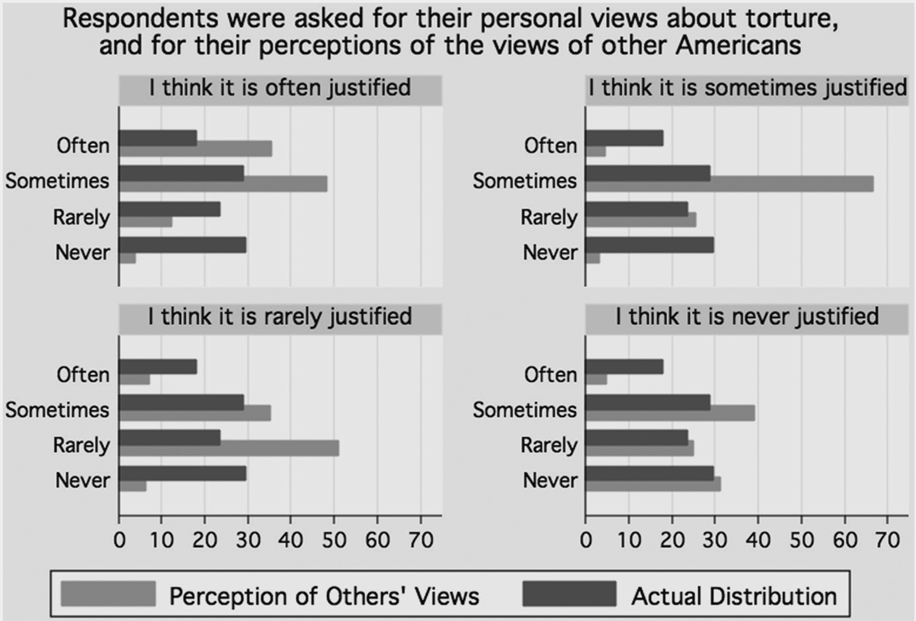
To test for the possibility of false consensus, we added items to a national opinion poll of 1,000 respondents just before the 2008 election. In this study, we asked survey respondents about their own opinions on torture but then followed up by asking what the “average American” felt about the same subject. This is a standard method for measuring false consensus—the “real” responses (the distribution of individual responses) are compared to the “perceived” responses.
These differences are reflected in figure 2, where we compare the actual distribution of attitudes about torture (dark gray) to the perceived distribution of attitudes about torture (light gray). Thus, the gap between the dark and light bars is a measure of false consensus. When the light line is higher, groups are perceived as larger than they really are, and when the dark line is higher, groups are perceived as smaller than they really are. We make these comparisons across all four response groups—those who think torture is often, sometimes, rarely, and never justified.
Our survey shows that nearly two-thirds of Americans overestimated the level of national support for torture. But more important, these misperceptions are not evenly distributed across the population. The more strongly an individual supports torture, the larger the gap in his or her perception. Those who believe that torture is “often” justified—a mere 15% of the public—think that more than a third of the public agrees with them. The 30% who say that torture can “sometimes” be justified believe that 62% of Americans do as well, and think that another 8% “often” approve of torture.
Revealingly, those people most opposed to torture—29% of the public—are the most accurate in how they perceive public attitudes on the topic. They overestimate the proportion of the public who “sometimes” approve of torture by 10%, underestimate the proportion of the public who “often” approve of torture by 10%, and perceive the rest of the public with near precision.
In short, these patterns present a classic pattern of false consensus. People who were most in favor of torture assumed that most of the public agreed with them. While we obviously do not have survey data on Washington decision makers, we do know from public statements how leading voices such as former Vice President Dick Cheney felt about the interrogation techniques. These data show that it is not at all surprising that Cheney and other political figures believed that the public stood behind them. What is perhaps more surprising is how poorly journalists, regardless of personal belief regarding their objectivity or bias toward liberalism (Lee Reference Lee2005), misread public sentiments.
CONCLUSION
In his dedication to The Prince, Machiavelli says that one must be a prince to know the character of the people, and to understand the nature of princes well, one must be a commoner. His point is that one never sees oneself with a clear-eyed view; one has to count on the corrective vision of others in seeking to preserve power or expand liberty. Machiavelli suspects that politicians and people alike resist advice or insight; they are too eager to dismiss what they do not agree with or believe.
Since the election of President Obama, there has been an excessive exuberance in the air, as if the American people have just woken up and learned to oppose torture. That is a mistaken view of both the past and the present. Not once during the eight years of the Bush administration was there an American majority in favor of the use of torture. The soldiers serving in Iraq did not favor its use. It is only in the last few months that a bare majority in favor of torture seems to be present. Finally, wide majorities opposed most of the approved “enhanced interrogation” techniques, even under extreme threat conditions. Those wide majorities have persisted in recent polls.
People who supported torture were wrong for the most human of reasons—they believed that their view represented the public majority. They overestimated how many people agreed with them. And journalists believed them, whether they were liberal or not, for or against torture, Europeans or Americans. This is a mystery, because the evidence was always at their fingertips. The people who had the most accurate perception of public attitudes turned out to be the people nobody believed or supported throughout the Bush administration—the 29% who were most opposed to torture.
APPENDIX A:
Questions Posed by Polling Organizations regarding Torture
American Attitudes on Specific Torture Techniques

Note. PIPA = Program on International Policy Attitudes; AP-GfK = Collaboration between the Associated Press and the GfK Group.
APPENDIX B:
Polling Questions regarding Acceptable Methods of Torture
PIPA/Knowledge Networks Poll:
Let's say that the U.S. is holding someone prisoner and intelligence sources say that there is a strong chance that this person has information about a possible terrorist attack on the U.S. that may prove critical to stopping the attack, but this person denies having such information. Please select whether you would favor or oppose using each of the following methods as a way of trying to get the prisoner to reveal the information he may have:
• Applying electric shocks to the detainee
• Holding the detainee's head under water
• Sexually humiliating the detainee
• Making the detainee go naked
• Exposing the detainee to extreme heat or cold
• Punching or kicking the detainee
• Forcing detainees to remain in a physically stressful position for an extended period
• Withholding food and water
• Bombarding the detainee with loud noise for long periods of time
• Not allowing the detainee to sleep
ABC News/Washington Post Poll:
As part of the U.S. campaign against terrorism, please tell me if you think each item I name is acceptable in some cases as a method of getting information from prisoners, or is unacceptable in all cases:
• Applying electric shocks to the suspect
• Holding the suspect's head under water
• Sexually humiliating the suspect
• Making the suspect go naked
• Exposing the suspect to extreme heat or cold
• Punching or kicking the suspect
• Withholding food and water
• Bombarding the suspect with loud noise for long periods of time
• Not allowing the suspect to sleep
CNN/Opinion Research Corporation Poll:
In a procedure known as “waterboarding,” interrogators produce the sensation of drowning in a restrained prisoner by either dunking him in water or pouring water over his face. Do you think the U.S. government should or should not be allowed to use this procedure to attempt to get information from suspected terrorists?