





The use of whole genome sequencing (WGS) has been instrumental in detecting transmission of healthcare-associated infections. Reference Sundermann, Rosa and Harris1–Reference Sundermann, Kumar and Griffith3 However, access to WGS remains limited in many settings. We therefore sought to determine whether matrix-assisted laser desorption/ionization time-of-flight mass spectrometry (MALDI-TOF) combined with antibiotic susceptibility (AS) data, both more readily available than WGS, could accurately predict bacterial pathogen transmission when benchmarked against a real-time genomic surveillance data set.
We utilized 2,656 bacterial pathogens that underwent WGS at our acute care facility between November 2021and November 2023 that had MALDI-TOF, AS, and electronic health record (EHR) data available. Reference Sundermann, Chen and Kumar2–Reference Sundermann, Chen and Saul4 We created a model that used a U-Net autoencoder to learn compact representations of MALDI-TOF mass spectra, trained simultaneously on three objectives: spectral reconstruction, species identification, and mapping of pairwise MALDI-TOF distances to WGS-derived single nucleotide polymorphism (SNP) distances. Reference Liu, Chen and Sundermann5 The model compresses each MALDI-TOF spectra into a simplified numerical representation trained so that genomically related isolates are positioned closer together than unrelated isolates. Outbreak clusters were then derived from the learned MALDI-TOF representations using hierarchical clustering, with cluster assignments evaluated against WGS-defined transmission clusters as the reference standard.
For each pairwise isolate comparison, MALDI-TOF cluster concordance was used as the test variable, and WGS-defined transmission (≤10 pairwise SNPs) served as the reference standard. From the resulting 2×2 contingency tables, we calculated sensitivity, specificity, PPV, and NPV overall and stratified by organism. We additionally incorporated EHR-derived epidemiological linkage data, generated from a previously validated artificial intelligence (AI) model that ranks likely transmission routes from structured clinical data, as a supplementary predictor to evaluate whether clinical context could augment the MALDI-TOF model’s transmission prediction performance in the absence of WGS. Reference Sundermann, Chen and Kumar2,Reference Sundermann, Chen and Saul4 We then translated these metrics into two clinically relevant IP&C scenarios: (1) an infection preventionist uses the MALDI-TOF model to rule out transmission when no epidemiological link is apparent, and (2) an infection preventionist uses the MALDI-TOF model to confirm suspected transmission and trigger an investigation.
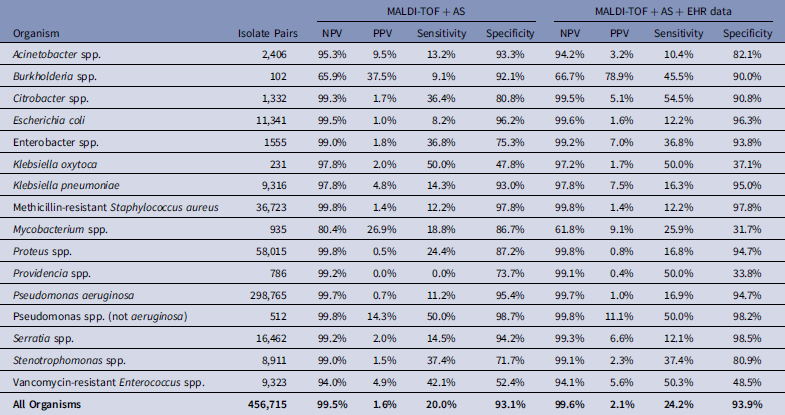
Overall, there were 456,715 pairwise comparisons across 2,656 organisms, of which 2,084 (0.54%) were defined as WGS transmission events. Overall model performance across all species showed NPV of 99.5%, PPV of 1.6%, sensitivity of 20%, and specificity of 93.1% (Table 1). Performance was largely consistent within organisms across models. The drivers of variability across species remain incompletely understood and warrant further investigation. Pseudomonas aeruginosa, representing the largest proportion of pairwise comparisons (298,765 pairs), demonstrated the poorest PPV at 0.7% and sensitivity of 11.2%. Burkholderia species demonstrated the highest PPV at 47.4%, though estimates based only on 96 analyzable pairs.
Performance of MALDI-TOF mass spectrometry and antibiotic susceptibility data for predicting WGS-defined bacterial transmission by organism

Table 1. Long description
A table comparing performance metrics of MALDI-TOF mass spectrometry and antibiotic susceptibility data for predicting bacterial transmission by organism. The table has 16 rows and 10 columns. Column headers are Organism, Isolate Pairs, NPV, PPV, Sensitivity, Specificity, NPV, PPV, Sensitivity, Specificity. Row labels include various organisms such as Acinetobacter spp., Burkholderia spp., Citrobacter spp., and more. Each row provides specific values for the performance metrics across different models. Notable trends include varying NPV, PPV, sensitivity, and specificity values across different organisms, with some organisms showing higher performance metrics than others.
MALDI-TOF, matrix-assisted laser desorption/ionization time-of-flight mass spectrometry; AS, antibiotic susceptibility; EHR, electronic health record; NPV, negative predictive value; PPV, positive predictive value; WGS, whole genome sequencing.
From a translational perspective, these results show when an infection preventionist suspects transmission and the MALDI-TOF model indicates no transmission, the model performs well with an overall NPV of 99.5%. However, this high NPV is likely attributable to the low prevalence of transmission in our data set and would be expected to decline in settings with a higher pretest probability of transmission. Additionally, when the MALDI-TOF model indicates likely transmission, the result is not reliable: a PPV of 0.016 indicates fewer than 2 in 100 flagged pairs represent true WGS-defined transmission events. Furthermore, the overall sensitivity of 0.200 indicates the MALDI-TOF model would miss 4 of every 5 true transmission events entirely.
Our results are aligned with prior research demonstrating the limited discriminatory power of MALDI-TOF for predicting WGS-defined transmission largely attributable to the inability of mass spectra to capture the fine-scale genomic SNP variation that distinguishes transmission-linked isolates from unrelated strains of the same species. Reference Park and Ryoo6–Reference Jun, Kim and Lee9 Taken together, these findings suggest that MALDI-TOF, despite its clinical accessibility, lacks the resolution necessary to serve as a reliable surrogate for WGS in transmission detection, and its use for this purpose risks both missing true outbreaks and triggering unnecessary investigations.
Our study has limitations. The analysis was conducted at a single tertiary care institution, which could limit generalizability. Second, approximately 16% of isolates were excluded due to missing MALDI-TOF or AS data, which may have introduced selection bias. Third, our analysis relied on pairwise isolate comparisons rather than cluster-level assessment. Isolates separated by more than 10 SNPs may still belong to the same transmission cluster through intermediate, unsampled linking isolates, so our pairwise approach may underestimate the model’s true cluster detection capability. Additionally, bacterial species mutate at different rates, and our uniform ≤ 10 SNP threshold, although informed by epidemiological linkage data, may have excluded isolate pairs belonging to the same transmission cluster at higher SNP distances. Fourth, higher PPVs observed among less common organisms likely reflect differences in the small numbers of analyzable pairs rather than superior MALDI-TOF discriminatory performance.
There are many barriers to the broader adoption of WGS. Reference Sundermann, Rosa and Harris1 First, institutions that are looking to perform WGS in-house must invest in the infrastructure, staff, and training required to perform and analyze WGS data. Second, there is currently no mechanism for financial reimbursement of WGS for healthcare outbreak detection. Thus, sustaining a pathogen WGS program would require upfront and long-term costs from healthcare institutions. A future state of pathogen WGS in healthcare would require payors to work with healthcare institutions and IPandC. Reference Sundermann, Rosa and Harris1
The increasing availability of MALDI-TOF in clinical microbiology laboratories makes such an approach an attractive solution for transmission detection. Reference Calderaro and Chezzi10 However, as we and others have demonstrated, its utility remains critically limited for this purpose. Instead, infection prevention programs should consider the adoption of real-time genomic surveillance using WGS, which has demonstrated both clinical and economic benefit in detecting and interrupting healthcare-associated transmission.
Acknowledgements
We thank Melissa Saul for her technical assistance with data extraction and management.
Financial support
This work was funded in part by the National Institutes of Health (NIH) (R01AI127472). Contributions by A.J.S. were supported in part by the NIH grant 1K01AI190052-01. NIH played no role in data collection, analysis, or interpretation; study design; writing of the manuscript; or decision to submit for publication.
Competing interests
AJS is a consultant to Next Gen Diagnostics. LHH is on the scientific advisory board of Next Gen Diagnostics. Next Gen Diagnostics had no involvement in this study, and no products from Next Gen Diagnostics were utilized. L.L.P. reports grant funding paid to her institution from AstraZeneca unrelated to this study.

 Open access

