Introduction
The growing evidence that depression in patients who have survived an acute coronary syndrome (ACS) is a risk factor for future cardiovascular morbidity (Meijer et al. Reference Meijer, Conradi, Bos, Thombs, van Melle and de Jonge2011) has stimulated efforts to understand mediating biobehavioural processes. Inflammation, autonomic dysregulation, endothelial dysfunction and failure to adhere to medication and lifestyle advice have been implicated (de Jonge et al. Reference de Jonge, Rosmalen, Kema, Doornbos, van Melle, Pouwer and Kupper2010; Poole et al. Reference Poole, Dickens and Steptoe2011). Another candidate is hypothalamic–pituitary–adrenal (HPA) dysregulation, which may lead to failure to limit inflammatory activity (Nijm & Jonasson, Reference Nijm and Jonasson2009) while stimulating other mechanisms contributing to coronary heart disease (CHD) (Brotman et al. Reference Brotman, Golden and Wittstein2007). Vogelzangs et al. (Reference Vogelzangs, Beekman, Milaneschi, Bandinelli, Ferrucci and Penninx2010) recently reported that elevated 24-h cortisol concentrations in urine were associated with increased risk of cardiovascular mortality over the next 6 years, independently of covariates, whereas a flatter slope of salivary cortisol decline over the day predicted cardiovascular mortality in the Whitehall II study (Kumari et al. Reference Kumari, Shipley, Stafford and Kivimaki2011). Subclinical atherosclerosis defined by coronary artery calcification or carotid plaque has also been associated with heightened cortisol stress responses (Hamer et al. Reference Hamer, O'Donnell, Lahiri and Steptoe2010), flatter cortisol profiles over the day (Matthews et al. Reference Matthews, Schwartz, Cohen and Seeman2006) and greater overall cortisol output over the day (Dekker et al. Reference Dekker, Koper, van Aken, Pols, Hofman, de Jong, Kirschbaum, Witteman, Lamberts and Tiemeier2008). An elevated cortisol awakening response (CAR) predicted progression of carotid intima media thickness over a 4-year period in women (Eller et al. Reference Eller, Netterstrom and Allerup2005), but the CAR was blunted in a small study of hypertensive versus non-hypertensive men (Wirtz et al. Reference Wirtz, von Känel, Emini, Ruedisueli, Groessbauer, Maercker and Ehlert2007). In patients with diabetes, elevated morning cortisol was associated with the presence of CHD (Reynolds et al. Reference Reynolds, Labad, Strachan, Braun, Fowkes, Lee, Frier, Seckl, Walker and Price2010a ), whereas cortisol levels on admission to hospital with ACS have been related to both unfavourable (Bain et al. Reference Bain, Fox, Jagger, Davies, Littler and Murray1992; Tenerz et al. Reference Tenerz, Nilsson, Forberg, Ohrvik, Malmberg, Berne and Leppert2003) and favourable (Fantidis, Reference Fantidis2010; Reynolds et al. Reference Reynolds, Walker, Haw, Newby, Mackay, Cobbe, Pell, Fischbacher, Pringle, Murdoch, Dunn, Oldroyd, Macintyre, O'Rourke and Pell2010b ) prognoses.
Disturbed HPA activity and modifications in cortisol output have also been implicated in depression (Belmaker & Agam, Reference Belmaker and Agam2008; Pariante & Lightman, Reference Pariante and Lightman2008). However, studies associating cortisol with depression in cardiac patients have not identified consistent relationships. An evaluation of urinary cortisol in the Heart and Soul Study showed positive associations with depression in chronic CHD patients (Otte et al. Reference Otte, Marmar, Pipkin, Moos, Browner and Whooley2004) but other studies have found that elevated morning cortisol (von Kanel et al. Reference von Kanel, Mausbach, Kudielka and Orth-Gomer2008) or flatter diurnal profiles (Bhattacharyya et al. Reference Bhattacharyya, Molloy and Steptoe2008) were related to depression. In a previous study we found no association between depressive symptoms and cortisol output over the day measured 4 months after hospitalization with an ACS (Molloy et al. Reference Molloy, Perkins-Porras, Strike and Steptoe2008). One important issue that has not been consistently taken into account is the patient's history of depression. Depressive symptoms in the period following ACS are predicted by previous history of depressive illness (Lesperance et al. Reference Lesperance, Frasure-Smith and Talajic1996; Spijkerman et al. Reference Spijkerman, van den Brink, Jansen, Crijns and Ormel2005; Martens et al. Reference Martens, Smith, Winter, Denollet and Pedersen2008). It might be the case that associations between cortisol output following ACS and depression are secondary to the influence of depression history. The aim of this study was therefore to determine whether a history of depression and current depression are associated with the profile of cortisol over the day measured 3 weeks after an ACS.
Method
Study population
The participants were 222 patients admitted with ACS to St George's Hospital in South London between June 2007 and October 2008 as part of a larger study relating biological and emotional factors in acute cardiac patients (Steptoe et al. Reference Steptoe, Molloy, Messerly-Bürgy, Wikman, Randall, Perkins-Porras and Kaski2011a , Reference Steptoe, Molloy, Messerli-Bürgy, Wikman, Randall, Perkins-Porras and Kaski b ). Patients were included if they fulfilled the following criteria: a diagnosis of ACS based on the presence of chest pain plus verification by diagnostic electrocardiographic (ECG) changes, troponin T or troponin I ⩾99th percentile of the upper reference limit and/or a creatine kinase measurement more than twice the upper range of normal for the measuring laboratory. Additional inclusion criteria were age of 18 years or over, absence of co-morbid conditions that might influence either symptom presentation or mood, other conditions that might cause troponin positivity, and ability to complete interviews and questionnaires in English. The study was approved by the Wandsworth Research Ethics Committee (Institutional Review Board), and written consent was obtained.
Clinical and sociodemographic measures
Information was obtained from medical notes about cardiovascular history, clinical factors during admission and management. Admission ECGs were reviewed and scrutinized for presentation as ST elevation myocardial infarction (STEMI) or non-STEMI/unstable angina. We computed the composite risk index based on the algorithm developed in the Global Registry of Acute Cardiac Events (GRACE) study (Eagle et al. Reference Eagle, Lim, Dabbous, Pieper, Goldberg, Van de Werf, Goodman, Granger, Steg, Gore, Budaj, Avezum, Flather and Fox2004) and validated in independent studies (Alter et al. Reference Alter, Venkatesh and Chong2006). This uses nine criteria (age, congestive heart failure, history of MI, systolic blood pressure and heart rate on admission, ST segment depression, initial serum creatinine, elevated cardiac enzymes and in-hospital percutaneous coronary intervention) to define risk of 6-month post-discharge death applicable to all types of ACS. The number of days spent in hospital was included as an additional indicator of clinical status. This variable showed a skewed distribution so was log transformed before analysis.
Socio-economic status (SES) was assessed using a social deprivation index based on three criteria: living in a crowded household (defined as one or more people to a room), renting as opposed to owning a home, and not having use of a motor vehicle (car or van) (Strike et al. Reference Strike, Perkins-Porras, Whitehead, McEwan and Steptoe2006). Patients were classified as low deprived (negative on all items), medium deprived (one positive) and high deprived (2–3 positive). Information concerning marital status, ethnicity and smoking was obtained by interview, and height and weight were recorded on admission for the computation of body mass index (BMI).
Assessment of depression
Patients were assessed in their homes at an average 21.6±8.5 days following admission to hospital. The assessment included the Depression Interview and Structured Hamilton (DISH; Freedland et al. Reference Freedland, Skala, Carney, Raczynski, Taylor, Mendes de Leon, Ironson, Youngblood, Krishnan and Veith2002), which was developed for the Enhancing Recovery in Coronary Heart Disease (ENRICHD) study. The DISH generates a clinical diagnosis of major and minor depression based on DSM-IV. All researchers had been trained in the interview technique. In view of the relatively small numbers in the study, these categories were combined for analysis. Lifetime history of clinical depression was obtained from the DISH. The Beck Depression Inventory (BDI; Beck et al. Reference Beck, Steer and Garbin1988) was also administered as part of this interview. This measure consists of 21 items rated on a scale of 0–3, so maximum scores can range from 0 to 63. The Cronbach α in this sample was 0.86.
Cortisol sampling
Salivary sampling with salivettes (Sarstedt, UK) was explained and undertaken during the interview at the patient's home. Cortisol sampling was undertaken during the next few days after the interview at the patient's home. Patients were asked to hold the cotton dental roll in their mouths for 2 min at six times: immediately after waking, 30 min later, 10:00–10:30 h, 14:00–14:30 h, 19:00–19:30 h, and then just before bedtime. Patients also recorded the exact time of sample collection and the time of waking. They were instructed to avoid caffeine and acidic drinks, smoking, tooth brushing, eating and drinking for 15 min before collecting saliva. Salivettes were stored in domestic refrigerators before posting them back to the laboratory. Patients who did not return their samples within 2 weeks were sent reminders and replacement salivettes if necessary. Saliva samples were sent to the Technical University Dresden for the analysis of cortisol by chemiluminescence immunoassay (CLIA; IBL-Hamburg, Germany). Inter- and intra-assay coefficients of variation were <8%.
Statistical analysis
Of the 222 patients interviewed 3 weeks after ACS, saliva samples were returned by 160 (72%), and complete usable cortisol data were obtained from 152. These individuals were included in the primary analyses. Seven people were not asked to collect saliva for dental or other reasons; the majority of non-respondents agreed verbally to collect the samples yet failed to do so. The patients who did and did not provide cortisol data did not differ in gender, ethnicity, marital status, BMI, type of ACS, history of MI, number of days spent in hospital, or in medication at the time of interview. However, the patients who did not complete cortisol assessments were significantly younger (mean age=55.43, s.d.=12.29 years versus mean age=61.70, s.d.=10.94 years, p<0.001), were more socially deprived (p<0.001), more likely to be smokers (52.8% versus 30.9%, p=0.002) and had lower GRACE risk scores (mean=84.40, s.d.=27.21 versus mean=95.05, s.d.=25.43, p=0.005). They were also more depressed on the BDI on average than those whose cortisol was analysed (mean=8.34, s.d.=9.00 versus mean=5.90, s.d.=5.12, p=0.011), but did not differ in history of depression (p=0.21).
Cortisol output was analysed using three measures: the cortisol awakening response (CAR), computed as the difference between measures taken on waking and 30 min later, total output over the day, estimated using the area under the curve method with respect to ground (Pruessner et al. Reference Pruessner, Kirschbaum, Meinlschmidt and Hellhammer2003a ), and the slope of cortisol decline over the day, computed as the reduction in cortisol per hour using regression methods. The slope measure excluded the 30-min post-waking sample, as is common in this literature. The CAR is crucially dependent on the waking cortisol sample being obtained without marked delays after waking because postponement can reduce the magnitude of the awakening response (Chida & Steptoe, Reference Chida and Steptoe2009). Based on analyses comparing self-report and objectively measured waking (Dockray et al. Reference Dockray, Bhattacharyya, Molloy and Steptoe2008), we excluded individuals from the CAR analyses if the waking sample was delayed >15 min after reported waking times. Seven individuals were excluded from the analyses on this basis. The CAR values were normally distributed, but the total output over the day and cortisol slopes were log transformed before analysis.
Comparisons of background factors between patients with and without a history of depression were carried out with t tests for continuous and χ2 tests for categorical variables. Associations between depression following ACS, history of depression, and cortisol were carried out using multivariable regression on the three cortisol measures. Factors related to the severity of cardiac disease (GRACE score, number of days spent in hospital) and other variables that might influence depression or cortisol (age, gender, ethnicity, social deprivation, marital status, BMI, smoking status) were included as covariates in the models, as were medication with statins and antiplatelet preparations. The analyses of the CAR included time of the first sample as an additional covariate because this has previously been related to the magnitude of responses (Edwards et al. Reference Edwards, Evans, Hucklebridge and Clow2001). There were no indications of multicollinearity in the dataset as determined by the variance inflation factor. Additionally, cortisol levels in patients with and without a history of depression and with and without diagnosed depression following ACS were compared by analysis of covariance, with the variables listed above included as covariates. The results are presented as means±standard deviations.
Results
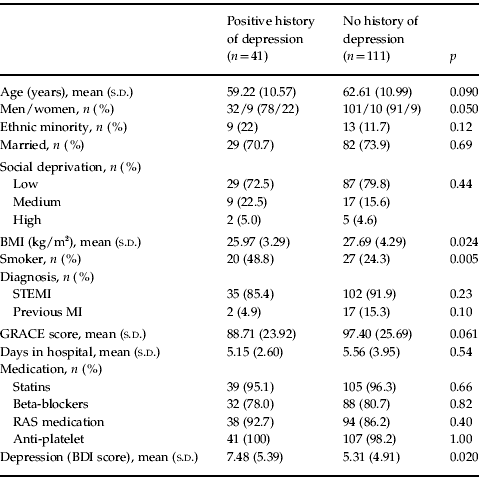
Participant characteristics are detailed in Table 1, where it can be seen that the majority were white men who experienced a STEMI. A history of depression was reported by 27%. A higher proportion of patients with a history of depression were women (p=0.050) and tended to be younger (p=0.090). Patients with a history of depression were more often smokers (p=0.005) and had a lower BMI (p=0.024). There were, however, no other differences in clinical characteristics or medication. As expected, scores on the BDI obtained 3 weeks after ACS were significantly higher among patients with a history of depression (p=0.020). The proportion of patients with major and minor depression according to the DISH was 19.4%, with a greater percentage among patients with a positive than a negative history of depression (25.8% v. 16.6%). However, because of attrition of patients with greater depression scores from cortisol sampling, the proportion with DISH diagnosed depression included in these analyses was 16.2%, comprising 21 men (16.7%) but only two women (12.5%). Mean BDI scores 3 weeks after ACS were substantially higher in the diagnosed depressed compared with non-depressed patients (mean=13.88±9.06 and 4.92±4.18 respectively, p<0.001). The waking cortisol sample was obtained at 07:18 h±64 min on average, with the 30-min sample taken at 07:51 h±66 min. The four remaining samples were obtained at 10:09±30, 14:07±30, 19:06±36 and 22:37 h±50 min, indicating good adherence to the protocol. The CAR (n=139) averaged 4.28±9.12 nmol/l.
Characteristics of the patients with and without a history of depression

BMI, Body mass index; STEMI, ST elevation myocardial infarction; GRACE, Global Registry of Acute Cardiac Events; RAS, renin–angiotensin system; BDI, Beck Depression Inventory; s.d., standard deviation.
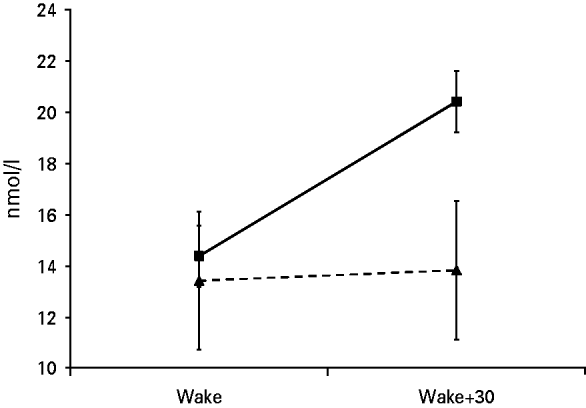
The CAR was not related to depressed mood following ACS assessed with the BDI. However, men who were diagnosed with depression on the DISH had smaller CARs than the remainder, after adjusting for age, ethnicity, marital status, social deprivation, smoking status, BMI, GRACE risk score, days in hospital, medication with statins and antiplatelet compounds, history of depression, and time of the first sample (p=0.038). This effect is shown in Fig. 1, where it is evident that the two groups did not differ in cortisol output on waking, but that the depressed patients showed no rise in cortisol after 30 min. The mean CAR adjusted for covariates was 0.41±6.81 nmol/l in the depressed compared with 6.03±9.05 nmol/l in the non-depressed participants. There was no difference in time of waking or SES between the groups. Thus, depression following ACS was associated with a blunted CAR among male cardiac patients.
Mean salivary cortisol on waking and 30 min later in male patients with (broken line, triangle) and without (solid line, square) current major or minor depression diagnosed using the Depression Interview and Structured Hamilton (DISH). Values are adjusted for age, marital status, social deprivation, ethnicity, smoking status, body mass index (BMI), Global Registry of Acute Cardiac Events (GRACE) risk score, days in hospital, medication with statins and antiplatelet compounds, history of depression and time of the first sample. Error bars are standard errors of the mean.

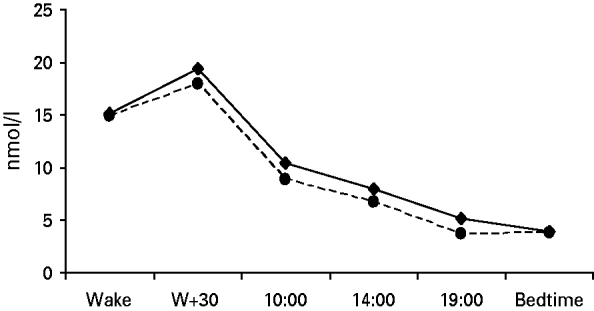
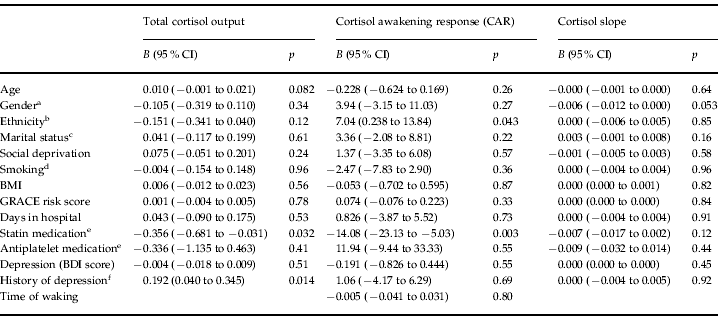
The regression model on total cortisol output is summarized in Table 2. Total cortisol output was positively associated with history of depression [B=0.192, 95% confidence interval (CI) 0.040–0.345, p=0.014], after adjustment for age, gender, marital status, social deprivation, ethnicity, smoking status, BMI, GRACE risk score, days in hospital, medication with statins and antiplatelet compounds, and current BDI score. Current BDI score was not associated with cortisol output. The association between history of depression and cortisol output is illustrated in Fig. 2, where it can be seen that cortisol levels were similar on waking in the two groups. Subsequently, cortisol levels were moderately elevated throughout the day in patients with a positive history of depression, converging again at bedtime. Apart from history of depression, the only other variable independently to predict cortisol output over the day was medication with statins. Additional analyses (not detailed here) comparing extreme BDI groups, assessing cognitive and somatic symptoms of depression as defined by de Jonge et al. (Reference de Jonge, Ormel, van den Brink, van Melle, Spijkerman, Kuijper, van Veldhuisen, van den Berg, Honig, Crijns and Schene2006), or comparing patients with major or minor depression according to the DISH, did not show any further links with cortisol output. There was no association between cortisol slope over the day and any of the factors mentioned above (see Table 2).
Mean salivary cortisol at six sampling points over the day in patients with (solid line, diamond) and without (broken line, disc) a history of depression. Values are adjusted for age, gender, marital status, ethnicity, smoking status, body mass index (BMI), Global Registry of Acute Cardiac Events (GRACE) risk score, days in hospital, medication with statins and antiplatelet compounds, and current Beck Depression Inventory (BDI) score.

Regressions on cortisol output

B, Regression coefficient; CI, confidence interval; BMI, body mass index; GRACE, Global Registry of Acute Cardiac Events; BDI, Beck Depression Inventory.
Reference groups are:
a men; b white; c married; d non-smokers; e no medication; f no history of depression.
Discussion
This study evaluated cortisol output over the day in patients who had recently survived an ACS, in order to investigate the relevance of HPA dysfunctioning to the association between post-ACS depression and future cardiac morbidity. Total cortisol output over the day was not related to depression assessed 3 weeks after an ACS. It was, however, elevated in patients with a history of depression, and this association was independent of demographic factors, markers of the clinical severity of the cardiac event, medication, and current depressed mood. Additionally, male patients who were diagnosed using a structured interview with major or minor depression at 3 weeks after their ACS showed a blunted CAR that was again independent of covariates.
At least 50% of patients with a major depressive disorder experience one or more recurrences in the future (Mueller et al. Reference Mueller, Leon, Keller, Solomon, Endicott, Coryell, Warshaw and Maser1999). Predictors of recurrent depression include the number of previous episodes, persisting subsyndromal symptomatology and stress exposure, and it has been suggested that disturbances of HPA regulation may also contribute (O'Toole et al. Reference O'Toole, Sekula and Rubin1997; Appelhof et al. Reference Appelhof, Huyser, Verweij, Brouwer, van Dyck, Fliers, Hoogendijk, Tijssen, Wiersinga and Schene2006). The relationship between HPA functioning and depression is complex, and disturbances in cortisol responses to stress, hippocampal control of the HPA and glucocorticoid receptor expression have been implicated (Pariante & Lightman, Reference Pariante and Lightman2008; Snyder et al. Reference Snyder, Soumier, Brewer, Pickel and Cameron2011; Stetler & Miller, Reference Stetler and Miller2011). The experience of a severe cardiac event such as an ACS is a strong emotional stressor, but the fact that elevated cortisol output was not related to depressed mood or diagnosed depression 3 weeks after an ACS suggests that the phenomenon is not specifically associated with experience of ACS. Nonetheless, the observation that these individuals have raised cortisol output over the day may increase their risk of cardiac sequelae through the impact of HPA function on inflammatory responses, endothelial dysfunction and insulin resistance (Girod & Brotman, Reference Girod and Brotman2004; Broadley et al. Reference Broadley, Korszun, Abdelaal, Moskvina, Jones, Nash, Ray, Deanfield and Frenneaux2005).
Interpretation of the association between depression following an ACS and a reduced CAR must be made cautiously, in light of the fact that effects emerged in analyses based on the DISH clinical interview rather than continuous scores on the BDI. It is, however, interesting that the more severe indications of current depression identified in the clinical interview were associated with the CAR. The proportion of individuals diagnosed as depressed was comparable to those reported in other studies (Thombs et al. Reference Thombs, de Jonge, Coyne, Whooley, Frasure-Smith, Mitchell, Zuidersma, Eze-Nliam, Lima, Smith, Soderlund and Ziegelstein2008). Some studies in populations without CHD have shown heightened CARs in more depressed individuals (Bhagwagar et al. Reference Bhagwagar, Hafizi and Cowen2005; Pruessner et al. Reference Pruessner, Hellhammer, Pruessner and Lupien2003b ), whereas others have described diminished responses (Stetler & Miller, Reference Stetler and Miller2005). In two studies with different groups of cardiac patients, we found no relationship between depressive symptoms measured with the BDI and the CAR (Bhattacharyya et al. Reference Bhattacharyya, Molloy and Steptoe2008; Molloy et al. Reference Molloy, Perkins-Porras, Strike and Steptoe2008). The results in this study suggest that disturbances of cortisol output early in the day are only associated with more severe depression as identified by clinical interview, rather than depressive symptoms as a continuous variable. We did not test effects in women because only two female patients who completed satisfactory early day cortisol assessments were diagnosed with depression on the clinical interview.
Another striking feature of the results is the relatively small CAR recorded even in non-depressed ACS patients. We did not test a healthy comparison group, but previous studies from our laboratory of individuals within the same age range have shown mean CARs in the range 6–10 nmol/l, compared with 4.28 nmol/l here (Kunz-Ebrecht et al. Reference Kunz-Ebrecht, Kirschbaum, Marmot and Steptoe2004; Wright & Steptoe, Reference Wright and Steptoe2005). Further studies are clearly required to explore the inconsistencies in these results. However, the complete absence of a CAR may indicate disturbances of HPA regulation that are potentially relevant to future cardiovascular risk.
A relevant factor to the interpretation of these findings was the low response rate (72%) for completion of cortisol assessments. Patients who failed to provide cortisol samples were younger, more likely to be socially deprived, and had suffered a less severe ACS. They were also more depressed at the time of the 3-week interview. The reasons why they did not return saliva samples are not certain. As these patients were more socio-economically deprived and had a less severe cardiac event than the remainder, they may have returned to work more promptly and therefore found it more difficult to incorporate the saliva sampling into their everyday lives. Alternatively, their greater depression may have made them less compliant to the demands of the study. Importantly, they did not differ from the remainder in their history of depression, so the response rate is unlikely to have affected the association between depression history and cortisol. However, their greater depression at the time of the 3-week interview may have compromised tests of associations between current depressed mood and total cortisol output. We consider this unlikely, because analyses of more extreme current depression groups or comparisons of individuals with and without clinical depression at the time of interview did not indicate stronger relationships with total cortisol output over the day.
Some further limitations of this study should be considered. Saliva samples were collected over a single day, and more robust effects may emerge with repeated sampling. There was no objective measure of sample timing, so we were reliant on patient reports for this information. History of depression was collected retrospectively following ACS, and this may have influenced reporting patterns, particularly among patients who were currently depressed. The study was not powered to determine whether the differences in HPA regulation associated with history of or current depression predicted later cardiac health. We were also not able to analyse the associations between cortisol and the combination of elevated depressed mood or depression diagnosis following ACS and history of depression. The strengths of the study include the use of a standard interview-based method of assessing history of depression and current depressive status. We also assessed medication in detail and controlled for the severity of the cardiac event with a well-validated measure. Our findings suggest that history of depression rather than depressed mood following ACS is a determinant of overall cortisol output following ACS, whereas current mental state may be more significant to cortisol levels early in the day. Whether these disturbances of cortisol regulation are sufficiently great to mediate in part the association between post-ACS depression and future cardiac morbidity will require a more extended longitudinal study.
Acknowledgements
This study was supported by the British Heart Foundation (RG/05/006) and was partly funded by a grant (PBBE1-117004) from the Swiss National Foundation to N.M.-B. The British Heart Foundation and the Swiss National Foundation had no role in the design, analysis or interpretation of this study. We are grateful to the staff and patients of St George's Hospital, London for their participation in the study.
Declaration of Interest
None.