Pressure to make policy issues gender neutral, as in the cases of policy debates concerning child care and anti-violence against women, had initially been put onto public policy agendas by feminist advocates. The broader influence of neoliberalism and post-neoliberalism (also known as the social-investment perspective) in Canada has amplified this trend. Global trends toward neoliberalism encouraged less state involvement and reduced public spending on the welfare state from the 1980s into the 1990s, with detrimental effects on women's policy. Moreover, feminist women's groups and women's issues were increasingly labeled “special interests”; advocacy claims toward the state were routinely delegitimized by successive provincial and federal governments, although this trend was less pronounced under left-wing regimes than right-wing ones (Collier Reference Collier2006; Reference Collier and Alexandra2009). As Canada entered the new millennium, many social-policy researchers identified a renewed state interest in reinvestment in social programs to position the state better in a competitive global marketplace. This newer shift toward the “social-investment perspective” is alleged to have consciously erased gender from social policy debates, particularly in the child-care arena (see Jenson Reference Jenson and Dobrowolsky2009).Footnote 1
There is an enduring tension within feminist policy analysis between the need to identify sex differences between men and women in order to ensure appropriate state public policy responses and an argument for identical treatment in terms of “rights, status and opportunities” (Vickers Reference Vickers1997, 157). According to Vickers, this tension has meant a “Catch 22” of sorts for feminist policy analysts who seek “appropriate treatment, which recognizes most women's distinctive reproductive responsibilities and sexual lives, without undercutting the argument for identical treatment by the state.” At the same time, “[c]ontemporary feminists have not made a clear and consistent case that men and women differ in important ways that should be taken into account in determining policies, programs and entitlements.”
This tension has, arguably, been detrimental in ensuring that feminist perspectives are advanced inside of policy debates and ultimately to ensuring feminist policy outcomes at the provincial and federal levels in Canada. Tensions between advocating for overtly pro-feminist goals and watering down those messages have been particularly evident in provincial child care and anti-violence against women's advocacy movements. This phenomenon speaks to the difficult task of “framing” inside of social movement lobbying. Benford and Snow (Reference Benford and Snow2000) argue that it is essential to understand social movement framing, alongside resource mobilization and political-opportunity processes, to delineate how effective social movement organizations (SMOs) are “as signifying agents actively engaged in the production and maintenance of meaning for constituents, antagonists, and bystanders or observers” (p. 613).Footnote 2 If SMOs articulate frames that are not consistent or that contain apparent contradictions, then this can have a negative effect on mobilization efforts with respect to political opportunities and, ultimately, outcomes (2000, 620).Footnote 3 As Canadian activists have increasingly adopted state-friendly gender-neutral frames that de-emphasize feminist arguments of the gendered nature of women's policy arenas, such as child care and anti-violence against women (and thus the differences between men and women), they help facilitate government ignorance of the greater goals of ending women's systemic discrimination, even if feminist frames have not entirely disappeared inside of SMO discourse.
This article, which recognizes the dual pressures of ideological tensions inside the women's movement itself and external pressure from the state, aims to explain changes to childcare and anti-violence movement organizations over time as they have contributed to policy gender neutralization. I begin by locating the former centrality of a feminist frame in both of these policy arenas, summarizing the ideological tensions along the lines identified by Vickers, and then analyze the trend as it relates to gender equality in the policy debates studied. I focus on provincial SMO activism in Ontario and British Columbia (BC) as representative examples—specifically highlighting questions concerning whether and to what extent advocates have emphasized the feminist nature of policy demands as part of their lobbying efforts. I draw on the provincial cases because the majority of women's movement activism in these policy areas in Canada has occurred at the provincial level and responsibility for social program/policy delivery falls primarily under provincial jurisdiction.Footnote 4 I then conduct a discursive frame and content analysis of advocacy and public-policy documents from BC and Ontario between the mid-1980s and 2010 (described) in order to ascertain whether women's concerns or attention to gender equality figures prominently inside of child-care and anti-violence policy debates. The article concludes by considering the implications of the findings with respect to longer-term goals of the women's movement that are aimed at ending discrimination and systemic inequality in Canadian society.
WOMEN AND GENDER IN ANTI-VIOLENCE AND CHILD-CARE POLICY FORMATION
Movement demands to end violence against women and for improved access to child care represent central pillars of the second-wave women's movement in Canada. Calls for better child-care service delivery have been made since World War II and, notably, formed one of the four key “principles” guiding the recommendations of the federal Royal Commission on the Status of Women (RCSW) in 1970. In its report, the RCSW directly linked access to child care to success in ending women's societal inequality, stating that “the care of children is a responsibility to be shared by the mother, the father and society. Unless this shared responsibility is acknowledged and assumed, women cannot be accorded true equality” (1970, xii).
In the second wave of the women's movement that followed the state's initial foray into women's policy, grassroots feminist groups worked independently to establish transition and interval houses that provided female victims of violence with financial support, temporary shelter, and legal advice in the face of growing need. As the first feminist transition houses appeared in the provinces, anti-violence advocates turned to the state to help fund victim services.
Feminist activists were instrumental in putting anti-violence and child-care issues onto government agendas, and “women” and “gender equality” were central to both policy debates. They argued that freedom from male violence and access to quality, affordable, and available child care were preconditions for the improvement of women's equality in Canadian society.
The need for a feminist focus on the gendered nature of anti-violence and child-care policy debates has remained strong into the new millennium.Footnote 5 Weldon argues that as international anti-violence policy research progresses over time, “the relationship between violence against women and male dominance has become increasingly well established” (2002, 13). She cites the 1993 United Nations Declaration on the Elimination of Violence Against Women, which argues that violence against women “is one of the crucial social mechanisms by which women are forced into a subordinate position compared with men.” Research on child care links its improved availability and accessibility to more equitable employment and living standards for women. It also consistently argues that child-care provision is an essential structural support undergirding the achievement of gender equality. According to Gornick, “[t]he primary responsibility for dependent care work remains delegated to women. The gendered nature of standard patterns of unpaid work affects women throughout the life cycle, since adult work roles are long anticipated and have enduring consequences” (Reference Gornick1999, 2). Mahon adds that “many contemporary feminists [see] the demand for accessible, high-quality child care . . . as indispensable to women's economic independence” (Reference Mahon, Mahon and Michel2002, 13).
Following from these arguments, it is apparent that a continued articulation of the gendered nature of the issues and a feminist focus on women inside anti-violence and child-care policy debates are essential for ensuring successful Canadian policy outcomes. Yet tensions within movements—between a focus on women's differences to men and the equal interest of both genders in these areas of public policy—detract from the centrality of women and gender equality in these debates, thereby possibly diminishing the feminist nature of both issues. This turn in policy framing has been further facilitated by the tendency of government policymakers to be more receptive to gender-neutral claims made toward the state (Heitlinger Reference Heitlinger1993; Young Reference Young2000). Contemporary movements are then encouraged to de-emphasize women's centrality to violence against women and child-care policies and programs in order to secure short-term policy gains. This trend has been evident since the mid-1980s, when neoliberalism cast women's issues as “special interests” and the majority of governments in Western democracies, including Canada, acquiesced in accepting this view (Collier Reference Collier and Alexandra2009). Arguably, the deepening of the trend toward the gender neutralizing of women's policy brought further pressure for women's advocacy groups to temper feminist demands in favor of arguments that stress the needs of children, as well as for investment in education and human capital (Jenson Reference Jenson and Dobrowolsky2009, 41). Thus, over time, we see competing policy frames arising from different advocacy strategies.
THE EXAMPLE OF ANTI-VIOLENCE SMOS IN ONTARIO AND BRITISH COLUMBIA
The provincial anti-violence movements in Ontario and BC are distinct, particularly in the ways in which they have chosen to engage with different provincial governments to advocate for better funding for anti-violence services for women victims, for better policies to protect victims and enforcement of existing laws to punish offenders, and for the state to address the systemic causes of violence against women.Footnote 6 At the same time, the SMOs in both provinces are similar in that they have both been weakened in lobbying the state by internal divisions, many of which involved tensions between feminist advocates and those less committed to predominantly feminist agendas (Collier Reference Collier2006).
In Ontario during the 1970s and 1980s, more “radical” feminist anti-violence groups, such as Women Against Violence Against Women (WAVAW) refused to work alongside other anti-violence groups that they saw as not “feminist” enough, including any groups that permitted mixed membership (WAVAW 1981, Women's Movement Archives).Footnote 7 These more radical groups were less service oriented than groups such as the Ontario Coalition of Rape Crisis Centres (OCRCC) and the Ontario Association of Interval and Transition Houses (OAITH), and were much less state focused in their activism. Although the OCRCC and OAITH also articulated the gendered nature of women's violence, they were not as focused on the broad-based goals of ending women's systemic inequality deemed to be the main cause of violence by groups including WAVAW (1981). In response to the framing of the issue, the Ontario governments tended to view the OCRCC and OAITH as the main anti-violence SMOs in the province (Collier Reference Collier2006).
In British Columbia, similar tensions among anti-violence groups that considered themselves more feminist than their sister organizations in the province were evident in the same period. SMOs tried to find common ground at a 1984 anti-violence conference attended by more than 200 representatives of BC women's centers, transition houses, sexual assault centers, crisis lines, native friendship centers, mental health centers, and legal service centers for women but were unsuccessful (Callahan et al. Reference Callahan, Cronin, Larose, Lund, MacPherson and Savage1984, 1). In the years leading up to the conference, the BC branch of WAVAW had a very public falling out with Vancouver Rape Relief (VRR) over what it meant to be a “feminist organization.” WAVAW, which had been working inside of Vancouver Rape Relief in the early 1980s, left VRR in 1982 claiming that it was too liberal, hierarchical, elitist, nonfeminist, and isolated from the broader women's movement (Price Reference Price1988). Similar disagreements between WAVAW and the BC Association of Specialized Victims Assistance and Counselling Programs (BCASVACP) and between the BC Yukon Association of Women's Centres and the BC/Yukon Society of Transition Houses (BCYSTH) in the early 1990s left the anti-violence movement weakened by internal fighting (Collier Reference Collier2006). As in Ontario, the more liberal feminist groups worked closer to the state than other more “radical” SMOs.
Tensions between more vocal feminist perspectives and those less committed to pressing the feminist nature of the anti-violence issue continued into the 2000s; the more “liberal” feminist voices within the movement were routinely viewed as the movement leaders, with other overtly (and often radical) feminist voices often being pushed to the periphery. In Ontario, the anti-violence movement tried to bridge some of the historical gaps from both sides in order to bolster attempts to lobby an increasingly hostile provincial Conservative government. The Coalition in Defence of Women's Anti-Violence Services and the Cross Sectoral Violence Against Women Strategy Group were both created in the late 1990s to push the Conservative government to do more on the anti-violence file. While these coalitions continued to issue feminist critiques of government action, each made efforts to gain an audience with the right-wing Conservatives by stressing moderate commonalities over time (such as the economic costs of violence against women) as opposed to areas in which they were less in agreement (including the need to privilege frontline feminist anti-violence workers in policy development) (Collier Reference Collier2006).
In BC, some SMOs worked together to lobby more closed right-wing regimes as in Ontario, but overall, the gap between the more radical and more liberal strands of the movement remained. In the late 1990s, with the center-left New Democratic Party (NDP) in power, Vancouver Rape Relief created a more radical, feminist transition-house organization as an alternative to the BC/Yukon Society of Transition Houses. It also organized an anti-violence conference in 1999 for “frontline anti-violence workers [and] equality seeking women's groups” (Jay Reference Jay2000, 160). Neither the BCYSTH nor the BCASVACP was included among the approximately 100 attendees.Footnote 8 In 2007, liberal feminist SMOs, including the BCASVACP (later EVA BC [Ending Violence Association of BC]), BCYSTH, and the BC Institute Against Family Violence, worked together to lobby the right-wing Liberal government, but more radical SMOs were not included. In contrast, child-care SMOs in both provinces were not divided between liberal and radical approaches per se, but more on whether to include a women's equality frame at all.
THE EXAMPLE OF CHILD-CARE SMOS IN ONTARIO AND BRITISH COLUMBIA
While tensions were present in both provincial child-care movements, they were less centered around the desirable quality of “feminism” of the groups involved and more on strategies to bring attention to the need for child care—from a feminist women's-equality perspective, a welfare perspective, an educational children's perspective, or a family's perspective. In both provinces, child-care movements were different in the ways they engaged with their respective governments, but they were similar in highlighting the feminist nature of child care early in the second wave and then seeing that focus fade to a large extent over the years as child-care coalitions in the provinces grew to include nonfeminist groups. In Ontario, the early-child-care movement in the 1960s and early 1970s lobbied the state for “free universal day care” to aid women in their broader struggles for equality (Kyle et al. Reference Kyle and Pence1991). Yet by the early 1980s, the movement had broadened its coalition to include teachers’ federations, the labor movement, and early-childhood-education groups to lobby beyond “hippy-dippy small-scale solutions” to women's child-care woes (Prentice Reference Prentice1987). In 1981, the Ontario Coalition for Better Day Care (OCBDC, later Child Care rather than Day Care) was created, and the message that child care was an emancipatory tool for women, while still in evidence, ceded in importance to emergent and more pressing considerations related to vocation training and employment to justify improved child care.
BC child-care SMOs shared many similarities with Ontario SMOs in the early 1960s and 1970s, particularly in their commitment to free, universal, “ideal” cooperative day care services to be fully responsive to the needs of mainly female primary caregivers (Cohen et al. Reference Cohen, Duggan, Sayre, Todd and Wright1973). The BC movement, however, remained divided longer than the movement in Ontario. While the BC Day Care Action Coalition (later the Coalition of Child Care Advocates of BC [CCCABC]) was created in 1981, the same year as the OCBDC, it remained a grassroots feminist group that was mainly removed from other potential coalition partners, including early childhood educators, dividing advocacy calls for better child care and highlighting differences within the movement itself.Footnote 9
By the late 1990s and into the 2000s, the Ontario Coalition for Better Child Care remained the main advocacy voice lobbying the provincial government for child-care improvements, even as some limited (and ultimately unsuccessful) movement was made toward a national child-care program at the federal level.Footnote 10 The release of early childhood education research in Canada by child development experts, including Mustard and McCain (Reference Mustard and McCain1999) and Cleveland and Krashinsky (Reference Cleveland and Krashinsky2000), further strengthened the educative reasoning behind calls for better child care. The shift to viewing child care as more of a “children's issue” than a “women's issue” was further facilitated by international forces, including the UN Convention on the Rights of the Child in 1989 and the 1990 World Summit for Children (Mahon and Collier Reference Mahon, Collier, Vickers, Sawyer and Haussman2010). The primacy of arguments stressing the educative and child-centered economic benefits of improved child-care services was also seen in BC. The BC movement finally formed a workable coalition under the Child Care Advocacy Forum in 1999, and similarly moved away from feminist child-care demands (Collier Reference Collier2006).
FRAME/CONTENT DISCOURSE ANALYSIS: RATIONALE AND METHOD
Tensions between staunchly pro-feminist forces and those less focused on key structural feminist goals were apparent in both the anti-violence and child-care movements. I now examine the policy debates in the provinces in more detail in order to illustrate the extent of gender neutralization in these two policy arenas since the 1980s under neoliberalism and into 2010 under the social-investment perspective. Bacchi (Reference Bacchi2000) suggests that most policy-as-discourse analysts are interested in understanding “the reasons progressive change has proved so difficult to accomplish” and tend to “undertheorize” the “power to contest discursive constructions” (p. 47). While I seek to understand how policy has been framed through a discursive analysis, including attention to specific feminist policy content, I also attempt to understand who holds political power insofar as certain actors are able to “put [their] own interpretation of social relations and problems on the political agenda and thus to push for [their] own solutions and proposals” (to paraphrase Kulawik Reference Kulawik2009, 265–66). A discursive frame and content analysis of policy debates can aid in this endeavor by helping us understand if feminist voices and actors hold such power in child-care and anti-violence policy circles.
Admittedly, there is a wide variety of ways in which to construct a feminist discursive frame-and-content analysis of policy debate texts.Footnote 11 For the purposes of this article, I have based the analysis loosely on the methodology employed under the comparative MAGEEQ Project.Footnote 12 Lombardo and Meier (Reference Lombardo and Meier2006, 154–55) describe the MAGEEQ policy frame used to establish the level of feminism inside of gender-mainstreaming projects in European Union policy discourse as
an “organising principle that transforms fragmentary or incidental information into a structured and meaningful problem, in which a solution is implicitly or explicitly included” (Verloo Reference Verloo2005). For instance, gender inequality in politics can be represented as a problem of “women lagging behind men” or of “men dominating power positions and excluding women.” . . . When analysing policy frames…it is also relevant to identify who has a voice in defining problem and solution to see whether feminist actors are included.
While the MAGEEQ frame examined a wider variety of gendered policy issues in Europe that do not completely match the areas currently under study, the identification of a dominant feminist frame inside of policy debates (which goes beyond identifying “women” but fully identifies “feminism” and “feminist perspectives”) is a useful analytical tool to apply to this case.Footnote 13
Alongside the frame analysis, I include a content analysis of child-care and anti-violence policy debates to establish feminist and gender-neutral frames. Drawing on the feminist child-care and anti-violence women's movement literature (including criteria used in MAGEEQ), I compiled a list of feminist child-care terms, gender-neutral child-care terms, feminist anti-violence terms, and gender-neutral anti-violence terms.Footnote 14 These terms were counted each time they appeared in each document under review. Following this, a final tally of all feminist terms and gender-neutral terms was calculated for each policy debate document.
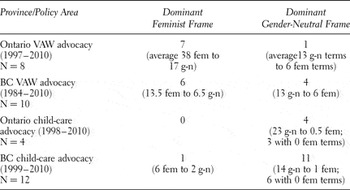
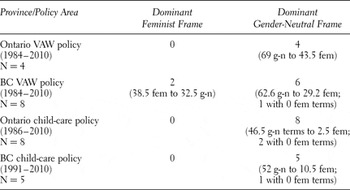
I examined a total of 59 advocacy policy papers and government policy documents from Ontario and British Columbia between 1984 and 2010.Footnote 15 I did not attempt to examine every document available over this period of time; instead, I aimed to review a fairly representative sample of dominant advocacy documents and main government policy position papers and policy texts available.Footnote 16 Advocacy documents prior to the 1990s in both Ontario and British Columbia are not included as they were not immediately available in primary form.Footnote 17 Thus, the conclusions are limited by a shorter time frame for the advocacy documents than was available for the government policy documents. The main results of the frame-and-content analysis are presented in Tables 1 and 2. An average of the content tallies of feminist (fem) versus gender-neutral (g-n) terms is included in brackets inside the tables where appropriate.
Frame and content analysis of child care and VAW advocacy documents in Ontario and British Columbia

Frame and content analysis of child care and VAW policy documents in Ontario and British Columbia

PROVINCIAL ANTI-VIOLENCE POLICY DEBATES
When we look at Tables 1 and 2, we see that despite divisions inside the provincial anti-violence movement, Ontario advocates retained a dominant feminist frame in seven of eight advocacy documents examined. Overall, there was a significant presence of both feminist and gender-neutral frames in all of the reviewed documents, with gender-neutral language slightly increasing over time. The presence of gender-neutral language had a tendency to detract from the dominant feminist frame in many instances, particularly in the Ontario movement's lobbying efforts in 2000 for all party cooperation on the anti-violence issue. We also see that the term patriarchy was used prominently in a 1997 Coalition advocacy position paper in opposition to the Conservatives’ Framework for Action on the Prevention of Violence Against Women.Footnote 18 Even though the term appeared once again in a separate 2008 OAITH advocacy document, that overarching frame was predominantly gender neutral. Thus, feminist frames on the advocacy side did not disappear over time and often dominated, despite the fact that gender-neutral language was also prominent and rose slightly over time in Ontario.
Advocacy documents in BC were predominantly framed by feminist ideas, but we also see more gender-neutral frames advanced than was the case in Ontario. These gender-neutral frames emphasized a law-and-order approach and the effects of violence on the broader “family”—themes echoed in government policy documents examined here. It is not immediately clear why BC advocates were more “mixed” in their policy lobbying than in Ontario. In the end, however, it is important to note that all anti-violence advocacy documents in both cases continued to include a feminist frame (for example, no documents registered zero feminist terms), even though gender-neutral terms were also always present.
There was more of a distinction between anti-violence government policy in Ontario and BC in the way in which governments tended to frame the issue of violence against women. In Ontario, violence-against-women policy was predominantly gender neutral in all instances. Feminist lenses were present, however, including a reference made to patriarchy in the 1997 policy, but gender-neutral law-and-order approaches (including announcements of adaptations to the criminal-justice system, mandatory arrests, etc.) were the preferred Ontario policy direction in each case.Footnote 19 By contrast in BC, feminist frames were dominant in two government policy documents: in 1984, when the anti-violence movement arguably had agency to help define and shape the issue of wife assault, which was new to the right-wing BC Social Credit government at the time; and in 1996, under the stewardship of the center-left NDP's freestanding Ministry of Women's Equality (MWE).Footnote 20 The recognition of “patriarchy” was also the most prominent in BC anti-violence government policy documents, compared with all other documents reviewed as part of this study, appearing in six out of eight instances. This also was likely attributable to the influence of the MWE and its lasting impact inside of the BC bureaucracy, particularly since it took the lead on violence against women research and policy development during the 1990s. Some feminist framing did continue after the MWE was disbanded in 2001, but we also see the only instance of a policy document devoid of any feminist terminology in 2007 under a right-wing Liberal regime.
Also in 2001, Liberal Attorney General Geoff Plant suggested that the main provincial anti-violence program should have its name changed from “Violence Against Women in Relationships” to “Violence Against People in Relationships,” ostensibly in order to recognize that “women, too, can initiate violence” (O'Neill Reference O'Neill2002, 32). Even though this change did not occur, recognition of male and female victims of female violence was included in gender-neutral frames in a 2010 Liberal policy document Domestic Violence Response. Thus, gender neutrality was dominant on the government side of the policy debate, but a favorable feminist institutional climate under the BC MWE helped facilitate feminist frames until 2001.
PROVINCIAL CHILD-CARE POLICY DEBATES
Tables 1 and 2 show a striking difference between child-care debates and anti-violence debates, with child-care debates coming up predominantly gender neutral, even on the advocacy side (the one exception is a single dominant feminist-framed CCCABC advocacy document responding to BC Liberal funding cuts). We also see the most instances of advocacy documents registering zero feminist terms (9), with three policy documents also devoid of any feminist reference terms.Footnote 21 Clearly, the feminist frame is much weaker inside child-care policy debates in the two provinces compared to anti-violence debates. Documents illustrate the strength of the social-investment perspective's elevation of “the child” as the dominant policy frame inside child-care and family policies, as opposed to “women” and “gender equality.” The related strength of early childhood education advocates inside advocacy coalitions was also evident in both provinces.
In Ontario, advocates cast child care predominantly as a “family” issue and emphasized the economic benefits of child-care provision inside a gender-neutral frame. BC advocates followed suit with little change in direction over time. BC was also more apt to stress the educative benefits of child care and to cast it as a children's issue following trends set nationally and internationally. Even though they did not dominate, feminist frames were present, including references made to “patriarchy” in 2003 and 2009 BC advocacy documents, but these frames were only dominant in one of 12 documents under review.
On the government policy side, all documents examined in both provinces were predominantly gender neutral. The most “feminist” was the 1991 BC Task Force on Child Care report, which received submissions from a wide variety of child-care advocates across the province, including feminist groups, which might explain the increased feminist framing. Yet even in this instance, the balance of coverage emphasized “children,” “the family,” and the “economic benefits of child care to society” above issues surrounding “women's equality.” The trend in both BC and Ontario in child-care policy into 2010 was more solidly gender neutral. The Ontario 2009 early-learning planning document on full-day kindergarten for four- and five-year-olds was overwhelmingly gender neutral in frame. The content analysis for this document counted 233 gender-neutral terms, opposed to only 9 that were feminist. Similarly in BC, the Early Childhood Learning Agency's expansion document querying the potential for full-day kindergarten for three- to five-year-olds was also overwhelmingly gender neutral; it tallied 104 gender-neutral terms to just 1 that was feminist. While child care may have been seen as a gender-equality feminist issue in the early 1970s, this had certainly changed from the 1980s to the 2000s. As noted by a former director of the Child Care Policy Unit inside of the BC Social Development and Economic Security Ministry, child care was “beyond a feminist issue now.”Footnote 22
WHAT IS WRONG WITH MIXED FRAMES AND THE POTENTIAL OMISSION OF GENDER EQUALITY FROM CHILD-CARE AND ANTI-VIOLENCE-AGAINST-WOMEN POLICY DEBATES?
From the BC and Ontario cases, we can see there there has been movement away from initial iterations of anti-violence and child care as mainly “gendered” policy areas since the 1970s. Yet it is important to note that in both cases, the shifts have been incomplete. Feminist frames are still present in child-care debates (even inside mixed advocacy coalitions) and actually remain dominant inside anti-violence advocacy documents, although even here gender-neutral frames are present, particularly on the government side. Advocates and policymakers on the child-care side are more apt to debate the merits of child care from a gender-neutral perspective, yet feminist frames are also still present, albeit in much smaller numbers than with anti-violence policy actors. The evidence thus demonstrates that overall, both policy debates occur inside mixed frames.
The advocacy strategy of watering down feminist frames and language and varying the messages inside child-care and anti-violence policy debates has not been without certain benefits. For example, the first steps toward a universal child-care program in BC occurred briefly under the Dosanjh NDP government in 2000 with its announcement of a seven-dollar-a-day after-school program—the initial stage of a promised universal program. This small success was couched in gender-neutral frames from the outset, evident when Premier Dosanjh announced the child-care plan invoking data from the Cleveland and Krashinsky study, citing economic benefits associated with better child-care services (Collier Reference Collier2006). Thus, an argument could be made that using gender-neutral child-care language in this instance, as well as working alongside nongendered advocacy partners, helped facilitate a positive policy result, even in a neoliberal/social investment context.
Short-term goals notwithstanding, I argue that there is a real danger to any shift away from gender equality in the anti-violence and child-care policy debates. When we look back at the BC example, it is important to note that even this watered-down reasoning for a step toward universality in child-care delivery resulted in a short-lived “gain.” The Liberal Party that won office in 2001 was quick to cancel the seven-dollar-a-day program, and the issue of universal child-care delivery was removed from the BC government's agenda (Collier Reference Collier2006). Indeed, feminist child-care researchers have noted similar dangers with the national-level child-care movement:
The risk involved is that the measures eventually adopted . . . may be a vastly watered down version of what advocates want. Thus, child care advocates might achieve success—that is, the establishment of some kind of child care and early childhood development programs in each province and territory—only by sacrificing their core goal, which is to achieve a comprehensive national daycare system. (White Reference White and Prentice2001, 111).
This phenomenon has been noted in frame-reflective policy research. While not mentioning gender specifically, Rein and Schon (Reference Rein, Schon, Wagner, Weiss, Wittrock and Wollmann1991) argue that different and competing perspectives on issues will likely fail to be properly represented within policy debates themselves and also in the actual policy results, when one frame dominates. They suggest that “different frames . . . lead [policymakers and SMOs] to see different things, make different interpretations of the way things are, and support different courses of action concerning what shall be done, how it shall be done, and by whom” (pp. 264–65). If feminists, then, are not in control of these frames or are the weaker voice within advocacy coalitions, then it follows that their perspectives will likely not be seen or adopted by decision makers, a phenomenon shown by the evidence in BC and Ontario, where policy in both arenas is dominated by gender-neutral framing. When feminists are not making a “clear and consistent case” for gender equality, the situation is further compounded. With neoliberalism/the social-investment perspective privileging gender-neutral language and demonizing feminist frames, it is clear that mixed feminist language and an increase in gender-neutral discourse will likely lead to nonfeminist policy results.
For feminist child-care movements, this has meant that a publicly funded, quality universal child-care program available across Canada continues to be an elusive goal. According to Mahon, the policy environment within which child care activists operated beginning in the 1990s saw “universally accessible care [as] increasingly utopian” (Reference Mahon, Mahon and Michel2002, 15). She argues that neoliberal welfare-state restructuring has made the terrain for child-care lobbying increasingly difficult as “employability concerns, calls for greater ‘choice’ and/or the projected demands of an emergent ‘knowledge based economy’ jostle with gender equality as possible rationales for new child care initiatives” (2002, 14); the latter seem to be losing the fight for legitimacy. Michel (Reference Michel, Mahon and Michel2002, 334) adds that the coalitions in which feminists find themselves often are a “source of frustration”:
The terms of such alliances may require feminists to cloak their own support for child care in the rhetoric of another interest group (early childhood education, as we have seen, being the most common). In consequence, though the resulting provisions may well benefit certain groups of women and children, they may also do little to advance the cause of feminism.
There are obvious parallels with the Canadian feminist anti-violence policy debate as seen in both the BC and Ontario examples. The larger feminist goal of addressing systemic power relations and inequalities between men and women—one of the key causes of violence against women—has been either absent from, or mixed up with, more gender-neutral claims inside contemporary anti-violence policy debates, oftentimes confusing the central messages. While anti-violence advocacy has remained feminist on balance, government policy responses remain stubbornly gender neutral, widening in scope to include all members of the “family” that may be impacted by domestic violence, including men. This trend is evident at the federal level as well, with Statistics Canada renaming its reports on violence against women “family violence” reports and conducting surveys showing that men “are as likely to face abuse from their partners as women” (Newman and White Reference Newman and White2006, 187).
Violence against women and violence against men, however, remain distinct problems. Weldon (Reference Weldon2002, 10) makes a strong case for the necessity of a feminist gender-based analysis:
Men and women tend to be victims or perpetrators of different kinds of violence, under different circumstances. Men are more likely to be assaulted by strangers (usually men), while women are more likely to be assaulted by intimates or people they know, usually men. This is because violence against women is largely a result of women's economic and social dependence on men, as cross-cultural studies have demonstrated.
Thus, the focus on other forms of violence and a watering down of the gendered nature of violence against women as a social problem increase the likelihood that policy responses will not be able to offer adequate solutions to the problem. Those solutions need to address “women's economic and social dependence on men” by acutely focusing on systemic gender inequalities, which, arguably, are only visible from a feminist perspective that sees differences between men and women. Lombardo and Meier (2006, 160) further argue that “[t]he rare presence of gender experts and the almost non-existent voice of feminist movements in official texts means that the contribution they could offer to the framing of the problem and solution of gender inequality in politics is de facto limited.”
CONCLUSIONS
While debates and tensions within women's movements are inevitable and, in most cases, are healthy ways for those movements to be fully representative, particularly with respect to issues of intersectionality or diverse ideological perspectives, I argue that women's equality goals can remain stubbornly elusive when SMOs approach child care and anti-violence against women policy advocacy from a gendered perspective alongside a more gender-neutral one. While the limited discursive frame-and-content analysis presented here for Ontario and British Columbia notably shows that “women” and “gender equality” are not completely absent from policy discussions, in most cases feminist messages are muted or confused with more state-friendly gender-neutral frames and have become more so over time. While it is impossible to state definitively that mixed framing “causes” gender-neutral policy responses, it appears to contribute to women's lack of power inside policy debates to define both problem and solution. Even though feminist voices did not disappear (a fact suggesting that the focus on male and female differences continues inside of advocacy coalitions), feminist language/framing was not adopted by the state in policy responses. The evidence presented here also suggests that feminist policy agencies, like the former freestanding Ministry of Women's Equality in BC, can help facilitate gender equality dialogue and framing, but more research is needed to further establish this link.
In an era of neoliberalism/the social-investment perspective, it has certainly become more attractive for advocates to pursue short-term anti-violence and child-care policy gains by casting lobbying demands in nonthreatening language that appeals to government policymakers. Yet when those policy gains make scant or no mention of women's equality, we should question whether or not they are “gains” at all. A shift in lobbying focus that obscures the centrality of women inside anti-violence and child-care policy debates, and thus their differences from men, may continue to derail earlier gains to feminist child-care and anti-violence policy and take us further away from long-term structural solutions to these problems. While it is beyond the scope of this article to suggest how to combine the arguments for sameness and difference raised by Vickers, it seems clear that the more we tip toward the sameness side of the debate, the more feminist voices lose power inside these policy circles. Thus, over time, feminist women may lose what little legitimacy they currently have to continue to speak on these issues.