1. Introduction
Historically, gas networks used to have characteristics of private goods. Gas network infrastructures were built and used according to the interest of their owners. Following the terminology of Ostrom et al. (Reference Ostrom, Gardner and Walker1994), infrastructures were excludable (as physically it is relatively easy to exclude individuals to use gas infrastructures) and subtractible (the use of network infrastructures decreases the available capacity). On the other hand, gas network infrastructures are dedicated assets (because of the existence of significant scale economies: suppliers often use just one or few pipelines) and also site-specific assets (as they cannot be easily moved). These characteristics are the source of severe transaction costs, and hence one should expect strong reliance on vertical integration (or quasi-vertical integration) among users and pipeline owners, as discussed in e.g. Mulherin (Reference Mulherin1986), Masten and Crocker (Reference Masten and Crocker1985) and Weiner and Hubbard (Reference Hubbard and Weiner1992). Put it differently, transactions considering network infrastructures were largely coordinated by large integrated firms, with gas suppliers or with gas distributors.
In the last decades, most of the developed countries restructured their natural gas industries. That restructuring essentially consisted in transforming former vertical integrated industries into market-based industries, as far as possible. In other words, some of the activities in the supply chain were opened up to competition. This objective drove the redesign of rules in order to avoid that the monopoly characteristics of infrastructures became an entry barrier for the resulting market. That is, the use of the same infrastructures by different players is at the core of the reform.
In this context, many authors consider natural gas pipelines as public goods, see for instance Newbery (Reference Newbery2002) and Ruff (Reference Ruff2012). The logic for considering networks as public goods comes from the fact that the infrastructure should be used in the same condition by all players in order to facilitate competition in the commodity market. Actually, non-discriminatory rules were established in every reformFootnote 1. These rules do not mean the impossibility to exclude players, but they make it institutionally more difficult (due to open access policies) and increase the exclusion costs (measurement and monitoring cost). These costs and restrictions did not exist with vertically integrated firms, as exclusion was defined by pipeline ownership. Under the restructured scheme, networks become costly to exclude and the infrastructure ownership does not define anymore the rights of use. Besides, gas network services are subtractable as the infrastructure facility can be overused causing congestion (in the short term) and decreasing the life-time of equipment (in the long term).
Therefore, after restructuring, the use of the same infrastructure by different players raises a new challenge: how different shippers should coordinate among them to share the available resources. The analysis developed in this paper allows us to point out the importance of considering network infrastructures under ‘open access’ regimes as common-pool resources and, consequently, of dealing with the intrinsic trade-offs to this kind of good. Moreover, the definition of gas transmission rules becomes still more challenging because the network can deliver at least two different kinds of valuable services: transmission and storage (line-pack storage), so the subtraction of one unit of transmission (storage) services decreases the available resources for storage (transmission) services. From demand's viewpoint, gas shippers may have different preferences for one service or the other, and these preferences may change according to market conditions. The use of transmission services depends on what will be the shipper's use of the gas. Industrial consumers, residential consumers and gas-fired power plants have different needs of transmission and line-pack storage. The heterogeneity of players, as explained by Ostrom (Reference Ostrom2005), brings new challenges for the definition of rules, or how to agree to a rule setting. In that context, the higher the heterogeneity of players’ preferences, the higher the need for communication.
Besides, many of energy policy debates have been focused on what are the efficient network rules. For instance, in Europe, the debate has been focused on network rules (Harris and Moselle, Reference Harris and Moselle2007), whereas in USA, the discussion has been focused on what kind of contract clauses has been developed to face demand requests (Goddard, Reference Goddard2010; KeySpan, 2008). In this paper, we update the theoretical framework, in order to be able to explain and include current policy discussions. In contrast to the main focus of previous literature (namely the length of contracts), we show that rules play a double role: on the one hand, they avoid congestion, and on the other they allocate resources among heterogeneous consumers.
Initially, the rules avoiding congestion could seem simple: one would only need to determine the maximum transmission capacity and then define a suitable allocation rule. Even in the presence of two different services, one may argue that the definition of optimal allocation rules and prices leads to an optimal solution. However, the definition of ex-ante allocation rules becomes complicated when not only is players’ heterogeneity introduced, but also dynamic preferences. In this context, the definition of rules or prices ex-ante does not guarantee the efficient allocation of resources. In that view, we show the potential advantages of ex-post rules. To that end, the need to share information and rights becomes important to achieve it. This can be put in terms of who decides the network rules. We show this using a simple game.
The paper is structured in six sections. After this introduction, Section 2 describes how the gas pipelines become an open access infrastructure. Section 3 discusses the common pool nature of gas networks in liberalized frameworks. Section 4 shows their service heterogeneity: gas network services are a specific kind of common-pool resource where heterogeneity matters. Section 5 uses some games to illustrate how the rules to define network service characteristics impact on the output. The last section concludes.
2. Opening the access of gas networks
The common-pool-resource concept has been usually applied to natural resources, but as underlined by Ostrom (Reference Ostrom2005) ‘the theoretical arguments are relevant to man-made common pool resources’. In that view, as we show in this section, the current gas industry is a nice playing field for the use of common-pool resource theory. That comes from the fact that, in the process of restructuring the gas industry to implement market arrangements, a key element was the ‘open access’Footnote 2.
The open access of the natural gas pipelines are a consequence of a regulatory change. In other words, the cost to exclude a shipper to use a pipeline is not necessarily high. But under ‘open access’ the cost becomes relevant. As a consequence of the ‘open access’ to the gas network, the analysis must change the focus from the characteristics of the facility infrastructure to the flow of servicesFootnote 3. And the characteristics of the flow of service are quite different of the characteristics of the infrastructure facility. For instance, it is fairly different from the cost to observe and measure what is happening inside (flows) or outside (infrastructure facilities) the infrastructures. In the first case, the analysis of how one player impacts on the capacity available to others depends on accurate and frequent measurement (regarding time, local, pressure, quality and volume of intakes and off-takes), whereas in the second case, externalities among infrastructures is less frequent (only at the moment of investment decisions) and easier to observe.
But open access has no clear-cut definition. Its precise meaning strongly depends on the particular regulatory frame. As examples of that, we describe two cases: open access according to the European UnionFootnote 4 and to the Federal Energy Regulatory Commission in USA.
Open access in the European Union
In the European Union, open access was established in the Directive 98/30/EC of the European Parliament and of the Council of 22 June 1998 (the First Gas Directive).
The first directive only defined that pipeline access shall be provided in manner determined by Member States, with the objective of fair and open access, achieving a competitive market in natural gas and avoiding abuse of dominant positions. In this first moment, the meaning of open access was vague and allowed varied interpretations. The second directive, (EC, 2003), defined the implementation of regulated Third Party Access. The interpretation of this directive led the EU Member States to define an ‘ex ante’ set of rules for infrastructure use. The definition of these rules depends on a third party (frequently a regulatory body but also may include other governmental bodies such as the Ministry). The third directive, (EC, 2009), did not change the main concept of the regulated Third Party Access, but it established the need to establish common (or harmonized) rules in the EU countriesFootnote 5. It meant that every shipper could access the network following a regulated set of procedures and paying a regulated tariff. According to the article 35 of EC (2009), the refusal to grant access would be possible whether there was lack of capacity and/or it could bring safety risk. However, duly substantiated reasons shall be given for any such a refusal. In the long run, Member States may take the measures necessary to ensure that the necessary enhancements are promoted in order to avoid refusals. That is, there is a strong effort to increase the difficulty to exclude players from accessing network services, as the network access is seen as a key element for promoting the wholesale gas market.
Open access in the United States
In the United States, the open access of network services has been claimed also as one of the main elements of the gas market liberalization and developmentFootnote 6. However, even if the meaning of open access in USA is different from the EU, we also observe an increased difficulty to exclude players from using the infrastructure.
In the US, the liberalization started almost two decades before Europe. In 1985, the Federal Energy Regulatory Commission (FERC) announced Order No. 436, which introduced voluntary open access for the interstate gas pipelines (Marston, Reference Marston1991). Pipeline companies could choose to be only a transporter of the gas (open access) or carry their own gas (remaining private carriers but keeping their gas price regulated). In 1992, FERC introduced Order No. 636, which required pipeline companies to fully unbundle gas trading from pipeline operation activities, and to set up separate transportation and trading affiliates. In other words, pipelines were forbidden to carry their own gas and forced to carry gas of third parties (Makholm, Reference Makholm2012). The key consequence of the Order N. 636 was the complete separation between the ownership of the infrastructure and the services provided.
The Federal Energy Regulatory Commission (FERC) regulates many aspects of interstate gas transmission pipeline operations, including approval, permitting and site for new pipeline facilities, as well as transmission rates that pipelines are permitted to charge for interstate shipments. The rules of service access, however, are negotiated among pipeline owners and shippers. Hence, the rules of network use are defined in the contract between the shipper and the pipeline and are supervised by FERCFootnote 7. So, differently from the European scheme, the rules of infrastructure use are defined by negotiation between the implicated players, and the third party (FERC) plays a role in case there is no agreement. The exclusion of a player from the access to the pipeline depends on the pipeline available capacity and in the rules defined between the pipeline and the users (in case that the exclusion is not justified by the pipeline, the shipper may require the intervention of FERC). Therefore, the ownership of the infrastructure does not define the rights of use of the infrastructure; those rights are defined by the service rules. Consequently, the definition of these rights becomes more costly, because the costs of measuring and enforcing those rights are greater than the costs to define rights of infrastructure ownership.
3. The creation of common-pool resources as consequence of open access in the gas industries
‘Common pool’ resources are defined by Ostrom (Reference Ostrom2005) as goods that are subtractable and where exclusion is costlyFootnote 8. So, the first step is to analyze whether gas transmission resources, after restructuring the industry by network services ‘open access’, fit in such a definition. In that view, as discussed by Ostrom (Reference Ostrom1990), it is important to differentiate the resource system, which in our analysis is the gas network, and the flow of resource units, which in our analysis are services provided by the network. Thus, subtractability refers to a situation where the use of a resource unit (as pipeline transmission services or pipeline storage services) decreases the available amount of resource units (units of network services) in a certain period. Excludability refers to the cost to exclude a user from withdrawing a unit of resource (a unit of network services) in a certain period.
Subtractability
As explained by Ostrom et al. (Reference Ostrom, Schroeder and Wynne1993b), it is important to highlight that, in general, an infrastructure that can be used by many players can be considered a subtractable service,Footnote 9 and it is especially important in the case in which the flow of services is scarce with respect to demand. Natural gas networks are a combination of pipelines and compressors. The gas flows from the higher pressure point to the lower pressure point, limited by the technical characteristics of the pipeline system. If the pressure differential between two points is lower than the pipeline material resistance, the gas will remain stored inside the pipeline. The limit of gas volume that can be transported/stored is largely limited by the pipeline characteristics and the compressor potential.Footnote 10
The flow of services that a gas network may offer is limited, that is, the use of the flow of services by a player decreases the amount of the available flow of services in the same period of time. Hence, the overuse of the gas network services may generate congestion or even safety risks, which is negative externality for all the network users and may be a problem even for players geographically close but not economically related with the infrastructure.Footnote 11
Excludability
Gas networks are ‘naturally’ excludable goods, in the sense that it is not particularly difficult to exclude individuals from the use of the gas network. However, restructuring gas industries implied opening the access to gas pipelines (for instance, United States and European countries) in order to promote competition. As explained by Ostrom and Hess (Reference Ostrom and Hess2010), open access can be a consequence of conscious public policy to guarantee the access of all players for the use of a resource. That is the case of gas transmission pipelines. The precise meaning of that ‘open-access’ is quite diverse, as was shown in Section 2. However, all share the characteristic that the infrastructure owner has no right to discriminate users, and should allow a large number of players to access the infrastructures. Therefore, despite some differences in the implementation of open access, all cases are characterized by the choice of creating difficulties to the exclusion of players from accessing the network services. The other side of this process of decreasing excludability is the creation of access's rules. The logic for that can be thought to be that, in the presence of common-pool resources, it is necessary for the definition of some rules.Footnote 12 In the absence of suitable rules, incentives may lead to network overuse.
In that view, we may classify exclusion in the context of gas pipelines under two headers: exclusion to access the resource system (physical connection and permission to carry gas), and exclusion to access resources units (right to use the system). Open access policies required a series of characteristics and rules for the player to fulfill in order to obtain permission to carry gas. Thus, it is possible to argue that excludability decreases but it exists. Nonetheless, once the player becomes a shipper (obtains permission to carry gas), the ability of excluding the shipper to use a specific flow of service becomes much lower.Footnote 13 Consequently, after the player becomes a member of the group of users (a shipper), she has incentives to overuse the service. The entry procedure does not guarantee that players use the resources efficiently. It will depend on the incentives of shippers (benefits and costs of using the services in the different ways). In gas industries, the decision of what kind of service shippers may use depends on the rules of use of the network.
4. Gas network services: heterogeneity and rules
Because of the physical characteristics of the infrastructures, it can be used for transporting or for storing gas. Both services subtract from the total available services, but they do not subtract the same amount of network service units. The combination of storage and transporting services preferred by a shipper will depend on her characteristics. Simplifying, we may say that industrial consumers prefer the simplest service (essentially transporting); but gas-fired power plants require a significant amount of storage in addition to transporting services.
This section clarifies the meaning of the different kinds of services that shippers may use, and we show that the different kinds of services impact the available flow of services differently. After that, we will discuss who decides and how is decided the kind of services available.Footnote 14 Natural gas pipelines are able to offer at least three kinds of services, which are: (1) transport of gas between two points in a determined point in time; (2) transport between two regions (being each region a set of points) in determined point in time; (3) transport and storage of gas (different timing between the moment of injection and withdrawal of gas) (Vazquez et al., Reference Vazquez, Hallack and Glachant2012).
Transmission services between regions (2) and the use of the line-pack storage (3) are actually the offer of flexibility services, both time and spatial flexibility (Hallack and Vazquez, Reference Hallack and Vazquez2013). We will call such services flexible transmission services. Point-to-point services (1) will be called flat transmission services.
The physical system may deliver different services and the different services impact differently in the availability of resources. In that view, the use of flexible services decreases more than proportionally the availability of flat services units. In that view, flexible services subtract network services flow in a different manner than flat services.Footnote 15 The exact value depends on the physical features of the infrastructure facility and on the amount of flexibility: temporal flexibility (hourly, daily, weekly,. . .) and spatial flexibility (the size of the region where the gas can be injected and withdrawn).Footnote 16 Thus, the relationship between the opportunity cost of offering flexible and flat transmission services depends on physical characteristics of the network components: compressor stations (mechanical characteristics, position and power,. . .) and pipelines (size, diameter, material, thickness,. . .) (Glachant and Hallack, Reference Glachant and Hallack2010).
Two of the key examples of rule of use are the balancing rules and localization of the entry and exit of the flows. The balancing rules define how long the shipper can maintain differences between injection and withdrawal from the network (by using line-pack storage). Strict balancing rules, with short periods, mean that the network services flows would be flat. In other words, it prioritizes transmission over storage. Loose balancing rules mean that large periods with unbalances are allowed, so that line-pack storage will be extensively used, decreasing the availability of transmission services.
The localization rules define where natural gas can be injected and withdrawn. They can also be more or less strict, depending on the actual physical possibilities (number of pipelines interconnected) and on the service flow rules. Strict rules mean that it is defined exactly where the gas is injected and withdrawn (i.e. point-to-point transmission). It means the service is flat (not allowing changes) and more units of services flows can be available to others. On the other hand, if the localization of injection and withdrawal is broad (e.g. in any point of a country), the number of available resource units is lower.
For instance, in Europe, the balancing and localization rules are homogenous. Every player has the same rights and duties and pays the same tariffs, that is, it is obliged to have the same kind of network service flow. In the US interstate pipelines, the delivery points as well as the period of injection and withdrawal are heterogeneous. Players with different characteristics negotiate how flexible (regarding withdrawal points and balancing periods) the network services are. The tariffs also depend on how many service units are required by the shipper (knowing that flexible services require more service units than flat services). In this case, the service characteristics are heterogeneous, allocating costs and resources heterogeneously among shippers.
We will show in the next section, by means of simple games allocating flexible versus flat services, that the way to define the facility rules, that is, defining the kinds of services that will be available, can change the outcome.
5. Different uses of the gas transmission resource: analyzing games outputs
In this section, we show how rules of network use impact on the final output. By analyzing simple games—as in Ostrom et al. (Reference Ostrom, Gardner and Walker1994), we will show how the rules of transmission system allocation can generate incentives for diverse outputs.
For the sake of simplicity, we reduced the actual infrastructure facility rules to two kinds of services: flexible (flex) and flat. In order to represent the regulated allocation rules,Footnote 17 we simplify using the idea that assuming that allowing rules with flexibility (e.g. daily balancing rules) means an allocation rule that gives priority for using capacity to provide flexible services. Putting it differently, the infrastructure is allocated first to provide service units in flexible way, and then the rest available resource units are allocated to flat services. On the other hand, non-flexible rules (e.g. short balancing periods and or point-to-point transmission) means an allocation rule that gives priority to flat services, that is, services are first calculated and allocated for flat services and subsequently the available capacity is used to provide flexible services.
In order to introduce the possibility to use players preferences to design the rules (the kind of available service), instead of imposing an allocation rule, we allowed shippers to exchange rights, not just the rights to access the service, but the rights of deciding how to allocate resource units among different services.
Potential prisoner's dilemmas when networks offer different products
The first step of our reasoning is to put forward a simple example of a commons’ dilemma in gas networks. Consider a simplified model of a gas network that two players can use. Both players obtain the same value for the flat use of network vflat = 6 and a value for the flexible use of the network vflex = 10. Players decide on two possible options: using 2 MW of flat network capacity, or using 1 MW of flat capacity plus 1 MW of flexible capacity, that is, we are first supposing that flat and flex extract the same amount of services units of the available amount.
Game 1
Let us assume first that the network capacity is 4 MW regardless of the combination of flat and flexible use of the network. For the same transmission system, the amount of available flex capacity is equivalent to the amount of flat capacity.
The grey box of Table 1 represents the equilibrium of the game. In this case, there is no commons’ dilemma regarding the rules of resource allocation. But the result is based on considering that the services offered by the transmission network are equivalent for the system (the use of flexible capacity subtracts the same amount of the available capacity than flat capacity). It means that whether the use is flexible or flat is irrelevant, as they affect the others players the same way.
First game illustration

Game 2
Nevertheless, in practice, flexible capacity subtracts more from the available capacity than flat capacity. Hence, the impact of flexible demand for network capacity is different from the impact of flat demand. Flexible services demand more capacity from the total capacity of the system than flat services. To illustrate this, consider the following modification of the initial game: the capacity of the network, if both players choose to use it flat, is 4 MW. If one player chooses flexible use, the flat capacity is 2 MW and the flexible capacity is 1 MW. If both players use the network flexibly, the flat capacity is zero and the flexible capacity is 2 MW. It means that the use of flex capacity (1 MW) leaves less available flat capacity for further allocation than the use of flat capacity (1 MW).Footnote 18
Capacity allocation 1
If the demand for network is higher than its capacity, the rules for allocating network capacity are the following: (1) the capacity is allocated equally among users and (2) the flex capacity is allocated first (there is priority for flex capacity before the allocation of any flat capacity).
In this second game, the equilibrium is represented by the grey box in Table 2. We observe a prisoner's dilemma because players have to choose between more capacity or more valued capacity. If the other player chooses valuable capacity, the amount of your own capacity is restricted. The use of the rules allocating capacity to both shippers equivalently and giving priority to flexible capacity results in prisoners’ dilemma outputs.
Second game illustration

But it is possible to consider a different allocation rule.
Capacity allocation 2
If the demand for network is higher than its capacity, the rules for allocating network capacity are the following: (1) the capacity is allocated equally among users and (2) the flat capacity allocated first (there is priority for flat capacity allocation before the allocation of any flex capacity).
In this game, the equilibrium is represented by the grey box of Table 3. We observe that the previous dilemma is now solved by giving priority to the allocation of flat capacity.
Third game illustration

Lessons from the examples
We observe that the game output depends (1) on the characteristics of the services offered and (2) on the allocation rule. The game outputs change depending on whether the impact of services in the system is equivalent or not. In the former case, in case of excess of demand, the capacity is used equivalently by the two kinds of services. However, if the use of a unit of flexible service impacts differently on the system, it raises the question of how to allocate capacity in case of congestion. We showed that we generate different outputs, depending on whether flex services (more valuable and more costly) or flat services (less valuable and less costly) have priority in the use of the system. In that view, it may be possible for the pipeline operator of the previous examples to anticipate that flat capacity is more efficient, and thus the process of capacity calculation could do the coordination. We show below that this is not the case in presence of players’ heterogeneity.
Including players’ heterogeneity in the game
The simple examples developed earlier show that the definition of the rules allocating network services may be central to avoid dilemmas in the choice of network use, when the services offered have different costs for the system. We may assume that some fixed mechanism (priority for flat capacity, in the example earlier) is able to allocate common resources among players, taking into account their preferences and the system costs. However, in the presence of players’ heterogeneity, this might not be straightforward. Consider a simplified model of a gas network that two players can use. The two players have different preferences (thus give different values) for flexible and flat capacity. The first player obtains a value for the flat use of network v flat = 6 and for the flexible capacity vflex = 10. The second player obtains a value for flat capacity v flat = 6 and for flex capacity v flex = 30.
Let us consider the two options for capacity allocation of the previous section.
Capacity allocation 1
If the demand for network is higher than its capacity, the rules for allocating network capacity are the following: (1) the capacity is allocated equally among users and (2) the flex capacity is allocated first (there is priority for flex capacity before the allocation of any flat capacity).
Capacity allocation 2
If the demand for network is higher than its capacity, the rules for allocating network capacity are the following: (1) the capacity is allocated equally among users and (2) the flat capacity allocated first (there is priority for flat capacity allocation before the allocation of any flex capacity).
First of all, the use of the network depends on the rules of network use. But in this case, contrary to the first examples, we are not facing only a prisoner's dilemma. Both equilibria are maximizing the welfare of the corresponding game. What these examples show is that the pipeline operator, in the process of calculating the capacity, is inducing different games. Moreover, the distribution of the social welfare is not the same in both allocation schemes.
The conclusion that can be drawn for the games with heterogeneous users is that there is one solution for capacity that makes the flat player end up better off than in the other solution. Therefore, the initial mechanism considered to allocate capacity, characterized by a pipeline operator using the capacity calculation to coordinate the use of the pipeline, cannot be done efficiently in the case of heterogeneity. The capacity calculation process defines the game that network users will be playing, and thus the rules for network use affect the use of the network.
Adding negotiation to reveal preferences
Consider a case where the final capacity calculation (of flat and flexible services) takes into account players’ preferences. To represent it, we allow players to sign contracts without any ‘a priori’ constraint on services. The pipeline operator does not know a priori about the use of the pipeline and the definition of services would depend on the negotiation of services users. For that it is necessary to create the mechanisms for players to reveal their preferences. Hence, players should negotiate (and commit) before the capacity calculation takes place. It is necessary to have mechanisms allowing communication in the contracting process. Consider that a pipeline operator is trying to allocate pipeline capacity efficiently. To do so, some bidding mechanism may be established in order to allow players to reveal the kind of service they need and how much they are willing to pay for them. This negotiation may be done through bilateral negotiations or through auction-like processes. In this game, we introduce the bilateral negotiation.
The illustration here uses the examples stated earlier (Tables 4 and 5), where the choice of the priority rules actually defines winners and losers. Our intention here is not arguing that negotiation necessarily improves welfare,Footnote 19 but to point out the changes in the game where decision makers change (from the system operator to users). The main point to highlight in this example is that sharing information ex ante may help define the optimal set of rules. The situation we describe builds on the possibility of two possible contracting options. Both contracts involve implicit commitment of the pipeline operator.
Heterogeneous players: Game 1

Heterogeneous players: Game 2

These contracts are:
(1) The first one gives priority to flat services and player 1 commits to 2 units of flat capacity. Hence, the equilibrium is that player 2 takes 1 flat capacity 0,5 of flexible capacity and the outcome is (12,21), as in Table 5 earlier.
(2) The second one gives priority to flex services and player 2 commits to one flex capacity. Hence, the equilibrium implies that player 1 also chooses 1Flex and the payoff is (10,30), as in Table 4 earlier.
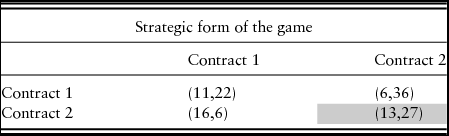
Player 1 would prefer to commit to 2 units of flat services but player 2 would prefer 1 flex unit. As there is no exogenous rule that defines who wins, they need to negotiate. As player 1 knows that player 2 will try to induce the second equilibrium, she commits to an additional payment. Such payment is so that player 1 still prefers the first equilibrium, so if both players sign this contract player 1 pays to player 2, as illustrated in table 6. The payment need to be:
(1) High enough so that player 1 have a payoff at least as good as it was in the case of priority to flat services, and
(2) Low enough so that the payoff of player 2 is still higher than in the case of priority to flat services.
The role of negotiation
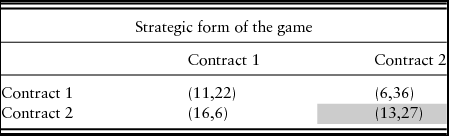
In order to illustrate the previous process, we will define a type of negotiation that may occur between player 1 and 2 in order to increase both payoffs. The first contract says that player 1 commits to choose 2 Flat and that the capacity will be that of the first equilibrium. As she knows that player 2 will try to induce the second equilibrium, she commits to an additional payment. Such payment is so that player 1 still prefers the first equilibrium, so if both players sign this contract player 1 pays one euro to player 2.The second contract says that player 2 commits to choose 1 Flat–1 Flex and that the capacity will be that of the second equilibrium. As she knows that player 1 prefers the first equilibrium, she specifies an additional payment of 3 in the case that both players sign the contract.
Finally, if players do not agree to a contract, the pipeline operator chooses the most valued of the previous equilibria. In this instance, the pipeline operator chooses the second equilibria.
This last example shows that, if players were able to negotiate their capacity,Footnote 20 they would be able to find a better solution, which allows them to maximize the welfare through the redistribution gains.
In order to extract lessons from this last game, note that the first assumption of our analysis is that different players may use the transmission system, but they need to follow some rules. These rules can be defined ex ante (through rules on which kind of service has priority). But we showed in this last game that the rules might be defined and implemented by a system of contracts. This implies a definition of the rules for network use by users’ negotiation, so the pipeline operator is not involved in the definition of the game. Assuming that users have more information about the value they give to flat and flex services, they may be able to arrive in a better solution if they are able to negotiate.
But it is important to note that our aim is not representing a complete process of negotiation and renegotiation. As we highlight in the beginning of this section, we are describing a static situation that maybe not a contracting situation but, for instance, a one-shot auction. Actually, what one finds in practice (as described for the case of the US system) is a system of contracts between shippers and pipeline owners. The main characteristic we are underlining is that pipeline owners receive all shippers’ information before the decision on capacity offer is made, and with that information, pipeline capacity is decided on. Therefore, even if the pipeline owner is counter-party of all contracts, it is not deciding on the offer of capacity in the pipeline system. In that view, the situation is similar to the one described by our last game.
Lessons from the simple games earlier
The sequence of simple games stated earlier shows how the inclusion of complexities in the relationship between players may strongly affect the outputs. We begin with the simplest case, in which the services are homogenous (both cost the same as they withdraw the same amount of resource flow units) and players have the same preferences. It is easy to see that there is no conflict: both will demand the same kind of service.
In a second step, we considered that services can have heterogeneous cost. That is, they subtract different amount of units from the available resources.Footnote 21 In this case, as one of the services decreases a greater amount of available resources, when the demand prefers the most expensive service, the pipeline will not have enough services. Thus, one faces the need to decide a rule that decides the way in which available resources are allocated. The objective is to ensure open access, and one needs to define rules to use services. To that end, we study two basic examples of usage rules: rules giving priority to flexible use and rules giving priority to flat use. In the first case (which is priority for the more costly service), it leads to a prisoner's dilemma situation; in the second one, we end up with the design of an efficient solution. Consequently, the design of rules matters when we have heterogeneous services, but it is possible to find the efficient rule which leads all players to efficient solution.
In the third step, we considered heterogeneous players (they valued differently the available network services). In this case, each of the rules considered benefits one player instead of the other. That means that the rules actually change the distribution of profits among players, so it is not possible to define which the most efficient rule is. In that third step, we could not define the ‘best’ ex ante rule, but we analyzed the possibility that players reveal information. Using the possibility of negotiation as a simple description of information revelation, we allowed players to define the rule that should be used and the profit transfer among them. In this case, we illustrate how players could find the ‘best’ set of rules. Nonetheless, we do not include the costs associated with the ‘negotiated’ solution (e.g. transaction costs), so that it is not possible to assert in general that the negotiated solution is better than the regulated one. Our intention is just underlining that revealing players’ information may play a role in finding the best rules of network use.
The previous sequence of games is aimed at showing step-by-step the consequences of the different ways to implement open access. The set of games using ex ante rules is aimed at representing the EU approach. Actually, such definition of ex ante rules has become the model adopted by the EU countries and recommended by the EU institutions. The ‘regulated’ approach has led to the homogenization of the services offered. As shown in the games, if users’ profiles are similar, it is feasible to find a common set of rules that, applied to the group of users, allow an efficient management of resources. The game implementing negotiation is aimed representing (schematically) the US approach. It highlights the differences associated with using a negotiated process to define the rules. In practice, under the US approach, it is possible to observe a relatively large amount of contract types. This, in turn, allows different flexibility degrees and flexibility types. Network services consider line-pack utilization, nomination scheduling and geographical localization. Furthermore, it is possible to observe unbundled flexibility services, such as loan and parking services, which had not been offered just by network operators but also by traders managing infrastructure portfolios, storage or LNG regasification owners.Footnote 22 In that view, when players are allowed to negotiate the rules, it is easier for them designing solutions to deal with heterogeneity.
6. Conclusion
Economies of scale and high transaction costs of gas infrastructures tend to promote vertical arrangements in the gas industry. Open access to gas transmission infrastructures changed that characteristic. The new situation created by open access policies, where different players share the same infrastructure, changed the coordination problem—and hence the potential solutions. The infrastructure, when open to different players, represents a softer force toward monopolies: as many players may access the infrastructure, it does not necessarily represent a significant entry barrier. On the other hand, the new arrangements implied by open access raise another set of coordination problems: how to organize the use of an infrastructure by different players? Rules of use become necessary but: who should define the rules? Even if players compete in the final gas market, they need to cooperate to organize the use of the common infrastructure. In order to understand the new issues raised by ‘open access’ policy in the liberalization of gas industries, it is necessary to include a new set of economic tools. We show in this paper that the new problems are associated with the need to share an infrastructure with low excludability but high subtractability. In particular, the paper shows how the concept of common-pool resources can be applied and the issues that it reveals, which were neglected by previous analysis. Hinging on the concepts developed by the Institutional Development Analysis, we showed that the differences between strategies of network infrastructure coordination are not simply explained by the capacity contracting mechanism. The process of defining capacity, or in general the rules of network use, largely affects the possible institutional frame that can be developed. The set of implementable rules significantly depends on whether one chooses regulated or negotiated strategies. In that view, we showed that in presence of strong heterogeneity of users, absence of a central agent in charge of the definition of rules can be advantageous. We also think that our approach may help to analyze regulation of other network industries, in analyzing the effects of different set of rules and different definitions of who decides the rules.
In our analysis, we show that different coordination strategies have been chosen by the US and the EU. In the former case, the rules of use were left under players’ responsibility. In the latter, the rules were defined by a third party (regulators). Thus, even if both systems rely on a certain combination of markets and regulated agents, we identify a fundamental difference in the way rules are defined. One of the main differences of these two mechanisms is that in the US, heterogeneous rules are more adapted to consumer's heterogeneity. In the EU, as homogenous rules are applied to heterogeneous players, one finds difficulties in finding a rule that is accepted by all the players. Besides, one finds the economic problems associated with cross-subsidies, as heterogeneous players bear the same costs. In addition, our paper shows an additional relevant difference between the EU and the US coordination choices. It is associated with the role that third parties play in the definition of network rules. In the EU case, rules are defined by a third party, so that there is less room to gather information on players’ features than in the US. From a practical viewpoint, in the gas industry, the development of gas-fired power plants creates a quite heterogeneous consumer, whose main value depends on system flexibility. The increasing importance of gas-fired power plants, as a new player introducing large heterogeneity, changes the factors affecting the choice between negotiated and regulated rules. In that view, the costs associated with choosing ex ante rules, as in the EU case, have increased with the massive introduction of gas-fired power plants. Consequently, re-evaluating the choice might be necessary.