One of the less noticed events of the “January 25 Revolution,” as Egyptians call the popular uprising that ousted President Hosni Mubarak, is the formation of the Egyptian Federation of Independent Trade Unions (EFITU). Its existence was announced at a press conference on January 30, 2011, in Cairo's Tahrir Square—the epicenter of the popular movement.Footnote 1 The independent unions of Real Estate Tax Authority workers, healthcare technicians, and teachers established since 2008 initiated the new federation. They were joined by the 8.5 million-member retirees' association, which has just received permission to reorganize itself as a professional syndicate, as well as representatives of textile, pharmaceutical, chemical, iron and steel, and automotive workers from industrial zones in Cairo, Helwan, Mahalla al-Kubra, Tenth of Ramadan, and Sadat City. The independent trade union federation was the first new institution to emerge from the popular uprising, and it linked the cause of workers to what was, after January 28, an explicitly revolutionary movement.
Labor-oriented nongovernmental organizations (NGOs) and trade unionists had been debating establishing independent trade unions for several years. Such unions are necessary because the Egyptian Trade Union Federation (ETUF) has been an institution of the state since its establishment in 1957. Its mission has always been to control workers rather than to mobilize them to improve their working conditions or standard of living.
ETUF has a legal monopoly on union organization in Egypt, guaranteed by the Trade Union Law of 1976 and Unified Labor Law of 2003. All enterprise-level trade union committees must affiliate with one of twenty-four national, sectoral general unions, and all twenty-four general unions must affiliate with ETUF. The presidents of the general unions make up the ETUF executive committee. Until Mubarak's demise, they were nearly all members of the ruling National Democratic Party; several held leadership positions.
The first substantial attempt to form an independent trade union since 1957 was at the Misr Spinning and Weaving Company (Ghazl al-Mahalla) in the central Delta city of Mahalla al-Kubra. Ghazl al-Mahalla was the first mechanized spinning and weaving mill in Egypt and one of the first firms to be nationalized by the regime of President Gamal ‘Abd al-Nasir (Nasser), inaugurating the era of Arab Socialism. It is Egypt's largest public sector manufacturing enterprise, employing some twenty-two thousand workers. Consequently, Ghazl al-Mahalla has high visibility and enormous symbolic and practical significance.
After a successful strike in December 2006—one of the most politically significant labor actions in the last decade—nearly thirteen thousand workers signed petitions calling for impeachment of their local trade union committee and the formation of an independent union. The local committee assumed office after the rigged nationwide trade union elections of November 2006 and did not support the strike. Neither the regime nor ETUF could accept this demand because the purpose of the electoral fraud was to install regime loyalists in the trade union committee of one of the most sensitive enterprises in the country. Nonetheless, in order to end the strike, the regime was compelled to negotiate with the workers’ elected strike committee, rendering the official trade union functionaries superfluous. Using extreme repression against the Ghazl al-Mahalla workers, as frequently occurred in the 1980s and 1990s, might have disrupted the Mubarak regime's program of encouraging foreign direct investment. Instead, it deployed a combination of moderate repression and cooptation to split the strike committee and thwart the demand for an independent union.
In 1991 the ETUF leadership acquiesced to the neoliberal Economic Restructuring and Stabilization Program (ERSAP) Egypt signed with the International Monetary Fund and the World Bank. Subsequently, the trade union federation has collaborated with capital and the regime against the interests of the workers it ostensibly represents. It raised no objection to the installation of the “government of businessmen” led by Prime Minister Ahmad Nazif in July 2004. Nazif's mandate was to accelerate the neoliberal transformation of the Egyptian economy and the sell-off of the public sector. The economic ministries in his cabinet were assigned to Western-educated Ph.D.'s and CEOs of large corporations; the minister of tourism had investments in that sector; the minister of construction was a real estate developer, etc. Not coincidentally, they were cronies of Egypt's first son, Gamal Mubarak. This is the cabinet Hosni Mubarak dismissed days before his own departure.
Despite the declining number of public sector workers due to implementation of the ERSAP, ETUF made no serious effort to organize workers in the expanding private sector. It assiduously avoided the Special Economic Zones, established to attract foreign direct investment, and the Qualified Industrial Zones, whose products enjoy duty-free and quota-free access to the United States if 10.5 percent of the valued added comes from Israeli sources.
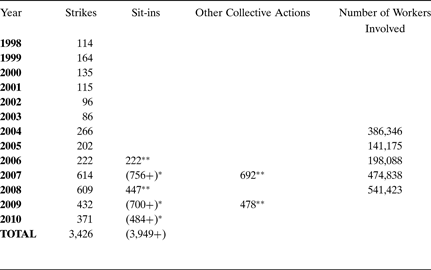
Working people responded to the Nazif government with an immediate escalation in the number of strikes, sit-ins, and other collective actions, which had been trending upward since 1998, with a slight decline in 2002–2003 due to a recession (see Table 1). In 1984–1989 and in the mid-1990s, there were twenty-five to eighty collective actions by workers a year.Footnote 2 From 1998 to 2003, the average was 118 a year. In 2004 there were 266 collective actions—more than double the 1998–2003 average; over seventy percent (190) of the collective actions that year occurred after the Nazif government took office in July. By 2007 the movement encompassed virtually every industrial sector, public services, and civil servants. Doctors, university professors, K-12 teachers, educational administrators, and other professionals joined in.
Collective Actions and Number of Workers Involved, 1998–2010
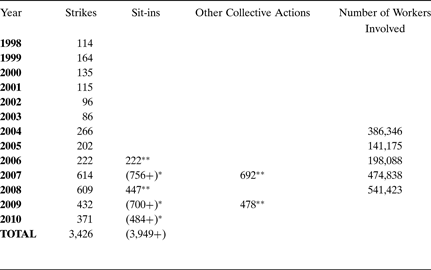
Source: Markaz al-Ard li-Huquq al-Insan (Land Center for Human Rights), Silsilat al-huquq al-iqtisadiyya wa'l-ijtima'iyya, no. 5 (December 1998); no. 14 (April 2000); no. 18 (May 2001); no. 22 (March 2002); no. 28 (March 2003); no. 31 (January 2004); no. 34 (July 2004); no. 35 (February 2005); no. 39 (August 2005); no. 42 (January 2006); no. 49 (July 2006); no. 54 (February 2007); no. 56 (July 2007); no. 58 (February 2008); no. 65 (March 2009); no. 75 (March 2010) no. 76 (May 2010); no. 79 (July 2010); no. 81 (August 2010); no. 84 (January 2011) at http://www.lchr-eg.org/ These statistics should be considered approximations. For a more detailed version of the table see Joel Beinin, “A Workers' Social Movement on the Margin of the Global Neoliberal Order, Egypt 2004–2009,” in Social Movements, Mobilization, and Contestation in the Middle East and North Africa, ed. Joel Beinin and Frédéric Vairel (Stanford, CA, 2011).
*LCHR considers a series of actions over a dispute in a workplace (a petition, a demonstration, then a strike) as one action. The larger figures in parenthesis (when available) count each individual action.
** Figures according to Khalid ‘Ali ‘Umar, ‘Adil Wilyam, and Mahmud al-Munsi, ‘Ummal misr, 2009 (Cairo, 2010), 17.
From 1998 to 2010, well over two million workers participated in at least 3,400 strikes and other collective actions—the largest social movement in the Arab world in six decades, except for the Algerian War of Independence (1954–1962). These collective actions were largely motivated by the threat or actual loss of jobs or social benefits after privatization of public sector enterprises, low wages, and delays or nonpayment of bonuses, incentive pay, and other wage supplements critical to bringing income to a level that can sustain survival.
Workers' collective action not only increased sharply since mid-2004, it assumed a more militant character than the strike waves of the 1980s and early 1990s. There were more strikes, as opposed to factory occupations while continuing production; and strikes became longer, with several lasting months.Footnote 3 From 1971 through the 1990s, collective action was concentrated among public sector workers seeking to preserve gains made under Arab Socialism. Since 2004 many private sector workers have also engaged in collective actions. In 2009 thirty-seven percent of all collective actions were in the private sector; in 2010 the figure reached forty-six percent.Footnote 4
The labor movement suffered a serious setback when state security personnel occupied the Ghazl al-Mahalla complex three days before a strike planned for April 6, 2008. The strike aimed to promote the campaign for a minimum monthly basic wage of 1,200 Egyptian pounds (about $215); there were also local demands. Through a combination of coercion and cooptation, several members of the strike committee were convinced to call off the strike. Nonetheless, on the afternoon of April 6, 2008, a large crowd of women and children gathered in the main square of Mahalla, demonstrating against the high prices of food. They were subjected to a hail of rocks thrown by hired thugs of the regime—the same treatment meted out to protesters in Tahrir Square on February 2, 2011.
The April 6 strike (for which the April 6 Youth Movement is named) was thwarted. Solidarity demonstrations in Cairo and several universities that day were only moderately larger than the usual several hundred. Nonetheless, the demonstration in Mahalla al-Kubra should have been a warning signal to the regime. Demonstrators ripped down a large poster of Hosni Mubarak and trampled it under their feet, an expression of contempt clearly indicating that they saw Mubarak as an obstacle to achieving their most basic economic requirements—even an adequate supply of subsidized bread, which had been in short supply that spring.
Thus, years before the “January 25 Revolution,” a social movement of workers, their families, and their neighbors established its presence. Through strikes and other collective actions, workers had made substantial economic gains, teaching many Egyptians a crucial lesson: Engaging in collective action, previously regarded as a losing game by all but committed middle-class activists, could achieve something of value.
However, the Egyptian workers' movement of the 2000s had some serious disabilities. The most important was the absence of a national or regional trade union or political organizational framework or—except for the widely accepted demand for a national monthly basic minimum wage of 1,200 Egyptian pounds—a unified program. The two leading labor-oriented NGOs in the 2000s were the Center for Trade Union and Workers Services (CTUWS) and the Coordinating Committee for Trade Union and Workers Rights and Liberties. In 2010 they were joined by the Egyptian Center for Economic and Social Rights (ECESR). ECESR's inaugural public action was a high-profile lawsuit. Tireless labor lawyer and ECESR director Khalid ‘Ali ‘Umar represented Nagi Rashad, a worker at the South Cairo Grain Mill, who sued the government for failing to ensure an adequate minimum wage. Rashad won, and the court ordered the government to establish a “fair” minimum wage. The National Council on Wages hastily raised the monthly minimum wage from 108.50 Egyptian poundsFootnote 5 (about $19) to 400 pounds (about $72). Because the NCW refused to explain its method for reaching this figure (very likely there was none), the case remains under adjudication.
The CTUWS is the most established of the three NGOs. Its general coordinator, Kamal ‘Abbas, has built relationships with European foundations and union federations, the International Trade Union Confederation, and the AFL-CIO. But none of the three had the capacity to lead the labor movement on a national scale. Until the “January 25 Revolution” was under way, ‘Abbas believed that Egypt was not ripe for establishing a nationwide alternative to ETUF.
‘Abbas was even reluctant to speak of the decade-long upsurge of workers’ collective action as a social movement because these actions were organized by informal local networks in factory towns with no national coordination.Footnote 6 Sometimes they received the support of dissident members of local union committees. But in the massively fraudulent 2006 elections, state security authorities arbitrarily barred most dissidents from running for trade union office. Consequently, insurgent workers faced huge obstacles and multiple adversaries: their employers, the union that nominally represented them (if there was one at all), the security forces, and the Ministry of Manpower and Migration.
When I lived in Cairo during 2004–2005 and 2006–2008, Western journalists—who typically viewed “Islamic fundamentalism,” the nonexistent “peace process,” and economic “reform” as the main stories in Egypt—persistently asked if workers would transition from “bread and butter” to “political” demands. This question fundamentally misunderstood the import of the labor movement. In an autocracy like Mubarak's Egypt, the capacity to organize large numbers of people to do anything is a potential political challenge to the regime. Workers electing strike committees and debating whether or not to accept strike settlement terms was one of the most democratic public activities during the Mubarak era.
During the September 2007 strike at Ghazl al-Mahalla, strike committee member Muhammad al-'Attar told a crowd of workers, “Politics and workers' rights are inseparable. Work is politics by itself. What we are witnessing here right now, this is as democratic as it gets.”Footnote 7 Al-'Attar, like Kamal ‘Abbas and others, saw the workers’ movement as an incubator for substantive—not merely formal—democracy from below, something that NGOs led by middle-class professionals or the ineffectual opposition parties who participated in the regime's parliamentary charade could never be.
In addition to providing a laboratory for democracy, the labor movement of the 2000s registered other notable accomplishments. Two independent trade unions were firmly established. In December 2007 Real Estate Tax Authority workers struck and occupied the street in front of the Ministry of Finance for ten days. They won a stunning victory—a 325 percent wage increase. After this success, the strike leaders used this momentum to organize an independent union, which was proclaimed in December 2008. Before a crowd that filled the entire building of the Journalists' Syndicate in Cairo to overflowing, Kamal Abu ‘Ayta, president of the Constituent Council, which included members from each of Egypt's twenty-nine governorates, announced that the independent General Union of Real Estate Tax Authority Workers represented over 30,000 of the 55,000 Real Estate Tax Authority workers. Despite the strenuous opposition of ETUF, the new union was recognized by the Ministry of Manpower and Migration in April 2009.
On December 29, 2010, an independent union of healthcare technicians was established. Organization of an independent teachers’ union, begun in spring 2009, also came to fruition before the end of 2010.
Workers participated in the “January 25 Revolution” from the start, but as individuals, not as organized workers. On February 9, Kamal ‘Abbas, abandoning the “bread and butter” approach he insisted on during the previous decade, called on workers to strike in support of the demand to oust Mubarak. Thousands of workers did so in Suez, Ismailia, Helwan, Kafr al-Zayyat, Sadat City, Giza, and Cairo—a cross-section of lower Egypt. Cairo Public Transport Authority workers struck and announced their intention to form an independent union. It is very likely that these strikes, which paralyzed the economy, were a major consideration in the military chiefs’ decision to ease Hosni Mubarak out of the presidency. Despite repeated calls by the Supreme Council of the Armed Forces for labor peace and its threats to break up strikes, workers persisted in striking and demonstrating after Mubarak's departure (and they continue to do so as of this writing in June 2011). They seized the opportunity to pursue economic demands and to advance a social justice agenda beyond the Facebook youth's demands for liberal democracy and far beyond the military's very limited conception of political change.
On February 19, forty labor leaders affiliated with the Egyptian Federation of Independent Trade Unions issued a declaration embracing the revolution and announcing demands including the right to form independent trade unions, the right to strike, and the dissolution of ETUF, “one of the most important symbols of corruption under the defunct regime.” Most importantly, they asserted “that if this revolution does not lead to the fair distribution of wealth it is not worth anything. Freedoms are not complete without social freedoms. The right to vote is naturally dependent on the right to a loaf of bread.”Footnote 8
A decade of struggle around economic and trade union issues and open participation in the “January 25 Revolution” gave worker-activists the confidence to assert political demands. On March 2, EFITU leaders convened a conference under the slogan “What Workers Want from the Revolution.” One of their key demands was met within two weeks. The Supreme Council of the Armed Forces initially appointed ETUF treasurer Isma'il Ibrahim Fathi as the new minister of manpower and migration. Independent trade unionists forcefully rejected this as merely a cleaned-up version of the old regime. Instead, they proposed Ahmad Hasan al-Bura'i, a professor of labor law at Cairo University who had for several years advocated trade union pluralism. Fathi was removed and al-Bura'i replaced him. Al-Bura'i promptly announced that the ministry would draft a new trade union law based on the recommendations of the CTUWS.Footnote 9
The International Trade Union Confederation (ITUC) began actively supporting independent trade unionism in Egypt soon after it was established in 2006. It sent letters of protest to President Mubarak on several labor issues, most notably the closure of the CTUWS offices in April 2007. The CTUWS was reopened and legally registered as an NGO for the first time in July 2008, largely due to international pressure. Soon after the EFITU designated a Founding Body to organize a founding congress, the ITUC sent a delegation to Egypt to express solidarity.Footnote 10 On March 14-15, 2011, the ITUC led a workshop, “Building a Democratic and Independent Trade Union Organization in Egypt—Visions and Objectives.” The ITUC also announced plans to open a regional office in Cairo.
Empowered by the new spirit of political engagement formed during the popular uprising, independent trade unionists did not simply rely on the minister of manpower and migration whose appointment they had advocated. The Founding Body of the EFITU and the CTUWS submitted two memoranda to the ministry with detailed criticisms of the 1976 Trade Union Law and specific, immediate demands.Footnote 11
On March 9 the generals forcefully indicated that it was time for the revolutionary process to end by dispersing the protesters who remained in Tahrir Square as a symbol of popular vigilance. About one thousand people were attacked by thugs wielding sticks, pipes, and stones—the same treatment protesters received from the Mubarak regime on February 2. The army stood by for an hour and then began arresting demonstrators. International human rights organizations reported that detainees were beaten and tortured at the Egyptian Museum on the north side of Tahrir Square.Footnote 12 Amnesty International reported that the army performed “virginity tests” on as many as eighteen of the detained women, a charge later confirmed by an anonymous general.Footnote 13
More subtly, the army acted to bring a quick end to the revolutionary process by appointing a committee tasked with amending specific articles of the 1971 constitution and bringing the proposed amendments to a referendum on March 19, 2011. The CTUWS and EITUF joined with a women's coalition, the “Revolutionary Youth Coalition,” and most of the other political currents that participated in the “January 25 Revolution”—with the notable exception of the Muslim Brothers—in calling for a “no” vote in the referendum. The proposed amendments dealt mainly with electoral procedures and left intact the rest of the undemocratic 1971 constitution, which concentrates power in the presidency. The proposed amendments passed with 77.2 percent of the vote in the freest election in Egypt in over sixty years, with double the participation rate of elections under the Mubarak regime. There was a much higher proportion of “yes” votes in rural areas than in urban areas and vice versa for “no” votes.
This is an expression of both the strength and the weakness of the workers' movement. Even in its embryonic organizational state, it appears to be the largest and best-mobilized component of the leftist elements of the revolutionary coalition that have challenged the army's efforts to limit the gains of the popular uprising and the continuation of discredited practices of the old regime, such as torture and detention without trial. But neither the workers' movement nor the broader elements of the left and liberal intelligentsia have the capacity to mobilize a nationwide grassroots constituency.
Consequently, the election due to be held in September 2011 will favor those forces who are already organized on a national scale—the Muslim Brothers and the former ruling National Democratic Party (or whatever it may rename itself). This will likely result in a more conservative parliament than the January 25 revolutionaries hoped for. Among the questions that may indicate the extent to which workers will succeed in persuading or forcing the generals and the new parliament to adopt their agenda are (1) Will the army implement its threat to use force to disperse strikes, which show no sign of abating; (2) Will the minimum wage be increased to a level significantly above the poverty line; and (3) Will ETUF be dissolved as the CTUWS and EFITU have demanded?