Let me begin with the bottom line: Samuel DeCanio has addressed a very important topic, skillfully crafted an argument, and marshaled an impressive body of evidence behind his thesis. The result is a significant addition to the literature on American political development on several different levels. And that is so despite the fact that I believe his interpretation extends beyond the evidence in some respects. This comment addresses both these extensions and, as a collateral objective, suggests that the way in which we reconstruct political situations and causal relationships is inevitably an art, not a science.
In broad outline, DeCanio's argument is that William Ralston, the cashier of the Bank of California, successfully bribed Henry Linderman, the director of the United States Mint in Philadelphia, who then bribed or otherwise persuaded certain powerful senators and congressmen to facilitate passage of the Coinage Act of 1873. Ironically, these powerful legislators later became strident advocates of a monetary policy that was the very opposite of the one they had earlier and secretly supported. In order to cover their tracks, they somewhat cynically and publicly charged that others (who were now bitter political opponents) had unethically and corruptly enacted the Coinage Act. This brief sketch, however, does not cover many elements in what is a complex and often elegant analytical argument. The first task, then, is to outline DeCanio's analysis.
THE ANALYTICAL BACKBONE OF “POPULISM, PARANOIA, AND THE POLITICS OF FREE SILVER”
In summarizing DeCanio's analysis, we should begin with the most well-defined elements and build out toward the broadest implications he has drawn. We begin with a material object that must have given DeCanio an “Aha!” moment in the archives.
(I) The central pivot upon which DeCanio's argument rests is a check from W. Ralston to H.R. Linderman for the amount of $3,500, drawn upon The Bank of California and dated April 5, 1871 (reproduced on p. 11).Footnote 1 Because this cashed check demonstrates that their relationship was consummated, its existence among Ralston's papers provides the single most convincing evidence that Linderman was bribed.
(II) The correspondence between William Ralston and Henry Linderman fleshes out their relationship. For example, DeCanio has shown that the $3,500 check was written in response to a request from Linderman, dated ten days earlier (March 26, 1871). Among many other things, the surviving letters also demonstrate that they carried on an extensive and wide-ranging relationship centered on matters involving government policy toward the role of silver in the national financial system.
(III) In response, Linderman, who was then director of the United States Mint at Philadelphia, drafted the legislation that became the Coinage Act of 1873. He then led “Ralston's legislative coalition” (pp. 5, 20) in overcoming both indifference among the many members who did not understand the legislation and strong opposition from some of those who were hostile to those portions of the bill that particularly favored Ralston's interests.
(IV) “Ralston's conspirators” (p. 24) included several members who later led the “free silver” movement. In order to conceal their support for the “Crime of `73,” as the coinage bill became known, these members abetted the creation and dissemination of false charges that eastern bankers had conspired to secretly demonetize silver.
(V) In part because “Ralston's conspirators” knew the true legislative history of the Coinage Act of 1873, they were able to persuasively misrepresent their role in its passage. However, those Populists who were fooled into blaming eastern bankers for secretly demonetizing silver were not paranoid or deluded because there was, in fact, a conspiracy associated with the bill's passage. However, the actual conspiracy was not the one to which they subscribed.
(VI) Bolstered by popular indignation over the demonetization of silver, in 1896 the free silver movement captured the national Democratic Party, which nominated William Jennings Bryan for the presidency. Bryan went on to win the Populist nomination as well but lost in the general election to the Republican candidate, William McKinley.
(VII) Despite losing the election, Bryan conducted the first modern presidential campaign, standing on a platform that, for the first time, committed the Democratic Party to support active government regulation of the national economy. The free silver movement was thus responsible for the origin of the modern Democratic Party and for a change in the way that government regulation was debated in national politics. And because “Ralston's conspirators” had both abetted the “Crime of `73” and fostered the conspiracy theories that subsequently fueled the rise of the free silver movement, the California banker's bribery of Henry Linderman had, somewhat paradoxically, produced a sea change in American political development.
A CRITIQUE OF THE ANALYTICAL BACKBONE
The significance of DeCanio's contribution primarily arises out of his analysis of the relationship between William Ralston and Henry Linderman, neither of whom were legislators, and legislative consideration of the Coinage Act of 1873. DeCanio's method relies on close interpretation of surviving private and public written records, placing them in historical context and knitting letters and events together into a coherent narrative. The most important analytical questions thus arise out of the way in which he reconstructs the private relationship between these two men and then connects their relationship to enactment of the Coinage Act.
I will thus focus upon the relationship between Ralston and Linderman in this critique. I will first ask whether or not the evidence for his interpretation is persuasive. At some points, I will also suggest an alternative interpretation of his evidence. Although these two exercises are theoretically independent of one another, they are difficult to separate in practice. When we have doubts as to an interpretation of an event, one of the first questions we usually ask is “What is really going on here?” While there are instances in which I have consulted original sources, I have more or less relied on the evidence that DeCanio has presented in his article. With only a few exceptions where I have introduced new material, I have merely placed the evidence in an alternative narrative.
Before I begin, let me say that I do not personally have “a horse in this race.” Like DeCanio, I do believe that bribery of public officials and legislators, in all the many forms that it can assume, was common in the last half of the nineteenth century. And, like him, I believe that politicians, whatever their ideological predisposition, often dissemble when describing personal motives and actions. My critique thus does not arise out of a difference of opinion as to the quality of American politics in that period. Nor would I dissent from DeCanio's judgments with respect to Populist paranoia. Although some Populists were certainly paranoid (as seems to be true of at least some partisans in all political parties), I believe most were not motivated by persecution complexes or deluded by fantastical conspiracies. In fact, I don't think there is anything important to be gained by either asking or answering the question of how paranoid the Populists might have been. Finally, DeCanio and I share a very similar materialist perspective on the primacy of narrowly conceived interests in late-nineteenth-century American politics. In fact, my own interpretation of what transpired between Ralston and Linderman may be more materialist than DeCanio's original analysis. For all these reasons, my critique arises out of rather narrow (but far from unimportant) differences of opinion as to what DeCanio's evidence can actually tell us about how and why the Coinage Act of 1873 came to be enacted.
Let me start by saying that I believe the check is convincing evidence that Ralston paid Linderman a very significant sum of money.Footnote 2 I also think that Linderman's requests for money, one in the March 26, 1871, letter and the other on May 19, 1872 (pp. 11 and 13, respectively), indicate an ongoing relationship during this period. If those requests also resulted in payments from Ralston, Linderman received at least $23,500 from the California banker.Footnote 3 I would, however, ask why the check and the letters in which the requests were made were retained by Ralston if they, in fact, were evidence of bribery. I will return to that question later.
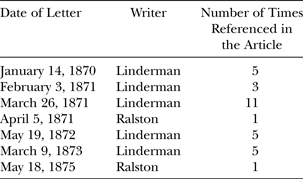
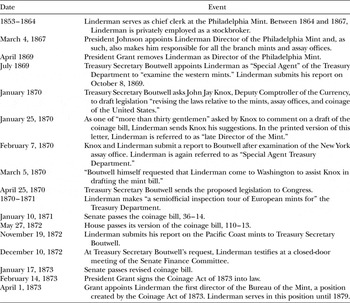
Other than the check, the most important evidence substantiating the relationship between Ralston and Linderman is their correspondence. DeCanio cites seven letters between William Ralston and Henry Linderman in his article, five written by Linderman and two by Ralston (see Table 1). These letters were written between January 14, 1870, and May 18, 1875. We can set aside the last of these letters because it reports events that took place well after the Coinage Act became law.Footnote 4 The other six letters were written either during the period when John Jay Knox, the deputy comptroller of the Currency, was preparing a draft of the legislation or while the bill was being considered in Congress (see Table 2 for a chronology of Coinage Act passage and Linderman's government service).
Correspondence between William Ralston and Henry Linderman
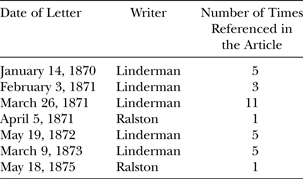
Note : Each occasion that a letter is footnoted counts as a “reference.”
Chronology of Henry Linderman's Government Service and Passage of the Coinage Act of 1873

Note and sources: For the March 5, 1870, the “1870–1871,” and the December 10, 1872, entries, see Weinstein, Prelude to Populism, pp. 15–16 (n. 22), 16, and 25, respectively. Also see S.R. no. 1406, 41st Congress, 2nd Session, Senate, Ex. Doc. no. 51, “Letter of the Secretary of the Treasury, February 24, 1870”; S.R. no. 1408, 41st Congress, 2nd Session, Senate, Mis. Doc. no. 132, “Letter of the Secretary of the Treasury, April 25, 1870”; S.R. no. 1426, 41st Congress, 2nd Session, House of Representatives, Ex. Doc. no. 307, “Letter from the Secretary of the Treasury, June 20, 1870”; David K. Watson, History of American Coinage (New York: G.P. Putnam's Sons, 1899), pp. 123–37.
The first letter was dated January 14, 1870. At this point, Knox had been asked by Secretary of the Treasury George S. Boutwell to draft a bill proposing a revision of the statutes pertaining to the operation of the mints, assay offices, and the coinage of gold and silver. Knox had subsequently written to “more than thirty gentlemen” asking them to comment on a preliminary draft of this bill. Although one of these gentlemen was Henry Linderman, he had not yet sent his comments to Knox. In fact, Knox would not complete work on the bill until late April, long after Linderman's letter to Ralston was written. Thus, the Treasury Department had not yet sent the proposed legislation to Congress and neither the House nor the Senate had started work on the revision. DeCanio uses the contents of the letter to show that Linderman “complained to Ralston that both Sherman and William Kelley (R-PA), chairman of the Coinage Committee, were ‘disposed to delay,’ forcing him to have ‘a plain talk’ with Kelley where Linderman ‘showed him the…advantages to be [had] by the passage of the Bill’” (pp. 9, 18). Because the bill faced “some apathy in the House and a quiet opposition from [Philadelphia],” Linderman asked Ralston to “write to all your members in the House particularly Sargent and Axtell asking them to give special attention to the Mint Bill in the House” in order to “work up some enthusiasm and interest in the House in order to insure early action by the committee on coinage” (pp. 9, 18).Footnote 5 For his part, Linderman reported that “the result of the interview [with Kelley was that the latter had] agreed to call a meeting of the committee of Wednesday next and with me to be present to explain any points that may be raised” (p. 18). All of these references indicate that Linderman was very heavily involved in a very active legislative consideration of a bill that had not yet been submitted to Congress because Knox had not finished writing the text.
Because it seems very unlikely that Linderman was actually lobbying for a bill that he had not yet helped to write, we might consider alternative interpretations of what was really going on in this letter. One interpretation could be that Linderman was, at this point, simply fabricating his lobbying activity in his correspondence with Ralston. A more likely possibility is that Linderman's lobbying activity was genuine but was not directed at what became the Coinage Act of 1873. In January 1870, Ralston was backing legislation in Congress that would have denied royalties to Adolph Sutro, who was then constructing what became known as the Sutro Tunnel beneath the mines collectively known as the Comstock Lode. These royalties would have come out of the earnings of the mine owners, among whom was William Ralston. Introduced by Thomas Fitch, the Republican congressman from Nevada, Ralston's bill was referred to the Committee on Mines and Mining. William Kelley, the Republican congressman with whom Linderman had “a plain talk,” testified before that committee in opposition to Ralston's bill. When brought up before the full House of Representatives on March 23, 1870, the bill was defeated in a tabling motion by a vote of 124 to 42.Footnote 6 However, the Sutro Tunnel bill had not yet been formally introduced when Linderman wrote his letter to Ralston and thus runs into the same kind of problems as the coinage legislation.Footnote 7 Even so, we should note that Ralston had other chestnuts in the legislative fire at about this time.Footnote 8 Without more information, we cannot be certain which of Ralston's several legislative projects Linderman was referencing in his letter.
The second letter was written on February 3, 1871, over a year after the first. At this point, the Senate had passed the coinage bill and sent it on to the House of Representatives. Linderman reported to Ralston that he was experiencing “some difficulty in getting action on the Mint Bill by the coinage committee” in the House. Linderman's reference to the “mint” bill instead of the “coinage” bill is probably significant because he goes on to say that “the New York folks, through Mason, of the Assay office, are stirring up the question of cheap refining claiming to be able to do it at rates much below S.F.” Despite this “eastern opposition” (presumably from the New York Assay Office), Linderman stated that “we have the matter well in hand” (p. 10). The third letter, written on March 26, 1871, also contains references to coinage charges at the San Francisco mint: “Seligman or some such man grossly misrepresented matters about the repeal of the coinage charge for the benefit of the Bank of California, to enable them [the Bank of California] to avoid paying about $90,000 per annum into the U.S. treasury.” Linderman also “reported that Allen G. Thurman (D-OH) ‘is strong with us for a free coinage’” and claimed that “Secretary of the Treasury George Boutwell ‘strongly favors a free coinage, and is very pleased with the results of the present refining system.’” “Linderman assured Ralston that he could generate support for the measure merely by continuing ‘to urge the matter officially if possible, on the necessities of the service and the importance of cheap refining and a free coinage for the financial and industrial interests of the country . . .’” (pp. 9–11, 14). If appropriately compensated, Linderman also offered to “attend to these matters and the pushing of the Mint Bill next session say up to Sept 1, 1872—13 months, which will carry us to the expiration of your present refining contract and by which time, I hope and firmly believe you will have all matters pertaining to refining and coinage in good shape” (p. 11).
The fifth letter, dated May 19, 1872, also contains references to the coinage charges: “Linderman complained of having ‘had a fight since January, with the Assay Officer Eugene Kelley and the Chamber of Commerce (of N.Y.) in relation to the Mint Bill and particularly the refining section.’” Also “Linderman assured Ralston ‘a rod is in the soak for these New York fellows . . . I have kept them whipped all the while and don't mean to let them up until the Bill is finally disposed of’” (p. 13). In all the passages in these letters, “free coinage” does not refer to the unlimited coinage of silver but to the elimination of the charge imposed at the mint for turning gold and silver bullion into coin. After passage of the Coinage Act, Linderman again referred to these charges and the refining contract when he wrote Ralston: “If it had not been for us (yourself Garnett and myself) this measure never would have come to fruition. It had not the least chance. Never in the history of legislation was a measure more carefully and persistently guarded than this coinage bill by me and of course I could not have been there without some friends behind me ” (p. 16). Garnett was Louis A. Garnett, the manager of the San Francisco Assaying and Refining Works. This refinery was the Ralston firm that apparently held the refining contract with the San Francisco mint that Linderman referred to in his March 26, 1872, letter.
In sum, there are far more references to the mint, the coinage charges, and the refining contract than there are to the impending demonetization of silver.Footnote 9 Linderman was, in point of fact, particularly well placed to promote Ralston's coinage and refining interests in San Francisco because mint policies in those areas had been the subject of his investigations for the Treasury Department. Described as “special agent Treasury Department—examination of branch mint, San Francisco,” Linderman had reported to Secretary Boutwell on October 8, 1869, that:
There are now in operation in San Francisco two large and complete private refineries, which do almost the exclusive refining of silver and the greater portion of the gold operated on for fine bars for export or coinage at the Mint. These refineries are the principal depositories of fine gold at the branch mint, and as their charges are much lower than the government, the true policy would be to allow them, or others that may be established hereafter, to do all the refining under such regulations and upon such terms as would at all times insure the government against risk or loss, and at the lowest possible rate of cost.Footnote 10
The two private refineries could operate more cheaply than the government mint because of economies of scale and a more efficient refining process.Footnote 11 In another report, this time as “Special Agent Treasury Department,” Linderman again praises the efficiency of “private enterprise on the Pacific coast” but says that the New York Assay Office should continue to carry out refining operations on the East Coast.Footnote 12 Without more information about how the refining contracts were made and the coinage charges were imposed, it is impossible to determine just what Linderman was doing for Ralston. But it does seem clear that his proposal to eliminate refining activity at the government mint at San Francisco would have meant increased business for Ralston's own firm and that officials at the New York Assay Office, because their own refining operation was more efficient than its San Francisco counterpart and because they thought the private refineries in San Francisco were charging the government too much, had become Linderman's principle opposition in his lobbying before Congress. In sum, there is abundant evidence in the excerpts from Linderman's correspondence that his relationship with Ralston focused on the latter's refining contract with the San Francisco Mint.Footnote 13 In contrast, there is little or no evidence that what became the Coinage Act of 1873 was anything more than a vehicle for achieving the elimination of the coinage charge and the creation of the trade dollar as a substitute for the silver dollar.Footnote 14
This brings us to the nature of Linderman's relationship with Ralston. DeCanio contends that “William Ralston, president of The Bank of California, secretly bribed Treasury Department bureaucrats” in order “to pass the Coinage Act of 1873” (p. 1); that “bankers were secretly involved in bribing the officials who wrote the legislation demonetizing the silver dollar” (p. 4); that “Ralston's method for influencing Linderman was straightforward; Ralston paid Linderman thousands of dollars in exchange for influencing the coinage statutes in ways that were advantageous to The Bank of California. Hardly based on circumstantial evidence, Ralston's bribery of Linderman is bluntly recorded in his correspondence…” (p. 4); and that “[b]y bribing Linderman, Ralston was directly influencing the official who was writing the revisions of the coinage statutes” (p. 12). In other passages, DeCanio refers to Linderman as “director of the Mint” (p. 4), one of the “Treasury Department bureaucrats” influenced by Ralston (p. 4), and “director of the Philadelphia Mint and subsequently director of the Mint in the Treasury Department” (p. 7). In sum, DeCanio contends that Ralston bribed Linderman, the director of the Philadelphia Mint, who then used his official position within the Treasury Department to influence the construction and passage of the Coinage Act of 1873.
There are several questions that can be raised with respect to this interpretation. The first concerns the conception of bribery. Here I must ask the patience of the reader for a moment because this turns out to be more complex than it might first appear. Here is the definition of “bribe” that appears in A Standard Dictionary of the English Language:
Law. Any gift, advantage, or emolument offered, given, or promised to, or asked or accepted by, any public officer to influence his behavior in his office; also, any such inducement offered to influence a private person corruptly in the discharge of any public duty or franchise.Footnote 15
If Henry Linderman was director of the Philadelphia Mint at the time he accepted money from Ralston in return for influencing federal legislation, that transaction could reasonably and perhaps unavoidably be termed a “bribe.” The problem is that Linderman was not director of the Philadelphia Mint at any time during the drafting of the coinage bill in the Treasury Department or its subsequent legislative consideration in Congress.Footnote 16 In fact, Linderman does not appear to have been employed by the Treasury Department in any official capacity during this period.Footnote 17 If we were to apply a very strict definition of bribery, this fact would seem to put an end to the matter: Linderman was not bribed because he was not a “public officer.” But it is not so simple. As has been noted, Linderman did file official reports with the Treasury Department. In some of those reports, Linderman is identified as “late Director of the Mint,” a description that suggests no current official government role. In other reports, Linderman is referred to as “Special Agent Treasury Department” or “special agent Treasury Department—examination of branch mint, San Francisco.”Footnote 18 Those descriptions do suggest some official relationship with the government. In the latter case, Linderman may have been intermittently employed as a special advisor (what we might now term a private subcontractor) or, as was sometimes the case in this period, only compensated for his expenses (e.g., incurred while visiting the San Francisco mint). Here we might still maintain that Linderman's relationship with Ralston still constituted bribery because it fell under the second clause of the definition (“any such inducement offered to influence a private person corruptly in the discharge of any public duty or franchise”). That, however, would be a closer call (e.g., the clause seems to be crafted to cover payments intended to influence voters, something very different from Linderman's relationship with the Treasury).
In any event, Linderman was almost certainly not paid enough by the Treasury Department to support himself. He would have needed another source of income in addition to his advisory roles (if, in fact, he was paid anything at all for the latter).Footnote 19 That seems clear from his March 26, 1871, letter to Ralston where he says that he was “not able to give my services without compensation” (p. 11). And, when Linderman asks Ralston for money in the same letter, he frames the request in much the same way that he might have done had he been writing an invoice for services rendered:
For my services and expense here, including anything that may be required in coming to Washington, off and on, or New York and until 30th of June next, you will please send me thirty five hundred dollars—on receipt hereof. I suppose you will desire to have me attend to these matters and the pushing of the Mint Bill next session say up to Sept 1, 1872—13 months, which will carry us to the expiration of your present refining contract and by which time, I hope and firmly believe you will have all matters pertaining to refining and coinage in good shape. If so, I will make no engagement nor enter into any business which would interfere with the service indicated. I am willing to do so for the sum of Five Thousand dollars payable January 1st 1872. (p. 11)
This looks much more like the presentation of a retainer fee for lobbying than an invitation to bribery. If we were to view Linderman's services as “lobbying,” that would explain why, for example, Ralston saved both the letter and the check (as records incidental to a business relationship as opposed to evidence of illicit payments). It would also explain why Linderman promises that he would “make no engagement nor enter into any business which would interfere with the service indicated” if Ralston were to agree to his terms. If this were bribery, it is unlikely that Linderman would say anything at all concerning the exclusivity of his attentions. He would instead promise results. On the other hand, if this were lobbying, he might very well promise exclusivity (e.g., that he would not lobby for anyone else while so employed). In sum, I would lean toward a “lobbying” interpretation of their relationship, as opposed to bribery.
But we cannot entirely rule out the possibility that Linderman was intentionally framing a corrupt bargain with Ralston as a conventional business relationship (e.g., as a precaution if his letter were to become public). Nor can we rule out the possibility that we should view the transaction as a bribe even if Ralston and Linderman saw it as a conventional business relationship. I, for one, would wager that neither of them would have wanted their relationship to become public knowledge. Nor does the “lobbying” interpretation rule out the possibility that Linderman himself was bribing other officials or legislators. The money that Linderman was receiving from Ralston appears to have been much more than he had previously received as director of the Philadelphia Mint (the director was paid $4,500 in 1871).Footnote 20 Finally, we cannot rule out the possibility that Ralston was independently bribing legislators, particularly those from California and Nevada, although that seems unlikely if only because their interests and his so closely coincided that bribery would be redundant. Everything considered, Ralston's relationship with Linderman certainly had tawdry aspects that might not bear close scrutiny, but whether or not it was founded on bribery is at least debatable.Footnote 21
And that brings us to the larger question of whether or not passage of the Coinage Act of 1873 was the product of a conspiracy organized by Ralston and Linderman. As DeCanio notes, the traditional interpretation of the Coinage Act of 1873 as the product of conspiracy centers on Senator John Sherman of Ohio as the central figure who knew: (a) that the legislation would demonetize silver; (b) that silver, which was then trading at a premium to gold, was about to drop below parity; (c) that this decline in the price of silver would encourage its redemption in gold at the U.S. Treasury; and (d) that the consequent decline in gold reserves would impede the resumption of the gold standard. Sherman (and eastern financiers) knew all of these things and failed to disclose what he knew as he shepherded the legislation through Congress. Although DeCanio downplays the role that eastern financiers play in the traditional account, he otherwise accepts this interpretation. For the purpose of analyzing DeCanio's contribution to the conspiracy narrative, I am willing to accept the traditional account as well.Footnote 22
DeCanio's contribution to the traditional account focuses on the relationship between Ralston (who plays no role at all in the traditional account) and Linderman (who plays a somewhat different role in that, in the traditional account, he is maneuvering solely with the purpose of demonetizing silver and is thus indifferent to the coinage charge and refining contract). While DeCanio views the trade dollar and the free coinage provision of the bill as significant ancillaries, he contends that Ralston and Linderman were really focusing on the demonetization of silver as their primary legislative goal. To that end, Linderman, after being bribed by Ralston, deploys his rather arcane knowledge of mint operations and thorough understanding of monetary systems in an effort to persuade Treasury officials and members of Congress to eliminate the silver dollar. What brings their relationship up to the level of conspiracy is their coordination with “Ralston's legislative coalition” (pp. 5, 20). DeCanio only identifies three members of Congress as belonging to Ralston's coalition: Senator Eugene Casserly, a Democrat from California; Congressman Aaron Sargent, a Republican from California; and Senator William Stewart, a Republican from Nevada (pp. 4–5).Footnote 23 Even if these members had been much more influential in their respective chambers than they actually were, their clout would not have been sufficient to pass the coinage bill.
DeCanio, of course, realizes this when he says: “Ralston's bribe did not cause the passage of a measure that otherwise would not have passed. Nor was Ralston bribing a majority of representatives. His bribe was focused on influencing the official who was writing the measure and who was explaining the bill to elected officials who had little understanding of what was occurring” (p. 12). From that perspective, Ralston's conspiracy contributed to a larger project in which other players, notably Senator Sherman, played significant roles. This interpretation, however, raises some issues of its own. For example, Senator Sherman, the leading congressional proponent of the coinage act, vigorously opposed elimination of the coinage charge at every step in the legislative process and even voted against passage in the Senate because the bill contained that provision.Footnote 24 And when Sherman invited Senator Casserly to join him in supporting the creation of the trade dollar, one of Ralston's pet projects, Casserly doesn't seem to have understood what Sherman was proposing to do.Footnote 25 In the first case, we might ask why, if the demonetization of silver was their primary object, Ralston and Linderman did not drop their insistence on the elimination of the coinage charge. Without Sherman's (and the New York Assay Office's) opposition to that charge, the bill would almost certainly have been enacted long before it actually was. In the second case, we might ask why one of Ralston's co-conspirators did not understand what was expected of him when the bill was debated. These things, of course, do not prove that a conspiracy of some sort did not exist. But they do raise enough doubt that we might ask to see more evidence before concluding that it did.
I now briefly examine the connection between the conspirators and the subsequent development of the free silver movement in American politics. Soon after the Coinage Act of 1873 was entered in the statute books,
Ralston's congressional allies found themselves facing constituents outraged by a bill that, unbeknownst to anyone, they had helped pass. Recognizing that their political careers would be ruined if their involvement in the Coinage Act were revealed, Ralston's congressional allies embarked upon a stunning, but entirely comprehensible, course of action . . . Ralston's congressional allies blamed eastern and European financiers for silver's demonetization, assumed leading roles in the free silver movement, and managed to elude responsibility for what they had done. (p. 5)
One member of Ralston's coalition was, as we have seen, Senator Eugene Casserly. Casserly retired from politics by resigning from the Senate on November 29, 1873. Although he practiced law in San Francisco and participated in a California constitutional convention in 1878–1879, he was neither a prominent member of the free silver movement nor had a political reason to misrepresent his role in passing the coinage act. Another member of the coalition was Republican Aaron Sargent, a congressman from California. Sargent was subsequently elected to the Senate but left the chamber when his term ended in 1879. Although he (unsuccessfully) stood for the Senate again in 1885, DeCanio provides no evidence that he then misrepresented his role in passing the coinage act or was a leading silver advocate. In fact, since California Republicans almost always supported gold during the “Battle of the Standards,” he would have had no apparent reason to misrepresent his role.
That leaves Republican Senator William Stewart of Nevada, who clearly coordinated his moves with both Ralston and Linderman.Footnote 26 And DeCanio convincingly demonstrates that Stewart later publicly misrepresented his participation. But that leaves Stewart standing alone as the only conspirator who became a leader of the free silver movement and was thus in a position to foster the myth we have come to know as the “Crime of `73.” Unless DeCanio can produce more people who fit this description, this seems to be a story only about Stewart—still fascinating but not as generalizable as DeCanio represents. This also leaves the connection between Ralston's coalition and William Jennings Bryan's transformation of the Democratic Party rather tenuous. While the free silver connection remains in place as a policy that both Stewart and Bryan supported, Stewart is the only member of Ralston's coalition who was politically active in 1896.
Returning now to DeCanio's evidence and the analytical backbone of his argument, I summarize both my critique and the alternative explanation I offer in place of DeCanio's interpretation.
(I) The check for $3,500. As DeCanio indicates, this was a payment from Ralston to Linderman for services rendered.
(II) Ralston bribed Linderman. That bribery was the basis of their relationship is at least debatable on several grounds. The alternative explanation is that Linderman was paid to lobby Congress for policies that would benefit Ralston's personal holdings and the Bank of California generally.
(III) Ralston and Linderman were primarily interested in the demonetization of silver. Outside of his relationship with Ralston, Linderman was certainly committed to the demonetization of silver because he openly advocated American adherence to a gold standard. But there is little in their correspondence to indicate that demonetization was the primary reason that Ralston engaged Linderman. The alternative explanation is that Ralston's refining contract with the San Francisco Mint, the elimination of the coinage charge, and the creation of a new “trade dollar” were, instead, the primary legislative goals they pursued together.
(IV) Ralston's conspirators and the later development of the free silver movement. Senator William Stewart seems to have been the only conspirator whose career spanned both legislative consideration of the Coinage Act of 1873 and its subsequent transformation into the “Crime of `73.” While he was certainly duplicitous, his later condemnation of the act as the product of eastern bankers and European financiers does not tar the silver movement's leaders with hypocrisy generally.
(V) Populists were not paranoid because there was, in fact, a conspiracy. The case for a conspiracy led by Ralston and Linderman that had the demonetization of silver as its primary legislative goal seems weak. But the alternative explanation would not be that the Populists were paranoid; Sherman's close, even intimate, relationship with eastern financiers could still raise reasonable suspicions of collusion.
(VI and VII) Bryan's nomination and the transformation of the Democratic Party were a partial by-product of Ralston's conspiracy. This contention is viable only to the extent: (a) that Ralston's conspiracy existed in fact; (b) that the conspiracy was primarily focused on demonetization; and (c) that the conspiracy played a decisive role in passing the Coinage Act of 1873. The alternative explanation is that Ralston's conspirators were primarily interested in other parts of the bill and were even willing to put demonetization at risk in order to include those features in the legislation. However, we should remember that Linderman strongly supported demonetization independently of his relationship with Ralston.
I would thus revise DeCanio's conclusions in a number of respects. But any analysis of politics is ultimately grounded in the craft of interpretation, often involving debatable conclusions as to what the evidence can actually demonstrate and what alternative explanations might be equally viable. The historical reconstruction of political activity, which involves chronological sequencing, taking into account competing personal strategies, and the imagination of political possibility, becomes at least partially a matter of personal judgment. When the stakes are high (and they have been high in this case for well over a century), there will be others who reach different conclusions. DeCanio's research, from that perspective, has reminded us that legislative deliberations are rarely what they appear to be on the surface and that the solution to the “Crime of `73” may, in the end, be so complex that no jury will ever reach a verdict in this case.