“New P.R.R. Plan to Sidetrack City Arouses Protest,” trumpeted a front-page headline in the Philadelphia North American for November 21, 1903. Beginning November 30, the Pennsylvania Railroad's fourteen daily through trains to and from New York would bypass the downtown Broad Street Station and stop instead at its new West Philadelphia depot. Nor would the company allow transfers or sell tickets to or from West Philadelphia to downtown. This diversion of traffic seemed unremarkable to the Pennsylvania's managers. It was not even mentioned in the company's annual reports for 1902 and 1903, and the company had done nothing to prepare local merchants for the change. But it occasioned an explosion of protest from Philadelphia's business community. As the North American framed the issue, Philadelphia had been SIDETRACKED!Footnote 2
Local businesses and their trade associations held protest rallies, urged boycotts, petitioned company executives, complained to city officials and threatened legal action—all of which were loudly reported by the North American, with a nearly endless supply of stinging editorial cartoons. Four months later the railroad admitted defeat, and through trains returned to Broad Street.Footnote 3
The North American's campaign mirrored on a city scale the muckraking efforts of national magazines. Its editorials cloaked a local business spat with the moral and political significance of antimonopoly. Alone among Philadelphia's papers, it made sidetracking the public issue until it won—reporting and cheerleading the story in a partisan manner that comforted supporters and damned the railroad. The North American's political cartoons proved an especially lethal weapon in the fight. While national magazines like Puck and Judge had long employed cartoons, their use by newspapers was more recent. Moreover, cartoons in most publications were on a range of topics. The North American aimed its images squarely at the Pennsylvania's sidetracking order, which they skewered nearly every day for three months with the regularity of a train schedule.Footnote 4
This squabble reveals much about business and urban conflicts, and business public relations, during the Progressive Era. Antimonopoly, as Daniel T. Rodgers wrote, was an older “social language” that progressives drew upon as they denounced trusts, municipal graft, and privilege. Its deployment by middle-class reformers, as he noted, probably reflected the recent and rapid growth of very large corporations. Yet as Richard John has argued, the antimonopoly tradition was less about the size of big businesses than about their practices, as is revealed by the widespread anti-railroad agitation during these years. For example, state two-cent fare laws began to regulate passenger fares, and there was widespread agitation to prevent carriers from providing free passes to legislators.Footnote 5
Practices that might obstruct economic opportunity—such as freight rebates available only to large shippers—were an especial concern for smaller firms. In such instances the rhetoric of reform became a weapon in inter-business disputes. As the sidetracking dispute demonstrates, however, such concerns encompassed far more than freight rebates. Apparently minor changes in the schedules of large carriers might yield threats that seemed mortal to smaller firms. And while sidetracking played to a local audience (the press outside Philadelphia largely ignored it), the sum of such threats contributed to the national efforts to regulate the trusts and the railroads. Indeed, the Elkins Act (1903) and the Hepburn Act (1906), which together forbade rebating and regulated the structure of freight rates, reflected both small business and local mercantile concerns.Footnote 6
The anti-sidetracking campaign also ran counter to the typical efforts of various city beautiful groups and others who fought to remove railroads from city centers in Washington, Chicago, and elsewhere. In most cities, grade crossings were a major source of conflict, and in Philadelphia, merchants had recently supported the city's long-term efforts to remove the tracks of the Philadelphia & Reading from the streets. But since the Pennsylvania Railroad entered downtown Philadelphia on a viaduct (the “Chinese Wall”), banning through trains would not reduce street congestion. Accordingly, to local merchants, sidetracking yielded costs but no benefits.Footnote 7
Finally, the sidetracking affair undermines any notion that the managerial revolution in American business necessarily produced a kinder, gentler enterprise. The Pennsylvania was hardly the epitome of the buccaneering, financier-dominated, capitalist corporation of lore; indeed Alfred Chandler lauded it as an early example of managerial capitalism. But in their dispute with local businesses, the Pennsylvania's (Pennsy's) managers displayed a hardheaded arrogance that would have made William H. Vanderbilt proud. Even so, hardheaded arrogance failed to carry the day. Thus the sidetrack episode reveals the conflicting and changing views of what was public and what was private business behavior. It also showed how crusading journalists could tip the scales in ways that threatened corporate autonomy. In response, large businesses became increasingly concerned with public relations. Sidetracking surely contributed to the decision by the Pennsylvania two years later to hire Ivy Lee as a public relations consultant.Footnote 8
The Combatants
To understand the motives of the contestants in this fight, some background is necessary. While corporate records are silent on the motives for the Pennsylvania's decision, it must have seemed to company executives necessary, yet comparatively unimportant to affected travelers. As the nineteenth century ended, traffic on the Pennsylvania was expanding rapidly with freight and passenger revenues rising 50 and 47 percent respectively between 1900 and 1903. Alexander J. Cassatt had assumed the presidency of the railroad in 1899. An engineer by training who had risen through the ranks, Cassatt was an ideal choice to preside over the many capital improvements that were necessary to accommodate this expanding traffic. Company annual reports describe plans for extensive investments. In 1901 the Pennsy proposed to tunnel under the Hudson River to enter New York City, a project that commenced in 1903. Company reports reveal ambitious plans to elevate tracks, double track lines, upgrade signals, experiment with electrification, expand and upgrade freight and passenger equipment, and improve stations.Footnote 9
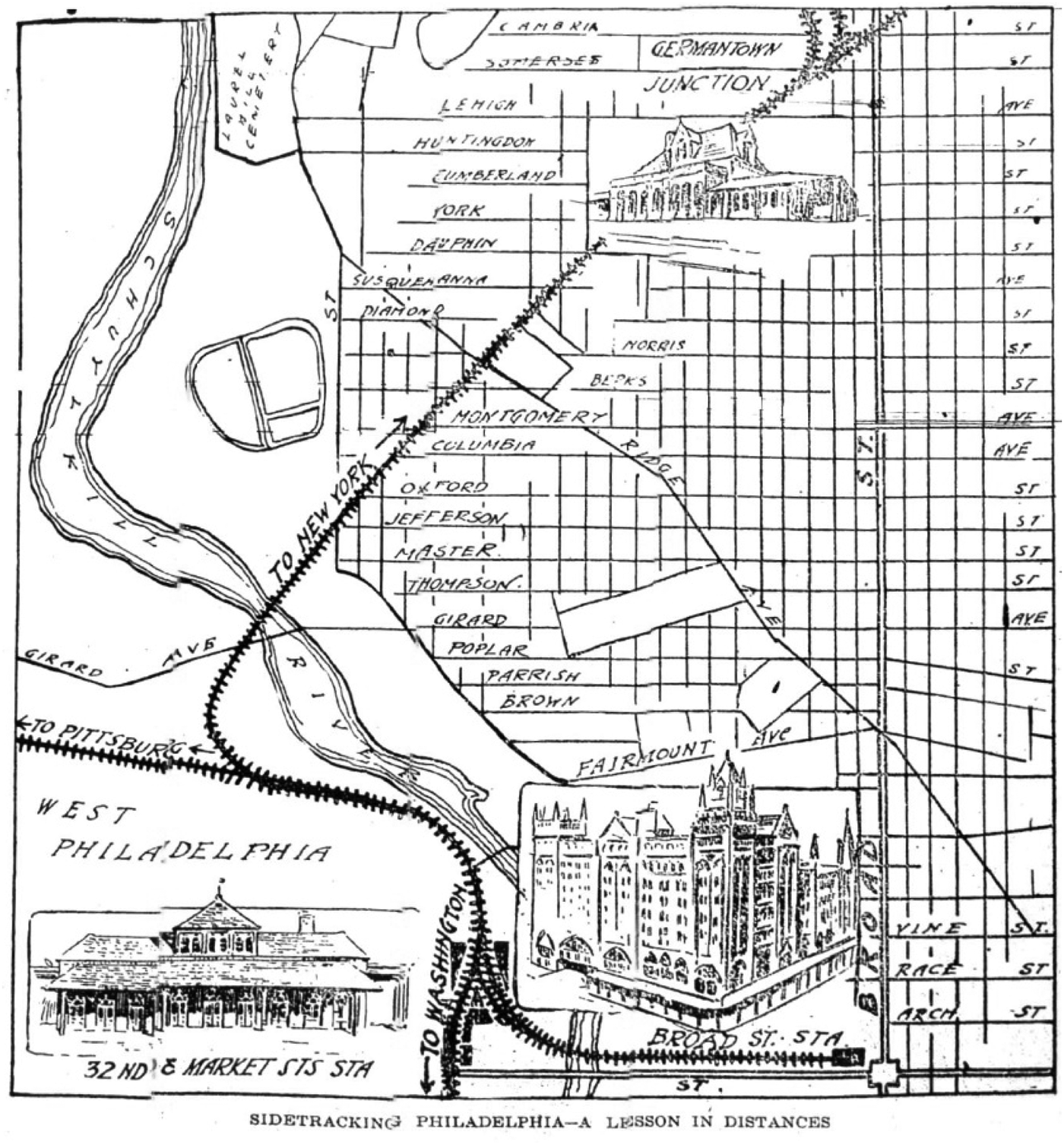
In Philadelphia, the railroad was drowning in traffic. There were three major stations. The main terminal was in the heart of the city at Broad Street, but in 1901 the company had opened the North Philadelphia/Germantown station, and in 1902 it completed a West Philadelphia terminal at 32nd and Market streets (figure 1). Broad Street typically saw about 530 passenger trains—some 50,000 passengers—daily, in addition to an immense freight business. To handle the traffic, the company was expanding the Broad Street train shed. It had recently completed two new bridges over the Schuylkill River and was doing away with crossings at grade via a host of tunnels and viaducts. Because passenger tracks at Broad Street were stub end, through trains had to be turned around to retrace their steps, puffing along for a mile and a half at five miles an hour to continue their journey, contributing to the congestion at that station and adding perhaps a half hour to their schedules at a time when speed was a major weapon in the Pennsylvania's competition for passenger traffic with the Philadelphia & Reading and other lines.Footnote 10
Philadelphia North American, November 24, 1903. The Pennsylvania's stations and lines through Philadelphia. The map's caption pointed out that a passenger could get off a through train and buy a ticket from North Philadelphia to Broad Street but that it was considerably farther than from West Philadelphia.

The diversion of through trains to West Philadelphia was, then, part of a much larger program of improvements that were intended to reduce congestion and speed up service. The company's refusal to sell tickets to or from Broad Street and West Philadelphia was similarly motivated, for transfers—including baggage—would slow local trains. This goal of segregating local and through traffic was becoming widespread and would soon be built into both Penn Station and Grand Central Station. Such improvements in service, the company's executives might have imagined, could even be popular.Footnote 11
They were not. The schedule change that to railroad executives appeared as a benign and necessary step to enhance services seemed an existential threat to many of Philadelphia's businesses. In 1900, the city was, in Philip Scranton's words, “the workshop of the world,” a major manufacturing and wholesaling hub. Most of these businesses dispatched their own agents throughout the country and hosted legions of buyers, while competing for orders with producers in many other cities, especially Baltimore and New York.
In most businesses, profit results from the last few percent of sales, and thus even minor reductions in demand might result in major declines in profitability. The Pennsy's new schedule therefore appeared to large numbers of local business leaders not as just a minor inconvenience but rather—because it hindered access to downtown—as a mortal thrust to the bottom line. Eventually virtually every trade association in the city would oppose sidetracking. Besides the more general business associations such as the Manufacturers' Club, these included the Hardware Manufacturers, Drug Association, Retail Grocers Exchange, Jewelers' Club, Wholesale Clothiers Association, Pork Packers, Paint Manufacturers, and Lumberman's Exchange, among others.Footnote 12
Clashes between local business interests and the Pennsylvania had been a recurring feature of the city's history for decades. Philadelphia's merchants were well aware of the Pennsylvania's plans to expand its facilities in New York, which made the apparent reduction in service to Broad Street even more unacceptable. Moreover, this was the second time in the same year that the Pennsylvania had adjusted its schedule without consulting local merchants and in a way that seemed to threaten their profitability. Earlier, the railroad had cancelled stopover privileges on tickets from Washington to New York. Such privileges allowed buyers on through trains to stop in Philadelphia and, merchants hoped, make purchases there. The city's Trades League, its backbone stiffened by the enthusiastic support of the North American, had petitioned and won a reversal of the policy. But the affair left hard feelings. The Pennsylvania and other eastern railroads had recently formed a “community of interest,” and the loss of stopover privileges heightened merchants' fears of monopoly. They formed a Merchants and Travelers' Association, which allied with the Trades League and began a campaign for more railroad competition in the city that would continue during the sidetracking protests.Footnote 13
Given the depth of their fears, Philadelphia's local businesses would have fought hard against the sidetracking order even without newspaper allies. As luck would have it, however, they found a standard bearer in the newly energized North American. That paper was one of seven major Philadelphia dailies in 1903.Footnote 14 While the other papers reported the story, none of them supported it editorially or made it a major issue. The North American, by contrast, broke the story on November 21, with a page-one broadside and went on to claim that passengers would be “barred from Broad Street.”Footnote 15
The North American was no stranger to controversy. In 1899 it had been all but dead with a daily circulation of 15,000, when it was purchased by Tom Wanamaker, heir to John Wanamaker, the department store king. The younger Wanamaker installed Edwin Van Valkenburg as editor. By about 1900, as Peter McCaffery has shown, the Republican political machine, run by Matthew Quay, had come to dominate Pennsylvania and Philadelphia politics. The senior Wanamaker had been active in Pennsylvania reform politics, opposing Quay's machine for a generation, where he had worked with Van Valkenburg. Thus his son's purchase of the North American, which had previously been a supporter of the machine, was to provide a voice for the reformers. Van Valkenburg made this clear in his initial editorial, describing Philadelphia as the most plundered city on earth and promising that the North American would oppose political and corporate interests that hindered its development. To do so he would breathe life into the paper and expand its circulation.Footnote 16
Wanamaker and Van Valkenburg imported top journalists from the New York Herald. They also brought cartoonists Charles Nelan from the Herald and Walt McDougall from the New York World, both well-known veterans of the circulation wars among the Herald, the World, and the New York Journal-American. Nelan would lead the charge against the Pennsylvania. Having started at the Cleveland Press, he had recently become known for his Herald cartoons on the Spanish-American war. Roger Fischer argues that the best political cartoons “have tended not to confront and to challenge but rather to reinforce and build on a priori beliefs, values, and prejudices.” At the North American, Nelan would exemplify this claim, marshaling common anti-railroad and anti-privilege sentiment to become a special thorn in the Pennsylvania's flesh.Footnote 17
Van Valkenburg and his staff transformed the North American from a stuffy, also-ran in 1899 to Philadelphia's leading journal of reform by 1903, raising circulation from 15,000 to 150,000 in the process. In 1901, when Philadelphia's two transit companies merged to form the Philadelphia Rapid Transit Company (PRT), an unregulated monopoly, the paper denounced what it called a “gigantic franchise grab.” It then began a long-running attack on the monopoly's poor service—complete with cartoons—that foreshadowed its sidetracking campaign. It inveighed against the “oleo trust,” reporting and trumpeting its own achievements in stories and editorials that allowed buyers of the North American to imagine that they too were part of the campaign against the interests.Footnote 18
In 1902 and early 1903, the North American achieved national notoriety for its run-in with Samuel Pennypacker, the machine candidate for governor. The paper ran several cartoons by Charles Nelan rendering him as a preening parrot, which resulted in a proposed state libel law forbidding the portrayal of public figures as animals. In response, the North American splashed a cartoon series by Walt McDougall across the front page caricaturing various politicians as plants. A similar law, nearly as objectionable, was later passed but soon repealed. The whole affair made Pennsylvania an object of ridicule but gained the North American national stature.Footnote 19
Such campaigns sold newspapers, skyrocketing the paper's circulation. Moreover, with most of the North American's advertising revenue coming from local merchants, there could have been little financial risk in challenging the Pennsylvania. And, in fact, the North American was ideally situated to lead the attack on sidetracking. As the son of a local businessman, Wanamaker was surely sensitive to merchants' fears of big business. Moreover, the contest with the Pennsylvania Railroad—like that with the PRT monopoly and Pennsylvania's machine politicians—was over power.Footnote 20
As Keith Revell and others have shown, in New York City at about this time the Pennsylvania was engaged in large-scale private planning, as it built into the city and constructed Penn Station. But there the railroad's planning and power were usually constrained by public bodies. In Philadelphia, by contrast, the Pennsylvania's sidetracking decision was a unilateral exercise of private power as unchecked as that of any machine politician and, the way local businessmen saw it, as detrimental to the interests of the city. Van Valkenburg had already fought the Pennsylvania once over its arbitrary cancelling of stopover privileges. While that company had apparently played no part in the Pennypacker affair, its role in Pennsylvania machine politics was beyond question, as was then being reported by Lincoln Steffens and others in the national media. Sidetracking therefore seemed part of the same old story. It was the little man, again, battling the interests.Footnote 21
Skirmishes
Although the story of the Pennsy's decision broke on November 21, the actual schedule change did not occur until the 30th. This delay was a blunder by the railroad, for it gave the North American and the local business community a week to marshal opposition. The initial articles in the North American and the Inquirer emphasized that not only would through trains be diverted to West Philadelphia, through passengers could not transfer to downtown locals. They could take a trolley or cab. A representative of the Merchants and Travelers' Association, again, described the change as a “direct result of the lack of railroad competition.” “Shift for Themselves,” cried a North American subheading, and the paper provided disapproving quotations from various representatives of the Trades League and Merchants and Travelers' Association.Footnote 22
The next days brought more of the same. The paper played on fears and jealousies of New York: a front-page story contrasted the money the railroad was spending to make Philadelphia “a way station” with the $50 million expense it was incurring to improve service in New York. Another story quoted George Boyd, a Pennsylvania passenger agent, with a phrase the railroad would soon regret. “This action is prompted by a desire to better serve the public and to advance the business interests of the company,” Boyd proclaimed. “It is likely that the business men of the city will have no quarrel with Mr. Boyd on the latter part of his proposition,” the North American dryly observed. Boyd explained that the “great increase in our passenger business … [and the need to] relieve the pressure at Broad Street Station” had motivated the schedule change. The reason for refusing to sell tickets downtown was to prevent local overcrowding and a slowdown of local trains that transfer (including baggage) would occasion. In a number of informal protests to Pennsylvania traffic officers, merchants offered to pay the extra fare to downtown, but to no avail. More “protests are coming,” the North American warned, and it referred to a “monster petition.”Footnote 23
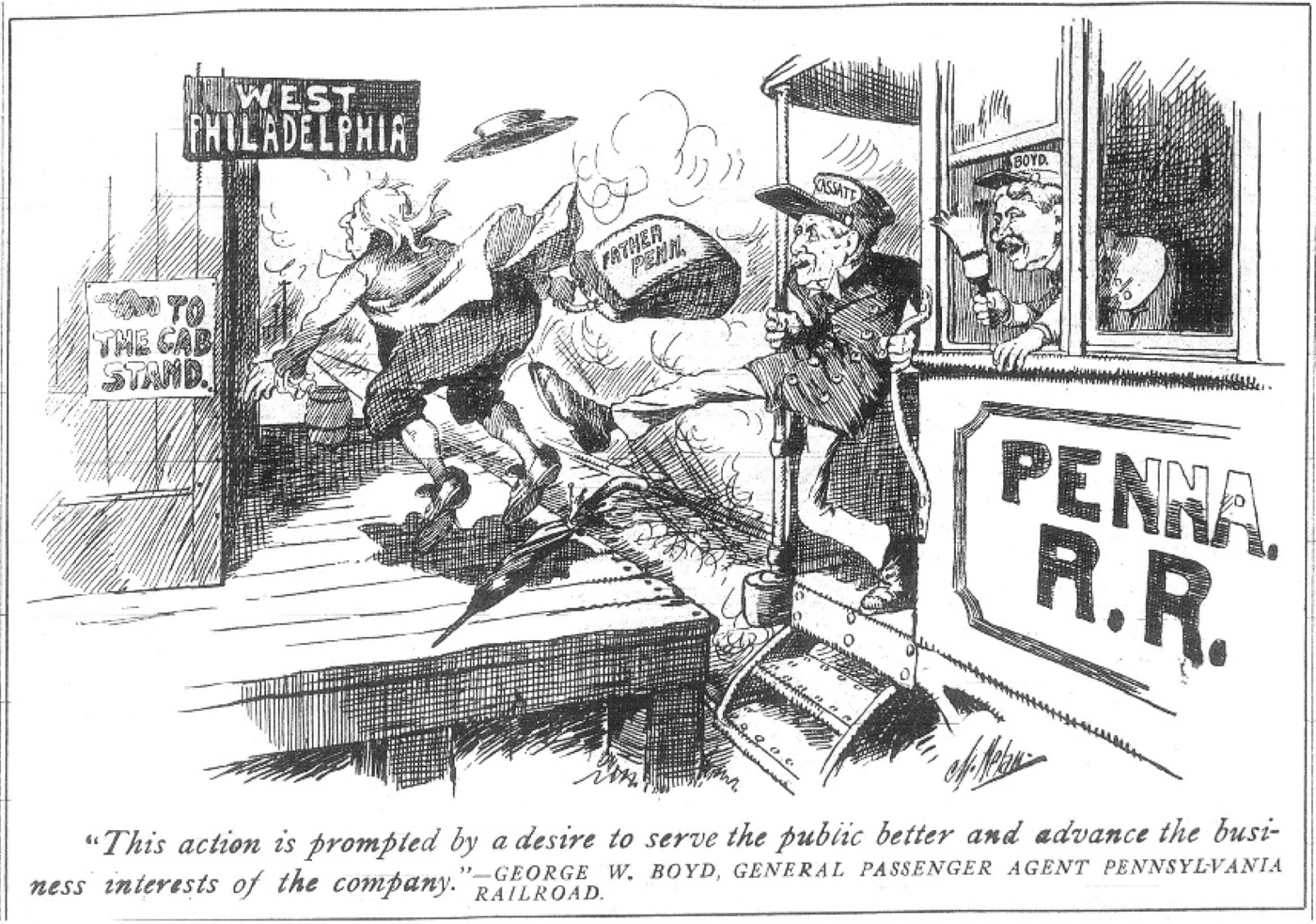
For the next week the North American bombarded the Pennsylvania with bad publicity. The typical layout consisted of a front-page story, usually with a cartoon, that continued with a full page of follow-up. The paper carried a page-one sidetrack story for twenty-one straight days until the Russo-Japanese War demoted it for a day. The first of what would prove to be over sixty Charles Nelan cartoons appeared, showing Cassatt booting Father Penn off the train in West Philadelphia with a sarcastic caption about improving service (figure 2). In Philadelphia at least, Father Penn was—like Uncle Sam—a stock cartoon figure. Nelan had used him in earlier cartoons about the Quay machine. By inference, the fight was not between two business groups but between the entire city and the railroad. The paper also reported a protest by the Merchants and Travelers' Association and a company response the paper tersely summarized as “Use P.R.R. Cabs.”Footnote 24
Philadelphia North American, November 23, 1903. Pennsylvania president Alexander Cassatt kicks Father Penn off at West Philadelphia, while the caption quotes passenger agent George W. Boyd, “This action is prompted by a desire to better serve the public and to advance the business interests of the company.”
In the first of many editorials, entitled “Another Challenge,” Van Valkenburg reminded readers of the stopover imbroglio and denounced the “impudent injustice” of the “railroad monopoly which is slowly strangling the progress of this city.” He noted that the railroad had claimed that the protest was “merely an attack from a single newspaper,” which he termed “an affront to the merchants.” Developing a theme he would return to later, Van Valkenburg denounced the Pennsylvania's “obdurate determination to run its business to suit itself.” Thus Van Valkenburg managed to make sidetracking a moral issue and to link it to continuing worries that an emerging railroad monopoly might stifle economic opportunity. In this way, he transformed what might have seemed a simple squabble among business interests into part of the larger national campaign, then taking form, to regulate the trusts. The railroad would lose, Van Valkenburg claimed, and he invoked for the sidetracked merchants the same claims that motivated national progressivism. “Stirred by a sense of causeless injustice and inspired by a recent victory, the businessmen of Philadelphia should go into the fight to win,” he thundered.Footnote 25
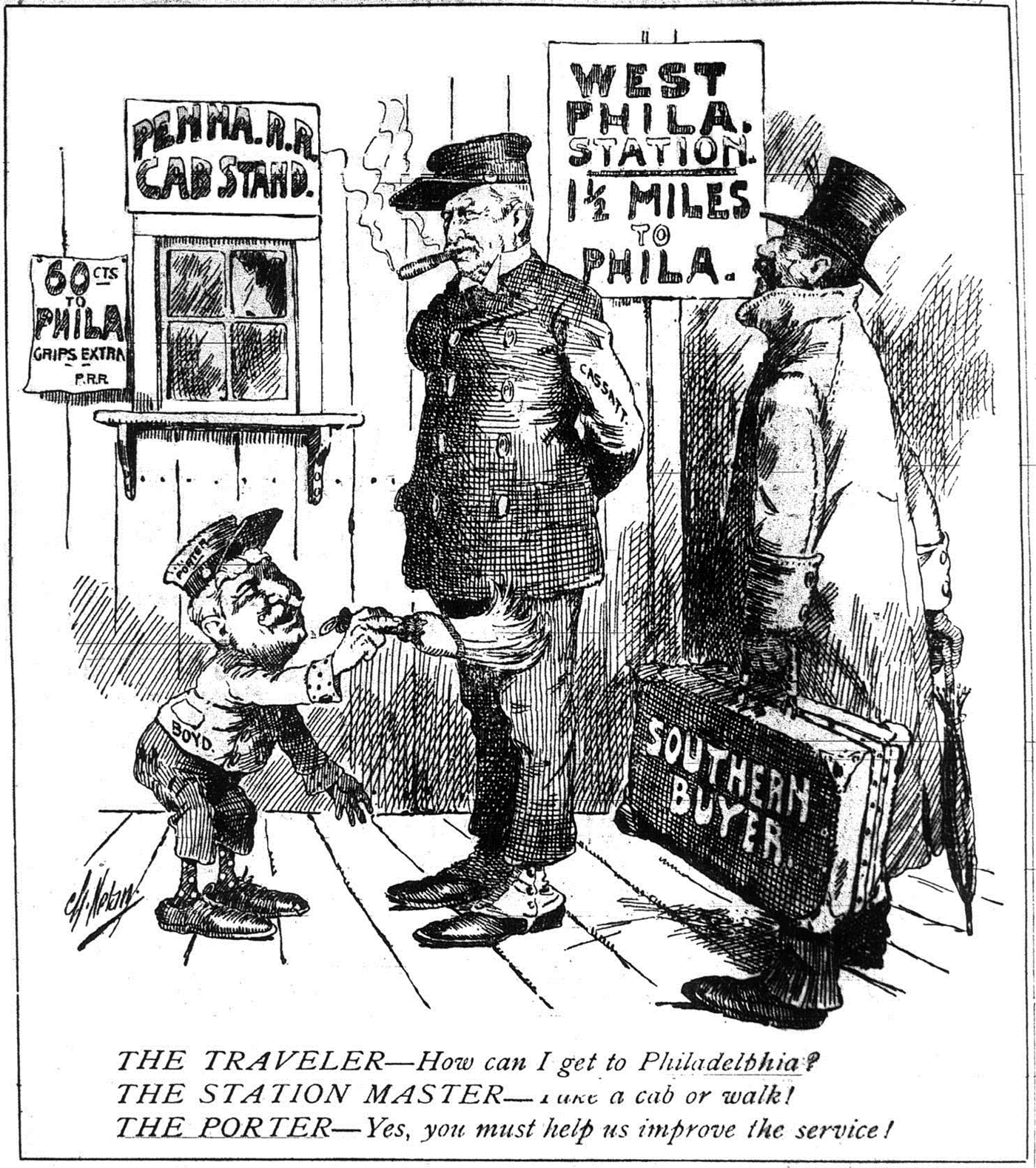
Every day brought more cartoons, page-one stories, and reports of unrest among the trade groups. “Protests Multiply,” the North American happily reported. Another cartoon (figure 3) showed Station-Master Cassatt, drawn as a typically imperious corporate titan, and pipsqueak Porter Boyd, who stand between a southern buyer and Philadelphia and inform the buyer that he can take a cab or walk to “help us to improve the service.” These and similar images powerfully depicted what was essentially the Philadelphia business variant of the antimonopoly tradition: the railroad's actions were arbitrary and harmful because they diminished economic opportunity to Philadelphia business.Footnote 26
Philadelphia North American, November 27, 1903. Cassatt is all that stands between southern buyers and downtown. Passenger agent George Boyd is clearly Cassatt's lackey.
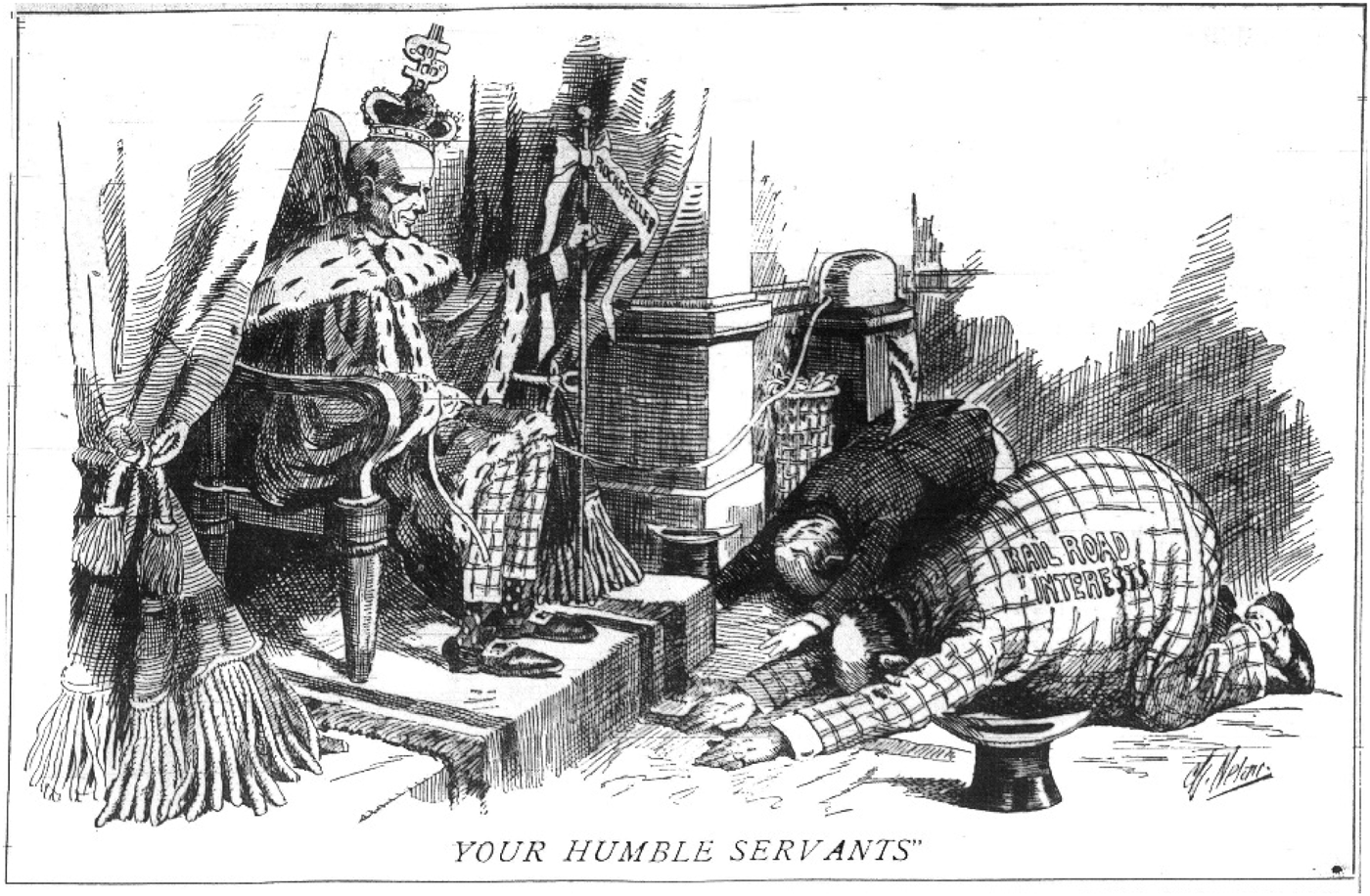
The new schedule was to commence November 30, and as that date approached, the protests became louder. “Sidetracking Decree United Trade Bodies in Stern Resistance,” a page-one headline announced on November 29. “City's Business Men in Big Meeting to Protest against Sidetracking” was the next day's lead. The paper publicized a “Monster Petition” and “Campaign against Pennsy Ukase.” It reported a meeting with Cassatt on the day that sidetracking would begin by a committee led by W. W. Foulkrod, president of the Trades League, which included members from that body and a number of trade associations. At the same time Foulkrod also wrote a private letter to the Pennsy's management. He pointed out that the business interests of the city were thoroughly “worked up” and predicted that since the railroad would sooner or later be forced to back down, compromise was the essence of wisdom.Footnote 27 Significantly, to mark the inauguration of sidetracking, the North American also published a cartoon (figure 4) showing railroad interests bowing down to “money king” John D. Rockefeller, thereby implying that their greed was limitless and again linking the protest movement with the larger national antimonopoly and antiplutocracy crusades.Footnote 28
Philadelphia North American, November 29, 1903. Through editorials and cartoons like this one, the paper coupled sidetracking to the national discourse on corporate greed and power, as symbolized by Rockefeller. The stock ticker, in turn, links him to the evils of finance.
“The Fight Is On”
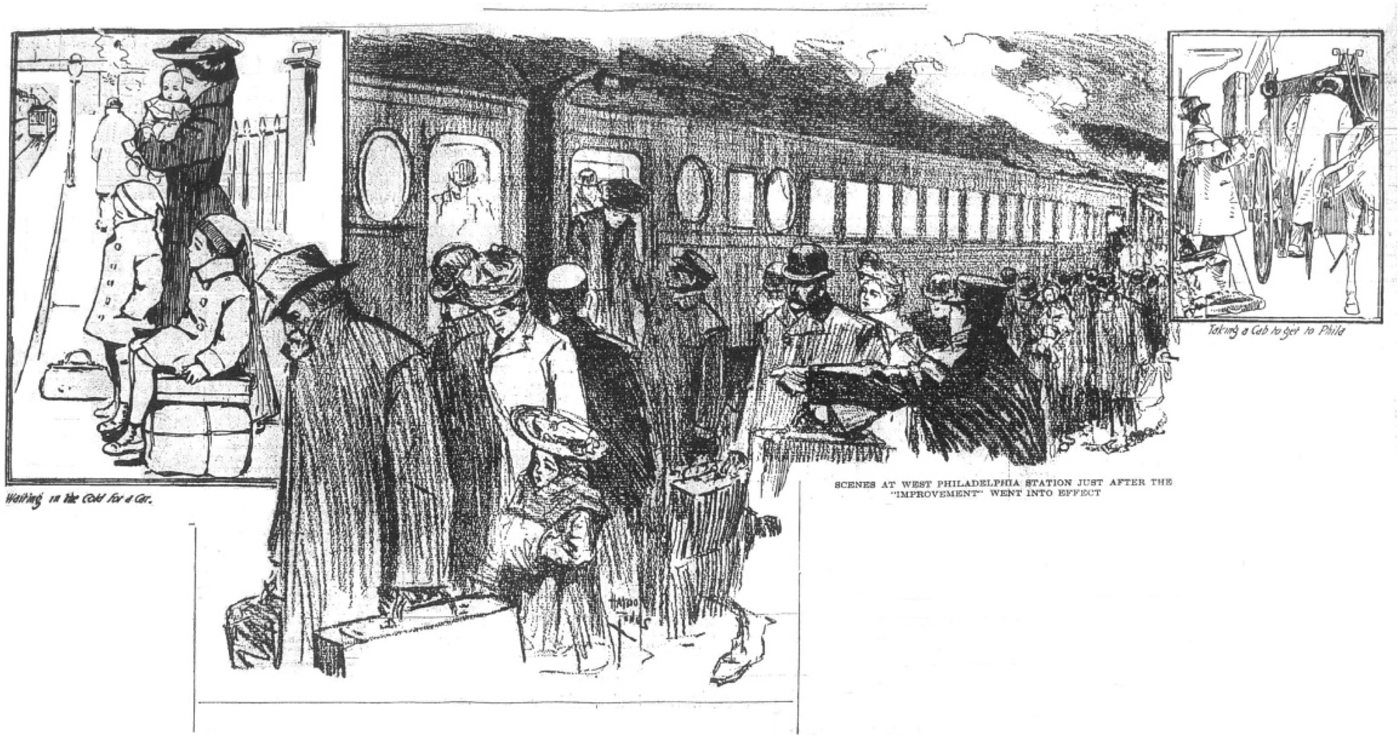
The initial petition accepted the railroad's argument that traffic congestion required the shifting of though trains to West Philadelphia. What the petitioners asked for was the right to purchase tickets on local trains to Broad Street. Foulkrod had announced that he believed the Pennsylvania would at least modify its order, but the North American must have realized that the petition would be rejected, for it attacked with all guns blazing. The headline read, “Penna Railroad Dumps More than 700 Passengers at Way Station First Day under Sidetracking Decree.” The article described the station as having a “small waiting room…. In temperature and humidity it closely approached the boiling out room of a Turkish bath, … [and] stank from the reek of a half dozen immigrant odors.” The front page also figured an artist's drawing (figure 5) of weary passengers, with heads bowed trudging through the station. The paper would continue to deploy these images—“dumping,” “sidetracking,” “‘improvement’”—for the remainder of the battle. Further stories with headlines such as “Order's First Victims Hot in Denunciation” quoted many “disgusted passengers” and “victims” who claimed that they would avoid the city in the future. One was George Miller, a dealer in photographic supplies, who termed the order “an outrage.” Another, a salesman for Julius Kessler & Co. distillers, claimed it was the sort of thing you expect in some prairie town. “I shall know enough to cut out Philadelphia next time,” he warned. A cartoon depicted Father Penn rolling a giant ball of protests toward the P.R.R.Footnote 29
Philadelphia North American, November 30, 1903. The caption reads: “Scenes at West Philadelphia Just after the ‘Improvement’ Went into Effect.” Although the primary concern with sidetracking was the potential loss of business, the picture suggests that large numbers of families were also affected, which was unlikely. A later drawing depicted a confused immigrant woman lost in West Philadelphia while her friends waited at Broad Street.
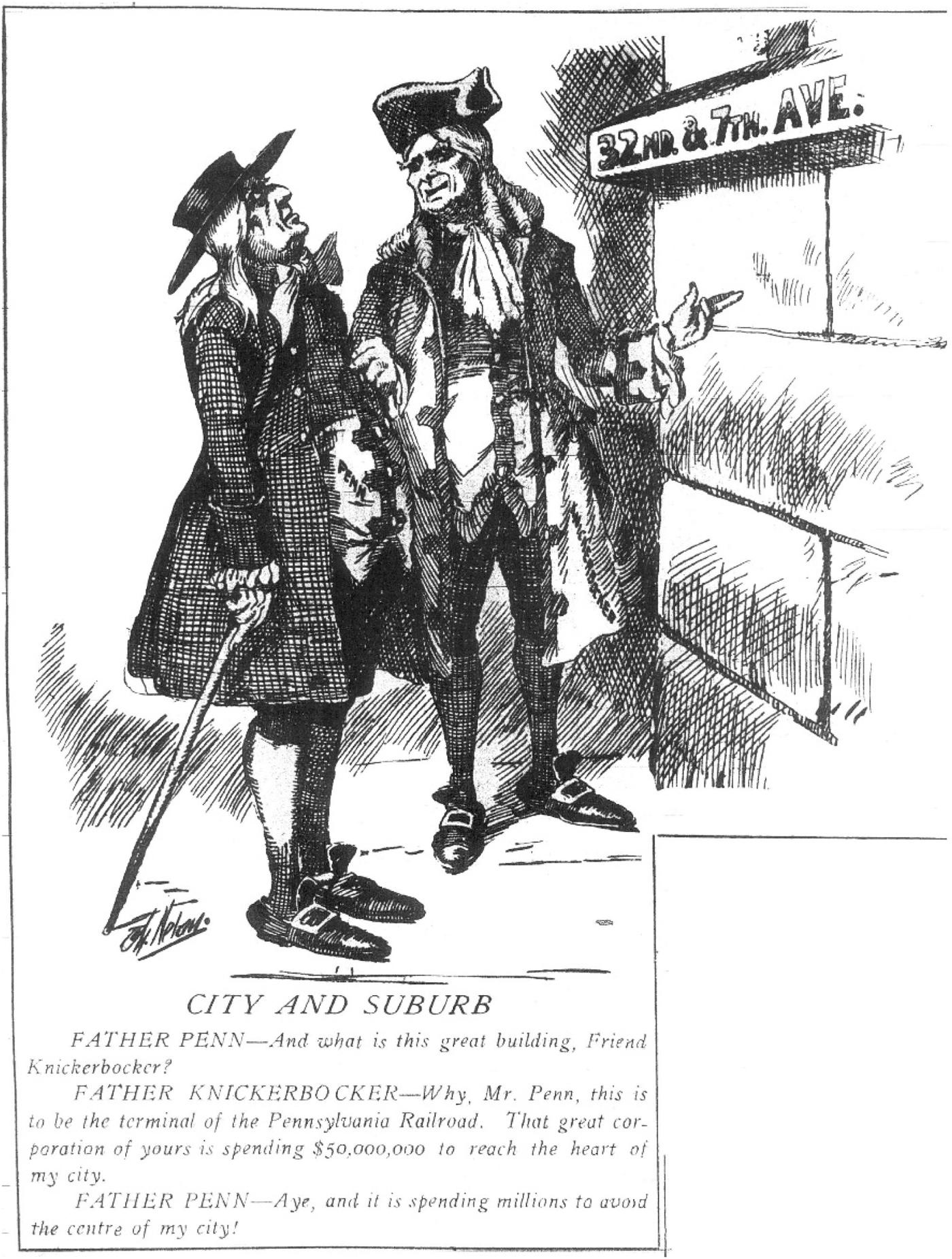
As they waited with “shotted guns,” as the North American put it, for Cassatt's reply to the petition, the various business and trade associations continued to mobilize, while the paper kept up its assault with daily cartoons and reports from outraged travelers. When Foulkrod's public utterances seemed insufficiently militant, the North American tried to add a little iron to his backbone with a cartoon. He was depicted—looking exactly like a pipsqueak version of Cassatt and wearing a “P.R.R” cap—offering soothing words to Father Penn, who towers over him and sternly urges “deeds not words.” Another image (figure 6), again emphasizing merchants' fears over New York competition, had Father Knickerbocker and Father Penn comparing the Pennsy's treatment of the two cities. The paper also published a schedule with late trains coming into the West Philadelphia Station describing the list as “A Few Facts about ‘Improved’ Service.” The paper followed this story with another the next day complaining that the new schedule was delaying the mails. There were more artists' renditions of forlorn passengers under the subheading, “Travel Weary Strangers Get Lost at Way Station through P.R.R. Sidetracking Order.” The next day saw an emphasis on bad weather: “Hungry Passengers from Belated Trains Stand in Slush.”Footnote 30
Philadelphia North American, December 3, 1903. The Pennsy's massive construction into the heart of New York City made sidetracking seem like putting salt in Philadelphia's wounds.
Cassatt's response came on December 4, a blunt rejection of the request characterized by the North American as “Take a Cab or Trolley Car.” The paper illustrated the statement with a tiny image of Cassatt kicking the petitioners down the steps. Given the widespread dissatisfaction with the PRT—so recently stoked by the North American—this must have come across as particularly irritating, as no doubt the newspaper intended. Another cartoon showed Father Penn with a dog sled searching for the West Philadelphia station. The paper published still more stories of outraged travelers and denunciations from trade groups.
In fact, Cassatt's letter contained a long and detailed response. Some travelers, he pointed out, could arrive in Broad Street simply by choosing trains where Philadelphia was the final destination; he claimed that comparatively few passengers would be affected by the change and explained that the railroad had done time studies and “actual trials,” which revealed that a cab took no more than two or three minutes more than a local train while the extra cost was trivial. Cassatt was an engineer, and this was an engineer's response: it laid out the railroad's position, seemed to trivialize the opposition's concerns, and offered nothing to the protesters.Footnote 31
This precipitated a war of words as local businessmen attempted to refute Cassatt's claims. Significantly they were led by Mahlon Kline of Smith, Kline & French, Wholesale Druggists; and Ellis Gimbel of Gimbel Brothers, two of the most prestigious men and firms in Philadelphia. The North American contributed more of the same loud headlines (“Sixth Day of Dumping Passengers in Suburb”) and reports of anger and mobilization. E. M. Childs, a jewelry salesman, termed sidetracking “a damned outrage,” while E. S. Goodwin, a cotton goods manufacturer, announced that he wanted “to go on record as being strongly opposed” to the order. The dispute revealed how sharply the perspectives of the two parties differed. Cassatt was right—few passengers would be affected and cab or trolley costs were trivial—but these claims missed the point as merchants saw matters. As head of a great railroad, Cassatt had probably never missed a train or had to conform to an inconvenient schedule. Fewer trains to Broad Street meant less choice, and travel was sometimes spur of the moment, while cabs and trolleys were slow and (as will be seen) sometimes unpleasant. Moreover, to the merchants not all passengers were equal, and if the “few” who were affected were potential buyers, they might matter a lot.Footnote 32
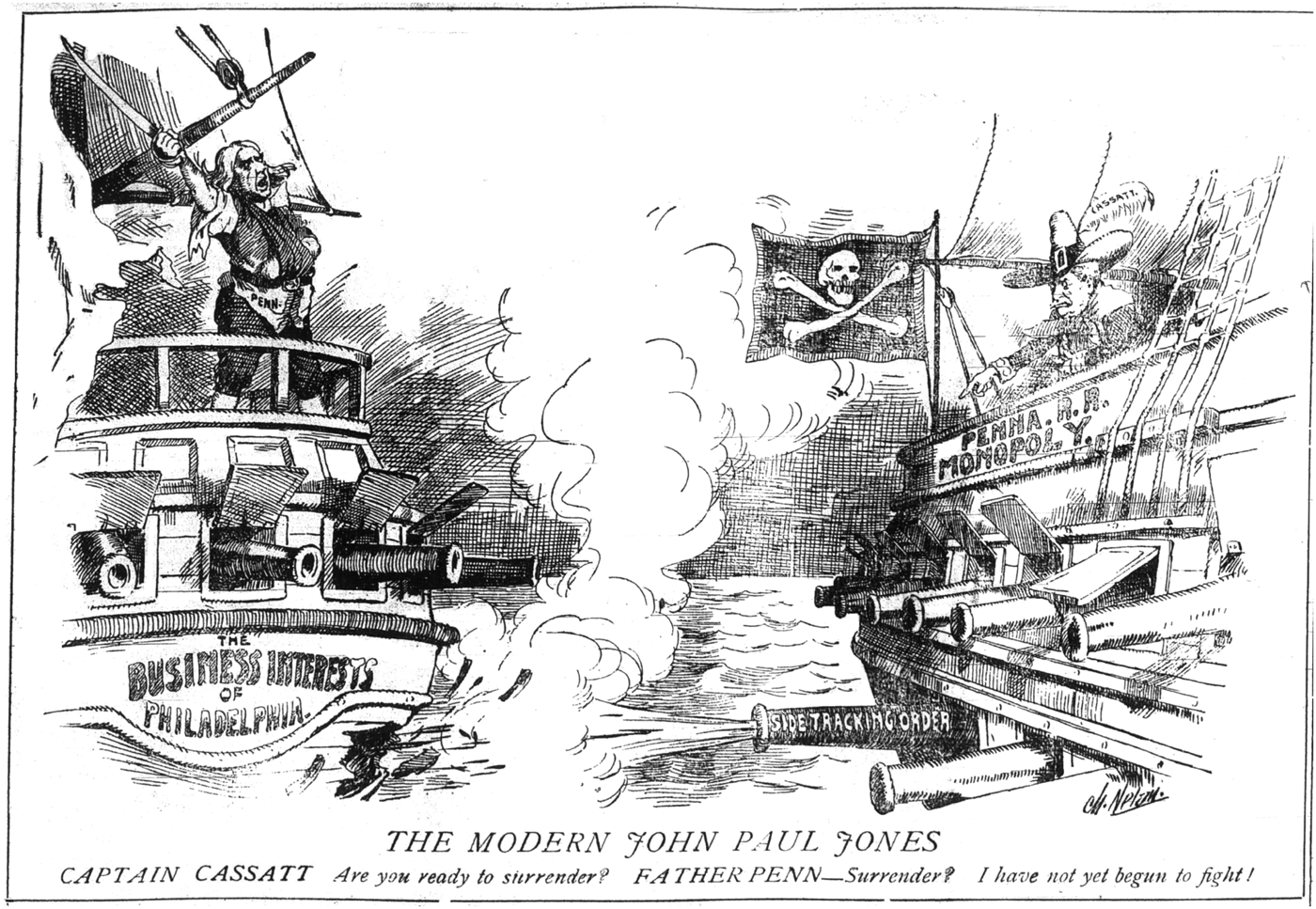
Another cartoon (figure 7) with Father Penn as John Paul Jones breathed defiance to the pirate monopoly—an image Nelan had previously employed when denouncing the Quay machine. The paper also argued that the sidetrack order was unnecessary, claiming that traffic density was higher on the Reading, which also had a downtown station. In a long editorial, Van Valkenburg again linked sidetracking to national political issues, arguing that the Pennsy was a monopoly “squeezing the lifeblood from the city's trade.” As with the nation, the issue for Philadelphia was “what are … [the businessmen] going to do about it.” The answer came in two parts, several days later. Some groups began to talk of a freight boycott, while the Merchants and Travelers' Association met to frame a response to Cassatt's rejection.Footnote 33
Philadelphia North American, December 5, 1903. Here Cassatt is a buccaneer captain of the railroad monopoly trying to hijack Philadelphia's business interests.
About this time, cracks began to appear in the wall of opposition, however. The Board of Trade declined to participate in the response, preferring instead “to give the Pennsylvania Railroad time to perfect and test their arrangements,” a fact reported in other papers but largely ignored by the North American. Privately the board wrote a conciliatory letter urging the Pennsylvania to make “such changes as are practicable having due regard for the best interests of your railroad service and of the traveling public.”Footnote 34
On December 9, the North American deployed a new weapon. Under its headline “Penna R.R. Discrimination Will Keep Many Buyers Away from Philadelphia,” it pointed out that sidetracking routed all southern trains through West Philadelphia, including those originating on the Atlantic Coast Line, Chesapeake & Ohio, Seaboard, and Southern as well. It printed a map of those lines with the title “Travelers from Eleven Southern States Barred from Broad Street.”Footnote 35
The North American was not the only Philadelphia paper to follow the sidetrack issue, although it was the only one to use that term, and its coverage was far more extensive and partisan than that of any other paper. The Inquirer also broke the story on November 21; thereafter it followed events in matter-of-fact tones. It published a reply from Cassatt to the private Board of Trade letter noted above that attributed any injury to business to the “spreading abroad of the impression that Philadelphia had been passed by,” a thinly veiled slap at the North American. On December 5, an Inquirer editorial deplored the “exaggerated statements” that had emanated from some individuals and newspapers. The same day, the Inquirer published a schedule of Pennsy trains to and from Philadelphia. When the North American published schedules, it was to emphasize late trains or lack of service; the Inquirer's goal was to illustrate “the smallness of the curtailment of the train service.” A front-page article in late January again claimed that “‛Side Track' Agitation Is Harmful,” for which it blamed other newspapers. The North American responded, terming the story “abysmal stupidity” and “hopeless rot.”Footnote 36
The Bulletin's first article appeared on page 1 on November 23; thereafter it tracked events closely for about two weeks before consigning the story to the financial pages. It never took an editorial stance on the matter. Coverage in the Record was skimpier but slightly more favorable to local businesses, although editorially that paper took the Pennsy's position, claiming “the railroad company is so clearly right that there is no real controversy.” At the Public Ledger, sidetracking never made it to page 1. Public Ledger editors claimed that the Pennsylvania's action “quite justifies itself,” while the “inconvenience caused to passengers … has been greatly exaggerated.” Such a stance by its competitors was a boon to the North American, which reproduced their editorials. “We do not for a moment believe that venality is at the root of this strange desertion,” Van Valkenburg penned in an editorial of his own—no doubt with tongue in cheek—and he piously concluded that “the North American … deeply regrets that it must stand alone.”Footnote 37
A few days later, in an editorial entitled “Not a Private Enterprise,” Van Valkenburg again wedded sidetracking to larger public issues and tried to undermine the presumption of legitimacy that he thought Cassatt and others claimed for the Pennsy's actions. The idea that the railroad as a private enterprise “should be allowed to conduct its business without public interference” was incorrect, Van Valkenburg asserted. Such arguments had a long history, and as Andrew Heath has shown, provided merchants with a language of legitimacy that cloaked a dispute over private profits. “There is nothing more thoroughly established in law than the principle that a railroad is not … a private institution,” Van Valkenburg reminded his readers. He cited various legal authorities to buttress his claim that railroads were common carriers affected with a public interest.Footnote 38
The paper dropped the next bomb on December 12, claiming in its usual front- page story that the Pennsy's original plan had been, in addition, to deny passengers who detrained from west bound through trains stopping at the North Philadelphia station the right to take a local into Broad Street. The protest, the paper asserted, had blocked the change. This surely provided a little grit to the protesters. The paper followed every day with items such as “21 Organizations To-Day Renew City's Sidetrack Protests,” along with endless reports of travelers' hardships and business denunciations of the railroad's perfidy. On December 21, an unexpected ally appeared in the form of U.S. Secretary of the Treasury Leslie Shaw, whose difficulties in getting from downtown Philadelphia to New York the North American gave wide publicity.Footnote 39
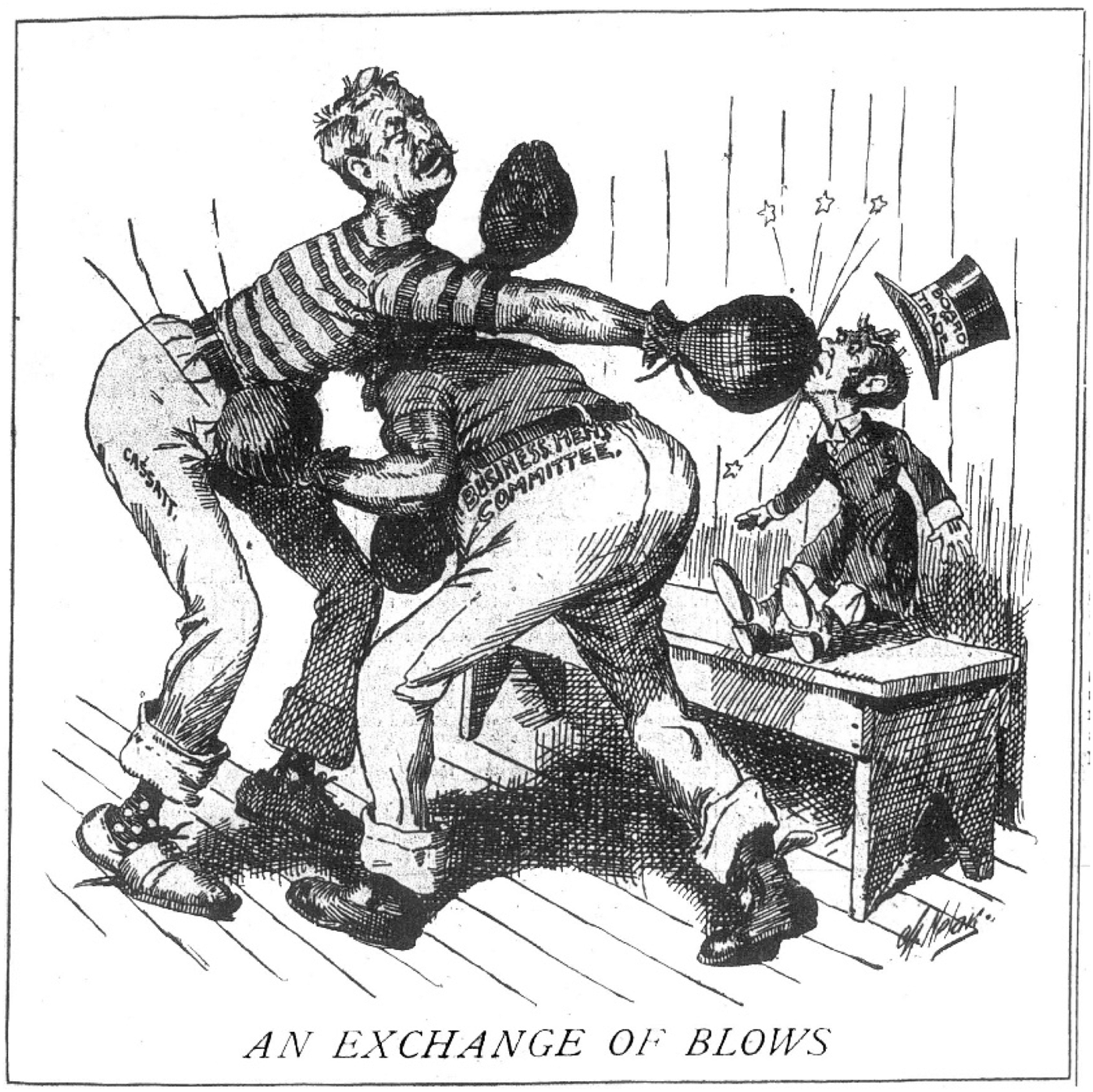
Another salvo came December 22 in the form of a second protest letter to President Cassatt from a committee representing twenty business associations. This included the Board of Trade, which had previously urged patience, though apparently its patience ended. The North American ran a cartoon (figure 8) showing a boxing match between Cassatt and the business committee in which a tiny bystander named Board of Trade gets an inadvertent punch in the nose from the railroad. Cassatt responded promptly, and as Van Valkenburg had editorialized, he saw the matter as simply a private business decision. “As a question of railroad operation, it is one with which the management of the company should, from long experience, be thoroughly competent to deal,” Cassatt grandly informed the petitioners. “Our Business, Not Yours,” the North American bluntly characterized it.Footnote 40
Philadelphia North American, December 23, 1903. The Board of Trade's punch in the nose from Cassatt is a warning to those (pipsqueaks) who might be too accommodating to the railroad. Perhaps inadvertently the cartoonist has the businessman's association landing a low blow.
Full-Scale War
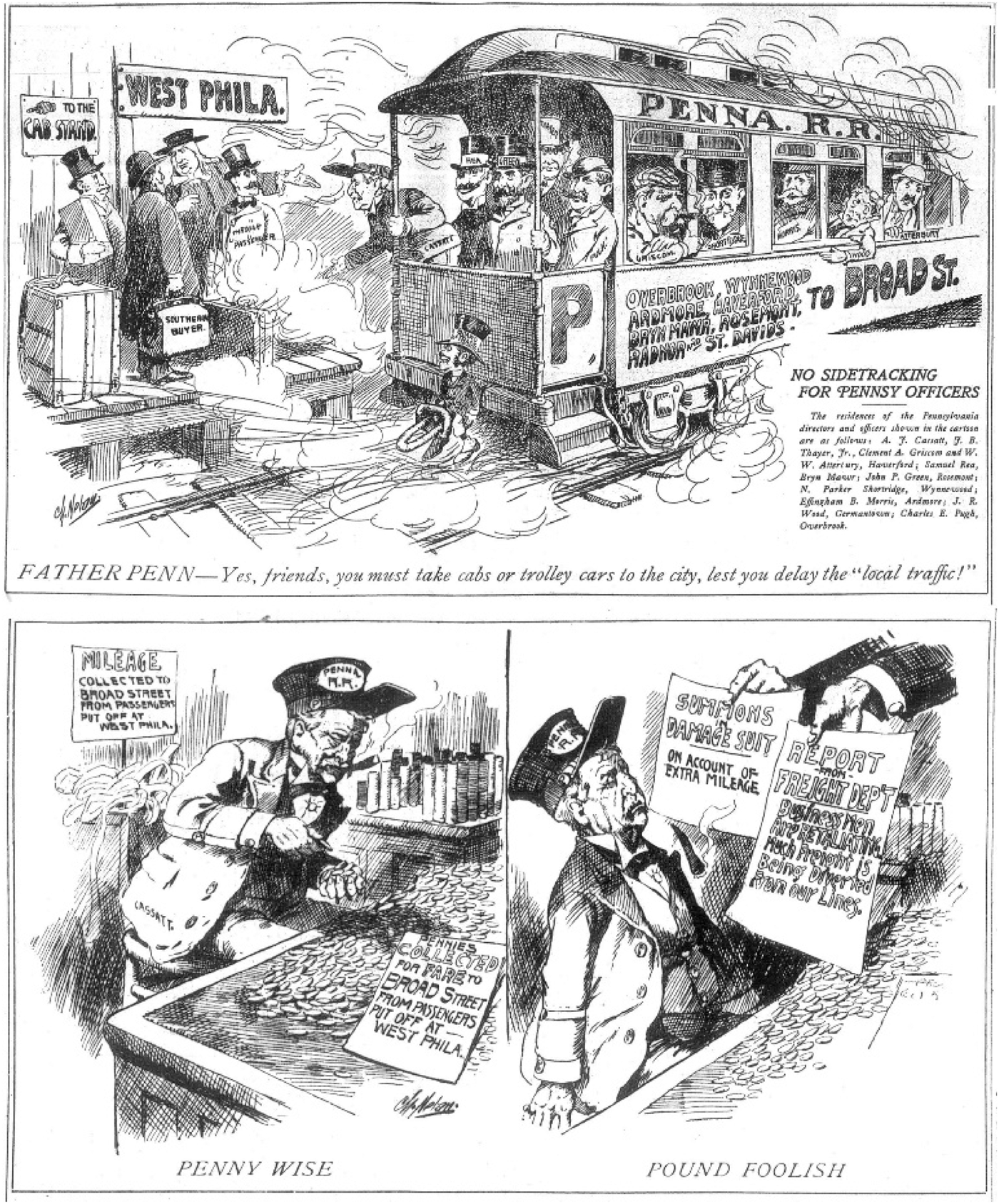
While on December 30, 1903, the Merchants and Travelers' Association resolved that it would “never … consider the matter a closed issue,” it had become apparent that protest alone would not move the Pennsylvania to rescind its sidetracking order. The North American reported some grumbling about a legal test of the order, but the preferred approach was to boycott the Pennsy's freight service. “Businessmen Begin War of Retaliation,” the paper announced, reporting there and elsewhere that companies were beginning to shift business to the Reading and other lines. The critique of corporate privilege had long been a weapon in the antimonopoly arsenal. About that time Charles Nelan depicted the Pennsy's managers happily riding local trains into Broad Street (figure 9, top). While these trains did not pick up passengers in North Philadelphia, as the image implies, that was no inconvenience to corporate management. There was also guerilla warfare: a Philadelphia lawyer, discommoded by the sidetrack order, sued the Pennsylvania for the two-cent fare representing the ride from West Philadelphia to Broad Street. Another North American cartoon (figure 9, bottom) promptly featured Cassatt counting pennies from the fare to Broad Street while losing dollars on the freight boycott. A week later the company rescinded the two-cent charge.Footnote 41
Philadelphia North American, December 28, 1903, and January 5, 1904. By now the newspaper was portraying the railroad not only as arrogant (top image) but self-destructive as well (bottom). The tiny figure on the coupling is the Board of Trade again. Because the Pennsy had not used link-and-pin couplers on passenger equipment since the 1860s, this technical detail was apparently a dig at the company's inferior service for Philadelphia businesses.
In early January, bad weather came to the aid of the protesters. “Two to 52 Below Zero in State; Suffering and Death; Business Halted,” the North American announced on January 6. The same issue included a story, “Sufferings of Dumped Passengers Reach Maximum.” About a year earlier, the North American had campaigned against the city's unheated trolley cars as part of its general critique of the poor service provided by the PRT. This was not a contrived complaint: measurements taken later revealed that January temperatures inside the cars averaged about 30 degrees. Bad weather thus merged the problems of municipal corruption and private corporate power.Footnote 42
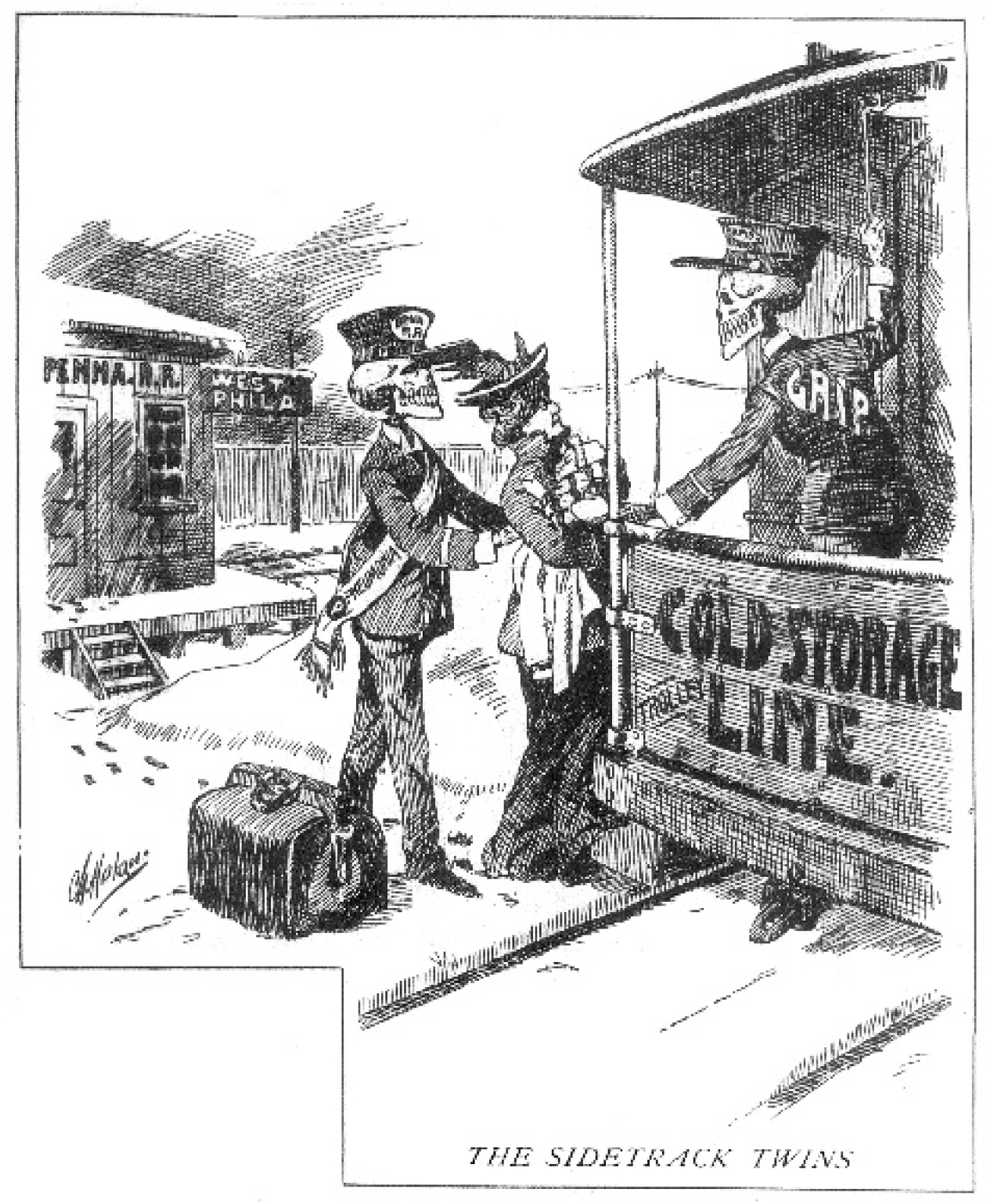
Charles Nelan dusted off an old cold weather theme for his cartoons. For the PRT campaign, Nelan had contributed drawings featuring two death's heads named Pneumonia and Grip conducting the cars. In the first of several new drawings (figure 10), Pneumonia and Grip, now named the “Sidetrack Twins,” hustled travelers from the West Philadelphia station to the “Cold Storage Trolley Line” headed downtown.
Philadelphia North American, January 9, 2004. Pneumonia and Grip greet each passenger. Note that passengers are no longer southern businessmen but rather women with small children.
A decisive engagement in the sidetrack war occurred on January 8, when the Philadelphia Common Council (the municipal governing body) unanimously voted to join the protesters. While accepting the need to divert through trains to West Philadelphia, the council requested that passengers be allowed to ride local trains between that station and Broad Street. At this point, it should have been clear to the Pennsylvania that it had lost the war. Inevitably with its expansion of Broad Street and other downtown construction work, it would require many permits and zoning changes. With the local business community and political establishment in its home city in almost unanimous opposition, the railroad could not expect the kind of cooperation it needed to do business.Footnote 43
Despite this blow, the war dragged on nearly another two months. The North American continued to lambaste the railroad with cartoons featuring the “Sidetrack Twins,” late trains, Cassatt under fire, and the dismal state of the West Philadelphia station. It featured stories of spreading retaliation, reporting “rapid growth” of the movement in a January 21 article. The Pennsylvania's own records contain a resolution of the Philadelphia Leaf Tobacco Board of Trade announcing that “we will divert all possible freight and traffic to other roads.” In late January the North American also began to publicize a potential stockholder revolt to protest sidetracking at the forthcoming annual meeting.Footnote 44
On January 30 signs appeared that the Pennsy was preparing to admit defeat. A North American article claimed that the railroad had promised to end sidetracking “sometime.” The Inquirer presented the story not as a defeat for the railroad but rather as a simple seasonal schedule change: sidetracking had occurred due to the heavy fall influx of trains to Florida combined with station repairs. “As has been anticipated by the Pennsylvania Railroad Company—when the fall schedule went into operation whereby through trains were stopped at West Philadelphia—this spring will see a return in a great measure to the [previous] schedule.” It quoted a railroad official that “this move apparently was much misunderstood. … It has always been our intention as soon as business and weather permitted to bring as many through trains into Broad Street Station as possible.”Footnote 45
If the Pennsy hoped that these soothing promises would undermine enemy morale, it was destined to be disappointed, for the North American's barrage never let up. When the paper got wind that the railroad was saying that its stories of discontent had been fabricated, it devoted a whole article to complaints by prominent merchants, complete with their portraits. In February it carried at least one article on sidetracking every single day, save one. An editorial lamented the effect of the “dump system” on invalids who were abandoned in West Philadelphia; an article claimed sidetracking harmed the city's prestige as a medical center. A cartoon showed old Mother Hubbard Cassatt with a dog named P.R.R. and a bare cupboard because shippers were moving freight to competitors. When Baltimore experienced a major fire, the paper claimed that Philadelphia would have captured its trade but for sidetracking. Another cartoon suggested using a dogsled to transport passengers downtown. Articles portrayed the company as desperately trying to peel off various trade groups and avoid a fight over the issue at the annual meeting. Other stories claimed that sidetracking had become an international issue or told of rival cities trying to use sidetracking to steal business from Philadelphia and of local businesses that were losing trade.Footnote 46
But what finally carried the day was a petition to the railroad from 3,592 Philadelphia companies that shipped freight on the Pennsy and the rather testy exchange between Cassatt and the petition's organizer, Mahlon Kline, of Smith, Kline & French. The petition—as usual—requested that the Pennsylvania agree to carry passengers from West Philadelphia to Broad Street on its local trains. After some prodding, Cassatt reluctantly met with the petitioners, but apparently the meeting did not go well. Kline then wrote him a thinly disguised ultimatum. The concern for trade that lay behind the petition, Kline informed him, was “not a manufactured one.” That is, the sidetrack war was not just something invented by the North American to sell newspapers. It “has been voiced by about every commercial body in this city,” Kline reminded him, and he concluded that sidetracking “ought not to stand between the Pennsylvania and the “goodwill and cooperation” of the local community. In short, sidetracking had lost the Pennsylvania the support of the entire local business (and political) establishment, a disaster for a company in need of zoning changes to accommodate downtown construction.Footnote 47
Cassatt responded with a grudging concession. What the petitioners wanted—to allow through passengers to take local trains into Broad Street—would result in “confusion, mistakes, and misunderstanding,” he informed Kline. Instead he announced that when repairs to Broad Street Station were completed, “we expect to run more trains” there. Moreover if the weather were to turn mild, “we may, in advance of these improvements, be able to bring in some … trains.” In short, while the mighty Pennsylvania would adjust its schedule to the forces of nature, it bowed to no human power. That was not how others saw matters. When Cassatt's response became public, the Record claimed “great petition has effect,” and the North American, of course termed the changes “a remarkable victory for the city's business men.” On March 1, through trains again began to run into Broad Street: The great sidetrack war was over.Footnote 48
Conclusion
Was the Pennsylvania's sidetracking of Philadelphia simply a temporary policy implemented under the press of seasonal traffic fluctuations for the period while the company was renovating Broad Street? If so, it was surely one of the most poorly explained policy changes in corporate history. In fact, there is no mention either in public or the company's records that the changes were to be temporary until January 30, by which time the Pennsy must have been looking for a graceful escape.
But whether the policy was intended to be permanent or temporary, it reveals much about the political economy of big business in early twentieth-century America. State and national efforts to regulate railroads, just then beginning to intensify, derived from many local struggles such as this one. The protest against sidetracking was a response by small business to perceived threats to their profitability. Such concerns, as the dispute demonstrates, extended beyond railroad rates, involving fears of railroad power more broadly conceived.
The boundaries of public and private were shifting at both the national and local levels, as Van Valkenburg saw and Cassatt did not. Cassatt viewed sidetracking as a simple matter of efficiency, but he failed to understand that efficiency now needed to be negotiated. Despite the fact that the railroad had already been forced to back down in a previous contest over stopover privileges—a dispute that had resulted in the formation of the Merchants and Travelers' Association—the Pennsy had done nothing to prepare local merchants for the sidetracking order. Its public pronouncements condescendingly implied that the merchants were being manipulated by the North American. Statements from the railroad were also tone deaf, even after Cassatt recognized the need for compromise. Even in defeat the railroad managed to look arrogant. To Philadelphia's merchants—and to the merchants of any other city if they followed the sidetracking squabble—there could have been no better argument for stricter trust regulation and an empowered Interstate Commerce Commission.
Yet if the Pennsylvania seemed to local businessmen a behemoth in need of public control, to modern eyes, in its blundering public relations it looks like a clumsy giant. As Mahlon Kline reminded Cassatt, the North American did not kindle the discontent all by itself. But the paper surely fanned the flames, whipping up a conflagration at times and blowing on the embers when the fires appeared to be guttering. Its stories and editorials dramatized the fight and invested it with more than ordinary importance, while Charles Nelan's daily barrage of cartoons ridiculed and diminished the company, making its defeat seem possible. The business community probably could not have won without the paper's wholehearted support. A few years later a cartoon in Life caught the new power relationships. Its caption read: “The rich muckraker asks for the hand of the poor railroad president's daughter.”Footnote 49
The Pennsylvania's bruising loss in the sidetrack war, combined with the continued bad publicity the company was receiving over its accident record, finally focused its managers on the need to improve public relations. About two years after the sidetrack imbroglio the company hired Ivy Lee, later to become famous as an image consultant to John D. Rockefeller. Lee began a general makeover of the railroad's public face. He also consulted at the Baltimore & Ohio, New York Central, and Union Pacific on ways to improve the companies' images. Indeed, about this time the carriers jointly launched the Bureau of Railway Economics to counter adverse publicity. Thus the sidetracking dispute reveals how antimonopoly campaigns that threatened corporate decision making helped launch modern corporate public relations.Footnote 50
On the Pennsy, Lee's skills in managing the news paid off in numerous ways. For example, in 1911 when schedule changes precipitated a flurry of charges that Philadelphia was again being sidetracked, the railroad reacted quickly, issuing a news bulletin and meeting with the head of the Trades League. The dispute petered out. Although the Pennsy would make numerous schedule changes in the future, there were no more sidetrack wars.Footnote 51