“Are we holding folx in the lobby before going into the gallery? Or are we asking folks to go straight into the gallery? […] Where can the folks who are watching the livestream see the program?” (Kosoko Reference Kosoko2020a)
Artist Jaamil Olawale Kosoko texted with me to finalize last-minute details for his remote event, Chameleon (The Living Installments) on 22 April 2020—Earth Day. Footnote 1 The lobby, gallery, and program were online spaces that the artist developed while doing a one-month remote residency at the Curtis R. Priem Experimental Media and Performing Arts Center (EMPAC) at Rensselaer Polytechnic Institute in Troy, New York. He repurposed the utilitarian-looking online social gaming platform Discord as an interactive venue where the artist hosted audio streaming of original sound, footage from a new moving-image work, a multimedia zine, remote conversations, a somatic workshop, and an archive of images, videos, and links. Aside from prerecorded video footage, the three-hour activation of the online space was a live audio experience supported by what cocommissioning curator Lane Czaplinski has called Kosoko’s “Glen Gould-esque” radio personality.
Texting each other, Kosoko and I reviewed how audience members would first enter the virtual lobby space where they would hear a verbal welcome from the box office and house managers. The greeting was designed to ground guests in a space that might otherwise feel disorienting in its difference from a physical venue. The sonic realm of Discord is devoid of a physical box office, an usher holding a program, or any other visual cues consistent with IRL performance or even more traditional livestream platforms like YouTube Live. I asked Kosoko if he could also suggest some songs to play before the performance started. He swiftly responded with a dramaturgically poignant list that would transport an audience directly into the belly of the artist’s work: Jesus Christ Superstar, “Everything’s Alright”; Anita Baker, “It’s Been You”; Valerie June, “Astral Plane”; ASAP Ferg, “Family”; Tierra Whack, “Hungry Hippo”; Moses Sumney, “Indulge Me”; Janet Jackson, “Got ’Til It’s Gone”; Grace Jones, “My Jamaican Guy” (Kosoko Reference Kosoko2020a).
Just before going live, Kosoko asked if we could chat briefly. I called him on WhatsApp and we mutually acknowledged how we felt “alone together.” But we were not alone together in the sense that science and technology scholar Sherry Turkle theorized (2011). We could not be physically together at all: We were quarantined separately in our individual residences at the peak of the Covid-19 outbreak in the northeastern US. The media studies paradigm of digital culture was turned on its head by a necessitated new kind of reliance on technology. The alone-togetherness that the artist and I shared was complicated. It was born in part from fear of a virus and of the Trump administration, and the acknowledgement that they both had a disproportionately negative impact on BIPOC communities. The togetherness was also the result of relief and gratitude: we were alive and well, occupying this intimate space that Kosoko had designed, and had an opportunity to share space—even and perhaps especially remotely—with a community of people.
We had no idea what to anticipate on that Earth Day morning when we opened to the world on the Discord platform, but just moments after our call we were met with a thousand unique views from almost 300 cities across 8 countries. (This type of performance in person in Upstate New York might typically host 200 patrons total.) As the network of invisible spectators waited in silence, Kosoko revealed his presence with a breathy sigh. He then acknowledged the weight of the moment, his voice quavering with emotion. In the absence of a darkened theatre where audience members sit shoulder to shoulder, Kosoko’s raw vulnerability reoriented listeners from quarantine confusion toward an intimate zone of familiarity with an artist, his practice, and possible futures.
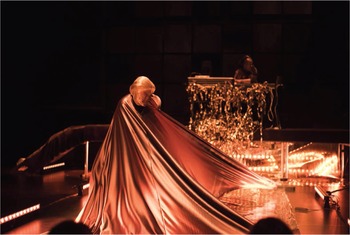
the hold, a work-in-progress iteration of Chameleon (A Visual Album). Jaamil Olawale Kosoko and Everett Saunders (keyboard). EMPAC/Curtis R. Priem Experimental Media and Performing Arts Center, 2019. (Photo by Sara Griffith; courtesy of Jaamil Olawale Kosoko and EMPAC)

Amidst fieldwide angst around the future of live performance in an era of social distancing, The Living Installments importantly demonstrated how there would not and could not be a one-size-fits-all response to the moment. Instead, proposals for coping would come from individual artists and their ways of navigating the world. Kosoko’s project, which he conceived well before Covid-19, was not originally intended for an online space. The artist’s pivot to Discord was a deliberate exploration of unknown territory, bolstered by a performance archive that Kosoko had built over decades. While the archive was being adapted to a new context, the project was always intended to embolden what the artist calls “adaptive strategies and ways of being in the world” (in Burke Reference Burke2020). Indeed, although Kosoko updated the subtitling, Footnote 2 the work was titled Chameleon even before he had to shift from the stage to online. His survival-driven focus on adaptability crystalizes the evolving politics and theoretical stakes of the moment. In production for Chameleon (The Living Installments), the artist reflected in solace on how coronavirus circumstances compelled presenters and audiences to value the vision that the artist had all along: a personally sustainable cross-platform experience that could transcend the physical presence of the artist.
Archival Sustenance
Screen-Based Media in Kosoko’s Live Art Practice
Kosoko’s live performance practice is a theatrical approach that he has not previously characterized as “new media” but that could easily qualify as such. The artist culls deep archives of news images, music videos, Instagram accounts, YouTube videos, and popular movies to find inspiration and material for his work. He used these archives to carefully craft narratives about loss and tragedy within Black queer life for his evening-length performances #negrophobia (2015) and Séanseurs (2017). In #negrophobia, for example, the artist pairs cellphone footage of police brutality with a live cellphone feed onstage, invoking the traumatic imagery of Black death relentlessly circulated on social and news media. In Séanseurs, the artist channels popular culture icons such as Little Richard, Prince, the specter of Michael Jackson, and M. Lamar in music video–style performances (Kosoko Reference Kosoko2020e). The way the artist embodies these materials in his onstage reperformances of them furthers the performative impact of Kosoko’s personal archive while also proliferating its materials across space and time, continuing a history of minoritarian cultural workers who develop archives to increase the visibility of marginalized social narratives (see Cvetkovich Reference Cvetkovich2003).
After significant touring of #negrophobia and Séanceurs across the US and in Europe, Kosoko turned again to the moving image for the making of Chameleon. This time, however, the artist entertained the idea of creating his own mechanically reproducible images. While touring is generally depleting, Kosoko was particularly exhausted from performing psychologically fraught works. In addition to cultural archives, Kosoko’s performances take inspiration directly from the artist’s personal experience of loss. A Nigerian American who was born and raised in Detroit, Michigan, by his mid-30s Kosoko had endured the loss of his grandmother, mother, father, and younger brother. Set pieces in #negrophobia include his brother’s sneakers and other ephemera from his brother’s violent passing; Kosoko’s brother was murdered in 2015 (Burke Reference Burke2017). In their critique of violence in performance Patrick Anderson and Jisha Menon warn that the “future-history of trauma” initiated by violence “does not merely describe, but performatively produces power relations” (Anderson and Menon Reference Anderson, Menon, Anderson and Menon2009:5). They cite representations of violence in contemporary media like cellphone footage of police brutality as reproducing the embodied sensationalism inherent in images of violence, and, thus, as performatively reasserting the power relations therein. The performance then supersedes the initial act of trauma itself and lives on in its future-history (see Anderson and Menon Reference Anderson, Menon, Anderson and Menon2009:1–15). Kosoko does not perform representations of violence per se onstage, but the cellphone footage that he includes in #negrophobia, for example, highlights the violence of everyday life inherent in institutionalized racism in the United States. Symbols such as the sneakers lend depth to the personal weight that Kosoko’s archive communicates.
Jaamil Olawale Kosoko performs a scene inspired by Curtis Mayfield among others for the filming of Chameleon (A Visual Album), first screened for Chameleon (The Living Installments) on 22 April 2020. Production still. EMPAC/Curtis R. Priem Experimental Media and Performing Arts Center, 2019. (Photo by Sara Griffith; courtesy of Jaamil Olawale Kosoko and EMPAC)

Looking to preserve his own future-history, the artist visited EMPAC at the beginning of 2018 for a site visit and to entertain the possibility of making a film. He wondered if he could use moving-image and installation to share his presence and perspective without having to endure the violence of physically reliving trauma onstage each time his work was produced for a new venue. After all, the turn toward moving-image also felt like an appropriate conceptual shift, since screen-based media had always been closely linked to Kosoko’s artmaking practice.
In the months that followed, Kosoko discussed his next work with curators at museums and performing arts venues to organize commissioning and coproduction support. The perspective that emerged from these conversations was that the market for his work was solidly within the realm of performance—curators wanted Kosoko’s now recognizable liveness whether it was in proscenium spaces or galleries. As curator of theatre and dance at EMPAC and as commissioning partner of Chameleon, I also held that perspective; one that for me comes in part from the logistics of creation. Beyond artistic importance, the ethical imperative to support artists beyond the immediate mastery of their disciplinary training is clear in light of the ways artists are being asked to perform chameleonic professionalism to survive the coronavirus moment. Since gathering in theatres and other venues was not possible at the time of this writing—and certainly was not at the time of the residency—those performance makers who were previously supported to invest in cross-disciplinary practice are perhaps more equipped to pivot toward inclusion in the new art market of streaming practices. Still, there is another layer of long-term pragmatism that comes from respecting the difficulty of attaining such flexibility while also maintaining a quickly growing career. It takes time to learn a new form.
The current market demand for emerging artists to produce entire evening-length productions in a one- to two-year timeframe does not afford the time for such exploration. Wrangling the production details to make a moving-image work is different from planning for rehearsal, tech, and dress leading up to a live show. One is not more or less difficult than the other, but each requires specific disciplinary knowledge and understanding. The approach to making a moving-image document for installation is entirely distinct from that of performance. The budget to hire a director of photography and rent camera equipment that is appropriate for a certain artistic vision—let alone knowing how to translate that vision on a film set—is astronomical compared to a dance budget. Not to mention the different approaches to set and lighting between camera and live stage environments. Artistic interdisciplinarity is important to facilitate aesthetic risk-taking and shifts in perspective that disrupt tired disciplinary habits and constraints, but as a curator who takes on production responsibilities I also feel accountable for having appropriate time and resources to adequately support artists through cross-disciplinary exploration within EMPAC’s program. I am aware that this could come across as a paternalist, or, in this case, a maternalist curatorial perspective, one that does not give the artist enough credit. At the same time, I am responding to the dearth of true production support for artists to build more complex touring performance works especially in the US. I hope to take some curatorial responsibility such that an artist is not completely alone in a production—especially an artist working without a producer. Footnote 3 Three years ago, before Covid-19, I was concerned that Kosoko might lose his momentum in the details of a turn toward mechanical reproducibility.
After it was clear that the artist would indeed proceed with another original live performance work, Kosoko and I had an emotional coffee debrief at the end of one production residency. I proposed scaling the work back for fear that even within the years-long process we would not have the time or resources to support his grand vision to create both the live performance that producers were asking for and the moving-image work that the artist felt called to make. Kosoko looked me in the eye and told me he sensed an urgency in the making of this work—all of it. I knew that the artist was referencing the incredible tragedy that he had endured and that deeply influences the narrative of his performance practice. Not only was he surviving the trauma of performing violence onstage, but as a queer Black man in the US Kosoko was not sure how long he would be supported to make this work. From there, he forged on with a compromise to capture moving-image footage that would be incorporated into a live performance. This would permit us to scale a shoot to allow for enough production time to also support the live performance—everything would fit under the umbrella of one commissioned work.
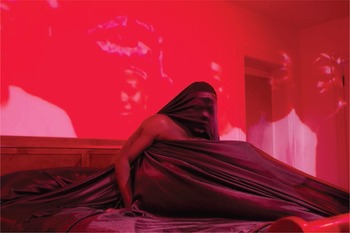
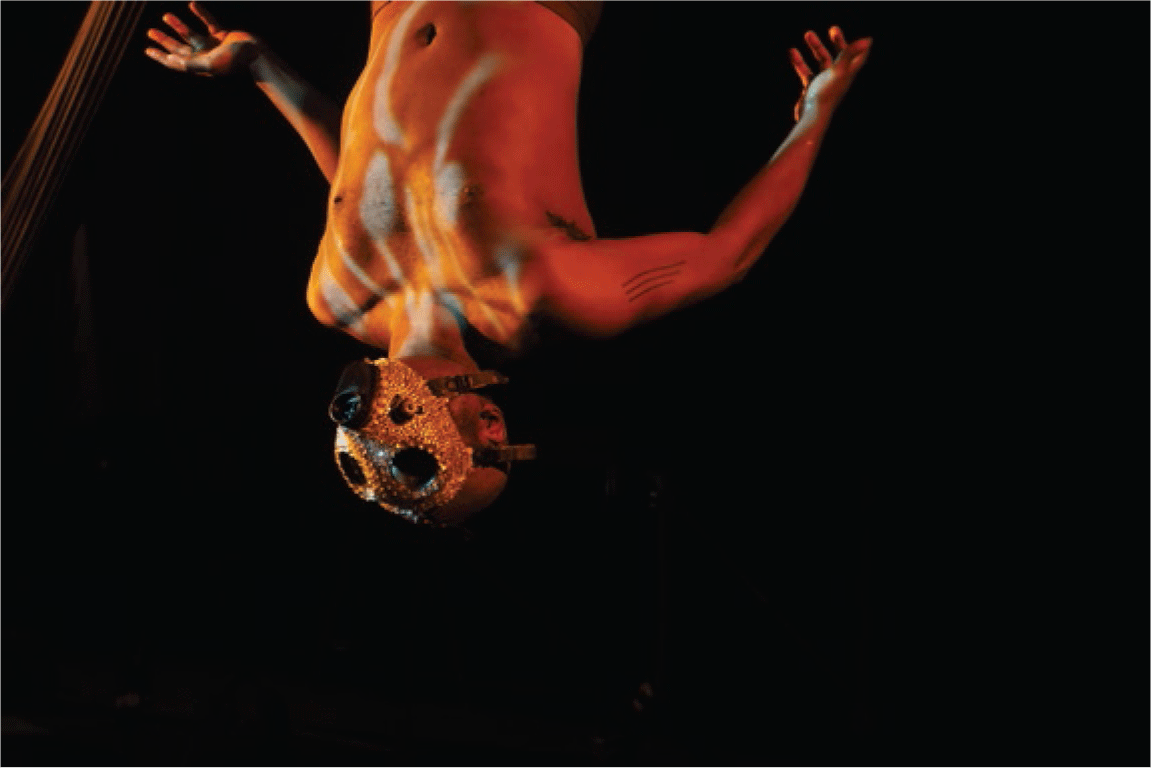
In November 2019 Kosoko arrived at EMPAC with codirector Ima Iduozee, makeup artist Joy Taney, costume designer SaVonne Whitfield, video artist Meena Murugesan, sound artist Everett Asis Saunders, and performer Nile Harris for a five-day film shoot across three venues. Kosoko was the central performer and staged several scenes for the moving-image work. As he had in #negrophobia and Séanceurs, the artist performed for the camera figures he had encountered only through mass media such as Curtis Mayfield, Sun Ra, Luther Vandross, and Prince. With the help of Whitfield, Taney, and EMPAC’s production team, Kosoko reenacted photographs of each icon for the camera. He called the reenactments “portraits,” and behind-the-scenes documentation of the shoot reveals that each one was a full production including Kosoko’s embodiment of an imagined persona and music that helped to enliven the set. He also filmed scenes of original choreography. Some included more derivative narrative moments such as Kosoko in a bathroom shaving. Others were dance-film style recordings of material that came directly from live performance explorations Kosoko had developed in preliminary residencies at EMPAC and Gibney Dance. In a choreographic response to Christina Sharpe’s In the Wake: On Blackness and Being, for example, Kosoko slithered between aesthetics of seduction and pain as he moved underneath and stretched into a swath of golden brown lycra that was chosen to extend the hue of the artist’s skin (see Sharpe Reference Sharpe2016). Kosoko performed this choreography from atop a bed, under red lighting, dancing with images of his archive projected onto the scene to fill the entire frame of the camera. Other scenes included inverted aerial work, lip-synching behind a stack of old CRTV monitors, performing a scene from Séanceurs in an empty theatre, and a fire ritual in a domestic living room space.
Kosoko was able to tactically use an institutional compromise to ultimately get what he wanted and needed. At the end of the residency there was ample footage for a feature-length moving-image work that Kosoko would go on to edit with support from the Wexner Center for the Arts at The Ohio State University. With the right collaborators anything is possible, but most importantly it became clear that perhaps Kosoko had been making moving-image work all along. His material thrived in the context of a shoot and it was as if his choreography had always been made for the camera. After all, his performance method in #negrophobia and Séanceurs was to embody and stage material from screen-based media in front of a live stage audience. In this sense Kosoko’s practice is distinct from the world of “dance film” for which one stages choreography for the camera.
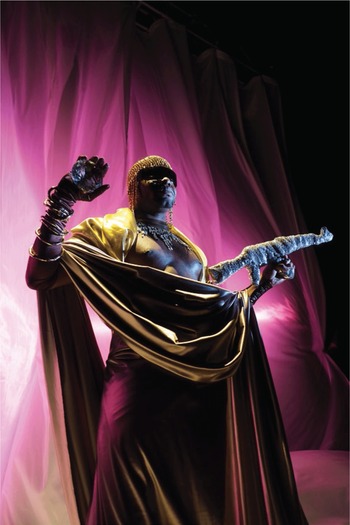
Jaamil Olawale Kosoko performs a scene inspired by Sun Ra in the filming of Chameleon (A Visual Album), screened during Chameleon (The Living Installments) on 22 April 2020. Production still. EMPAC/Curtis R. Priem Experimental Media and Performing Arts Center, 2019. (Photo by Sara Griffith; courtesy of Jaamil Olawale Kosoko and EMPAC)

Survivalist necessity gave Kosoko the drive to translate his live art practice back into an archive-friendly mediated form—despite the imposed limits of curators like myself. Kosoko strategically generated moving-image material both because it was conceptually important to his practice and because the shift, which so accurately captured and communicated the tone of his work, could potentially help to sustain a practice with less trauma- and fatigue-inducing habits. The work was not changing; the artist was simply finding different methods for communicating the message.
Discord, or Its Opposite
To be clear, shifting a practice from live toward moving-image is entirely distinct from creating work for online streaming platforms. Still, it seems important to reflect on Kosoko’s considered approach to moving-image production that developed in the context of his entire oeuvre over a long period of time. This work—both theoretical and pragmatic—inspired and carried Kosoko through his responses to the pandemic.
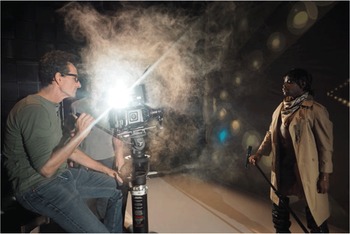
Jaamil Olawale Kosoko performs a scene inspired by Prince in the filming of Chameleon (A Visual Album), screened during the events on 22 April 2020. Mick Bello filming at the camera. Production still. EMPAC/Curtis R. Priem Experimental Media and Performing Arts Center, 2019. (Photo by Sara Griffith; courtesy of Jaamil Olawale Kosoko and EMPAC)

Four in-depth artist residencies at EMPAC during a three-year period brought Kosoko to spring 2020. His anticipated live performance, originally titled Chameleon: A Biomythography, was meant to premiere on 2 April. It would occupy the expanse of EMPAC’s public spaces and breathe into every nook and cranny of the proscenium theatre. There would be a step-and-repeat party atmosphere with red velvet stanchions in the lobby leading the audience into a contemplative installation that would enliven the theatre house. The installation would consist of recorded sounds and sculptures of books such as Ashon Crawley’s Blackpentecostal Breath (2016) and The Lonely Letters (2020), which were crucial to the making of Chameleon. The bulk of the performance would happen with the audience onstage. They would be invited to move in relation to the performers. The stage was to be saturated with melanated tones and pigments—intensified by Africanist texts and iconography from Luther Vandross to Audre Lorde’s Zami: A New Spelling of My Name (1982), where the term “biomythography” originated. There would be moments of cabaret-style performance on the stage apron, a “Pigin Chorus” vocalization, a single body suspended by his feet in aerial choreography, and Kosoko’s movement response to Sharpe’s text concealed underneath an expanse of silky, stretchy spandex (see Sharpe Reference Sharpe2016). Saunders would move original audio through the space according to the dramaturgical arch of the performance. The same old CRTV monitors would play footage from the November shoot. Video artist Murugesan would live-mix projected images from Kosoko’s personal archive into the space. These were all elements of a planned work—the show never came to be.
The in-real-life Chameleon: A Biomythography was postponed indefinitely amidst waves of virus-related cancellations in March 2020. On 7 and 8 March, just two weeks before Kosoko and collaborators planned to arrive at EMPAC for the final production residency leading up to their premiere, Rensselaer sent out a notification that the university would enact social distancing after two confirmed positive cases of the novel coronavirus were detected within a 20-mile radius of the campus. At that time, it was not clear how this would impact EMPAC residencies directly. We wondered if we could still host artists even if we had to limit audience size, for example. This was the point at which I first called Kosoko to let him know that the global health crisis would directly impact the premiere of Chameleon: A Biomythography. We reached out to cocommissioning partners at New York Live Arts who had planned to host the NYC premiere of Chameleon: A Biomythography immediately following the EMPAC engagement. While the production required the knowledge and expertise that EMPAC’s crew had cultivated with Kosoko’s team, we considered advising from afar if the artistic team could avoid the university mandate and convene in New York City instead. It was a compromise that would greatly impact the outcome of the final work, but at least the show would go on. To accommodate new plans, various financial compensation packages were drawn up to ensure that Kosoko and his collaborators could be paid the wages that they were promised during their planned two-week stay at EMPAC. As gig workers with contracts that include a force majeure clause, the artists could lose income entirely if the performance was canceled. Footnote 4 Adapting to the times and continuing the work in new ways felt important not only for the art, but also for the immediate needs and well-being of the participants.
The chameleonic capacity of the work was tested over, and over, and over again. This process of reshuffling plans went on for weeks—as soon as we settled on one approach, something else would shift. As the days passed it became increasingly clear that the cancellation of one EMPAC residency was the tip of the iceberg. Eventually no one was allowed to convene anywhere. Even if they had been, there was concern for the health of the artists. The relative precarity of their position as gig workers placed particular pressure on a need to travel in spite of unsafe conditions. With this in mind we finally settled on an entirely remote engagement of a reimagined work in order to remove any financial pressure to travel.
Kosoko swiftly pivoted to remake the years-long development from Chameleon: A Biomythography into the online work titled Chameleon (The Living Installments). Collaborators could remain relatively safe at home, still get paid, and receive support for putting work into the world. With continued creation there was also hope to avoid the ripple effect of canceled residencies that would impact future touring dates. The Living Installments would include a nod to each part of what would have been a multifaceted live work for four distinct venues in EMPAC’s sprawling building.
Almost immediately after I first spoke with Kosoko about a potential postponement he was interested in migrating the work online. There was certainly the initial shock of cancellation, but it was tempered by the ominous social expectation that the impacts of Covid-19 were on the brink of worsening all around. After the surprisingly brief initial moments of disbelief and disappointment, Kosoko did what so many artists who are in the habit of working within a scarcity model do; he resorted to his chameleonic tendency for survival. After all, he reasoned, this was what the work was made for. Kosoko found himself at least closer to the realm he had hoped to locate all along—live performance that could exist in spaces without the physical presence of the performers. We were both admittedly relieved for the escape hatch from the disappointment of cancelling the public window into three years of Kosoko’s work.
Once the initial energy of the triage and the relief wore off, however, the practical problems of the situation set in. As time progressed, performing for a virtual audience felt increasingly daunting. The personal hurdles of navigating a pandemic and settling into drastically new life rhythms set by isolation and fear of the unknown felt at times insurmountable. The additional pressure of creatively conceiving new work raised the hurdles significantly.
The Zoom meeting became the traumatic stage of sorts; Kosoko was made to relive the trauma of cancellation and isolation in each video conversation: meetings between myself and Kosoko, Kosoko and his collaborators, the collaborators and the EMPAC production team, Kosoko and EMPAC’s video team, Kosoko and EMPAC’s audio team, network administration meetings, marketing meetings, design meetings, and personal check-ins. There were also meetings between Kosoko and other producers, since the shift in development time and focus at EMPAC impacted future engagements that relied on Kosoko’s EMPAC production and schedule. He did not have to tour his body to different geographic locations, but he was having to perform the liveness of composure and professionalism amidst personal upheaval. To be clear, this Covid-related trauma was again racially specific as Black Americans were then three-times as likely to become infected with Covid-19 than white Americans (Oppel et al. Reference Oppel, Robert Gebeloff, Lai, Wright and Smith2020). The artist recalls in a New York Times feature about the work, “Shortly after this thing unleashed itself and we were put on lockdown, something in me broke psychologically […] It was so intense. It still is” (in Burke Reference Burke2020).
Along with Kosoko’s personal response to the practical challenges of putting his work online, the EMPAC team was acutely aware of the technical enormity of the proposal. While well equipped to handle such a transition, EMPAC’s engineers were all too familiar with how much it would take to produce online alternatives to a live performance. Such a transition would require its own three-year-long development process; audience onboarding and bandwidth alone would require special attention.
Plus, no one, including the artist, wanted to force work onto a platform that would diminish it. Everyone at EMPAC had seen Kosoko perform live; they had experienced Saunders’s DJ sets and the way his practice responded in real time to the energy of a space. We all knew that temporal lag of video conferencing, with sound delay and the inevitable glitch and freezing of video images, would irreparably disrupt the process and, therefore, the performance experience. The group could not even handle the lag in an hour-long meeting, let alone a creative development process that would ultimately need to host a large group of audience members.
The art world in general was also adapting with internet platforms as one way to share new and old performance—conversations, workshops, and really any content that could allow artworkers to continue their livelihood. Some, like Seattle’s OntheBoards.TV, continued their tradition of sharing high-quality documentation of live stage works with renewed attention. Others chose to put forth original commissions conceived for the screen, like the Onassis Foundation commissions for the virtual edition of the Fusebox Festival, Austin, Texas, 24–26 April 2020. Footnote 5 Many institutions hosted online galas to navigate revamped funding models for new types of presentation, such as more widespread use of online formats, presentation of performance documentation, performance for smaller audiences, and outdoor events. It seems that most institutions felt the need to change quickly and to bring artists along with them in order to maintain relevancy and exposure during a time when revenue streams seemed to evaporate at every turn.
Suddenly sequestered at home due to New York State’s stay-at-home mandates and without access to the group conversations that so often lead to creative breakthroughs, EMPAC video engineer Ryan Jenkins invited other staff to remotely gather on the Discord gaming platform where he and media systems integrator Gordon Clement and desktop support analyst Dave DeLaRosa spent much of their personal time. The curiously named Discord touts itself as “the easiest way to communicate over voice, video, and text, whether you’re part of a school club, a nightly gaming group, a worldwide art community, or just a handful of friends that want to hang out” (Discord 2020). While Discord was reported as a place where internet trolls trade links to public Zoom video conference meetings to support the fishy Covid-19 era trend of “zoombombing,” the platform is by and large a space where gamers meet up (see Lorenz Reference Lorenz2020). With screen-sharing capabilities, text and voice-chat functionality, and the ability to easily share embedded video and images, users can watch others play games. Importantly, the platform is less glitchy and more socially casual than Skype, Zoom, and even paid services such as WebX. Where Skype, Zoom, and WebX promote a culture of setting meeting times to convene for specific conversation, or even more structured social hours, the culture of Discord is to leave it on and share space at your leisure with those who happen to be there at the same time. Like leaving a telephone on speaker with a friend or lover, there is a casual intimacy to Discord that could organically fill social gaps during the secluded times of coronavirus isolation.
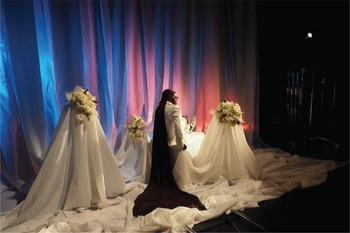
In a scene from Chameleon (A Visual Album) Jaamil Olawale Kosoko dances on a bed under red lighting with footage from his archive projected on him. Screened for Chameleon (The Living Installments), 22 April 2020. Production still. EMPAC/Curtis R. Priem Experimental Media and Performing Arts Center, 2019. (Photo by Sara Griffith; courtesy of Jaamil Olawale Kosoko and EMPAC)

When the idea to move Kosoko and his team to Discord came about, it was not the result of a strategic artistic decision. Instead, it was during a moment of utter exasperation with the reality of being together on video calls that members of EMPAC’s production team proposed Discord as a lower-pressure alternative. Maybe that platform could offer a space to have more freedom of thought than Zoom. Perhaps we could simply be with one another to keep each other company and remove the pressure of a deliverable; whether or not a public-facing show came from it was entirely beside the point. While EMPAC’s team migrated to Discord for daily exchanges on a voice channel called “water cooler,” it took longer for the strategy to take hold with respect to Chameleon. “Longer” was only a week’s lag, but at that time one week was also an eternity in the development of lifestyle shifts within Covid-19 temporalities. Changes seemed to happen overnight.
What followed was a production period of two- to three-hour-long scheduled times for being together on Discord daily. The intent was to create a space for gathering and, maybe, if it happened naturally, for creation. The conversation began with how to use the platform and then migrated into its various facets for Kosoko’s work. Discord seemed to open more introspective creative space for Kosoko, who identified how the text chat spaces of the platform, for example, could also host pasted images and embedded videos from his archive—this would include materials he had planned to present in A Biomythography as well as behind-the-scenes glimpses into the production of the cancelled live performance. Set designer Peiyi Wong uploaded photographs of a stage diorama and Whitfield shared inspiration images for costume design. Ironically, Kosoko’s creative team members were already accustomed to remote sharing as they were based across the country and the world. Still, the casual Discord platform eased pressure. Asynchronous sharing capabilities took some pressure off, as did the ability to talk without being seen, as in the more widely used Zoom setting. At that time, it felt that everyone was jumping on Zoom or an equivalent video chat space. Going onto Discord felt like a relief from video conference fatigue and the space allowed users to be less performatively “on.” What started as a catalogue for the live production became a space for healing that Kosoko decided to open to the public. In that sense, The Living Installments offered a window into a production process as opposed to a new performance work.
One afternoon during a production meeting, Saunders tried using Discord to livestream a mix he made from recordings of residencies with Kosoko and collaborators. The recordings were from a section of vocalization the artists called “Pidgin Chorus” developed in a 2019 prepandemic in-person residency. After some technical finagling, the sounds came through loud and clear. There was excited relief from the artists and the EMPAC production team that, in fact, the sharing of live art, too, could happen on Discord. There was much less perceptible lag than with video conferencing software. The mix coupled with Kosoko’s voice became the perfect way to begin a day—not a performance per se, but what Kosoko began to call a proposal:
Dear Viewers,
I hope this finds you in good health and spirits during these tumultuous times. I’m grateful to have the opportunity to share this reimagined proposal for my new project Chameleon (The Living Installments). I consider this an invitation into a new virtual space, a studio where I will continue to work and dream and play and hold future gatherings. This is simply the beginning. You are welcome to stop by anytime.
There are multiple access points to the project to accommodate your level of interaction.
I look forward to spending time with you in The Living Installments.
—Jaamil Olawale Kosoko (Reference Kosoko2020c)
In addition to Saunders, Ebony Noelle Golden and mayfield brooks joined Kosoko in conversation on Earth Day to discuss topics that had always been central to Kosoko’s practice: embodiment, mental health, the Black experience in the US, queer intimacy, and, sometimes, the impact of Covid-19 on these topics. Golden and Kosoko walked through a zine that Kosoko designed for the day titled A Syllabus for Survival and included links, images, and texts (Kosoko Reference Kosoko2020b). For the first time, Kosoko shared footage from a conversation he had with Bill T. Jones at New York Live Arts. The duo discussed Kosoko’s upbringing and some of the personal experiences that shaped the artist’s approach to performance. Ashon Crawley read a passage from The Lonely Letters. Crawley’s Blackpentecostal Breath had impacted the way Kosoko was thinking about sound and his own amplified voice in performance, so to have the addition of Crawley’s live reading brought a piece of the anticipated stage work to Discord. And as an antidote to hours spent online and to ground audience members in their bodies, Kosoko invited Michelle Boulé to lead an hour-long somatic workshop. Boulé, who is a choreographer, performer, teacher, and Certified Body Talk Practitioner in New York, led audience members through an hour-long session that included a body scan and other cues to bring awareness to the body and its surroundings. EMPAC’s web manager Shannon Johnson built a website to direct the audience through the new experience of using Discord. Video engineer Eric Brucker used Open Broadcaster Software (OBS) to livestream from his computer and navigate through materials for those who were overwhelmed by the Discord platform.
An online premiere of the edited moving-image footage that Kosoko and collaborators shot at EMPAC in November became a feature moment of the day’s happenings. Coupled with voiceover of Kosoko reciting his poetry, it grounded The Living Installments in the artist’s recognizable live art practice. And since the footage was prerecorded and edited over a five-month period, it also represented the amount of time Kosoko, as a professional, typically invests in his onstage practice; it highlighted the archival citations that the artist carefully crafted over the years-long development for each work. The Living Installments was a studied, knowledgeable, and experienced approach to production, but was also necessarily hasty amidst the pandemic. Presented with the preconceived moving-images, however, the Discord experience imbued the audience experience with Kosoko’s durational practice. From here, the conversations, images, and text presented alongside the moving-image work discursively illustrated a theoretical and cultural context that was always aesthetically present in the work. Plus, the prerecorded nature of the footage meant that it had fewer glitches than if the artist had attempted to share live movement with video streaming.
One striking image of Kosoko wearing a bedazzled gas mask in the moving-image footage gained particular poignancy in the context of the coronavirus. This became the cover image for The Living Installments. The foresight of this image was not uncanny, but underscores how survival as a core component of Kosoko’s identity was always central to the project.
A production still of Jaamil Olawale Kosoko in a bedazzled gas mask for Chameleon (A Visual Album), an image that took on new meaning when screened for Chameleon (The Living Installments) in April 2020. EMPAC/ Curtis R. Priem Experimental Media and Performing Arts Center, 2019. (Photo by Sara Griffith; courtesy of Jaamil Olawale Kosoko and EMPAC)

Beyond the logistics of what could be made available to the public on Discord, the team spent hours debating whether or not Discord was the right platform for the occasion. What is it about this platform in particular that is better suited for the work than, for example, livestreaming a prerecorded conversation between Kosoko and invited guests directly to a platform like YouTube Live? A live event on Discord certainly left more to chance than prerecorded livestreamed events. For one, there was not ample time to onboard collaborators who were added to the project specifically for the Discord events. These collaborators did not have time to fully acquaint themselves with the platform and its intricacies prior to the public events, which led to some technical glitches and other production confusion. Still, it was clear that Kosoko enjoyed the nonlinear temporality of Discord more than a livestream. Audiences could visit materials on Discord at their own pace, return to the archive later, or comment in real time. There could be collective exchange around audio and visual materials while providing a space for remote community gathering later—the Discord platform was open to users beyond the institutionalized time frame of a “show.”
The Earth Day events on 22 April 2020 went off more smoothly than any of us had expected given the tumult of the production period. The sustained presence of an audience and the cohesiveness of Kosoko’s performance guided listeners seamlessly through the three-hour convening. Audience comments at the end were reflectively thankful. Amelia UB commented “Thank you. I eased into rest listening. Feeling, breathing. Made my dinner and felt not alone.” badwolf084 commented how “It’s nice to remember art is very much alive and kindred spirits exist even in isolation.” BiG SiSSY shared that it was “Definitely the most immersive experience I’ve had online.” Participants also publicly shared reflections on their experiences on the Discord chat. For Crawley it was “a reprieve and a respite” and brooks left the group with the notion that “This pandemic is a portal.” KGo responded enthusiastically, “quantumly entangled through a portal!” (Radical Reimaginings n.d.). The group seemed to leave one another from within a collective Afrofuturist approach to the pandemic. One thing was clear: they felt alone-together in a positive sense of the popular pandemic phrase.
Resurrecting Liveness
The Myth of New Circumstances
To compare Kosoko’s 22 April 2020 proposal to one of his in-person performances would not make sense. This was not meant to be a replacement of the in-person event, or even an antidote to a moment when in-person performance could not happen. These goals would have been too didactic for Kosoko’s practice and, from my perspective, too lofty for any one work—especially work being made amidst the early stages of a global pandemic. As a proposal for how one artist and maybe also his community might consider convening, sharing work, and navigating the US during the coronavirus pandemic, however, the day provided at least some form of performative sustenance.
The Living Installments seems to have provided something to others as well. Kosoko and his collaborators conducted a remote “tour” of the work beginning with a further iteration for the Tanz im August festival presented by HAU in Berlin on 23 August 2020, which is both the International Day for the Remembrance of the Slave Trade and Its Abolition as well as the European Day of Remembrance for Victims of Stalinism and Nazism. The project continued with an iteration copresented for the Philadelphia FringeArts festival and the Portland Institute for Contemporary Art’s (PICA) Time-Based Arts (TBA) Festival on the International Day of Peace, 21 September 2020. Both iterations evolved from Kosoko’s April 2020 work to commemorate the days on which the new proposals were shared. They included new materials such as footage of Brenda Dixon Gottschild reciting a new essay responding to Kosoko’s work and a spoken healing session by mayfield brooks. Some content remained the same as in the April convening with EMPAC/NYLA, like the screening of Kosoko’s film, but the framing and discussions of the subsequent iterations progressed with the times. The Discord platform’s gallery and chat archived the progression from one convening to the next (see Kosoko Reference Kosoko2020d).
Discord gave the appearance of a DIY platform and gathering space: it provided the opportunity for audience exchange, sharing of artwork, articles, and other materials, and proposals for healing that are traditionally more difficult to access within institutional production contexts. This is due in part to access. Kosoko’s own artistic community, spread across the US and the world, could gather and contribute to the work regardless of the institution presenting it. The Discord platform as site also decentered the presenting institution. You did not need a ticket, or even to access the platform through a presenting organization’s website. The convening existed on Discord as an independent entity. And Discord provided a venue for audience members to return postperformance to continue conversations beyond the scheduled institutionally sponsored event. No one could tell audience members that it was time to close the theatre at the end of the show, and the doors were not locked the next day.
I hope that my account of curating and producing Kosoko’s The Living Installments makes clear, however, that the work still required as much if not more infrastructural support as an in-person performance in a theatre. Postmortem conversations between the EMPAC team and Kosoko’s team focused expressly on what it would take to transfer engineering knowledge to Kosoko’s team for tour. We discussed how many and what type of crew members they would need, if that crew should tour with the company or be provided by the presenting organization, and the amount of necessary preproduction hours. To help ease the transition, Kosoko hired EMPAC’s Jenkins to work freelance helping to facilitate the Tanz im August and Fringe/PICA productions. The artist had to build an entirely new company infrastructure in order to maintain fluidity in hosting large numbers of people on the Discord platform, featuring multimedia presentations throughout the day, and shifting seamlessly between presenters. Just like for an in-person performance, the ease of use and tightness of presentation are in part what keeps an audience within the world of the work. It takes a carefully crafted village to accomplish this.
Importantly for Kosoko, moving between artistic media and identities was nothing new. Bill T. Jones recalls how he first encountered Kosoko as a young poet working in arts administration (Jones and Kosoko Reference Jones and Kosoko2020). Other occupations include choreographer, dancer, performance artist, teacher, workshop leader, activist, and archivist. Regardless of category, Kosoko projects intimacy and presence across media. His chameleonic ability to enact different roles allows him to survive even inside the cultural-capitalist mainstream. Indeed, before Covid-19, he was already making moves toward online spaces in addition to his work on moving images. After reading a draft of this article, Kosoko shared with me something he wrote in 2016 for a Princeton fellowship application: “I am also curious about new genre/internet-based performance practices and culture jamming […] What do new forms of social media—twitter, snapchat, vine—tell us about the future of choreographic study, social formations, and cultural inventions?” (Kosoko Reference Kosoko2020f). In some ways, Covid provided the opportunity for Kosoko to innovate with forms he had been yearning for all along. Kosoko’s work before and during the pandemic provides an example of how one artist persists with the characteristic qualities of his work despite a move to screen-based presentations.
Kosoko’s immediate response to Covid-19 won’t work for every artist and certainly cannot address the concerns of each curator, critic, or audience member. Shifting times call for shifting practices. Likewise, the sense that Chameleon (The Living Installments) would not work in video conference format does not mean that another show won’t. The same month as Kosoko’s Living Installments at EMPAC/Live Arts, Ashley Tata directed a poignant rendition of Caryl Churchill’s Mad Forest (2020) on Zoom for the Bard College Theatre and Performance Program as a part of Bard Fisher Center’s UPSTREAMING platform. That evening my Instagram was abuzz. One colleague even cheekily professed that she may never need in-person theatre again. At that moment I wholeheartedly agreed (still, no one is earnestly suggesting this be the case!!).
One could write an entire essay on other potential approaches to and reasons for/benefits of online and hybrid performance in the 21st century. Such perspectives include environmental impact and disability access. The environmental sustainability of less frequent touring, for example, has come up frequently in conversation with Kosoko and other artists and curators since March 2020 (Calderon et al. Reference Calderon, Lewis, Otake and Parson2021; Kosoko Reference Kosoko2020d). Disability communities have long lobbied for more flexible performance formats in order to increase the accessibility for both artists and audiences (see Nonko Reference Nonko2019). Alice Sheppard has provided important context on this issue since the onset of Covid-19 (in Wingenroth Reference Wingenroth2020). There are likewise complex arguments about the possible detriment that online Covid-era performance will have to the future of performing arts (see Dance/NYC 2020; Berger Reference Berger2020). Meanwhile, the established history of dancing online pre-Covid is storied and significant. Footnote 6
As Chameleon (The Living Installments) demonstrates, Kosoko’s years of creating across fields combined with financial and institutional support, press exposure, and more made it possible for him to pivot. The pivot suited and was even necessary for Kosoko’s work, which was always steeped in the socially imposed need for survival and adaptability; a need that is intrinsic to Kosoko’s experience as a queer American Black artist producing contemporary performance internationally.
Artist-led efforts like the Creating New Futures project and its 193-page Phase One reflective and instructional document articulate the field-wide need for post-Covid, artist-centered resources that are tailored to individual circumstances (see Castro et al. Reference Castro, poe, Sherman, Greenbaum, Rogers, Willis, Sakamoto, Smith, Johnson, Colby and Smith2020). The document chronicles the perils of the Covid-19 moment across one section of the dance field from both artist and institution perspectives. As dance, theatre, and performance confront new frontiers, there is an opportunity to address existing problems including practices and protocols that continue histories of institutional racism like those that Kosoko tried to address with his turn toward use of moving-image formats. As can be seen in Kosoko’s work, a path forward will undoubtedly require openness to a wide range of perspectives and, therefore, platforms: online event platforms, moving-image installations, and in-person performances. Kosoko and I have already discussed what it will mean to begin migrating his practice back to an in-person or more hybrid format while maintaining what the artist has gained through online praxis (Kosoko Reference Kosoko2020e). The beauty of contemporary performance is that no one artist or even production needs to re-perform the same. The next can be different.
Postscript
Almost two years later Kosoko continues to navigate shifting Covid-19 realities, as are so many of us. I am revisiting this article amidst Omicron, and Kosoko and I are finalizing his upcoming on-site EMPAC residency, scheduled for February 2022. It was meant to be—finally—his in-person show. The new work (because nothing stays the same) is titled Black Body Amnesia. Again, we are having to refigure. As of January 2022 the university still cannot host public audiences, so this time (we hope) Kosoko will be at EMPAC where he will stage and film Black Body Amnesia for live broadcast. Kosoko is thinking critically about what this setup affords his work in terms of audience makeup and engagement. Indeed, the artist continues to develop adaptive strategies whereby, almost certainly, the next can be different.