I
Most towns and cities in early modern Europe originated in some beneficial conjuncture of geographies and commodities. Perhaps this is true of towns and cities everywhere. A good place to ford a well-travelled river, a meeting point of popular roadways, or a protected harbour where a navigable river meets the sea; these propitious places offered obvious advantages for conurbation, especially when a commodity suitable for distant trading was readily produced in the vicinity. Take, for example, Boston in Old England, which became a prosperous city in the middle ages and a trading port in the Hanseatic League. Its location at the point where the River Witham joins the Haven leading out to the North Sea made it an advantageous place for exporting wool raised in Lincolnshire to the Netherlands, France, and Italy. In the thirteenth century, Boston ranked second only to London among England's port cities in the amount of taxes paid on merchants’ moveable goods. But what geography and commodities give can be taken away. The rise of England's domestic weaving industry and the silting over of the Haven led to Old Boston's inexorable decline as an overseas trading port.Footnote 1 A sad story, but not an unusual one: think of Detroit.
By contrast, Boston in New England's rise to prominence as a prosperous port town in the early modern Atlantic was highly unusual, because the Shawmut peninsula in Massachusetts Bay had neither the geographical nor commodity-based advantages that might predict the rise of a city there. Before the Europeans’ arrival, Shawmut was not a site of extensive Indian habitation. The Massachusett Indians, the dominant tribe in the region, were centred around the Great Blue Hill on the mainland to the south-west, the Pawtucket occupied the coastal region to the north, and the Wampanoag lived to the south towards Cape Cod.Footnote 2 Neither of the rivers that entered the bay near Shawmut, the Charles and the Mystic, was navigable for more than a few miles, limiting their value as catchment basins for commodities like furs, which were more easily acquired by North American colonists and traders along the St Lawrence, Hudson, Connecticut, Delaware, and Susquehanna rivers. And as the puritan colonists arriving after 1620 learned all too quickly, there were no local commodities to be found or produced in Boston's vicinity likely to attract overseas traders. London merchants had no interest in crossing the Atlantic to buy salt pork, Indian corn, or barrel staves. England's fishermen could catch their own fish.Footnote 3
Unlike most towns and cities, then, what accounts for the emergence of Boston in New England was neither geography nor commodity, nothing more tangible than the sheer desire among thousands of England's dissenting and disgruntled Protestants in the early Stuart period that there should be a city like the one Boston became: a godly city, filled with pure churches where the divine ordinances as described in scripture could be enjoyed unmolested by king or bishop. For such a godly city to prosper, a thriving economy would be needed to provide employment for a people who owned their own land in modest amounts, and lived comfortably with access to those goods, the ‘means of grace’, bibles and works of piety, meetinghouses and schools, and sufficient manufactured articles for each to live a respectable life according to his or her station.Footnote 4
There were, of course, European examples of places with similar qualities, ranging from Calvin's Geneva to England's Dorchester, the latter reformed after a great fire in 1613 into a model puritan city.Footnote 5 But these were ancient market towns dating back to Roman times; they were built for other reasons, including geographical and commodity advantages, and were ‘re-formed’ for godly purposes. Boston in New England was willed into existence de novo without these prior advantages, built simply on the desire that such a place might exist. Unlike many European towns and cities of the early modern era, whose growing material and cultural complexity had evolved across many centuries, the new Boston was born commercial, engaged in and aspiring to be part of a market society from its beginnings. Despite the arguments made by many social historians of the ‘New England town’ in the 1960s and ’70s, these new settlements were not aiming to be ‘peasant utopias’, retreats to a more primitive pre-market culture.Footnote 6 Rather, the founders of Boston, many of them puritan merchants, tradesmen, artisans, and other urban people, were driven by a powerful desire for a refined and reformed version of the commercial world they knew, freed from false worship, ecclesiastical persecution, and the cultural hostility of the profane.Footnote 7
II
To describe or define this desire is no simple thing – it was an expression of a rarefied set of tastes among a peculiar people, or of a manner of combining goods and services into a distinctive bundle, which modern economists might call a ‘Z-commodity’. I borrow this term from Jan de Vries's study of the rise of the modern Western consumer family, The industrious revolution (2008), though de Vries himself draws on the work of the Nobel Prize-winning economist Gary Becker.Footnote 8 Z-commodities are ultimate commodities, omega commodities, essentially the pinnacle of consumption, the experiential end towards which the production, acquisition, and use of ‘things’ is aimed, and to which these things serve as means. The Z-commodity might be thought of as the complex civilizational extreme on the spectrum of consumption, at the opposite remove from the simplest form. If, for example, a hunter-gatherer harvested wild grapes and ate them on the spot, the grapes might be thought of as an alpha commodity, consumption at its most basic level. But if cultivated grapes are painstakingly fermented into fine wine, and the wine is aged, bottled, labelled, and sold to a customer at a sophisticated restaurant celebrating a special occasion among family and friends, then the heightened experience of the ritual's participants might be thought of as a Z-commodity. In the quasi-mathematical language of the ‘new household economics’, the Z-commodity can be described as follows:
 $${\rm Z}_{\rm i}{\rm} = f( {{\rm x}_{\rm i}{\rm T}_{\rm i}} ) $$
where x consists of a bundle of purchased goods, and T (for ‘time’) is comprised of three elements: T1 the time spent on labour to acquire goods, plus T2 the time spent on labour to transform the goods into a Z-commodity, and T3 the time required to actually enjoy or ‘consume’ the Z-commodity.
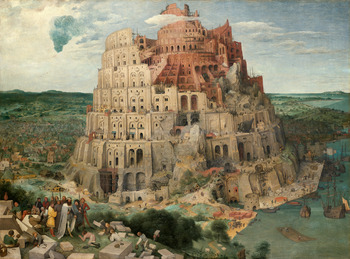
Whether or not we use Thomas More's neologism ‘utopia’ to describe such a wished-for place, and whether such places take the form of learned austerity (as in Bacon's Bensalem of the New Atlantis (1627)) or of endless and effortless pleasures (as in Bruegel's ‘Luilekkerland’ (1567)), the ultimate referent of these fantasies tends towards the earliest recorded Z-commodity, the ur-Z-commodity in the Western tradition, the tower of Babel (another favourite subject for Bruegel: see Figure 1). The household of Nimrod, descendants of Noah (himself a notorious drunkard), say one to another, ‘Go to, let vs buylde a citie and a tower, whose toppe may reach vnto the heauen, that we may get vs a name, lest we be scatred vpon ye whole earth’ (Genesis 11:3–4, Geneva Bible (1560)). The ultimate object of consumption here was not the ‘brick they had for stone’, or the ‘slime’ they had ‘instead of mortar’, but the result of the laborious and artful arrangement of these commodities into a tower so grand that it would give them an identity, a reputation, ‘a name’. Whether we want to call this yearning for a name refinement or intoxication, here was a mythic representation of humankind's earliest efforts to get high.
Pieter Breugel the Elder, The tower of Babel, 1563. Bruegel's painting meticulously details the myriad lesser commodities and forms of labour generated by the surrounding walled city and bustling seaport necessary to produce this extraordinary tower.
Source: Kunsthistorisches Museum, Vienna.

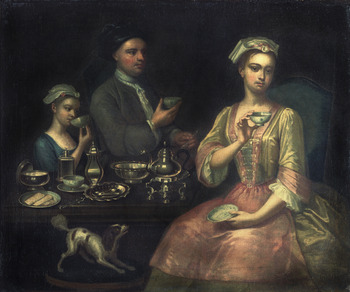
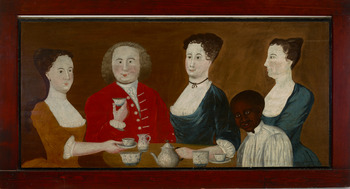
Tea, rather than strong drink, is the classic early modern example used by de Vries (and many other historians of early modern material culture) to illustrate the Z-commodity as the product of ‘bundling’ and consuming a set of goods under particular circumstances.Footnote 9 The point is that tea alone is not the ultimate commodity, certainly not the dried leaves, a fact illustrated by many a story of rustic rubes, on their first encounter with tea, eating the leaves (and pretending to enjoy them). Rather, the Z-commodity consists (to fill out the Becker equation's variables with specific examples) of a cluster of purchased goods (X1–n): tea, yes, but also sugar, milk, china cups and saucers, a silver tea service, a mahogany tea table and chairs (one could go on – and that, of course, is the point), as well as the time spent earning money to acquire this ever expanding array of things (T1), plus the time to prepare the tea, bake scones and biscuits, make jam, and so on (T2), plus a leisurely afternoon uninterrupted by demands of work to enjoy the tea party in the company of family, friends, and refined guests (T3), as seen in Figures 2 and 3.
Richard Collins, A family of three at tea, c. 1727. Collins's oil painting depicts a fashionable English gentry family dressed in silks and satins, taking tea with the latest silver equipment, including a sugar dish, a tea canister, sugar tongs, and a lamp beneath the teapot to keep its contents warm, while showing off their fine porcelain teacups and saucers.
Source: Victoria and Albert Museum, London.

John Potter and family, artist unknown, c. 1749. This overmantel painting hung above the fireplace in the parlour of the Potter family home in South Kingstown, Rhode Island. Although the unknown artist lacked the painterly skill of a Richard Collins, we can see that the Potter family's colonial finery fell far short of Collins's metropolitan gentry family (note the absence of silver equipage) and the Potters were less inclined to hide the labour that went into their Z-commodity, preferring to depict their enslaved house servant as another marker of colonial refinement. They were nonetheless attempting to place themselves in the same cluster of commodity consumption as the family in Collins's portrait. That this painting itself hung in a room where the people it depicted took tea adds another level of self-reflective purpose in their embrace of the practice of refinement.
Source: Newport Historical Society, Newport, RI.

The experience in its entirety is the Z-commodity, and as you will note, it includes labour as part of what is consumed, effectively spanning the production–consumption divide. It also transcends the typical modern definition of ‘commodity’, in that the Z-commodity, the ultimate purpose of consumer behaviour, is ‘inherently non-traded’ – like those things that MasterCard advertisements used to call ‘priceless’ while telling you how to buy their ingredients. The first of these ads, in 1997, featured a father and son at a professional baseball game, where the priceless commodity – ‘real conversation with eleven-year-old son’ – was produced via $73 worth of tickets and snacks, and a $50 autographed baseball, the last of these itself a ‘bundled’ commodity, where the price of an ordinary baseball ($6 in 1997) is greatly inflated by the labour-time (autograph-signing) and the fame of the player who signed it, ‘that we may get us a name’.Footnote 10
It is no accident that de Vries, quoting Sidney Mintz's equally influential Sweetness and power (1985), seized upon New World intoxicants to exemplify Z-commodities as ‘consumption bundles’:
The first cup of sweetened hot tea to be drunk by an English worker was a significant historical event, because it prefigured the transformation of an entire society, a total remaking of its economic and social basis. We must struggle to understand fully the consequences of that and kindred events, for upon them was erected an entirely different conception of the relationship between producers and consumers, of the meaning of work, of the definition of self, of the nature of things.Footnote 11
Neither de Vries nor Mintz italicizes the phrase above, but I do so in order to highlight its bundled quality as a Z-commodity, not unlike the bundled commodity that Christ offers his disciples when he says, ‘this cup [filled with wine] is that new Testament in my blood, which is shed for you’ (Luke 22:20, Geneva Bible). To put it in terms parallel to Mintz's, ‘the first cup of wine drunk in remembrance of Christ by believers in his divinity was a significant historical event, because it prefigured the transformation of an entire society’.
One reason why intoxicants play such a likely and prominent role in these transformations is that, in their nature as ‘things’, they generally demand bundling for their consumption. We laugh at rubes eating tea leaves precisely because no-one expects to eat tobacco leaves either, or unprocessed coffee or cacao beans for that matter. These are not staples of life. Many intoxicants are (at least initially, to the neophyte) unpalatable, even after a great deal of processing (drying, curing, and rolling tobacco; roasting, grinding, and brewing coffee beans), unless they are bundled with other commodities (like milk or sugar with coffee or tea), or unless time and labour has been spent to acquire a taste for the harshly unfamiliar (inhaling tobacco smoke) through the instructions of others already adept in its consumption. In 1659, Sir Henry Blunt, an early English promoter of coffee drinking, admitted that coffee and tobacco ‘have not the advantage of any pleasing taste wherewith to tempt and debauch our palat, as Wine and other such pernicious things have; for at first Tobacco is most horrid, and Cophie insipid’.Footnote 12 Rather, intoxicants are intensifiers, material substances that, when consumed correctly, in the right place and time, with the right company, in the right quantities, and combined with other goods, intensify an experience on which people already place some value. If energy and alertness are useful, then caffeinated beverages and sugar can intensify these qualities, as can tobacco. If it is uninhibited conviviality you seek, then beer or wine, rum or gin will do the job. Jesus’ disciples already knew about eating bread and drinking wine, but the Nazarene had to instruct them how to do it in remembrance of him in a particular way that would elevate their status, ‘that ye may eate, and drinke at my table in my kingdome, and sit on seates, and iudge the twelue tribes of Israel’ (Luke 22:30, Geneva Bible).
III
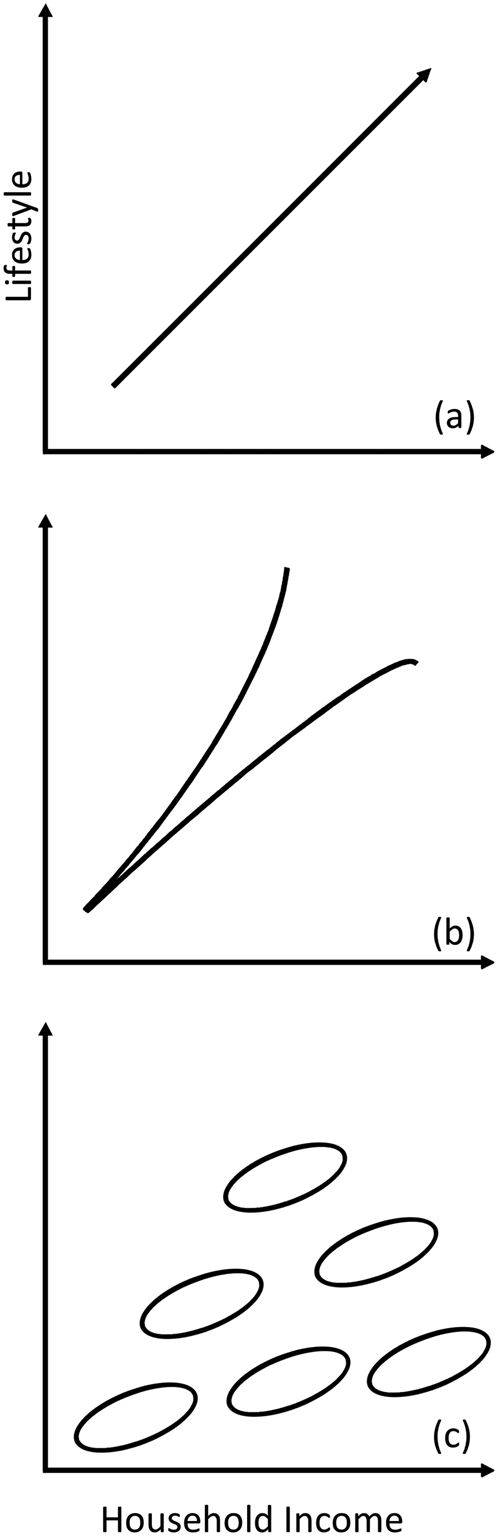
The analysis offered in many scholarly studies of material culture and consumer behaviour in early modernity is often limited by a focus on the household economy, mainly because households left measurable evidence of their consumption patterns in the form of wills or estate inventories. However, the more limited historiography on intoxicants offers a distinctive exception to this general pattern, because a striking characteristic of intoxicants in early modern Europe and America is the way in which they generated spaces of public or group sociability for their consumption, spaces beyond the household such as taverns and coffeehouses, places where tobacco was consumed along with alcohol or caffeine and sugar, in which part of the bundling of these commodities also involved newspapers, pamphlets, and the like, as well as the ‘labour’ of conversation and argument, which collectively generated a Z-commodity experienced outside the household, in spaces often segregated by sex, age, and status.Footnote 13 One of the ways in which de Vries explains the significance of the Z-commodity for understanding changing consumer behaviour at the household level is with a series of graphs – sketches, really – that model ways of thinking about the relationship between income and consumption, where the horizontal axis depicts rising income, and the vertical axis measures ‘lifestyle’ as defined through the consumption of goods (Figure 4).
Three models of the relationship between household income and consumer choice.
Source: After Jan de Vries, The industrious revolution: consumer behavior and the household economy, 1650 to the present (Cambridge, 2008), p. 35.

Figure 4(a) illustrates the simplest way to imagine the growth of consumption as a function of income: a family makes more money and its consumption of goods increases incrementally. Figure 4(b) introduces the notion of consumer choice and distinction: differing families will diverge in what they choose to buy and consume as income increases. But Figure 4(c) more accurately illustrates the reality of consumer behaviour revealed by the Z-commodity concept: that the ultimate experiences people seek tend towards differentiated bundles or clusters of consumption. The two families depicted in Figures 2 and 3 are clearly within the same consumption cluster, though the Potter family of Rhode Island, with greater income and access to refined goods, could advance within the cluster to ‘keep up’ with Collins's sitters.Footnote 14 In de Vries's words,
Each cluster constitutes a kind of equilibrium, a pool of local attraction, in which consumption elements reinforce one another …. Movement within the cluster is continuous [as in Figure 4(a) and 4(b)], but movement between clusters is a different matter. One does not drift into a new cluster by inadvertence; the change requires an element of strategy, typically effected at the household level.Footnote 15
If their income were to grow, the Potter family could acquire a silver tea service, and they might find a more skilled artist to paint their portraits dressed in finer clothing. But having embraced and invested in the culture that requires this bundle of goods, it would seem unlikely that such a family would suddenly uproot themselves, move to frontier Vermont, and begin farming in the wilderness. Such a change would require an altogether different bundle of goods and strategy for how to spend money, time, and labour. It would not happen by accident.
It is precisely this complex intentionality, the element of strategy present in the founding of Boston in New England, together with Boston's manifold connections to the world of intoxicants, that makes it a very good place in which to explore the transformation of desire in early modernity and, in particular, its expression and pursuit in groups beyond the household. In a sense, we might think of the entire Massachusetts Bay Company project which led to Boston's founding in 1630 as a large-scale attempt by a self-selecting group of middling English puritans – eventually around 20,000 of them – to move between clusters. It was not drifted into inadvertently. It required a strategy. And although the migrants’ decisions were, to some extent, made at a household level, as thousands of families divested themselves of property in farms, shops, homes, and businesses, the whole was organized and planned collectively at a much wider societal level necessary to acquire a royal charter through the Council for New England, assemble fleets of ships and provisions, recruit clergymen and civic leaders, and move people by the thousand across the Atlantic. The whole was driven by a common desire for a godly community that was cultivated at a level beyond the household as well. Or, as John Hull, a Boston merchant, magistrate, and silversmith, put it in his memoir of the Great Migration of the 1630s, during which his family moved from Leicestershire to Massachusetts:
God therefore moved the hearts of many to transport themselves far off beyond the seas, into this our New England, and brought, year after year, such as might be fit materials for a Commonwealth in all respects, and among others some of the choicest use both for ministry and magistracy, military men, seamen, tradesmen, &c., and of large estates and free spirits, to spend and be spent for the advancement of this work that the Lord had to perform, and to make this wilderness as Babylon was once to Israel, as a wine-cellar for Christ to refresh his spouse in.Footnote 16
The ‘choicest’ labour and the ‘large estates’ spent by the colonists in the making of Boston in New England were devoted to transforming the American wilderness into a spiritual pleasure garden, where the exiled puritan churches might be ‘refreshed’. ‘Go to, let vs buylde a citie’!
As I have argued elsewhere, we might think of the inspiration for this large-scale colonial relocation and community-building, expensive in material goods, time, and labour, as the pursuit of a complex commodity, a form of refinement or elevation that puritans thought of as ‘grace’, and which I am now inclined to think of, if not as an intoxicant itself, then as the kind of elevated experience that intoxicants are meant to intensify.Footnote 17 In other words, the puritan cultivation of godliness happened not just at the household level, but in communities, such as the dissenting conventicle or church, or, for the fortunate few, at one of the colleges of Cambridge University or later in the primitive buildings of early Harvard or Yale. In these communities, bundles of commodities such as published bibles and other books of piety and theology, supplemented by the time and labour of teachers, preachers, and congregants, generated states of feeling, both individual and communal, to which the converted might attest in a profession of faith marking them as ‘visible saints’ suitable for admission to full membership in a gathered church.Footnote 18
A material intoxicant played an essential role in marking and policing the boundary between those within and without the community. Only the elect were eligible to consume the wine of the Lord's Supper, though others might witness the ceremony and be instructed in its spiritual value. In this sense, the gathered Protestant church with its admission of qualified laity to the eucharist, as opposed to priestly celebration of the mass, was a form of instruction for lay people in how to drink intoxicants, who were the fit subjects to use them, and what sort of experiences one might expect to attain with their aid. Like material intoxicants, the pursuit of ecstatic spiritual experiences could be overdone as well: critics of excessive religious enthusiasm among radical dissenters would describe the afflicted as ‘drunk’ on the spirit, ‘godded with god’, ranters, quakers, and shakers – sufferers from a spiritual delirium tremens.Footnote 19
John Cotton, a student at Emmanuel College, Cambridge, and later minister of St Botolph's Church in Old Boston, clerical leader of Massachusetts Bay, and minister of New Boston's First Church, enunciated the desire and the expectations that generated this massively expensive and laborious project in terms that relied on the language of consumption: ‘when a man out of a good and honest heart, and an hungering desire after God's Ordinances, shall be willing to be at charge of them, he hath this promise made to him, and it shall be fulfilled, He shall of the Spirit reap life everlasting’.Footnote 20 The language of consumption was echoed by those who became members and stalwarts of Boston's puritan churches, such as Samuel Sewall, who recorded in his diary that, while feeding chickens one cold January morning, he observed how well they thrived on very ‘mean’ food, ‘which much affected me and convinced what need I stood in of spiritual food, and that I should not nauseat daily duties of prayer &c’.Footnote 21 Sewall's Harvard College classmate, the puritan poet Edward Taylor, playfully used the language of consumer desire and intoxication in the hundreds of ‘Preparatory meditations’ he composed in cultivating his readiness to distribute the Lord's Supper to his church:
What I am suggesting, then, is that we might fill in one of the ovals on a de Vriesian graph of social consumption clusters with a ‘G’ for godliness, and that we might understand the founding of Boston, Massachusetts as a strategic attempt by a substantial social group to spend money, labour, and time to move themselves bodily and build for themselves just such a consumption cluster in the New England ‘wilderness’.
Among other things, this understanding helps explain the puritan colonists’ insistence that the conversion of the indigenous population of New England to Christianity would also require that the Indians deliberately and fully adopt the consumption bundle that the colonists themselves were generating. This transformation would be marked by a radical change in the indigenous people's tastes, who would learn to renounce their traditional ‘delights that the flesh and blood of man can devise’ as so much ‘filthy and stinking dung’, and instead embrace the joys of the ‘knowledge of God … Jesus Christ … and the Book of God’, which are ‘sweeter to our soul, than honey is unto the mouth’.Footnote 23 ‘Praying Indians’ would live in English towns, farm the land like Englishmen, wear English clothing, form gathered churches on the puritan model where they would drink communion wine (a beverage utterly alien to their pre-colonial experience),Footnote 24 and read from a printed bible and prayer books that John Eliot and his supporters, at enormous cost in material goods (imported paper and ink), time, and labour, translated into the Massachusett language and printed at the Cambridge press.Footnote 25
The virtue in using the language and concepts of consumer behaviour to describe the development of a culture of godliness in early New England is not to provide a better understanding of puritan Boston, so much as to broaden our understanding of how consumption functions beyond the individual or the household in larger social groupings, as well as to put experiences and institutions associated with religion and the spiritual on the same spectrum as a wide array of other categories of experience, including material intoxicants and intoxication, in order to see them in relation one to the other. If ‘godliness’ may be thought of as a name for a consumer cluster associated with churches as social institutions, I am not prepared to say where it belongs on the y-axis, the ‘lifestyle’ axis – whether it should be higher or lower than taverns, guilds, or coffeehouses, or further out or closer in on the income/expense x-axis. But that it does belong on such a graph seems essential. The placement of religious life on a graph of social consumption clusters is potentially useful for understanding the role of intoxicants as intensifying commodities, ideally suited for bundling with other goods in the production of Z-commodities, in the construction of many different clusters of consumer behaviour that organized society and culture in the early modern world. That an array of exotic new intoxicants found such ready acceptance and use in so many different social spaces may tell us a great deal about the early modern transformation of demand and desire.
IV
Thinking in these terms about consumer behaviour may help to explain why the economy of a colonial town like Boston, powerfully and enduringly devoted to the cultivation of godliness, nonetheless became so deeply immersed in the early modern Atlantic trade in intoxicants of all sorts, given the frequent cultural association of intoxicants with vice and misbehaviour, from James I's Counterblaste to tobacco (1604) to William Hogarth's Gin lane (1751). Part of the explanation lies in the peculiar qualities of a number of intoxicant commodities relative to the realities of the early modern Atlantic economy. The exotic (to England) nature of the ‘new groceries’, products of tropical climates across distant oceans, fetched relatively high prices for these goods in European markets. They were cheap to produce in the colonies, but rare and therefore (initially) expensive in the metropolis. Their intoxicating and/or addictive qualities were ideal for building and sustaining demand over time. Consuming them made people want or need to consume even more, effectively turning luxuries into necessities. The extensive processing of these agricultural products transformed perishable leaves, stalks, fruits, and beans into durable commodities suitable for lengthy storage or shipping across great distances with minimal spoilage. And unlike other high-value commodities like gold or silver, a new crop could be grown every year – the supply was in theory perpetual and expandable.
Boston in New England's principal economic challenge was its incapability of producing any of these commodities: no silver or gold, no tropical staples. But the early profitability of some of these crops in other English New World plantations, beginning with Virginia tobacco even before Boston's founding, and expanding with West Indian sugar in the 1640s, meant that Boston's merchants could trade the commodities that New Englanders did produce – fish, meat, grain, timber – for the planters’ sugar, and thereby gain an entry into high-value Atlantic commodity trading. The initial high value of the intoxicants produced in other colonies – places that Boston merchants could supply with New England products – offered the essential entry point for Boston's prosperous overseas trade. From the 1640s to the 1810s, this became the city's economic model. Whether bringing Barbadian rum to West Africa in the 1640s to enter the slave trade or competing with the Dutch to carry Virginia's tobacco to England, smuggling tea from Dutch sources in the eighteenth century to evade the Navigation Acts, or cornering the market on Turkish opium from the Ottoman empire in the 1820s to compete with the British in China, Boston's merchants consistently invested in the intoxicant trade as a reliably profitable way to survive in the niche they carved out in the Atlantic economy.Footnote 26 And when possible, as with sugar and rum, they turned trade into industry. By 1743, there were at least eight distilleries operating in Boston, using sugar purchased legally in Jamaica and Barbados or smuggled from Saint-Domingue to produce rum for local consumption and for export in the Africa trade.Footnote 27
In this sense, one direction for pursuing the notion that Boston was an ‘intoxicant town’ would be to examine the extant records for overseas trade in its first two centuries, from 1630 to 1830, to find out how much of its external economy was engaged in the intoxicant trade. Such calculations would be fraught with peril, of course, not unlike recent attempts to assess the role that slavery played in the antebellum American economy, but it is not impossible for plausible estimates to be reached. For example, David Hancock has used surviving Naval Office shipping lists from 1714 to 1719, and again from 1752 to 1765, to demonstrate a growing and vigorous wine import trade, and an even more vigorous re-export trade, suggesting that a good deal of wine was also smuggled into Boston. Over the latter period, more than a hundred Boston and Salem merchants took part in the legal importation of 5,400 pipes of wine, amounting to more than 600,000 gallons.Footnote 28
In addition, and perhaps more promisingly, the experience of the consumption of intoxicants as elements of Z-commodities in the extra-household world of Boston's social spectrum offers great possibilities for rethinking our understanding of the rise of consumer culture. There already exists a substantial literature on alcohol consumption in early America, including Boston and New England, as well as a good deal of antiquarian literature on alehouses, taverns, and the like.Footnote 29 But the framing of this work tends to pit tavern culture and drink against church and puritanism as if they could only be enemies, and places them on a modernization/secularization trajectory in which religious authority will inevitably give way to commercial values. Undoubtedly, there were puritans like Increase Mather who preached sermons with titles such as Wo to drunkards (1673). But Mather himself was not a teetotaller – no-one in seventeenth-century Boston was. Cider, beer, and wine were common everyday beverages. Cultural authority, especially in an increasingly complex urban society, need not be a zero-sum game. By imagining early Boston's world of intoxicants along the lines of de Vries's consumption clusters, it may be possible to sketch out a wider array of possibilities for understanding the organization and evolution of its culture.
For example, one of the more significant findings in the scholarship on tavern culture involves the important role that taverns played in courts and civic authority. In Boston and in the many surrounding towns to which circuit-riding judges such as Boston's Samuel Sewall travelled for their quarterly rounds, most court proceedings took place in taverns. Few towns had the wherewithal to build, staff, heat, and light separate buildings for the sake of occasional judicial business, especially when the arrival of judges touring on horseback, or the need to respond to unpredictable events, made for unreliable timing of court sessions. Taverns or inns, built to expect any and all comers with food, lodging, and public meeting spaces, fitted the bill perfectly, and consequently civic authority was intimately connected with institutions that were licensed to sell strong drink, much as churches were associated with the practice of dispensing wine to the visible saints.Footnote 30 The two institutions were not exactly opponents, so much as separate clusters of social experience. A man like Sewall frequented and was at home in both of them.
In the single-minded way in which historians identify topics and then run them to the ground, we often miss the wider connections or the spaces for interplay in the worlds thus rudely abstracted. Studies of tavern culture, or of churches, can easily miss the intricate array of overlapping connections that make actual worlds. For that reason, holistic documents such as Sewall's fifty-year diary from the 1670s to the 1720s can be enormously helpful in illuminating the connections.Footnote 31 We can follow Sewall consuming a wide array of intoxicants: beer, ale, wines of various sorts, brandy, rum, ‘spirits’, chocolate, and coffee (though not tea or tobacco). We can observe this consumption in a wide array of settings: at his first communion in the Old South meetinghouse, drinking wine from a silver cup while fearing he might drink his own damnation if he was not truly among the elect; at regular militia training exercises on Boston Common, where the practice of keeping together in time among soldiers created a feeling of communal solidarity that liquor heightened and intensified;Footnote 32 in taverns or ‘ordinaries’ on his judicial circuit ridings, where dinners and toasts for the visiting judges marked their honour and authority; in Boston alehouses haunted by workingmen and prostitutes, where Sewall the civic magistrate intervened to prevent and punish social disorder; and in new sites of consumption such as the Crown Coffee House at the foot of Long Wharf, built in the early eighteenth century to accommodate this newer intoxicant while still serving the more traditional liquors, and where dignitaries such as a newly arrived royal governor might properly be entertained.Footnote 33
In another fashion, the Crown Coffee House itself might be examined as a site for the bundling of goods and labour into Z-commodities. Built by Sewall's friend, fellow merchant, and member of Boston's Old South Church, Jonathan Belcher, and leased to Thomas Selby in the 1710s, the Crown had thirteen rooms, including one for milling, brewing, and serving coffee, with special equipment and dishes for the novel beverage. But the Crown also offered, in other rooms, a wide selection of liquors, from rum punch to wines of Canary, Madeira, and Fayall, various grades of brandy, and fruit juices and other ingredients for mixing. Fine dining with an array of utensils, dishes, and glassware was available: the Crown had silver punch bowls, various glass decanters and cruets, candlesticks, sconces, and lanterns, pictures on the walls, and an enormous array of tables, chairs, and table linens for organizing parties of various sizes. After dark, it was likely the most brilliantly lit space in Boston. The main rooms of the Crown, however, consisted of spaces with large numbers of comfortable chairs, many with leather cushions, to promote genteel conviviality. Clay pipes for smoking tobacco were available by the thousand.Footnote 34
The appearance of a place like the Crown Coffee House is the sort of marker that historians of early America have associated with the rise of gentility or refinement, and therefore (it is usually assumed) the disappearance of something else that preceded it. In the case of New England this is mostly taken to be ‘puritanism’ or a form of cultural authority associated with a religious worldview.Footnote 35 But a peek inside Boston's congregational churches at the time that Thomas Selby was operating the Crown would reveal a similar set of refinements arriving in these spaces as well, including elaborate family pews with cushions and heating systems, new designs to improve lighting, the gradual introduction of musical instruments to heighten the communal fellow feeling of group hymn-singing, and the recasting of older silver communion services into newly designed matched sets.Footnote 36 By 1755, when Sewall's son, Joseph Sewall, the minister of Boston's Old South Church, hosted a clerical consociation, the church spent £17 to supply wine for the visiting ministers. A decade later, the church purchased ‘wine, tea, coffee, sugar, biscuit, and tobacco’ for the ordination ceremonies of Samuel Blair (incidentally foreshadowing the time when church without ‘coffee hour’ afterwards would be unthinkable).Footnote 37
The sets of goods being bundled might be different, creating different consumption clusters, but the processes taking place in the Crown Coffee House and the Old South meetinghouse are parallel. Someone like Samuel Sewall could be a partaker in both of them, while at the same time opposing the consumption cluster of the alehouse on ‘Mount Whoredom’ on the back side of Beacon Hill. In fact, a cautionary tract against tavern-frequenting published in 1726 by a group of twenty-three Boston ministers might as well have cited Gary Becker as a source for its reasoning. A serious address to those who unnecessarily frequent the tavern makes its case by first and foremost condemning the ‘very faulty mispence of TIME’ wasted by male household heads in taverns when they could have been frequenting other, more beneficial social organizations, such as ‘in Religious Associations, in reforming societies, and the like’, or cultivating ‘Family Order and Religion’ at home in the evenings through family prayer and devotions. Fifty years after Increase Mather preached Wo to drunkards, his successors in the Boston clergy were urging their parishioners to choose better consumption clusters among those available in their intoxicant town.Footnote 38
V
In 1629, much of the planning for the Massachusetts Bay Company, the organization that founded Boston in New England, took place at the earl of Lincoln's residence in Sempringham, about eighteen miles south-west of the enormous St Botolph's church in Old Boston where John Cotton preached before migrating to New England. The earl, who had attended Emmanuel College at Cambridge, had close ties to many of the leading Massachusetts organizers. His sister, the lady Arabella, had married Isaac Johnson, the largest shareholder in the company – it was after her that the migrant fleet's flagship was named. The earl's Sempringham estate had once been St Mary's priory, founded by the Gilbertine monastic order in the twelfth century, but dissolved by Henry VIII in 1538. The earl had demolished the old priory and used the stone to build himself a new palace, and thus the process that created a new Boston began, quite literally, among the ruins of England's old monastic order.
In a larger sense, the three centuries after the Reformation witnessed an extraordinary transformation in the world of desire and demand in Western Christendom, driven by a powerful sense unleashed by reformers of all confessions that human salvation required people to become different, better, more refined … higher. From this yearning for a new tower of Babel was born a world of new desires and, although every level of society, from the household to the state, played a part in this process, my sense is that we still do not know very much about how communities larger than the household, but smaller than the state, went about the task of allocating their collective resources on goods, labour, and time to create experiences of human betterment, improvement, refinement, grace, comfort, fellow feeling, and solidarity. A town like Boston in New England, whose founders set out to spend their resources to create a wine-cellar for Christ to refresh his bride in, offers an opportunity to explore the part played by intoxicants in shaping the social and cultural organizations critical to this transformation.
Acknowledgements
This article forms part of Intoxicants and early modern European globalization: spaces, practices, material culture, a special issue resulting from a workshop series, held in 2017 at the Victoria and Albert Museum and in 2018 at the Beinecke Library, Yale University.
Funding Statement
The workshop series at the Victoria and Albert Museum was funded by the ESRC ‘Intoxicants & Early Modernity Project’.